


ASTM E2218-23
(Test Method)Standard Test Method for Determining Forming Limit Curves
Standard Test Method for Determining Forming Limit Curves
SIGNIFICANCE AND USE
5.1 The forming limit curve (FLC) is specific to the material sampled. It can change if the material is subjected to cold work or any annealing process. Thus, two samples from a given lot of material can produce different curves if their processing is varied.
5.2 The processing history of the material must be known if the test is to be considered representative of a grade of a product.
5.3 A forming limit curve (FLC) defines the maximum (limiting) strain that a given sample of a sheet metal can undergo for a range of forming conditions, such as deep drawing, plane strain, biaxial stretching, and bending over a radius in a press and die drawing operation, without developing a localized zone of thinning (localized necking) that would indicate incipient failure.
5.3.1 FLCs may be obtained empirically by using a laboratory hemispherical punch biaxial stretch test and also a tension test to strain metal sheet test specimens, from a material sample, from beyond their elastic limit to just prior to localized necking and fracture.
5.3.1.1 Since the location of localized necking and fracture cannot be predetermined, one or both surfaces of test specimens are covered with a pattern of gauge length measurement units, usually as squares or small diameter circles, by a suitable method such as scribing, photo-grid, or electro-etching, and then each test specimen is formed to the point of localized necking, or fracture.
5.3.2 Strains in the major (e1) and minor (e2) directions are measured using individual gauge length measurement units on the pattern in the area of the localized necking or fracture.
5.3.2.1 Test specimens of varied widths are used to produce a wide range of strain states in the minor (e2) direction.
5.3.2.2 The major strain (e1) is determined by the capacity of the material to be stretched in one direction as simultaneous surface forces either stretch, do not change, or compress, the metal in the minor strain (e2) direction.
5.3.2.3 In the ten...
SCOPE
1.1 This test method gives the procedure for constructing a forming limit curve (FLC) for a metallic sheet material by using a hemispherical deformation punch test and a uniaxial tension test to quantitatively simulate biaxial stretching and deep drawing processes.
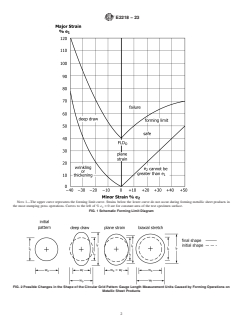
1.1.1 Fig. 1 shows an example of a forming limit curve on a schematic forming limit diagram (FLD).
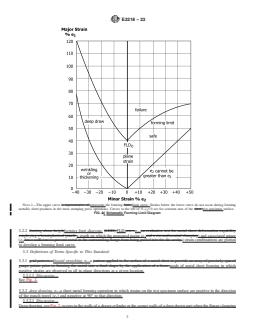
FIG. 1 Schematic Forming Limit Diagram
Note 1: The upper curve represents the forming limit curve. Strains below the lower curve do not occur during forming metallic sheet products in the most stamping press operations. Curves to the left of % e2 = 0 are for constant area of the test specimen surface.
1.2 FLCs are useful in evaluating press performance by metal fabrication strain analysis.
1.3 The method applies to metallic sheet from 0.5 mm (0.020 in.) to 3.3 mm (0.130 in.).
1.4 The values stated in SI units are to be regarded as the standard. The values given in parentheses after SI units are provided for information only and are not considered standard.
1.5 This standard does not purport to address all of the safety concerns, if any, associated with its use. It is the responsibility of the user of this standard to establish appropriate safety, health, and environmental practices and determine the applicability of regulatory limitations prior to use.
1.6 This international standard was developed in accordance with internationally recognized principles on standardization established in the Decision on Principles for the Development of International Standards, Guides and Recommendations issued by the World Trade Organization Technical Barriers to Trade (TBT) Committee.
General Information
- Status
- Published
- Publication Date
- 31-Jan-2023
- Technical Committee
- E28 - Mechanical Testing
- Drafting Committee
- E28.02 - Ductility and Formability
Relations
- Effective Date
- 01-Mar-2024
- Effective Date
- 01-Jan-2024
- Effective Date
- 01-Nov-2019
- Effective Date
- 01-Oct-2019
- Effective Date
- 01-May-2018
- Effective Date
- 01-Jan-2018
- Effective Date
- 01-Nov-2017
- Effective Date
- 01-Sep-2017
- Effective Date
- 15-Jul-2016
- Effective Date
- 01-Feb-2016
- Effective Date
- 15-Nov-2015
- Effective Date
- 01-Nov-2015
- Effective Date
- 01-Feb-2015
- Effective Date
- 01-Oct-2013
- Effective Date
- 01-Oct-2013
Overview
ASTM E2218-23 is the international standard test method for determining forming limit curves (FLC) of metallic sheet materials. Established by ASTM International, this standard outlines a systematic procedure for evaluating the formability of metal sheets by constructing FLCs using hemispherical deformation punch tests and uniaxial tension tests. The forming limit curve is a critical tool in sheet metal forming, providing valuable data about the maximum strain a sheet metal sample can withstand before localized necking or failure occurs during various forming operations.
Key Topics
- Forming Limit Curve (FLC): The FLC quantifies the forming limits of a given metallic sheet, indicating the boundary between safe deformation and the onset of localized necking or fracture.
- Testing Procedures: The standard details the use of laboratory hemispherical punch tests and uniaxial tension tests to deform metal specimens and measure strain distribution.
- Strain Measurement: Strains are analyzed in major (e₁) and minor (e₂) directions using precision-applied grid or circle patterns on the sheet surface. These patterns assist in capturing local strains in areas of localized thinning.
- Material-Specific Results: The forming limit curve is not a universal property but is specific to the tested material sample, which can be influenced by material processing history (cold work, annealing, etc.), thickness, and mechanical properties.
Applications
- Metal Forming & Stamping: The primary application of ASTM E2218-23 is in the automotive, aerospace, and manufacturing industries where sheet metal forming is essential. FLCs help process engineers and material scientists evaluate which materials can endure complex forming operations without failure.
- Process Optimization: The data obtained from FLCs are used to predict and prevent material failures such as necking and fractures during deep drawing, biaxial stretching, and other high-strain forming operations.
- Material Evaluation: Manufacturers rely on this test method to assess new grades of sheet metals, verify consistency across production lots, and compare material performance for selection and quality control.
- Press & Tooling Performance: By analyzing strain limits, press operators can refine tool and die designs, adjust lubrication practices, and optimize forming parameters to maximize yield and reduce waste due to ruptures or rejected parts.
Related Standards
ASTM E2218-23 references and aligns with several other widely adopted ASTM standards pertinent to sheet metal testing and strain measurement:
- ASTM A568/A568M – Specification for Steel, Sheet, Carbon, Structural, and High-Strength, Low-Alloy, Hot-Rolled and Cold-Rolled, General Requirements
- ASTM E6 – Terminology Relating to Methods of Mechanical Testing
- ASTM E8/E8M – Test Methods for Tension Testing of Metallic Materials
- ASTM E517 – Test Method for Plastic Strain Ratio r for Sheet Metal
- ASTM E646 – Test Method for Tensile Strain-Hardening Exponents (n Values)
- ASTM E2208 – Guide for Evaluating Non-Contacting Optical Strain Measurement Systems
Practical Value
By implementing ASTM E2218-23, organizations benefit from:
- Improved Predictive Accuracy: Reduce the risk of unexpected failures during forming and enhance simulation models with empirical data.
- Better Material Utilization: Select optimal materials and optimize processing routes based on accurate forming limit data.
- Consistent Quality Control: Ensure sheet metal components meet demanding performance criteria for strength, ductility, and formability.
- International Compliance: Align material testing with globally recognized methodologies, supporting seamless quality assurance in supply chains.
ASTM E2218-23 is an essential resource for those aiming to evaluate and maximize the performance of metallic sheets in industrial forming operations, ensuring high product quality and manufacturing efficiency.
Buy Documents
ASTM E2218-23 - Standard Test Method for Determining Forming Limit Curves
REDLINE ASTM E2218-23 - Standard Test Method for Determining Forming Limit Curves
Get Certified
Connect with accredited certification bodies for this standard

Element Materials Technology
Materials testing and product certification.

Inštitut za kovinske materiale in tehnologije
Institute of Metals and Technology. Materials testing, metallurgical analysis, NDT.
Sponsored listings
Frequently Asked Questions
ASTM E2218-23 is a standard published by ASTM International. Its full title is "Standard Test Method for Determining Forming Limit Curves". This standard covers: SIGNIFICANCE AND USE 5.1 The forming limit curve (FLC) is specific to the material sampled. It can change if the material is subjected to cold work or any annealing process. Thus, two samples from a given lot of material can produce different curves if their processing is varied. 5.2 The processing history of the material must be known if the test is to be considered representative of a grade of a product. 5.3 A forming limit curve (FLC) defines the maximum (limiting) strain that a given sample of a sheet metal can undergo for a range of forming conditions, such as deep drawing, plane strain, biaxial stretching, and bending over a radius in a press and die drawing operation, without developing a localized zone of thinning (localized necking) that would indicate incipient failure. 5.3.1 FLCs may be obtained empirically by using a laboratory hemispherical punch biaxial stretch test and also a tension test to strain metal sheet test specimens, from a material sample, from beyond their elastic limit to just prior to localized necking and fracture. 5.3.1.1 Since the location of localized necking and fracture cannot be predetermined, one or both surfaces of test specimens are covered with a pattern of gauge length measurement units, usually as squares or small diameter circles, by a suitable method such as scribing, photo-grid, or electro-etching, and then each test specimen is formed to the point of localized necking, or fracture. 5.3.2 Strains in the major (e1) and minor (e2) directions are measured using individual gauge length measurement units on the pattern in the area of the localized necking or fracture. 5.3.2.1 Test specimens of varied widths are used to produce a wide range of strain states in the minor (e2) direction. 5.3.2.2 The major strain (e1) is determined by the capacity of the material to be stretched in one direction as simultaneous surface forces either stretch, do not change, or compress, the metal in the minor strain (e2) direction. 5.3.2.3 In the ten... SCOPE 1.1 This test method gives the procedure for constructing a forming limit curve (FLC) for a metallic sheet material by using a hemispherical deformation punch test and a uniaxial tension test to quantitatively simulate biaxial stretching and deep drawing processes. 1.1.1 Fig. 1 shows an example of a forming limit curve on a schematic forming limit diagram (FLD). FIG. 1 Schematic Forming Limit Diagram Note 1: The upper curve represents the forming limit curve. Strains below the lower curve do not occur during forming metallic sheet products in the most stamping press operations. Curves to the left of % e2 = 0 are for constant area of the test specimen surface. 1.2 FLCs are useful in evaluating press performance by metal fabrication strain analysis. 1.3 The method applies to metallic sheet from 0.5 mm (0.020 in.) to 3.3 mm (0.130 in.). 1.4 The values stated in SI units are to be regarded as the standard. The values given in parentheses after SI units are provided for information only and are not considered standard. 1.5 This standard does not purport to address all of the safety concerns, if any, associated with its use. It is the responsibility of the user of this standard to establish appropriate safety, health, and environmental practices and determine the applicability of regulatory limitations prior to use. 1.6 This international standard was developed in accordance with internationally recognized principles on standardization established in the Decision on Principles for the Development of International Standards, Guides and Recommendations issued by the World Trade Organization Technical Barriers to Trade (TBT) Committee.
SIGNIFICANCE AND USE 5.1 The forming limit curve (FLC) is specific to the material sampled. It can change if the material is subjected to cold work or any annealing process. Thus, two samples from a given lot of material can produce different curves if their processing is varied. 5.2 The processing history of the material must be known if the test is to be considered representative of a grade of a product. 5.3 A forming limit curve (FLC) defines the maximum (limiting) strain that a given sample of a sheet metal can undergo for a range of forming conditions, such as deep drawing, plane strain, biaxial stretching, and bending over a radius in a press and die drawing operation, without developing a localized zone of thinning (localized necking) that would indicate incipient failure. 5.3.1 FLCs may be obtained empirically by using a laboratory hemispherical punch biaxial stretch test and also a tension test to strain metal sheet test specimens, from a material sample, from beyond their elastic limit to just prior to localized necking and fracture. 5.3.1.1 Since the location of localized necking and fracture cannot be predetermined, one or both surfaces of test specimens are covered with a pattern of gauge length measurement units, usually as squares or small diameter circles, by a suitable method such as scribing, photo-grid, or electro-etching, and then each test specimen is formed to the point of localized necking, or fracture. 5.3.2 Strains in the major (e1) and minor (e2) directions are measured using individual gauge length measurement units on the pattern in the area of the localized necking or fracture. 5.3.2.1 Test specimens of varied widths are used to produce a wide range of strain states in the minor (e2) direction. 5.3.2.2 The major strain (e1) is determined by the capacity of the material to be stretched in one direction as simultaneous surface forces either stretch, do not change, or compress, the metal in the minor strain (e2) direction. 5.3.2.3 In the ten... SCOPE 1.1 This test method gives the procedure for constructing a forming limit curve (FLC) for a metallic sheet material by using a hemispherical deformation punch test and a uniaxial tension test to quantitatively simulate biaxial stretching and deep drawing processes. 1.1.1 Fig. 1 shows an example of a forming limit curve on a schematic forming limit diagram (FLD). FIG. 1 Schematic Forming Limit Diagram Note 1: The upper curve represents the forming limit curve. Strains below the lower curve do not occur during forming metallic sheet products in the most stamping press operations. Curves to the left of % e2 = 0 are for constant area of the test specimen surface. 1.2 FLCs are useful in evaluating press performance by metal fabrication strain analysis. 1.3 The method applies to metallic sheet from 0.5 mm (0.020 in.) to 3.3 mm (0.130 in.). 1.4 The values stated in SI units are to be regarded as the standard. The values given in parentheses after SI units are provided for information only and are not considered standard. 1.5 This standard does not purport to address all of the safety concerns, if any, associated with its use. It is the responsibility of the user of this standard to establish appropriate safety, health, and environmental practices and determine the applicability of regulatory limitations prior to use. 1.6 This international standard was developed in accordance with internationally recognized principles on standardization established in the Decision on Principles for the Development of International Standards, Guides and Recommendations issued by the World Trade Organization Technical Barriers to Trade (TBT) Committee.
ASTM E2218-23 is classified under the following ICS (International Classification for Standards) categories: 77.040.20 - Non-destructive testing of metals. The ICS classification helps identify the subject area and facilitates finding related standards.
ASTM E2218-23 has the following relationships with other standards: It is inter standard links to ASTM E517-24, ASTM E8/E8M-24, ASTM A568/A568M-19a, ASTM E517-19, ASTM E2208-02(2018)e1, ASTM E517-18, ASTM A568/A568M-17a, ASTM A568/A568M-17, ASTM E8/E8M-16, ASTM E646-16, ASTM E646-15, ASTM A568/A568M-15, ASTM E8/E8M-15, ASTM A568/A568M-13a, ASTM A568/A568M-13ae1. Understanding these relationships helps ensure you are using the most current and applicable version of the standard.
ASTM E2218-23 is available in PDF format for immediate download after purchase. The document can be added to your cart and obtained through the secure checkout process. Digital delivery ensures instant access to the complete standard document.
Standards Content (Sample)
This international standard was developed in accordance with internationally recognized principles on standardization established in the Decision on Principles for the
Development of International Standards, Guides and Recommendations issued by the World Trade Organization Technical Barriers to Trade (TBT) Committee.
Designation: E2218 − 23
Standard Test Method for
Determining Forming Limit Curves
This standard is issued under the fixed designation E2218; the number immediately following the designation indicates the year of
original adoption or, in the case of revision, the year of last revision. A number in parentheses indicates the year of last reapproval. A
superscript epsilon (´) indicates an editorial change since the last revision or reapproval.
1. Scope E8/E8M Test Methods for Tension Testing of Metallic Ma-
terials
1.1 This test method gives the procedure for constructing a
E517 Test Method for Plastic Strain Ratio r for Sheet Metal
forming limit curve (FLC) for a metallic sheet material by
E646 Test Method for Tensile Strain-Hardening Exponents
using a hemispherical deformation punch test and a uniaxial
(n -Values) of Metallic Sheet Materials
tension test to quantitatively simulate biaxial stretching and
E2208 Guide for Evaluating Non-Contacting Optical Strain
deep drawing processes.
Measurement Systems
1.1.1 Fig. 1 shows an example of a forming limit curve on
a schematic forming limit diagram (FLD).
3. Terminology
1.2 FLCs are useful in evaluating press performance by
3.1 The terms accuracy, gauge length, necking, precision,
metal fabrication strain analysis.
strain hardening, engineering strain, and true strain are used as
defined in Terminology E6.
1.3 The method applies to metallic sheet from 0.5 mm
(0.020 in.) to 3.3 mm (0.130 in.).
3.2 Definitions of Terms Common to Mechanical Testing:
3.2.1 forming limit curve, FLC, n—an empirically derived
1.4 The values stated in SI units are to be regarded as the
curve showing the biaxial strain levels beyond which localized
standard. The values given in parentheses after SI units are
through-thickness thinning (necking) and subsequent failure
provided for information only and are not considered standard.
occur during the forming of a metallic sheet.
1.5 This standard does not purport to address all of the
3.2.1.1 Discussion—The forming limit curve is sometimes
safety concerns, if any, associated with its use. It is the
referred to as the “forming limit.”
responsibility of the user of this standard to establish appro-
3.2.2 forming limit diagram, FLD, n—a graph on which the
priate safety, health, and environmental practices and deter-
measured major (e ) and associated minor (e ) strain combi-
mine the applicability of regulatory limitations prior to use. 1 2
nations are plotted to develop a forming limit curve.
1.6 This international standard was developed in accor-
dance with internationally recognized principles on standard-
3.3 Definitions of Terms Specific to This Standard:
ization established in the Decision on Principles for the
3.3.1 biaxial stretching, n—a mode of metal sheet forming
Development of International Standards, Guides and Recom-
in which positive strains are observed in all in-plane directions
mendations issued by the World Trade Organization Technical
at a given location.
Barriers to Trade (TBT) Committee.
3.3.1.1 Discussion—See Fig. 2.
3.3.2 deep drawing, n—a sheet metal forming operation in
2. Referenced Documents
which strains on the test specimen surface are positive in the
2.1 ASTM Standards:
direction of the punch travel (e ) and negative at 90° to that
A568/A568M Specification for Steel, Sheet, Carbon,
direction.
Structural, and High-Strength, Low-Alloy, Hot-Rolled and
3.3.2.1 Discussion—Deep drawing, see Fig. 2, occurs in the
Cold-Rolled, General Requirements for
walls of a drawn cylinder or the corner walls of a deep drawn
E6 Terminology Relating to Methods of Mechanical Testing
part when the flange clamping force is sufficient to restrain
metal movement and wrinkling, while permitting the punch to
1 push the center area of the test specimen into the cavity of the
This test method is under the jurisdiction of ASTM Committee E28 on
Mechanical Testing and is the direct responsibility of Subcommittee E28.02 on
die. Strain conditions that can cause wrinkling or thickening
Ductility and Formability.
are shown in Fig. 1.
Current edition approved Feb. 1, 2023. Published April 2023. Originally
3.3.2.2 Discussion—In forming a square pan shape, metal
published in 2002. Last previous edition approved in 2015 as E2218–15. DOI:
from an area of the flange under a reduced clamping force is
10.1520/E2218-23
For referenced ASTM standards, visit the ASTM website, www.astm.org, or
pulled into the die to form the side wall of the part.
contact ASTM Customer Service at service@astm.org. For Annual Book of ASTM
3.3.3 FLD , n—the location on the forming limit curve that
Standards volume information, refer to the standard’s Document Summary page on o
the ASTM website. has the lowest major strain (e ).
Copyright © ASTM International, 100 Barr Harbor Drive, PO Box C700, West Conshohocken, PA 19428-2959. United States
E2218 − 23
NOTE 1—The upper curve represents the forming limit curve. Strains below the lower curve do not occur during forming metallic sheet products in
the most stamping press operations. Curves to the left of % e = 0 are for constant area of the test specimen surface.
FIG. 1 Schematic Forming Limit Diagram
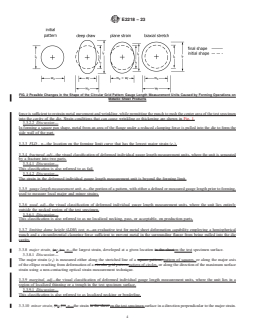
FIG. 2 Possible Changes in the Shape of the Circular Grid Pattern Gauge Length Measurement Units Caused by Forming Operations on
Metallic Sheet Products
E2218 − 23
3.3.4 fractured, adj—the visual classification of deformed limit curve (FLC), see Fig. 1. For convenience, many FLCs are
individual gauge length measurement units, where the unit is shown with the low point at e = 0 % or a slightly positive
separated by a fracture into two parts. value; however, such an abrupt reversal of e strain does not
3.3.4.1 Discussion—This classification is also referred to as occur. See Fig. 3 and Figs. X2.1-X2.3.
fail.
4. Summary of Test Method
3.3.4.2 Discussion—The strain in the deformed individual
4.1 Determination of a forming limit curve (FLC) involves
gauge length measurement unit is beyond the forming limit.
selecting a style of testing apparatus, deforming multiple test
3.3.5 gauge length measurement unit, n—the portion of a
specimens biaxially, measuring the resulting strain (including
pattern, with either a defined or measured gauge length prior to
classifying if these strains are localized), and drawing a curve
forming, used to measure local major and minor strains.
through the measured points.
3.3.6 good, adj—the visual classification of deformed indi-
4.2 Various test apparatus (see Section 6) may be used to
vidual gauge length measurement units, where the unit lies
deform test specimens biaxially including a hemispherical
entirely outside the necked region of the test specimen.
punch testing machine such as an LDH testing machine, a sub
3.3.6.1 Discussion—This classification is also referred to as
press in a universal testing machine, or a hydraulic bulge
no localized necking, pass, or acceptable, on production parts.
testing machine.
3.3.7 limiting dome height (LDH) test, n—an evaluative test
4.2.1 Contact surfaces of the undeformed test specimen and
for metal sheet deformation capability employing a hemi-
punch are lubricated for the hemispherical punch test.
spherical punch and a circumferential clamping force sufficient
4.2.2 The flanges of a test specimen are securely clamped in
to prevent metal in the surrounding flange from being pulled
serrated or lock-bead test-specimen-holder dies for the hemi-
into the die cavity.
spherical punch and hydraulic bulge tests.
3.3.8 major strain, e , n—the largest strain, developed at a
1 4.3 Stretching the central area of the blank biaxially or
given location on the test specimen surface.
pulling in the tension test is performed without interrupting the
3.3.8.1 Discussion—The major strain (e ) is measured either
1 force.
along the stretched line of a pattern of squares, or along the
4.3.1 A series of patterned test specimens is prepared with
major axis of the ellipse resulting from deformation of a pattern
different widths and a common length suitable for being
of circles, or along the direction of the maximum surface strain
securely held in the test apparatus.
using a non-contacting optical strain measurement technique.
4.3.2 Negative minor strains (e ) can be obtained using
sheared narrow strip test specimens stretched over the punch of
3.3.9 marginal, adj—the visual classification of deformed
a hemispherical punch testing machine.
individual gauge length measurement units, where the unit lies
4.3.3 If possible, the punch advance or the force is stopped
in a region of localized thinning or a trough in the test
when a localized through-thickness neck (localized necking) is
specimen surface.
observed, or as soon as the test specimen fractures.
3.3.9.1 Discussion—This classification is also referred to as
4.3.4 Unless there is a defect in the material, the test
localized necking or borderline.
specimen will not split across the nose of the punch. Instead,
3.3.10 minor strain, e , n—the strain on the test specimen
when the punch is advanced beyond the forming limit of the
surface in a direction perpendicular to the major strain.
material, necking or fracturing, or both, will occur in a ring
3.3.10.1 Discussion—The minor strain (e ) is measured at
encircling the round cap of the formed region.
90° to the major strain, either along the shorter dimension of
NOTE 1—Lubrication improves sliding of the material over the surface
the final rectangular shape of a part formed using a square
of the punch and causes rupture to occur closer to the nose of the punch.
gauge length measurement unit, or along the shorter axis of the
This does not change the forming limit, as the minor strain (e ) adjusts to
ellipse resulting from deformation of a pattern of circles, or
the increased major strain (e ).
along the direction of the minimum surface strain using a
4.4 The major (e ) and the minor (e ) strains of the
1 2
non-contacting optical strain measurement technique.
individual gauge length measurement units of the pattern on
3.3.11 pattern, n—a regular array or randomly placed set of
the surface area are measured near the neck of all the test
features applied, prior to forming, to the surface of a test
specimens for the series and recorded.
specimen, that are used as gauge length measurement units.
4.4.1 The strain measurements may include good (no local-
3.3.11.1 Discussion—A regular array of features, such as
ized necking), marginal (localized necking), and fractured
lines, circles, or dots, is often called a “grid pattern” or “circle
areas.
grid pattern.”
4.4.2 The measured strain combinations are plotted on a
3.3.11.2 Discussion—A random placed set of features, such
forming limit diagram (see Fig. 3).
as paint overspray for digital image correlation, is often called
4.4.3 If other than good (no localized necking) locations are
a “speckle pattern”.
included, then each measured point is visually evaluated and
noted as illustrated in Fig. 3.
3.3.12 plane strain, n—the condition in metal sheet forming
that maintains a near zero (0 % to +5 %) minor strain (e ) while
4.5 The FLC is established by drawing a curve on the FLD
the major strain (e ) is positive (in tension).
based on the criteria in 12.4.
3.3.12.1 Discussion—Plane strain is the most severe defor-
NOTE 2—The curve of Fig. 3 is considered the forming limit for the
mation mode and ideally causes a low point in the forming material when the metal is subjected to a stamping press operation. It was
E2218 − 23
Cold Rolled Drawing Quality Aluminum Killed Steel
Longitudinal Mechanical Properties
Yield Tensile
% El
Thickness Strength Strength
n Value r Value
in 50 mm
mm (in.) MPa (ksi) MPa (ksi)
0.86 (0.034) 163.4 (23.7) 304.7 (44.2) 43.5 0.230 1.71
Chemical Composition
Element C S N Mn Al P Si
Percent 0.035 0.006 0.006 0.19 0.29 0.006 0.004
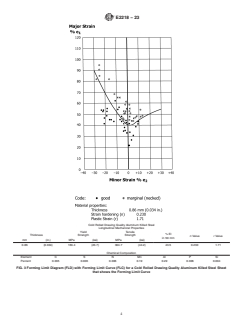
FIG. 3 Forming Limit Diagram (FLD) with Forming Limit Curve (FLC) for a Cold Rolled Drawing Quality Aluminum Killed Steel Sheet
that shows the Forming Limit Curve
E2218 − 23
obtained for a drawing quality aluminum-killed steel sheet. The curve of
5.3.6 FLCs are known to change with material (specifically
Fig. 3 correlates with the upper curve of Fig. 1, a schematic curve
with the mechanical or formability properties developed during
representing a metallic sheet material with an FLD of 40 %.
o
the processing operations used in making the material) and the
NOTE 3—The curve for negative minor strains (e ) will generally follow
thickness of the sheet metal.
a constant surface area relationship to the associated major strains (e ).
5.3.6.1 The strain hardening exponent (n value), defined in
Test Method E646, affects the forming limit. A high n value
5. Significance and Use
will raise the limiting major strain (e ), allowing more stretch
5.1 The forming limit curve (FLC) is specific to the material
under positive minor strain conditions (e > 0).
sampled. It can change if the material is subjected to cold work
5.3.6.2 The plastic strain ratio (r value), defined in Test
or any annealing process. Thus, two samples from a given lot
Method E517, affects the capacity of a material to be deep
of material can produce different curves if their processing is
drawn. A high r value will move the minor strain (e ) into a less
varied.
severe area to the left of the FLD (e < 0), thus permitting
o 2
5.2 The processing history of the material must be known if deeper draws for a given major strain (e ).
the test is to be considered representative of a grade of a
5.3.6.3 The thickness of the material will affect the FLC
product. since a thicker test specimen has more volume to respond to the
forming process.
5.3 A forming limit curve (FLC) defines the maximum
5.3.6.4 The properties of the steel sheet product used in
(limiting) strain that a given sample of a sheet metal can
determining the FLC of Fig. 3 included the n value and the r
undergo for a range of forming conditions, such as deep
value.
drawing, plane strain, biaxial stretching, and bending over a
5.3.7 FLCs serve as a diagnostic tool for material strain
radius in a press and die drawing operation, without developing
analysis and have been used for evaluations of stamping
a localized zone of thinning (localized necking) that would
operations and material selection.
indicate incipient failure.
5.3.8 The FLC provides a graphical basis for comparison
5.3.1 FLCs may be obtained empirically by using a labora-
with strain distributions on parts formed by sequential press
tory hemispherical punch biaxial stretch test and also a tension
operations.
test to strain metal sheet test specimens, from a material
5.3.9 The FLC obtained by this method follows a constant
sample, from beyond their elastic limit to just prior to localized
proportional strain path where there is a nominally fixed ratio
necking and fracture.
of major (e ) to minor (e ) strain.
1 2
5.3.1.1 Since the location of localized necking and fracture
5.3.9.1 There is no interrupted loading, or reversal of
cannot be predetermined, one or both surfaces of test speci-
straining, but the rate of straining may be slowed as the test
mens are covered with a pattern of gauge length measurement
specimen approaches necking or fracture.
units, usually as squares or small diameter circles, by a suitable
5.3.9.2 The FLC can be used for conservatively predicting
method such as scribing, photo-grid, or electro-etching, and
the performance of an entire class of materials provided the n
then each test specimen is formed to the point of localized
value, r value, and thickness of the material used are represen-
necking, or fracture.
tative of that class.
5.3.2 Strains in the major (e ) and minor (e ) directions are
1 2
5.3.10 Complex forming operations, in which the strain path
measured using individual gauge length measurement units on
changes, or the strain is not homogeneous through the metal
the pattern in the area of the localized necking or fracture.
sheet thickness, can produce limiting strains that do not agree
5.3.2.1 Test specimens of varied widths are used to produce
with the forming limit obtained by this method.
a wide range of strain states in the minor (e ) direction.
5.3.11 Characterization of a material’s response to plastic
5.3.2.2 The major strain (e ) is determined by the capacity
deformation can involve strain to fracture as well as to the
of the material to be stretched in one direction as simultaneous
onset of necking. These strains are above the FLC.
surface forces either stretch, do not change, or compress, the
5.3.12 The FLC is not suitable for lot-to-lot quality assur-
metal in the minor strain (e ) direction.
ance testing because it is specific to that sample of a material
5.3.2.3 In the tension test deformation process, the minor
which is tested to establish the forming limit.
strains (e ) are negative, and the test specimen is narrowed
both through the thickness and across its width.
6. Apparatus
5.3.3 These strains are plotted on a forming limit diagram
6.1 Data points for minor strains (e ) near 0 % and for
(FLD), and the forming limit curve (FLC) is drawn to connect
positive minor strains (e > 0) associated with major strains
the highest measured e and e strain combinations that include
1 2
(e ) may be obtained using a hemispherical punch testing
good data points.
machine such as a LDH testing machine, a sub press in a
5.3.3.1 When there is intermixing and no clear distinction
universal testing machine, or a hydraulic bulge testing ma-
between good and marginal data points, a best fit curve is
chine.
established to follow the maximum good data points as the
FLC. NOTE 4—The LDH test was designed to give a repeatable measure of
punch movement among specimens of a specific metal sheet sample; thus
5.3.4 The forming limit is established at the maximum
the only measured value would be the punch height at incipient fracture.
major strain (e ) attained prior to necking.
Problems with maintaining a secure clamp result in variation of the
5.3.5 The FLC defines the limit of useful deformation in
measured LDH value. A modification of the LDH test using a strip
forming metallic sheet products. approximately 200 mm (8 in.) wide as a test specimen, for a 200 mm (8
E2218 − 23
in.) LDH hemispherical punch, was found to give values of e near 0 %,
strips and full size (square or round) test specimens to obtain
when the surface strains were measured using a grid pattern. On this basis,
data for determining the forming limit curve (FLC).
a test was developed to use a sheared strip of metal sheet 200 mm (8 in.)
6.8.2 A 75 mm (3 in.) round ball seated in a spherical mount
wide and sufficiently long to be securely clamped in the LDH test fixture.
may be used as a hemispherical nose punch.
The height at incipient fracture correlated with FLD . The test was not
o
sufficiently repeatable to be employed for evaluation of metal sheet
6.9 Clearance between the hemispherical punch and hold
samples. The equipment is used to stretch test specimens that have been
down dies shall be large enough to prevent pinching of the
sheared to various widths and have been patterned, and is one method to
metal if the punch advances to full penetration of the die.
obtain a range of e and associated e values for plotting a FLC on a FLD.
2 1
6.10 The draw approach radius of the hold down die shall be
6.1.1 The hydraulic bulge testing machine may employ a
sufficient to avoid fracture of the test specimen in that area
liquid or a soft elastic material to apply the forming force.
during stretching.
6.2 Data points for the negative minor strain (e < 0)
6.10.1 Wide test specimens can wrinkle or produce an edge
associated with a major strain (e ) may be obtained using
tear in the periphery near the hold down bead areas. This is not
various width strips in a LDH testing machine and also a
considered as fractured.
universal testing machine and Test Method E8/E8M for a
6.11 The punch nose and hold down dies shall have a
tension test of a test specimen that has a pattern on the surface
minimum hardness of 50.0 HRC.
to be used as gauge length measurement units.
6.2.1 A series of test specimens having different widths of
7. Materials
reduced parallel sections or a series of sheared full length strips
with patterns may be used to obtain a range of e strains. 7.1 The pattern shall adhere to the metal so that it will not
be moved on the surface or rubbed off by the forming
6.3 The testing apparatus shall be capable of securely
operation.
clamping the test specimen to prevent, or minimize, draw-in of
7.1.1 The gauge length should be 2.5 mm (0.10 in.).
flange metal.
7.1.1.1 After the part has been formed, measure the critical
6.3.1 Serrated dies work well with equipment using 75 mm
areas for the resulting change in the gauge lengths in the long
(3 in.), or 100 mm (4 in.) diameter punches. If an interlocking
dimension from l to l of the gauge length measurement unit,
o f
ring bead is used, the fit between the two clamping parts should
and in the width dimension w to w at 90° to the long
o f
be such that no area of the test specimen flange is pulled-in by
dimension as shown in Fig. 2. The major strain (e ) and
the forming force.
associated minor strain (e ) at 90° to e are calculated from
2 1
these changes from the gauge lengths. The strains may be
NOTE 5—Restriction of the pull-in of flange metal is not critical when
using sheared strips for measuring e and associated e strains to establish
1 2 either engineering or true strain based on the gauge lengths.
the forming limit.
7.1.2 Larger gauge lengths, of 6 mm (0.25 in.) up to
NOTE 6—Unlike the forming limit curve test that uses strain
125 mm (5 in.), may be used to measure low strain levels on
measurements, secure clamping of the flange is critical for the LDH test
formed parts, but shall not be used in determining the FLC.
in which only the punch height is recorded.
7.2 A pattern may be printed on one or both surfaces of the
6.4 The test system shall have sufficient force and stroke to
test specimen.
ensure the hemispherical punch can be driven until the metal
sheet ruptures.
NOTE 7—Printing on both surfaces is sometimes done when studying a
production formed part, but not usually for the test specimens used in
6.5 The apparatus shall produce sufficient force to both hold
establishing the FLC.
down the flanges and advance the punch to complete the
7.3 The pattern shall cover an area of the test specimen
deformation of the test specimen.
sufficient to encompass the critically strained areas.
6.6 Although no punch displacement- or force-measuring
7.4 The type of pattern (for example, square, circle, random
capabilities are required for determining data, such devices are
speckle) and the application method are specific to the mea-
helpful in conducting the test.
surement technique and the sample material.
6.7 The hemispherical punch is advanced against the center
7.5 The preferred pattern consists of 2.50 mm (0.100 in.)
of the clamped test specimen at a constant rate until the
squares, or circle diameters, as the gauge length measurement
material exhibits localized necking (through thickness thin-
units. Other patterns, such as those that incorporate random
ning) and a fracture appears in the surface of the test specimen.
designs, may be used in conjunction with non-contacting
6.7.1 The punch advance may be slowed at the end of the
optical strain measurement techniques using 2.5 mm (0.10 in.)
forming process to aid in stopping at the start of localized
as the gauge length measurement unit size.
necking, or when fracture begins.
7.6 An alternative to circles is a pattern of solid dots of
6.7.2 The nominal punch speed shall be measured and
precise diameter that is measured across the diameter of the
reported.
dot.
6.8 The punch shall have a hemispherical nose with a
7.7 For the preferred pattern, print an array of squares, or
nominal diameter of at least 75 mm (3 in.). Diameters of 100
circles, or both, on the surface of the test specimen. Suggested
mm (4 in.) and 200 mm (8 in.) have been used.
gauge length measurement units are shown in Fig. 4.
6.8.1 The 100 mm (4 in.) diameter limiting dome height
(LDH) testing equipment is well suited to straining narrow NOTE 8—Refer to Specification A568/A568M, Appendix
E2218 − 23
NOTE 1—The basic gauge length measurement unit is repeated over the area of the part to be studied on a flat test specimen.
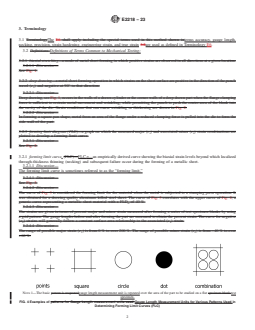
FIG. 4 Examples of Gauge Length Measurement Units for Various Patterns Used in Determining Forming Limit Curves (FLC)
X4–Procedures for Determining the Extent of Plastic Deformation En- NOTE 12—Cleaning will not affect the results. Patterns have been
countered in Forming or Drawing, for procedures to apply photographic successfully applied to metallic coated and pre-lubricated surfaces.
and electrochemically printed patterns and a review of strain analysis.
7.7.6 Patterns using circular or square gauge length mea-
7.7.1 The gauge lengths should be 2.50 mm (0.100 in.) for
surement units made with a metal scribing tool may be used.
the sides of a square gauge length measurement unit, or a
7.7.6.1 Each scribed circle and rectangle shall be measured
diameter of a circular gauge length measurement unit.
prior to forming the test specimen to establish the gauge length
7.7.2 Circles should be used for deformations where the
in the final measured directions.
major strain (e ) might not align with the lines of a square or
1 7.7.7 The length of each side of the square gauge length
grid of points defining the gauge length measurement units.
measurement unit and the diameter of the circular gauge length
measurement unit shall be within 60.025 mm (60.001 in.) of
NOTE 9—This condition is less likely in the process of determining the
the established gauge length.
FLC than in production stamping evaluations where the major strain
direction often will not align the lines of a square or grid of points defining
7.7.7.1 Due to possible line width variations within a
the gauge length measurement units.
printed pattern, the measurements shall be from the inside of
7.7.2.1 These circles commonly have diameters of 2.50 mm the line on one side of the square, or circle, to the inside of the
(0.100 in.) and may be spaced up to 2.50 mm (0.100 in.) apart. opposite line. This is important when measuring high strains
7.7.2.2 Measure the circles across the diameter of the circle where the pattern line width has increased.
when the pattern line width is minimal. For wider lines, the 7.7.8 Solid dots may be used in place of square or open
enclosed area of the etched circle should be consistent from circle gauge length measurement units. These are preferred for
one circle to another and the measurement made across the some electronic measuring devices employing a camera and a
inside diameter. This is more critical for patterns with wider programmed computer sometimes referred to as a circle grid
line widths and at high e strains when the line width spreads analyzer.
as the metal surface stretches.
7.8 When using non-contacting optical strain measurement
7.7.3 Prepared stencils of suitable size and accurate dimen-
techniques, a pattern and an application method specific to the
sions may be used with electrochemical etching equipment,
technique shall be used.
photo grid, or other transfer method to produce patterns of
NOTE 13—Appendix X3 has suggested guidance for the use of stereo
squares, circles, or dots, or combination thereof.
digital image correlation.
7.7.3.1 The dimensions of the pattern shall be checked for
each stencil at the start of each test series and periodically
8. Sampling
during use to ensure that dimensions are not changing due to
8.1 Test specimens to be tested shall be representative of the
stretching or shrinking.
properties of the material, as specified in the applicable product
7.7.3.2 Wrinkling of the stencil shall be prevented to ensure
specification, and shall be from a common known source, such
precise gauge lengths over the pattern area.
as a single sample.
7.7.3.3 Dimensions of transferred patterns on the metal
8.1.1 For coil processed materials, the rolling direction shall
sheet test specimen shall be confirmed by measuring at random
be identified on the sample and the test specimens.
locations on the test specimen.
7.7.4 Techniques for applying patterns are explained in
NOTE 14—The forming limit curve (FLC) is specific to the tested
sample of a material. It is possible for the forming limit curve (FLC) to be
Appendix X1 of this method.
different for separate samples of a given grade of metal. Some causes of
NOTE 10—Refer to Specification A568/A568M, Appendix X4, for the
this are differences in the strain hardening exponent (n value), material
photographic and electrochemical etching techniques. Improper applica-
non-homogeneity, test specimen thickness, and the cold rolling and
tion of the electric current and time can affect the line appearance so that
annealing processing methods used in producing the material.
establishing the line edge becomes difficult when the pattern is magnified
for measurement.
9. Test Specimen Preparation
NOTE 11—A pattern with a dark thin line maximizes the precision of
9.1 Several test specimen are required to establish the
readings.
forming limit curve (FLC).
7.7.5 The surface of the test specimen may be cleaned
before applying the pattern. NOTE 15—For example, the 64 data points of Fig. 3 are from 32 test
E2218 − 23
specimens of different widths that were formed by several methods.
is, square, circles, dot, or combination of these) is used may
involve one of the five following devices, or it may be a
9.1.1 Use test specimens over a range of widths to obtain
comparable technique and device that gives equivalent accu-
different minor strains (e ).
racy:
9.1.2 All test specimens for a series shall have their long
10.3.1 A machinist’s microscope with 10× magnification
dimension in the same orientation, relative to the original
and incorporating a calibrated scale.
process rolling direction of the sample and that direction noted
in the report. 10.3.1.1 The surface being measured shall be held perpen-
dicular to the microscope.
9.2 The test specimens shall be sufficiently long in the major
10.3.2 A steel scale with 0.25 mm (0.01 in.) divisions. The
strain direction of the forming operation to allow secure
scale lines shall be read from center to center of the scale line
clamping in the holding die and allow a free span over which
widths.
stretching occurs.
10.3.3 A magnifier that incorporates a calibrated scale.
9.2.1 For the tension strain applied in a universal testing
10.3.4 A tapered wedge scale on clear plastic that gives the
machine, either standard reduced parallel section 50 mm (2 in.)
strain in percent for an established gauge length, which
sheet test specimens, or sheared parallel strips of various
effectively magnifies the strain.
widths, may be used.
10.3.5 A circle grid analyzer employing a camera and
9.2.2 For hemispherical punch tests, the test specimen shall
computer that makes multiple simultaneous readings.
be sufficiently long to be securely clamped in the holding die
without excessive pull-in.
10.4 The procedure to measure the strains when using a
non-contacting optical strain measureme
...
This document is not an ASTM standard and is intended only to provide the user of an ASTM standard an indication of what changes have been made to the previous version. Because
it may not be technically possible to adequately depict all changes accurately, ASTM recommends that users consult prior editions as appropriate. In all cases only the current version
of the standard as published by ASTM is to be considered the official document.
Designation: E2218 − 15 E2218 − 23
Standard Test Method for
Determining Forming Limit Curves
This standard is issued under the fixed designation E2218; the number immediately following the designation indicates the year of
original adoption or, in the case of revision, the year of last revision. A number in parentheses indicates the year of last reapproval. A
superscript epsilon (´) indicates an editorial change since the last revision or reapproval.
1. Scope
1.1 This test method gives the procedure for constructing a forming limit curve (FLC) for a metallic sheet material by using a
hemispherical deformation punch test and a uniaxial tension test to quantitatively simulate biaxial stretchstretching and deep
drawing processes.
1.1.1 Fig. 1 shows an example of a forming limit curve on a schematic forming limit diagram (FLD).
1.2 FLCs are useful in evaluating press performance by metal fabrication strain analysis.
1.3 The method applies to metallic sheet from 0.5 mm (0.020 in.) to 3.3 mm (0.130 in.).
1.4 The values stated in SI units are to be regarded as the standard. The inch-pound equivalents are approximate.values given in
parentheses after SI units are provided for information only and are not considered standard.
1.5 This standard does not purport to address all of the safety concerns, if any, associated with its use. It is the responsibility
of the user of this standard to establish appropriate safety and healthsafety, health, and environmental practices and determine
the applicability of regulatory limitations prior to use.
1.6 This international standard was developed in accordance with internationally recognized principles on standardization
established in the Decision on Principles for the Development of International Standards, Guides and Recommendations issued
by the World Trade Organization Technical Barriers to Trade (TBT) Committee.
2. Referenced Documents
2.1 ASTM Standards:
A568/A568M Specification for Steel, Sheet, Carbon, Structural, and High-Strength, Low-Alloy, Hot-Rolled and Cold-Rolled,
General Requirements for
E6 Terminology Relating to Methods of Mechanical Testing
E8/E8M Test Methods for Tension Testing of Metallic Materials
E517 Test Method for Plastic Strain Ratio r for Sheet Metal
E646 Test Method for Tensile Strain-Hardening Exponents (n -Values) of Metallic Sheet Materials
E2208 Guide for Evaluating Non-Contacting Optical Strain Measurement Systems
This test method is under the jurisdiction of ASTM Committee E28 on Mechanical Testing and is the direct responsibility of Subcommittee E28.02 on Ductility and
Formability.
Current edition approved Oct. 1, 2015Feb. 1, 2023. Published December 2015April 2023. Originally published in 2002. Last previous edition approved in 20142015 as
ɛ1
E2218–14–15. . DOI: 10.1520/E2218-1510.1520/E2218-23
For referenced ASTM standards, visit the ASTM website, www.astm.org, or contact ASTM Customer Service at service@astm.org. For Annual Book of ASTM Standards
volume information, refer to the standard’s Document Summary page on the ASTM website.
Copyright © ASTM International, 100 Barr Harbor Drive, PO Box C700, West Conshohocken, PA 19428-2959. United States
E2218 − 23
3. Terminology
3.1 TerminologyThe E6 shall apply including the special terms used in this method shown interms accuracy, gauge length,
necking, precision, strain hardening, engineering strain, and true strain 3.2are used as defined in Terminology E6.
3.2 Definitions:Definitions of Terms Common to Mechanical Testing:
3.2.1 biaxial stretching—a mode of metal sheet forming in which positive strains are observed in all directions at a given location.
3.2.1.1 Discussion—
See Fig. 1.
3.2.2 deep drawing—a metal sheet forming operation in which strains on the sheet surface are positive in the direction of the punch
travel (e ) and negative at 90° to that direction.
3.2.2.1 Discussion—
Deep drawing, see Fig. 1, occurs in the walls of a drawn cylinder or the corner walls of a deep drawn part when the flange clamping
force is sufficient to restrain metal movement and wrinkling, while permitting the punch to push the center area of the blank into
the cavity of the die. Strain conditions that can cause wrinkling or thickening are shown in Fig. 2.
3.2.2.2 Discussion—
In forming a square pan shape, metal from an area of the flange under a reduced clamping force is pulled into the die to form the
side wall of the part.
3.2.3 forming limit diagram (FLD)—a graph on which the measured major (e ) and associated minor (e ) strain combinations are
1 2
plotted to develop a forming limit curve.
3.2.3.1 Discussion—
See Fig. 2.
3.2.1 forming limit curve, (FLC)—FLC,n—an empirically derived curve showing the biaxial strain levels beyond which localized
through-thickness thinning (necking) and subsequent failure occur during the forming of a metallic sheet.
3.2.1.1 Discussion—
The forming limit curve is sometimes referred to as the “forming limit.”
3.2.4.1 Discussion—
See Fig. 3.
3.2.4.2 Discussion—
The curve of Fig. 3 is considered the forming limit for the material when the metal is subjected to a stamping press operation. It
was obtained for a drawing quality aluminum killed steel sheet. The curve of Fig. 3 correlates with the upper curve of Fig. 2, a
generic curve representing a metallic sheet material with a FLD of 40 %.
o
3.2.4.3 Discussion—
The strains are given in terms of percent major and minor strain measured after forming a series of test specimen blanks by using
a grid pattern. The gauge lengths before and after forming the part are measured to obtain the percent strain. The curve for negative
(e ) strains will generally follow a constant surface area relationship to the associated (e ) strain.
2 1
3.2.4.4 Discussion—
The range of possible major strain (e ) is from 0 % to over 200 %. The range of possible minor strain (e ) is from −40 % to over
1 2
+60 %.
NOTE 1—The basic pattern is reapeatedgauge length measurement unit is repeated over the area of the part to be studied on a flat specimen blank.test
specimen.
FIG. 4 Examples of patterns for Gauge Length measurement units used Gauge Length Measurement Units for Various Patterns Used in
Determining Forming Limit Curves (FLC)
E2218 − 23
NOTE 1—The upper curve is representative of represents the forming limit. limit curve. Strains below the lower curve do not occur during forming
metallic sheet products in the most stamping press operations. Curves to the left of % e = 0 are for constant area of the sheet test specimen surface.
FIG. 21 Schematic Forming Limit Diagram
3.2.2 limiting dome heightforming limit diagram, (LDH) FLD,test—n—an evaluative test for metal sheet deformation capability
employing a hemispherical punch a graph on which the measured major (e and a circumferential clamping) and associated minor
(e force sufficient to prevent metal in the surrounding flange from being pulled into the die cavity.) strain combinations are plotted
to develop a forming limit curve.
3.3 Definitions of Terms Specific to This Standard:
3.3.1 grid pattern—biaxial stretching, n—a pattern applied to the surface of a metal sheet to provide an array of precisely spaced
gauge points prior to forming the metal into a final shape by the application of a force.mode of metal sheet forming in which
positive strains are observed in all in-plane directions at a given location.
3.3.1.1 Discussion—
See Fig. 2.
3.3.2 deep drawing, n—a sheet metal forming operation in which strains on the test specimen surface are positive in the direction
of the punch travel (e ) and negative at 90° to that direction.
3.3.2.1 Discussion—
Deep drawing, see Fig. 2, occurs in the walls of a drawn cylinder or the corner walls of a deep drawn part when the flange clamping
E2218 − 23
FIG. 2 Possible Changes in the Shape of the Circular Grid Pattern Gauge Length Measurement Units Caused by Forming Operations on
Metallic Sheet Products
force is sufficient to restrain metal movement and wrinkling, while permitting the punch to push the center area of the test specimen
into the cavity of the die. Strain conditions that can cause wrinkling or thickening are shown in Fig. 1.
3.3.2.2 Discussion—
In forming a square pan shape, metal from an area of the flange under a reduced clamping force is pulled into the die to form the
side wall of the part.
3.3.3 FLD , n—the location on the forming limit curve that has the lowest major strain (e ).
o 1
3.3.4 fractured, adj—the visual classification of deformed individual gauge length measurement units, where the unit is separated
by a fracture into two parts.
3.3.4.1 Discussion—
This classification is also referred to as fail.
3.3.4.2 Discussion—
The strain in the deformed individual gauge length measurement unit is beyond the forming limit.
3.3.5 gauge length measurement unit, n—the portion of a pattern, with either a defined or measured gauge length prior to forming,
used to measure local major and minor strains.
3.3.6 good, adj—the visual classification of deformed individual gauge length measurement units, where the unit lies entirely
outside the necked region of the test specimen.
3.3.6.1 Discussion—
This classification is also referred to as no localized necking, pass, or acceptable, on production parts.
3.3.7 limiting dome height (LDH) test, n—an evaluative test for metal sheet deformation capability employing a hemispherical
punch and a circumferential clamping force sufficient to prevent metal in the surrounding flange from being pulled into the die
cavity.
3.3.8 major strain, (ee )—, n—the largest strain, developed at a given location in the sheeton the test specimen surface.
3.3.8.1 Discussion—
The major strain (e ) is measured either along the stretched line of a square pattern, pattern of squares, or along the major axis
of the ellipse resulting from deformation of a circular grid pattern,pattern of circles, or along the direction of the maximum surface
strain using a non-contacting optical strain measurement technique.
3.3.9 marginal, adj—the visual classification of deformed individual gauge length measurement units, where the unit lies in a
region of localized thinning or a trough in the test specimen surface.
3.3.9.1 Discussion—
This classification is also referred to as localized necking or borderline.
3.3.10 minor strain, (ee )—, n—the strain in the sheet on the test specimen surface in a direction perpendicular to the major strain.
E2218 − 23
3.3.10.1 Discussion—
The minor strain (e ) is measured at 90° to the major strain, either along the shorter dimension of the final rectangular shape of
a part formed using a square pattern, gauge length measurement unit, or along the shorter axis of the ellipse resulting from
deformation of a circular grid pattern,pattern of circles, or along the direction of the minimum surface strain using a non-contacting
optical strain measurement technique.
3.3.11 pattern, n—a regular array or randomly placed set of features applied, prior to forming, to the surface of a test specimen,
that are used as gauge length measurement units.
3.3.11.1 Discussion—
A regular array of features, such as lines, circles, or dots, is often called a “grid pattern” or “circle grid pattern.”
3.3.11.2 Discussion—
A random placed set of features, such as paint overspray for digital image correlation, is often called a “speckle pattern”.
3.3.12 plane strain, FLDn— —the condition in metal sheet forming that maintains a near zero (0(0 % to +5 %) minor strain (e )
o 2
while the major strain (e ) is positive (in tension)tension).
3.3.12.1 Discussion—
Plane strain is the most severe deformation mode and ideally causes a low point in the forming limit curve (FLC). (FLC), see Fig.
1. For convenience, many FLCs are shown with the low point at 0 % (e ), = 0 % or a slightly positive value; however, such an
abrupt reversal of (e ) strain does not occur. See Fig. 3 and Figs. X2.1-X2.3.
4. Summary of Test Method
4.1 Determination of a forming limit curve (FLC) involves selecting a style of testing apparatus, deforming multiple test
specimens biaxially, measuring the resulting strain (including judgingclassifying if these strains are localized), and drawing a curve
through the measured points.
4.2 Various test apparatus (see Section 6) may be used to deform test specimens biaxially including a hemispherical punch testing
machine such as an LDH tester, testing machine, a sub press in a universal testing machine, or a hydraulic bulge testing machine.
4.2.1 Contact surfaces of the blank undeformed test specimen and punch are lubricated for the hemispherical punch test.
4.2.2 The flanges of a blank test specimen are securely clamped in serrated or lock bead, blank-holder lock-bead test-specimen-
holder dies for the hemispherical punch and hydraulic bulge tests.
4.3 Stretching the central area of the blank biaxially or pulling in the tension test is performed without interrupting the force.
4.3.1 A series of grid pattern blankspatterned test specimens is prepared with different widths and a common length suitable for
being securely grippedheld in the test apparatus.
4.3.2 Negative minor strains (e ) strains can be obtained using sheared narrow strips strip test specimens stretched over the punch
of a hemispherical punch tester.testing machine.
4.3.3 If possible, the punch advance or the force is stopped when a localized through-thickness neck (localized necking) is
observed, or as soon as the test specimen fractures.
4.3.4 Unless there is a defect in the material, the test specimen will not split across the nose of the punch. Instead, when the punch
is advanced beyond the forming limit of the material, necking or fracturing, or both, will occur in a ring encircling the round cap
of the formed region.
NOTE 1—Lubrication improves sliding of the material over the surface of the punch and causes rupture to occur closer to the nose of the punch. This does
not change the forming limit, as the minor strain (e ) adjusts to the increased major strain (e ).
2 1
4.4 The major (e ) and the minor (e ) strains of the grid individual gauge length measurement units of the pattern on the surface
1 2
area are measured near the neck of all the test specimens for the series and recorded.
4.4.1 The strain measurements may include good (no localized necking), marginal (localized necking), and fracturefractured areas.
E2218 − 23
Cold Rolled Drawing Quality Aluminum Killed Steel
Longitudinal Mechanical Properties
Yield Tensile
% El
Thickness Strength Strength
n Value r Value
in 50 mm
mm (in.) MPa (ksi) MPa (ksi)
0.866 (0.034) 163.4 (23.7) 304.7 (44.2) 43.5 0.230 1.71
Cold Rolled Drawing Quality Aluminum Killed Steel
Longitudinal Mechanical Properties
Yield Tensile
% El
Thickness Strength Strength
n Value r Value
in 50 mm
mm (in.) MPa (ksi) MPa (ksi)
0.86 (0.034) 163.4 (23.7) 304.7 (44.2) 43.5 0.230 1.71
Chemical Composition
Element C S N Mn Al P Si
Percent 0.035 0.006 0.006 0.19 0.29 0.006 0.004
FIG. 3 Forming Limit Diagram (FLD) with Forming Limit Curve (FLC) for a Cold Rolled Drawing Quality Aluminum Killed Steel Sheet-
.Sheet that shows the Forming Limit Curve
E2218 − 23
4.4.2 The measured strain combinations are plotted on a forming limit diagram (see Fig. 3).
4.4.3 If other than good (no localized necking) locations are included, then each measured point is visually evaluated and noted
as illustrated in Fig. 3.
4.5 The FLC is established by drawing a curve on the FLD based on the criteria in 13.412.4.
NOTE 2—The curve of Fig. 3 is considered the forming limit for the material when the metal is subjected to a stamping press operation. It was obtained
for a drawing quality aluminum-killed steel sheet. The curve of Fig. 3 correlates with the upper curve of Fig. 1, a schematic curve representing a metallic
sheet material with an FLD of 40 %.
o
NOTE 3—The curve for negative minor strains (e ) will generally follow a constant surface area relationship to the associated major strains (e ).
2 1
5. Significance and Use
5.1 The forming limit curve (FLC) is specific to the material sampled. It can change if the material is subjected to cold work or
any annealing process. Thus, two samples from a given lot of material can produce different curves if their processing is varied.
5.2 The processing history of the material must be known if the test is to be considered representative of a grade of a product.
5.3 A forming limit curve (FLC) defines the maximum (limiting) strain that a given sample of a metallic sheet metal can undergo
for a range of forming conditions, such as deep drawing, stretching plane strain, biaxial stretching, and bending over a radius in
a press and die drawing operation, without developing a localized zone of thinning (localized necking) that would indicate incipient
failure.
5.3.1 FLCs may be obtained empirically by using a laboratory hemispherical punch biaxial stretch test and also a tension test to
strain metal sheet specimens test specimens, from a material sample sample, from beyond their elastic limit, limit to just prior to
localized necking and fracture.
5.3.1.1 Since this the location of localized necking and fracture cannot be predetermined, one or both surfaces of test specimens
are covered with a grid pattern of gauge lengths length measurement units, usually as squares or small diameter circles, by a
suitable method such as scribing, photo-grid, or electro-etching, and then each test specimen is formed to the point of localized
necking, or fracture.
5.3.2 Strains in the major (e ) and minor (e ) directions are measured using points individual gauge length measurement units on
1 2
the grid pattern in the area of the localized necking or fracture.
5.3.2.1 Blanks Test specimens of varied widths are used to produce a wide range of strain states in the minor (e ) direction.
5.3.2.2 The major strain (e ) strain is determined by the capacity of the material to be stretched in one direction as simultaneous
surface forces either stretch, do not change, or compress, the metal in the minor strain (e ) direction.
5.3.2.3 In the tension test deformation process, the minor strains (e ) strains are negative, and the metal test specimen is narrowed
both through the thickness and across its width.
5.3.3 These strains are plotted on a forming limit diagram (FLD)(FLD), and the forming limit curve (FLC) is drawn to connect
the highest measured (e and e ) strain combinations that include good data points.
1 2
5.3.3.1 When there is intermixing and no clear distinction between good and neckedmarginal data points, a best fit curve is
established to follow the maximum good data points as the FLC.
5.3.4 The forming limit is established at the maximum major strain (e ) strain attained prior to necking.
5.3.5 The FLC defines the limit of useful deformation in forming metallic sheet products.
5.3.6 FLCs are known to change with material (specifically with the mechanical or formability properties developed during the
processing operations used in making the material),material) and the thickness of the sheet sample.metal.
E2218 − 23
5.3.6.1 The strain hardening exponent (n value), defined in Test Method E646, affects the forming limit. A high n value will raise
the limiting major strain (e ), allowing more stretch under positive (+minor strain conditions (e ) strain conditions. > 0).
1 2
5.3.6.2 The plastic strain ratio (r value), defined in Test Method E517, affects the capacity of a material to be deep drawn. A high
r value will move the minor (−strain (e ) strain into a less severe area to the left of the FLD , (e < 0), thus permitting deeper draws
2 o 2
for a given major strain (e ) strain.).
5.3.6.3 The thickness of the material will affect the FLC since a thicker test specimen has more volume to respond to the forming
process.
5.3.6.4 The properties of the steel sheet product used in determining the FLC of Fig. 3 included the n value and the r value.
5.3.7 FLCs serve as a diagnostic tool for material strain analysis and have been used for evaluations of stamping operations and
material selection.
5.3.8 The FLC provides a graphical basis for comparison with strain distributions on parts formed by sequential press operations.
5.3.9 The FLC obtained by this method follows a constant proportional strain path where there is a nominally fixed ratio of major
(e ) to minor (e ) strain.
1 2
5.3.9.1 There is no interrupted loading, or reversal of straining, but the rate of straining may be slowed as the test specimen
approaches neck-down,necking or fracture.
5.3.9.2 The FLC can be used for conservatively predicting the performance of an entire class of materialmaterials provided the
n value, r value, and thickness of the material used are representative of that class.
5.3.10 Complex forming operations, in which the strain path changes, or the strain is not homogeneous through the metal sheet
thickness, maycan produce limiting strains that do not agree with the forming limit obtained by this method.
5.3.11 Characterization of a material’s response to plastic deformation can involve strain to fracture as well as to the onset of
necking. These strains are above the FLC.
5.3.12 The FLC is not suitable for lot-to-lot quality assurance testing because it is specific to that sample of a material which is
tested to establish the forming limit.
6. Apparatus
6.1 Data points for minor strains (e ) near 0 % and for positive minor strains (+(e ) > 0) associated with major strains (e ) may
2 2 1
be obtained using a hemispherical punch testing machine such as a LDH tester, testing machine, a sub press in a universal testing
machine, or a hydraulic bulge testing machine.
NOTE 1—The LDH test was designed to give a repeatable measure of punch movement among specimens of a specific metal sheet sample; thus the only
measured value would be the punch height at incipient fracture. Problems with maintaining a secure clamp result in variation of the measured LDH value.
A modification of the LDH test using a strip in the range of 200 mm (8 in.) wide was found to give (e) values near 0 % (e ), when the surface strains
1 2
were measured using a grid pattern. On this basis, a test was developed to use a sheared strip of metal sheet 200 mm (8 in.) wide and sufficiently long
to be securely clamped in the LDH test fixture. The height at incipient fracture was to correlate with FLD . The test was not sufficiently repeatable to
o
be employed for evaluation of metal sheet samples. The equipment is used to stretch specimens, with grid patterns that have been sheared to various
widths and is one method to obtain a range of (e ) and associated (e ) values for plotting a FLC on a FLD.
2 1
NOTE 4—The LDH test was designed to give a repeatable measure of punch movement among specimens of a specific metal sheet sample; thus the only
measured value would be the punch height at incipient fracture. Problems with maintaining a secure clamp result in variation of the measured LDH value.
A modification of the LDH test using a strip approximately 200 mm (8 in.) wide as a test specimen, for a 200 mm (8 in.) LDH hemispherical punch,
was found to give values of e near 0 %, when the surface strains were measured using a grid pattern. On this basis, a test was developed to use a sheared
strip of metal sheet 200 mm (8 in.) wide and sufficiently long to be securely clamped in the LDH test fixture. The height at incipient fracture correlated
with FLD . The test was not sufficiently repeatable to be employed for evaluation of metal sheet samples. The equipment is used to stretch test specimens
o
that have been sheared to various widths and have been patterned, and is one method to obtain a range of e and associated e values for plotting a FLC
2 1
on a FLD.
6.1.1 The hydraulic bulge testing machine may employ a liquid or a soft elastic material as to apply the forming force.
E2218 − 23
6.2 Data points for the negative minor (−strain (e ) strain < 0) associated with a major strain (e ) strain may be obtained using
2 1
various width strips in a LDH tester testing machine and also a universal testing machine and Test Method E8/E8M for a tension
test of a test specimen that has a grid pattern on the surface.surface to be used as gauge length measurement units.
6.2.1 A series of test specimens having different widths of reduced parallel sections or a series of sheared full length strips with
grid patterns may be used to obtain a range of (e ) strains.
6.3 The presstesting apparatus shall be capable of securely clamping the test blankspecimen to prevent, or minimize, draw-in of
flange metal.
6.3.1 Serrated dies work well with equipment using 75 mm (3 in.), or 100 mm (4 in.) diameter punches. If an interlocking ring
bead is used, the fit between the two clamping parts shallshould be such that no area of the test specimen flange is pulled-in by
the forming force.
NOTE 5—Restriction of the pull-in of flange metal is not critical in obtaining when using sheared strips for measuring (e ) and associated (e ) strains to
1 2
establish the forming limit.
NOTE 6—Unlike the forming limit curve test that uses strain measurements, secure clamping of the flange is critical for the LDH test in which only the
punch height is recorded.
6.3.2 Secure clamping of the flange is critical for the LDH test in which only the punch height is recorded.
6.4 The test system shall have sufficient force and stroke to ensure the hemispherical punch can be driven until the metal sheet
ruptures.
6.5 The apparatus shall produce sufficient force to both hold down the flanges and advance the punch to complete the deformation
of the blank.test specimen.
6.6 Although no punch displacement or load measuring displacement- or force-measuring capabilities are required for determining
data, such devices are helpful in conducting the test.
6.7 The hemispherical punch is advanced against the center of the clamped test specimen at a constant rate until the material
exhibits localized necking (through thickness thinning) and a fracture appears in the surface of the test specimen.
6.7.1 The punch advance may be slowed at the end of the forming process to aid in stopping at the start of localized necking, or
when fracture begins.
6.7.2 The nominal punch speed shall be measured and reported.
6.7.3 Unless there is a defect in the material, it should not split across the nose of the punch. Instead, when the punch is advanced
beyond the forming limit of the material, necking or fracturing, or both, will occur in a ring encircling the round cap of the formed
region.
NOTE 3—Lubrication improves sliding of the material over the surface of the punch and causes rupture to occur closer to the top. This does not change
the forming limit, as the minor (e ) strain adjusts to the increased major (e ) strain.
2 1
6.8 The punch shall have a hemispherical nose with a nominal diameter of at least 75 mm (3 in.). Diameters of 100 mm (4 in.)
and 200 mm (8 in.) have been used.
6.8.1 The 100 mm (4 in.) diameter limiting dome height (LDH) testing equipment is well suited to straining narrow strips and full
size (square,(square or round) specimen blankstest specimens to obtain data for determining the forming limit curve (FLC).
6.8.2 A 75mm 75 mm (3 in.) round ball seated in a spherical mount may be used as a hemispherical nose punch.
E2218 − 23
6.9 Clearance between the forminghemispherical punch and hold down dies shall be large enough to prevent pinching of the metal
if the punch advances to full penetration of the die.
6.10 The draw approach radius of the hold down die shall be sufficient to avoid fracture of the test blankspecimen in that area
during stretching.
6.10.1 Wide blanks may test specimens can wrinkle or produce an edge tear in the periphery near the hold down bead areas. This
is not considered a failure.as fractured.
6.11 The punch nose and hold down dies shall have a minimum hardness of 50.0 HRC 6 5.0.HRC.
7. Materials
7.1 The grid pattern shall adhere to the metal so that it will not be moved on the surface or rubbed off by the forming operation.
7.1.1 The suggested dimension for the gauge length is should be 2.5 mm (0.10 in.).
7.1.1.1 After the part has been formed, measure the critical areas are measured for the resulting gauge length changes change in
the gauge lengths in the long dimension from (ll ) to (ll ) of the pattern, gauge length measurement unit, and in the width dimension
o f
(ww ) to (ww ) at 90° to the long dimension as shown in Fig. 12. The major strain (e ) and associated minor strain (e ) at 90° to
o f 1 2
(e ) are calculated from these gauge length changes. changes from the gauge lengths. The strains may be either engineering or true
strain based on the original gauge length, or true strain.gauge lengths.
7.1.2 Larger gauge lengths, of 6 mm (0.25 in.) up to 125 mm 125 mm (5 in.), may be used to measure low strain levels on formed
parts, but shall not be used in determining the FLC.
7.2 A grid pattern may be printed on one or both surfaces of the test specimen.
7.2.1 Printing on both surfaces is sometimes necessary when studying a production formed part, but not for the specimens used
in establishing the FLC.
NOTE 7—Printing on both surfaces is sometimes done when studying a production formed part, but not usually for the test specimens used in establishing
the FLC.
7.3 The grid pattern shall cover an area of the test specimen blank sufficient to encompass the critically strained areas.
7.4 The type of pattern (for example, square, circle, random) of grid pattern random speckle) and the application method are
specific to the measurement technique and the sample material.
7.5 The preferred grid pattern consists of 2.50 mm (0.100 in.) squares, or circle diameters, as the gauge length. Other grid length
measurement units. Other patterns, such as those that incorporate random designs, may be used in conjunction with non-contacting
optical strain measurement techniques using 2.5 mm (0.10 in.) as the effective gauge length.gauge length measurement unit size.
7.6 An alternative to circles is a pattern of solid dots of precise diameter that areis measured across the diameter of the dot.
7.7 For the preferred pattern, print an array of squares, or circles, or both, is printed on the surface of the test specimen. Suggested
patterns gauge length measurement units are shown in Fig. 4.
NOTE 4—Refer to Specification A568/A568M, Appendix X4–Procedures for Determining the Extent of Plastic Deformation Encountered in Forming or
Drawing, for procedures to apply photographic and electrochemically printed grid patterns and a review of strain analysis.
NOTE 8—Refer to Specification A568/A568M, Appendix X4–Procedures for Determining the Extent of Plastic Deformation Encountered in Forming or
Drawing, for procedures to apply photographic and electrochemically printed patterns and a review of strain analysis.
E2218 − 23
7.7.1 Suggested dimensions for the gauge lengths are 2.5 The gauge lengths should be 2.50 mm (0.100 in.) for the sides of a square
pattern, gauge length measurement unit, or a diameter of a circle pattern. circular gauge length measurement unit.
7.7.2 Circles should be used for deformations where the major strain (e ) doesmight not align with the lines of a square pattern.
This condition is less likely in the process of determining the FLC than in production stamping evaluations. These circles
commonly have diameters of 2.5 mm (0.100 in.) and may be spaced up to 2.5 mm (0.100 in.) apart. They are measured across the
diameter of the circle when the line width is minimal. For wider lines, the enclosed area of the etched circle should be consistent
from one circle to another and the measurement made across the inside diameter. This is more critical with wider line width
patterns and at high or grid of points defining the gauge length measurement units.e strains when the line spreads as the metal
surface stretches.
NOTE 9—This condition is less likely in the process of determining the FLC than in production stamping evaluations where the major strain direction often
will not align the lines of a square or grid of points defining the gauge length measurement units.
7.7.2.1 These circles commonly have diameters of 2.50 mm (0.100 in.) and may be spaced up to 2.50 mm (0.100 in.) apart.
7.7.2.2 Measure the circles across the diameter of the circle when the pattern line width is minimal. For wider lines, the enclosed
area of the etched circle should be consistent from one circle to another and the measurement made across the inside diameter. This
is more critical for patterns with wider line widths and at high e strains when the line width spreads as the metal surface stretches.
7.7.3 Prepared stencils of suitable size and accurate dimensions may be used with electrochemical etching equipment, photo grid,
or other transfer method to produce grid patterns of squares, circles, or dots, or combination thereof.
7.7.3.1 The dimensions of the grid pattern shall be checked for each stencil at the start of each test series and periodically during
use to ensure that dimensions are not changing due to stretching or shrinking.
7.7.3.2 Wrinkling of the stencil shall be prevented to ensure precise gauge lengths over the pattern area.
7.7.3.3 Dimensions of transferred patterns on the metal sheet blank test specimen shall be confirmed by measuring at random
locations on the test specimen.
7.7.4 Techniques for applying gridspatterns are explained in Appendix X1 of this method.
7.7.4.1 Refer to Specification A568/A568M, Appendix X4, for the photographic and electrochemical etching techniques. Improper
application of the electric current and time can affect the line appearance so that establishing the line edge becomes difficult when
the pattern is magnified for measurement.
NOTE 10—Refer to Specification A568/A568M, Appendix X4, for the photographic and electrochemical etching techniques. Improper application of the
electric current and time can affect the line appearance so that establishing the line edge becomes difficult when the pattern is magnified for measurement.
7.7.4.2 A grid pattern with a dark thin line maximizes the precision of readings.
NOTE 11—A pattern with a dark thin line maximizes the precision of readings.
7.7.5 The surface of the test specimen may be cleaned before applying the pattern.
NOTE 12—Cleaning will not affect the results. Patterns have been successfully applied to metallic coated and pre-lubricated surfaces.
7.7.6 Rectangular and circle grid patterns Patterns using circular or square gauge length measurement units made with a metal
scribing tool may be used.
7.7.6.1 It is necessary to measure each Each scribed circle and rectangle shall be measured prior to forming the test blankspecimen
to establish the initial gauge length in the final measured directions.
E2218 − 23
7.7.7 The length of each side of the square pattern gauge length measurement unit and the diameters of all circles diameter of the
circular gauge length measurement unit shall be within 60.025 mm (0.001(60.001 in.) of the established gauge length.
7.7.7.1 Due to possible line width variations within a printed pattern, the measurements shall be from the inside of the line on one
side of the square, or circle, to the inside of the opposite line. This is important when measuring high strains where the pattern
line width has increased.
7.7.8 Solid dots may be used in place of square or open circle patterns. gauge length measurement units. These are preferred for
some electronic measuring devices employing a camera and a programmed computer.computer sometimes referred to as a circle
grid analyzer.
7.8 When using non-contacting optical strain measurement techniques, a grid pattern and an application method specific to the
technique shall be used.
NOTE 13—Appendix X3 has suggested guidance for the use of stereo digital image correlation.
8. Sampling
8.1 Blanks Test specimens to be tested shall be representative of the properties of the material, as specified in the applicable
product specification, and shall be from a common known source, such as a single sample.
8.1.1 For coil processed materials, the rolling direction shall be identified on the sample and the test specimens.
NOTE 6—The forming limit curve (FLC) is specific to the tested sample of a material. It is possible for the forming limit curve (FLC) to be different for
separate samples of a given grade of metal. Some causes of this are differences in the strain hardening exponent (n value), material non-homogeneity,
specimen thickness, and the cold rolling and annealing processing methods used in producing the material.
NOTE 14—The forming limit curve (FLC) is specific to the tested sample of a material. It is possible for the forming limit curve (FLC) to be different
for separate samples of a given grade of metal. Some causes of this are differences in the strain hardening exponent (n value), material non-homogeneity,
test specimen thickness, and the cold rolling and annealing processing methods used in producing the material.
9. Sample Preparation
9.1 Several specimen blanks are required to establish the forming limit curve (FLC).
9.1.1 For example, the 64 data points of Fig. 3 are from 32 specimens of different widths that were formed by several methods.
9.1.2 Specimens over a range of widths are used to obtain different (e ) strains.
9.1.3 All specimens for a series shall have their long dimension in the same orientation, relative to the original process rolling
direction of the sample and that direction noted in the report.
9.2 The blanks shall be sufficiently long in the major strain direction of the forming operation to allow secure clamping in the
holding grips and allow a free span over which stretching occurs.
9.2.1 For the tension strain applied in a universal testing machine, either standard reduced-section 50 mm (2 in.) sheet specimens,
or sheared parallel strips of various widths, may be used.
9.2.2 For hemispherical punch tests, the blanks must be sufficiently long to be securely clamped in the holding die without
excessive pull-in.
9.2.2.1 This secure clamping condition for the flange is not critical for the FLC determination, but it is necessary for the limiting
dome height (LDH) test.
9.2.3 Example lengths are 180 to 225 mm (7 to 9 in.) for a test using a hemispherical punch diameter of 100 mm (4 in.) and also
for the tension test specimen.
E2218 − 23
9.3 The width of each set of specimen blanks is different in order to produce a range of minor strain (e ) values.
9.3.1 Several sets of specimens may be needed to provide sufficient data.
9.3.2 Rectangular strips are cut to various widths, typically ranging from 12 mm (0.50 in.) up to 180 or 200 mm (7 to 8 in.) in
increments of 12 mm (0.50 in.), or 25 mm (1 in.).
9.4 Test blanks from a given sample shall all be sheared to width in the same direction, either across the rolling direction or along
the rolling direction, of the sheet product.
9.5 The width cut shall be made using a shear with sharp blades and a blade clearance of approximately 10 % of sheet thickness
to minimize double shear and edge burr effects that could be a safety hazard when handling test specimens.
9.5.1 A moderate amount of shear burr will not affect the test results.
9.5.2 The rake angle of the upper shear blade should be less than 3° to prevent curling of the narrow specimens.
9.6 Edges of the specimen blanks may be polished to remove excessive edge burr.
9.7 Specimens shall have edges that are parallel within 1 % of their length.
9. Test Specimen Preparation
9.1 Several test specimen are required to establish the forming limit curve (FLC).
NOTE 15—For example, the 64 data points of Fig. 3 are from 32 test specimens of different widths that were formed by several methods.
9.1.1 Use test specimens over a range of widths to obtain different minor strains (e ).
9.1.2 All test specimens for a series shall have their long dimension in the same orientation, relative to the original process rolling
direction of the sample and that direction noted in the report.
9.2 The test specimens shall be sufficiently long in the major strain direction of the forming operation to allow secure clamping
in the holding die and allow a free span over which stretching occurs.
9.2.1 For the tension strain applied in a universal testing machine, either standard reduced parallel section 50 mm (2 in.) sheet test
specimens, or sheared parallel strips of various widths, may be used.
9.2.2 For hemispherical punch tests, the test specimen shall be sufficiently long to be securely clamped in the holding die without
excessive pull-in.
NOTE 16—The prevention of any pull-in of the flange is not critical for the FLC determination, but it is necessary for the limiting dome height (LDH)
test. See Note 4.
NOTE 17—Example test specimen lengths are 180 to 225 mm (7 to 9 in.) for a test using a hemispherical punch diameter of 100 mm (4 in.) and also for
the tension test specimen.
9.3 The width of each set of test specimens is different in order to produce a range of minor strain (e ) values.
9.3.1 Several sets of test specimens may be needed to provide sufficient data.
9.3.2 Cut rectangular strips to various widths, typically ranging from 12 mm (0.50 in.) up to 180 mm or 200 mm (7 in. to 8 in.)
in increments of 12 mm (0.50 in.), or 25 mm (1 in.), for a 100 mm punch diameter.
E2218 − 23
9.4 Test specimens from a given sample shall all be sheared to width in the same direction, either across the rolling direction or
along the rolling direction, of the sheet product.
9.5 The width cut shall be made using a shear with sharp blades and a blade clearance of approximately 10 % of sheet thickness
to minimize double shear and edge burr effects that could be a safety hazard when handling test specimens.
NOTE 18—A moderate amount of shear burr will not affect the test results.
9.5.1 The rake angle of the upper shear blade should be less than 3° to prevent curling of the narrow test specimens.
9.6 Edges of the test specimens may be polished to remove excessive edge burr.
9.7 Test specimens shall have edges that are parallel within 1 % of their length.
10. Calibration
10.1 Tests for forming limit curves made in hemispherical punch forming presses and universal testing machines do not require
measurements of the forces applied.
10.2 The measurements of (e ) and (e ) strain shall be accurate to 62.5 % strain.
1 2
10.3 The procedure used to make these measurements when the preferred grid pattern pattern and gauge length measurement unit
(that is, square, circles, spots,dot, or combination of these) is used may involve one of the five following devices, or it may be a
comparable technique and device that gives equivalent precision: accuracy:
10.3.1 A machinist’s microscope with 10× magnification and incorporating a calibrated scale.
10.3.1.1 The surface being measured shall be held perpendicular to the microscope.
10.3.2 A steel scale with 0.25 mm (0.01 in.) divisions. The scale lines shall be read from center to center of the scale line widths.
10.3.3 A magnifier that incorporates a calibrated scale.
10.3.4 A tapered wedge scale on clear plastic (Mylar) that gives the strain in percent for an established gauge length, which
effectively magnifies the strain.
10.3.5 A circle grid analyzer employing a camera and computer imaging that makes multiple simultaneous readings.
10.4 The procedure to measure the strains when using a non-contacting optical strain measurement technique should follow the
suggestions of the measurement equipment manufacturer.
10.4.1 If the measurements are made while the force is still applied to the test specimen, then this should be noted in the report
along with the method that was used.
NOTE 19—The measurement methods described in 10.3 are typically performed on samples test specimens removed
...
Questions, Comments and Discussion
Ask us and Technical Secretary will try to provide an answer. You can facilitate discussion about the standard in here.
Loading comments...