

ASTM E2568-17a
(Specification)Standard Specification for PB Exterior Insulation and Finish Systems
General Information
- Abstract
ABSTRACT
This specification covers PB Exterior Insulation and Finish Systems (EIFS) defined as an exterior, non-bearing wall covering providing a weather-resistant exterior wall envelope on walls required to be combustible or noncombustible, fireresistance-rated or nonfire-resistance-rated. Further, PB EIFS is a system described as being applied over insulation board, an adhesive or mechanical attachment of the insulation board to a substrate, or both, glass fiber reinforcing mesh, a base coat on the face of the insulation board, and a textured protective finish coat. The following tests shall be performed in accordance to the following test methods” accelerated weathering; freeze/thaw; salt spray resistance; tensile bond adhesion; water penetration; water resistance; physical properties and requirements for EPS; alkali resistance of reinforcing mesh; fire endurance; full-scale multi-story fire test; and ignition resistance.
SCOPE
1.1 This specification covers PB Exterior Insulation and Finish Systems (EIFS) defined as an exterior, non-bearing wall covering providing a weather-resistant exterior wall envelope on walls required to be combustible or noncombustible, fire-resistance-rated or nonfire-resistance-rated. Further, PB EIFS is a system described as being applied over expanded polystyrene or polyisocyanurate insulation board, an adhesive or mechanical attachment of the insulation board to a substrate, or both, glass fiber reinforcing mesh, a base coat on the face of the insulation board, and a textured protective finish coat.
1.2 This specification does not cover Class PB EIFS with drainage.
1.3 This specification qualifies EIFS products for use in normal service conditions and is not for evaluating in service EIFS installations.
1.4 The values stated in inch-pound units are to be regarded as standard. The values given in parentheses are mathematical conversions to SI units that are provided for information only and are not considered standard.
1.5 This standard does not purport to address all of the safety concerns, if any, associated with its use. It is the responsibility of the user of this standard to establish appropriate safety and health practices and determine the applicability of regulatory limitations prior to use.
- Status
- Published
- Publication Date
- 28-Feb-2017
- Technical Committee
- E06 - Performance of Buildings
- Drafting Committee
- E06.58 - Exterior Insulation and Finish Systems (EIFS)
Buy Documents


ASTM E2568-17a - Standard Specification for PB Exterior Insulation and Finish Systems

REDLINE ASTM E2568-17a - Standard Specification for PB Exterior Insulation and Finish Systems
Overview
ASTM E2568-17a defines a comprehensive specification for PB Exterior Insulation and Finish Systems (EIFS). Developed by ASTM International, this standard establishes requirements for non-bearing, exterior wall coverings that create a weather-resistant envelope for both combustible and noncombustible walls, as well as fire-resistance-rated and non-fire-resistance-rated assemblies. PB EIFS, as covered by this specification, typically consist of insulation boards (expanded polystyrene or polyisocyanurate), adhesive or mechanical attachments, glass fiber reinforcing mesh, a base coat, and a textured protective finish.
This standard does not address PB EIFS with drainage and is meant for qualifying EIFS products for normal service conditions rather than evaluating existing installations.
Key Topics
1. System Components and Installation
- Insulation Board: Use of expanded polystyrene (EPS) or polyisocyanurate insulation boards.
- Attachment Methods: Adhesive, mechanical attachments, or both.
- Reinforcement: Glass fiber reinforcing mesh is embedded in the base coat.
- Finishes: Textured, durable coatings provide aesthetic and weather protection.
2. Performance Requirements
- Weather Resistance: Systems must withstand exposure to accelerated weathering, freeze/thaw cycles, salt spray, and water resistance testing.
- Adhesion and Bond Strength: Tensile bond adhesion tests ensure correct system integration.
- Fire Performance: Requirements for fire endurance, surface burning characteristics, ignition resistance, and resistance to fire spread in multi-story applications.
- Structural and Impact Resistance: Must meet standards for wind load resistance and withstand varying degrees of impact.
- Component Testing: Specific material standards apply to EPS and polyisocyanurate boards, along with alkali resistance for reinforcing mesh.
3. Inspection and Delivery
- Inspection upon Delivery: Materials must arrive in original, sealed containers with intact labels and be inspected for damage.
- Packaging and Marking: Packaging must include relevant identification, lot numbers, storage instructions, and, where applicable, expiration dates and inspection agency information.
Applications
ASTM E2568-17a standard is pivotal for:
- Commercial and Residential Construction: Ensures reliable exterior wall envelopes with consistent performance across different building types.
- New Builds and Renovations: Used in projects requiring a robust insulating and finishing system for enhanced thermal and weather protection.
- Fire-Rated and Non-Fire-Rated Assemblies: Applicable for buildings with diverse regulatory requirements.
- Design Flexibility: EIFS covered by this standard offer architectural variety in finishes and colors while maintaining weatherproofing.
The adoption of this standard helps architects, contractors, and building owners select high-performing PB EIFS solutions and comply with safety, durability, and performance expectations.
Related Standards
ASTM E2568-17a references several international test methods and standards essential for verifying PB EIFS performance:
- ASTM C578 - Specification for Rigid, Cellular Polystyrene Thermal Insulation
- ASTM C1289 - Specification for Polyisocyanurate Thermal Insulation Board
- ASTM E84 - Surface Burning Characteristics of Building Materials
- ASTM E119 - Fire Tests of Building Construction and Materials
- ASTM E330/E330M - Structural Performance by Uniform Static Air Pressure Difference
- ASTM E2485/E2485M - Freeze/Thaw Resistance of EIFS
- ASTM E2486/E2486M - Impact Resistance of EIFS
- NFPA 268 and NFPA 285 - Fire Test Methods for Ignition and Fire Propagation
Implementing ASTM E2568-17a ensures that PB EIFS installations meet the highest standards for safety, performance, and durability in exterior insulation and finish systems for modern construction needs.
Relations
- Effective Date
- 01-Dec-2023
- Effective Date
- 01-Oct-2023
- Effective Date
- 01-Sep-2023
- Effective Date
- 01-Sep-2023
- Effective Date
- 01-Sep-2023
- Effective Date
- 01-Jun-2020
- Effective Date
- 01-Oct-2019
- Effective Date
- 01-Jul-2019
- Effective Date
- 15-Apr-2019
- Effective Date
- 01-Mar-2019
- Effective Date
- 15-Nov-2018
- Effective Date
- 01-Nov-2018
- Effective Date
- 01-Nov-2018
- Effective Date
- 01-Oct-2018
- Effective Date
- 01-Sep-2018
Buy Documents
ASTM E2568-17a - Standard Specification for PB Exterior Insulation and Finish Systems
REDLINE ASTM E2568-17a - Standard Specification for PB Exterior Insulation and Finish Systems
Get Certified
Connect with accredited certification bodies for this standard

DIBt (Deutsches Institut für Bautechnik)
German Institute for Building Technology.
DIN CERTCO
DIN Group product certification.

Aboma Certification B.V.
Specialized in construction, metal, and transport sectors.
Sponsored listings
Frequently Asked Questions
ASTM E2568-17a is a technical specification published by ASTM International. Its full title is "Standard Specification for PB Exterior Insulation and Finish Systems". This standard covers: ABSTRACT This specification covers PB Exterior Insulation and Finish Systems (EIFS) defined as an exterior, non-bearing wall covering providing a weather-resistant exterior wall envelope on walls required to be combustible or noncombustible, fireresistance-rated or nonfire-resistance-rated. Further, PB EIFS is a system described as being applied over insulation board, an adhesive or mechanical attachment of the insulation board to a substrate, or both, glass fiber reinforcing mesh, a base coat on the face of the insulation board, and a textured protective finish coat. The following tests shall be performed in accordance to the following test methods” accelerated weathering; freeze/thaw; salt spray resistance; tensile bond adhesion; water penetration; water resistance; physical properties and requirements for EPS; alkali resistance of reinforcing mesh; fire endurance; full-scale multi-story fire test; and ignition resistance. SCOPE 1.1 This specification covers PB Exterior Insulation and Finish Systems (EIFS) defined as an exterior, non-bearing wall covering providing a weather-resistant exterior wall envelope on walls required to be combustible or noncombustible, fire-resistance-rated or nonfire-resistance-rated. Further, PB EIFS is a system described as being applied over expanded polystyrene or polyisocyanurate insulation board, an adhesive or mechanical attachment of the insulation board to a substrate, or both, glass fiber reinforcing mesh, a base coat on the face of the insulation board, and a textured protective finish coat. 1.2 This specification does not cover Class PB EIFS with drainage. 1.3 This specification qualifies EIFS products for use in normal service conditions and is not for evaluating in service EIFS installations. 1.4 The values stated in inch-pound units are to be regarded as standard. The values given in parentheses are mathematical conversions to SI units that are provided for information only and are not considered standard. 1.5 This standard does not purport to address all of the safety concerns, if any, associated with its use. It is the responsibility of the user of this standard to establish appropriate safety and health practices and determine the applicability of regulatory limitations prior to use.
ABSTRACT This specification covers PB Exterior Insulation and Finish Systems (EIFS) defined as an exterior, non-bearing wall covering providing a weather-resistant exterior wall envelope on walls required to be combustible or noncombustible, fireresistance-rated or nonfire-resistance-rated. Further, PB EIFS is a system described as being applied over insulation board, an adhesive or mechanical attachment of the insulation board to a substrate, or both, glass fiber reinforcing mesh, a base coat on the face of the insulation board, and a textured protective finish coat. The following tests shall be performed in accordance to the following test methods” accelerated weathering; freeze/thaw; salt spray resistance; tensile bond adhesion; water penetration; water resistance; physical properties and requirements for EPS; alkali resistance of reinforcing mesh; fire endurance; full-scale multi-story fire test; and ignition resistance. SCOPE 1.1 This specification covers PB Exterior Insulation and Finish Systems (EIFS) defined as an exterior, non-bearing wall covering providing a weather-resistant exterior wall envelope on walls required to be combustible or noncombustible, fire-resistance-rated or nonfire-resistance-rated. Further, PB EIFS is a system described as being applied over expanded polystyrene or polyisocyanurate insulation board, an adhesive or mechanical attachment of the insulation board to a substrate, or both, glass fiber reinforcing mesh, a base coat on the face of the insulation board, and a textured protective finish coat. 1.2 This specification does not cover Class PB EIFS with drainage. 1.3 This specification qualifies EIFS products for use in normal service conditions and is not for evaluating in service EIFS installations. 1.4 The values stated in inch-pound units are to be regarded as standard. The values given in parentheses are mathematical conversions to SI units that are provided for information only and are not considered standard. 1.5 This standard does not purport to address all of the safety concerns, if any, associated with its use. It is the responsibility of the user of this standard to establish appropriate safety and health practices and determine the applicability of regulatory limitations prior to use.
ASTM E2568-17a is classified under the following ICS (International Classification for Standards) categories: 91.060.10 - Walls. Partitions. Facades. The ICS classification helps identify the subject area and facilitates finding related standards.
ASTM E2568-17a has the following relationships with other standards: It is inter standard links to ASTM E84-23d, ASTM E2098/E2098M-13(2023), ASTM C1289-23a, ASTM C578-23, ASTM E84-23c, ASTM D2247-15(2020), ASTM E119-19, ASTM E84-19b, ASTM E84-19a, ASTM E84-19, ASTM C1289-18a, ASTM E119-18c, ASTM E119-18ce1, ASTM E84-18b, ASTM E2098/E2098M-13(2018). Understanding these relationships helps ensure you are using the most current and applicable version of the standard.
ASTM E2568-17a is available in PDF format for immediate download after purchase. The document can be added to your cart and obtained through the secure checkout process. Digital delivery ensures instant access to the complete standard document.
Standards Content (Sample)
This international standard was developed in accordance with internationally recognized principles on standardization established in the Decision on Principles for the
Development of International Standards, Guides and Recommendations issued by the World Trade Organization Technical Barriers to Trade (TBT) Committee.
Designation: E2568 − 17a
Standard Specification for
PB Exterior Insulation and Finish Systems
This standard is issued under the fixed designation E2568; the number immediately following the designation indicates the year of
original adoption or, in the case of revision, the year of last revision. A number in parentheses indicates the year of last reapproval. A
superscript epsilon (´) indicates an editorial change since the last revision or reapproval.
1. Scope C1289 Specification for Faced Rigid Cellular Polyisocyanu-
rate Thermal Insulation Board
1.1 This specification covers PB Exterior Insulation and
D2247 Practice for Testing Water Resistance of Coatings in
Finish Systems (EIFS) defined as an exterior, non-bearing wall
100 % Relative Humidity
covering providing a weather-resistant exterior wall envelope
E84 Test Method for Surface Burning Characteristics of
on walls required to be combustible or noncombustible, fire-
Building Materials
resistance-rated or nonfire-resistance-rated. Further, PB EIFS
E119 Test Methods for Fire Tests of Building Construction
is a system described as being applied over expanded polysty-
and Materials
rene or polyisocyanurate insulation board, an adhesive or
E330/E330M Test Method for Structural Performance of
mechanical attachment of the insulation board to a substrate, or
both, glass fiber reinforcing mesh, a base coat on the face of the Exterior Windows, Doors, Skylights and Curtain Walls by
insulation board, and a textured protective finish coat. Uniform Static Air Pressure Difference
E331 Test Method for Water Penetration of Exterior
1.2 This specification does not cover Class PB EIFS with
Windows, Skylights, Doors, and Curtain Walls by Uni-
drainage.
form Static Air Pressure Difference
1.3 This specification qualifies EIFS products for use in
E2098/E2098M Test Method for Determining Tensile
normal service conditions and is not for evaluating in service
Breaking Strength of Glass Fiber Reinforcing Mesh for
EIFS installations.
Use in Class PB Exterior Insulation and Finish Systems
1.4 The values stated in inch-pound units are to be regarded
(EIFS), after Exposure to a Sodium Hydroxide Solution
as standard. The values given in parentheses are mathematical
E2110 Terminology for Exterior Insulation and Finish Sys-
conversions to SI units that are provided for information only
tems (EIFS)
and are not considered standard.
E2134/E2134M Test Method for Evaluating the Tensile-
1.5 This standard does not purport to address all of the Adhesion Performance of an Exterior Insulation and
safety concerns, if any, associated with its use. It is the
Finish System (EIFS)
responsibility of the user of this standard to establish appro-
E2485/E2485M Test Method for Freeze/Thaw Resistance of
priate safety and health practices and determine the applica-
Exterior Insulation and Finish Systems (EIFS) and Water
bility of regulatory limitations prior to use.
Resistive Barrier Coatings
E2486/E2486M Test Method for Impact Resistance of Class
2. Referenced Documents
PB and PI Exterior Insulation and Finish Systems (EIFS)
2.1 ASTM Standards:
G23 Practice for Operating Light-Exposure Apparatus
B117 Practice for Operating Salt Spray (Fog) Apparatus
(Carbon-Arc Type) With and Without Water for Exposure
C297/C297M Test Method for Flatwise Tensile Strength of
of Nonmetallic Materials (Withdrawn 2000)
Sandwich Constructions
G26 Practice for Operating Light-Exposure Apparatus
C578 Specification for Rigid, Cellular Polystyrene Thermal
(Xenon-Arc Type) With and Without Water for Exposure
Insulation
of Nonmetallic Materials (Discontinued 2001) (With-
drawn 2000)
1 G153 Practice for Operating Enclosed Carbon Arc Light
This specification is under the jurisdiction of ASTM Committee E06 on
Performance of Buildings and is the direct responsibility of Subcommittee E06.58
Apparatus for Exposure of Nonmetallic Materials
on Exterior Insulation and Finish Systems (EIFS).
G155 Practice for Operating Xenon Arc Lamp Apparatus for
Current edition approved March 1, 2017. Published March 2017. Originally
Exposure of Materials
approved in 2007. Last previous edition approved in 2017 as E2568-17. DOI:
10.1520/E2568-17A.
For referenced ASTM standards, visit the ASTM website, www.astm.org, or
contact ASTM Customer Service at service@astm.org. For Annual Book of ASTM
Standards volume information, refer to the standard’s Document Summary page on The last approved version of this historical standard is referenced on
the ASTM website. www.astm.org.
Copyright © ASTM International, 100 Barr Harbor Drive, PO Box C700, West Conshohocken, PA 19428-2959. United States
E2568 − 17a
2.2 NFPA Standards: 5.2 Performance:
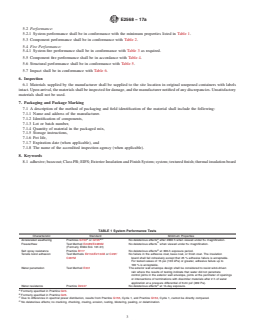
ANSI/NFPA 268 Standard Test Method for Determining 5.2.1 System performance shall be in conformance with the
Ignitability of Exterior Wall Assemblies Using a Radiant minimum properties listed in Table 1.
Heat Energy Source
5.3 Component performance shall be in conformance with
ANSI/NFPA 285 Standard Fire Test Method for the Evalu-
Table 2.
ation of Fire Propagation Characteristics of Exterior,
5.4 Fire Performance:
Nonload-bearing Wall Assemblies Containing Combus-
5.4.1 System fire performance shall be in conformance with
tible Components
Table 3 as required.
3. Terminology
5.5 Component fire performance shall be in accordance with
Table 4.
3.1 Definitions are in accordance with Terminology E2110
unless otherwise specified.
5.6 Structural performance shall be in conformance with
Table 5.
3.2 Definitions of Terms Specific to This Standard:
3.2.1 class PB EIFS, n—EIFS where the base coat varies in
5.7 Impact shall be in conformance with Table 6.
thickness depending upon the number of layers, or thickness of
6. Inspection
reinforcing mesh. The reinforcing mesh is glass fiber mesh that
is encapsulated by the base coat in accordance with EIFS 6.1 Materials supplied by the manufacturer shall be supplied
manufacturer recommendations. Protective finish coats, of to the site location in original unopened containers with labels
various thicknesses in a variety of textures and colors, are intact. Upon arrival, the materials shall be inspected for
applied over the base coat. damage, and the manufacturer notified of any d
...
This document is not an ASTM standard and is intended only to provide the user of an ASTM standard an indication of what changes have been made to the previous version. Because
it may not be technically possible to adequately depict all changes accurately, ASTM recommends that users consult prior editions as appropriate. In all cases only the current version
of the standard as published by ASTM is to be considered the official document.
Designation: E2568 − 17 E2568 − 17a
Standard Specification for
PB Exterior Insulation and Finish Systems
This standard is issued under the fixed designation E2568; the number immediately following the designation indicates the year of
original adoption or, in the case of revision, the year of last revision. A number in parentheses indicates the year of last reapproval. A
superscript epsilon (´) indicates an editorial change since the last revision or reapproval.
1. Scope
1.1 This specification covers PB Exterior Insulation and Finish Systems (EIFS) defined as an exterior, non-bearing wall
covering providing a weather-resistant exterior wall envelope on walls required to be combustible or noncombustible,
fire-resistance-rated or nonfire-resistance-rated. Further, PB EIFS is a system described as being applied over expanded polystyrene
or polyisocyanurate insulation board, an adhesive or mechanical attachment of the insulation board to a substrate, or both, glass
fiber reinforcing mesh, a base coat on the face of the insulation board, and a textured protective finish coat.
1.2 This specification does not cover Class PB EIFS with drainage.
1.3 This specification qualifies EIFS products for use in normal service conditions and is not for evaluating in service EIFS
installations.
1.4 The values stated in inch-pound units are to be regarded as standard. The values given in parentheses are mathematical
conversions to SI units that are provided for information only and are not considered standard.
1.5 This standard does not purport to address all of the safety concerns, if any, associated with its use. It is the responsibility
of the user of this standard to establish appropriate safety and health practices and determine the applicability of regulatory
limitations prior to use.
2. Referenced Documents
2.1 ASTM Standards:
B117 Practice for Operating Salt Spray (Fog) Apparatus
C297/C297M Test Method for Flatwise Tensile Strength of Sandwich Constructions
C578 Specification for Rigid, Cellular Polystyrene Thermal Insulation
C1289 Specification for Faced Rigid Cellular Polyisocyanurate Thermal Insulation Board
D2247 Practice for Testing Water Resistance of Coatings in 100 % Relative Humidity
E84 Test Method for Surface Burning Characteristics of Building Materials
E119 Test Methods for Fire Tests of Building Construction and Materials
E330/E330M Test Method for Structural Performance of Exterior Windows, Doors, Skylights and Curtain Walls by Uniform
Static Air Pressure Difference
E331 Test Method for Water Penetration of Exterior Windows, Skylights, Doors, and Curtain Walls by Uniform Static Air
Pressure Difference
E2098/E2098M Test Method for Determining Tensile Breaking Strength of Glass Fiber Reinforcing Mesh for Use in Class PB
Exterior Insulation and Finish Systems (EIFS), after Exposure to a Sodium Hydroxide Solution
E2110 Terminology for Exterior Insulation and Finish Systems (EIFS)
E2134/E2134M Test Method for Evaluating the Tensile-Adhesion Performance of an Exterior Insulation and Finish System
(EIFS)
E2485/E2485M Test Method for Freeze/Thaw Resistance of Exterior Insulation and Finish Systems (EIFS) and Water Resistive
Barrier Coatings
E2486/E2486M Test Method for Impact Resistance of Class PB and PI Exterior Insulation and Finish Systems (EIFS)
This specification is under the jurisdiction of ASTM Committee E06 on Performance of Buildings and is the direct responsibility of Subcommittee E06.58 on Exterior
Insulation and Finish Systems (EIFS).
Current edition approved Jan. 1, 2017March 1, 2017. Published January 2017March 2017. Originally approved in 2007. Last previous edition approved in 20092017 as
ɛ1
E2568–09-17. . DOI: 10.1520/E2568-17.10.1520/E2568-17A.
For referenced ASTM standards, visit the ASTM website, www.astm.org, or contact ASTM Customer Service at service@astm.org. For Annual Book of ASTM Standards
volume information, refer to the standard’sstandard’s Document Summary page on the ASTM website.
Copyright © ASTM International, 100 Barr Harbor Drive, PO Box C700, West Conshohocken, PA 19428-2959. United States
E2568 − 17a
G23 Practice for Operating Light-Exposure Apparatus (Carbon-Arc Type) With and Without Water for Exposure of Nonmetallic
Materials (Withdrawn 2000)
G26 Practice for Operating Light-Exposure Apparatus (Xenon-Arc Type) With and Without Water for Exposure of Nonmetallic
Materials (Discontinued 2001) (Withdrawn 2000)
G153 Practice for Operating Enclosed Carbon Arc Light Apparatus for Exposure of Nonmetallic Materials
G155 Practice for Operating Xenon Arc Light Apparatus for Exposure of Non-Metallic Materials
2.2 NFPA Standards:
ANSI/NFPA 268 Standard Test Method for Determining Ignitability of Exterior Wall Assemblies Using a Radiant Heat Energy
Source
ANSI/NFPA 285 Standard Fire Test Method for the Evaluation of Fire Propagation Characteristics of Exterior, Nonload-bearing
Wall Assemblies Containing Combustible Components
3. Terminology
3.1 Definitions are in accordance with Terminology E2110 unless otherwise specified.
3.2 Definitions of Terms Specific to This Standard:
3.2.1 class PB EIFS, n—EIFS where the base coat varies in thickness depending upon the number of layers, or thickness of
reinforcing mesh. The reinforcing mesh is glass fiber mesh that is encapsulated by the base coat in accordance with EIFS
manufacturer recommendations. Protective finish coats, of various thicknesses in a variety of textures and colors, are applied over
the base coat.
The last approved version of this historical standard is referenced on www.astm.org.
Available from National Fire Protection Association (NFPA), 1 Batterymarch Park, Quincy, MA 02169-7471, http://www.nfpa.org.
3.2.1.1 Discussion—
Class PB EIFS includes foam plastic conforming to either Specifications C578 or C1289.
3.2.2 EIFS-related construction, n—construction that works in conjunction with the EIFS, but is not part of the EIFS.
4. Materials and Manufacture
4.1 Product Description—The material and specifications shall be as specified by the selected EIFS manufacturer and shall be
defined as in Terminology E2110 except as modified herein.
5. Performance Requirements
5.1 The system and its components shall meet or exceed the performance standards described in 5.2 – 5.7 of this specification.
----------
...