

ASTM D5456-21e1
(Specification)Standard Specification for Evaluation of Structural Composite Lumber Products
General Information
- Abstract
ABSTRACT
This specification recognizes the complexity of structural glued products. This specification, or parts thereof, shall be applicable to structural composite lumber portions of manufactured structural components. Tests shall be performed to determine the properties of the material in accordance to the following test methods: moisture content measurement; bending; tension parallel to grain; compression parallel to grain; compression perpendicular to grain; longitudinal shear; connections; bond quality; product durability; edgewise bending durability; lateral edge nail durability; thickness swell; and density gradient through the thickness.
SCOPE
1.1 This specification recognizes the complexity of structural glued products. Consequently, this specification covers both specific procedures and statements of intent that sampling and analysis must relate to the specific product.
1.2 This specification was developed in the light of currently manufactured products as defined in 3.2. Materials that do not conform to the definitions are beyond the scope of this specification. A brief discussion is found in Appendix X2.
1.3 Details of manufacturing procedures are beyond the scope of this specification.
Note 1: There is some potential for manufacturing variables to affect the properties of members that are loaded for sustained periods of time. Users of this specification are advised to consider the commentary on this topic in Appendix X2.
1.4 This specification primarily considers end use in dry service conditions defined in the governing code-referenced design standards, such as in most covered structures. The conditioning environment of 6.3 is considered representative of such uses.
1.5 The performance of structural composite lumber is affected by wood species, wood element size and shape, and adhesive and production parameters. Therefore, products produced by each individual manufacturer shall be evaluated to determine their product properties, regardless of the similarity in characteristics to products produced by other manufacturers. Where a manufacturer produces product in more than one facility, each production facility shall be evaluated independently. For additional production facilities, any revisions to the full qualification program in accordance with this specification shall be approved by the independent qualifying agency.
1.6 This specification is intended to provide manufacturers, regulatory agencies, and end users with a means to evaluate a composite lumber product intended for use as a structural material.
1.7 This specification covers initial qualification sampling, mechanical and physical tests, analysis, and design value assignments. Requirements for a quality-control program and cumulative evaluations are included to ensure maintenance of allowable design values for the product.
1.8 This specification, or parts thereof, shall be applicable to structural composite lumber portions of manufactured structural components.
1.9 The values stated in inch-pound units are to be regarded as standard. The values given in parentheses are mathematical conversions to SI units that are provided for information only and are not considered standard.
1.10 This standard does not purport to address all of the safety concerns, if any, associated with its use. It is the responsibility of the user of this standard to establish appropriate safety, health, and environmental practices and determine the applicability of regulatory limitations prior to use.
1.11 This international standard was developed in accordance with internationally recognized principles on standardization established in the Decision on Principles for the Development of International Standards, Guides and Recommendations issued by the World Trade Organization Technical Barriers to Trade (TBT) Committee.
- Status
- Published
- Publication Date
- 31-Jan-2021
- Technical Committee
- D07 - Wood
- Drafting Committee
- D07.02 - Lumber and Engineered Wood Products
Overview
ASTM D5456-21e1 is the internationally recognized standard for the evaluation of structural composite lumber (SCL) products. Developed by ASTM Committee D07 on Wood, this specification outlines procedures for testing and assessing the mechanical and physical properties of structural glued products used in building and construction. The standard applies to structural composite lumber portions of manufactured components, ensuring reliability and safety for engineered wood products like laminated veneer lumber (LVL), parallel strand lumber (PSL), laminated strand lumber (LSL), oriented strand lumber (OSL), and laminated veneer bamboo (LVB).
This standard provides clear protocols for qualification sampling, mechanical and physical testing, design value assignments, and ongoing quality assurance, supporting manufacturers, regulatory bodies, and end users in maintaining consistent product standards.
Key Topics
Scope and Applicability
- Applicable to SCL in manufactured structural components used primarily in dry service conditions, such as covered structures.
- Focuses on both specific test procedures and intention statements, which must be tailored to the product being assessed.
- Excludes manufacturing procedure details.
SCL Types Covered
- Laminated Veneer Lumber (LVL)
- Parallel Strand Lumber (PSL)
- Laminated Strand Lumber (LSL)
- Oriented Strand Lumber (OSL)
- Laminated Veneer Bamboo (LVB)
Testing and Evaluation Methods
- Moisture content measurement
- Bending, tension parallel to grain, compression parallel and perpendicular to grain
- Longitudinal shear
- Connection strength
- Bond quality and product durability
- Edgewise bending and nail durability
- Thickness swell, density gradient
Quality Control and Assurance
- Requires quality-control programs and periodic evaluations to confirm that products continue to meet established design values.
- Each manufacturer, and each production facility, must be separately qualified and monitored.
Health, Safety, and International Standardization
- Users are responsible for adopting appropriate safety, health, and environmental practices.
- Developed according to World Trade Organization (WTO) TBT Committee principles.
Applications
Structural composite lumber products evaluated under ASTM D5456-21e1 are widely used in:
Residential and Commercial Buildings
- Floor joists, beams, headers, rafters, and columns
- Prefabricated elements in covered structures where dry service conditions prevail
Engineered Wood Construction
- Use in hybrid construction with other materials (steel, concrete)
- Custom applications in modular or panelized construction
Quality Assurance and Regulatory Compliance
- Specification aids regulatory agencies and product certifiers in ensuring that SCL products meet safety and performance requirements as specified in building codes.
- Equips manufacturers with a framework for ongoing product assessment and reporting.
Research and Product Development
- Used by product developers and engineers as a benchmark for comparative testing of new SCL formulations or adhesive systems.
Related Standards
ASTM D5456-21e1 references and is closely linked to a range of other standards and guides, including:
- ASTM D4761: Test methods for mechanical properties of lumber and wood-based structural materials
- ASTM D2559: Specification for adhesives for bonded structural wood products for exterior use
- ASTM D2915: Practice for sampling and data-analysis for structural wood and wood-based products
- ASTM D4442: Test methods for direct moisture content measurement of wood and wood-based materials
- ASTM D1037: Test methods for evaluating properties of wood-base fiber and particle panel materials
- ASTM D6815: Specification for evaluation of duration of load and creep effects of wood and wood-based products
- CSA O325: Construction sheathing (Canada)
- ISO/IEC 17025: General requirements for the competence of testing and calibration laboratories
Practical Value
The rigorous evaluation and testing protocols in ASTM D5456-21e1 help ensure that structural composite lumber products are consistently safe and high-performing for load-bearing applications in modern construction. Adherence to this specification supports regulatory compliance, risk management, and product reliability across the engineered wood industry. By referencing this standard, manufacturers demonstrate commitment to quality control and continuous improvement in engineered lumber products.
Relations
- Effective Date
- 01-Mar-2024
- Effective Date
- 15-Feb-2024
- Effective Date
- 01-Dec-2023
- Effective Date
- 15-Nov-2023
- Effective Date
- 15-Nov-2023
- Effective Date
- 30-Sep-2023
- Effective Date
- 01-Sep-2023
- Refers
ASTM D1761-20 - Standard Test Methods for Mechanical Fasteners in Wood and Wood-Based Materials - Effective Date
- 15-Apr-2020
- Effective Date
- 01-Mar-2020
- Effective Date
- 01-Jan-2020
- Effective Date
- 01-Oct-2019
- Effective Date
- 01-Jul-2019
- Effective Date
- 01-Jul-2019
- Effective Date
- 15-Apr-2019
- Effective Date
- 15-Apr-2019
Get Certified
Connect with accredited certification bodies for this standard

Gozdarski inštitut Slovenije
Slovenian Forestry Institute. Forest management certification support, timber testing.
Sponsored listings
Frequently Asked Questions
ASTM D5456-21e1 is a technical specification published by ASTM International. Its full title is "Standard Specification for Evaluation of Structural Composite Lumber Products". This standard covers: ABSTRACT This specification recognizes the complexity of structural glued products. This specification, or parts thereof, shall be applicable to structural composite lumber portions of manufactured structural components. Tests shall be performed to determine the properties of the material in accordance to the following test methods: moisture content measurement; bending; tension parallel to grain; compression parallel to grain; compression perpendicular to grain; longitudinal shear; connections; bond quality; product durability; edgewise bending durability; lateral edge nail durability; thickness swell; and density gradient through the thickness. SCOPE 1.1 This specification recognizes the complexity of structural glued products. Consequently, this specification covers both specific procedures and statements of intent that sampling and analysis must relate to the specific product. 1.2 This specification was developed in the light of currently manufactured products as defined in 3.2. Materials that do not conform to the definitions are beyond the scope of this specification. A brief discussion is found in Appendix X2. 1.3 Details of manufacturing procedures are beyond the scope of this specification. Note 1: There is some potential for manufacturing variables to affect the properties of members that are loaded for sustained periods of time. Users of this specification are advised to consider the commentary on this topic in Appendix X2. 1.4 This specification primarily considers end use in dry service conditions defined in the governing code-referenced design standards, such as in most covered structures. The conditioning environment of 6.3 is considered representative of such uses. 1.5 The performance of structural composite lumber is affected by wood species, wood element size and shape, and adhesive and production parameters. Therefore, products produced by each individual manufacturer shall be evaluated to determine their product properties, regardless of the similarity in characteristics to products produced by other manufacturers. Where a manufacturer produces product in more than one facility, each production facility shall be evaluated independently. For additional production facilities, any revisions to the full qualification program in accordance with this specification shall be approved by the independent qualifying agency. 1.6 This specification is intended to provide manufacturers, regulatory agencies, and end users with a means to evaluate a composite lumber product intended for use as a structural material. 1.7 This specification covers initial qualification sampling, mechanical and physical tests, analysis, and design value assignments. Requirements for a quality-control program and cumulative evaluations are included to ensure maintenance of allowable design values for the product. 1.8 This specification, or parts thereof, shall be applicable to structural composite lumber portions of manufactured structural components. 1.9 The values stated in inch-pound units are to be regarded as standard. The values given in parentheses are mathematical conversions to SI units that are provided for information only and are not considered standard. 1.10 This standard does not purport to address all of the safety concerns, if any, associated with its use. It is the responsibility of the user of this standard to establish appropriate safety, health, and environmental practices and determine the applicability of regulatory limitations prior to use. 1.11 This international standard was developed in accordance with internationally recognized principles on standardization established in the Decision on Principles for the Development of International Standards, Guides and Recommendations issued by the World Trade Organization Technical Barriers to Trade (TBT) Committee.
ABSTRACT This specification recognizes the complexity of structural glued products. This specification, or parts thereof, shall be applicable to structural composite lumber portions of manufactured structural components. Tests shall be performed to determine the properties of the material in accordance to the following test methods: moisture content measurement; bending; tension parallel to grain; compression parallel to grain; compression perpendicular to grain; longitudinal shear; connections; bond quality; product durability; edgewise bending durability; lateral edge nail durability; thickness swell; and density gradient through the thickness. SCOPE 1.1 This specification recognizes the complexity of structural glued products. Consequently, this specification covers both specific procedures and statements of intent that sampling and analysis must relate to the specific product. 1.2 This specification was developed in the light of currently manufactured products as defined in 3.2. Materials that do not conform to the definitions are beyond the scope of this specification. A brief discussion is found in Appendix X2. 1.3 Details of manufacturing procedures are beyond the scope of this specification. Note 1: There is some potential for manufacturing variables to affect the properties of members that are loaded for sustained periods of time. Users of this specification are advised to consider the commentary on this topic in Appendix X2. 1.4 This specification primarily considers end use in dry service conditions defined in the governing code-referenced design standards, such as in most covered structures. The conditioning environment of 6.3 is considered representative of such uses. 1.5 The performance of structural composite lumber is affected by wood species, wood element size and shape, and adhesive and production parameters. Therefore, products produced by each individual manufacturer shall be evaluated to determine their product properties, regardless of the similarity in characteristics to products produced by other manufacturers. Where a manufacturer produces product in more than one facility, each production facility shall be evaluated independently. For additional production facilities, any revisions to the full qualification program in accordance with this specification shall be approved by the independent qualifying agency. 1.6 This specification is intended to provide manufacturers, regulatory agencies, and end users with a means to evaluate a composite lumber product intended for use as a structural material. 1.7 This specification covers initial qualification sampling, mechanical and physical tests, analysis, and design value assignments. Requirements for a quality-control program and cumulative evaluations are included to ensure maintenance of allowable design values for the product. 1.8 This specification, or parts thereof, shall be applicable to structural composite lumber portions of manufactured structural components. 1.9 The values stated in inch-pound units are to be regarded as standard. The values given in parentheses are mathematical conversions to SI units that are provided for information only and are not considered standard. 1.10 This standard does not purport to address all of the safety concerns, if any, associated with its use. It is the responsibility of the user of this standard to establish appropriate safety, health, and environmental practices and determine the applicability of regulatory limitations prior to use. 1.11 This international standard was developed in accordance with internationally recognized principles on standardization established in the Decision on Principles for the Development of International Standards, Guides and Recommendations issued by the World Trade Organization Technical Barriers to Trade (TBT) Committee.
ASTM D5456-21e1 is classified under the following ICS (International Classification for Standards) categories: 79.060.01 - Wood-based panels in general. The ICS classification helps identify the subject area and facilitates finding related standards.
ASTM D5456-21e1 has the following relationships with other standards: It is inter standard links to ASTM E96/E96M-24, ASTM D2718-24, ASTM E84-23d, ASTM D143-23, ASTM E96/E96M-23, ASTM D669-03, ASTM E84-23c, ASTM D1761-20, ASTM D4442-20, ASTM D3755-20, ASTM E119-19, ASTM D5457-19c, ASTM E84-19b, ASTM E84-19a, ASTM D5457-19b. Understanding these relationships helps ensure you are using the most current and applicable version of the standard.
ASTM D5456-21e1 is available in PDF format for immediate download after purchase. The document can be added to your cart and obtained through the secure checkout process. Digital delivery ensures instant access to the complete standard document.
Standards Content (Sample)
This international standard was developed in accordance with internationally recognized principles on standardization established in the Decision on Principles for the
Development of International Standards, Guides and Recommendations issued by the World Trade Organization Technical Barriers to Trade (TBT) Committee.
´1
Designation:D5456 −21
Standard Specification for
Evaluation of Structural Composite Lumber Products
This standard is issued under the fixed designation D5456; the number immediately following the designation indicates the year of
original adoption or, in the case of revision, the year of last revision.Anumber in parentheses indicates the year of last reapproval.A
superscript epsilon (´) indicates an editorial change since the last revision or reapproval.
ε NOTE—Eq X5.1 was corrected editorially in June 2021.
INTRODUCTION
Structural composite lumber is intended for use as an engineering material for a variety of end-use
applications. The composition of the lumber varies by wood species, adhesive composition, wood
element size, shape, and arrangement. To provide the intended performance, composite lumber
products require: (1) an evaluation of the mechanical and physical properties and their response to
end-use environments, and (2) establishment of and conformance to standard performance specifica-
tions for quality.
Procedures contained in this specification are also to be used for establishing the design properties
and for checking the effectiveness of property assignment and quality assurance procedures.
The quality assurance sections in this specification are intended to serve as a basis for designing
quality-control programs specific to each product. The objective is to ensure that design values
established in the qualification process are maintained.
This specification is arranged as follows:
Section
Qualification 6
Determination of Allowable Design 7
Stresses
Independent Inspection 8
Quality Assurance 10
1. Scope 1.4 This specification primarily considers end use in dry
service conditions defined in the governing code-referenced
1.1 This specification recognizes the complexity of struc-
design standards, such as in most covered structures. The
tural glued products. Consequently, this specification covers
conditioningenvironmentof6.3isconsideredrepresentativeof
bothspecificproceduresandstatementsofintentthatsampling
such uses.
and analysis must relate to the specific product.
1.2 This specification was developed in the light of cur-
1.5 The performance of structural composite lumber is
rently manufactured products as defined in 3.2. Materials that
affected by wood species, wood element size and shape, and
do not conform to the definitions are beyond the scope of this
adhesive and production parameters. Therefore, products pro-
specification. A brief discussion is found in Appendix X2.
duced by each individual manufacturer shall be evaluated to
1.3 Details of manufacturing procedures are beyond the determine their product properties, regardless of the similarity
scope of this specification. incharacteristicstoproductsproducedbyothermanufacturers.
Where a manufacturer produces product in more than one
NOTE 1—There is some potential for manufacturing variables to affect
facility, each production facility shall be evaluated indepen-
the properties of members that are loaded for sustained periods of time.
Users of this specification are advised to consider the commentary on this
dently.Foradditionalproductionfacilities,anyrevisionstothe
topic in Appendix X2.
full qualification program in accordance with this specification
shall be approved by the independent qualifying agency.
This specification is under the jurisdiction ofASTM Committee D07 on Wood
andisthedirectresponsibilityofSubcommitteeD07.02onLumberandEngineered 1.6 This specification is intended to provide manufacturers,
Wood Products.
regulatory agencies, and end users with a means to evaluate a
Current edition approved Feb. 1, 2021. Published March 2021. Originally
ɛ1 composite lumber product intended for use as a structural
approved in 1993. Last previous edition approved in 2019 as D5456–19 . DOI:
10.1520/D5456-21E01. material.
Copyright © ASTM International, 100 Barr Harbor Drive, PO Box C700, West Conshohocken, PA 19428-2959. United States
´1
D5456−21
1.7 This specification covers initial qualification sampling, D1761Test Methods for Mechanical Fasteners inWood and
mechanical and physical tests, analysis, and design value Wood-Based Materials
assignments. Requirements for a quality-control program and D2132Test Method for Dust-and-FogTracking and Erosion
cumulative evaluations are included to ensure maintenance of Resistance of Electrical Insulating Materials
allowable design values for the product. D2394TestMethodsforSimulatedServiceTestingofWood
and Wood-Based Finish Flooring
1.8 Thisspecification,orpartsthereof,shallbeapplicableto
D2395TestMethodsforDensityandSpecificGravity(Rela-
structural composite lumber portions of manufactured struc-
tive Density) of Wood and Wood-Based Materials
tural components.
D2559Specification for Adhesives for Bonded Structural
1.9 Thevaluesstatedininch-poundunitsaretoberegarded
Wood Products for Use Under Exterior Exposure Condi-
as standard. The values given in parentheses are mathematical
tions
conversions to SI units that are provided for information only
D2718Test Methods for Structural Panels in Planar Shear
and are not considered standard.
(Rolling Shear)
1.10 This standard does not purport to address all of the
D2915Practice for Sampling and Data-Analysis for Struc-
safety concerns, if any, associated with its use. It is the
tural Wood and Wood-Based Products
responsibility of the user of this standard to establish appro- D3201Test Method for Hygroscopic Properties of Fire-
priate safety, health, and environmental practices and deter-
Retardant Wood and Wood-Based Products
mine the applicability of regulatory limitations prior to use. D3755Test Method for Dielectric Breakdown Voltage and
1.11 This international standard was developed in accor-
DielectricStrengthofSolidElectricalInsulatingMaterials
dance with internationally recognized principles on standard- Under Direct-Voltage Stress
ization established in the Decision on Principles for the
D4300Test Methods for Ability of Adhesive Films to
Development of International Standards, Guides and Recom- Support or Resist the Growth of Fungi
mendations issued by the World Trade Organization Technical
D4442Test Methods for Direct Moisture Content Measure-
Barriers to Trade (TBT) Committee. ment of Wood and Wood-Based Materials
D4761Test Methods for Mechanical Properties of Lumber
2. Referenced Documents
and Wood-Based Structural Materials
D4933Guide for Moisture Conditioning of Wood and
2.1 ASTM Standards:
Wood-Based Materials
C177Test Method for Steady-State Heat Flux Measure-
D5055Specification for Establishing and Monitoring Struc-
ments and Thermal Transmission Properties by Means of
tural Capacities of Prefabricated Wood I-Joists
the Guarded-Hot-Plate Apparatus
D5457SpecificationforComputingReferenceResistanceof
C384Test Method for Impedance andAbsorption ofAcous-
Wood-Based Materials and Structural Connections for
tical Materials by Impedance Tube Method
Load and Resistance Factor Design
C423TestMethodforSoundAbsorptionandSoundAbsorp-
D5764Test Method for Evaluating Dowel-Bearing Strength
tion Coefficients by the Reverberation Room Method
of Wood and Wood-Based Products
D9Terminology Relating to Wood and Wood-Based Prod-
D6815SpecificationforEvaluationofDurationofLoadand
ucts
Creep Effects of Wood and Wood-Based Products
D143Test Methods for Small Clear Specimens of Timber
D7247Test Method for Evaluating the Shear Strength of
D150Test Methods forAC Loss Characteristics and Permit-
AdhesiveBondsinLaminatedWoodProductsatElevated
tivity (Dielectric Constant) of Solid Electrical Insulation
Temperatures
D198Test Methods of Static Tests of Lumber in Structural
D7480Guide for Evaluating the Attributes of a Forest
Sizes
Management Plan
D245Practice for Establishing Structural Grades and Re-
E84Test Method for Surface Burning Characteristics of
lated Allowable Properties for Visually Graded Lumber
Building Materials
D669Test Method for Dissipation Factor and Permittivity
E96/E96MTest Methods for Water Vapor Transmission of
Parallel with Laminations of Laminated Sheet and Plate
Materials
Materials (Withdrawn 2012)
E119Test Methods for Fire Tests of Building Construction
D1037Test Methods for Evaluating Properties of Wood-
and Materials
Base Fiber and Particle Panel Materials
2.2 CSA Standards:
D1583Test Method for Hydrogen Ion Concentration of Dry
CSAStandardsforWoodAdhesivesO112-M Series
Adhesive Films
CSA O325Construction Sheathing
D1666Test Methods for Conducting Machining Tests of
2.3 ISO/IEC Standards:
Wood and Wood-Base Panel Materials
ISO/IEC 17020General Criteria for the Operation of Vari-
ous Types of Bodies Performing Inspection
For referenced ASTM standards, visit the ASTM website, www.astm.org, or
contact ASTM Customer Service at service@astm.org. For Annual Book of ASTM
Standards volume information, refer to the standard’s Document Summary page on Available from Canadian Standards Association (CSA), 5060 Spectrum Way,
the ASTM website. Mississauga, ON L4W 5N6, Canada, http://www.csa.ca.
3 5
The last approved version of this historical standard is referenced on Available from International Organization for Standardization (ISO), 1, ch. de
www.astm.org. la Voie-Creuse, CP 56, CH-1211 Geneva 20, Switzerland, http://www.iso.org.
´1
D5456−21
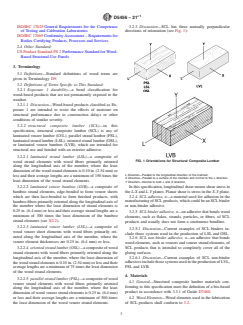
ISO/IEC 17025General Requirements for the Competence 3.2.3 Discussion—SCL has three mutually perpendicular
of Testing and Calibration Laboratories directions of orientation (see Fig. 1):
ISO/IEC 17065ConformityAssessment – Requirements for
Bodies Certifying Products, Processes and Services
2.4 Other Standard:
US Product Standard PS 2Performance Standard forWood-
Based Structural-Use Panels
3. Terminology
3.1 Definitions—Standard definitions of wood terms are
given in Terminology D9.
3.2 Definitions of Terms Specific to This Standard:
3.2.1 Exposure 1 durability—a bond classification for
wood-based products that are not permanently exposed to the
weather.
3.2.1.1 Discussion—Wood-based products classified as Ex-
posure 1 are intended to resist the effects of moisture on
structural performance due to construction delays or other
conditions of similar severity.
3.2.2 structural composite lumber (SCL)—in this
specification, structural composite lumber (SCL) is any of
laminated veneer lumber (LVL), parallel strand lumber (PSL),
laminated strand lumber (LSL), oriented strand lumber (OSL),
or laminated veneer bamboo (LVB), which are intended for
structural use and bonded with an exterior adhesive.
3.2.2.1 laminated strand lumber (LSL)—a composite of
FIG. 1Orientations for Structural Composite Lumber
wood strand elements with wood fibers primarily oriented
along the longitudinal axis of the member, where the least
dimensionofthewoodstrandelementsis0.10in.(2.54mm)or
L Direction—Parallel to the longitudinal direction of the member.
less and their average lengths are a minimum of 150 times the
X Direction—Parallel to a surface of the member and normal to the L direction.
least dimension of the wood strand elements.
Y Direction—Normal to both L and X direction.
3.2.2.2 laminated veneer bamboo (LVB)—a composite of Inthisspecification,longitudinalshearmeansshearstressin
the L-X and L-Y planes. Planar shear is stress in the X-Y plane.
bamboo strand elements, edge-bonded to form veneer sheets
which are then face-bonded to form finished products, with 3.2.4 SCL adhesive, n—a material used for adhesion in the
manufacturingofSCLproducts,whichcouldbeanSCLbinder
bamboofibersprimarilyorientedalongthelongitudinalaxisof
or non-binder adhesive.
the member where the least dimension of strand elements is
0.25 in. (6.4 mm) or less and their average strand lengths are a
3.2.5 SCL binder adhesive, n—anadhesivethatbondswood
minimum of 300 times the least dimension of the bamboo
elements, such as flakes, strands, particles, or fibers, of SCL
strand elements (see X2.2).
products and usually does not form a continuous bondline.
3.2.2.3 laminated veneer lumber (LVL)—a composite of
3.2.5.1 Discussion—Current examples of SCL binders in-
wood veneer sheet elements with wood fibers primarily ori-
clude those systems used in the production of LSL and OSL.
ented along the longitudinal axis of the member, where the
3.2.6 SCL non-binder adhesive, n—an adhesive that bonds
veneer element thicknesses are 0.25 in. (6.4 mm) or less.
woodelements,suchasveneersandveneerstrandelements,of
SCL products that is intended to completely cover all of the
3.2.2.4 orientedstrandlumber(OSL)—acompositeofwood
gluing surfaces.
strand elements with wood fibers primarily oriented along the
3.2.6.1 Discussion—Current examples of SCL non-binder
longitudinal axis of the member, where the least dimension of
adhesivesincludethosesystemsusedintheproductionofLVL,
thewoodstrandelementsis0.10in.(2.54mm)orlessandtheir
PSL and LVB.
averagelengthsareaminimumof75timestheleastdimension
of the wood strand elements.
4. Materials
3.2.2.5 parallel strand lumber (PSL)—a composite of wood
4.1 General—Structural composite lumber materials con-
veneer strand elements with wood fibers primarily oriented
forming to this specification meet the definition of a bio-based
along the longitudinal axis of the member, where the least
product in accordance with 3.3.1 of Guide D7480.
dimensionofwoodveneerstrandelementsis0.25in.(6.4mm)
or less and their average lengths are a minimum of 300 times 4.2 Wood Elements—Wood elements used in the fabrication
the least dimension of the wood veneer strand elements. of SCL products shall conform to 3.2.
´1
D5456−21
4.3 Adhesives elevatedtemperature(Section7.2ofTestMethodD7247)shall
4.3.1 Non-Binder Adhesives—Non-binderadhesivesusedin meet the requirements of Items (1), (2), (3), (4), (5), and (6)
below.
the fabrication of SCL products shall conform to the require-
ments in Specification D2559. In Canada, non-binder adhe- (1) The solid wood control specimens shall be: Douglas
Fir,SouthernPine,orthepredominatespeciesusedintheLSL
sives shall conform to the appropriate section of CSAStan-
dardsforWoodAdhesives, O112-M Series, except that the or OSLproduct. Each piece of solid wood used as part of this
test method shall have a specific gravity equal to or exceeding
LVB adhesives shall be based on the criteria for hardwood
species. the value specified in the National Design Specification.
(2)The highest grade of the LSLor OSLproducts shall be
4.3.2 Binder Adhesive—Binder adhesives, when used, shall
be evaluated to meet the requirements specifed in Annex A5 tested.
(3)The LSL and OSL specimen shear tests shall be
(see Note 2).
conducted in the L-X plane and shall be loaded parallel to the
NOTE 2—AnnexA5 requirements meet or exceed the requirements for
wood grain or strands.
Exposure 1; other conditions are beyond the scope of this specification.
(4)For the LSL and OSL specimens, the minimum target
See the commentary and the section on Design and Mechanical Property
Concerns in Appendix X2 for further information. bondline or shear plane temperature shall be 428 °F (220 °C).
For the solid wood control specimens, the minimum target
4.3.3 Non-Binder and Binder Adhesives—All adhesives
temperature at the shear plane shall be 428 °F (220 °C).
usedforSCLshallbequalifiedforheatdurabilityperformance
(5)The minimum target temperatures of Item (4) shall be
in accordance with 4.3.4. X2.2.4 provides additional informa-
maintained for a minimum of 10 min or until achieving a
tion.
residual strength ratio for the solid wood control specimens of
NOTE 3—Heat durable performance implies that the bond between
30 6 10%, whichever is longer.
wood elements will permit the SCL to exhibit similar performance
(6)Block shear testing shall be conducted immediately
characteristics as solid wood in an elevated temperature environment.
afterremovalfromtheovensuchthatthespecimenbondlineor
4.3.4 Adhesive Heat Durability:
shear plane temperature does not drop more than 9 °F (5 °C)
4.3.4.1 Adhesives used for LVL and PSL shall be qualified
after leaving the oven and prior to failure. This provision is
for heat durability performance through testing in accordance
satisfied when the time interval from the removal of the
with Test Method D7247. The test temperature and heat
specimen from the oven to the failure of the block shear
exposuredurationforspecimenstestedatelevatedtemperature
specimen does not exceed 60 s for each specimen tested and
(Section 7.2 of Test Method D7247) shall meet the require-
the room temperature of the test laboratory at the time of
ments of Items (1), (2), (3), and (4) below.
testing is not less than 60 °F (15.5 °C).
(1)The solid wood control specimens and bonded speci-
4.3.4.3 For adhesives tested in accordance with 4.3.4.1 and
mens shall be prepared from the same wood species of either
4.3.4.2, the residual shear strength ratio for the bonded
DouglasFir,SouthernPine,orthepredominatespeciesusedin
specimens, as calculated in accordance with Test Method
the LVL or PSL product, provided the same adhesive formu-
D7247, shall be equal to or higher than the lower 95%
lation is used for these wood species.
confidence interval on the mean residual shear strength ratio
(2)For the bonded specimens, the minimum target bond-
for the solid wood control specimens.
line temperature shall be 428 °F (220 °C). For the matched
NOTE4—Theabilityoftheacceptancecriteriatodetectaheat-sensitive
solidwoodcontrolspecimens,theminimumtargettemperature
binder system may depend on the strand thickness or strand alignment, or
at the shear plane shall be 428 °F (220 °C).
both. Additional consideration may be warranted for products with large
(3)The minimum target temperatures of Item (1) shall be
strand thickness or strands that are substantially not aligned with the test
specimen shear plane, or both.
maintained for a minimum of 10 min or until achieving a
residual strength ratio for the solid wood control specimens of
5. Mechanical Properties
30 6 10 %, whichever is longer.
(4)Block shear testing shall be conducted immediately
5.1 The characteristic value for SCL is a statistic derived
afterremovalfromtheovensuchthatthespecimenbondlineor
from test data as specified in 7.1. For bending and tension
shear plane temperature does not drop more than 9 °F (5 °C)
parallel to grain, the characteristic value is obtained at the unit
after leaving the oven and prior to failure. This provision is
volume as specified in 6.5.1 and 6.5.2.
satisfied when the time interval from the removal of the
5.2 The design stress related to SCL is derived from the
specimen from the oven to the failure of the block shear
characteristic value through application of the adjustments
specimen does not exceed 60 s for each specimen tested and
listed in Table 1 of this specification.
the room temperature of the test laboratory at the time of
5.3 The allowable design stress published for engineering
testing is not less than 60 °F (15.5 °C).
use shall be derived from the design stress modified by factors
4.3.4.2 The adhesive used for LSL and OSL shall be
given in 7.3.
qualified for heat durability performance through testing in
accordancewithTestMethodD7247exceptthathomogeneous
6. Qualification
pieces of LSL or OSL product shall be used in lieu of solid
sawn face bonded specimens. The solid wood control species, 6.1 Samples for qualification testing shall be representative
LSL or OSL grade, test orientation of LSL and OSL, test of the population being evaluated. When an intentional modi-
temperatureandheatexposuredurationforspecimenstestedat fication to the process results in a reduction in mechanical
´1
D5456−21
TABLE 1 Adjustment Factors
paralleltothegrain,compressivestrengthparalleltothegrain,
compressive strength perpendicular to the grain, and longitu-
NOTE 1—Neither apparent modulus of elasticity nor compression
dinal shear strength.
strengthperpendiculartograinissubjecttoloaddurationadjustments.All
other factors are the product of 1.62, that adjusts data to normal duration
6.5.1 Bending—Modulus of rupture and apparent modulus
as defined in 7.3.1 of Practice D245, and an additional factor for
ofelasticityshallbedeterminedforbothflatwiseandedgewise
uncertainty (see Appendix X4 for an explanation of the shear block test
bending in accordance with principles of Test Methods D198
adjustment factor).
or D4761. Specimen cross section shall not be less than the
Property Adjustment Factor
minimum anticipated structural size. Selection of specimen
Apparent modulus of elasticity 1.00
dimensions establishes the unit volume for the analysis of
Bending strength 2.10
Tensile strength parallel to grain 2.10
7.4.1. Loading at third points and a span-to-depth ratio in the
Compressive strength parallel to grain 1.90
range from 17 to 21 shall be used for flatwise and edgewise
Longitudinal shear strength
bending.
Shear block test 3.15
Structural-size shear test 2.10
NOTE 5—A span-to-depth ratio of 18 is a frequent international
Compressive strength perpendicular to grain
standard.
Load applied normal to L-Y plane 1.67
Load applied normal to L-X plane 1.00
6.5.1.1 Wheneitherorboththesizeandmoisturecontentof
the qualification specimens will differ from specimens to be
testedinqualitycontrol,thebendingtestsof6.5.1shallalsobe
conducted on specimens of the size and the moisture content
properties as indicated by the quality-control program, then
that will prevail at the time of routine quality-control testing.
new qualification is required.
Thespecimensrepresentingthequality-controlconditionsshall
6.1.1 Qualification tests shall be conducted or witnessed by
bematchedwiththosetobeconditioned(see6.3).Theratioof
aqualifiedagencyinaccordancewith8.1.Alltestresultsareto
the means of both strength and stiffness shall be used to adjust
be certified by the qualified agency.
quality-control test results to the qualification level, for use in
the confirmation required in 10.6.1.
6.2 Sampling of the test material shall be done in accor-
6.5.1.2 Moisturecontentisrecognizedasdifferentwhenthe
dance with applicable portions of the section on Statistical
discrepancy between the average of the two test sets is one
Methodology of Practice D2915.
percentage point of moisture content or more. Sample size
6.2.1 Designstress,exceptforcompressionperpendicularto
shall be the same for both test sets and not less than 78.
grain and apparent modulus of elasticity, shall be based on the
th
6.5.1.3 If testing is required in accordance with 6.5.1.1, the
5 percentile tolerance limit.
coefficientofvariationofthebendingstrengthfromthosetests
6.2.2 The confidence level for calculating tolerance limits
shallbethebasisforcomparisonrequiredin10.6.3.Otherwise,
and confidence intervals shall be 75%.
the coefficient of variation of the bending strength from the
6.2.3 Minimum sample size for calculating tolerance limits
th
tests in 6.5.1 shall be the basis.
on 5 percentiles shall be 53. When volume effect tests are
made at multiple sizes for bending and tension, the minimum 6.5.2 Tension Parallel to Grain—Tension strength parallel
to grain shall be tested in accordance with principles of Test
sampleshallbe78specimensattheunitvolumespecimensize.
th
6.2.3.1 The calculated 5 percentile parametric tolerance Methods D198 or D4761. Specimen cross section shall not be
less than the minimum anticipated structural size. Specimen
limits (PTL) shall have a standard error no greater than 5% of
thePTL,whenevaluatedinaccordancewith4.4.3.2ofPractice length shall provide for a minimum length of 36 in. (915 mm)
between grips. Selection of specimen dimensions establishes
D2915.When necessary, the sample shall be increased beyond
the minimum of 53, to meet this requirement. the unit volume for the analysis of 7.4.1.
6.5.2.1 Wheneitherorboththesizeandmoisturecontentof
6.2.4 Minimum unit sample sizes for compression perpen-
dicular to grain (see 6.5.4) shall provide estimation of mean the qualification specimens will differ from specimens to be
values within 5% in accordance with 4.4.2 of Practice D2915. tested in quality control, the tension tests of 6.5.2 shall also be
Minimum sample size shall not be less than 30. conducted on specimens of the size and the moisture content
that will prevail at the time of routine quality-control testing.
6.3 Composite lumber used in qualification testing shall be
Thespecimensrepresentingthequality-controlconditionsshall
brought to moisture equilibrium in a conditioned environment
bematchedwiththosetobeconditioned(see6.3).Theratioof
of68 611°F(20 66°C)and65%(65%)relativehumidity.
themeansofstrengthshallbeusedtoadjustquality-controltest
Methods for determination of completion of conditioning are
results to the qualification level, for use in the confirmation
given in Guide D4933.
required in 10.6.1. Moisture content is recognized as different
6.4 Moisture content and specific gravity shall be measured
when the discrepancy between the average of the two test sets
and reported for each specimen tested in the qualification
is one percentage point of moisture content or more. Sample
program. Measurement for moisture content shall be in accor-
size shall be the same for both test sets and not less than 78.
dance with Test Methods D4442 and measurement of specific
6.5.2.2 If testing is required in accordance with 6.5.2.1, the
gravity shall be in accordance with Test Methods D2395.
coefficient of variation of the tensile strength from those tests
6.5 Mechanical Properties—The properties that shall be shallbethebasisforcomparisonrequiredin10.6.3.Otherwise,
evaluated by qualification testing shall include, but are not thecoefficientofvariationofthetensilestrengthfromthetests
limited to: bending strength and stiffness, tensile strength in 6.5.2 shall be the basis.
´1
D5456−21
6.5.3 Compression Parallel to Grain—Short-column com- AnnexA2. Determination of allowable design values for other
pression strength parallel to grain shall be determined in connectors is beyond the scope of this specification.
accordance with principles of Test Methods D198 or D4761.
6.7 Shear Modulus—Shear modulus (G) for LVB shall be
Minimum cross section shall be 1.5 by 1.5 in. (38 by 38 mm).
determined and reported in accordance with Test Methods
Length of the specimen shall be such that L/r is less than 17
D198. The shear deformation shall be considered in the total
andgreaterthan15,whereListheeffectiveunsupportedlength
deflection calculation.
and r is the least radius of gyration.
6.8 Bond Quality:
6.5.4 Compression Perpendicular to Grain—Compressive
6.8.1 Internal Bond—For bond quality evaluation of PSL,
strength perpendicular to grain shall be determined in accor-
LSL, and OSL, internal bond shall be tested and reported in
dance with principles of Test Methods D143 except that
accordancewithTestMethodsD1037(seeNote8),exceptthat
references to placement of growth rings are not applicable and
the tests shall be done at a constant rate of displacement such
the dimension in the Y direction (see Fig. 1) is permitted to be
that the average time-to-failure is not less than 1 min. The
a minimum of 1.5 in. (38 mm). The dimension in the X
minimum sample size shall not be less than 50 test specimens
direction shall be 2.0 in. (51 mm). Testing shall be conducted
taken from multiple cross-sections and locations.
withloadappliednormaltothe L-Yplaneinonetestseriesand
6.8.2 For LVL, the glue bond quality shall be evaluated in
to the L-X plane in another series. Stress at both 0.02 and
accordance with 6.5.5 in the L-X plane except that the
0.04-in. (0.5 and 1.0-mm) deformation shall be reported. For
percentage of wood failure shall be evaluated and reported.
load applied normal to the L-X plane, the proportional limit
stress determined in accordance with 6.5.4.1 shall also be
NOTE 7—A4.2 provides an adhesive durability test method that a
reported.
manufacturer may use as a means to evaluate bond durability for quality
assurance or product optimization. However, A4.2 is not intended for
6.5.4.1 Proportional Limit Stress—The proportional limit
adhesive qualification testing as required in Annex A5.
stress shall be calculated from the proportional limit load
defined as the load at which the load-deformation curve
6.8.3 For LVB, the glue bond quality shall be evaluated in
deviates from a linear regression fitted to the approximately
accordancewith6.5.5inthe L-Xand L-Yplanesexceptthatthe
linear portion of the load-deformation curve.
percentage of fiber failure shall be evaluated and reported.
σ 5 P ⁄~l b! (1)
PL PL p 6.9 Product Durability:
6.9.1 Edgewise Bending Durability—For all SCL products,
where:
edgewise bending durability shall be conducted in accordance
σ = proportional limit stress,
PL
with A4.3. The average strength retention shall be at least
P = proportional limit load,
PL
75%.
l = measured length of bearing plate parallel to specimen
p
6.9.2 Lateral Edge Nail Durability—For PSL, LSL, OSL,
length (L-direction), and
and LVB, lateral edge (X-L) nail durability shall be evaluated
b = measured width of specimen (X-direction).
in accordance with A4.4. The average strength retention shall
NOTE 6—The proportional limit stress can also be determined from a
stress-strain curve derived from the load-deformation curve.
be at least 75%.
6.5.5 Longitudinal Shear—Longitudinal shear strength in
6.10 Physical Properties:
the L-Y plane shall be determined by conductingASTM block
6.10.1 Thickness Swell—For PSL, LSL, OSL, and LVB,
shear tests or structural-size horizontal shear tests. Longitudi-
thicknessswellshallbetestedandreportedinaccordancewith
nal shear strength in the L-X plane shall be determined by
Test Methods D1037 (see Note 8). The minimum sample size
conducting ASTM block shear tests. When evaluating the
shall not be less than 25 test specimens taken from multiple
effect of systematic manufacturing characteristics that might
cross-sections and locations.
affect horizontal shear strength, the structural size horizontal
NOTE 8—Test Methods D1037 specifies that the test thickness shall be
shear test method shall be used (see Annex A3).
that of the finished board. Some SCL products are manufactured in
6.5.5.1 ASTM block shear tests shall be conducted in
thicknessesgreaterthanthoseintendedforevaluationbytheproceduresin
accordancewithprinciplesofTestMethodsD143exceptthata
Test Methods D1037. It may be necessary to limit the test thickness for
PSLproductsthataremanufacturedinthicknessesgreaterthan3.5in.(89
minimum dimension of 1.5 in. (38 mm) at the shear area is
mm).
acceptable provided that the total shear area is 4 in. (2580
mm ).
6.10.2 Density Gradient Through the Thickness—For LSL
6.5.5.2 Structural-sizehorizontalsheartestsinthe L-Yplane andOSL,densitygradientthroughthethicknessshallbetested
shallbeconductedinaccordancewiththeproceduresspecified and reported in accordance with A4.5.
in Annex A3 of this specification. 6.10.3 Other Physical Properties—Other physical proper-
6.5.5.3 If anticipated end use involves shear perpendicular ties shall be assessed when they affect end use. Information on
other physical properties and related standards is given in
to grain on a face of the material (planar shear), testing shall
establish allowable shear stress in accordance with the prin- Appendix X2.
ciples of Test Method D2718.
7. Determination of Allowable Design Stresses
6.6 Connections—Determinationofallowabledesignvalues
for withdrawal capacities of nails, and dowel-bearing capaci- 7.1 Allowable design values developed in this section are
ties of bolts, lag screws, wood screws, and nails is specified in consistent with engineering practice in building construction.
´1
D5456−21
Their applicability in other types of structures has not been where:
evaluated and such applications require independent evalua-
F = allowable design stress,
a
tion.
C = product of end use (K) factors, and
e
S = design stress.
7.2 Characteristic Value—In the derivation of the charac-
Factors common to all members are detailed in this section.
teristic value, the procedures in the sections on Statistical
7.4.1 Volume Factors:
Methodology and Analysis and Presentation of Results of
7.4.1.1 Strength properties are affected by the relative vol-
PracticeD2915shallbefollowed,exceptthatprovisionsofthis
umeatagivenstress.Forpurposesofthissection,themembers
specification govern where differences occur.
th
tested in edge bending or axial tension in Section 6 shall be
7.2.1 The 5 percentile tolerance limit (TL) with 75%
taken as a unit volume. Sections other than solid rectangles, or
confidence from test results of 6.5 shall be the characteristic
solid rectangular sections not loaded axially or normal to one
value for strengths in flexure, tension parallel to grain, com-
of its surfaces, require special investigation.
pression parallel to grain, and longitudinal shear.
7.4.1.2 Volume factors shall either be determined from the
7.2.1.1 Parametric or nonparametric analysis shall be per-
prescribed theoretical relationships or by testing on a range of
th
formed to obtain a 5 percentile tolerance limit.
sizes, as detailed in Annex A1.
7.2.1.2 For parametric analysis either the normal or lognor-
7.4.1.3 Bending—Bending design stress shall be adjusted
th
mal distribution shall be used to establish a 5 percentile
for volume effect by multiplication with the factor as follows:
tolerance limit with 75% confidence. The distribution selec-
2/m 1/n
d d
1 1
tion shall be based on standard statistical goodness of fit tests.
K 5 5 (4)
S D S D
d
d d
As a minimum, the fit selection shall include visual inspection
of cumulative frequency plots of the fitted distributions with
where:
the data and the lesser of standard errors of the estimate from
K = factor applied to design stress of the member of unit
d
the two distributions fitted by the method of least squares.
volume,
d = depth of unit volume members,
NOTE 9—Experience has shown that data from SCL typically has
d = depth of an application member,
coefficients of variation (COV) less than 20% and are symmetrical to
m = a parameter determined in accordance with AnnexA1,
slightly right skewed and, therefore, are reasonably described by the
normal and lognormal distributions. Goodness of fit references are given
and
in Note 6 of Practice D2915. The minimum procedures of 7.2.1.2 are
n = m/2
detailed in X5.7 of Specification D5055. 6
NOTE10—AderivationofEq4isgiveninRef (1) alongwithexample
data. In this case, volume considered is only two-dimensional since, at
7.2.2 The average value for apparent modulus of elasticity
least within the limits given in Annex A1, increasing width of SCL
from test results of 6.5.1 shall be the characteristic value for
bending members does not result in strength reduction. In some cases,
apparent modulus of elasticity.
tests show a strength increase with increasing width, possibly because of
greater stability along the compression edge. Therefore the two-
7.2.3 Compression Perpendicular to Grain:
1/m 1/m
dimensional form of the equation is of the form K =(d /d) (L /L)
d 1 1
7.2.3.1 Compression Perpendicular to L-Y Plane—The av-
where L and Larethelengthoftheunitvolumeandapplicationmember,
erage stress at 0.04-in. (1.0-mm) deformation for compression
respectively. When a constant span/depth ratio is assumed, Eq 4 becomes
2/m 1/n
perpendicular to grain from test results of 6.5.4 shall be the K =(d /d) , which can be further simplified to K =(d /d) , where
d 1 d 1
n= m/2.
characteristic value for compression perpendicular to the L-Y
plane.
7.4.1.4 Axial Tension—Tensile design stress shall be ad-
justed for volume by multiplication with factor as follows:
7.2.3.2 Compression Perpendicular to L-X Plane—The
1/m
loweroftheaveragestressat0.04-in.(1.0-mm)deformationor
L
K 5 (5)
S D
the average stress at the proportional limit from the test results L
L
of 6.5.4 shall be the characteristic value for compression
where:
perpendicular to the L-X plane.
K = adjustment factor,
L
7.3 Design Stresses—Design stresses shall be calculated
L = base length between grips tested in 6.5.2,
from the characteristic value defined in 7.2 in accordance with
L = end-use length, and
the following formula:
m = parameter determined in accordance with Annex A1.
NOTE 11—Tension tests of SCL do not show strength reductions for
B
S 5 (2)
increasing cross section so that volume is represented by length alone.
C
a
Annex A1 states criteria for accepting this approach without limitations.
Ref (1) gives example data.
where:
7.4.1.5 When volume effect factors are based on single-size
S = design stress,
testinginaccordancewithA1.2.3,increaseddesignstressesfor
B = characteristic value, and
C = adjustment factor from Table 1. members smaller than that tested are not permitted.
a
7.4.1.6 Other related conditions that influence the bending
7.4 Allowable Design Stress—Design stresses shall be
strength of a member include the loading diagram and support
modified by factors that consider the end-use applications as
follows:
The boldface numbers in parentheses refer to a list of references at the end of
F 5 C S (3) this standard.
a e
´1
D5456−21
condition. Adjustments for common load cases are given in 8.2.3 Has procedures to be followed by its personnel in
Annex A1 and other information is found in Ref (2). performance of the inspection and testing;
8.2.4 Has no financial interest in, or is not financially
7.4.2 Duration of Load/Creep Effects:
dependent upon, any single company manufacturing the prod-
7.4.2.1 Durationofloadandcreepeffectsshallbeevaluated
uct being inspected or tested; and
in accordance with Specification D6815. As a minimum, one
8.2.5 Is not owned, operated, or controlled by any such
representative grade per adhesive classification shall be evalu-
company.
ated. It is the responsibility of the manufacturer and the
certified agency to determine which representative grade and
9. Manufacturing Standard
what species or species combination shall be evaluated by
consideringthedensityandgluingcharacteristicsofthespecies
9.1 Amanufacturingstandard,subjecttotheapprovalofthe
or species combination. Chapter 9 of the Wood Handbook (3)
qualified agency, shall be written and maintained by the
provides additional guidance.
manufacturer for each product and each production facility.
Thisspecificationshallincludeprovisionforqualityassurance.
NOTE 12—For products manufactured with one or more species, either
separately or mixed, the greatest anticipated percentage(s) of the highest
density species should be evaluated (see Appendix X2). 10. Quality Assurance
7.4.2.2 The allowable design stresses developed in this 10.1 Quality Assurance in Manufacturing Standard—This
portion of the manufacturing standard shall include subject
specification correspond to the condition of normal loading as
defined in 7.3 of Practice D245 provided the product demon- matter necessary to the quality-assurance program including
the following:
stratesacceptablelong-termloadperformanceasdeterminedin
accordance with Specification D6815. These stresses shall be 10.1.1 Material specifications, including incoming material
inspection and acceptance requirements, and
adjusted for other loading durations using the same factors
applied to sawn lumber and other wood and wood-based 10.1.2 Quality assurance, inspection, testing, and accep-
tance procedures.
structural members, as defined in Ref (4).
10.1.2.1 Sampling and inspection frequencies shall be de-
7.4.3 Allowable design stresses developed in this specifica-
vised to encompass all variables that affect the quality of the
tion are for use in dry conditions as defined in 1.4. If use at
finished product. Increased frequencies shall be used in con-
othermoistureconditionsisintended,adocumentedtest-based
nection with new or revised facilities. A random sampling
investigationleadingtoappropriatepropertiesadjustmentmust
scheme shall generally be used for specimen selection.
be carried out.
7.4.4 Other End-Use Adjustments—In some cases, end use
NOTE 13—Increased sampling and test frequency is a useful procedure
requires other adjustments. A brief discussion of such use when investigating apparent data trends or adjustments in the process. It
is desirable at times to deviate from a random sampling scheme while
conditions is given in Appendix X2.
investigating effects of specific variables.
7.5 To convert allowable design stresses to load and resis-
10.1.3 Procedures to be followed upon failure to meet
tance factor design (LRFD) format, use the procedures of
specifications or upon out-of-control conditions shall be speci-
Specification D5457.
fied. Included shall be reexamination criteria for suspect
material and material rejection criteria.
8. Independent Inspection
10.1.4 Finished product marking, handling, protection, and
shippingrequirementsastheyrelatetotheperformancequality
8.1 A qualified agency shall be employed by the manufac-
turer to audit the quality assurance program and inspect the of the product shall be defined.
production process of the plant without prior notification or
10.2 Inspection Personnel—All manufacturing personnel
with minimal prior notification. The audit and inspection shall
responsible for quality control shall demonstrate to the quali-
include review and approval of the plant’s quality assurance
fiedagencythattheyhaveknowledgeoftheinspectionandtest
programandinspectionofrandomlyselectedproductsandQC
procedures used to control the process of the operation and
data. When production is sporadic, the qualified agency shall
calibration of the recording and test equipment used and of the
communicate with the manufacturer to schedule inspections to
maintenance and interpretation of quality-control records.
coincide with production.
10.2.1 Use of quality-control records beyond quality
control, for monitoring and adjusting allowable design values,
8.2 Qualified Agency—A qualified agency is defined to be
requires special recognition. The independent inspection
one that:
agency and manufacturing quality-control personnel must
8.2.1 Has been accredited by an InternationalAccreditation
maintaincontinuingawarenessofthisadditionalresponsibility.
Forum (IAF) member accreditor as meeting ISO/IEC 17020
requirements;
10.3 Record Keeping—All pertinent records shall be main-
8.2.2 Has access to the facilities and trained technical tained on a current basis and be available for review by the
personnel to verify that the grading, measuring, species, qualified agency personnel.As a minimum, such records shall
include:
construction, bonding, workmanship, and other characteristics
of the products as determined by inspection, sampling, and 10.3.1 All inspection reports and records of test equipment
testing comply with all applicable requirements specified in calibration, including identification of personnel carrying out
this specification; the tests;
´1
D5456−21
NOTE 14—References (5-7) provide useful background material on
10.3.2 All test data, including retests and data associated
quality control.
with rejected production; and
10.5.2 When the analysis of 10.5.1 indicates that the mate-
10.3.3 Details of any corrective actions taken and the
rial properties are below the control level, the associated
disposition of any rejected production resulting from tests or
portion of production shall be subject to reexamination in
inspections.
accordance with acceptance procedures of 10.1.3.
10.4 Quality Assurance Testing:
10.6 Cumulative Evaluation:
10.4.1 Testing Equipment—Testingequipmentistobeprop-
10.6.1 Design Stresses—Periodically, characteristic values
erly maintained, calibrated, and evaluated for accuracy and
and associated allowable stress values shall be formally
adequacy at a frequency satisfactory to the qualified agency.
checked using data accumulated in 10.4. At least one such
10.4.2 Required Tests—Thefollowingshallbeconsideredto
check shall be made in the first six months of operation
be the scope of a minimum testing program:
involving new production or from any new product line.
10.4.2.1 The bending test described in 6.5.1 shall be used
Thereafter, analysis shall be conducted at intervals not to
for quality assurance of bending strength and stiffness.
exceed one year.
10.4.2.2 Thetensiontestdescribedin6.5.2shallbeusedfor
10.6.2 Analysis—The periodic analysis shall be conducted
quality assurance of tensile strength parallel to grain.
in accordance with 7.1 – 7.3. All data from the period
10.4.2.3 Moisture content dat
...