

ASTM D1666-22
(Test Method)Standard Test Methods for Conducting Machining Tests of Wood and Wood-Base Panel Materials
General Information
- Abstract
SIGNIFICANCE AND USE
4.1 Machining tests are made to determine the working qualities and characteristics of different species of wood and of different wood-based panel materials under a variety of machine operations such as are encountered in commercial manufacturing practice. The tests provide a systematic basis for comparing the behavior of different products with respect to woodworking machine operations and of evaluating their potential suitability for certain uses where these properties are of prime importance.
SCOPE
1.1 These test methods cover procedures for planing, routing/shaping, turning, mortising, boring, and sanding, all of which are common wood-working operations used in the manufacture of wood products. These tests apply, in different degrees, to two general classes of materials:
1.1.1 Wood in the form of lumber, and
1.1.2 Wood-base panel materials such as plywood and wood-base fiber and particle panels.
1.2 Because of the importance of planing, some of the variables that affect the results of this operation are explored with a view to determining optimum conditions. In most of the other tests, however, it is necessary to limit the work to one set of fairly typical commercial conditions in which all the different woods are treated alike.
1.3 Several factors enter into any complete appraisal of the machining properties of a given wood or wood-base panel. Quality of finished surface is recommended as the basis for evaluation of machining properties. Rate of dulling of cutting tools and power consumed in cutting are also important considerations but are beyond the scope of these test methods.
1.4 Although the methods presented include the results of progressive developments in the evaluation of machining properties, further improvements are anticipated. For example, by present procedures, quality of the finished surface is evaluated by visual inspection, but as new mechanical or physical techniques become available that will afford improved precision of evaluation, they should be employed.
1.5 The values stated in inch-pound units are to be regarded as standard. The values given in parentheses are mathematical conversions to SI units that are provided for information only and are not considered standard.
1.6 This standard does not purport to address all of the safety concerns, if any, associated with its use. It is the responsibility of the user of this standard to establish appropriate safety and health practices and determine the applicability of regulatory limitations prior to use.
1.7 This international standard was developed in accordance with internationally recognized principles on standardization established in the Decision on Principles for the Development of International Standards, Guides and Recommendations issued by the World Trade Organization Technical Barriers to Trade (TBT) Committee.
- Status
- Published
- Publication Date
- 31-Jul-2022
- Technical Committee
- D07 - Wood
- Drafting Committee
- D07.01 - Fundamental Test Methods and Properties
Buy Documents
ASTM D1666-22 - Standard Test Methods for Conducting Machining Tests of Wood and Wood-Base Panel Materials
REDLINE ASTM D1666-22 - Standard Test Methods for Conducting Machining Tests of Wood and Wood-Base Panel Materials
Overview
ASTM D1666-22 establishes standardized test methods for conducting machining tests on wood and wood-base panel materials. Developed by ASTM International, this standard provides essential procedures for assessing the working qualities and characteristics of various wood species and wood-based panel products during common machining operations. ASTM D1666-22 is widely referenced in the woodworking, furniture, and wood product manufacturing industries as a benchmark for evaluating material machinability, enabling manufacturers to compare products and optimize processing methods.
Key Topics
ASTM D1666-22 covers systematic testing of the following wood machining operations:
- Planing: Evaluating how wood and panels respond to cutting and smoothing; focus on surface quality and identification of planing defects.
- Routing and Shaping: Assessing the capability of wood products to be formed or edged, critical for detailed components.
- Turning: Determining how well materials can be shaped on a lathe, relevant for furniture or decorative pieces.
- Mortising and Boring: Evaluating the ease with which holes and slots can be machined; relevant for joinery and fastener insertion.
- Sanding: Assessing the resulting surface finish, including scratch and fuzz, after abrasive operations.
Each test method uses objectively defined sample preparation, machine setup, and visual grading scales to allow for direct comparison of different woods and wood-based panels.
Key terms referenced include:
- Feed rate (material movement through the cutting tool)
- Cutting angles and speeds
- Surface grading for machining defects (tearout, chip marks, fuzziness, grain issues)
- Representative sample selection (lumber and panels)
Applications
ASTM D1666-22 delivers value to a range of stakeholders in the wood products sector:
- Material Comparison: Manufacturers can use these test methods to compare the machining performance of different species, panel types, or grades, aiding in material selection for specific applications.
- Process Optimization: By understanding how variables such as moisture content, feed rate, and cutter geometry affect machining results, operations can be adjusted for higher quality output and reduced waste.
- Quality Control: Standardized evaluations help ensure that wood and panel products meet required machining quality benchmarks, which is crucial for cabinetry, millwork, and precision furniture.
- Research & Development: The standard supports the evaluation of new engineered wood products or treatments by providing repeatable assessment techniques.
- Supplier-Buyer Communication: Clear, quantitative data based on ASTM D1666-22 enables effective communication about machining properties in supply chains.
The test methods are applicable to:
- Hardwood and softwood lumber
- Plywood, particleboard, MDF, and other composite panels
- Both traditional and CNC machining scenarios
Related Standards
For consistency and enhanced testing accuracy, ASTM D1666-22 should be applied alongside other ASTM standards such as:
- ASTM D9 - Terminology Relating to Wood and Wood-Based Products
- ASTM D1038 - Terminology for Veneer, Plywood, and Wood Structural Panels
- ASTM D1554 - Terminology for Wood-Base Fiber and Particle Panel Materials
- ASTM D2395 - Test Methods for Density and Specific Gravity of Wood and Wood-Based Materials
- ASTM D4442 - Direct Moisture Content Measurement
- ASTM D4933 - Guide for Moisture Conditioning
- ASTM D7438 - Practice for Field Calibration of Hand-Held Moisture Meters
Summary
ASTM D1666-22 provides a robust, industry-recognized set of procedures for evaluating the machining properties of wood and wood-based panel materials, enhancing product quality and process efficiency across woodworking applications. By standardizing sample preparation, testing, and evaluation criteria, it ensures reliability and comparability of results for manufacturers, researchers, and quality control professionals in the wood products industry.
Relations
- Effective Date
- 01-Mar-2020
- Effective Date
- 01-Mar-2019
- Effective Date
- 15-Nov-2016
- Effective Date
- 01-Jun-2015
- Effective Date
- 01-May-2014
- Effective Date
- 01-May-2014
- Effective Date
- 15-Oct-2012
- Effective Date
- 01-Nov-2011
- Effective Date
- 01-May-2010
- Refers
ASTM D4933-99(2010) - Standard Guide for Moisture Conditioning of Wood and Wood-Base Materials - Effective Date
- 01-May-2010
- Effective Date
- 15-Nov-2009
- Effective Date
- 15-Nov-2009
- Effective Date
- 01-May-2009
- Refers
ASTM D7438-08 - Standard Practice for Field Calibration and Application of Hand-Held Moisture Meters - Effective Date
- 01-Apr-2008
- Effective Date
- 15-Nov-2007
Buy Documents
ASTM D1666-22 - Standard Test Methods for Conducting Machining Tests of Wood and Wood-Base Panel Materials
REDLINE ASTM D1666-22 - Standard Test Methods for Conducting Machining Tests of Wood and Wood-Base Panel Materials
Get Certified
Connect with accredited certification bodies for this standard

Gozdarski inštitut Slovenije
Slovenian Forestry Institute. Forest management certification support, timber testing.
Sponsored listings
Frequently Asked Questions
ASTM D1666-22 is a standard published by ASTM International. Its full title is "Standard Test Methods for Conducting Machining Tests of Wood and Wood-Base Panel Materials". This standard covers: SIGNIFICANCE AND USE 4.1 Machining tests are made to determine the working qualities and characteristics of different species of wood and of different wood-based panel materials under a variety of machine operations such as are encountered in commercial manufacturing practice. The tests provide a systematic basis for comparing the behavior of different products with respect to woodworking machine operations and of evaluating their potential suitability for certain uses where these properties are of prime importance. SCOPE 1.1 These test methods cover procedures for planing, routing/shaping, turning, mortising, boring, and sanding, all of which are common wood-working operations used in the manufacture of wood products. These tests apply, in different degrees, to two general classes of materials: 1.1.1 Wood in the form of lumber, and 1.1.2 Wood-base panel materials such as plywood and wood-base fiber and particle panels. 1.2 Because of the importance of planing, some of the variables that affect the results of this operation are explored with a view to determining optimum conditions. In most of the other tests, however, it is necessary to limit the work to one set of fairly typical commercial conditions in which all the different woods are treated alike. 1.3 Several factors enter into any complete appraisal of the machining properties of a given wood or wood-base panel. Quality of finished surface is recommended as the basis for evaluation of machining properties. Rate of dulling of cutting tools and power consumed in cutting are also important considerations but are beyond the scope of these test methods. 1.4 Although the methods presented include the results of progressive developments in the evaluation of machining properties, further improvements are anticipated. For example, by present procedures, quality of the finished surface is evaluated by visual inspection, but as new mechanical or physical techniques become available that will afford improved precision of evaluation, they should be employed. 1.5 The values stated in inch-pound units are to be regarded as standard. The values given in parentheses are mathematical conversions to SI units that are provided for information only and are not considered standard. 1.6 This standard does not purport to address all of the safety concerns, if any, associated with its use. It is the responsibility of the user of this standard to establish appropriate safety and health practices and determine the applicability of regulatory limitations prior to use. 1.7 This international standard was developed in accordance with internationally recognized principles on standardization established in the Decision on Principles for the Development of International Standards, Guides and Recommendations issued by the World Trade Organization Technical Barriers to Trade (TBT) Committee.
SIGNIFICANCE AND USE 4.1 Machining tests are made to determine the working qualities and characteristics of different species of wood and of different wood-based panel materials under a variety of machine operations such as are encountered in commercial manufacturing practice. The tests provide a systematic basis for comparing the behavior of different products with respect to woodworking machine operations and of evaluating their potential suitability for certain uses where these properties are of prime importance. SCOPE 1.1 These test methods cover procedures for planing, routing/shaping, turning, mortising, boring, and sanding, all of which are common wood-working operations used in the manufacture of wood products. These tests apply, in different degrees, to two general classes of materials: 1.1.1 Wood in the form of lumber, and 1.1.2 Wood-base panel materials such as plywood and wood-base fiber and particle panels. 1.2 Because of the importance of planing, some of the variables that affect the results of this operation are explored with a view to determining optimum conditions. In most of the other tests, however, it is necessary to limit the work to one set of fairly typical commercial conditions in which all the different woods are treated alike. 1.3 Several factors enter into any complete appraisal of the machining properties of a given wood or wood-base panel. Quality of finished surface is recommended as the basis for evaluation of machining properties. Rate of dulling of cutting tools and power consumed in cutting are also important considerations but are beyond the scope of these test methods. 1.4 Although the methods presented include the results of progressive developments in the evaluation of machining properties, further improvements are anticipated. For example, by present procedures, quality of the finished surface is evaluated by visual inspection, but as new mechanical or physical techniques become available that will afford improved precision of evaluation, they should be employed. 1.5 The values stated in inch-pound units are to be regarded as standard. The values given in parentheses are mathematical conversions to SI units that are provided for information only and are not considered standard. 1.6 This standard does not purport to address all of the safety concerns, if any, associated with its use. It is the responsibility of the user of this standard to establish appropriate safety and health practices and determine the applicability of regulatory limitations prior to use. 1.7 This international standard was developed in accordance with internationally recognized principles on standardization established in the Decision on Principles for the Development of International Standards, Guides and Recommendations issued by the World Trade Organization Technical Barriers to Trade (TBT) Committee.
ASTM D1666-22 is classified under the following ICS (International Classification for Standards) categories: 79.040 - Wood, sawlogs and sawn timber; 79.060.01 - Wood-based panels in general. The ICS classification helps identify the subject area and facilitates finding related standards.
ASTM D1666-22 has the following relationships with other standards: It is inter standard links to ASTM D4442-20, ASTM D1038-19, ASTM D4442-16, ASTM D4442-15, ASTM D2395-14, ASTM D2395-14e1, ASTM D9-12, ASTM D1038-11, ASTM D1554-10, ASTM D4933-99(2010), ASTM D9-09ae1, ASTM D9-09a, ASTM D9-09, ASTM D7438-08, ASTM D4442-07. Understanding these relationships helps ensure you are using the most current and applicable version of the standard.
ASTM D1666-22 is available in PDF format for immediate download after purchase. The document can be added to your cart and obtained through the secure checkout process. Digital delivery ensures instant access to the complete standard document.
Standards Content (Sample)
This international standard was developed in accordance with internationally recognized principles on standardization established in the Decision on Principles for the
Development of International Standards, Guides and Recommendations issued by the World Trade Organization Technical Barriers to Trade (TBT) Committee.
Designation: D1666 − 22
Standard Test Methods for
Conducting Machining Tests of Wood and Wood-Base Panel
Materials
This standard is issued under the fixed designation D1666; the number immediately following the designation indicates the year of
original adoption or, in the case of revision, the year of last revision.Anumber in parentheses indicates the year of last reapproval.A
superscript epsilon (´) indicates an editorial change since the last revision or reapproval.
INTRODUCTION
One of the significant characteristics of wood and wood-base panels is the facility with which they
can be machined and fabricated. Different species and products, however, vary greatly in their
behavior under cutting tools, so that some systematic method is needed for determining their
suitability for uses where the character of the machined surface is of prime importance. Such uses
include cabinetwork, millwork, and other applications where favorable machining properties are
essential to good finish. For such products as common boards, on the other hand, good machining
properties are secondary, although still an asset.
The machining test procedures presented in these test methods cover such common operations as
planing, routing/shaping, turning, boring, mortising, and sanding. They are the result of many years
of extensive research and development and include practical methods for qualitatively evaluating and
interpreting the results. Because of their satisfactory use with a wide range of materials, it is believed
that the methods are equally applicable to all species of hardwoods and softwoods, and to wood-base
panel materials, such as plywood, particleboard, fiberboard, and hardboard.
1. Scope Quality of finished surface is recommended as the basis for
evaluation of machining properties. Rate of dulling of cutting
1.1 These test methods cover procedures for planing,
tools and power consumed in cutting are also important
routing/shaping, turning, mortising, boring, and sanding, all of
considerations but are beyond the scope of these test methods.
which are common wood-working operations used in the
manufacture of wood products. These tests apply, in different
1.4 Although the methods presented include the results of
degrees, to two general classes of materials:
progressive developments in the evaluation of machining
1.1.1 Wood in the form of lumber, and
properties, further improvements are anticipated. For example,
1.1.2 Wood-base panel materials such as plywood and
by present procedures, quality of the finished surface is
wood-base fiber and particle panels.
evaluated by visual inspection, but as new mechanical or
physicaltechniquesbecomeavailablethatwillaffordimproved
1.2 Because of the importance of planing, some of the
precision of evaluation, they should be employed.
variables that affect the results of this operation are explored
withaviewtodeterminingoptimumconditions.Inmostofthe
1.5 The values stated in inch-pound units are to be regarded
othertests,however,itisnecessarytolimittheworktooneset
as standard. The values given in parentheses are mathematical
of fairly typical commercial conditions in which all the
conversions to SI units that are provided for information only
different woods are treated alike.
and are not considered standard.
1.3 Several factors enter into any complete appraisal of the
1.6 This standard does not purport to address all of the
machining properties of a given wood or wood-base panel.
safety concerns, if any, associated with its use. It is the
responsibility of the user of this standard to establish appro-
1 priate safety and health practices and determine the applica-
These test methods are under the jurisdiction of ASTM Committee D07 on
Wood and are the direct responsibility of Subcommittee D07.01 on Fundamental
bility of regulatory limitations prior to use.
Test Methods and Properties.
1.7 This international standard was developed in accor-
Current edition approved Aug. 1, 2022. Published August 2022. Originally
dance with internationally recognized principles on standard-
approved in 1959. Last previous edition approved in 2017 as D1666–17. DOI:
10.1520/D1666-22. ization established in the Decision on Principles for the
Copyright © ASTM International, 100 Barr Harbor Drive, PO Box C700, West Conshohocken, PA 19428-2959. United States
D1666 − 22
Development of International Standards, Guides and Recom- 3.2.2 planer knife clearance angle—planer cutterhead knife
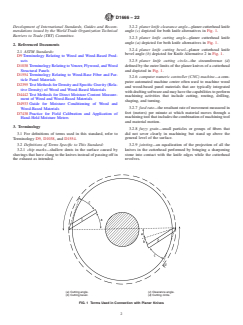
mendations issued by the World Trade Organization Technical angle (c) depicted for both knife alternatives in Fig. 1.
Barriers to Trade (TBT) Committee.
3.2.3 planer knife cutting angle—planer cutterhead knife
angle (a) depicted for both knife alternatives in Fig. 1.
2. Referenced Documents
3.2.4 planer knife cutting bevel—planer cutterhead knife
2.1 ASTM Standards:
bevel angle (b) depicted for Knife Alternative 2 in Fig. 1.
D9Terminology Relating to Wood and Wood-Based Prod-
ucts 3.2.5 planer knife cutting circle—the circumference (d)
defined by the outer limits of the planer knives of a cutterhead
D1038TerminologyRelatingtoVeneer,Plywood,andWood
Structural Panels and depicted in Fig. 1.
D1554Terminology Relating to Wood-Base Fiber and Par-
3.2.6 computer numeric controller (CNC) machine—acom-
ticle Panel Materials
puter automated machine center often used to machine wood
D2395TestMethodsforDensityandSpecificGravity(Rela-
and wood-based panel materials that are typically integrated
tive Density) of Wood and Wood-Based Materials
withdraftingsoftwareandmayhavethecapabilitiestoperform
D4442Test Methods for Direct Moisture Content Measure-
machining activities that include cutting, routing, drilling,
ment of Wood and Wood-Based Materials
shaping, and turning.
D4933Guide for Moisture Conditioning of Wood and
3.2.7 feed rate—theresultantrateofmovementmeasuredin
Wood-Based Materials
feet (meters) per minute at which material moves through a
D7438Practice for Field Calibration and Application of
machiningtoolthatincludesthecombinationofmachiningtool
Hand-Held Moisture Meters
and material motion.
3. Terminology
3.2.8 fuzzy grain—small particles or groups of fibers that
did not sever clearly in machining but stand up above the
3.1 For definitions of terms used in this standard, refer to
Terminology D9, D1038, and D1554. general level of the surface.
3.2 Definitions of Terms Specific to This Standard: 3.2.9 jointing—an equalization of the projection of all the
3.2.1 chip marks—shallow dents in the surface caused by knives in the cutterhead performed by bringing a sharpening
shavings that have clung to the knives instead of passing off in stone into contact with the knife edges while the cutterhead
the exhaust as intended. revolves.
(a) Cutting angle. (c) Clearance angle.
(b) Cutting bevel. (d) Cutting circle.
FIG. 1 Terms Used in Connection with Planer Knives
D1666 − 22
should be machined with the regular test specimens and compared with
3.2.10 land (or heel)—the part of the cutting edges of the
the control. When the machined surface deteriorates perceptibly, as
knivesthatconformstothecuttingcircle,hasnoclearance,and
indicated by this comparison, the cutting tool should be resharpened or
that comes into contact with the sharpening stone in the
replaced.
jointing operation.
Similarly with wood-base panels, some well-known product that has
good machining properties may be used as a control material for
3.2.11 speed, cutterhead—the rate measured in revolutions
comparison.
per minute at which a cutterhead is turning.
NOTE 3—Whenever possible, preference should be given to carbide
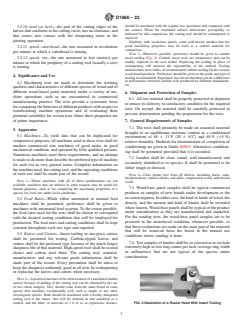
3.2.12 speed, rim—the rate measured in feet (meters) per insert tooling (Fig. 2). Carbide insert tools are inexpensive and can be
readily replaced in the tool holder. Replacing the tooling in place of
minute at which the periphery of a cutting tool (usually a saw)
resharpening will increase the repeatability of the method. Tooling
is turning.
manufactures have tables of recommended carbide tooling for the various
wood-basedproducts.Preferenceshouldbegiventothegradeandtypeof
4. Significance and Use
toolingrecommended.Experiencehasshownthattherecanbeadifference
in performance between carbide tools produced by different manufactur-
4.1 Machining tests are made to determine the working
ers.
qualitiesandcharacteristicsofdifferentspeciesofwoodandof
different wood-based panel materials under a variety of ma-
6. Shipment and Protection of Samples
chine operations such as are encountered in commercial
6.1 All test material shall be properly protected in shipment
manufacturing practice. The tests provide a systematic basis
to ensure its delivery in satisfactory condition for the required
forcomparingthebehaviorofdifferentproductswithrespectto
tests. On receipt, the material shall be carefully protected to
woodworking machine operations and of evaluating their
prevent deterioration pending the preparation for the tests.
potential suitability for certain uses where these properties are
of prime importance.
7. General Requirements of Samples
7.1 The tests shall primarily be made on seasoned material
5. Apparatus
brought to an equilibrium moisture content in a conditioned
5.1 Machines—To yield data that can be duplicated for
environment of 68 6 11°F (20 6 6°C) and 65% (65%)
comparative purposes, all machines used in these tests shall be
relative humidity. Methods for determination of completion of
modern commercial size machines of good make, in good
conditioning are given in Guide D4933.Alternative condition-
mechanical condition, and operated by fully qualified persons.
ing shall be permitted provided that it is recorded.
Numerous machines meet these requirements, and no attempt
7.2 Lumber shall be clear, sound, well-manufactured, and
ismadetodomorethandescribethepreferredtypeofmachine
accurately identified as to species. It shall be permitted to be
for each test in very general terms. Complete information on
either rough or dressed.
themachineused,thecuttingtool,andtheoperatingconditions
of each test shall be made part of the record.
NOTE 4—Clear means free from all defects, including knots, stain,
incipientdecay,surfacechecks,endsplits,compressionwood,andtension
NOTE 1—Where machines with all of these qualifications are not
wood.
available, machines that are inferior in some respects may be useful for
7.3 Wood-base panel samples shall be typical commercial
limited purposes, such as for comparing the machining properties of a
species for local use under local conditions.
products or samples of new boards under development as the
occasionrequires.Ineithercase,thekindorkindsofwood,the
5.2 Feed Rates—While either automated or manual feed
density, and the amount and kind of binder shall be recorded
machines shall be permitted, preference shall be given to
whereknown.Wood-basepanelsshallbetypicaloftheproduct
machines with automated feed systems.To the extent possible,
under consideration as they are manufactured and marketed.
the feed rates used for the tests shall be chosen to correspond
For the sanding tests, the wood-base panel samples are to be
with the desired cutting conditions that will be employed for
procured in the unsurfaced condition, whenever possible, so
production. The feed rates and cutting conditions shall be kept
thattheseevaluationsaremadeonthesamepartofthematerial
constant throughout each test type and reported.
that will be removed from the board in the normal use
5.3 Knives and Cutters—Insert tooling or one-piece cutters
conditions where sanding is done.
shall be permitted for testing. Carbide-tipped knives and
7.4 Testsamplesoflumbershallbesoselectedastoexclude
cutters shall be the preferred type because of the much longer
extremelyhighorlowringcountsperinch(averageringwidth
sharpnesslifeofthatmaterial.High-speedsteelshallbesecond
in millimeters) that are not typical of the species under
choice and carbon steel third. The cutting tool, material,
consideration.
manufacturer, and any relevant grade information shall be
made part of the record. Every precaution shall be taken to
keep the sharpness uniformly good in all tests by resharpening
or replacing the knives and cutters when necessary.
NOTE2—Apracticalmeasureofthedeteriorationofamachinedlumber
surface because of dulling of the cutting tool can be obtained by the use
of two check samples. They should come from the same board of some
species that machines exceptionally well, such as maple or any other
closed-grain species. Both should be machined with a freshly sharpened
cutting tool at the outset. One will be retained in that condition as a
control, and the other, at intervals of1horsoas experience dictates, FIG. 2 Illustration of a Router Head With Insert Tooling
D1666 − 22
NOTE 5—Number of rings per inch (or average ring width in millime-
representative of the product being shipped, and if it meets the
ters) is determined by visual count along a line perpendicular to the
specifications. If only exploratory tests are to be made, a
growth rings. Different samples of a given species often differ widely in
smaller number of samples shall be permitted to be selected.
thisrespect,andoftenthesamplesatbothextremesarenottypicalintheir
properties.
NOTE 7—It is desirable that the samples represent numerous different
trees and logs. The material for tests should preferably be obtained in log
8. Dimensions, Weight, and Moisture Content of Samples
form and then sawn to the desired size. When this is not possible, it will
be necessary to select random samples from a lumber pile.
8.1 Samples must be large enough to yield the minimum
acceptable size of 0.75 in. by 5 in. by 4 ft (19 mm by 127 9.2 For each type of wood-base panel tested, five samples
shall be selected, one from each of five different sheets. The
mmby1.2 m) when at the prescribed moisture content and
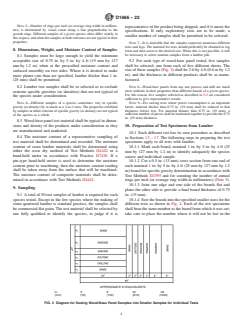
surfaced smoothly on two sides. Where it is desired to make sizeofthesesamples(Fig.3)shallbe2ftby4ft(0.6mby1.2
m), and the thickness in different products shall be as manu-
more planer cuts than are specified, lumber thicker than 1 in.
(25 mm) shall be permitted. factured.
8.2 Lumber test samples shall be so selected as to exclude NOTE 8—Wood-base panels from any one process and mill are much
more uniform in their properties than different boards of a given species.
extreme specific gravities (or densities) that are not typical of
For this reason, five samples selected as described in 9.2 are considered
the species under consideration.
sufficient to give representative results.
NOTE 9—For sawing tests where power consumption is an important
NOTE 6—Different samples of a species sometimes vary in specific
factor, material thicker than 0.75 in. (19 mm) shall be reduced to that
gravity (or density) by as much as a 2-to-1 ratio.The properties exhibited
thickness before test. For material thinner than 0.75 in. (19 mm), a
bysamplesateitherextremeofspecificgravity(ordensity)arenottypical
sufficientnumberofpiecesshallbelaminatedtogethertoprovidethe0.75
of the species as a whole.
in. (19 mm) thickness.
8.3 Wood-basepaneltestmaterialshallbetypicalindimen-
sions and density of the products under consideration as they
10. Preparation of Test Specimens from Lumber
are manufactured and marketed.
10.1 Each different test has its own procedure as described
8.4 The moisture content of a representative sampling of
in Sections12–17. The following steps in preparing the test
test material shall be determined and recorded. The moisture
specimens apply to all tests with lumber:
content of sawn lumber materials shall be determined using
10.1.1 Mark each board, nominal 1 in. by 5 in. by 4 ft (25
either the oven dry method of Test Methods D4442 or a
mm by 127 mm by 1.2 m) to identify adequately the species
hand-held meter in accordance with Practice D7438.Ifa
source and individual sample.
pin-type hand-held meter is used to determine the moisture
10.1.2 Cut a 0.5 in. (13 mm) cross section from one end of
content prior to machining, then the moisture content reading
each nominal 1 in. by 5 in. by 4 ft (25 mm by 127 mm by 1.2
shall be taken away from the surface that will be machined.
m) board for specific gravity determination in accordance with
The moisture content of composite materials shall be deter-
Test Methods D2395 and for counting the number of annual
mined in accordance with Test Methods D4442.
rings per inch (or average ring width in millimeters) (Note 5).
10.1.3 Joint one edge and one side of the boards flat and
9. Sampling
plane the other side to provide a final board thickness of 0.75
9.1 Atotal of 50 test samples of lumber is required for each in. (19 mm).
species tested. Except in the few species where the making of 10.1.4 Sawtheboardsintothespecifiedsmallersizesforthe
some quartered lumber is standard practice, the samples shall different tests as shown in Fig. 4. Each of the test specimens
be commercial flat grain.The test material shall be selected by shallbearthesamenumberastheboardfromwhichitwascut;
one fully qualified to identify the species, to judge if it is take care to place the number where it will not be lost in the
APPROXIMATE SI EQUIVALENTS
in. 3 6 24 48
(mm) (76) (152) (610) (1220)
FIG. 3 Diagram for Sawing Wood-Base Panel Samples into Smaller Samples for Individual Tests
D1666 − 22
machining process. The specimen for routing/shaping, boring,
and mortising (Fig. 4) shall be accurately cut to size to ensure
proper positioning. The turning specimens also shall be accu-
rate since they have to fit special lathe centers.
NOTE 10—The size of the planing specimen is not critical and, if
necessary, it may be 1 in. (25 mm) or so short of the specified 3 ft (0.9 m)
without serious objection.
11. Preparation of Specimens from Wood-Base Panels
11.1 Each different test has its own procedure as described
in Sections19–22. The following steps in preparing the test
specimens apply to all tests with wood-base panels:
11.1.1 Mark each 2 ft by 4 ft (0.6 m by 1.2 m) board to
identify the source and the individual sample.
11.1.2 Saw each of the original wood-base panel samples
into smaller sizes for the different tests as shown in Fig. 3.
11.1.3 Each of the test specimens shall bear the same
number as the board from which it was cut.
METHODS OF TESTING LUMBER
12. Planing
12.1 A moulder (Fig. 5) is the preferable machine for the
planing test because of its relatively wide range of feeds and
speeds and because of the ease of changing heads. In the
absence of a moulder, a planer or planer-matcher shall be
permitted. In any case use only straight knives, and plane only
one side of the test specimen at a time.
APPROXIMATE SI EQUIVALENTS
12.2 Knivesshallbefreshlygroundattheoutsetandjointed
in. ⁄2 3 4 5 12 36 48
(mm) (13) (76) (102) (127) (305) (910) (1220) to a point where each knife shows a hairline land for the entire
length of the blade. When the land or jointed portion of the
FIG. 4 Diagram for Sawing Lumber Samples into Smaller
edgebecomesasmuchas ⁄32in.(0.79mm)wide,asaresultof
Samples for Individual Tests
repeatedjointings,theknivesshallberegroundbeforecontinu-
ing with the test. Provided that the feed rates are adjusted to
NOTE 1—This moulder offers a much wider range of cutterhead speeds
and feed rates than does the typical planer. The slip-on heads are easy to
changeasdesired.Moulderscomewithtwoormorecutterheadstopermit
machining up to four sides with one pass. In planing tests, however, only
one cutterhead is used, the bottom head equipped with straight blades.
FIG. 5 Desirable Type of Machine for Use in Planing Tests
D1666 − 22
maintain the required knife marks per inch as outlined in 12.8, where the numbers in the column refer to the grade of the
itshallalsobeacceptabletouseasingleknifefinishinsteadof specific defect under consideration shall be used. For each
a jointed knife finish. specimen, grade any planing defect according to degree and
record on prepared forms. Classify the planing characteristics
12.3 Allspecimensusedinthistest(50perspecies)shallbe
of each specimen by visual examination on the basis of five
0.75 in. by 4 in. by 3 ft (19 mm by 102 mm by 0.9 m).
grades or groups as follows:
12.4 Allcutsshallbe ⁄16in.(1.6mm)deep.Atestspecimen
Grade 1, excellent
0.75 in. (19 mm) thick will permit making seven cuts before
Grade 2, good
thespecimenbecomesthinenoughtointroduceanewvariable.
Grade 3, fair
12.5 When several species are being tested, mix them well
Grade 4, poor
to equalize the effect of the gradual dulling of the knives.
Grade 5, very poor
12.6 Feed the specimens into the machine, so that half are
NOTE 14—The runs described in Section 12 cover the more critical
machined with the grain and half against the grain.
conditions. If additional runs are desired for any reason, additional test
material will be needed.
NOTE11—Itissuggestedthatalternativecutsbemadeonoppositefaces
NOTE 15—The characteristic of black walnut with respect to planing
to avoid cupping from the release of interior stress.
qualities is illustrated by Grades Nos. 1 and 5 in Fig. 7. The top sample,
12.7 Mark the end of each specimen as it emerges from the Grade No. 1, is easy to classify because it is practically free from any and
all machining defects. Traces of chipped grain can be seen around the
machine to indicate the direction of feed and the side that has
small burls in this specimen.They would not be visible, except in oblique
just been machined. Feed individual specimens in the same
light, and represent about as large a defect that is admissible in this grade.
direction at each cut.
Knife marks, which are quite plainly visible in this specimen, are not
considered a machining defect, because they are largely unavoidable in
12.8 Cutting Angles and Knife Mark Frequencies—The
planing. They vary in visibility according to the number per inch (knife
cutting angles and knife mark frequencies used for the testing
marks per millimeter) and, to some extent, with the species. For exacting
shall be as required to satisfy the test objectives:
uses, they are customarily removed by sanding as would be the traces of
12.8.1 Optimization Testing—If the goal of the test program chipped grain. The second specimen, also black walnut, shows torn grain
too extreme to be allowed in any grade above No. 5. In this instance, the
is to optimize the cutting angle or knife mark frequency, or
degrade was no doubt due to a dip in the grain. The third sample, which
both, then make four runs with knives at cutting angles of 15,
illustrates an extreme degree of fuzzing in quartered mahogany, probably
20, 25, and 30°.The feed rates and cutterhead speeds for these
due to abnormal fibers, is also a Grade No. 5.
tests shall be adjusted to give 20 knife marks/in. (0.8/mm).
While the extreme conditions seen in the two lower specimens can
occur in any species, they are usually lacking or negligible in most
Three additional runs shall then be made with a fixed 20°
species, except when planing under very unfavorable conditions. Figs.
cutting angle. Feed rates and cutterhead speeds for these
8-11 show the intermediate grades, Nos. 2, 3, and 4, which is considered
additional runs shall be adjusted to give 8, 12, and 16 knife
as slight, medium, and advanced degrees.
marks/in. (0.3, 0.5, and 0.6 knife marks/mm).
12.10 Base comparisons of planing properties of different
12.8.2 Representative Testing—If the cutting angle and
species on percentages of defect-free pieces in each dataset.
knife mark frequency are recommended by the tooling manu-
NOTE 16—Planing specimens are usually either defect-free or only
facturer or otherwise known, then make four runs using the
slightly defective. Although Grade Nos. 3, 4, and 5 are relatively
knownconditions.Thecuttingangleandknifemarkfrequency
infrequent,theyservetogiveamorecompletepictureofthedegreeofany
used for the test shall be recorded.
defects present. Two things to be kept in mind when grading: (1)
Consecutive grades merge gradually without any abrupt change in quality
NOTE 12—Cutting angles, which have an important influence on the
or any sharp dividing line, and (2) Any given grade is not completely
quality of work in planer-type machines, may be changed in two general
uniform in quality, but has some range between the best and the poorest
ways: (1) By changing the angle of the knife slot or slot that holds the
examples within the grade.
knife in the head. This, of course, means a different cutterhead for every
different knife angle. Heads with knife slots ground at 20 to 30° are
13. Sanding
common,buttherearedefinitelimitsbeyondwhichthismethodcannotbe
carried without danger of weakening the cutterhead too much. (2)By
13.1 The machine shall preferably be either a two-head,
grinding a “back-bevel” on knives, as shown on knife 2 in Fig. 1. This
wide-beltsanderoradrumsander.Ifneitherofthesemachines
means one cutterhead with, say, four sets of knives back-beveled at four
different degrees can be used to achieve four different cutting angles. areavailable,thenthemachineusedshallbereportedincluding
NOTE 13—Where each knife in the cutterhead is doing its share of the
the type of roll or drum employed. Conduct the sanding
work, the number of knife marks per inch (millimeter) should agree with
operation using a contact roll or drum. Report the roll or drum
the following formula:
hardness in Shore A durometer
...
This document is not an ASTM standard and is intended only to provide the user of an ASTM standard an indication of what changes have been made to the previous version. Because
it may not be technically possible to adequately depict all changes accurately, ASTM recommends that users consult prior editions as appropriate. In all cases only the current version
of the standard as published by ASTM is to be considered the official document.
Designation: D1666 − 17 D1666 − 22
Standard Test Methods for
Conducting Machining Tests of Wood and Wood-Base Panel
Materials
This standard is issued under the fixed designation D1666; the number immediately following the designation indicates the year of
original adoption or, in the case of revision, the year of last revision. A number in parentheses indicates the year of last reapproval. A
superscript epsilon (´) indicates an editorial change since the last revision or reapproval.
INTRODUCTION
One of the significant characteristics of wood and wood-base panels is the facility with which they
can be machined and fabricated. Different species and products, however, vary greatly in their
behavior under cutting tools, so that some systematic method is needed for determining their
suitability for uses where the character of the machined surface is of prime importance. Such uses
include cabinetwork, millwork, and other applications where favorable machining properties are
essential to good finish. For such products as common boards, on the other hand, good machining
properties are secondary, although still an asset.
The machining test procedures presented in these test methods cover such common operations as
planing, routing/shaping, turning, boring, mortising, and sanding. They are the result of many years
of extensive research and development and include practical methods for qualitatively evaluating and
interpreting the results. Because of their satisfactory use with a wide range of materials, it is believed
that the methods are equally applicable to species, all species of hardwoods and softwoods, and to
wood-base panel materials, such as plywood, particleboard, fiberboard, and hardboard.
1. Scope
1.1 These test methods cover procedures for planing, routing/shaping, turning, mortising, boring, and sanding, all of which are
common wood-working operations used in the manufacture of wood products. These tests apply, in different degrees, to two
general classes of materials:
1.1.1 Wood in the form of lumber, and
1.1.2 Wood-base panel materials such as plywood and wood-base fiber and particle panels.
1.2 Because of the importance of planing, some of the variables that affect the results of this operation are explored with a view
to determining optimum conditions. In most of the other tests, however, it is necessary to limit the work to one set of fairly typical
commercial conditions in which all the different woods are treated alike.
1.3 Several factors enter into any complete appraisal of the machining properties of a given wood or wood-base panel. Quality
of finished surface is recommended as the basis for evaluation of machining properties. Rate of dulling of cutting tools and power
consumed in cutting are also important considerations but are beyond the scope of these test methods.
These test methods are under the jurisdiction of ASTM Committee D07 on Wood and are the direct responsibility of Subcommittee D07.01 on Fundamental Test Methods
and Properties.
Current edition approved March 1, 2017Aug. 1, 2022. Published June 2017August 2022. Originally approved in 1959. Last previous edition approved in 20112017 as
D1666 – 11.D1666 – 17. DOI: 10.1520/D1666-17.10.1520/D1666-22.
Copyright © ASTM International, 100 Barr Harbor Drive, PO Box C700, West Conshohocken, PA 19428-2959. United States
D1666 − 22
1.4 Although the methods presented include the results of progressive developments in the evaluation of machining properties,
further improvements may be are anticipated. For example, by present procedures, quality of the finished surface is evaluated by
visual inspection, but as new mechanical or physical techniques become available that will afford improved precision of evaluation,
they should be employed.
1.5 The values stated in inch-pound units are to be regarded as the standard. The metric equivalents of inch-pound units may be
approximate.standard. The values given in parentheses are mathematical conversions to SI units that are provided for information
only and are not considered standard.
1.6 This standard does not purport to address all of the safety concerns, if any, associated with its use. It is the responsibility
of the user of this standard to establish appropriate safety and health practices and determine the applicability of regulatory
limitations prior to use.
1.7 This international standard was developed in accordance with internationally recognized principles on standardization
established in the Decision on Principles for the Development of International Standards, Guides and Recommendations issued
by the World Trade Organization Technical Barriers to Trade (TBT) Committee.
2. Referenced Documents
2.1 ASTM Standards:
D9 Terminology Relating to Wood and Wood-Based Products
D1038 Terminology Relating to Veneer, Plywood, and Wood Structural Panels
D1554 Terminology Relating to Wood-Base Fiber and Particle Panel Materials
D2395 Test Methods for Density and Specific Gravity (Relative Density) of Wood and Wood-Based Materials
D4442 Test Methods for Direct Moisture Content Measurement of Wood and Wood-Based Materials
D4933 Guide for Moisture Conditioning of Wood and Wood-Based Materials
D7438 Practice for Field Calibration and Application of Hand-Held Moisture Meters
3. Terminology
3.1 For definitions of terms used in this standard, refer to Terminology D9, D1038, and D1554.
3.2 Definitions of Terms Specific to This Standard:
3.2.1 chip marks—shallow dents in the surface caused by shavings that have clung to the knives instead of passing off in the
exhaust as intended.
3.2.2 planer knife clearance angle—planer cutterhead knife angle (c) depicted for both knife alternatives in Fig. 1.
3.2.3 planer knife cutting angle—planer cutterhead knife angle (a) depicted for both knife alternatives in Fig. 1.
3.2.4 planer knife cutting bevel—planer cutterhead knife bevel angle (b) depicted for Knife Alternative 2 in Fig. 1.
3.2.5 planer knife cutting circle—the circumference (d) defined by the outer limits of the planer knives of a cutterhead and depicted
in Fig. 1.
3.2.6 computer numeric controller (CNC) machine—a computer automated machine center often used to machine wood and
wood-based panel materials that are typically integrated with drafting software and may have the capabilities to perform machining
activities that include cutting, routing, drilling, shaping, and turning.
3.2.7 feed rate—the resultant rate of movement measured in feet (metres)(meters) per minute at which material moves through a
machining tool that includes the combination of machining tool and material motion.
3.2.8 fuzzy grain—small particles or groups of fibers that did not sever clearly in machining but stand up above the general level
of the surface.
D1666 − 22
(a) Cutting angle. (c) Clearance bevel.
(a) Cutting angle. (c) Clearance angle.
(b) Cutting bevel. (d) Cutting circle.
FIG. 1 Terms Used in Connection with Planer Knives
3.2.9 jointing—an equalization of the projection of all the knives in the cutterhead performed by bringing a sharpening stone into
contact with the knife edges while the cutterhead revolves.
3.2.10 land (or heel)—the part of the cutting edges of the knives that conforms to the cutting circle, has no clearance, and that
comes into contact with the sharpening stone in the jointing operation.
3.2.11 speed, cutterhead—the rate measured in revolutions per minute at which a cutterhead is turning.
3.2.12 speed, rim—the rate measured in feet (metres)(meters) per minute at which the periphery of a cutting tool (usually a saw)
is turning.
4. Significance and Use
4.1 Machining tests are made to determine the working qualities and characteristics of different species of wood and of different
wood-based panel materials under a variety of machine operations such as are encountered in commercial manufacturing practice.
The tests provide a systematic basis for comparing the behavior of different products with respect to woodworking machine
operations and of evaluating their potential suitability for certain uses where these properties are of prime importance.
5. Apparatus
5.1 Machines—To yield data that can be duplicated for comparative purposes, all machines used in these tests shall be modern
commercial size machines of good make, in good mechanical condition, and operated by fully qualified persons. Numerous
machines meet these requirements, and no attempt is made to do more than describe the preferred type of machine for each test
in very general terms (terms. Note 1). Complete information on the machine used, the cutting tool, and the operating conditions
of each test shall be made part of the record.
D1666 − 22
NOTE 1—Where machines with all of these qualifications are not available, machines that are inferior in some respects have limited uses,may be useful
for limited purposes, such as for comparing the machining properties of a species for local use under local conditions.
5.2 Feed Rates—While either automated or manual feed machines mayshall be used,permitted, preference shall be given to
machines with automated feed systems. To the extent possible, the feed rates used for the tests shall be chosen to correspond with
the desired cutting conditions that will be employed for production. The feed rates and cutting conditions shall be kept constant
throughout each test type and reported.
5.3 Knives and Cutters—Insert tooling or one-piece cutters mayshall be usedpermitted for testing. Carbide-tipped knives and
cutters shall be the preferred type because of the much longer sharpness life of that material. High-speed steel shall be second
choice and carbon steel third. The cutting tool, material, manufacturer, and any relevant grade information shall be made part of
the record. Every precaution shall be taken to keep the sharpness uniformly good in all tests by resharpening or replacing the knives
and cutters when necessary.
NOTE 2—A practical measure of the deterioration of a machined lumber surface because of dulling of the cutting tool can be obtained by the use of two
check samples. They should come from the same board of some species that machines exceptionally well, such as maple or any other closed-grain species.
Both should be machined with a freshly sharpened cutting tool at the outset. One will be retained in that condition as a control, and the other, at intervals
of 1 h or so as experience dictates, should be machined with the regular test specimens and compared with the control. When the machined surface
deteriorates perceptibly, as indicated by this comparison, the cutting tool should be resharpened or replaced.
Similarly with wood-base panels, some well-known product that has good machining properties may be used as a control material for comparison.
NOTE 3—Whenever possible, preference should be given to carbide insert tooling (Fig. 2). Carbide insert tools are inexpensive and can be readily replaced
in the tool holder. Replacing the tooling in place of resharpening will increase the repeatability of the method. Tooling manufactures have tables of
recommended carbide tooling for the various wood-based products. Preference should be given to the grade and type of tooling recommended. Experience
has shown that there can be a difference in performance between carbide tools produced by different manufacturers.
6. Shipment and Protection of Samples
6.1 All test material shall be properly protected in shipment to ensure its delivery in satisfactory condition for the required tests.
On receipt, the material shall be carefully protected to prevent deterioration pending the preparation for the tests.
7. General Requirements of Samples
7.1 The tests shall primarily be made on seasoned material brought to an equilibrium moisture content in a conditioned
environment of 68 6 11°F (20 6 6°C) and 65 % (65 %) relative humidity. Methods for determination of completion of
conditioning are given in Guide D4933. Alternative conditioning mayshall be specifiedpermitted provided that it is recorded.
7.2 Lumber shall be clear (clear, Note 4), sound, well-manufactured, and accurately identified as to species. It may be shall be
permitted to be either rough or dressed.
NOTE 4—Clear means free from all defects, including knots, stain, incipient decay, surface checks, end splits, compression wood, and tension wood.
7.3 Wood-base panel samples mayshall be typical commercial products or samples of new boards under development as the
occasion requires. In either case, the kind or kinds of wood, the density, and the amount and kind of binder should be known and
made part of the record. shall be recorded where known. Wood-base panels shall be typical of the product under consideration as
they are manufactured and marketed. For the sanding tests, the wood-base panel samples should are to be procured in the
unsurfaced condition, whenever possible, so that these evaluations may be are made on the same part of the material that will be
removed from the board in the normal use conditions where sanding is done.
FIG. 2 Illustration of a Router Head With Insert Tooling
D1666 − 22
7.4 Test samples of lumber shall be so selected as to exclude extremely high or low ring counts per inch (average ring width per
millimetre)in millimeters) that are not typical of the species under consideration.
NOTE 5—Number of rings per inch (or average ring width in millimeters) is determined by visual count along a line perpendicular to the growth rings.
Different samples of a given species often differ widely in this respect, and often the samples at both extremes are not typical in their properties.
8. Dimensions, Weight, and Moisture Content of Samples
8.1 Samples must be large enough to yield the minimum acceptable size (0.75 of 0.75 in. by 5 in. by 4 ft)ft (19 mm by 127
mm by 1.2 m) when at the prescribed moisture content and surfaced smoothly on two sides. Where it is desired to make more
planer cuts than are specified, lumber thicker than 1 in. (25 mm) mayshall be used.permitted.
8.2 Lumber test samples shall be so selected as to exclude the small amount at each extreme of weight that isextreme specific
gravities (or densities) that are not typical of the species under consideration.
NOTE 6—Different samples of a species sometimes vary in density specific gravity (or density) by as much as a 2-to-1 ratio. The properties exhibited by
samples at either extreme of density specific gravity (or density) are not typical of the species as a whole.
8.3 Wood-base panel test material shall be typical in dimensions and weightdensity of the products under consideration as they
are manufactured and marketed.
8.4 The moisture content of a representative sampling of test material shall be determined and recorded. The moisture content of
sawn lumber materials shall be determined using either the oven dry method of Test Methods D4442 or a hand-held meter in
accordance with Practice D7438. If a pin-type hand-held meter is used to determine the moisture content prior to machining, then
the moisture content reading shall be taken away from the surface that will be machined. The moisture content of composite
materials shall be determined in accordance with Test Methods D4442.
9. Sampling
9.1 A total of 50 test samples of lumber is required for each species tested (tested. Note 7). Except in the few species where the
making of some quartered lumber is standard practice, the samples shall be commercial flat grain. The test material shall be
selected by one fully qualified to identify the species, to judge if it is fairly representative of the product being shipped, and if it
meets the specifications. If only exploratory tests are to be made, a smaller number of samples may be shall be permitted to be
selected.
NOTE 7—It is desirable that the samples represent numerous different trees and logs. The material for tests should preferably be obtained in log form and
then sawn to the desired size. When this is not possible, it will be necessary to select random samples from a lumber pile.
9.2 For each type of wood-base panel tested, five samples (Note 8) shall be selected, one from each of five different sheets. The
size of these samples (Fig. 3) shall be 2 ft by 4 ft (0.6 m by 1.2 m), and the thickness in different products shall be as manufactured
(manufactured.Note 9).
NOTE 8—Wood-base panels from any one process and mill are much more uniform in their properties than different boards of a given species. For this
reason, five samples selected as described in 9.2 are considered sufficient to give representative results.
NOTE 9—For sawing tests where power consumption is an important factor, material thicker than 0.75 in. (19 mm) shall be reduced to that thickness before
test. For material thinner than 0.75 in. (19 mm), a sufficient number of pieces shall be laminated together to provide the 0.75-in. (19-mm) 0.75 in. (19
mm) thickness.
10. Preparation of Test Specimens from Lumber
10.1 Each different test has its own procedure as described in Sections 12 – 17. The following steps in preparing the test specimens
apply to all tests with lumber:
10.1.1 Mark each board, nominal 1 in. by 5 in. by 4 ft (25 mm by 127 mm by 1.2 m) to identify adequately the species source
and individual sample.
D1666 − 22
METRIC APPROXIMATE SI EQUIVALENTS
in. 3 6 24 48
mm 76 152 610 1220
in. 3 6 24 48
(mm) (76) (152) (610) (1220)
FIG. 3 Diagram for Sawing Wood-Base Panel Samples into Smaller Samples for Individual Tests
10.1.2 Cut a 0.5-in. (13-mm) 0.5 in. (13 mm) cross section from one end of each nominal 1 in. by 5 in. by 4 ft (25 mm by 127
mm by 1.2 m) board for specific gravity determinations determination in accordance with Test Methods D2395 and for counting
the number of annual rings per inch (average (or average ring width in millimetres)millimeters) (Note 5).
10.1.3 Joint one edge and one side of the boards flat and plane the other side to provide a final board thickness of 0.75 in. (19
mm).
10.1.4 Saw the boards into the specified smaller sizes for the different tests as shown in Fig. 4. Each of the test specimens shall
bear the same number as the board from which it was cut; take care to place the number where it will not be lost in the machining
process. The specimen for routing/shaping, boring, and mortising (Fig. 4) shall be accurately cut to size to ensure proper
positioning. The turning specimens also shall be accurate since they have to fit special lathe centers.
NOTE 10—The size of the planing specimen is not critical and, if necessary, it may be 1 in. (25 mm) or so short of the specified 3 ft (0.9 m) without serious
objection.
11. Preparation of Specimens from Wood-Base Panels
11.1 Each different test has its own procedure as described in Sections 19 – 22. The following steps in preparing the test specimens
apply to all tests with wood-base panels:
11.1.1 Mark each 2 ft by 4-ft 4 ft (0.6 m by 1.2 m) board to identify the source and the individual sample.
11.1.2 Saw each of the original wood-base panel samples into smaller sizes for the different tests as shown in Fig. 3.
11.1.3 Each of the test specimens shall bear the same number as the board from which it was cut.
METHODS OF TESTING LUMBER
12. Planing
12.1 A moulder (Fig. 5) is the preferable machine for the planing test because of its relatively wide range of feeds and speeds and
because of the ease of changing heads. In the absence of a moulder, a planer or planer-matcher mayshall be used.permitted. In any
case use only straight knives, and plane only one side of the test specimen at a time.
12.2 Knives shall be freshly ground at the outset and jointed to a point where each knife shows a hairline land for the entire length
of the blade. When the land or jointed portion of the edge becomes as much as ⁄32 in. (0.79 mm) wide, as a result of repeated
D1666 − 22
METRIC APPROXIMATE SI EQUIVALENTS
in. ⁄2 3 4 5 12 36 48
mm 13 76 102 127 305 910 1220
in. ⁄2 3 4 5 12 36 48
(mm) (13) (76) (102) (127) (305) (910) (1220)
FIG. 4 Diagram for Sawing Lumber Samples into Smaller Samples for Individual Tests
jointings, the knives shall be reground before continuing with the test. Provided that the feed rates are adjusted to maintain the
required knife marks per inch as outlined in 12.8, it shall also be acceptable to use a single knife finish instead of a jointed knife
finish.
12.3 All specimens used in this test (50 per species) shall be 0.75 in. by 4 in. by 3 ft (19 mm by 102 mm by 0.9 m).
12.4 All cuts shall be ⁄16 in. (1.6 mm) deep. A test specimen 0.75 in. (19 mm) thick will permit making seven cuts before the
specimen becomes thin enough to introduce a new variable.
12.5 When several species are being tested, mix them well to equalize the effect of the gradual dulling of the knives.
12.6 Feed the specimens into the machine, so that half are machined with the grain and half against the grain.
NOTE 11—It is suggested that alternative cuts be made on opposite faces to avoid cupping from the release of interior stress.
12.7 Mark the end of each specimen as it emerges from the machine to indicate the direction of feed and the side that has just
been machined. Feed individual specimens in the same direction at each cut.
12.8 Cutting Angles and Knife Mark Frequencies—The cutting angles and knife mark frequencies used for the testing shall be as
required to satisfy the test objectives:
D1666 − 22
NOTE 1—This moulder offers a much wider range of cutterhead speeds
and feed rates than does the typical planer. The slip-on heads are easy to
change as desired. Moulders come with two or more cutterheads to permit
machining up to four sides with one pass. In planing tests, however, only
one cutterhead is used, the bottom head equipped with straight blades.
FIG. 5 Desirable Type of Machine for Use in Planing Tests
12.8.1 Optimization Testing—If the goal of the test program is to optimize the cutting angle or knife mark frequency, or both, then
make four runs with knives at cutting angles of 15, 20, 25, and 30°. The feed rates and cutterhead speeds for these tests shall be
adjusted to give 20 knife marks/in. (0.8/mm). Three additional runs shall then be made with a fixed 20° cutting angle. Feed rates
and cutterhead speeds for these additional runs shall be adjusted to give 8, 12, and 16 knife marks/in. (0.3, 0.5, and 0.6 knife
marks/mm).
12.8.2 Representative Testing—If the cutting angle and knife mark frequency are recommended by the tooling manufacturer or
otherwise known, then make four runs using the known conditions. The cutting angle and knife mark frequency used for the test
shall be recorded.
NOTE 12—Cutting angles, which have an important influence on the quality of work in planer-type machines, may be changed in two general ways: (1)
By changing the angle of the knife slot or slot that holds the knife in the head. This, of course, means a different cutterhead for every different knife angle.
Heads with knife slots ground at 20 to 30° are common, but there are definite limits beyond which this method cannot be carried without danger of
weakening the cutterhead too much. (2) By grinding a “back-bevel” on knives, as shown on knife 2 in Fig. 1. This means one cutterhead with, say, four
sets of knives back-bevelledback-beveled at four different degrees achieves can be used to achieve four different cutting angles.
NOTE 13—Where each knife in the cutterhead is doing its share of the work, the number of knife marks per inch (millimetre)(millimeter) should agree
with the following formula:
No. of knife cuts per inch = (A × B)/(C × 12)
No. of knife cuts per millimetre = (A × B)millimeter = (A × B) ⁄C
where:
A = revolutions per minute,
B = number of knives in head, and
C = feed rate, ft/min (mm/min).
If the theoretical number does not agree with the actual number, the jointing is probably inadequate. This should always be checked visually using
a datasheet as shown in Fig. 6, where the numbers in the column refer to the grade of the specific defect under consideration.
12.9 Visually examine each test specimen carefully for planing defects after each run (run. ANote 14). datasheet similar to Fig.
6, where the numbers in the column refer to the grade of the specific defect under consideration shall be used. For each specimen,
grade any planing defect that may be present according to degree and record on prepared forms (forms. Note 15). Classify the
planing characteristics of each specimen by visual examination on the basis of five grades or groups as follows:
Grade 1, excellent
Grade 2, good
Grade 3, fair
D1666 − 22
NOTE 1—This form may be modified for use in other tests. The numbers in the column refer to the grade of the specific defect under consideration.
FIG. 6 Sample Data Sheet Used in Planing Test
Grade 4, poor
Grade 5, very poor
NOTE 14—The runs described in Section 12 cover the more critical conditions. If additional runs are desired for any reason, additional test material will
be needed.
NOTE 15—The characteristic of black walnut with respect to planing qualities is illustrated by Grades Nos. 1 and 5 in Fig. 7. The top sample, Grade No.
1, is easy to classify because it is practically free from any and all machining defects. Traces of chipped grain can be seen around the small burls in this
specimen. They would not be visible, except in oblique light, and represent about as large a defect that is admissible in this grade. Knife marks, which
are quite plainly visible in this specimen, are not considered a machining defect, because they are largely unavoidable in planing. They vary in visibility
according to the number per inch (millimetre) (knife marks per millimeter) and, to some extent, with the species. For exacting uses, they are customarily
removed by sanding as would be the traces of chipped grain. The second specimen, also black walnut, shows torn grain too extreme to be allowed in
any grade above No. 5. In this instance, the degrade was no doubt due to a dip in the grain. The third sample, which illustrates an extreme degree of
fuzzing in quartered mahogany, probably due to abnormal fibers, is also a Grade No. 5.
While the extreme conditions seen in the two lower specimens maycan occur in any species, they are usually lacking or negligible in most species,
except when planing under very unfavorable conditions. Figs. 8-11 show the intermediate grades, Nos. 2, 3, and 4, which may be is considered as slight,
medium, and advanced degrees.
D1666 − 22
(1) Black Walnut Grade No. 1.
(2) Black Walnut Grade No. 5.
(3) Mahogany Grade No. 5.
FIG. 7 Planing Grades Nos. 1 and 5
12.10 Base comparisons of planing properties of different species on percentages of defect-free pieces. Most of the planing
specimens were either defect-free or only slightly defective. Although Grade Nos. 3, 4, and 5 were of relatively infrequent
occurrence, they served to give a more complete picture of the degree of any defects that were present. Two things shall be kept
in mind: (pieces in each dataset. 1) Consecutive grades merge gradually without any abrupt change in quality or any sharp dividing
line, and (2) Any given grade is not completely uniform in quality, but has some range between the best and the poorest examples
within the grade.
NOTE 16—Pl
...