

ASTM D1166-21
(Test Method)Standard Test Method for Methoxyl Groups in Wood and Related Materials
General Information
- Abstract
SIGNIFICANCE AND USE
3.1 Most of the methoxyl in wood is attributable to the lignin. This test method is used extensively in the study of lignin.
SCOPE
1.1 This test method covers the determination of methoxyl groups in wood and related materials (1-7).2 The test method is applicable to milled wood or sawdust, or by suitable adjustment in size of the test specimen, to fractions isolated from wood and lignin.
1.2 This standard does not purport to address all of the safety concerns, if any, associated with its use. It is the responsibility of the user of this standard to establish appropriate safety, health, and environmental practices and determine the applicability of regulatory limitations prior to use. Specific precautionary statements are given in Section 6.
1.3 This international standard was developed in accordance with internationally recognized principles on standardization established in the Decision on Principles for the Development of International Standards, Guides and Recommendations issued by the World Trade Organization Technical Barriers to Trade (TBT) Committee.
- Status
- Published
- Publication Date
- 31-Mar-2021
- Technical Committee
- D07 - Wood
- Drafting Committee
- D07.01 - Fundamental Test Methods and Properties

Overview
ASTM D1166-21 - Standard Test Method for Methoxyl Groups in Wood and Related Materials is a widely recognized method from ASTM International, primarily used in the analysis of wood components. This test method outlines procedures for determining methoxyl groups, which are predominantly found in the lignin fraction of wood. Accurate quantification of methoxyl groups is vital for research, quality control, and process optimization in wood chemistry, pulp and paper production, and wood-based product manufacturing.
The standard applies to milled wood, sawdust, or, with appropriate specimen size adjustments, fractions isolated from wood and lignin. As an internationally developed standard, ASTM D1166-21 aligns with principles established by the World Trade Organization’s Technical Barriers to Trade (TBT) Committee.
Key Topics
Purpose and Significance
- Enables precise determination of methoxyl content in wood, crucial for lignin studies.
- Supports both routine quality testing and advanced research in wood chemistry.
- Methoxyl group analysis aids in understanding wood composition, chemical reactivity, and behavior during processing.
Test Applicability
- Applicable to sawdust, milled wood, and isolated wood fractions.
- Adaptable specimen size ensures versatility across various sample types, including isolated lignins and other substances of high or low methoxyl content.
Core Methodology
- Utilizes a chemical approach based on adapted Zeisel procedures.
- Methoxyl groups are cleaved, resulting in the liberation of methyl iodide, which is measured as liberated iodine via titration.
- Emphasizes the importance of reagent purity, controlled analysis conditions, and meticulous sample handling to ensure reliable results.
Safety and Good Laboratory Practice
- Addresses user responsibility for implementing appropriate safety, health, and environmental practices.
- Explicitly notes that all regulatory considerations and hazard precautions (see Section 6 in the standard) must be observed.
Applications
ASTM D1166-21 provides significant practical value in a range of scientific and industrial settings:
Lignin Research and Biomass Analysis
- Essential for determining the structure, content, and chemical properties of lignin in wood and related materials.
- Supports the development of new wood-based materials, biochemicals, and fuels.
Pulp and Paper Industry
- Used to characterize raw materials, evaluate process efficiency, and ensure consistent product quality.
- Enables effective monitoring of lignin content, which impacts pulp yield and paper characteristics.
Wood Product Manufacturing
- Assists in quality assurance by verifying the chemical properties of raw wood sources.
- Useful in developing engineered wood products and innovative biomaterials.
Environmental and Regulatory Compliance
- Provides a standardized approach for reporting chemical composition, supporting compliance with industry and environmental requirements.
Related Standards
For comprehensive wood and lignin analysis, consider these related ASTM standards and methodologies:
- ASTM D1106 – Test Method for Alcohol-Benzenes Soluble and Insoluble Content (Lignin and Cellulose Fractionation)
- ASTM D1109 – Test Method for α-Cellulose in Wood
- ASTM D1102 – Test Method for Ash in Wood
- ASTM D143 – Test Methods for Small Clear Specimens of Timber
These standards, alongside ASTM D1166-21, contribute to robust, standardized laboratory practices in the analysis and processing of wood and lignocellulosic materials.
Keywords: ASTM D1166-21, methoxyl groups in wood, lignin analysis, wood chemistry, wood testing standards, pulp and paper, wood fractionation, wood-based materials, chemical testing wood, ASTM wood standards
Get Certified
Connect with accredited certification bodies for this standard

Gozdarski inštitut Slovenije
Slovenian Forestry Institute. Forest management certification support, timber testing.
Sponsored listings
Frequently Asked Questions
ASTM D1166-21 is a standard published by ASTM International. Its full title is "Standard Test Method for Methoxyl Groups in Wood and Related Materials". This standard covers: SIGNIFICANCE AND USE 3.1 Most of the methoxyl in wood is attributable to the lignin. This test method is used extensively in the study of lignin. SCOPE 1.1 This test method covers the determination of methoxyl groups in wood and related materials (1-7).2 The test method is applicable to milled wood or sawdust, or by suitable adjustment in size of the test specimen, to fractions isolated from wood and lignin. 1.2 This standard does not purport to address all of the safety concerns, if any, associated with its use. It is the responsibility of the user of this standard to establish appropriate safety, health, and environmental practices and determine the applicability of regulatory limitations prior to use. Specific precautionary statements are given in Section 6. 1.3 This international standard was developed in accordance with internationally recognized principles on standardization established in the Decision on Principles for the Development of International Standards, Guides and Recommendations issued by the World Trade Organization Technical Barriers to Trade (TBT) Committee.
SIGNIFICANCE AND USE 3.1 Most of the methoxyl in wood is attributable to the lignin. This test method is used extensively in the study of lignin. SCOPE 1.1 This test method covers the determination of methoxyl groups in wood and related materials (1-7).2 The test method is applicable to milled wood or sawdust, or by suitable adjustment in size of the test specimen, to fractions isolated from wood and lignin. 1.2 This standard does not purport to address all of the safety concerns, if any, associated with its use. It is the responsibility of the user of this standard to establish appropriate safety, health, and environmental practices and determine the applicability of regulatory limitations prior to use. Specific precautionary statements are given in Section 6. 1.3 This international standard was developed in accordance with internationally recognized principles on standardization established in the Decision on Principles for the Development of International Standards, Guides and Recommendations issued by the World Trade Organization Technical Barriers to Trade (TBT) Committee.
ASTM D1166-21 is classified under the following ICS (International Classification for Standards) categories: 79.040 - Wood, sawlogs and sawn timber; 79.060.01 - Wood-based panels in general. The ICS classification helps identify the subject area and facilitates finding related standards.
ASTM D1166-21 is available in PDF format for immediate download after purchase. The document can be added to your cart and obtained through the secure checkout process. Digital delivery ensures instant access to the complete standard document.
Standards Content (Sample)
This international standard was developed in accordance with internationally recognized principles on standardization established in the Decision on Principles for the
Development of International Standards, Guides and Recommendations issued by the World Trade Organization Technical Barriers to Trade (TBT) Committee.
Designation: D1166 − 21
Standard Test Method for
Methoxyl Groups in Wood and Related Materials
This standard is issued under the fixed designation D1166; the number immediately following the designation indicates the year of
original adoption or, in the case of revision, the year of last revision. A number in parentheses indicates the year of last reapproval. A
superscript epsilon (´) indicates an editorial change since the last revision or reapproval.
1. Scope 3. Significance and Use
3.1 Most of the methoxyl in wood is attributable to the
1.1 This test method covers the determination of methoxyl
lignin. This test method is used extensively in the study of
groups in wood and related materials (1-7). The test method is
lignin.
applicable to milled wood or sawdust, or by suitable adjust-
ment in size of the test specimen, to fractions isolated from
4. Apparatus
wood and lignin.
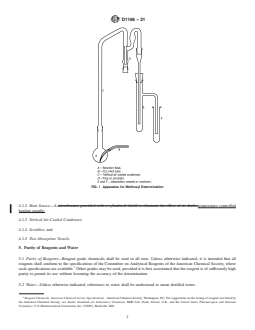
4.1 The apparatus shall be similar to that illustrated in Fig.
1.2 This standard does not purport to address all of the
1 and shall consist of the following:
safety concerns, if any, associated with its use. It is the
4.1.1 Reaction Flask,
responsibility of the user of this standard to establish appro-
4.1.2 Heat Source—A temperature controlled heating
priate safety, health, and environmental practices and deter-
mantle,
mine the applicability of regulatory limitations prior to use.
4.1.3 Vertical Air-Cooled Condenser,
Specific precautionary statements are given in Section 6.
4.1.4 Scrubber, and
1.3 This international standard was developed in accor-
4.1.5 Two Absorption Vessels.
dance with internationally recognized principles on standard-
5. Purity of Reagents and Water
ization established in the Decision on Principles for the
Development of International Standards, Guides and Recom-
5.1 Purity of Reagents—Reagent grade chemicals shall be
mendations issued by the World Trade Organization Technical
used in all tests. Unless otherwise indicated, it is intended that
Barriers to Trade (TBT) Committee.
all reagents shall conform to the specifications of the Commit-
tee onAnalytical Reagents of theAmerican Chemical Society,
2. Principle of Method
where such specifications are available. Other grades may be
used, provided it is first ascertained that the reagent is of
2.1 Theprincipleofthetestmethodisthesameasthatinthe
sufficiently high purity to permit its use without lessening the
original method of Zeisel (1), except that the methyl iodide is
accuracy of the determination.
collected in an acetic acid solution of potassium acetate
containing bromine. The following reactions then occur:
5.2 Water—Unless otherwise indicated, references to water
shall be understood to mean distilled water.
CH I1Br →CH Br1IBr (1)
3 2 3
6. Reagents
IBr12Br 13H O→HIO 15HBr
2 2 3
6.1 Hydroiodic Acid (HI) (57 % in water sp gr 1.70)—This
The iodic acid is determined by titration of iodine liberated
best reagent grade HI, should be stored in the absence of light
by the reaction:
and at a low temperature to keep its purity.
HIO 15HI→3I 13H O (2)
3 2 2
6.2 Phenol.
From the above equations, it follows that one methoxyl
6.3 Cadmium Sulfate Solution (50 g CdSO /L)—Dissolve
group (CH O) liberates six atoms of iodine.
3 67.2 g of CdSO ·4H O in water and dilute to 1 L.
4 2
NOTE 1—A water suspension of red phosphorus is equally satisfactory
in the scrubber.
This test method is under the jurisdiction of ASTM Committee D07 on Wood
and is the direct responsibility of Subcommittee D07.01 on Fundamental Test
Methods and Properties. Reagent Chemicals, American Chemical Society Specifications , American
Current edition approved April 1, 2021. Published April 2021. Originally Chemical Society, Washington, DC. For suggestions on the testing of reagents not
approved in 1956. Last previous edition approved in 2013 as D1166 – 84 (2013). listed by the American Chemical Society, see Analar Standards for Laboratory
DOI: 10.1520/D1166-21. Chemicals, BDH Ltd., Poole, Dorset, U.K., and the United States Pharmacopeia
The boldface numbers in parentheses refer to the references listed at the end of and National Formulary, U.S. Pharmaceutical Convention, Inc. (USPC), Rockville,
this test method. MD.
Copyright © ASTM International, 100 Barr Harbor Drive, PO Box C700, West Conshohocken, PA 19428-2959. United States
D1166 − 21
solution should be prepared.
6.11 Sulfuric Acid (1 + 9) —Mix one volume of H SO (sp
2 4
gr 1.84) with nine volumes of water.
6.12 Standard Sodium Thiosulfate Solution (0.1 N)—
Dissolve 25 g of Na S O ·5H O in 200 mL of water and
2 2 3 2
dilute to 1 L. Use freshly boiled and cooled water. It is
preferable to allow the solution to stand for a few days before
standardization. Standardize the solution against an approxi-
mately 0.1 N solution of KMnO that has been standardized
against sodium oxalate oxidimetric standard furnished by the
National Bureau of Standards (standard sample No. 40). In
each of two glass-stoppered Erlenmeyer flasks put2gofKI
and 100 mL of freshly boiled and cooled water. Shake to
dissolve the KI and add 2 mLof HCl (sp gr 1.18). To one flask
add slowly from a buret either 20.0 mL of 0.1 N KMnO or
10.0 mL of 0.18 N KMnO , while swirling the flask gently. To
the other flask add an equal volume of water. Stopper the flasks
andletthemstandinthedarkfor10min.Titratetheiodinethat
has been set free with the Na S O until the solution is of a
2 2 3
faint straw color.Add 2 mLof starch solution and continue the
titration until the blue color has just been destroyed. Subtract
the volume of Na S O required in the blank determination
2 2 3
from that required in the other titration, and calculate the
normality of the Na S O , based on the normality of the
2 2 3
KMnO .
6.13 Starch Indicator Solution (10 g/L)—Make a paste of 1
g of soluble starch in 5 mL of water and add to 100 mL of
boiling water. Prepare fresh as needed.
7. Test Specimen
7.1 The test specimen of wood shall consist of about 0.1 g,
weighed to the nearest 0.0001 g, of air-dry sawdust or milled
FIG. 1 Apparatus for Methoxyl Determination wood that has been ground to pass a 420 µm (40 mesh) sieve.
For analysis of isolated lignins or other preparations of high
methoxyl content, it is recommended that the specimen not
6.4 Sodium Thiosulfate Solution (50 g Na S O /L)—
2 2 3
exceed 0.05 g. For specimens of very low methoxyl content,
Dissolve 78.5 g of Na S O ·5H O in water and dilute to 1 L
2 2 3 2
the specimen may be increased to 0.2 g.
(Note 1).
7.2 The specimen may be weighed in a glass boat, in a
6.5 Carbon Dioxide Gas—The CO may be drawn from a
gelatin capsule, or on a weighing paper. The container shall be
cylinder of the compressed gas. It may be obtained also by the
transferred with the specimen to the reaction flask. The paper
use of a Kipp generator and washed, before introduction into
or capsule shall contain no methoxyl groups, as determined by
the apparatus, through two wash bottles, the first containing
a separate analysis.
saturated NaHCO solution and the second containing H SO
3 2 4
(sp gr 1.84). Solid CO , or “dry ice,” is a convenient source (5)
8. Moisture Determination
and the gas requires no purification.
8.1 At the same time the test specimen is weighed, weigh
6.6 Potassium Acetate Solutio
...
This document is not an ASTM standard and is intended only to provide the user of an ASTM standard an indication of what changes have been made to the previous version. Because
it may not be technically possible to adequately depict all changes accurately, ASTM recommends that users consult prior editions as appropriate. In all cases only the current version
of the standard as published by ASTM is to be considered the official document.
Designation: D1166 − 84 (Reapproved 2013) D1166 − 21
Standard Test Method for
Methoxyl Groups in Wood and Related Materials
This standard is issued under the fixed designation D1166; the number immediately following the designation indicates the year of
original adoption or, in the case of revision, the year of last revision. A number in parentheses indicates the year of last reapproval. A
superscript epsilon (´) indicates an editorial change since the last revision or reapproval.
1. Scope
1.1 This test method covers the determination of methoxyl groups in wood and related materials (1-7). The test method is
applicable to wood sawdust and, milled wood or sawdust, or by suitable adjustment in size of the test specimen, to fractions
isolated from wood and lignin.
1.2 This standard does not purport to address all of the safety concerns, if any, associated with its use. It is the responsibility
of the user of this standard to establish appropriate safety safety, health, and healthenvironmental practices and determine the
applicability of regulatory limitations prior to use. Specific precautionary statements are given in Section 6.
1.3 This international standard was developed in accordance with internationally recognized principles on standardization
established in the Decision on Principles for the Development of International Standards, Guides and Recommendations issued
by the World Trade Organization Technical Barriers to Trade (TBT) Committee.
2. Principle of Method
2.1 The principle of the test method is the same as that in the original method of Zeisel (1), except that the methyl iodide is
collected in an acetic acid solution of potassium acetate containing bromine. The following reactions then occur:
CH I1Br →CH Br1IBr (1)
3 2 3
IBr12Br 13H O→HIO 15HBr
2 2 3
The iodic acid is determined by titration of iodine liberated by the reaction:
HIO 15HI→3I 13H O (2)
3 2 2
From the above equations, it follows that one methoxyl group (CH O) liberates six atoms of iodine.
3. Significance and Use
3.1 Most of the methoxyl in wood is attributable to the lignin. This test method is used extensively in the study of lignin.
4. Apparatus
4.1 The apparatus shall be similar to that illustrated in Fig. 1 and shall consist of the following:
4.1.1 Reaction Flask,
This test method is under the jurisdiction of ASTM Committee D07 on Wood and is the direct responsibility of Subcommittee D07.01 on Fundamental Test Methods
and Properties.
Current edition approved Aug. 1, 2013April 1, 2021. Published August 2013April 2021. Originally approved in 1956. Last previous edition approved in 20072013 as
D1166 – 84 (2007).(2013). DOI: 10.1520/D1166-84R13.10.1520/D1166-21.
The boldface numbers in parentheses refer to the references listed at the end of this test method.
Copyright © ASTM International, 100 Barr Harbor Drive, PO Box C700, West Conshohocken, PA 19428-2959. United States
D1166 − 21
FIG. 1 Apparatus for Methoxyl Determination
4.1.2 Heat Source—A microburner, provided with a cylindrical shield to eliminate the effect of air drafts,temperature controlled
heating mantle,
4.1.3 Vertical Air-Cooled Condenser,
4.1.4 Scrubber, and
4.1.5 Two Absorption Vessels.
5. Purity of Reagents and Water
5.1 Purity of Reagents—Reagent grade chemicals shall be used in all tests. Unless otherwise indicated, it is intended that all
reagents shall conform to the specifications of the Committee on Analytical Reagents of the American Chemical Society, where
such specifications are available. Other grades may be used, provided it is first ascertained that the reagent is of sufficiently high
purity to permit its use without lessening the accuracy of the determination.
5.2 Water—Unless otherwise indicated, references to water shall be understood to mean distilled water.
Reagent Chemicals, American Chemical Society Specifications , American Chemical Society, Washington, DC. For suggestions on the testing of reagents not listed by
the American Chemical Society, see Analar Standards for Laboratory Chemicals, BDH Ltd., Poole, Dorset, U.K., and the United States Pharmacopeia and National
Formulary, U.S. Pharmaceutical Convention, Inc. (USPC), Rockville, MD.
D1166 − 21
6. Reagents
6.1 Hydriodic Acid (sp Hydroiodic Acid (HI) (57 % in water sp gr 1.70)—TheThis best reagent grade HI, if should be stored in
the absence of light and at a low temperature, may be used without redistillation. If purification is necessary, the HI may be
redistilled. If purification is necessary, the HI may be redistilled after addition of a few grams of red phosphorus, taking care not
to overheat the sides of the flask above the liquid level, and collecting the distillate which comes over between 124 and 130°C.
A slow stream of COtemperature to keep its purity. should be maintained through the receiver during the distillation.
(Warning—During the distillation, the poisonous gas phosphine, PH , may be formed under certain conditions, and this may unite
with molecular iodine to form the explosive PI , similar in properties to NI . The PI may explode on contact with air. It is therefore
3 3 3
advisable to keep the current of CO going after the distillation has been finished, until the apparatus has cooled; this prevents air
from being sucked into the apparatus. As a safety precaution, the distillation should be conducted in a hood or behind a wire-glass
shield.) A permanently colorless solution of hydriodic acid may be obtained if the liquid, heated to approximately 100°C, is treated
with slightly more than the quantity of H PO (50 %) necessary to effect complete de-colorization.
3 2
6.2 Phenol.
6.3 Cadmium Sulfate Solution (50 g CdSO /L)—Dissolve 67.2 g of CdSO ·4H O in water and dilute to 1 L.
4 4 2
NOTE 1—A water suspension of red phosphorus is equally satisfactory in the scrubber.
6.4 Sodium Thiosulfate Solution (50 g Na S O /L)—Dissolve 78.5 g of Na S O ·5H O in water and dilute to 1 L (Note 1).
2 2 3 2 2 3 2
6.5 Carbon Dioxide Gas—The CO may be drawn from a cylinder of the compressed gas. It may be obtained also by the use of
a Kipp generator and washed, before introduction into the apparatus, through two wash bottles, the first containing saturated
NaHCO solution and the second containing H SO (sp gr 1.84). Solid CO , or “dry ice,” is a convenient source (5) and the gas
2 4 2
requires no purification.
6.6 Potassium Acetate Solution in Acetic Acid—Dissolve 100 g of anhydrous potassium acetate in 1 L of glacial acetic acid. Traces
of moisture are not significant.
6.7 Liquid Bromine.
6.8 Sodium Acetate Solution (250 g/L)—Dissolve 415 g of sodium acetate trihydrate in water and dilute to 1 L.
6.9 Formic Acid (90 %).
6.10 Potassium Iodide Solution (100 g KI/L)—Dissolve 100 g of KI in water and dilute to 1 L.
NOTE 2—The KI solution, on standing, develops a yellow color due to free iodine. If a blank titration on the solution consumes Na S O , a fresh solution
2 2 3
should be prepared.
6.11 Sulfuric Acid (1 + 9) —Mix one volume of H SO (sp gr 1.84) with nine volumes of water.
2 4
6.12 Standard Sodium Thiosulfate Solution (0.1 N)—Dissolve 25 g of Na S O ·5H O in 200 mL of water and dilute to 1 L. Use
2 2 3 2
freshly boiled and cooled water. It is preferable to allow the solution to stand for a few days before standardization. Standardize
the solution against an approximately 0.1 N solution of KMnO that has been standardized against sodium oxalate oxidimetric
standard furnished by the National Bureau of Standards (standard sample No. 40). In each of two glass-stoppered Erlenmeyer
flasks put 2 g of KI and 100 mL of freshly boiled and cooled water. Shake to dissolve the KI and add 2 mL of HCl (sp gr 1.18).
To one flask add slowly from a buret either 20.0 mL of 0.1 N KMnO or 10.0 mL of 0.18 N KMnO , while swirling the flask gently.
4 4
To the other flask add an equal volume of water. Stopper the flasks and let them stand in the dark for 10 min. Titrate the iodine
that has been set free with the Na S O until the solution is of a faint straw color. Add 2 m
...