

SIST IEC 61643-1:2010
(Main)Low-voltage surge protective devices - Part 1: Surge protective devices connected to low-voltage power distribution systems - Requirements and tests
General Information
- Abstract
This part of IEC 61643 is applicable to devices for surge protection against indirect and direct effects of lightning or other transient overvoltages. These devices are packaged to be connected to 50/60 Hz a.c. and d.c. power circuits, and equipment rated up to 1 000 V r.m.s. or 1 500 V d.c. Performance characteristics, standard methods for testing, and ratings are established for these devices that contain at least one nonlinear component that is intended to limit surge voltages and divert surge currents.
- Status
- Withdrawn
- Public Enquiry End Date
- 30-Oct-2009
- Publication Date
- 18-Nov-2009
- Withdrawal Date
- 14-Jan-2019
- Technical Committee
- POD - Surge aresters
- Current Stage
- 9900 - Withdrawal (Adopted Project)
- Start Date
- 15-Jan-2019
- Due Date
- 07-Feb-2019
- Completion Date
- 15-Jan-2019
Buy Documents


Overview
IEC 61643-1 specifies requirements and test methods for low-voltage surge protective devices (SPDs) intended to protect 50/60 Hz a.c. and d.c. power circuits and equipment rated up to 1 000 V r.m.s. or 1 500 V d.c.. The standard covers SPDs that contain at least one nonlinear component (for example metal-oxide varistors, gas discharge tubes, avalanche breakdown diodes) and are designed to limit surge voltages and divert surge currents caused by indirect or direct lightning strikes and other transient overvoltages.
Key topics and requirements
- Scope & service conditions: application limits, normal and abnormal service environments.
- Definitions & classifications: device classes (Class I, II, III), number of ports, topology, location, mounting and accessibility.
- Performance characteristics: ratings and parameters used for selection (e.g., voltage protection level Up, nominal discharge current In, impulse current Iimp).
- Standard tests:
- Type tests (operating duty, measured limiting voltage, TOV-temporary overvoltages, disconnectors and overstress behavior)
- Electrical, mechanical and environmental tests
- Safety and insulation tests (air clearance, creepage, dielectric withstand)
- Routine and acceptance tests for production quality control
- Test methods & measurement: standardized waveforms, test circuits, flow charts and tolerances to ensure repeatable verification of SPD performance.
- Marking, terminals and installation: identification, connection requirements, torque and conductor sizing, and enclosure protection (IP codes).
Practical applications
- Specifies how to evaluate and certify surge protection devices used in:
- Residential, commercial and industrial low-voltage power distribution systems
- Substations and distribution panels
- Renewable energy installations and DC power systems within the rated voltages
- Helps ensure SPDs meet performance expectations for limiting surge voltages and carrying/diverting surge currents during lightning or switching transients.
- Supports selection, specification and installation of SPDs to improve equipment longevity and reduce downtime from transient overvoltages.
Who uses IEC 61643-1
- SPD manufacturers and R&D teams for product design and type testing
- Independent test laboratories and certification bodies for compliance verification
- Electrical engineers, consultants and specifiers writing protection schemes and procurement specifications
- Utilities, panel builders and installers requiring tested protection solutions for low-voltage distribution
Related standards
- Other parts of the IEC 61643 series cover selection/application principles and SPDs for telecommunications, plus component test specifications (e.g., parts for GDTs and ABDs). Refer to the IEC 61643 family when designing or specifying comprehensive surge protection systems.
Keywords: IEC 61643-1, low-voltage surge protective devices, surge protection, SPD testing, voltage protection level, surge current ratings.
Relations
- Effective Date
- 01-Dec-2012
Buy Documents
Get Certified
Connect with accredited certification bodies for this standard

IMQ S.p.A. (Certification)
Italian electrical product certification.

SLG Prüf- und Zertifizierungs GmbH
German testing and certification body.

UL Solutions
Global safety science company with testing, inspection and certification.
Sponsored listings
Frequently Asked Questions
SIST IEC 61643-1:2010 is a standard published by the Slovenian Institute for Standardization (SIST). Its full title is "Low-voltage surge protective devices - Part 1: Surge protective devices connected to low-voltage power distribution systems - Requirements and tests". This standard covers: This part of IEC 61643 is applicable to devices for surge protection against indirect and direct effects of lightning or other transient overvoltages. These devices are packaged to be connected to 50/60 Hz a.c. and d.c. power circuits, and equipment rated up to 1 000 V r.m.s. or 1 500 V d.c. Performance characteristics, standard methods for testing, and ratings are established for these devices that contain at least one nonlinear component that is intended to limit surge voltages and divert surge currents.
This part of IEC 61643 is applicable to devices for surge protection against indirect and direct effects of lightning or other transient overvoltages. These devices are packaged to be connected to 50/60 Hz a.c. and d.c. power circuits, and equipment rated up to 1 000 V r.m.s. or 1 500 V d.c. Performance characteristics, standard methods for testing, and ratings are established for these devices that contain at least one nonlinear component that is intended to limit surge voltages and divert surge currents.
SIST IEC 61643-1:2010 is classified under the following ICS (International Classification for Standards) categories: 29.120.50 - Fuses and other overcurrent protection devices; 29.240.10 - Substations. Surge arresters. The ICS classification helps identify the subject area and facilitates finding related standards.
SIST IEC 61643-1:2010 has the following relationships with other standards: It is inter standard links to SIST EN 61643-11:2012. Understanding these relationships helps ensure you are using the most current and applicable version of the standard.
SIST IEC 61643-1:2010 is available in PDF format for immediate download after purchase. The document can be added to your cart and obtained through the secure checkout process. Digital delivery ensures instant access to the complete standard document.
Standards Content (Sample)
2003-01.Slovenski inštitut za standardizacijo. Razmnoževanje celote ali delov tega standarda ni dovoljeno.UD]GHOLOQHParafoudres basse tension - Partie 1: Parafoudres connectés aux réseaux de distribution basse tension - Exigences et essaisLow-voltage surge protective devices - Part 1: Surge protective devices connected to low-voltage power distribution systems - Requirements and tests29.240.10Transformatorske postaje. Prenapetostni odvodnikiSubstations. Surge arresters29.120.50Fuses and other overcurrent protection devicesICS:Ta slovenski standard je istoveten z:IEC 61643-1SIST IEC 61643-1:1999en01-september-1999SIST IEC 61643-1:1999SLOVENSKI
STANDARD
SIST IEC 61643-1:1999
SIST IEC 61643-1:1999
SIST IEC 61643-1:1999
SIST IEC 61643-1:1999
SIST IEC 61643-1:1999
SIST IEC 61643-1:1999
SIST IEC 61643-1:1999
SIST IEC 61643-1:1999
SIST IEC 61643-1:1999
SIST IEC 61643-1:1999
SIST IEC 61643-1:1999
SIST IEC 61643-1:1999
SIST IEC 61643-1:1999
SIST IEC 61643-1:1999
SIST IEC 61643-1:1999
SIST IEC 61643-1:1999
SIST IEC 61643-1:1999
SIST IEC 61643-1:1999
SIST IEC 61643-1:1999
SIST IEC 61643-1:1999
SIST IEC 61643-1:1999
SIST IEC 61643-1:1999
SIS
...
2003-01.Slovenski inštitut za standardizacijo. Razmnoževanje celote ali delov tega standarda ni dovoljeno.Parafoudres basse tension - Partie 1: Parafoudres connectés aux réseaux de distribution basse tension - Exigences et essaisLow-voltage surge protective devices - Part 1: Surge protective devices connected to low-voltage power distribution systems - Requirements and tests29.240.10Transformatorske postaje. Prenapetostni odvodnikiSubstations. Surge arresters29.120.50Fuses and other overcurrent protection devicesICS:Ta slovenski standard je istoveten z:IEC 61643-1SIST IEC 61643-1:2010en01-januar-2010SIST IEC 61643-1:2010SLOVENSKI
STANDARD
NORME INTERNATIONALECEIIEC INTERNATIONAL STANDARD 61643-1Deuxième éditionSecond edition2005-03 Parafoudres basse tension – Partie 1: Parafoudres connectés aux réseaux de distribution basse tension – Exigences et essais
Low-voltage surge protective devices – Part 1: Surge protective devices connected to
low-voltage power distribution systems – Requirements and tests
Pour prix, voir catalogue en vigueur For price, see current catalogue IEC 2005
Droits de reproduction réservés
Copyright - all rights reserved Aucune partie de cette publication ne peut être reproduite ni utilisée sous quelque forme que ce soit et par aucun procédé, électronique ou mécanique, y compris la photocopie et les microfilms, sans l'accord écrit de l'éditeur. No part of this publication may be reproduced or utilized in any form or by any means, electronic or mechanical, including photocopying and microfilm, without permission in writing from the publisher. International Electrotechnical Commission,
3, rue de Varembé, PO Box 131, CH-1211 Geneva 20, SwitzerlandTelephone: +41 22 919 02 11 Telefax: +41 22 919 03 00 E-mail: inmail@iec.ch
Web: www.iec.ch CODE PRIX PRICE CODE
XC Commission Electrotechnique InternationaleInternational Electrotechnical Commission
61643-1 IEC:2005 – 3 –
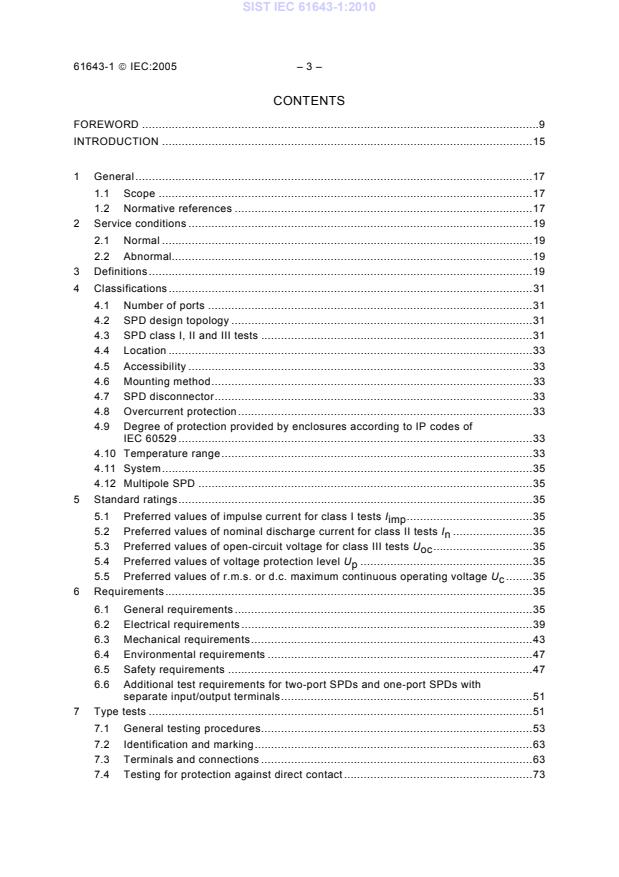
CONTENTS FOREWORD.9 INTRODUCTION.15
1 General.17 1.1 Scope.17 1.2 Normative references.17 2 Service conditions.19 2.1 Normal.19 2.2 Abnormal.19 3 Definitions.19 4 Classifications.31 4.1 Number of ports.31 4.2 SPD design topology.31 4.3 SPD class I, II and III tests.31 4.4 Location.33 4.5 Accessibility.33 4.6 Mounting method.33 4.7 SPD disconnector.33 4.8 Overcurrent protection.33 4.9 Degree of protection provided by enclosures according to IP codes of IEC 60529.33 4.10 Temperature range.33 4.11 System.35 4.12 Multipole SPD.35 5 Standard ratings.35 5.1 Preferred values of impulse current for class I tests Iimp.35 5.2 Preferred values of nominal discharge current for class II tests In.35 5.3 Preferred values of open-circuit voltage for class III tests Uoc.35 5.4 Preferred values of voltage protection level Up.35 5.5 Preferred values of r.m.s. or d.c. maximum continuous operating voltage Uc.35 6 Requirements.35 6.1 General requirements.35 6.2 Electrical requirements.39 6.3 Mechanical requirements.43 6.4 Environmental requirements.47 6.5 Safety requirements.47 6.6 Additional test requirements for two-port SPDs and one-port SPDs with separate input/output terminals.51 7 Type tests.51 7.1 General testing procedures.53 7.2 Identification and marking.63 7.3 Terminals and connections.63 7.4 Testing for protection against direct contact.73 SIST IEC 61643-1:2010
61643-1 IEC:2005 – 5 –
7.5 Determination of the measured limiting voltage.73 7.6 Operating duty test.83 7.7 SPD disconnectors and safety performance of overstressed SPDs.93 7.8 Test for two-port SPDs and one-port SPDs with separate input/output terminals.111 7.9 Additional tests.117 8 Routine and acceptance tests.151 8.1 Routine tests.151 8.2 Acceptance tests.151
Annex A (informative)
Considerations for SPDs when class I tests are to be applied.153 Annex B
(normative)
TOV values.157
Bibliography.159
Figure 1 – Example of a decoupling network for single-phase power.61 Figure 2 – Example of a decoupling network for three-phase power.61 Figure 3 – Test flow chart to determine the voltage protection level Up.77 Figure 4 – Alternate test for the measured limiting voltage.83 Figure 5 – Flow chart of the operating duty test.85 Figure 6 – Preconditioning and operating duty cycle test schedule.89 Figure 6a – Test circuit for SPDs with Ifi lower than the declared
short-circuit withstand capability.101 Figure 13 – Example of a circuit for use in testing SPDs under TOVs caused by
faults in the high (medium) voltage system and the corresponding timing diagram for the prospective voltages at the SPD terminals.107 Figure 7 – Example of a test circuit and corresponding timing diagram to
perform the test under TOVs caused by faults in
the low voltage system.109 Figure 8 – Apparatus for testing the cord retention.119 Figure 9 – Apparatus for flexing test.123 Figure 10a – Test apparatus.127 Figure 10 – Impact test apparatus.129 Figure 11 – Tumbling barrel.135 Figure 12a – Ball thrust tester.139 Figure 12b – Loading rod for ball thrust tester.139 Figure A.1 – General distribution of lightning current.155
Table 1 – Class I, II and III tests.31 Table 2 – Type test requirements where applicable for SPDs.55 Table 3 – Parameters for class I test.57 Table 4 – Tolerances on class III test waveform parameters.61 Table 5 – Screw thread diameters and applied torques.65 Table 6 – Connectable cross-sections of copper conductors for screw-type terminals or screwless terminals.67 Table 7 – Pulling forces (screw terminals).67 SIST IEC 61643-1:2010
61643-1 IEC:2005 – 7 –
Table 8 – Conductor dimensions.69 Table 9 – Pulling force (screwless terminals).71 Table 10 – Tests to be performed to determine the measured limiting voltage.73 Table 11 – Prospective short-circuit current and power factor.97 Table 11x – Current factor k for overload behaviour.115 Table 12 – Tightening requirements for clamping screws.119 Table 13 – Fall distance for impact requirement.131 Table 14 – Air clearances and creepage distances for SPDs category outdoor.143 Table 15 – Air clearances and creepage distances for SPDs category indoor.145 Table 16 – Dielectric withstand.149 Table 17 – Tolerances for proportional surge currents.151 Table B.1 – TOV test values.157
61643-1 IEC:2005 – 9 –
INTERNATIONAL ELECTROTECHNICAL COMMISSION _________
LOW-VOLTAGE SURGE PROTECTIVE DEVICES –
Part 1: Surge protective devices connected
to low-voltage power distribution systems –
Requirements and tests
FOREWORD 1) The International Electrotechnical Commission (IEC) is a worldwide organization for standardization comprising all national electrotechnical committees (IEC National Committees). The object of IEC is to promote international co-operation on all questions concerning standardization in the electrical and electronic fields. To this end and in addition to other activities, IEC publishes International Standards, Technical Specifications, Technical Reports, Publicly Available Specifications (PAS) and Guides (hereafter referred to as “IEC Publication(s)”). Their preparation is entrusted to technical committees; any IEC National Committee interested in the subject dealt with may participate in this preparatory work. International, governmental and non-governmental organizations liasing with the IEC also participate in this preparation. IEC collaborates closely with the International Organization for Standardization (ISO) in accordance with conditions determined by agreement between the two organizations. 2) The formal decisions or agreements of IEC on technical matters express, as nearly as possible, an international consensus of opinion on the relevant subjects since each technical committee has representation from all interested IEC National Committees.
3) IEC Publications have the form of recommendations for international use and are accepted by IEC National Committees in that sense. While all reasonable efforts are made to ensure that the technical content of IEC Publications is accurate, IEC cannot be held responsible for the way in which they are used or for any misinterpretation by any end user. 4) In order to promote international uniformity, IEC National Committees undertake to apply IEC Publications transparently to the maximum extent possible in their national and regional publications. Any divergence between any IEC Publication and the corresponding national or regional publication shall be clearly indicated in the latter. 5) IEC provides no marking procedure to indicate its approval and cannot be rendered responsible for any equipment declared to be in conformity with an IEC Publication. 6) All users should ensure that they have the latest edition of this publication. 7) No liability shall attach to IEC or its directors, employees, servants or agents including individual experts and members of its technical committees and IEC National Committees for any personal injury, property damage or other damage of any nature whatsoever, whether direct or indirect, or for costs (including legal fees) and expenses arising out of the publication, use of, or reliance upon, this IEC Publication or any other IEC Publications.
8) Attention is drawn to the Normative references cited in this publication. Use of the referenced publications is indispensable for the correct application of this publication. 9) Attention is drawn to the possibility that some of the elements of this IEC Publication may be the subject of patent rights. IEC shall not be held responsible for identifying any or all such patent rights. International Standard IEC 61643-1 has been prepared by subcommittee 37A: Low-voltage surge protective devices, of IEC technical committee 37: Surge arresters. This second edition of IEC 61643-1 cancels and replaces the first edition of IEC 61643-1, published 1998, Amendment 1 (2001) and corrigendum 1 (2003). This edition incorporates Amendment 2 which was not published separately due to the number of changes and pages The document 37A/169/FDIS, circulated to the National Committees as amendment 2, led to the publication of this standard. SIST IEC 61643-1:2010
61643-1 IEC:2005 – 11 –
The text of this standard is based on the first edition of IEC 61643-1, its Amendment 1, its corrigendum 1 and on the following documents: FDIS Report of voting 37A/169/FDIS 37A/172/RVD
Full information on the voting for the approval of this standard can be found in the report on voting indicated in the above table. This publication has been drafted in accordance with the ISO/IEC Directives, Part 2. The IEC TC 37, SC 37A and SC 37B have adopted a new numbering scheme for all IEC publications developed within these committees. In this scheme, the IEC 61643 series of publications covers all the publications from SC 37A and SC 37B according to the table below with the common general title Low-voltage surge protective devices. Publication No Title Present document IEC 61643 Low-voltage surge protective devices – IEC 61643-11 Low-voltage surge protective devices – Part 11: Surge protective devices connected to low-voltage power distribution systems – Performance requirements and testing methods IEC 61643-1 IEC 61643-12 Low-voltage surge protective devices – Part 12: Surge protective devices connected to low-voltage power distribution systems – Selection and application principles IEC 61643-12 IEC 61643-21 Low-voltage surge protective devices – Part 21: Surge protective devices connected to telecommunications and signalling networks – Performance requirements and testing methods IEC 61643-21 IEC 61643-22 Low-voltage surge protective devices – Part 22: Surge protective devices connected to telecommunications and signalling networks – Selection and application principles
IEC 61643-301 Low-voltage surge protective devices – Components for surge protective devices – Part 301: General test specifications
IEC 61643-302 Low-voltage surge protective devices – Components for surge protective devices – Part 302: General performance specifications
IEC 61643-303 Low-voltage surge protective devices – Components for surge protective devices – Part 303: General selection and application principles
IEC 61643-311 Low-voltage surge protective devices – Components for surge protective devices – Part 311: Test specification for gas discharge tubes (GDTs) IEC 61643-311 IEC 61643-312 Low-voltage surge protective devices – Components for surge protective devices – Part 312: Performance specification for gas discharge tubes (GDTs)
IEC 61643-313 Low-voltage surge protective devices – Components for surge protective devices – Part 313: Selection and applications principles for gas discharge tubes (GDTs)
IEC 61643-321 Low-voltage surge protective devices – Components for surge protective devices – Part 321: Test specification for avalanche breakdown diodes (ABDs) IEC 61643-321 SIST IEC 61643-1:2010
61643-1 IEC:2005 – 13 –
IEC 61643-322 Low-voltage surge protective devices – Components for surge protective devices – Part 322: Performance specification for avalanche breakdown diodes (ABDs)
IEC 61643-323 Low-voltage surge protective devices – Components for surge protective devices – Part 323: Selection and applications principles for avalanche breakdown diodes (ABDs)
IEC 61643-331 Low-voltage surge protective devices – Components for surge protective devices – Part 331: Test specification for metal oxide varistors (MOVs) IEC 61643-331 IEC 61643-332 Low-voltage surge protective devices – Components for surge protective devices – Part 332: Performance specification for metal oxide varistors (MOVs)
IEC 61643-333 Low-voltage surge protective devices – Components for surge protective devices – Part 333: Selection and application principles for metal oxide varistors (MOVs)
IEC 61643-341 Low-voltage surge protective devices – Components for surge protective devices – Part 341: Test specification for thyristor surge suppressors (TSSs) IEC 61643-341 IEC 61643-342 Low-voltage surge protective devices – Components for surge protective devices – Part 342: Performance specification for thyristor surge suppressors (TSSs)
IEC 61643-343 Low-voltage surge protective devices – Components for surge protective devices – Part 343: Selection and application principles for thyristor surge suppressors (TSSs)
The committee has decided that the contents of this publication will remain unchanged until the maintenance result date indicated on the IEC web site under "http://webstore.iec.ch" in the data related to the specific publication. At this date, the publication will be
• reconfirmed; • withdrawn; • replaced by a revised edition, or • amended.
61643-1 IEC:2005 – 15 –
INTRODUCTION The present standard addresses performance tests for surge protective devices (SPDs). There are three classifications of tests. The class I test is intended to simulate partial conducted lightning current impulses. SPDs subjected to class I test methods are generally recommended for locations at points of high exposure, e.g., line entrances to buildings protected by lightning protection systems. SPDs tested to class II or III test methods are subjected to impulses of shorter duration. These SPDs are generally recommended for locations with lesser exposure. All SPDs are tested on a "black box" basis. Tests are included to assess techniques used by the manufacturers in order to apply the most appropriate test method. Part 12 addresses the selection and application principles of SPDs in practical situations. SIST IEC 61643-1:2010
61643-1 IEC:2005 – 17 –
LOW-VOLTAGE SURGE PROTECTIVE DEVICES –
Part 1: Surge protective devices connected
to low-voltage power distribution systems –
Requirements and tests
1 General 1.1 Scope This part of IEC 61643 is applicable to devices for surge protection against indirect and direct effects of lightning or other transient overvoltages. These devices are packaged to be connected to 50/60 Hz a.c. and d.c. power circuits, and equipment rated up to 1 000 V r.m.s. or 1 500 V d.c. Performance characteristics, standard methods for testing, and ratings are established for these devices that contain at least one nonlinear component that is intended to limit surge voltages and divert surge currents.
1.2 Normative references The following referenced documents are indispensable for the application of this document. For dated references, only the edition cited applies. For undated references, the latest edition of the referenced document (including any amendments) applies. IEC 60060-1:1989, High-voltage test techniques – Part 1: General definitions and test requirements IEC 60112:2003, Method for determining the comparative and the proof tracking indices of solid insulating materials under moist conditions IEC 60227 (all parts), Polyvinyl chloride insulated cables of rated voltages up to and including 450/750 V IEC 60245 (all parts), Rubber insulated cables – Rated voltages up to and including 450/750 V IEC 60364-5-53:2001, Electrical installations of buildings – Part 5-53: Selection and erection of electrical equipment – Isolation, switching and control IEC 60529:1989, Degrees of protection provided by enclosures (IP code) IEC 60664-1:1992, Insulation coordination for equipment within low-voltage systems – Part 1: Principles, requirements and tests IEC 60695-2-1/1:1994, Fire hazard testing – Part 2-1/1: Test methods – Sheet 1: Glow wire end-product test and guidance IEC 60884-1:2002, Plugs and socket outlets for household and similar purposes – Part 1: General requirements IEC 60947-1:1996, Low voltage switchgear and controlgear – Part 1: General rules SIST IEC 61643-1:2010
61643-1 IEC:2005 – 19 –
IEC 60947-5-1:2003, Low-voltage switchgear and controlgear – Part 5-1: Control circuit devices and switching elements – Electromechanical control circuit devices IEC 60999 (all parts), Connecting devices – for electrical copper conductors – Safety require-ments for screw-type and screwless type clamping units IEC 61180-1:1992, High-voltage test techniques for low voltage equipment – Part 1: Definitions, test and procedure requirements IEC 61643-12:2002, Low-voltage surge protective devices – Part 12: Surge protective devices connected to low-voltage power distribution systems –Selection and application principles
2 Service conditions 2.1 Normal 2.1.1 Frequency: frequency of the supply mains is between 48 Hz and 62 Hz a.c. 2.1.2 Voltage: the voltage applied continuously between the terminals of the Surge Protective Device (SPD) must not exceed its maximum continuous operating voltage. 2.1.3 Altitude: altitude shall not exceed 2 000 m. 2.1.4 Operating and storage temperatures – normal range:
–5 °C to +40 °C – extended range:
–40 °C to +70 °C 2.1.5 Humidity – relative humidity: under indoor temperature conditions shall be between 30 % and 90 %. 2.2 Abnormal Exposure of the SPD to abnormal service conditions may require special consideration in the design or application of the SPD, and should be called to the attention of the manufacturer. For outdoor SPDs exposed to solar or other radiation, additional requirements may be necessary.
3 Definitions For the purpose of this part of IEC 61643, the following definitions apply. 3.1 Surge Protective Device SPD device that is intended to limit transient overvoltages and divert surge currents. It contains at least one nonlinear component 3.2 one-port SPD SPD connected in shunt with the circuit to be protected. A one port device may have separate input and output terminals without a specific series impedance between these terminals SIST IEC 61643-1:2010
61643-1 IEC:2005 – 21 –
3.3 two-port SPD SPD with two sets of terminals, input and output. A specific series impedance is inserted between these terminals 3.4 voltage switching type SPD SPD that has a high impedance when no surge is present, but can have a sudden change in impedance to a low value in response to a voltage surge. Common examples of components used as voltage switching devices are spark gaps, gas tubes, thyristors (silicon-controlled rectifiers) and triacs. These SPDs are sometimes called "crowbar type" 3.5 voltage limiting type SPD SPD that has a high impedance when no surge is present, but will reduce it continuously with increased surge current and voltage. Common examples of components used as non-linear devices are varistors and suppressor diodes. These SPDs are sometimes called "clamping type" 3.6 combination type SPD SPD that incorporates both voltage switching type components and voltage limiting type components may exhibit voltage switching, voltage limiting or both voltage switching and voltage limiting behaviour depending upon the characteristics of the applied voltage 3.7 modes of protection SPDs protective component may be connected line-to-line or line-to-earth or line-to-neutral or neutral-to-earth and combinations thereof. These paths are referred to as modes of protection 3.8 nominal discharge current
In crest value of the current through the SPD having a current waveshape of 8/20. This is used for the classification of the SPD for class II test and also for preconditioning of the SPD for class I and II tests 3.9
impulse current
Iimp
defined by three parameters, a current peak value Ipeak, a charge Q and a specific energy W/R.
Note: This is used for the classification of the SPD for test class I 3.10 maximum discharge current Imax for class II test crest value of a current through the SPD having an 8/20 waveshape and magnitude according to the test sequence of the class II operating duty test. Imax is greater than In 3.11 maximum continuous operating voltage
Uc maximum r.m.s. or d.c. voltage, which may be continuously applied to the SPD´s mode of protection SIST IEC 61643-1:2010
61643-1 IEC:2005 – 23 –
3.12 standby power consumption Pc power consumed by the SPD when energized at the maximum continuous operating voltage (Uc) with balanced voltages and phase angles and no load. The SPD is connected in accordance with the manufacturer's instructions 3.13 follow current
If current supplied by the electrical power system and flowing through the SPD after a discharge current impulse. The follow current is significantly different from the continuous operating current Ic 3.14 rated load current
IL maximum continuous rated r.m.s. or d.c. current that can be supplied to a load connected to the protected output of an SPD 3.15 voltage protection level
Up a parameter that characterizes the performance of the SPD in limiting the voltage across its terminals, which is selected from a list of preferred values. This value shall be greater than the highest value of the measured limiting voltages. 3.16 measured limiting voltage the maximum magnitude of voltage that is measured across the terminals of the SPD during the application of impulses of specified waveshape and amplitude 3.17 residual voltage
Ures the peak value of voltage that appears between the terminals of an SPD due to the passage of discharge current 3.18 temporary overvoltage test value
UT test voltage applied, for a specific duration, to the SPD to simulate the stress under TOV conditions
3.19 load-side surge withstand capability for a two-port SPD ability of a two-port SPD to withstand surges on the output terminals originated in loads downstream of the SPD 3.20 voltage drop (in per cent)
∆U = ((UIN – UOUT) / UIN) × 100 % where UIN
is the input voltage and UOUT is the output voltage measured simultaneously with a full rated resistive load connected. This parameter is only used for two-port SPDs. SIST IEC 61643-1:2010
61643-1 IEC:2005 – 25 –
3.21 insertion loss at a given frequency, the insertion loss of an SPD connected into a given power system is defined as the ratio of voltages appearing across the mains immediately beyond the point of insertion before and after the insertion of the SPD under test. This result is expressed in decibels NOTE Requirements and tests are under consideration. 3.22 1,2/50 voltage impulse voltage impulse with a virtual front time of 1,2 µs and a time to half-value of 50 µs Note 1 the front
time is defined according to IEC 60060-1 to be 1,67 x (t90 – t30), where t90 and t30 are the 90 % and 30 % points on the leading edge of the waveform; Note 2 the time to half-value is defined as the time between the virtual origin and the 50 % point on the tail. The virtual origin is the point where a straight line, drawn through the 30 % and 90 % points on the leading edge of the waveform, intersects the U = 0 line.
3.23 8/20 current impulse current impulse with a virtual front time of 8 µs and a time to half-value of 20 µs Note 1 the front time is defined according to IEC 60060-1 to be 1,25 x (t90 – t10), where t90 and t10 are the 90 % and 10 % points on the leading edge of the waveform; Note 2 the time to half-value is defined as the time between the virtual origin and the 50 % point on the tail. The virtual origin is the point where a straight line, drawn through the 10 % and 90 % points on the leading edge of the waveform, intersects the I = 0 line.
3.24 combination wave the combination wave is delivered by a generator that applies a 1,2/50 voltage impulse across an open circuit and an 8/20 current impulse into a short circuit. The voltage, current amplitude and waveforms that are delivered to the SPD are determined by the generator and the impedance of the SPD to which the surge is applied. The ratio of peak open-circuit voltage to peak short-circuit current is 2 Ω; this is defined as the fictive impedance Zf. The short-circuit current is symbolized by Isc. The open-circuit voltage is symbolized by Uoc 3.25 thermal runaway operational condition when the sustained power dissipation of an SPD exceeds the thermal dissipation capability of the housing and connections, leading to a cumulative increase in the temperature of the internal elements culminating in failure 3.26 thermal stability SPD is thermally stable if after the operating duty test causing temperature rise, the temperature of the SPD decreases with time when the SPD is energized at specified maximum continuous operating voltage and at specified ambient temperature conditions 3.27 degradation change of original performance parameters as a result of exposure of the SPD to surge, service or unfavourable environment SIST IEC 61643-1:2010
61643-1 IEC:2005 – 27 –
3.28 short-circuit withstand maximum prospective short-circuit current that the SPD is able to withstand 3.29 SPD disconnector device (internal and/or external) required for disconnecting an SPD from the power system NOTE This disconnecting device is not required to have isolating capability. It is to prevent a persistent fault on the system and is used to give an indication of the SPD failure.
There may be more than one disconnector function, for example an overcurrent protection function and a thermal protection function. These functions may be integrated into one unit or performed in separate units. 3.30 degrees of protection provided by enclosure
IP code the extent of protection provided by an enclosure against access to hazardous parts, against ingress of solid foreign objects and/or against ingress of water (see IEC 60529) 3.31 type tests tests which are made upon the completion of the development of a new SPD design. They are used to establish representative performance and to demonstrate compliance with the relevant standard. Once made, these tests need not be repeated unless the design is changed so as to modify its performance. In such a case, only the relevant tests need be repeated 3.32 routine tests tests made on each SPD or on parts and materials as required to ensure that the product meets the design specifications 3.33 acceptance tests tests which are made when it has been agreed between the manufacturer and the purchaser that the SPD or representative samples of an order are to be tested 3.34 decoupling network device intended to prevent surge energy from being propagated to the power network during energized testing of SPD. Sometimes called a "back filter" 3.35
impulse test classification 3.35.1 class I tests tests carried out with the nominal discharge current In defined in 3.8, the 1,2/50 voltage impulse defined in 3.22, and the maximum impulse current Iimp for class I test defined in 3.9 3.35.2 class II tests tests carried out with the nominal discharge current In defined in 3.8, the 1,2/50 voltage defined in 3.22, and the maximum discharge current Imax for class II test defined in 3.10 3.35.3 class III tests tests carried out with the combination wave (1,2/50, 8/20) defined in 3.24 SIST IEC 61643-1:2010
61643-1 IEC:2005 – 29 –
3.36 overcurrent protection
overcurrent device (for example, circuit-breaker or fuse), which could be part of the electrical installation located externally upstream of the SPD 3.37 residual current device (RCD) mechanical switching device or association of devices intended to cause the opening of the contacts when the residual or unbalanced current attains a given value under specified conditions 3.38 sparkover voltage of a voltage switching SPD maximum voltage value before disruptive discharge between the electrodes of the gap of a SPD 3.39 specific energy W/R for class I test energy dissipated by the impulse current Iimp in a unit resistance of 1 Ω. It is equal to the time integral of the square of the current W/R = ∫ i2dt
3.40 prospective short-circuit current of a power supply
Ip current which would flow at a given location in a circuit if it were short-circuited at that location by a link of negligible impedance 3.41 follow current interrupting rating
Ifi prospective short-circuit current that an SPD is able to interrupt by itself 3.42 residual current
IPE current flowing through the PE terminal, when the SPD is energized at the maximum continuous operating voltage (Uc) when connected according to the manufacturer’s instructions 3.43
status indicator device that indicates the operational status of an SPD NOTE Such indicators may be local with visual and/or audible alarms and/or may have remote signalling and/or output contact capability. 3.44 output contact contact included in a circuit separate from the main circuits and linked to an SPD disconnector or a status indicator 3.45 nominal a.c. voltage of the system
Uo nominal line to neutral voltage (r.m.s. value of the a.c. voltage) of the system SIST IEC 61643-1:2010
61643-1 IEC:2005 – 31 –
3.46 multipole SPD type of SPD with more than one mode of protection, or a combination of electrically interconnected SPDs offered as a unit 3.47 total discharge current
ITotal current which flows through the PE or PEN conductor of a multipole SPD during the total discharge current test NOTE 1 This test is used to check for the cumulative effects that occur when multiple modes of protection of a multipole SPD conduct at the same time. NOTE 2 ITotal is particularly relevant for class I tested SPDs used for the purpose of lightning protection equipotential bonding according to IEC 61312 series. 3.48
maximum continuous operating voltage of the power system
Ucs maximum r.m.s. or d.c. voltage to which the SPD may be permanently subjected at the point of application of the SPD NOTE This only takes into account voltage regulation and/or voltage drop or increase. It is also called “actual maximum system voltage” and is directly linked to U0. 4 Classifications The manufacture shall classify the SPDs in accordance with the following parameters. 4.1 Number of ports 4.1.1 One 4.1.2 Two 4.2 SPD design topology 4.2.1 Voltage switching type
4.2.2 Voltage limiting type
4.2.3 Combination type
4.3 SPD class I, II and III tests Information required for class I, class II and class III tests is given in Table 1. Table 1 – Class I, II and III tests
Tests Required information Test procedures (see subclauses) Class I Iimp
7.1.1 Class II Imax
7.1.2 Class III Uoc
7.1.4
61643-1 IEC:2005 – 33 –
4.4 Location 4.4.1 Indoor 4.4.2 Outdoor NOTE For SPDs, which are made and classified for outdoor use only, and for mounting out of reach, it is in general not required to fulfil all the requirements with regard to protection of the surrounding environment. 4.5 Accessibility 4.5.1 Accessible 4.5.2 Inaccessible (out-of-reach) NOTE Out-of-reach means no access to live parts without the use of tools or other equipment. 4.6 Mounting method 4.6.1 Fixed 4.6.2 Portable 4.7 SPD disconnector 4.7.1 Location
4.7.1.1 Internal 4.7.1.2 External 4.7.1.3 Both (one part internal and one part external) 4.7.2 Protection functions 4.7.2.1 Thermal
4.7.2.2 Leakage current
4.7.2.3 Overcurrent NOTE The disconnector may not be necessary. 4.8 Overcurrent protection 4.8.1 Specified 4.8.2 Not specified 4.9 Degree of protection provided by enclosures according to IP codes of IEC 60529
4.10 Temperature range 4.10.1 Normal 4.10.2 Extended
61643-1 IEC:2005 – 35 –
4.11 System 4.11.1 a.c. between 48 Hz and 62 Hz 4.11.2 d.c.
4.11.3 a.c. and d.c.
4.12 Multipole SPD 5 Standard ratings 5.1 Preferred values of impulse current for class I tests Iimp
I
peak
1,0;
2;
5;
10;
and
20 kA Q charge 0,5;
1;
2,5;
5;
and
10 As 5.2 Preferred values of nominal discharge current for class II tests In 0,05 0,1 0,25 0,5 1,0 1,5 2,0 2,5 3,0 5,0
15 and 20 kA 5.3 Preferred values of open-circuit voltage for class III tests Uoc 0,1 0,2 0,5 1
2 3 4 5 6 10 and 20 kV 5.4 Preferred values of voltage protection level Up 0,08 0,09 0,10 0,12 0,15 0,22 0,33 0,4 0,5 0,6 0,7 0,8 0,9
1,0 1,2 1,5 1,8 2,0 2,5 3,0 4,0 5,0 6,0 8,0 and 10 kV 5.5 Preferred values of r.m.s. or d.c. maximum continuous operating voltage Uc 52 63 75 95 110 130 150 175 220 230 240 250 260 275 280 320 420 440 460 510 530 600 630 690 800 900 1 000 and 1 500 V 6 Requirements
6.1 General requirements 6.1.1 Identification
The following minimum information shall be provided by the manufacturer. Tested in accordance with clause 7.
a) Manufacturer's name or trade mark and model number b) Location category c) Number of ports d) Method of mounting e) Maximum continuous operating voltage Uc (one value for each mode of protection) SIST IEC 61643-1:2010
61643-1 IEC:2005 – 37 –
f) Test classification and discharge parameters for each mode of protection declared by the manufacturer and printed next to each other:
– for test class I: “test class I” and “IImp“ and the value in kA, or
“T1“ (T1 in a square) and “IImp“and the value in kA – for test class II: “test class II” and “Imax“ and the value in kA, or
“T2” (T2 in a square) and “Imax“ and the value in kA – for test class III: “test class III” and “Uoc“ and the value in kV, or
“T3“ (T3 in a square) and “Uoc“ and the value in kV. g) Nominal discharge current In for classes I and II (one value for each mode of protection) h) Voltage protection level Up (one value for each mode of protection) i) Rated load current IL (if required) j) Degree of protection provided by the enclosure (IP code) (if IP > 20) k) Short-circuit withstand l) Maximum recommended ratings of overcurrent protection (if applicable) m) Indication of disconnector operation (if any) n) Position of normal use if significant o) Identification of terminals (if necessary) p) Installation instructions (e.g. connection to LV systems, mechanical dimensions, lead lengths, etc.) q) Type of current: a.c. frequency or d.c., or both
r) Specific energy W/R for class I test only (from 7.1.1) s) Temperature range t) Follow current interrupting rating Ifi (except in the case of voltage limiting type SPDs) u) The external SPD disconnector requirements shall be defined by the manufacturer v) Residual current IPE (optional) w) Temporary overvoltage (TOV) characteristic
x)
Total discharge current ITotal for multipole SPDs (if declared by the manufacturer). 6.1.2 Marking Markings a), e), f), g), h), j), I), o) and q) in 6.1.1 are mandatory on the body, or permanently attached to the body, of the SPD. Marking shall be indelible and legible and shall not be placed on screws and removable washers. Compliance is in accordance with the test of 7.2. NOTE Where space is limited, the manufacturer's name or trade mark and model number will appear on the device; other markings should appear on the smallest package. SIST IEC 61643-1:2010
61643-1 IEC:2005 – 39 –
6.2 Electrical requirements 6.2.1 Electrical connections Terminals shall be designed for the connection of cables having a minimum and a maximum cross-sectional area according to the manufacturer declaration. Each of the tests must be passed by using the most severe configuration (i.e. the maximum or minimum cross-sectional area depending on the test (see clause 7). The SPD shall be equipped with terminals where electrical connection is possible by means of screws, nuts, plugs, sockets or equal effective means. This is checked in 7.3. 6.2.2 Voltage protection level Up The measured limiting voltage of SPDs shall not exceed the voltage protection level that is specified by the manufacturer. Compliance is in accordance with the test of 7.5. 6.2.3 Class I impulse current test(s) An SPD shall be tested to class I test when the manufacturer declares that it meets those requirements. Compliance is in accordance with the test of 7.6.5. 6.2.4
Class II nominal discharge current test(s) An SPD shall be tested to class II test when the manufacturer declares that it meets those requirements. Compliance is in accordance with 7.6.5. 6.2.5 Class III combination wave test(s) An SPD shall be tested to class III test when the manufacturer declares that it meets those requirements. Compliance is in accordance with the test of 7.6.7. 6.2.6 Operating duty test The SPD shall be capable of withstanding specified discharge currents during application of the maximum continuous operating voltage Uc without unacceptable changes in its characteristics. Compliance is in accordance with the test of 7.6. 6.2.7 SPD disconnector The SPD may have SPD disconnectors (which can be either internal, external or both). Their operation shall be indicated. NOTE Installation requirements not related to the SPDs may require additional and/or lower rated overcurrent protective devices. SPD disconnectors shall be tested with the SPD during the sequence of type tests of 7.7 and 7.8.3, except for RCDs, which are not tested during the operating duty test according to 7.7.1. Compliance is in accorda
...