

SIST EN 13885:2022
(Main)Food processing machinery - Clipping machines - Safety and hygiene requirements
General Information
- Abstract
This document specifies safety and hygiene requirements of clipping machines (hereafter referred to as machine) for closing of casings filled with foodstuffs (hereafter referred to as product) by using a clip, and which are intended to be used in butcheries, meat processing factories, main kitchens and other food processing factories.
Clipping machines are used to close tubes with a single clip (one side) or a double clip (end locking and start locking).
The machines are equipped with closing tools (punch/die), which create the closure by deforming the locking element (clip).
This document deals with all significant hazards, hazardous situations and hazardous events relevant to machinery when it is used as intended and under conditions of misuse which are reasonably foreseeable by the manufacturer (see Clause 4).
This document covers the following types of machines:
— semi-automatic machine (see Figure 1 and Figure 2);
— automatic machine (see Figure 3).
This document does not cover any machines whose closing procedure is only performed manually.
This document is not applicable to machinery manufactured before the date of publication of this document by CEN.
- Status
- Published
- Public Enquiry End Date
- 30-Dec-2019
- Publication Date
- 10-Nov-2022
- Technical Committee
- VSN - Safety of machinery
- Current Stage
- 6060 - National Implementation/Publication (Adopted Project)
- Start Date
- 03-Aug-2022
- Due Date
- 08-Oct-2022
- Completion Date
- 11-Nov-2022
- Directive
- 2006/42/EC - Directive 2006/42/EC of the European Parliament and of the Council of 17 May 2006 on machinery, and amending Directive 95/16/EC (recast)OJ Ref: OJ L 194, TIP C,7.9.2026 UMIK 20.1.2027 OJ Date: 02-Aug-2023 Conflicting Date: 20-Jan-2027

Overview
EN 13885:2022 - Food processing machinery: Clipping machines - Safety and hygiene requirements is a CEN European standard that sets safety and hygiene rules for machines used to close food casings with clips. It applies to clipping machines intended for butcheries, meat processing factories, main kitchens and other food-processing facilities. The standard covers semi‑automatic and automatic clipping machines (not machines where the clip is formed only manually) and replaces EN 13885:2005+A1:2010.
Key topics
- Scope and definitions - Precise terms for clipping machines, clips, closure tools (punch/die), infeed/outfeed, casing, removal devices and accessories (labellers, hanging devices).
- Risk coverage - Addresses all significant hazards, hazardous situations and foreseeable misuse relevant to these machines (see Annex D).
- Safety requirements - Mechanical hazards, guards, interlocks, two‑hand controls, guarding position and safety distances.
- Electrical & EMC - Requirements for electrical equipment and electromagnetic compatibility consistent with EN 60204‑1 and related standards.
- Pneumatic and instability hazards - Safety rules for pneumatic systems and stability of equipment.
- Noise & ergonomics - Noise testing and reduction (Annex A) and ergonomic considerations for safe manual handling and operation.
- Hygiene & cleanability - Design principles to ensure machines can be cleaned and maintained without contamination risk (Annex B), and lubrication hygiene (EN ISO 21469).
- Verification & performance levels - Procedures for verifying safety measures and required performance levels for safety functions (Annex C).
- Information for use - Instruction handbook, marking and user information requirements, and linkage to Directive 2006/42/EC (Annex ZA).
Applications
EN 13885:2022 is used to:
- Guide machine manufacturers in designing safe, hygienic clipping machines (semi‑automatic and automatic).
- Inform safety regulators and conformity assessors when checking machinery against the Machinery Directive.
- Help food processors, butchers and main kitchens select, install and operate clipping machines that meet recognized safety and hygiene expectations.
- Support maintenance and service providers in applying correct cleaning, guarding and verification procedures.
Who should use it
- Clipping machine designers and manufacturers
- Food plant safety managers and procurement teams
- Regulatory and market surveillance authorities
- Maintenance, cleaning and validation teams in meat and food processing industries
Related standards
Relevant normative references include EN ISO 12100 (risk assessment), EN 60204‑1 (electrical equipment), EN ISO 13849‑1 (safety-related control systems), EN 1672‑2 (hygiene), EN ISO 14120 (guards) and EN ISO 21469 (lubricants with incidental product contact). These support compliance and integrated safety/hygiene design.
Relations
- Effective Date
- 03-Aug-2022
- Effective Date
- 09-Feb-2026
- Effective Date
- 09-Feb-2026
- Effective Date
- 09-Feb-2026
- Effective Date
- 09-Feb-2026
- Effective Date
- 09-Feb-2026
- Effective Date
- 28-Jan-2026
- Effective Date
- 28-Jan-2026
- Effective Date
- 28-Jan-2026
- Refers
SIST EN 1672-2:2021 - Food processing machinery - Basic concepts - Part 2: Hygiene requirements - Effective Date
- 28-Jan-2026
- Effective Date
- 28-Jan-2026
- Effective Date
- 28-Jan-2026
- Effective Date
- 28-Jan-2026
- Effective Date
- 28-Jan-2026
- Effective Date
- 28-Jan-2026
Get Certified
Connect with accredited certification bodies for this standard

BSI Group
BSI (British Standards Institution) is the business standards company that helps organizations make excellence a habit.

Bureau Veritas
Bureau Veritas is a world leader in laboratory testing, inspection and certification services.

DNV
DNV is an independent assurance and risk management provider.
Sponsored listings
Frequently Asked Questions
SIST EN 13885:2022 is a standard published by the Slovenian Institute for Standardization (SIST). Its full title is "Food processing machinery - Clipping machines - Safety and hygiene requirements". This standard covers: This document specifies safety and hygiene requirements of clipping machines (hereafter referred to as machine) for closing of casings filled with foodstuffs (hereafter referred to as product) by using a clip, and which are intended to be used in butcheries, meat processing factories, main kitchens and other food processing factories. Clipping machines are used to close tubes with a single clip (one side) or a double clip (end locking and start locking). The machines are equipped with closing tools (punch/die), which create the closure by deforming the locking element (clip). This document deals with all significant hazards, hazardous situations and hazardous events relevant to machinery when it is used as intended and under conditions of misuse which are reasonably foreseeable by the manufacturer (see Clause 4). This document covers the following types of machines: — semi-automatic machine (see Figure 1 and Figure 2); — automatic machine (see Figure 3). This document does not cover any machines whose closing procedure is only performed manually. This document is not applicable to machinery manufactured before the date of publication of this document by CEN.
This document specifies safety and hygiene requirements of clipping machines (hereafter referred to as machine) for closing of casings filled with foodstuffs (hereafter referred to as product) by using a clip, and which are intended to be used in butcheries, meat processing factories, main kitchens and other food processing factories. Clipping machines are used to close tubes with a single clip (one side) or a double clip (end locking and start locking). The machines are equipped with closing tools (punch/die), which create the closure by deforming the locking element (clip). This document deals with all significant hazards, hazardous situations and hazardous events relevant to machinery when it is used as intended and under conditions of misuse which are reasonably foreseeable by the manufacturer (see Clause 4). This document covers the following types of machines: — semi-automatic machine (see Figure 1 and Figure 2); — automatic machine (see Figure 3). This document does not cover any machines whose closing procedure is only performed manually. This document is not applicable to machinery manufactured before the date of publication of this document by CEN.
SIST EN 13885:2022 is classified under the following ICS (International Classification for Standards) categories: 67.260 - Plants and equipment for the food industry. The ICS classification helps identify the subject area and facilitates finding related standards.
SIST EN 13885:2022 has the following relationships with other standards: It is inter standard links to SIST EN 13885:2005+A1:2010, SIST EN 60529:1997/A2:2014, SIST EN 61496-1:2014, SIST EN 60529:1997, SIST EN 60529:1997/A1:2000, SIST EN 60204-1:2018, SIST EN 1005-3:2002+A1:2008, SIST EN ISO 3744:2010, SIST EN ISO 4871:2009, SIST EN 1672-2:2021, SIST EN ISO 4414:2011, SIST EN ISO 7010:2020, SIST EN ISO 21469:2006, SIST EN ISO 14119:2014, SIST EN ISO 21920-2:2022. Understanding these relationships helps ensure you are using the most current and applicable version of the standard.
SIST EN 13885:2022 is associated with the following European legislation: EU Directives/Regulations: 2006/42/EC; Standardization Mandates: M/396. When a standard is cited in the Official Journal of the European Union, products manufactured in conformity with it benefit from a presumption of conformity with the essential requirements of the corresponding EU directive or regulation.
SIST EN 13885:2022 is available in PDF format for immediate download after purchase. The document can be added to your cart and obtained through the secure checkout process. Digital delivery ensures instant access to the complete standard document.
Standards Content (Sample)
SLOVENSKI STANDARD
01-december-2022
Nadomešča:
SIST EN 13885:2005+A1:2010
Stroji za predelavo hrane - Stroji za sponkanje - Varnostne in higienske zahteve
Food processing machinery - Clipping machines - Safety and hygiene requirements
Nahrungsmittelmaschinen - Clipmaschinen - Sicherheits- und Hygieneanforderungen
Machines pour les produits alimentaires - Machines à attacher - Prescriptions relatives à
la sécurité et à l'hygiène
Ta slovenski standard je istoveten z: EN 13885:2022
ICS:
67.260 Tovarne in oprema za živilsko Plants and equipment for the
industrijo food industry
2003-01.Slovenski inštitut za standardizacijo. Razmnoževanje celote ali delov tega standarda ni dovoljeno.
EN 13885
EUROPEAN STANDARD
NORME EUROPÉENNE
July 2022
EUROPÄISCHE NORM
ICS 67.260 Supersedes EN 13885:2005+A1:2010
English Version
Food processing machinery - Clipping machines - Safety
and hygiene requirements
Machines pour les produits alimentaires - Machines à Nahrungsmittelmaschinen - Clipmaschinen -
attacher - Prescriptions relatives à la sécurité et à Sicherheits- und Hygieneanforderungen
l'hygiène
This European Standard was approved by CEN on 13 June 2022.
CEN members are bound to comply with the CEN/CENELEC Internal Regulations which stipulate the conditions for giving this
European Standard the status of a national standard without any alteration. Up-to-date lists and bibliographical references
concerning such national standards may be obtained on application to the CEN-CENELEC Management Centre or to any CEN
member.
This European Standard exists in three official versions (English, French, German). A version in any other language made by
translation under the responsibility of a CEN member into its own language and notified to the CEN-CENELEC Management
Centre has the same status as the official versions.
CEN members are the national standards bodies of Austria, Belgium, Bulgaria, Croatia, Cyprus, Czech Republic, Denmark, Estonia,
Finland, France, Germany, Greece, Hungary, Iceland, Ireland, Italy, Latvia, Lithuania, Luxembourg, Malta, Netherlands, Norway,
Poland, Portugal, Republic of North Macedonia, Romania, Serbia, Slovakia, Slovenia, Spain, Sweden, Switzerland, Türkiye and
United Kingdom.
EUROPEAN COMMITTEE FOR STANDARDIZATION
COMITÉ EUROPÉEN DE NORMALISATION
EUROPÄISCHES KOMITEE FÜR NORMUNG
CEN-CENELEC Management Centre: Rue de la Science 23, B-1040 Brussels
© 2022 CEN All rights of exploitation in any form and by any means reserved Ref. No. EN 13885:2022 E
worldwide for CEN national Members.
Contents Page
European foreword . 3
Introduction . 5
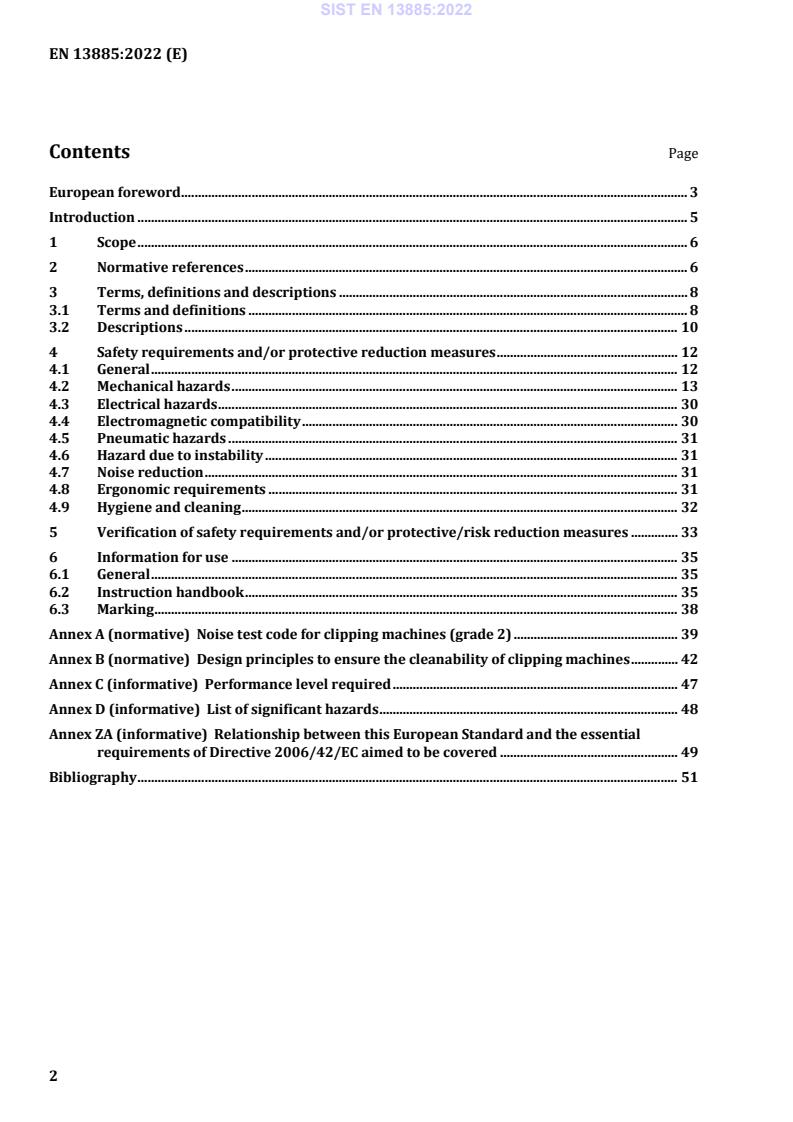
1 Scope . 6
2 Normative references . 6
3 Terms, definitions and descriptions . 8
3.1 Terms and definitions . 8
3.2 Descriptions . 10
4 Safety requirements and/or protective reduction measures . 12
4.1 General . 12
4.2 Mechanical hazards . 13
4.3 Electrical hazards . 30
4.4 Electromagnetic compatibility . 30
4.5 Pneumatic hazards . 31
4.6 Hazard due to instability . 31
4.7 Noise reduction . 31
4.8 Ergonomic requirements . 31
4.9 Hygiene and cleaning . 32
5 Verification of safety requirements and/or protective/risk reduction measures . 33
6 Information for use . 35
6.1 General . 35
6.2 Instruction handbook . 35
6.3 Marking . 38
Annex A (normative) Noise test code for clipping machines (grade 2) . 39
Annex B (normative) Design principles to ensure the cleanability of clipping machines . 42
Annex C (informative) Performance level required . 47
Annex D (informative) List of significant hazards . 48
Annex ZA (informative) Relationship between this European Standard and the essential
requirements of Directive 2006/42/EC aimed to be covered . 49
Bibliography . 51
European foreword
This document (EN 13885:2022) has been prepared by Technical Committee CEN/TC 153 “Machinery
intended for use with foodstuffs and feed”, the secretariat of which is held by DIN.
This European Standard shall be given the status of a national standard, either by publication of an
identical text or by endorsement, at the latest by January 2023, and conflicting national standards shall
be withdrawn at the latest by January 2023.
Attention is drawn to the possibility that some of the elements of this document may be the subject of
patent rights. CEN shall not be held responsible for identifying any or all such patent rights.
This document supersedes EN 13885:2005+A1:2010.
The significant changes with respect to the previous edition EN 13885:2005+A1:2010 are listed below:
— structure adapted to CEN Guide 414:2017;
— figures were improved, partly exchanged or newly inserted;
— Clause 1 Scope: simplified, the description of machine types has been integrated in Clause 3, technical
features have been transformed into requirements;
— Clause 2 Normative references: completed and updated;
— Clause 3 Descriptions, terms and definitions: completed with descriptions and terms updated;
— Clause 4 Safety requirements: safety requirements were revised;
— Clause 5 Verification: adapted to the requirements of Clause 4;
— Clause 6 Information for use: improved and supplemented with references to the relevant clauses;
— Annex A Noise test code: updated;
— Annex B Design principles to ensure the cleanability: updated;
— Annex C Performance level required: added to give a quick-view summary of PLr for each safety
function;
— Annex D List of significant hazards: contains the former Clause 4;
— Annex ZA Relationship to Directive 2006/42/EC: improved and updated.
This document has been prepared under a Standardization Request given to CEN by the European
Commission and the European Free Trade Association, and supports essential requirements of EU
Directive(s) / Regulation(s).
For relationship with EU Directive(s) / Regulation(s), see informative Annex ZA, which is an integral part
of this document.
Any feedback and questions on this document should be directed to the users’ national standards body.
A complete listing of these bodies can be found on the CEN website.
According to the CEN-CENELEC Internal Regulations, the national standards organizations of the
following countries are bound to implement this European Standard: Austria, Belgium, Bulgaria, Croatia,
Cyprus, Czech Republic, Denmark, Estonia, Finland, France, Germany, Greece, Hungary, Iceland, Ireland,
Italy, Latvia, Lithuania, Luxembourg, Malta, Netherlands, Norway, Poland, Portugal, Republic of North
Macedonia, Romania, Serbia, Slovakia, Slovenia, Spain, Sweden, Switzerland, Türkiye and the United
Kingdom.
Introduction
This document is a type-C standard as stated in EN ISO 12100:2010.
This document is of relevance, in particular, for the following stakeholder groups representing the market
players with regard to machinery safety:
— machine manufacturers (small, medium and large enterprises);
— health and safety bodies (regulators, accident prevention organizations, market surveillance etc.).
Others can be affected by the level of machinery safety achieved with the means of the document by the
above-mentioned stakeholder groups:
— machine users/employers (small, medium and large enterprises);
— machine users/employees (e.g. trade unions, organizations for people with special needs);
— service providers, e.g. for maintenance (small, medium and large enterprises);
— consumers (in case of machinery intended for use by consumers).
The above-mentioned stakeholder groups have been given the possibility to participate at the drafting
process of this document.
The machinery concerned and the extent to which hazards, hazardous situations and events are covered
are indicated in the scope of this document.
When requirements of this type-C-standard are different from those which are stated in type-A- or type-
B-standards, the requirements of this type-C-standard take precedence over the requirements of the
other standards for machines that have been designed and built according to the requirements of this
type-C standard.
1 Scope
This document specifies safety and hygiene requirements of clipping machines (hereafter referred to as
machine) for closing of casings filled with foodstuffs (hereafter referred to as product) by a clip deformed
by a closing tool, and which are intended to be used in butcheries, meat processing factories, main
kitchens and other food processing factories.
This document deals with all significant hazards, hazardous situations and hazardous events relevant to
machinery when it is used as intended and under conditions of misuse which are reasonably foreseeable
by the manufacturer (see Annex D).
This document does not cover any devices whose clip is exclusively formed manually.
This document is not applicable to clipping machines manufactured before the date of its publication.
2 Normative references
The following documents are referred to in the text in such a way that some or all of their content
constitutes requirements of this document. For dated references, only the edition cited applies. For
undated references, the latest edition of the referenced document (including any amendments) applies.
EN 619:2002+A1:2010, Continuous handling equipment and systems - Safety and EMC requirements for
equipment for mechanical handling of unit loads
EN 1005-2:2003+A1:2008, Safety of machinery - Human physical performance - Part 2: Manual handling
of machinery and component parts of machinery
EN 1005-3:2002+A1:2008, Safety of machinery - Human physical performance - Part 3: Recommended
force limits for machinery operation
EN 1005-4:2005+A1:2008, Safety of machinery - Human physical performance - Part 4: Evaluation of
working postures and movements in relation to machinery
EN 1672-2:2020, Food processing machinery - Basic concepts - Part 2: Hygiene and cleanability
requirements
EN 60204-1:2018, Safety of machinery - Electrical equipment of machines - Part 1: General requirements
(IEC 60204-1:2016, modified)
EN 60529:1991 , Degrees of protection provided by enclosures (IP Code) (IEC 60529:1989)
EN 61496-1:2013, Safety of machinery - Electro-sensitive protective equipment - Part 1: General
requirements and tests (IEC 61496-1:2012)
EN ISO 3744:2010, Acoustics - Determination of sound power levels and sound energy levels of noise sources
using sound pressure - Engineering methods for an essentially free field over a reflecting plane (ISO
3744:2010)
EN ISO 3746:2010, Acoustics - Determination of sound power levels and sound energy levels of noise sources
using sound pressure - Survey method using an enveloping measurement surface over a reflecting plane (ISO
3746:2010)
As impacted by EN 60529:1991/A1:2000 and EN 60529:1991/A2:2013.
EN ISO 4414:2010, Pneumatic fluid power - General rules and safety requirements for systems and their
components (ISO 4414:2010)
EN ISO 4871:2009, Acoustics - Declaration and verification of noise emission values of machinery and
equipment (ISO 4871:1996)
EN ISO 7010:2020, Graphical symbols - Safety colours and safety signs - Registered safety signs (ISO
7010:2019, Corrected version 2020-06)
EN ISO 11201:2010, Acoustics - Noise emitted by machinery and equipment - Determination of emission
sound pressure levels at a work station and at other specified positions in an essentially free field over a
reflecting plane with negligible environmental corrections (ISO 11201:2010)
EN ISO 11202:2010, Acoustics - Noise emitted by machinery and equipment - Determination of emission
sound pressure levels at a work station and at other specified positions applying approximate environmental
corrections (ISO 11202:2010)
EN ISO 11688-1:2009, Acoustics - Recommended practice for the design of low-noise machinery and
equipment - Part 1: Planning (ISO/TR 11688-1:1995)
EN ISO 12100:2010, Safety of machinery - General principles for design - Risk assessment and risk reduction
(ISO 12100:2010)
EN ISO 13849-1:2015, Safety of machinery - Safety-related parts of control systems - Part 1: General
principles for design (ISO 13849-1:2015)
EN ISO 13851:2019, Safety of machinery - Two-hand control devices - Principles for design and selection
(ISO 13851:2019)
EN ISO 13855:2010, Safety of machinery - Positioning of safeguards with respect to the approach speeds of
parts of the human body (ISO 13855:2010)
EN ISO 13857:2019, Safety of machinery - Safety distances to prevent hazard zones being reached by upper
and lower limbs (ISO 13857:2019)
EN ISO 14119:2013, Safety of machinery - Interlocking devices associated with guards - Principles for
design and selection (ISO 14119:2013)
EN ISO 14120:2015, Safety of machinery - Guards - General requirements for the design and construction
of fixed and movable guards (ISO 14120:2015)
EN ISO 21469:2006, Safety of machinery - Lubricants with incidental product contact - Hygiene
requirements (ISO 21469:2006)
EN ISO 21920-2:2022, Geometrical product specifications (GPS) - Surface texture: Profile - Part 2: Terms,
definitions and surface texture parameters (ISO 21920-2:2021)
3 Terms, definitions and descriptions
For the purposes of this document, the terms and definitions given in EN ISO 12100:2010 and the
following apply.
ISO and IEC maintain terminological databases for use in standardization at the following addresses:
— IEC Electropedia: available at https://www.electropedia.org/
— ISO Online browsing platform: available at https://www.iso.org/obp/
3.1 Terms and definitions
3.1.1
clipping machine
machine for closing of casings filled with foodstuffs by using a clip
3.1.2
product
clipped casing filled with foodstuff
3.1.3
infeed
area where casing and foodstuff are fed to the closing zone
3.1.4
outfeed
area where product leaves the closing zone
3.1.5
clip
element for closing the gathering
3.1.6
clip guide
device for guiding the clip through the channel to the closure tool
3.1.7
casing
flexible element for receiving the foodstuff
EXAMPLE Skins, tubular films, foil bags.
3.1.8
casing brake
device for retaining and braking of the casing on the filling horn
3.1.9
thread dispenser
loop dispenser
device which adds a means to the closing zone for hanging up the product
3.1.10
labelling device
device which feeds a label tape to the closing zone
Note 1 to entry Optionally, further information can be applied to the label during feeding, and the label can also
be cut to length by a cutting device directly before setting the clip.
3.1.11
hanging device
device which holds the product in the outfeed of the clipping machine, hangs it onto sticks and transports
the filled sticks to the discharge station
3.1.12
casing sealing device
device which is located between the inlet opening on the filling horn and the closing zone, which shapes
a flat film tape into a tube and seals the longitudinal seal
3.1.13
gathering
radial folding of the casing
3.1.14
loop
fixed eye for hanging
3.1.15
removal
device for gathering the casing and creating a foodstuff-free area for setting the clip
3.1.15.1
manual removal
device for closing the removal by hand
Note 1 to entry: Only for semi-automatic machines.
3.1.15.2
powered removal
device for closing the removal by means of a power unit
Note 1 to entry: For semi-automatic machines and automatic machines.
3.1.15.3
spread removal
powered removal accompanied by axial spreading of the removal
Note 1 to entry: Only for automatic machines.
3.1.16
closure tool
combination of punch and die
3.1.17
dividing knife
powered knife for automatically cutting through the casing
3.1.18
sleeve
casing slipped axially onto the filling horn
3.1.19
closing zone
space in which the closure tool, removal and, if applicable, the dividing knife are located
3.1.20
filling horn
device for receiving the casing and feeding the foodstuff
3.1.21
rotor
device with several filling horns
Note 1 to entry: One filling horn is in working position while the others are in a position suitable for taking the
next sleeve. As soon as the sleeve of the filling horn that is currently in working position is nearly used up, then the
next filling horn provided with a new sleeve can be turned into working position.
3.2 Descriptions
This clause describes the types of clipping machines, semi-automatic machine (see Figure 1 and Figure 2)
and automatic machines (see Figure 3).
Clipping machines are used to close casings with a single clip (one side) or a double clip (end locking and
start locking).
The machines are equipped with a closure tool, which creates the closure by deforming the clip.
On semi-automatic machines every closure operation is triggered by the action of an operator.
An automatic machine, once started, performs each further closure operation without manual
intervention or start command.
Key
1 closing zone s distance between the parts of the clip guide
2 fixed clip guide s width of the feed opening of the clip guide
a cut A/A see Figure 4 and Figure 5
Figure 1 — Example of a semi-automatic machine without removal
a) Removal open b) Removal closed
Key
1 closing zone 3 fixed part of clip guide
2 movable part of clip guide s distance between the parts of the clip guide
a cut A/A see Figure 4 and Figure 5
Figure 2 — Example of a semi-automatic machine with manual removal
Key
1 closing zone 3 outfeed
2 infeed 4 filling horn
Figure 3 — Example of an automatic machine
4 Safety requirements and/or protective reduction measures
4.1 General
Clipping machines shall comply with the safety requirements and/or protective measures of this clause.
In addition, the machine shall be designed according to the principles of the EN ISO 12100:2010, Clause 4,
for relevant but not significant hazards which are not dealt with by this document (e.g. sharp edges).
The interlocking devices associated with guards shall at least comply with EN ISO 14119:2013 Type 1,
and shall not be positioned in the food area (e.g. inside the machine housing or another housing).
Machines safety functions are implemented and ensured through Safety-Related Parts of the Control
System (SRP/CS) that shall achieve a required Performance Level (PLr) in accordance with
EN ISO 13849-1:2015. This requirement is given for each safety function in the relevant subclauses of
Clause 4.
Table C.1 summarizes PL for each safety function; however, the provisions of Clause 4 remain the sole
r
and complete normative set of requirements and explanations.
The maximum forces which can act on body parts shall not exceed the values stated in Table 1.
Table 1 — Maximum forces on body parts (biomechanical limit values)
a
Quasi static contact (clamping) Transient contact (free impact)
Peak Force Peak Force
2 2
pressure [N/cm ] [N] pressure [N/cm ] [N]
Lower arm and
180 160 360 320
wrist
Hand and finger 190 140 380 280
Skull and forehead 110 130 not applicable not applicable
Neck 140 150 280 300
NOTE The values in the table have been defined according to ISO/TS 15066:2016.
a
The transient contact is based on a maximum action duration of 0,5 s.
On clipping machines, a normal stop device shall be provided on each workstation to stop the machine.
The normal stop device requires a performance level PL of at least “c” in accordance with
r
EN ISO 13849-1:2015. The stopping function of the normal stop device shall be in accordance with
EN 60204-1:2018, 9.2.2, Category 0.
When power is recovered or when the power supply is switched on, restarting of the machine shall be
prevented.
4.2 Mechanical hazards
4.2.1 Closing zone
4.2.1.1 General
This clause deals with the different types of displacement in order to enable the setting of the clip.
4.2.1.2 Semi-automatic machines
4.2.1.2.1 General
On semi-automatic machines there exists a crushing hazard for fingers caused by the closure tool and
severing hazard for fingers due to the movement of the dividing knife.
Access to the danger point shall be prevented or secured:
— at a distance s ≤ 8 mm by the dimensions x ≥ 2 mm and y ≥ 5 mm (see Figure 4);
— at a distance s > 8 mm by the dimensions x ≥ 2 mm, y ≥ 5 mm s ≤ 8 mm and s ≤ 15 mm (see
1 2 3
Figure 5).
a) without dividing knife b) with dividing knife
Key
1 dividing knife s distance between the parts of the clip guide
2 parts of clip guide x external distance to the channel of the clip guide
4 channel of the clip guide y external distance to dividing knife
Figure 4 — Cut A/A to Figure 1 and Figure 2 at s ≤ 8 mm
a) without dividing knife b) with dividing knife
Key
1 dividing knife s1 distance between the parts of the clip guide
2 parts of clip guide s distance between the fixed guard and clip guide
3 fixed guard s width of fixed guard
4 channel of the clip guide x external distance to the channel of the clip guide
t external collar height of the fixed guard y external distance to dividing knife
Figure 5 — Cut A/A to Figure 1 and Figure 2 at s > 8 mm
4.2.1.2.2 Without removal
To enable removing the product on semi-automatic machines without removal, a side opening shall be
provided in the clip guide.
To prevent access to the danger point in the closing zone through the side opening in the clip guide, a
cover plate (see Figure 6) shall meet the following requirements:
— attached on one side;
— with the dimension s = s ≤ 8 mm;
5 1
— foldable, so that the closed casing can be taken out sideways and then return automatically into the
initial position.
Key
1 cover plate s5 slot width of the cover plate
2 parts of clip guide s6 total channel width of the clip guide
s distance between the parts of the clip guide t slot depth of the cover plate
1 5
t6 height of the cover plate
Figure 6 — Cover plate of the closing zone
4.2.1.2.3 Manual removal
On semi-automatic machines with a manual removal the casing is inserted into the closing zone and the
removal is closed by hand (see Figure 2).
The manual removal shall be interlocked and shall not activate the closure tool and/or dividing knife
before the gap between the parts of the clip guide s ≤ 8 mm (see Figure 2).
The required performance level PL of the safety-related parts of the control system shall present at least
r
a performance level “c” according to EN ISO 13849-1:2015.
4.2.1.2.4 Powered removal
On semi-automatic machines the removal is opened and closed by the action of an operator (Figure 7).
Crushing or shearing hazard for fingers caused by the removal and/or the closure tool and severing
hazard for fingers due to the dividing knife shall be prevented or secured according to 4.2.1.2.1.
a) removal open b) removal closed
Key
1 pneumatic cylinder 3 piston rod, extended
2 piston rod, retracted
Figure 7 — Example of a powered removal
4.2.1.3 Automatic machines
4.2.1.3.1 Powered removal
On automatic machines the removal is opened and closed in an automatic process (Figure 3).
Crushing or shearing hazard for fingers caused by the removal and/or the closure tool and severing
hazard for fingers due to the dividing knife shall be prevented or secured according to 4.2.2 at the infeed
and according to 4.2.3 at the outfeed.
4.2.1.3.2 Spread removal
On automatic machines with a spread removal, the removal will not only be opened and closed by an
automatic process, but also moved in the axial direction (Figure 8).
Crushing or shearing hazard for fingers caused by closing the spread removal and its axial movement
shall be prevented or secured according to 4.2.2 at the infeed and according to 4.2.3 at the outfeed.
Key
1 spread removal 3 casing brake
2 filling horn 4 sleeve
Figure 8 — Machine with spread removal
4.2.2 Infeed
4.2.2.1 Filling horn
4.2.2.1.1 General
On machines with filling horn crushing or shearing hazard for fingers shall be prevented by distance A
according to Table 2 (see Figure 12).
The safe procedure for installing and removing the filling horn and casing brake shall be described in the
instruction handbook (see 6.2 d)).
Table 2 — Safety distance for inlet
D ≤ 100 mm 100 mm < D ≤ 200 mm
A ≥ 250 mm ≥ 850 mm
4.2.2.1.2 Rigid or pivoting filling horn
On machines with filling horn crushing hazard between the end of the filling horn and the casing brake
when moving the filling horn into working position shall be prevented.
Depending on how the moving into working position is realized it shall be prevented by the following
measurements:
a) in case of power-operated movement:
1) by using a guard in accordance with EN ISO 14120:2015; it can be fixed or movable, when
movable it shall be interlocked (see 4.1) and shall not release the movement of the filling horn
into working position until the guard is closed and the required performance level PL of the
r
safety-related parts of the control system shall present at least a performance level “c” according
to EN ISO 13849-1:2015; openings in the guard shall be in accordance with EN ISO 13857:2019,
Table 4;
2) or by using electro-sensitive protective equipment in accordance with EN 61496-1:2013, Type 2;
the distance to the hazard point is to be determined with an approach speed of the human body
of K = 1 600 mm/s according to EN ISO 13855:2010; if a light curtain is used the sensor detection
capability of the electro-sensitive protective device shall be ≤ 14 mm;
3) or by using a two-hand control device in accordance with EN ISO 13851:2019, Type I, the
distance to the hazard point is to be determined with an approach speed of the human body of
K = 1 600 mm/s according to EN ISO 13855:2010;
b) in case of power-assisted movement:
1) by limitation of the maximum forces which can act on hand and fingers according to Table 1;
2) or by limitation of the closing speed of the power assistance to a maximum of 50 mm/s over the
last 200 mm;
c) in case of hand-operated movement by limitation of the force required for hand operation to a
maximum of 250 N.
NOTE 1 Power-operated means that the operation is fully automatic.
NOTE 2 Power-assisted means that the manual operation is only supported by a power source.
a) rigid b) pivoting
Key
1 filling horn 3 foodstuff infeed
2 exhaust 4 holder
Figure 9 — Types of a single filling horn
4.2.2.1.3 Rotor
4.2.2.1.3.1 General
Depending on the type of rotor (see Figure 10) the hazard of trapping and drawing-in between the several
filling horns during rotation and impact and crushing on the filling horns shall be prevented.
Key
1 filling horn 3 turntable support
2 foodstuff infeed 4 turntable
Figure 10 — Example of a rotor
4.2.2.1.3.2 Semi-automatic rotor
The operator shall trigger the rotation of the rotor in order to put the next filling horn into working
position.
Depending on how the rotation of the rotor is carried out, the hazard shall be prevented by the following
measures:
a) in case of power-operated rotation of the rotor:
1) by using a two-hand control device in accordance with EN ISO 13851:2019, Type I, the distance
to the hazard point is to be determined with an approach speed of the human body of
K = 1 600 mm/s according to EN ISO 13855:2010, whereby the start signal shall only trigger a
limited rotation up to the next filling horn;
2) or by using electro-sensitive protective equipment in accordance with EN 61496-1:2013, Type 2;
the distance to the hazard point is to be determined with an approach speed of the human body
of K = 1 600 mm/s according to EN ISO 13855:2010; if a light curtain is used, the sensor
detection capability of the electro-sensitive protective device shall be ≤ 14 mm;
3) or by using a guard in accordance with EN ISO 14120:2015, it can be fixed or movable, when
movable, it shall be interlocked (see 4.1) and shall not release the movement of the rotor until
the guard is closed and the required performance level PL of the safety-related parts of the
r
control system shall present at least a performance level “c” according to EN ISO 13849-1:2015;
openings in the guard shall be in accordance with EN ISO 13857:2019, Table 4;
b) in case of power-assisted rotation of the rotor:
1) by limitation of the maximum forces which can act on hand and fingers according to Table 1;
2) or by limitation of the closing speed of the power assistance to a maximum of 50 mm/s over the
last 200 mm;
c) in the case of hand-operated rotation of the rotor by limitation of the force required for hand
operation to a maximum of 250 N.
NOTE 1 Power-operated means that the operation is fully automatic.
NOTE 2 Power-assisted means that the manual operation is only supported by a power source.
4.2.2.1.3.3 Automatic rotor
The machine control shall trigger the rotation of the rotor automatically.
Access to the danger points shall be prevented by one of the following measures:
— by using a guard in accordance with EN ISO 14120:2015. This guard can be fixed or movable. If it is
movable, it shall be interlocked (see 4.1) and shall not release the movement of the rotor until the
guard is closed and the required performance level PL of the safety-related parts of the control
r
system shall present at least a performance level “c” according to EN ISO 13849-1:2015; openings in
the guard shall be in accordance with EN ISO 13857:2019, Table 4;
— by using electro-sensitive protective equipment in accordance with EN 61496-1:2013, Type 2; the
distance to the hazard point is to be determined with an approach speed of the human body of
K = 1 600 mm/s according to EN ISO 13855:2010; if a light barrier is used the sensor detection
capability of the electro-sensitive protective device shall be ≤ 14 mm;
— the movement of the casing brake shall be maintained at a maximum force which can act on hand
and fingers according to Table 1. In case of a gap ≤ 4 mm between the moving casing brake and filling
horn, a greater force is permissible for moving out onto the filling horn.
4.2.2.2 Braking of the casing
4.2.2.2.1 General
Depending on the kind of braking of the casing, the hazard of crushing the hand or fingers through the
annular gap between the machine housing and the filling horn shall be prevented by the following
measurements.
4.2.2.2.2 Manual braking of the casing
Access to the danger points shall be prevented by the following measures:
— the annular gap between the machine housing and filling horn shall be ≤ 8 mm, and the distance to
the danger point shall be ≥ 20 mm;
— in case of an annular gap between the machine housing and filling horn of > 8 mm by use of a dummy
casing brake, which shall be interlocked (see 4.1) and shall not release the drive of the machine until
the dummy casing brake is in place, the required performance level PL of the safety-related parts of
r
the control system shall present at least a performance level “c” according to EN ISO 13849-1:2015;
the annular gaps between the dummy and machine housing and between the dummy and filling horn
shall be ≤ 8 mm, and the distance to the danger point shall be ≥ 20 mm.
NOTE A dummy casing brake is an element that only fills the annular gap between the machine housing and
filling horn, but without performing the function of the casing brake.
4.2.2.2.3 Casing brake
4.2.2.2.3.1 General
The casing brake (see Figure 8) shall be interlocked (see 4.1) and shall not release the drive of the
machine until the casing brake is in place. The required performance level PL of the safety-related parts
r
of the control system shall present at least a performance level “c” according to EN ISO 13849-1:2015.
4.2.2.2.3.2 Fixed casing brake
Access to the danger points shall be prevented by an annular gap between the machine housing and
casing brake of ≤ 8 mm and a distance to the danger point of ≥ 20 mm.
4.2.2.2.3.3 Movable casing brake
Access to the danger points between the fixed machine housing and the movable casing brake shall be
prevented by a fixed guard (see Figure 11 a)) according the following measures:
— the width B covers at least the entire travel path of the movable casing brake;
— an annular gap between the fixed guard and movable casing brake shall be ≤ 8 mm, and the distance
to the danger point shall be ≥ 20 mm;
— openings in the fixed guard shall apply to EN ISO 13857:2019, Table 4.
4.2.2.2.3.4 Movable casing brake for sleeve changing
Access to the danger point between machine housing and pivoting casing brake and/or filling horn (see
Figure 11 b)) shall be prevented by one of the following measures:
— the force of its movement which can act on forearm, wrist, hand or fingers shall not exceed the lowest
value according to Table 1. In case of a gap ≤ 4 mm between the moving casing brake and filling horn,
a greater force is permissible for moving out onto the filling horn.
— by using a guard in accordance with EN ISO 14120:2015. This guard shall be fixed or movable. If it is
movable, it shall be interlocked (see 4.1) and the required performance level PLr of the safety-related
parts of the control system shall present at least a performance level “c” according to
EN ISO 13849-1:2015. Openings in the guard shall correspond to EN ISO 13857:2019, Table 4.
a) movable b) mobile
Key
1 filling horn 5 casing brake (end position)
2 exhaust 6 casing brake (moved down)
3 foodstuff infeed 7 elements for the casing brake travel
4 casing brake (initial position) B width of the guard
Figure 11 — Casing brake
4.2.3 Outfeed
4.2.3.1 General
Access to the danger point on the closing zone shall be prevented by one of the following measures:
— a movable tunnel-shaped cover. Depending on the height H of the outlet opening, the length L of the
tunnel-shaped cover (see Figure 12) shall correspond to the values of Table 3. The actuating force
for lifting the guard shall be ≤ 50 N. The tunnel-shaped cover shall be interlocked (see 4.1) to stop
the machine if the tunnel-shaped cover has been moved by ≤ 20 mm out of the closed position, and
the required performance level PL of the safety-related parts of the control system shall present at
r
least a performance level “c” according to EN ISO 13849-1:2015;
— a fixed tunnel-shaped cover. Depending on the height H of the outlet opening, the length L of the
tunnel-shaped cover (see Figure 12) shall correspond to the values of Table 4.
Openings, except the outlet opening, in the tunnel-shaped cover and distances to neighbouring
constructional elements (e.g. chute, conveyor) shall correspond to EN ISO 13857:2019, Table 4.
In addition, for setting the first clip one of the following shall be applied:
— a two-hand control device shall be provided. This two-hand control device shall be at least of Type II
in accordance with EN ISO 13851:2019, and its positioning shall be in accordance with
EN ISO 13851:2019, 7.3 and 8.8; or
— a hold-to-run control device on the opposite side of the discharge can be used if the distance between
the outlet opening and the first control device that can be reached is S ≥ 1 250 mm (see Figure 12).
Setting the first clip shall be described in the instruction handbook (see 6.2 d)).
Key
1 closing zone A distance between closing zone and inlet
2 casing brake D largest inner diameter of inlet
3 tunnel-shaped cover L safety distance
4 outlet H height of outlet
5 control device S distance from the outlet opening to the first control device that can
be reached
6 chute, conveyor, or roller conveyor on bottom side
Figure 12 — Infeed and outfeed at clipping machines
Table 3 — Dimensions of the outlet opening in movable tunnel-shaped cover
H ≤ 60 mm ≤ 110 mm ≤ 220 mm
L ≥ 120 mm ≥ 230 mm ≥ 550 mm
Table 4 — Dimensions of the outlet opening in fixed tunnel-shaped cover
H 20 mm < H ≤ 60 mm ≤ 280 mm
L ≥ 200 mm ≥ 850 mm
4.2.3.2 Non-powered outfeed
In addition to the requirements of 4.2.3.1 the following requirements shall be applied.
When using a roller conveyor, access to the danger zone by intervention through the rollers from below
shall be prevented by distances between the rollers and to neighbouring constructional elements (e.g.
tunnel-shaped cover at the outfeed) according to EN ISO 13857:2019, Table 4.
When the roller conveyor or chute is movable, it shall be interlocked (see 4.1), to allow operation of the
machine only when it is in position. The required performance level PL of the safety-related parts of the
r
control system shall present at least a performance level “c” according to EN ISO 13849-1:2015.
4.2.3.3 Powered outfeed
4.2.3.3.1 In direction of production
In addition to the requirements of 4.2.3.1 the following requirements shall be applied.
When the conveyor is movable, it shall be interlocked (see 4.1), to allow operation of the machine only
when it is in position. The required performance level PL of the safety-related parts of the control system
r
shall present at least a performance level “c” according to EN ISO 13849-1:2015.
When using a telescopic conveyor, the force of its travel movement which can act on forearm, wrist, hand
or fingers shall not exceed the lowest value according to Table 1.
Access to the drawing in points at the conveyor shall be prevented by side guards according to
EN ISO 13857:2019, Table 4, or nip guards according to EN 619:2002+A1:2010, Figure D.7.
4.2.3.3.2 Transverse to direction of production
The product outfeed shall be done by a powered discharge flap in the area of the tunnel-shaped cover.
In addition to the requirements of 4.2.3.1 the following requirements shall be applied.
Access to the danger points shall be prevented by the following measures:
— an interlocked discharge flap (see 4.1) to stop the machine if the discharge flap has been moved
by ≤ 20 mm out of the closed position, and the required performance level PL of the safety-related
r
parts of the control system shall present at least a performance level “d” according to
EN ISO 13849-1:2015;
— the interlocking of the discharge flap shall be muted by the control system so that the product can be
discharged without triggering the interlocking, during muting the hazardous movements in the
closing zone of the machine shall be switched off until the discharge flap is closed again;
— during opening and closing the discharge flap, the force of its movement which can act on forearm,
wrist, hand or fingers shall not exceed the lowest value according to Table 1
4.2.4 Optional additional appliances
4.2.4.1 Thread dispenser
Access to the powered parts (which release the thread in a defined length) on the thread dispenser (see
Figure 13) shall be safeguarded by one of the following measures:
— fixed guard, which houses all hazardous machine function located behind this guard, all openings
shall be according to EN ISO 13857:2019, Table 4;
— an interlocked movable guard (see 4.1), which houses all hazardous machine function located behind
this guard, which shall not release the drive of the machine until the movable guard is in place, the
required performance level PL of the safety-re
...