

SIST EN 12042:2014+A1:2021
(Main)Food processing machinery - Automatic dough dividers - Safety and hygiene requirements
General Information
- Abstract
1.1 This European Standard applies to the design and manufacture of standalone automatic dough dividers having a feed hopper, and which can be used separately or in a line in the food industry and shops (pastry making, bakeries, confectionery etc.) for dividing and additionally for moulding/rounding dough or pastry into adjustable portions to produce the required weight of dough piece during a dividing process. These machines can be fed by hand or mechanically.
This European Standard deals with all significant hazards, hazardous situations and events relevant to the transport, installation, adjustment, operation, cleaning, maintenance, dismantling, disassembling and scrapping of automatic dough dividers, when they are used as intended and under conditions of misuse which are reasonably foreseeable by the manufacturer (see Clause 4).
These machines are not intended to be cleaned with pressurized water.
1.2 This European Standard is not applicable to the following:
- experimental and testing machines, under development by the manufacturer;
- weighing devices;
- pressure dough dividers, without a feed hopper, using knives for the dividing process;
- lines with separate cutting or forming elements outside the housing;
- lifting and tilting machines ) or other separate feeding machines;
- additional hazards generated when the machine is used in a line or mechanically feed.
1.3 A noise test code is included in Annex A to assist manufacturers to measure noise levels for the purpose of the noise emission declaration.
1.4 This European Standard is not applicable to machines which are manufactured before its publication as EN.
- Status
- Published
- Publication Date
- 10-Jan-2021
- Technical Committee
- VSN - Safety of machinery
- Current Stage
- 6060 - National Implementation/Publication (Adopted Project)
- Start Date
- 24-Sep-2020
- Due Date
- 29-Nov-2020
- Completion Date
- 11-Jan-2021



Overview
EN 12042:2014+A1:2020 is a CEN European Standard specifying safety and hygiene requirements for standalone automatic dough dividers with a feed hopper. It covers machines used singly or in-line in bakeries, pastry-making, confectionery and food industry shops for dividing and (optionally) moulding/rounding dough into adjustable portions. The standard addresses hazards throughout the machine lifecycle - transport, installation, operation, cleaning, maintenance, dismantling and scrapping - and includes an Annex noise test code (Annex A) and cleanability design principles (Annex B).
Key topics and technical requirements
- Scope and exclusions: applies to feed-hopper automatic dough dividers (hand- or mechanically-fed). Not applicable to experimental/test machines, weighing devices, pressure dough dividers without a hopper using knives, external cutting/forming lines, separate lifting/tilting feeding machines, or retroactive machines manufactured before publication.
- Hazard coverage: mechanical, electrical, pneumatic/hydraulic, ergonomic, noise, dust (flour) emissions, oil spillage and hygiene risks are all considered.
- Safety measures: requirements for guards, interlocks, emergency stop and prevention of unexpected start-up; inclusion of pressure-sensitive protective edges and active opto-electronic protective devices (AOPDs) where appropriate.
- Control performance: updated stopping-time requirement (≤ 0.35 s) and a specified control performance level d for relevant safety functions.
- Hygiene and cleanability: design principles to ensure materials, surfaces and machine geometry support hygienic cleaning (note: machines covered are not intended to be cleaned with pressurized water).
- Noise: Annex A provides a noise test code to measure and declare noise emission levels (sound pressure and sound power).
- Verification and information: requirements for verification tests, instruction handbook content, markings, warnings and safe operating/cleaning instructions.
Practical applications and users
- Machine manufacturers and designers: to design compliant automatic dough dividers that meet EU safety and hygiene expectations and to support CE marking under the Machinery Directive.
- Safety and compliance engineers: to perform risk assessments, validate guarding, control systems and stopping times, and prepare instruction handbooks.
- Bakery and food-processing operations: procurement teams and maintenance staff can use the standard to specify machines and ensure safe installation, use and cleaning.
- Regulatory bodies and certification bodies: for conformity assessment, inspection and noise/hygiene compliance checks.
Related standards
Relevant normative references used by EN 12042 include:
- EN ISO 12100 (risk assessment and risk reduction)
- EN ISO 14120 (guards)
- EN ISO 13849-1 (safety-related control systems)
- EN 1672-2 (hygiene requirements)
- EN 60204-1 (electrical equipment)
- EN ISO 11201 / EN ISO 3744 / EN ISO 4871 (acoustics and noise declaration)
For manufacturers and specifiers working with automatic dough dividers, EN 12042 provides the authoritative framework for integrating safety, hygiene and noise considerations into machine design, testing and documentation.
Relations
- Effective Date
- 09-Feb-2026
- Effective Date
- 09-Feb-2026
- Effective Date
- 28-Jan-2026
- Effective Date
- 28-Jan-2026
- Refers
SIST EN ISO 14118:2018 - Safety of machinery - Prevention of unexpected start-up (ISO 14118:2017) - Effective Date
- 28-Jan-2026
- Effective Date
- 28-Jan-2026
- Effective Date
- 28-Jan-2026
- Effective Date
- 28-Jan-2026
- Effective Date
- 28-Jan-2026
- Effective Date
- 28-Jan-2026
- Effective Date
- 28-Jan-2026
- Effective Date
- 28-Jan-2026
- Effective Date
- 28-Jan-2026
- Effective Date
- 28-Jan-2026
- Effective Date
- 28-Jan-2026
Get Certified
Connect with accredited certification bodies for this standard

BSI Group
BSI (British Standards Institution) is the business standards company that helps organizations make excellence a habit.

Bureau Veritas
Bureau Veritas is a world leader in laboratory testing, inspection and certification services.

DNV
DNV is an independent assurance and risk management provider.
Sponsored listings
Frequently Asked Questions
SIST EN 12042:2014+A1:2021 is a standard published by the Slovenian Institute for Standardization (SIST). Its full title is "Food processing machinery - Automatic dough dividers - Safety and hygiene requirements". This standard covers: 1.1 This European Standard applies to the design and manufacture of standalone automatic dough dividers having a feed hopper, and which can be used separately or in a line in the food industry and shops (pastry making, bakeries, confectionery etc.) for dividing and additionally for moulding/rounding dough or pastry into adjustable portions to produce the required weight of dough piece during a dividing process. These machines can be fed by hand or mechanically. This European Standard deals with all significant hazards, hazardous situations and events relevant to the transport, installation, adjustment, operation, cleaning, maintenance, dismantling, disassembling and scrapping of automatic dough dividers, when they are used as intended and under conditions of misuse which are reasonably foreseeable by the manufacturer (see Clause 4). These machines are not intended to be cleaned with pressurized water. 1.2 This European Standard is not applicable to the following: - experimental and testing machines, under development by the manufacturer; - weighing devices; - pressure dough dividers, without a feed hopper, using knives for the dividing process; - lines with separate cutting or forming elements outside the housing; - lifting and tilting machines ) or other separate feeding machines; - additional hazards generated when the machine is used in a line or mechanically feed. 1.3 A noise test code is included in Annex A to assist manufacturers to measure noise levels for the purpose of the noise emission declaration. 1.4 This European Standard is not applicable to machines which are manufactured before its publication as EN.
1.1 This European Standard applies to the design and manufacture of standalone automatic dough dividers having a feed hopper, and which can be used separately or in a line in the food industry and shops (pastry making, bakeries, confectionery etc.) for dividing and additionally for moulding/rounding dough or pastry into adjustable portions to produce the required weight of dough piece during a dividing process. These machines can be fed by hand or mechanically. This European Standard deals with all significant hazards, hazardous situations and events relevant to the transport, installation, adjustment, operation, cleaning, maintenance, dismantling, disassembling and scrapping of automatic dough dividers, when they are used as intended and under conditions of misuse which are reasonably foreseeable by the manufacturer (see Clause 4). These machines are not intended to be cleaned with pressurized water. 1.2 This European Standard is not applicable to the following: - experimental and testing machines, under development by the manufacturer; - weighing devices; - pressure dough dividers, without a feed hopper, using knives for the dividing process; - lines with separate cutting or forming elements outside the housing; - lifting and tilting machines ) or other separate feeding machines; - additional hazards generated when the machine is used in a line or mechanically feed. 1.3 A noise test code is included in Annex A to assist manufacturers to measure noise levels for the purpose of the noise emission declaration. 1.4 This European Standard is not applicable to machines which are manufactured before its publication as EN.
SIST EN 12042:2014+A1:2021 is classified under the following ICS (International Classification for Standards) categories: 67.260 - Plants and equipment for the food industry. The ICS classification helps identify the subject area and facilitates finding related standards.
SIST EN 12042:2014+A1:2021 has the following relationships with other standards: It is inter standard links to SIST EN 60204-1:2006, SIST EN 60529:1997, SIST EN ISO 14119:2014, SIST EN ISO 3744:2010, SIST EN ISO 14118:2018, SIST EN ISO 4871:2009, SIST EN 1672-2:2005+A1:2009, SIST EN ISO 13856-1:2013, SIST EN ISO 7010:2012, SIST EN 894-4:2010, SIST EN ISO 4414:2011, SIST EN ISO 3743-1:2010, SIST EN ISO 13856-2:2013, SIST EN ISO 13855:2010, SIST EN ISO 13857:2008. Understanding these relationships helps ensure you are using the most current and applicable version of the standard.
SIST EN 12042:2014+A1:2021 is associated with the following European legislation: EU Directives/Regulations: 2006/42/EC; Standardization Mandates: M/396. When a standard is cited in the Official Journal of the European Union, products manufactured in conformity with it benefit from a presumption of conformity with the essential requirements of the corresponding EU directive or regulation.
SIST EN 12042:2014+A1:2021 is available in PDF format for immediate download after purchase. The document can be added to your cart and obtained through the secure checkout process. Digital delivery ensures instant access to the complete standard document.
Standards Content (Sample)
SLOVENSKI STANDARD
01-februar-2021
Stroji za predelavo hrane - Avtomatski delilniki testa - Varnostne in higienske
zahteve
Food processing machinery - Automatic dough dividers - Safety and hygiene
requirements
Nahrungsmittelmaschinen - Teigteilmaschinen - Sicherheits- und Hygieneanforderungen
Machines pour les produits alimentaires - Diviseuses automatiques - Prescriptions
relatives à la sécurité et à l'hygiène
Ta slovenski standard je istoveten z: EN 12042:2014+A1:2020
ICS:
67.260 Tovarne in oprema za živilsko Plants and equipment for the
industrijo food industry
2003-01.Slovenski inštitut za standardizacijo. Razmnoževanje celote ali delov tega standarda ni dovoljeno.
EN 12042:2014+A1
EUROPEAN STANDARD
NORME EUROPÉENNE
September 2020
EUROPÄISCHE NORM
ICS 67.260 Supersedes EN 12042:2014
English Version
Food processing machinery - Automatic dough dividers -
Safety and hygiene requirements
Machines pour les produits alimentaires - Diviseuses Nahrungsmittelmaschinen - Teigteilmaschinen -
automatiques - Prescriptions relatives à la sécurité et à Sicherheits- und Hygieneanforderungen
l'hygiène
This European Standard was approved by CEN on 27 December 2013 and includes Amendment approved by CEN on 15 June
2020.
CEN members are bound to comply with the CEN/CENELEC Internal Regulations which stipulate the conditions for giving this
European Standard the status of a national standard without any alteration. Up-to-date lists and bibliographical references
concerning such national standards may be obtained on application to the CEN-CENELEC Management Centre or to any CEN
member.
This European Standard exists in three official versions (English, French, German). A version in any other language made by
translation under the responsibility of a CEN member into its own language and notified to the CEN-CENELEC Management
Centre has the same status as the official versions.
CEN members are the national standards bodies of Austria, Belgium, Bulgaria, Croatia, Cyprus, Czech Republic, Denmark, Estonia,
Finland, France, Germany, Greece, Hungary, Iceland, Ireland, Italy, Latvia, Lithuania, Luxembourg, Malta, Netherlands, Norway,
Poland, Portugal, Republic of North Macedonia, Romania, Serbia, Slovakia, Slovenia, Spain, Sweden, Switzerland, Turkey and
United Kingdom.
EUROPEAN COMMITTEE FOR STANDARDIZATION
COMITÉ EUROPÉEN DE NORMALISATION
EUROPÄISCHES KOMITEE FÜR NORMUNG
CEN-CENELEC Management Centre: Rue de la Science 23, B-1040 Brussels
© 2020 CEN All rights of exploitation in any form and by any means reserved Ref. No. EN 12042:2014+A1:2020 E
worldwide for CEN national Members.
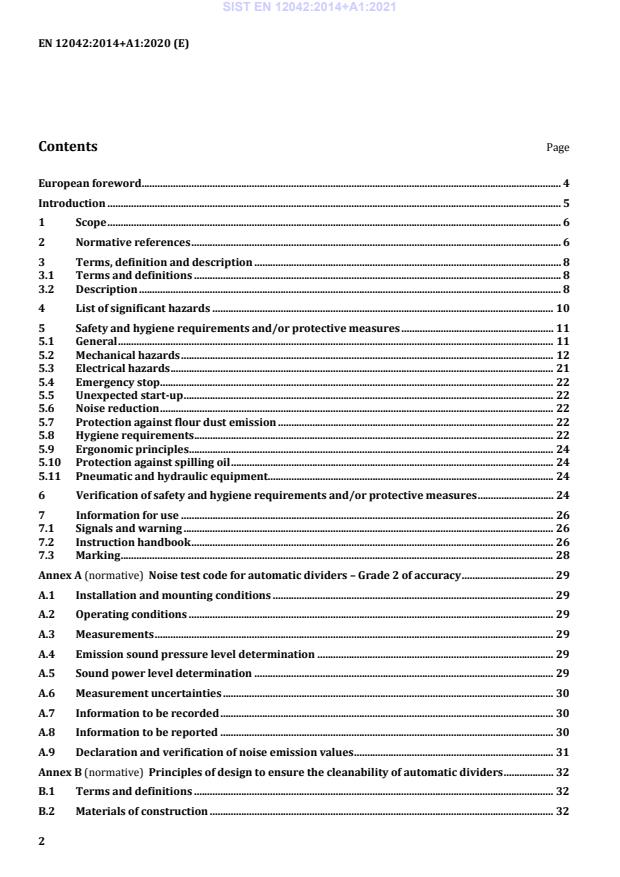
Contents Page
European foreword . 4
Introduction . 5
1 Scope . 6
2 Normative references . 6
3 Terms, definition and description . 8
3.1 Terms and definitions . 8
3.2 Description . 8
4 List of significant hazards . 10
5 Safety and hygiene requirements and/or protective measures . 11
5.1 General . 11
5.2 Mechanical hazards . 12
5.3 Electrical hazards . 21
5.4 Emergency stop . 22
5.5 Unexpected start-up . 22
5.6 Noise reduction . 22
5.7 Protection against flour dust emission . 22
5.8 Hygiene requirements . 22
5.9 Ergonomic principles . 24
5.10 Protection against spilling oil . 24
5.11 Pneumatic and hydraulic equipment. 24
6 Verification of safety and hygiene requirements and/or protective measures . 24
7 Information for use . 26
7.1 Signals and warning . 26
7.2 Instruction handbook . 26
7.3 Marking . 28
Annex A (normative) Noise test code for automatic dividers – Grade 2 of accuracy . 29
A.1 Installation and mounting conditions . 29
A.2 Operating conditions . 29
A.3 Measurements . 29
A.4 Emission sound pressure level determination . 29
A.5 Sound power level determination . 29
A.6 Measurement uncertainties . 30
A.7 Information to be recorded . 30
A.8 Information to be reported . 30
A.9 Declaration and verification of noise emission values . 31
Annex B (normative) Principles of design to ensure the cleanability of automatic dividers . 32
B.1 Terms and definitions . 32
B.2 Materials of construction . 32
B.3 Design . 34
Annex ZA (informative) Relationship between this European Standard and the essential
requirements of Directive 2006/42/EC aimed to be covered . 49
Bibliography . 52
European foreword
This document (EN 12042:2014+A1:2020) has been prepared by Technical Committee CEN/TC 153
“Machinery intended for use with foodstuffs and feed”, the secretariat of which is held by DIN.
This European Standard shall be given the status of a national standard, either by publication of an
identical text or by endorsement, at the latest by March 2021, and conflicting national standards shall
be withdrawn at the latest by March 2021.
Attention is drawn to the possibility that some of the elements of this document may be the subject of
patent rights. CEN shall not be held responsible for identifying any or all such patent rights.
This document includes Amendment 1 approved by CEN on 15 June 2020.
This document supersedes !EN 12042:2014".
The start and finish of text introduced or altered by amendment is indicated in the text by tags !".
This document has been prepared under a mandate given to CEN by the European Commission and the
European Free Trade Association, and supports essential requirements of EU Directive 2006/42/EC.
For relationship with EU Directive 2006/42/EC, see informative Annex ZA, which is an integral part of
this document.
Significant changes
The significant changes with respect to the previous edition EN 12042:2005+A1:2010 are listed below:
— Normative references updated;
— Clause 4: new presentation in a table;
— 5.2.2, zone 1:
— !the requirements don't distinguish between fed by hand or mechanically";
— addition of new requirements for pressure sensitive edge (see !5.2.2.1.2"), AOPD (see
!5.2.2.1.3"), cleaning of the hopper (se !5.2.2.1.6") and feeding assistance device
inside the hopper (see !5.2.2.1.7");
— new stopping time ≤ 0,35 s;
— new performance level d.
— 5.2.3, zone 2: Table 1 (Dimensions of the guard or tunnel) replaced by a reference to EN ISO 13857;
— Instruction handbook updated (environmental information).
According to the CEN-CENELEC Internal Regulations, the national standards organisations of the
following countries are bound to implement this European Standard: Austria, Belgium, Bulgaria,
Croatia, Cyprus, Czech Republic, Denmark, Estonia, Finland, France, Germany, Greece, Hungary, Iceland,
Ireland, Italy, Latvia, Lithuania, Luxembourg, Malta, Netherlands, Norway, Poland, Portugal, Republic of
North Macedonia, Romania, Serbia, Slovakia, Slovenia, Spain, Sweden, Switzerland, Turkey and the
United Kingdom.
Introduction
This document is a type C standard as stated in EN ISO 12100:2010.
The machinery concerned and the extent to which hazards, hazardous situations and events are
covered are indicated in the scope of this document.
When provisions of this type C standard are different from those that are stated in type A or B
standards, the provisions of this type C standard take precedence over the provisions of the other
standards, for machines that have been designed and built according to the provisions of this type C
standard.
1 Scope
1.1 !This European Standard applies to the design and manufacture of standalone automatic dough
dividers having a feed hopper, and which can be used separately or in a line in the food industry, artisan
bakeries and shops (pastry making, bakeries, confectionery, etc.) for dividing and additionally for
moulding/rounding dough or pastry into adjustable portions to produce the required weight of dough
piece during a dividing process. These machines can be fed by hand or mechanically.
This European Standard deals with all significant hazards, hazardous situations and events relevant to
the transport, installation, adjustment, operation, cleaning, maintenance, dismantling, disassembling
and scrapping of automatic dough dividers, when they are used as intended and under conditions of
misuse which are reasonably foreseeable by the manufacturer (see Clause 4).
These machines are not intended to be cleaned with pressurized water."
1.2 This European Standard is not applicable to the following:
— experimental and testing machines, under development by the manufacturer;
— weighing devices;
— pressure dough dividers, without a feed hopper, using knives for the dividing process;
— lines with separate cutting or forming elements outside the housing;
1)
— lifting and tilting machines or other separate feeding machines;
— additional hazards generated when the machine is used in a line or mechanically fed.
1.3 A noise test code is included in Annex A to assist manufacturers to measure noise levels for the
purpose of the noise emission declaration.
1.4 This European Standard is not applicable to machines which are manufactured before its
publication as EN.
2 Normative references
The following documents, in whole or in part, are normatively referenced in this document and are
indispensable for its application. For dated references, only the edition cited applies. For undated
references, the latest edition of the referenced document (including any amendments) applies.
EN 619:2002+A1:2010, Continuous handling equipment and systems - Safety and EMC requirements for
equipment for mechanical handling of unit loads
EN 894-4:2010, Safety of machinery - Ergonomics requirements for the design of displays and control
actuators - Part 4: Location and arrangement of displays and control actuators
!
EN ISO 14120:2015, Safety of machinery — Guards — General requirements for the design and
construction of fixed and movable guards (ISO 14120:2015)
1) See EN 13288.
EN ISO 14118:2018, Safety of machinery — Prevention of unexpected start-up (ISO 14118:2017)
EN ISO 14119:2013, Safety of machinery — Interlocking devices associated with guards - Principles for
design and selection (ISO 14119:2013)
"
EN 1672-2:2005+A1:2009, Food processing machinery - Basic concepts - Part 2: Hygiene requirements
EN 60204-1:2006, Safety of machinery - Electrical equipment of machines - Part 1: General requirements
(IEC 60204-1:2005)
EN 60529, Degrees of protection provided by enclosures (IP code) (IEC 60529)
!EN ISO 7010:2012, Graphical symbols - Safety colours and safety signs - Registered safety signs (ISO
7010:2011)"
EN ISO 3743-1:2010, Acoustics - Determination of sound power levels and sound energy levels of noise
sources using sound pressure - Engineering methods for small movable sources in reverberant fields - Part
1: Comparison method for a hard-walled test room (ISO 3743-1:2010)
EN ISO 3744:2010, Acoustics - Determination of sound power levels and sound energy levels of noise
sources using sound pressure - Engineering methods for an essentially free field over a reflecting plane
(ISO 3744:2010)
EN ISO 4413, Hydraulic fluid power - General rules and safety requirements for systems and their
components (ISO 4413)
EN ISO 4414, Pneumatic fluid power - General rules and safety requirements for systems and their
components (ISO 4414)
EN ISO 4871:2009, Acoustics - Declaration and verification of noise emission values of machinery and
equipment (ISO 4871)
EN ISO 11201:2010, Acoustics - Noise emitted by machinery and equipment - Determination of emission
sound pressure levels at a work station and at other specified positions in an essentially free field over a
reflecting plane with negligible environmental corrections (ISO 11201:2010)
EN ISO 12100:2010, Safety of machinery - General principles for design - Risk assessment and risk
reduction (ISO 12100:2010)
EN ISO 13857:2008, Safety of machinery - Safety distances to prevent hazard zones being reached by
upper and lower limbs (ISO 13857:2008)
!EN ISO 13849-1:2015, Safety of machinery - Safety-related parts of control systems - Part 1: General
principles for design (ISO 13849-1:2015)"
EN ISO 13855:2010, Safety of machinery - Positioning of safeguards with respect to the approach speeds
of parts of the human body (ISO 13855:2010)
EN ISO 13856-1, Safety of machinery - Pressure-sensitive protective devices - Part 1: General principles for
design and testing of pressure-sensitive mats and pressure-sensitive floors (ISO 13856-1)
EN ISO 13856-2, Safety of machinery - Pressure-sensitive protective devices - Part 2: General principles for
design and testing of pressure-sensitive edges and pressure-sensitive bars (ISO 13856-2)
!EN ISO 14122-2:2016, Safety of machinery - Permanent means of access to machinery - Part 2:
Working platforms and walkways (ISO 14122-2:2016)"
3 Terms, definition and description
3.1 Terms and definitions
For the purposes of this document, the terms and definitions given in EN ISO 12100:2010 and the
following apply.
3.1.1
stopping time (time for hazard elimination)
period between the point at which the interlocking device initiates the stop command and the point at
which the risk from hazardous machine functions has passed
!deleted text"
3.2 Description
The dividers in the scope consist of the elements listed below (including optional equipment) (see
Figure 1):
1) loading hopper;
2) feeding assistance device inside the hopper (optional, see one example at Figure 2);
3) dividing device which can be of one of the following types:
— rotating drum with chamber and piston;
— piston with or without cutting slide;
— rotating blades or cutting devices (e.g. knives, star rollers);
— and the operating mechanisms;
4) flour duster at the delivery of pieces of dough (optional);
5) one or more conveyor belts designed to discharge pieces of dough;
6) one or more drive units to operate the dividing device and the discharge devices;
7) miscellaneous devices, e.g. to set the volume of the portions;
8) control panel;
9) oiling device (optional, not included in Figure 1);
10) moulding/rounding device (optional, not included in Figure 1).
Figure 1 — Main parts of an automatic dough divider
Key
1 star rollers
2 feeding assistance device (rollers)
Figure 2 — Example of a hopper equipped with a feeding assistance device and star rollers
4 List of significant hazards
This clause contains all the significant hazards, hazardous situations and events identified by risk
assessment as significant for this type of machinery and which require action to eliminate or reduce the
risk (see Table 1).
Table 1 — List of significant hazards
Clause/subclause in
Hazards, hazardous situations
Location or cause this European
and hazardous events
Standard
Mechanical hazards (see Figure 3)
Zone 1 - dividing zone or feeding
— shearing, crushing and cutting assistance device zone (if any)
access via the hopper
Zone 2 - access to dividing
mechanisms and other moving parts
— entanglement and crushing
via discharge opening/discharge
5.2
belt
Zone 3 - discharge belt, in-running
— drawing-in
nip between belt and roller
— crushing, impact, shearing and Zone 4 - drive mechanisms and
drawing-in other moving internal components
— entanglement Zone 5 - flour duster
Electrical hazards Electric shock from direct or indirect 5.3
contact with live components
external influences on electrical
equipment (e.g. cleaning with water)
Stopping of the machine No access to the normal OFF of the 5.4
machine
Unexpected start-up Start-up of the machine 5.5
Hazards generated by noise Hearing damage, accidents due to 5.6
interference with speech
7.2
communication and interference
with the perception of acoustic
signals
Hazards generated by materials 5.7
Flour dusters
and substances (inhalation of dust)
Hazards generated by neglecting e.g. contamination by microbial 5.8
hygienic design principles growth or foreign materials
Hazards generated by neglecting During operation, cleaning and 5.9
ergonomic principles maintenance
If divider oil is allowed to spill onto 5.10
Hazards generated by spilling oil
the floor around the divider.
Hazards generated by pneumatic Ejection of parts, explosion and 5.11
and hydraulic equipment injection of fluid
Figure 3 illustrates the danger zones associated with the mechanical hazards:
— Zone 1: dividing zone or feeding assistance device zone (if any) access via the hopper;
— Zone 2: access to dividing mechanisms and other moving parts via discharge opening/discharge bel
— Zone 3: discharge belt, in-running nip between belt and roller;
— Zone 4: drive mechanisms and other moving internal components;
— Zone 5: flour duster.
Key
1 zone 1
2 zone 2
3 zone 3
4 zone 4
5 zone 5
Figure 3 — Danger zones associated with mechanical hazards
5 Safety and hygiene requirements and/or protective measures
5.1 General
Machinery shall comply with the safety requirements and/or protective measures of this clause.
In addition, the machine shall be designed according to the principles of EN ISO 12100:2010 for
relevant but not significant hazards, which are not dealt with by this document.
Fixing systems of fixed guards or of parts of the machine acting as such shall remain attached to the
guards or to the machinery when the guards are removed.
5.2 Mechanical hazards
5.2.1 General
Guards shall comply with !EN ISO 14120:2015". Where reference is made to interlocking devices
throughout Clause 5, they can be interlocked without guard locking and shall comply with
!EN ISO 14119:2013", Clause 5 and Clause 6.
Where the interlocking mechanism has movable parts, e.g. position switches, these shall be protected
from contamination by dough or dry ingredients, e.g. by mounting them within the machine body.
!The safety-related parts of the control systems referring to the safeguarding of the access to
hazardous zones through the hopper shall present at least a performance level “d” defined in
accordance with EN ISO 13849-1:2015.
The safety-related parts to other safety systems shall present at least a performance level “c” defined in
accordance with EN ISO 13849-1:2015."
5.2.2 Zone 1: Access to the dividing zone or feeding assistance device zone if any, via the hopper
!deleted text"
5.2.2.1 Feeding — Safeguarding at the hopper
5.2.2.1.1 General
Access via the hopper opening to the danger zone shall be prevented while the machine is in operation.
!The access to the danger zones in the feed intake hopper shall be restricted or prevented by at least
one of the following":
— a pressure sensitive edge !or pressure sensitive bar" (see !5.2.2.1.2" and Figure 4);
— an AOPD (see !5.2.2.1.3");
— a swan neck hopper (see !5.2.2.1.4 "and Figure 5);
— an interlocked guard (see !5.2.2.1.5").
!deleted text"
5.2.2.1.2 Pressure sensitive edge !or pressure sensitive bar"
If a pressure sensitive edge !or bar" is used as a safeguarding measure to stop the hazardous
movement, the following requirements apply:
— the pressure sensitive edge !or bar" shall comply with EN ISO 13856-2, and
— it shall be attached to the upper rim of the hopper or to a provided supporting system, and
— the stopping time after activation of the pressure sensitive edge !or bar" shall be less than or
equal to 0,35 s (calculated by taking into account EN ISO 13855:2010), and
— the distance between the pressure sensitive !bar" and the edge of the hopper shall be less than
or equal to 8 mm, and
— !the vertical distance (d) between the floor and the upper edge of the hopper shall be more than
or equal to 1 600 mm, and"
— the vertical distance (D) between the upper edge of the hopper and the cutting/crushing zone shall
be more than or equal to 550 mm, and
— a distance bar shall be provided when the vertical distance (D) is less than 850 mm. In that case:
— the safety distance from the distance bar to the danger zone shall be more than or equal to
E+F ≥ 850 mm, and
— the distance bar shall be placed at a maximum height (G) comprised between 0 mm and 50 mm
from the edge of the hopper, and with a minimum horizontal distance (F) from the edge of the
hopper of 200 mm.
!If the distance between the upper rim of the hopper and the floor is > 1 600 mm, a working platform
according to EN ISO 14122-2:2016 shall be provided. The platform shall be located below the upper rim
of the hopper and the vertical distance between the upper rim of the hopper and the standing area of
the platform shall be ≥ 1 100 mm. If the vertical distance between the upper rim of the hopper and the
standing area of the platform is < 1 600 mm, the platform shall be interlocked.
The interlocking shall be realized, e.g. by:
— use of a pressure sensitive mat or floor according to EN ISO 13856-1, or
— use of an AOPD to prevent access to the working platform, or
— use of an interlocked guard.
If the vertical distance between the floor and the upper edge of the hopper is < 1 600 mm, all distances
shall comply with EN ISO 13857:2008, Table 2."
!
With
d ≥ 1 600 mm
D ≥ 550 mm
E+F ≥ 850 mm
F ≥ 200 mm
G ≤ 50 mm
Key
1 pressure-sensitive edge
2 danger zone
3 distance bar
d vertical distance between the upper point and the floor
D vertical distance between the upper edge of the hopper and the cutting/crushing zone
E minimum distance from the edge of the hopper to the danger zone
F minimum horizontal distance
G maximum height between the edge of the hopper and the distance bar
Figure 4 — Example of a hopper equipped with a pressure-sensitive edge"
5.2.2.1.3 AOPD
!If an electro-sensitive protective equipment (ESPE) as defined in EN ISO 13855:2010, 3.1.4,
employing active optoelectronic protective devices (AOPD as defined in EN ISO 12100:2010, 3.28.6,
laser scanner (AOPDDR) and vision-based protective devices (VBPD) included), is used the following
requirements apply:
a) If a protective device which detects an area (for instance light curtain, multi-beam device, laser
scanner) and/or a volume (for instance vision-based protective device), is used:
1) the distance between the AOPD/AOPDDR and the edge of the hopper shall be less than 20 mm,
and
2) the whole upper opening of the hopper shall be detected by the protective device, and
3) the distance between the beams shall be ≤ 70 mm, and
4) the minimum distance S between the safeguard and any hazard zone shall be calculated,
according to the overall system stopping performance, as defined in EN ISO 13855:2010.
NOTE The distance between the beams means the detection capability of the AOPD, see EN ISO 13855:2010,
6.2.3.
b) If a one beam light barrier is used around the upper edge of the hopper:
1) the stopping time shall be less than 0,35 s, and
2) the distance between the one-beam light barrier and the edge of the hopper shall be less than
or equal to 8 mm, and
3) the height of the protective structure and the position of danger zone shall comply with
EN ISO 13857:2008, Table 2, and
4) a distance bar shall be provided when the vertical distance (D) is less than 850 mm. In that
case:
i) the safety distance from the distance bar or from the edge of the hopper to the danger zone
shall be more than or equal to E+F ≥ 850 mm, and
ii) the distance bar shall be placed at a maximum height (G) comprised between 0 mm and
50 mm from the edge of the hopper, and with a minimal horizontal distance (F) from the
edge of the hopper of 200 mm."
5.2.2.1.4 Swan neck hopper
If a swan neck hopper (see Figure 5) is used the distance between the edge of the hopper and the
danger zone shall comply with EN ISO 13857:2008, Table 2.
NOTE Dimensions of a, b and c are given in EN ISO 13857:2008, Table 2.
Key
1 danger zone
a height of danger zone
b height of protective structure
c horizontal distance to danger
zone
Figure 5 — Example of a divider equipped with a swan neck hopper
5.2.2.1.5 Interlocked guard
If an interlocked guard is used at the top of the hopper the following requirements apply:
— if the stopping time is less than or equal to 0,35 s, the distance between the edge of the hopper and
the hazard zone shall be more than or equal to 550 mm, or
— if the stopping time is more than 0,35 s, the distance between the edge of the hopper and the
hazard zone shall be more than or equal to 850 mm, and the guard shall be interlocked with guard
locking.
The interlocking device shall be activated before the opening gap between the fixed and the movable
parts exceeds 25 mm;
If the guard is a grid, EN ISO 13857:2008, Table 4, shall apply.
5.2.2.1.6 Cleaning of the hopper
If for cleaning reasons (e.g. scraping off the dough), it is necessary to access inside the hopper, one of
the following solutions shall apply to stop the machine:
— interlocked guard at the top of the hopper (see !5.2.2.1.5");
— interlocked tilting hopper if the stopping time is less than or equal to 0,35 s or interlocked tilting
hopper with guard locking if the stopping time is more than 0,35 s. The interlocking device shall be
activated before the opening gap between the fixed and the movable parts exceeds !20 mm";
— interlocked opening in the hopper if the stopping time is less than or equal to 0,35 s or interlocked
opening in the hopper with guard locking if the stopping time is more than 0,35 s;
— interlocked access (e.g. AOPD, interlocked guard, etc.) to the working area from where it is possible
to clean the hopper.
5.2.2.1.7 Feeding assistance device inside the hopper
If a feeding assistance device is provided, the minimum horizontal distance between the rollers shall be
more than or equal to 100 mm (see Figure 6).
When driven rollers are used, access to potential in-running nips shall be prevented. The distance
between the rollers themselves and between the rollers and the fixed parts of the hopper shall be less
than or equal to 4 mm.
Dimensions in millimetres
Key
1 hopper
2 danger zone
Figure 6 — Feeding assistance device — Safety distances
5.2.3 Zone 2: Access to the dividing mechanism and other moving parts via the discharge
opening
!In principle, there is no significant hazard at the discharge side of a drum and piston type dividing
mechanism.
When a cutting/shearing zone could be reached by a person through the discharge opening, access to
the hazard zone shall be prevented by:
— either a fixed guard with opening according to EN ISO 13857:2008, Table 4; or
— a movable interlocking guard in accordance with EN ISO 13857:2008, Table 4; or
— a movable interlocking guard acting as a trip device (see Table 2 and Figure 7); the guard shall
comply with Table 2 and be free to move vertically or near vertically at the products outlet opening.
If the guard has openings, the distance between bars or mesh shall comply with EN ISO 13857:2008,
Table 4, except for the products outlet opening.
Table 2 — Dimensions of movable interlocking guard acting as a trip device
Dimensions in millimetres
L 35 40 45 50 55 60 65 70 105 140 150
D 205 230 250 300 350 400 450 500 550 600 850
E EN ISO 13857:2008, Table 4
Where
L = distance between the conveyor belt and the front opening of the guard when the interlocking device
actuates;
D = distance from the edge of the tunnel to danger point of the mechanism;
E = distance between the lower edge of the guard and the surface where the piece/s of dough is/are lying,
when the interlocking device is activated.
Figure 7 —Movable interlocking distance guard"
5.2.4 Zone 3: Discharge belt
If there is hazard with in-running nips (see !Figure 8") they shall be safeguarded in accordance
with EN 619:2002+A1:2010, 5.1.3.2.
Fixed side guards (e.g. sheet metals) shall be mounted at the sides of the conveyor where access is
possible, covering the whole length of the conveyor. The distance between the belt and the fixed side
guards of the machine shall be less than or equal to 4 mm. If this is not possible the fixed guards or
movable interlocked guards in accordance with !EN ISO 14120:2015" shall prevent access to the
danger zone.
Key
1 discharge belt
2 roller
3 in-running nip
!Figure 8" — In-running nip on a discharge belt
5.2.5 Zone 4: Drive mechanisms and other moving internal components
Access to the drive mechanism and other moving internal components including the dividing
mechanisms, and the moulding/rounding device if relevant, from other sides than the discharge
opening of the machine shall be prevented. This may be achieved by use of fixed guards complying with
!EN ISO 14120:2015" and where guards have to be removed daily or more regularly for cleaning
or maintenance by movable interlocking guards.
If the stopping time of the drive mechanism or other moving internal components is more than 1 s, the
movable guard shall be interlocked with guard locking.
5.2.6 Zone 5: Flour duster
If there are mechanical risks, the flour containers shall be fitted with a fixed or interlocked guard with
dimensions according to EN ISO 13857:2008, Table 4, acting on the flour feed system. If the stopping
time of the flour duster is more than 1 s, the movable guard shall be interlocked with guard locking.
If there are no mechanical hazards (e.g. if the feed consists of a spindle with rubber spokes or notches,
or if the flour is sprinkled by a vibrating device) due to the flour feed system and if a guard is necessary
to prevent dust emission (see 5.7), this guard shall automatically be closed (e.g. by gravity, etc.). In this
case, an interlocked guard is not necessary.
5.2.7 Loss of stability
5.2.7.1 Machines shall be designed to be stable and shall comply with 5.2.7.2 and 5.2.7.3 as
applicable. For machines designed to be fixed to the floor, the instruction handbook shall indicate the
values of torques at the fixing points.
5.2.7.2 Free standing machines without castors shall be stable when tilted 10° from the horizontal
plane, in the most unfavourable direction.
5.2.7.3 Free standing machines with castors shall have a locking device for example a brake on at
least two castors (or sets of castors) and shall comply with the provisions of 5.2.7.2.
5.2.8 !Working platform
If the machine is provided with a working platform, it shall fulfill the following requirements:
— The working platform shall comply with EN ISO 14122-2:2016.
— The working platform shall be located below the upper rim of the hopper and the vertical distance
between the upper rim of the hopper and the standing area of the platform shall be ≤ 1 600 mm and
≥ 1 100 mm.
If the machine is equipped with pressure sensitive edge or one beam light barrier around the upper rim
of the hopper and the distance between the upper rim of the hopper and the standing area of the
platform is < 1 600 mm, the working platform shall be interlocked. The interlocking shall be realized,
by:
— use of a pressure sensitive mat or floor according to EN ISO 13856-1, or
— use of an AOPD to prevent access to the working platform, or
— use of an interlocked guard."
5.3 Electrical hazards
5.3.1 General
Electrical equipment, for example switches, that may be exposed to water, e.g. during cleaning, shall be
protected to an appropriate IP rating according to EN 60529 and EN 60204-1:2006.
The electrical equipment shall comply with EN 60204-1:2006, with the precisions given in the following
subclauses.
5.3.2 Safety requirements related to electromagnetic phenomena
The machines shall have sufficient immunity to electromagnetic disturbances to enable them to operate
safely as intended and not fail to danger when exposed to the levels and types of disturbances for the
intended use of the machine (see EN 61000-6-1).
The manufacturer of the machines shall design, install and wire the equipment and sub-assemblies
taking into account the recommendations of the suppliers of these sub-assemblies.
5.3.3 Protection against electric shock
The electrical equipment shall comply with EN 60204-1:2006, Clause 6.
5.3.4 Power circuits
Devices for detection and interruption of over-current have to be applied to each live conductor in
compliance with EN 60204-1:2006, 7.2.3. !deleted text"
5.3.5 Protection against earth faults in control circuits
For machinery supplied from a single-phase conductor and an earthed neutral conductor the single pole
interruption shall be in the phase conductor (see EN 60204-1:2006, 9.4.3.1).
5.3.6 Motor enclosures
Where a motor has a degree of protection lower than IP23 (see EN 60529) it shall be mounted inside an
enclosure (see EN 60204-1:2006, 14.2) that guarantees a minimum degree of protection of IP23 (see
EN 60529).
5.4 Emergency stop
No emergency stop is required for automatic dividers but particular attention shall be given to the
accessibility of the normal OFF switch from the operator position.
5.5 Unexpected start-up
Unexpected start-up shall be prevented using the measures described in !EN ISO 14118:2018" and
a separate means of isolation shall be provided with for each type of energy.
5.6 Noise reduction
Automatic dividers shall be so designed and constructed that risks from airborne noise emission are
reduced to the lowest level by particularly applying measures at source to control noise, see for
example EN ISO 11688-1. The success of the applied noise reduction measures is assessed on the basis
of the actual noise emission values (see Annex A) in relation to other machines of the same family.
5.7 Protection against flour dust emission
Means shall be provided to prevent flour from spilling onto the floor, for example a collecting device for
flour below the rear end of the outlet conveyor.
If a flour duster is used to sprinkle special types of dough, the following shall be provided:
— a guard according to 5.2.6;
— automatically stop of the flour duster when the machine stops;
— maximum height of 50 mm of the underside of the flour duster above the height of the largest
dough pieces as specified in the instruction handbook.
5.8 Hygiene requirements
Automatic dividers shall be designed and manufactured in accordance with EN 1672-2:2005+A1:2009
and Annex B.
The 3 zones mentioned in EN 1672-2:2005+A1:2009 are defined as follows and shown in
!Figure 9":
— food area:
— inside surfaces of the hopper;
— all dividing components;
— portion discharge belt;
— inside surface of flour duster, including the inside surface of the movable cover.
— splash area:
— outside surface of the hopper;
— upper panel or cover over the dividing mechanism;
— outside surface of the flour duster, including the outside surface of the cover;
— fixed horizontal surface below the hopper.
— non-food area:
— the remaining area of the machine.
Key
food area
splash area
non-food area
!Figure 9" — Hygiene areas
5.9 Ergonomic principles
For hand-fed machines the manufacturer shall pay particular attention to the ergonomic aspects of the
loading of the dough and define procedures for facilitating the loading.
Awkward body postures (e.g. hand feeding at a height more than 1,6 m, cleaning a hopper deeper than
850 mm) during maintenance and cleaning as well as filling and emptying the dividers or other
operations, shall be avoided (e.g. platform, tilting hopper, etc.).
!If the distance between the upper rim of the hopper and the floor is > 1 600 mm, a working platform,
according to 5.2.8, shall be provided."
Control devices shall be placed within proper reach distance for the operator as stated in
EN 894-4:2010, Annex A.
5.10 Protection against spilling oil
The divider oil reservoir shall be constructed and positioned so that it can be filled easily, minimizing
the risk of spilling oil. The manufacturer shall provide means to collect divider oil, so that it does not
spill on the floor e.g. catch trays.
5.11 Pneumatic and hydraulic equipment
All pneumatic components and piping shall conform to the requirements of EN ISO 4414.
All hydraulic components and piping shall conform to the requirements of EN ISO 4413.
6 Verification of safety and hygiene requirements and/or protective measures
This clause contains the methods of testing for the presence and adequacy of the safety requirements
stated in Clause 5.
Verification of the requirements can be made by means of inspection, calculation, measurement or
testing. These shall be applied to a machine in a fully commissioned condition but partial dismantling
may be necessary for the purpose of some checks. Such partial dismantling shall not invalidate the
result of verification.
Methods of verification are given in !Table 3".
!Table 3 " — Verification
Safety and hygiene
Relevant
requirements and/or Method of verification
clause
measures
By visual inspection
5.2.1 General
By analysis or calculation (see EN ISO 13849-2)
By functional test
Zone 1 Access to the dividing
5.2.2 zone or feeding assistance By measurement of the safety distances
device via the hopper
By calculation
by measuremen
...