

SIST-TP CEN/TR 15221-9:2025
(Main)Facility Management - Part 9: Study of area and space measurement standards and guidelines used in Europe
General Information
- Abstract
This document provides the information gathered from the national standardization bodies regarding
area and space measurement standards and local rules. This document also identifies the potential
liaisons and stakeholders in addition to complementary standards to support the review of EN 15221-
6:2011 [1]. Finally, this document contains a preliminary gap analysis of EN 15221-6:2011 and
documents the criteria for the review work of the standard.
- Status
- Published
- Publication Date
- 24-Sep-2025
- Technical Committee
- I13 - Imaginarni 13
- Current Stage
- 6060 - National Implementation/Publication (Adopted Project)
- Start Date
- 21-Aug-2025
- Due Date
- 26-Oct-2025
- Completion Date
- 25-Sep-2025

Overview
SIST-TP CEN/TR 15221-9:2025 is a technical report developed by the European Committee for Standardization (CEN), specifically by Technical Committee CEN/TC 348 “Facility Management.” This document provides an in-depth study of area and space measurement standards and guidelines utilized across European countries. Its primary focus is to collect and present data from national standardization bodies, analyze the existing standards, and identify the alignment and potential gaps in the approach to facility area and space measurement within Europe.
The report serves as a resource for facility management professionals by documenting the criteria for reviewing the existing EN 15221-6:2011 “Facility Management - Part 6: Area and Space Measurement,” providing a basis for the future development and harmonization of space measurement methodologies at a European level.
Key Topics
National Standards Review
The document provides a country-by-country overview of area and space measurement standards, indicating the diversity and similarities in definitions, calculation rules, and reporting criteria across Europe.Gap Analysis
An initial analysis highlights where current standards, including EN 15221-6:2011, may fall short in addressing modern facility management challenges, such as digitalization and Building Information Modelling (BIM) integration.Stakeholder and Liaison Identification
SIST-TP CEN/TR 15221-9:2025 identifies key organizations, industry stakeholders, and potential collaborators essential for the harmonization and evolution of space measurement standards.Complementary Standards and Guidelines
The report references complementary international standards, such as those developed by ISO, BOMA (Building Owners and Managers Association), and IPMS (International Property Measurement Standards).Criteria for Review
This standard documents the criteria used as a foundation for the structured review and future revision of EN 15221-6:2011.
Applications
SIST-TP CEN/TR 15221-9:2025 is valuable for multiple applications within facility management and the broader built environment sector:
Space Planning and Optimization
Ensures consistent and accurate building area measurement, supporting effective space planning and resource allocation.International and Cross-border Projects
Facilitates standardization and comparability for multinational organizations and projects that span multiple European countries.Regulatory Compliance
Provides guidance for meeting both national and European regulatory requirements for building measurement and reporting.Digital Transformation in FM
Supports digitalization initiatives, such as BIM-based planning and asset management, by informing the creation of machine-readable measurement standards.Real Estate Transactions and Valuations
Assists real estate professionals in producing transparent and consistent area data for property transactions, leasing, and valuation purposes.Facilities Operations and Maintenance
Offers a framework for defining and measuring areas needed for cleaning, maintenance, and operational planning.
Related Standards
To ensure a harmonized approach, SIST-TP CEN/TR 15221-9:2025 references several related standards and guidelines such as:
EN 15221-6:2011
Facility Management - Area and Space Measurement. This is the standard under review and forms the basis for comparison.EN ISO 41011
Facility Management - Vocabulary, providing terminology harmonization.National Standards
- DIN 277 (Germany): Principles for area and volume calculation
- ÖNORM B 1800 (Austria): Floor area measurement
- NEN 2580 (Netherlands): Building area and volume determination
- SFS 5139 (Finland): Measurement in residential and non-residential buildings
- NS 3940 (Norway): Area and volume calculations
International Guidelines
- BOMA Standards: Office and commercial property measurement
- IPMS: Harmonized, globally agreed standards for property measurement
Relevant European Regulations and Local Building Codes
Ensuring national alignment with European practice and promoting best practices in facility management.
SIST-TP CEN/TR 15221-9:2025 is essential reading for facility managers, architects, real estate professionals, and regulators seeking to understand, implement, or influence best practices in building area and space measurement across Europe. Its comprehensive review lays the groundwork for greater alignment and interoperability in facility management standards.
Relations
- Effective Date
- 28-Jan-2026
Get Certified
Connect with accredited certification bodies for this standard

Great Wall Tianjin Quality Assurance Center
Established 1993, first batch to receive national accreditation with IAF recognition.
Hong Kong Quality Assurance Agency (HKQAA)
Hong Kong's leading certification body.

Innovative Quality Certifications Pvt. Ltd. (IQCPL)
Known for integrity, providing ethical & impartial Assessment & Certification. CMMI Institute Partner.
Sponsored listings
Frequently Asked Questions
SIST-TP CEN/TR 15221-9:2025 is a technical report published by the Slovenian Institute for Standardization (SIST). Its full title is "Facility Management - Part 9: Study of area and space measurement standards and guidelines used in Europe". This standard covers: This document provides the information gathered from the national standardization bodies regarding area and space measurement standards and local rules. This document also identifies the potential liaisons and stakeholders in addition to complementary standards to support the review of EN 15221- 6:2011 [1]. Finally, this document contains a preliminary gap analysis of EN 15221-6:2011 and documents the criteria for the review work of the standard.
This document provides the information gathered from the national standardization bodies regarding area and space measurement standards and local rules. This document also identifies the potential liaisons and stakeholders in addition to complementary standards to support the review of EN 15221- 6:2011 [1]. Finally, this document contains a preliminary gap analysis of EN 15221-6:2011 and documents the criteria for the review work of the standard.
SIST-TP CEN/TR 15221-9:2025 is classified under the following ICS (International Classification for Standards) categories: 03.080.10 - Maintenance services. Facilities management. The ICS classification helps identify the subject area and facilitates finding related standards.
SIST-TP CEN/TR 15221-9:2025 has the following relationships with other standards: It is inter standard links to SIST EN ISO 41011:2024. Understanding these relationships helps ensure you are using the most current and applicable version of the standard.
SIST-TP CEN/TR 15221-9:2025 is available in PDF format for immediate download after purchase. The document can be added to your cart and obtained through the secure checkout process. Digital delivery ensures instant access to the complete standard document.
Standards Content (Sample)
SLOVENSKI STANDARD
01-oktober-2025
Upravljanje objektov in storitev - 9. del: Študija standardov in smernic za merjenje
površin in prostorov, ki se uporabljajo v Evropi
Facility Management - Part 9: Study of area and space measurement standards and
guidelines used in Europe
Untersuchung der in Europa verwendeten Standards und Leitlinien für die Flächen- und
Raummessung
Étude des normes et lignes directrices utilisées en Europe pour la mesure de la
superficie et de l'espace
Ta slovenski standard je istoveten z: CEN/TR 15221-9:2025
ICS:
03.080.10 Vzdrževalne storitve. Maintenance services.
Upravljanje objektov Facilities management
2003-01.Slovenski inštitut za standardizacijo. Razmnoževanje celote ali delov tega standarda ni dovoljeno.
CEN/TR 15221-9
TECHNICAL REPORT
RAPPORT TECHNIQUE
August 2025
TECHNISCHER REPORT
ICS 03.080.10
English Version
Facility Management - Part 9: Study of area and space
measurement standards and guidelines used in Europe
Étude des normes et lignes directrices utilisées en Untersuchung der in Europa verwendeten Standards
Europe pour la mesure de la superficie et de l'espace und Leitlinien für die Flächen- und Raummessung
This Technical Report was approved by CEN on 9 June 2025. It has been drawn up by the Technical Committee CEN/TC 348.
CEN members are the national standards bodies of Austria, Belgium, Bulgaria, Croatia, Cyprus, Czech Republic, Denmark, Estonia,
Finland, France, Germany, Greece, Hungary, Iceland, Ireland, Italy, Latvia, Lithuania, Luxembourg, Malta, Netherlands, Norway,
Poland, Portugal, Republic of North Macedonia, Romania, Serbia, Slovakia, Slovenia, Spain, Sweden, Switzerland, Türkiye and
United Kingdom.
EUROPEAN COMMITTEE FOR STANDARDIZATION
COMITÉ EUROPÉEN DE NORMALISATION
EUROPÄISCHES KOMITEE FÜR NORMUNG
CEN-CENELEC Management Centre: Rue de la Science 23, B-1040 Brussels
© 2025 CEN All rights of exploitation in any form and by any means reserved Ref. No. CEN/TR 15221-9:2025 E
worldwide for CEN national Members.
CEN TR 15221-9:2025 (E)
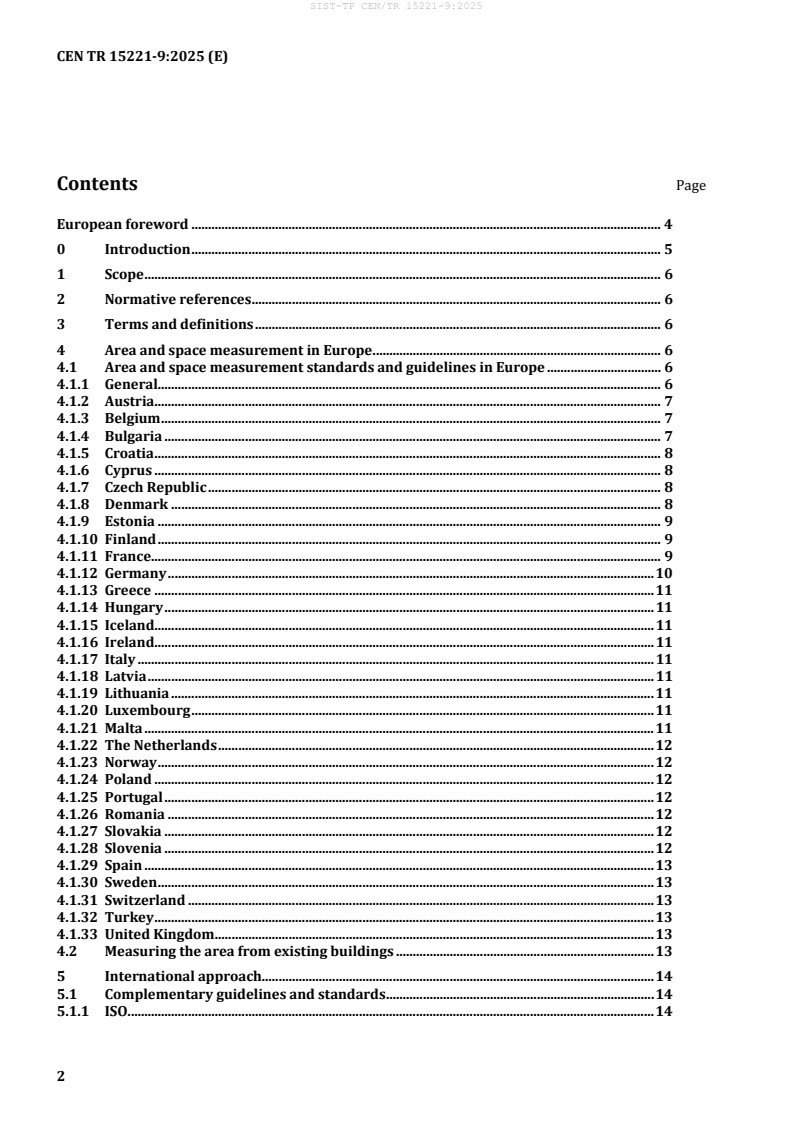
Contents Page
European foreword . 4
0 Introduction . 5
1 Scope . 6
2 Normative references . 6
3 Terms and definitions . 6
4 Area and space measurement in Europe . 6
4.1 Area and space measurement standards and guidelines in Europe . 6
4.1.1 General. 6
4.1.2 Austria . 7
4.1.3 Belgium . 7
4.1.4 Bulgaria . 7
4.1.5 Croatia . 8
4.1.6 Cyprus . 8
4.1.7 Czech Republic . 8
4.1.8 Denmark . 8
4.1.9 Estonia . 9
4.1.10 Finland . 9
4.1.11 France . 9
4.1.12 Germany . 10
4.1.13 Greece . 11
4.1.14 Hungary . 11
4.1.15 Iceland. 11
4.1.16 Ireland . 11
4.1.17 Italy . 11
4.1.18 Latvia . 11
4.1.19 Lithuania . 11
4.1.20 Luxembourg . 11
4.1.21 Malta . 11
4.1.22 The Netherlands . 12
4.1.23 Norway . 12
4.1.24 Poland . 12
4.1.25 Portugal . 12
4.1.26 Romania . 12
4.1.27 Slovakia . 12
4.1.28 Slovenia . 12
4.1.29 Spain . 13
4.1.30 Sweden . 13
4.1.31 Switzerland . 13
4.1.32 Turkey . 13
4.1.33 United Kingdom . 13
4.2 Measuring the area from existing buildings . 13
5 International approach. 14
5.1 Complementary guidelines and standards . 14
5.1.1 ISO. 14
CEN TR 15221-9:2025 (E)
5.1.2 BOMA (Building Owners and Managers Association) . 14
5.1.3 IPMS (International Property Measurement Standards) . 15
Figure 1 — Different parts of IPMS . 15
5.2 Potential liaisons . 16
6 GAP analysis . 16
6.1 Current state . 16
6.2 Desired Future State . 16
6.3 Audience . 17
6.4 Common objectives in the EU . 17
6.4.1 Transition Pathway for Construction . 17
6.4.2 Standardization as an enabler of digitalization . 17
6.5 Definition of net room area . 17
6.6 Use cases for room areas and space measures . 18
6.7 Machine-readability . 18
6.8 Current and desired states . 19
6.9 What are the gaps . 19
6.10 Summary . 20
Bibliography . 21
CEN TR 15221-9:2025 (E)
European foreword
This document (CEN/TR 15221-9:2025) has been prepared by Technical Committee CEN/TC 348
“Facility Management”, the secretariat of which is held by SN.
Attention is drawn to the possibility that some of the elements of this document may be the subject of
patent rights. CEN shall not be held responsible for identifying any or all such patent rights.
This document is part of the EN 15221-series for Facility Management and together with EN ISO 41000-
series they form the European family of FM standards. A list of all parts in the series can be found on the
CEN website: www.cencenelec.eu.
Any feedback and questions on this document should be directed to the users’ national standards body.
A complete listing of these bodies can be found on the CEN website.
CEN TR 15221-9:2025 (E)
0 Introduction
0.1 Facility Management standards
Facility Management (FM) ensures the functionality, comfort, safety, performance and efficiency of the
built environment by integrating people, place, process, and technology. The European Standards provide
a coherent framework for defining, implementing, and improving FM practices across various
organizational contexts, aligning with international best practices and evolving organizational or core
business needs.
Developed by the European Committee for Standardization (CEN), the EN 15221 series aligns closely
with the ISO 41000 series, ensuring consistency in terminology, processes, and methodologies. They are
designed to support organizations in optimizing resource use, enhancing support service quality, and
delivering value through effective FM. They reflect the collective expertise of professionals, industry
stakeholders, and national standardization bodies, ensuring that it is both practical and adaptable to the
dynamic nature of the FM sector.
The European standards on Facility Management (FM) consist of two series:
• EN 15221
• EN ISO 41000
For an overview of published standards and ongoing work, see CEN Website: www.cencenelec.eu
These series address a wide range of FM topics, including terminology, management system, service
procurement, quality management, space planning and more.
Their purpose is to standardize practices and provide organizations with tools to align FM strategies with
their broader business objectives. By offering a structured approach, the series serves as a foundation for
organizations of all sizes to develop sustainable, resilient, and future-ready facilities that contribute to
organizational success, and thus achieve greater performance, efficiency, sustainability, and stakeholder
satisfaction.
0.2 Study of area and space measurement standards and guidelines used in Europe
This document describes the standards and guidelines used to measure the floor areas of buildings in
different CEN member countries. The report has not been able to provide a very reliable assessment of
the extent to which these standards are used or how they meet their intended purpose.
The information in the report is based partly on the results of a survey addressed to CEN member
organisations of CEN/TC 348 and partly on information gathered by CEN/TC 348 WG 6 “Space
measurement in Facility Management” members. In addition to the national standards, the report also
describes the content and use of other key industry standards for Facility Management.
Based on the information collected, WG 6 has analysed the current status of area and space measurement
standards in Europe and assessed possible development needs and target status. These assessments have
considered the increasing use of Building Information Modelling (BIM)-based design in construction and
renovation projects. The background research, analyses and assessments are intended to support the
further development of EN standards for measuring areas and volumes.
CEN TR 15221-9:2025 (E)
1 Scope
This document provides the information gathered from the national standardization bodies regarding
area and space measurement standards and local rules. This document also identifies the potential
liaisons and stakeholders in addition to complementary standards to support the review of EN 15221-
6:2011 [1]. Finally, this document contains a preliminary gap analysis of EN 15221-6:2011 and
documents the criteria for the review work of the standard.
2 Normative references
The following documents are referred to in the text in such a way that some or all of their content
constitutes requirements of this document. For dated references, only the edition cited applies. For
undated references, the latest edition of the referenced document (including any amendments) applies.
EN ISO 41011, Facility management - Vocabulary (ISO 41011)
3 Terms and definitions
For the purposes of this document, the terms and definitions given in EN ISO 41011 apply.
No terms and definitions are listed in this document.
ISO and IEC maintain terminology databases for use in standardization at the following addresses:
— ISO Online browsing platform: available at https://www.iso.org/obp/
— IEC Electropedia: available at https://www.electropedia.org/
4 Area and space measurement in Europe
4.1 Area and space measurement standards and guidelines in Europe
4.1.1 General
The standards for calculating and defining the floor areas of buildings vary by country and are usually
published by each country's standardisation organisation. These standards provide guidelines and
criteria for measuring, defining, and reporting the floor areas of buildings.
In spring 2022, CEN/TC 348 conducted a survey addressed to all CEN member organisations. The aim of
the survey was to identify the standards used for surface area measurement in the different member
countries and to find out how EN 15221-6 [1] has been implemented in each country. Fifteen countries
responded to the survey. Statistically, this could be considered a reasonable result, but the absence of
many large Member States such as Germany, France, and Italy from the sample of respondents reduces
the significance of the results. To complement the survey results, it was decided to examine the material
provided by the standardisation organisations in each country. Almost all countries have a webshop or
website for standards, which helped in this process. The challenge in this approach was the languages
and finding suitable search terms.
The results of the survey and other investigations are presented below. For each country, an attempt has
been made to briefly describe the standards or guidelines used for measuring the different areas of
buildings. Unfortunately, it was not possible to obtain this information for all countries. As a general
observation, standards in different countries may differ in some details, but the basic principles are often
similar.
The current level of results already gives some overview of the measurement standards for building floor
areas used in different countries and is sufficient for the outcome of this report. However, it would be
CEN TR 15221-9:2025 (E)
interesting to refine the results to cover all Member States. In addition, due to the methods used, there
may be errors in the current results, which should be corrected before they are to be used more widely.
4.1.2 Austria
Austrian standards ÖNORM B 1800 [5] and ÖNORM B 1801 [6] defines methods for determining the floor
areas of residential and office buildings, including living spaces and common areas. The present ÖNORM
is to be used together with EN 15221-6 [1] for determining the areas and volumes of buildings and for
determining outdoor areas.
ÖNORM B 1800 “Supplement 1, Applications examples” contains examples of the application of ÖNORM
B 1800 [5] for determining the area of specific individual cases. Appropriate support is thus offered for
planners, facility managers, building owners, building administrators, authorities and experts, but also
for other users in a number of detailed questions.
4.1.3 Belgium
In Belgium, the standards and specifications for the calculation and measurement of building areas are
somewhat different from those in countries like France or Germany.
NBN B 06-001 [7] provides guidelines for calculating the gross floor area of buildings. It is used for
determining the total area of each floor in a building, including the walls and partitions.
NBN S 01-400-1 [8] focuses on residential buildings, providing guidelines for the calculation of floor areas
and volumes. It includes details on how to measure different types of spaces within residential buildings,
such as living areas, balconies, and terraces.
NBN S 01-400-2 [9] is a complementary standard to NBN S 01-400-1 [8], but it specifically addresses the
measurement of energy performance in residential buildings. While not directly a standard for area
calculation, it is relevant in the context of building assessments where floor area measurements are a
necessary input.
While CIB (Confédération Internationale du Bâtiment) Guidelines is not a standard, the CIB, which is an
international construction association based in Belgium, offers guidelines that can be relevant in the
context of building measurement and management. These guidelines may cover space and area
measurement aspects, particularly in an international context.
In Belgium, there can also be regional differences in building regulations and standards, particularly
between Flanders, Wallonia, and the Brussels-Capital Region. These regional regulations may include
specific requirements for measuring and reporting building areas.
These standards are used by various professionals in the construction, real estate, and architectural
sectors in Belgium for a range of purposes, including building design, real estate transactions, Facility
Management, and compliance with building regulations. They ensure a consistent approach to measuring
and reporting building areas and volumes, which is crucial for transparency and accuracy in these fields.
In Belgium, as in many European countries, there is a blend of local and European standards in practice,
and the adoption of specific standards like EN 15221-6 [1] can depend on the context and the specific
needs of a project or organisation.
EN 15221-6 [1] is particularly relevant for multinational corporations or projects that span across
multiple European countries, where a common standard facilitates consistency and comparability. In
many cases, EN 15221-6 [1] may be used in conjunction with local Belgian standards like NBN B 06-001
[7] or NBN S 01-400-1 [8]. Nevertheless, local standards tend to be more widely used for domestic
projects.
4.1.4 Bulgaria
In Bulgaria, the calculation and measurement of building areas is governed by a national standard (BDS),
which covers calculation methods, architectural design and construction processes. Compliance with
CEN TR 15221-9:2025 (E)
national standards is crucial for legal compliance, especially in the construction and property
development sectors. BDS standards ensure that buildings meet the safety, quality and durability criteria
of Bulgarian legislation.
BDS EN 15221-6 is the Bulgarian version of the European standard EN 15221-6 [1]. The study did not
find out how widely EN 15221-6 is adopted in Bulgaria.
4.1.5 Croatia
In Croatia, the standards for calculating and measuring building areas are guided by both national
regulations and European standards.
Croatian Standards for Construction (HRN) cover various aspects of construction, including the
calculation and measurement of building areas. These standards provide guidelines for architectural
planning, building design, and construction processes within the local context and align with Croatian
building regulations and practices. Regulatory Compliance with national standards is essential in Croatia,
particularly for meeting local building regulations and codes. These standards ensure that buildings meet
national safety, quality, and sustainability requirements. Construction and architectural design primarily
use HRN standards.
As a member of CEN, Croatia has also recognised and adopted EN 15221-6 [1], but for domestic projects
or projects mainly limited to projects within Croatia, HRN standards are commonly used, as they are
specifically tailored to the national context. The study did not find out how widely EN 15221-6 is adopted
in Croatia.
4.1.6 Cyprus
In Cyprus, the approach to calculating and measuring building areas incorporates both national
standards and European Union directives and standards. This dual approach is reflective of the country's
alignment with EU norms while also maintaining its own specific regulations and standards.
Cyprus has its own national standards, denoted as CYS, which cover various aspects of construction and
building design, including calculating and measuring building areas. While specific CYS standards may be
related to building area calculation, they would primarily be used within the local context and are
designed to align with Cyprus's building regulations and practices.
As a member of CEN, Cyprus also recognises and adheres to European standards (EN) and therefore also
EN 15221-6 [1]. This standard would be applicable and relevant in Cyprus, especially in projects that
require alignment with broader European practices. The study did not find out how widely EN 15221-6
is adopted in Cyprus.
4.1.7 Czech Republic
In the Czech Republic, the calculation and measurement of building areas are governed by specific
national ČSN (Česká norma) Standards, which are aligned with broader European norms.
As a member of CEN, the Czech Republic has also recognised and adopted EN 15221-6 [1], but the study
did not find out how widely it is used in the Czech Republic. However, the industry uses primarily ČSN
standards.
4.1.8 Denmark
In Denmark, the standards for measuring and calculating building areas are generally guided by national
guidelines and standards as well as national building regulations.
DS 13000:2007 [10] defines concepts and sets calculation rules for the calculation of areas and volumes
in buildings. The standard contains rules for when and how an area or volume should be included in the
inventory. Rooms or parts of rooms that do not fulfil these requirements are not included in the inventory.
The standard applies to all building types and can be used in planning, financing, marketing, valuation,
statistics, etc. The standard does not specify which concepts or combinations of concepts should be used
CEN TR 15221-9:2025 (E)
for different purposes. It is assumed that building authorities, lending institutions, etc. choose the area or
volume concept that best suits their purpose. The standard can be used in connection with a renewed
area inventory of buildings when buying, selling and letting existing properties.
Danish building regulations also play a crucial role in defining the standards for building measurements.
These regulations ensure that constructions meet local safety, sustainability, and usability criteria. They
may include specific guidelines on how to measure different types of spaces within a building.
As a member of CEN, Denmark also recognizes EN 15221-6 [1]. However, for regulatory compliance and
general construction practices, Danish standards and regulations are typically the primary reference.
4.1.9 Estonia
In general, Estonia has implemented EN standards such as EN 15221-6 [1] extensively and there are no
competing national EVS standards. Nevertheless, Estonian building regulations also play a crucial role in
defining the standards for building measurements. These regulations ensure that constructions meet
local safety, sustainability, and usability criteria.
4.1.10 Finland
The Finnish standard SFS 5139 [11] defines net room areas in residential buildings, including the
distinction between living and storage spaces. In addition, the standard describes the measurement of
the floor and total areas of a building with sub-concepts. The standard is also used for calculating the
floor areas of non-residential buildings.
The Finnish Building Act and related decrees and tax guidelines define the calculation of total building
areas slightly differently from that defined in SFS 5139 [11]. There are also differences in the terminology
used in the standard and the legislation. This leads to differences of interpretation, for example, in the
building permit process.
The standard does not cover the calculation of volume and area in Facility Management, for which the
European standard EN 15221-6 [1] has been developed. This European standard is used to some extent
in the measurement of floor areas for rent, cleaning, and other facility maintenance needs of commercial
and public buildings.
4.1.11 France
In France, the standard for area calculation, particularly in the context of residential real estate, is
primarily defined by the "Loi Carrez". This law is crucial for the real estate market in France, especially
in the context of selling condominiums or apartments.
The Loi Carrez, enacted in 1996, mandates the accurate measurement of the living area (or private area)
in co-owned residential buildings to be sold. Its primary aim is to protect buyers from inaccuracies in the
stated size of purchased property. The law specifies how the floor area is to be calculated. It includes only
the spaces with a ceiling height of more than 1,8 meters (excluding areas like balconies, terraces, garages,
and cellars) in the total area. If the actual area is more than 5% smaller than the stated area, the seller
may be liable to reimburse the buyer for the difference. This makes the accurate measurement of floor
area critical in real estate transactions.
Alongside the Loi Carrez, another important standard in France for calculating floor areas in buildings is
NF X 46-020 [12]. This standard provides guidelines for defining and measuring areas for commercial
and other non-residential properties. It includes methods for measuring various types of areas within
buildings, such as usable floor area and technical spaces, which are essential for property valuation,
Facility Management, and space planning in commercial contexts.
The NF P01-101 [13], NF P01-020 [14], and NF P01-030 [15] are French standards that pertain to the
measurement and definition of floor areas in buildings. Each of these standards serves a specific purpose
in the context of building area calculation.
CEN TR 15221-9:2025 (E)
NF P01-101 [13] defines the methods for calculating the habitable surface area of a dwelling. It's
particularly important in the context of residential real estate in France. The habitable surface area, as
defined in this standard, includes the floor area of the rooms where the ceiling height is at least 1,8 meters,
similar to the Loi Carrez, but it is specifically used for rental purposes. It excludes areas such as balconies,
terraces, garages, and other non-liveable spaces.
NF P01-020 [14] deals with the calculation of the floor area of buildings in general. It offers a
comprehensive approach to measuring and defining various types of areas within a building. It's used
broadly in the context of both residential and commercial real estate, providing guidelines that are crucial
for architectural planning, real estate transactions, and Facility Management.
NF P01-030 [15] focuses on the calculation of the volume of buildings, providing standards for measuring
the physical space within a building. This standard is important for architects, engineers, and
construction professionals, as it helps in determining the volume for purposes like heating and cooling
requirements, space planning, and building design.
NF P01 standards are essential in France for different stakeholders in the construction, real estate, and
architectural sectors. They provide a consistent and reliable method for measuring and reporting floor
areas and volumes of buildings, which is crucial for a range of applications including real estate
transactions, architectural design, Facility Management, and compliance with building regulations. In
practice, these NF standards are often used alongside or in conjunction with other legal requirements
(like the Loi Carrez).
The adoption of EN 15221-6 [1] in France is unknown.
4.1.12 Germany
The German standard DIN 277 [16] covers the calculation of floor areas in office buildings, including the
distinction between gross, net, and usable floor area. It is a critical guideline in Germany for the
calculation of floor areas and volumes of buildings. It provides a framework for defi
...