

SIST EN 50342-1:2016/A2:2021
(Amendment)Lead-acid starter batteries - Part 1: General requirements and methods of test
General Information
- Abstract
TC21X working group 3 has been agree to implement following changes to EN 50342-1:2015/1:2018
- Deletion of high current discharge after water consumption test. This is not needed as a dedicated corrosion test is available in the document.
- Limitation of the maximum discharge time in cranking performance test. Batteries with high power capability might be damaged if discharge until the cut off voltage of 6,0 V is reached. To prevent this the maximum discharge time of the second step of the cranking performance test has been limited to 180 s.
- Status
- Published
- Public Enquiry End Date
- 31-Mar-2021
- Publication Date
- 14-Nov-2021
- Technical Committee
- ISCB - Secondary cells and batteries
- Current Stage
- 6060 - National Implementation/Publication (Adopted Project)
- Start Date
- 31-Aug-2021
- Due Date
- 05-Nov-2021
- Completion Date
- 15-Nov-2021

Overview
EN 50342-1:2015/A2:2021 is a CENELEC amendment for lead‑acid starter batteries specifying general requirements and standardized methods of test. Prepared by CLC/TC 21X (working group 3), this amendment updates the original EN 50342‑1:2015 (and A1:2018) to refine test sequencing and protect high‑power starter batteries during cranking performance testing. It was approved 2021‑08‑17 and is for national implementation by 2022‑08‑17 (ICS 29.220.20).
Key topics and requirements
- Scope: general requirements and test methods for lead‑acid starter batteries (starter battery testing, battery performance).
- Deletion of the high current discharge after water consumption test from Table 3 (test sequence). Rationale: a dedicated corrosion test covers the same objective, so the high current discharge step was removed to avoid redundancy.
- Limitation in the cranking performance test:
- Recognizes that some high‑power batteries can be harmed by prolonged discharge down to the 6.0 V cut‑off.
- New rule: if battery voltage remains greater than 6 V after 180 seconds in stage 2, the discharge current must be cut off (maximum discharge time = 180 s).
- Administrative edits: removal and renumbering of subclauses (6.9.6 deleted; subsequent renumbering).
- Notes on compliance: CENELEC members must adopt the amendment as a national standard; the document exists in English, French, and German.
Practical applications
- Ensures consistent, repeatable starter battery testing and safer test procedures for modern, high‑power lead‑acid batteries.
- Prevents test‑induced damage to high‑output starter batteries by enforcing a maximum discharge time.
- Removes redundant or potentially harmful test steps by relying on a dedicated corrosion test instead of a high current discharge.
- Useful for:
- Battery manufacturers implementing quality control and type approval procedures.
- Automotive OEMs specifying starter battery performance and supplier compliance.
- Independent test laboratories and certification bodies conducting EN 50342 series tests.
- Regulatory and standards teams ensuring conformity with CENELEC national implementations.
Related standards and keywords
- Related: EN 50342 series (starter battery standards), corrosion test methods referenced within EN 50342‑1.
- SEO keywords: lead‑acid starter batteries, EN 50342‑1, cranking performance test, high current discharge, battery testing standards, CENELEC, starter battery performance, water consumption test, corrosion test, battery test methods.
This amendment refines test safety and clarity for starter battery testing while aligning test sequences with dedicated corrosion assessment methods.
Relations
- Effective Date
- 09-Feb-2026
- Effective Date
- 09-Feb-2026
- Effective Date
- 06-Oct-2020
Get Certified
Connect with accredited certification bodies for this standard

IMQ S.p.A. (Certification)
Italian electrical product certification.

SLG Prüf- und Zertifizierungs GmbH
German testing and certification body.

UL Solutions
Global safety science company with testing, inspection and certification.
Sponsored listings
Frequently Asked Questions
SIST EN 50342-1:2016/A2:2021 is a amendment published by the Slovenian Institute for Standardization (SIST). Its full title is "Lead-acid starter batteries - Part 1: General requirements and methods of test". This standard covers: TC21X working group 3 has been agree to implement following changes to EN 50342-1:2015/1:2018 - Deletion of high current discharge after water consumption test. This is not needed as a dedicated corrosion test is available in the document. - Limitation of the maximum discharge time in cranking performance test. Batteries with high power capability might be damaged if discharge until the cut off voltage of 6,0 V is reached. To prevent this the maximum discharge time of the second step of the cranking performance test has been limited to 180 s.
TC21X working group 3 has been agree to implement following changes to EN 50342-1:2015/1:2018 - Deletion of high current discharge after water consumption test. This is not needed as a dedicated corrosion test is available in the document. - Limitation of the maximum discharge time in cranking performance test. Batteries with high power capability might be damaged if discharge until the cut off voltage of 6,0 V is reached. To prevent this the maximum discharge time of the second step of the cranking performance test has been limited to 180 s.
SIST EN 50342-1:2016/A2:2021 is classified under the following ICS (International Classification for Standards) categories: 29.220.20 - Acid secondary cells and batteries. The ICS classification helps identify the subject area and facilitates finding related standards.
SIST EN 50342-1:2016/A2:2021 has the following relationships with other standards: It is inter standard links to SIST EN 14972-1:2021, SIST EN 14972-1:2021+A1:2025, SIST EN 50342-1:2016. Understanding these relationships helps ensure you are using the most current and applicable version of the standard.
SIST EN 50342-1:2016/A2:2021 is available in PDF format for immediate download after purchase. The document can be added to your cart and obtained through the secure checkout process. Digital delivery ensures instant access to the complete standard document.
Standards Content (Sample)
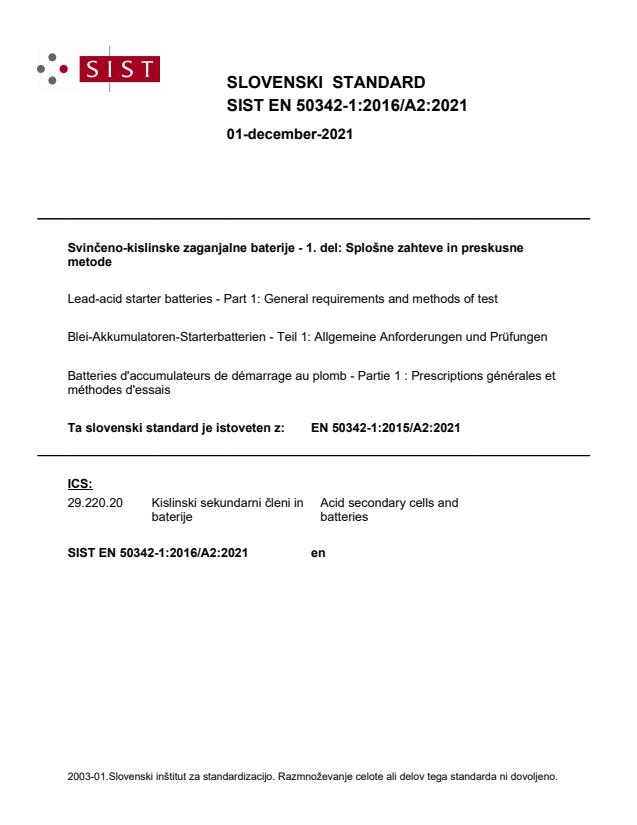
SLOVENSKI STANDARD
01-december-2021
Svinčeno-kislinske zaganjalne baterije - 1. del: Splošne zahteve in preskusne
metode
Lead-acid starter batteries - Part 1: General requirements and methods of test
Blei-Akkumulatoren-Starterbatterien - Teil 1: Allgemeine Anforderungen und Prüfungen
Batteries d'accumulateurs de démarrage au plomb - Partie 1 : Prescriptions générales et
méthodes d'essais
Ta slovenski standard je istoveten z: EN 50342-1:2015/A2:2021
ICS:
29.220.20 Kislinski sekundarni členi in Acid secondary cells and
baterije batteries
2003-01.Slovenski inštitut za standardizacijo. Razmnoževanje celote ali delov tega standarda ni dovoljeno.
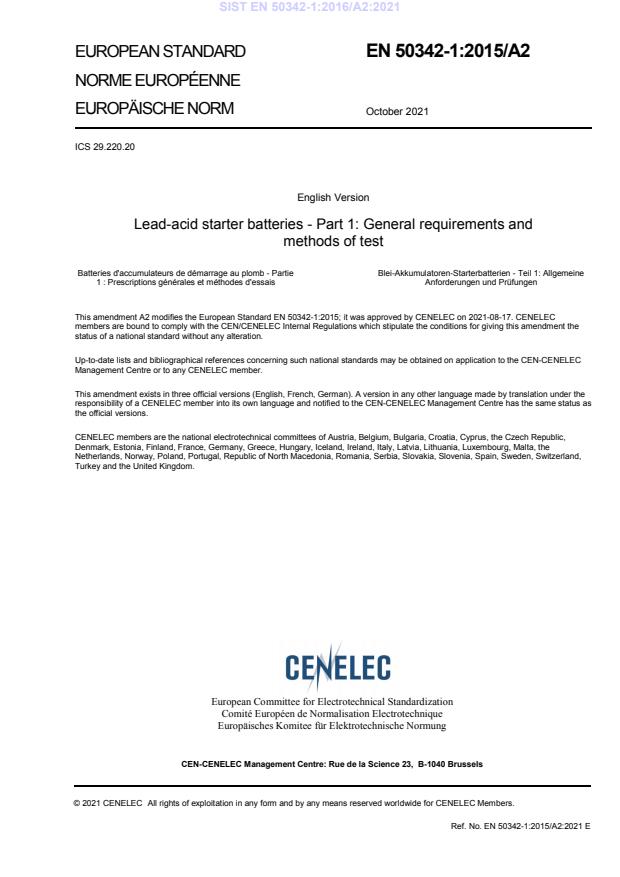
EUROPEAN STANDARD EN 50342-1:2015/A2
NORME EUROPÉENNE
EUROPÄISCHE NORM
October 2021
ICS 29.220.20
English Version
Lead-acid starter batteries - Part 1: General requirements and
methods of test
Batteries d'accumulateurs de démarrage au plomb - Partie Blei-Akkumulatoren-Starterbatterien - Teil 1: Allgemeine
1 : Prescriptions générales et méthodes d'essais Anforderungen und Prüfungen
This amendment A2 modifies the European Standard EN 50342-1:2015; it was approved by CENELEC on 2021-08-17. CENELEC
members are bound to comply with the CEN/CENELEC Internal Regulations which stipulate the conditions for giving this amendment the
status of a national standard without any alteration.
Up-to-date lists and bibliographical references concerning such national standards may be obtained on application to the CEN-CENELEC
Management Centre or to any CENELEC member.
This amendment exists in three official versions (English, French, German). A version in any other language made by translation under the
responsibility of a CENELEC member into its own language and notified to the CEN-CENELEC Management Centre has the same status as
the official versions.
CENELEC members are the national electrotechnical committees of Austria, Belgium, Bulgaria, Croatia, Cyprus, the Czech Republic,
Denmark, Estonia, Finland, France, Germany, Greece, Hungary, Iceland, Ireland, Italy, Latvia, Lithuania, Luxembourg, Malta, the
Netherlands, Norway, Poland, Portugal, Republic of North Macedonia, Romania, Serbia, Slovakia, Slovenia, Spain, Sweden, Switzerland,
Turkey and the United Kingdom.
European Committee for Electrotechnical Standardization
Comité Européen de Normalisation Electrotechnique
Europäisches Komitee für Elektrotechnische Normung
CEN-CENELEC Management Centre: Rue de la Science 23, B-1040 Brussels
© 2021 CENELEC All rights of exploitation in any form and by any means reserved worldwide
...