

SIST EN IEC 62485-5:2021
(Main)Safety requirements for secondary batteries and battery installations - Part 5: Safe operation of stationary lithium-ion batteries
General Information
- Abstract
IEC 62485-5:2020 applies to the installation of one or more stationary secondary batteries having a maximum aggregate DC voltage of 1 500 V to any DC part of the power network, and describes the principal measures for protections during normal operation or under expected fault conditions against hazards generated from:
– electricity,
– short-circuits,
– electrolyte,
– gas emission,
– fire,
– explosion.
This document provides requirements on safety aspects associated with the installation, use, inspection, and maintenance and disposal of lithium ion batteries used in stationary applications.
- Status
- Published
- Publication Date
- 02-Feb-2021
- Technical Committee
- ISCB - Secondary cells and batteries
- Current Stage
- 6060 - National Implementation/Publication (Adopted Project)
- Start Date
- 13-Jan-2021
- Due Date
- 20-Mar-2021
- Completion Date
- 03-Feb-2021


Overview
EN IEC 62485-5:2021 (published by CLC/CENELEC) sets safety requirements for the safe operation of stationary lithium‑ion batteries and their installations. The standard applies to installations of one or more stationary secondary batteries with a maximum aggregate DC voltage up to 1 500 V to any DC part of the power network. It describes principal protective measures for normal operation and expected fault conditions against hazards from electricity, short‑circuits, electrolyte, gas emission, fire and explosion, and covers requirements for installation, use, inspection, maintenance and disposal.
Key topics and technical requirements
- Protection against electric shock: basic and fault protection strategies, including automatic disconnection, class II insulation, and electrical separation methods.
- Extra‑low voltage measures: use of SELV, PELV and FELV principles where applicable.
- Short‑circuit and current effects: prevention, calculation guidance and measures during fault conditions.
- Charging requirements and modes: safe charging practices, ripple/current considerations and operation modes for stationary systems.
- Hazard mitigation: procedures and design measures for gas emission, fire and explosion risk reduction.
- Chemical safety: handling, initial actions for hazardous releases, and PPE/first‑aid considerations for electrolyte exposure.
- Accommodation and enclosures: requirements for battery rooms, separated areas, enclosures and minimum working distances.
- Identification, labeling and documentation: marking on cells/modules/systems, warning labels in rooms, and user/maintenance instructions.
- Inspection, monitoring and maintenance: periodic checks, protective measures during maintenance and lifecycle considerations including disposal.
- EMC and environmental aspects: electromagnetic compatibility for stationary applications, transport, storage and environmental requirements.
Practical applications and who uses this standard
- Facilities deploying stationary lithium‑ion battery systems for grid storage, UPS, telecom, microgrids, renewable energy integration and industrial backup.
- System integrators, battery manufacturers, electrical designers, safety engineers and facility managers responsible for design, installation, commissioning, operation and maintenance.
- Inspectors and regulatory authorities assessing compliance with European electrotechnical safety requirements.
- Health & safety teams designing emergency response plans for battery rooms (fire, gas release, electrolyte exposure).
Related standards
Relevant cross‑references cited in the document include: IEC/EN 62485‑1, IEC 62619, IEC 62133‑2, IEC 62620, and various IEC/EN standards on low‑voltage installation, EMC and fire testing (e.g., IEC 60364 series, IEC 61000 series, IEC 60695).
This standard is essential reading for anyone responsible for the safe deployment and lifecycle management of stationary lithium‑ion battery installations in Europe and internationally.
Relations
- Effective Date
- 02-Jun-2026
- Effective Date
- 10-Feb-2026
- Effective Date
- 09-Feb-2026
- Effective Date
- 09-Feb-2026
- Effective Date
- 03-Feb-2026
- Effective Date
- 03-Feb-2026
- Effective Date
- 03-Feb-2026
- Effective Date
- 03-Feb-2026
- Effective Date
- 03-Feb-2026
- Effective Date
- 03-Feb-2026
- Effective Date
- 03-Feb-2026
- Effective Date
- 03-Feb-2026
- Effective Date
- 03-Feb-2026
- Effective Date
- 03-Feb-2026
- Effective Date
- 03-Feb-2026
Get Certified
Connect with accredited certification bodies for this standard

IMQ S.p.A. (Certification)
Italian electrical product certification.

SLG Prüf- und Zertifizierungs GmbH
German testing and certification body.

UL Solutions
Global safety science company with testing, inspection and certification.
Sponsored listings
Frequently Asked Questions
SIST EN IEC 62485-5:2021 is a standard published by the Slovenian Institute for Standardization (SIST). Its full title is "Safety requirements for secondary batteries and battery installations - Part 5: Safe operation of stationary lithium-ion batteries". This standard covers: IEC 62485-5:2020 applies to the installation of one or more stationary secondary batteries having a maximum aggregate DC voltage of 1 500 V to any DC part of the power network, and describes the principal measures for protections during normal operation or under expected fault conditions against hazards generated from: – electricity, – short-circuits, – electrolyte, – gas emission, – fire, – explosion. This document provides requirements on safety aspects associated with the installation, use, inspection, and maintenance and disposal of lithium ion batteries used in stationary applications.
IEC 62485-5:2020 applies to the installation of one or more stationary secondary batteries having a maximum aggregate DC voltage of 1 500 V to any DC part of the power network, and describes the principal measures for protections during normal operation or under expected fault conditions against hazards generated from: – electricity, – short-circuits, – electrolyte, – gas emission, – fire, – explosion. This document provides requirements on safety aspects associated with the installation, use, inspection, and maintenance and disposal of lithium ion batteries used in stationary applications.
SIST EN IEC 62485-5:2021 is classified under the following ICS (International Classification for Standards) categories: 29.220.20 - Acid secondary cells and batteries; 29.220.30 - Alkaline secondary cells and batteries. The ICS classification helps identify the subject area and facilitates finding related standards.
SIST EN IEC 62485-5:2021 has the following relationships with other standards: It is inter standard links to SIST EN IEC 61000-6-3:2026, SIST ISO 3864:1995, SIST EN 1060-1:2000/A1:2002, SIST ENV 1402-7:1998, SIST EN 62620:2015, SIST EN 61660-1:1998, SIST EN 61140:2016, SIST HD 60364-4-41:2017, SIST EN 61000-6-7:2015, SIST EN 62619:2018, SIST EN IEC 60664-1:2020, SIST EN 62133-2:2017, SIST EN 61660-2:1998, SIST EN 61000-1-2:2016, SIST HD 60364-5-54:2011. Understanding these relationships helps ensure you are using the most current and applicable version of the standard.
SIST EN IEC 62485-5:2021 is available in PDF format for immediate download after purchase. The document can be added to your cart and obtained through the secure checkout process. Digital delivery ensures instant access to the complete standard document.
Standards Content (Sample)
SLOVENSKI STANDARD
01-marec-2021
Varnostne zahteve za sekundarne baterije in baterijske naprave - 5. del: Varnostne
zahteve za nepremične litij-ionske baterije
Safety requirements for secondary batteries and battery installations - Part 5: Safe
operation of stationary lithium-ion batteries
Ta slovenski standard je istoveten z: EN IEC 62485-5:2021
ICS:
29.220.20 Kislinski sekundarni členi in Acid secondary cells and
baterije batteries
29.220.30 Alkalni sekundarni členi in Alkaline secondary cells and
baterije batteries
2003-01.Slovenski inštitut za standardizacijo. Razmnoževanje celote ali delov tega standarda ni dovoljeno.
EUROPEAN STANDARD EN IEC 62485-5
NORME EUROPÉENNE
EUROPÄISCHE NORM
January 2021
ICS 29.220.20; 29.220.30
English Version
Safety requirements for secondary batteries and battery
installations - Part 5: Safe operation of stationary lithium ion
batteries
(IEC 62485-5:2020)
Exigences de sécurité pour les batteries d'accumulateurs et Sicherheitsanforderungen an sekundäre Batterien und
les installations de batteries - Partie 5: Fonctionnement en Batterieanlagen - Teil 5: Sicherer Betrieb von stationären
toute sécurité des batteries ions-lithium stationnaires Lithium-Ionen-Batterien
(IEC 62485-5:2020) (IEC 62485-5:2020)
This European Standard was approved by CENELEC on 2020-12-30. CENELEC members are bound to comply with the CEN/CENELEC
Internal Regulations which stipulate the conditions for giving this European Standard the status of a national standard without any alteration.
Up-to-date lists and bibliographical references concerning such national standards may be obtained on application to the CEN-CENELEC
Management Centre or to any CENELEC member.
This European Standard exists in three official versions (English, French, German). A version in any other language made by translation
under the responsibility of a CENELEC member into its own language and notified to the CEN-CENELEC Management Centre has the
same status as the official versions.
CENELEC members are the national electrotechnical committees of Austria, Belgium, Bulgaria, Croatia, Cyprus, the Czech Republic,
Denmark, Estonia, Finland, France, Germany, Greece, Hungary, Iceland, Ireland, Italy, Latvia, Lithuania, Luxembourg, Malta, the
Netherlands, Norway, Poland, Portugal, Republic of North Macedonia, Romania, Serbia, Slovakia, Slovenia, Spain, Sweden, Switzerland,
Turkey and the United Kingdom.
European Committee for Electrotechnical Standardization
Comité Européen de Normalisation Electrotechnique
Europäisches Komitee für Elektrotechnische Normung
CEN-CENELEC Management Centre: Rue de la Science 23, B-1040 Brussels
© 2021 CENELEC All rights of exploitation in any form and by any means reserved worldwide for CENELEC Members.
Ref. No. EN IEC 62485-5:2021 E
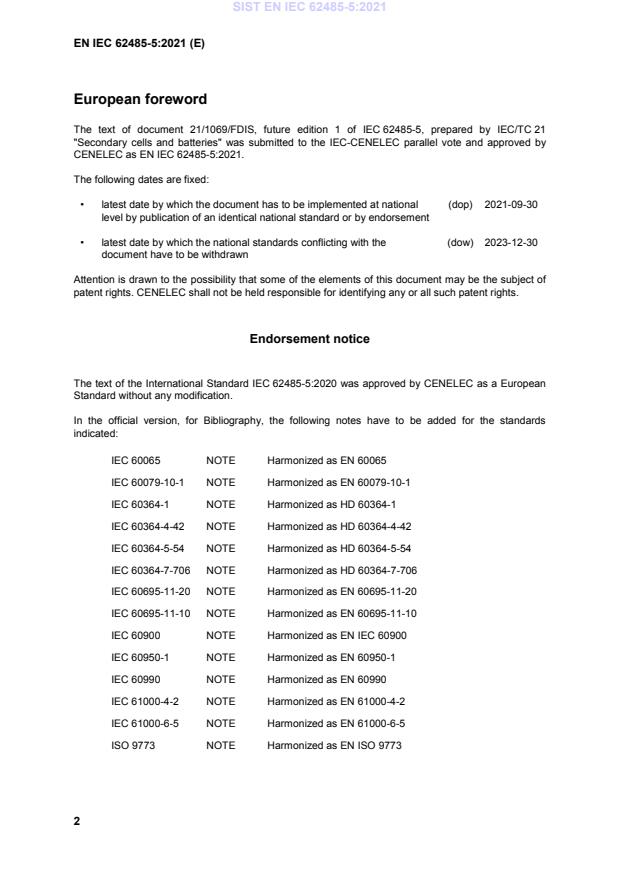
European foreword
The text of document 21/1069/FDIS, future edition 1 of IEC 62485-5, prepared by IEC/TC 21
"Secondary cells and batteries" was submitted to the IEC-CENELEC parallel vote and approved by
CENELEC as EN IEC 62485-5:2021.
The following dates are fixed:
• latest date by which the document has to be implemented at national (dop) 2021-09-30
level by publication of an identical national standard or by endorsement
• latest date by which the national standards conflicting with the (dow) 2023-12-30
document have to be withdrawn
Attention is drawn to the possibility that some of the elements of this document may be the subject of
patent rights. CENELEC shall not be held responsible for identifying any or all such patent rights.
Endorsement notice
The text of the International Standard IEC 62485-5:2020 was approved by CENELEC as a European
Standard without any modification.
In the official version, for Bibliography, the following notes have to be added for the standards
indicated:
IEC 60065 NOTE Harmonized as EN 60065
IEC 60079-10-1 NOTE Harmonized as EN 60079-10-1
IEC 60364-1 NOTE Harmonized as HD 60364-1
IEC 60364-4-42 NOTE Harmonized as HD 60364-4-42
IEC 60364-5-54 NOTE Harmonized as HD 60364-5-54
IEC 60364-7-706 NOTE Harmonized as HD 60364-7-706
IEC 60695-11-20 NOTE Harmonized as EN 60695-11-20
IEC 60695-11-10 NOTE Harmonized as EN 60695-11-10
IEC 60900 NOTE Harmonized as EN IEC 60900
IEC 60950-1 NOTE Harmonized as EN 60950-1
IEC 60990 NOTE Harmonized as EN 60990
IEC 61000-4-2 NOTE Harmonized as EN 61000-4-2
IEC 61000-6-5 NOTE Harmonized as EN 61000-6-5
ISO 9773 NOTE Harmonized as EN ISO 9773
Annex ZA
(normative)
Normative references to international publications with their
corresponding European publications
The following documents are referred to in the text in such a way that some or all of their content
constitutes requirements of this document. For dated references, only the edition cited applies. For
undated references, the latest edition of the referenced document (including any amendments)
applies.
NOTE 1 Where an International Publication has been modified by common modifications, indicated by (mod),
the relevant EN/HD applies.
NOTE 2 Up-to-date information on the latest versions of the European Standards listed in this annex is available
here: www.cenelec.eu.
Publication Year Title EN/HD Year
IEC 60050-482 - International Electrotechnical Vocabulary - -
- Part 482: Primary and secondary cells
and batteries
IEC 60364-4-41 2005 Low-voltage electrical installations - Part HD 60364-4-41 2017
(mod) 4-41: Protection for safety - Protection
against electric shock
+A1 2017 + A11 2017
- - + A12 2019
IEC 60364-4-43 - IEC 60364-4-43 Ed. 4: Low-voltage - -
electrical installations - Part 4-43:
Protection for safety - Protection against
overcurrent
IEC 60364-5-53 - Low-voltage electrical installations - Part - -
5-53: Selection and erection of electrical
equipment - Protection, isolation,
switching, control and monitoring
IEC 60364-5-54 - Low-voltage electrical installations - Part HD 60364-5-54 -
5-54: Selection and erection of electrical
equipment - Earthing arrangements and
protective conductors
IEC 60417 - Graphical symbols for use on equipment. - -
Index, survey and compilation of the
single sheets.
IEC 60529 - Degrees of protection provided by - -
enclosures (IP Code)
IEC 60664-1 2020 Insulation coordination for equipment EN IEC 60664-1 2020
within low-voltage supply systems -
Part 1: Principles, requirements and
tests
IEC 60755 - General safety requirements for residual - -
current operated protective devices
Publication Year Title EN/HD Year
IEC 61000-1-2 - Electromagnetic compatibility (EMC) - EN 61000-1-2 -
Part 1-2: General - Methodology for the
achievement of functional safety of
electrical and electronic systems
including equipment with regard to
electromagnetic phenomena
IEC 61000-6-1 - Electromagnetic compatibility (EMC) - EN IEC 61000-6-1 -
Part 6-1: Generic standards - Immunity
standard for residential, commercial and
light-industrial environments
IEC 61000-6-2 - Electromagnetic compatibility (EMC) - EN IEC 61000-6-2 -
Part 6-2: Generic standards - Immunity
standard for industrial environments
IEC 61000-6-3 - Electromagnetic compatibility (EMC) - EN IEC 61000-6-3 -
Part 6-3: Generic standards - Emission
standard for equipment in residential
environments
IEC 61000-6-4 - Electromagnetic compatibility (EMC) - EN IEC 61000-6-4 -
Part 6-4: Generic standards - Emission
standard for industrial environments
IEC 61000-6-7 - Electromagnetic compatibility (EMC) - EN 61000-6-7 -
Part 6-7: Generic standards - Immunity
requirements for equipment intended to
perform functions in a safety-related
system (functional safety) in industrial
locations
IEC 61140 - Protection against electric shock - EN 61140 -
Common aspects for installation and
equipment
IEC/TR 61340-1 - Electrostatics - Part 1: Electrostatic - -
phenomena - Principles and
measurements
IEC 61340-5-1 - Electrostatics - Part 5-1: Protection of EN 61340-5-1 -
electronic devices from electrostatic
phenomena - General requirements
IEC 61660-1 - Short-circuit currents in d.c. auxiliary EN 61660-1 -
installations in power plants and
substations - Part 1: Calculation of short-
circuit currents
IEC 61660-2 - Short-circuit currents in d.c. auxiliary EN 61660-2 -
installations in power plants and
substations - Part 2: Calculation of
effects
IEC 62133-2 - Secondary cells and batteries containing EN 62133-2 -
alkaline or other non-acid electrolytes -
Safety requirements for portable sealed
secondary lithium cells, and for batteries
made from them, for use in portable
applications - Part 2: Lithium systems
To be published. Stage at the time of publication: prEN IEC 61000-6-3:2019.
Publication Year Title EN/HD Year
IEC 62485-1 - Safety requirements for secondary EN IEC 62485-1 -
batteries and battery installations -
Part 1: General safety information
IEC 62619 2017 Secondary cells and batteries containing EN 62619 2017
alkaline or other non-acid electrolytes -
Safety requirements for secondary
lithium cells and batteries, for use in
industrial applications
IEC 62620 2014 Secondary cells and batteries containing EN 62620 2015
alkaline or other non-acid electrolytes -
Secondary lithium cells and batteries for
use in industrial applications
ISO/IEC Guide 51 - Safety aspects - Guidelines for their - -
inclusion in standards
ISO 3864 series Graphical symbols - Safety colours and - -
safety signs
ISO 7010 - Graphical symbols - Safety colours and - -
safety signs - Registered safety signs
IEC 62485-5 ®
Edition 1.0 2020-11
INTERNATIONAL
STANDARD
NORME
INTERNATIONALE
colour
inside
Safety requirements for secondary batteries and battery installations –
Part 5: Safe operation of stationary lithium ion batteries
Exigences de sécurité pour les batteries d'accumulateurs et les installations
de batteries –
Partie 5: Fonctionnement en toute sécurité des batteries ions-lithium
stationnaires
INTERNATIONAL
ELECTROTECHNICAL
COMMISSION
COMMISSION
ELECTROTECHNIQUE
INTERNATIONALE
ICS 29.220.20; 29.220.30 ISBN 978-2-8322-9091-0
– 2 – IEC 62485-5:2020 © IEC 2020
CONTENTS
FOREWORD . 5
INTRODUCTION . 7
1 Scope . 8
2 Normative references . 8
3 Terms and definitions and abbreviated terms . 10
3.1 Terms and definitions . 10
3.2 Abbreviated terms . 14
4 Protection against electric shock . 14
4.1 General . 14
4.2 Basic protection . 14
4.3 Fault protection . 15
4.3.1 General . 15
4.3.2 Protection by automatic disconnection of supply . 16
4.3.3 Protection by use of class II equipment or by equivalent insulation . 20
4.3.4 Protection by electrical separation . 20
4.4 Protective measure: extra-low voltage provided by SELV, PELV and FELV . 20
4.4.1 General . 20
4.4.2 Protection by SELV or by PELV . 20
4.4.3 Protection by functional extra-low voltage (FELV) without protective
separation . 20
5 Disconnection and separation . 21
6 Prevention of short-circuits and protection from other effects of electric current . 21
6.1 General . 21
6.2 Short-circuits . 22
6.3 Maintenance instructions . 22
6.3.1 General . 22
6.3.2 Protective measures during maintenance . 22
6.4 Leakage currents . 23
7 Provision against hazards . 23
7.1 General . 23
7.2 Charging modes . 23
7.3 Overcharging or overdischarging under fault conditions . 24
7.4 Prevention of electrostatic discharges when working with batteries . 24
8 Provision against hazards posed by chemical substances . 24
8.1 General . 24
8.2 Initial actions in case of hazardous chemical release . 24
8.2.1 General . 24
8.2.2 Eye or skin contact . 25
8.2.3 Swallowing . 25
8.2.4 Respiratory tract . 25
8.2.5 Burns . 25
8.3 Battery accessories and maintenance tools. 25
9 Accommodation, housing . 25
9.1 General . 25
9.2 Specific requirements for separate battery rooms . 25
IEC 62485-5:2020 © IEC 2020 – 3 –
9.3 Specific requirements for the specially separated areas in rooms
accommodating electrical equipment. 26
9.4 Battery enclosures . 26
9.5 Working on or near batteries . 26
9.5.1 Working distances within battery rooms . 26
9.5.2 Remarks on special work in battery rooms . 27
9.6 Accommodation of lithium ion batteries in combination with batteries
containing aqueous electrolyte (e.g. lead-acid and NiCd batteries) in the
same room . 27
10 Charge current requirements . 27
10.1 General . 27
10.2 Superimposed ripple current . 27
10.3 Maximum ripple current . 27
11 Identification labels, warning notices and instructions for use, installation and
maintenance . 28
11.1 Warning labels and notices in rooms . 28
11.2 Identification labels or marking on cell, module, battery pack or battery
system . 28
11.3 Instructions for use, installation and maintenance . 28
12 Transportation, storage and environmental aspects . 28
13 Inspection and monitoring . 29
14 EMC for stationary application . 29
Annex A (informative) Charging methods and modes of operation. 31
A.1 Parallel operation mode . 31
A.1.1 General . 31
A.1.2 Battery "stand-by" operation mode . 31
A.1.3 Battery "buffer" operation mode . 31
A.1.4 Shallow cycling operation mode . 32
A.2 Response mode operation . 32
A.3 Charging methods . 32
A.3.1 General . 32
A.3.2 Temperature compensation of the charge voltage and limiting of charge
currents . 33
A.4 Discharge . 33
Annex B (normative) Electromagnetic compatibility (EMC) . 34
B.1 Case 1 – EMC requirements for battery systems depending on each end-
device application . 34
B.2 Case 2 – EMC requirements for testing battery system as an end-device . 34
Annex C (informative) Cell behaviour inside and outside of operating region . 35
Bibliography . 36
Figure 1 – TN system with separate protective conductor (PE) in the entire system
(TN-S network) . 16
Figure 2 – TN system with functional earthing and protective earthing (FPE, PEN)
combined with an external line conductor (TN-C system) . 17
Figure 3 – TT system . 18
Figure 4 – IT system . 19
Figure 5 – Converters with intermediate DC circuit (IT system) (example) . 19
Figure A.1 – Parallel operation mode circuit . 31
– 4 – IEC 62485-5:2020 © IEC 2020
Figure A.2 – Example of battery charge current interlaced with frequent temporary
discharge events due to a load current exceeding the current supply capability . 32
Figure A.3 – Response mode operation circuit . 32
Figure A.4 – Constant current/constant voltage charge . 33
Figure C.1 – An example for operating region of lithium ion cell . 35
IEC 62485-5:2020 © IEC 2020 – 5 –
INTERNATIONAL ELECTROTECHNICAL COMMISSION
____________
SAFETY REQUIREMENTS FOR SECONDARY
BATTERIES AND BATTERY INSTALLATIONS –
Part 5: Safe operation of stationary lithium ion batteries
FOREWORD
1) The International Electrotechnical Commission (IEC) is a worldwide organization for standardization comprising
all national electrotechnical committees (IEC National Committees). The object of IEC is to promote
international co-operation on all questions concerning standardization in the electrical and electronic fields. To
this end and in addition to other activities, IEC publishes International Standards, Technical Specifications,
Technical Reports, Publicly Available Specifications (PAS) and Guides (hereafter referred to as "IEC
Publication(s)"). Their preparation is entrusted to technical committees; any IEC National Committee interested
in the subject dealt with may participate in this preparatory work. International, governmental and non-
governmental organizations liaising with the IEC also participate in this preparation. IEC collaborates closely
with the International Organization for Standardization (ISO) in accordance with conditions determined by
agreement between the two organizations.
2) The formal decisions or agreements of IEC on technical matters express, as nearly as possible, an international
consensus of opinion on the relevant subjects since each technical committee has representation from all
interested IEC National Committees.
3) IEC Publications have the form of recommendations for international use and are accepted by IEC National
Committees in that sense. While all reasonable efforts are made to ensure that the technical content of IEC
Publications is accurate, IEC cannot be held responsible for the way in which they are used or for any
misinterpretation by any end user.
4) In order to promote international uniformity, IEC National Committees undertake to apply IEC Publications
transparently to the maximum extent possible in their national and regional publications. Any divergence
between any IEC Publication and the corresponding national or regional publication shall be clearly indicated in
the latter.
5) IEC itself does not provide any attestation of conformity. Independent certification bodies provide conformity
assessment services and, in some areas, access to IEC marks of conformity. IEC is not responsible for any
services carried out by independent certification bodies.
6) All users should ensure that they have the latest edition of this publication.
7) No liability shall attach to IEC or its directors, employees, servants or agents including individual experts and
members of its technical committees and IEC National Committees for any personal injury, property damage or
other damage of any nature whatsoever, whether direct or indirect, or for costs (including legal fees) and
expenses arising out of the publication, use of, or reliance upon, this IEC Publication or any other IEC
Publications.
8) Attention is drawn to the Normative references cited in this publication. Use of the referenced publications is
indispensable for the correct application of this publication.
9) Attention is drawn to the possibility that some of the elements of this IEC Publication may be the subject of
patent rights. IEC shall not be held responsible for identifying any or all such patent rights.
International Standard IEC 62485-5 has been prepared by IEC technical committee 21:
Secondary cells and batteries.
The text of this International Standard is based on the following documents:
FDIS Report on voting
21/1069/FDIS 21/1076/RVD
Full information on the voting for the approval of this International Standard can be found in
the report on voting indicated in the above table.
This document has been drafted in accordance with the ISO/IEC Directives, Part 2.
– 6 – IEC 62485-5:2020 © IEC 2020
A list of all parts in the IEC 62485 series, published under the general title Safety
requirements for secondary batteries and battery installations, can be found on the IEC
website.
The committee has decided that the contents of this document will remain unchanged until the
stability date indicated on the IEC website under "http://webstore.iec.ch" in the data related to
the specific document. At this date, the document will be
• reconfirmed,
• withdrawn,
• replaced by a revised edition, or
• amended.
IMPORTANT – The 'colour inside' logo on the cover page of this publication indicates
that it contains colours which are considered to be useful for the correct
understanding of its contents. Users should therefore print this document using a
colour printer.
IEC 62485-5:2020 © IEC 2020 – 7 –
INTRODUCTION
The described safety requirements comprise the protective measures to protect from hazards
generated by electricity and chemical substances when using secondary batteries. In addition
measures are described to maintain the functional safety of batteries and battery installations.
For electrical safety (protection against electric shock) under Clause 4, this document refers
to IEC 60364-4-41. The pilot function of this document is fully observed by indication of cross-
reference numbers of the relevant clauses, but interpretation is given where adoption to direct
current (DC) circuits is required.
This document comes into force with the date of publication and applies to all new batteries
and battery installations. Previous installations are intended to conform to the existing
national standards at the time of installation. In the case of the redesign of old installations,
this document applies.
Lithium ion cells/batteries used in stationary industrial applications are intended to fulfil safety
requirements in accordance with IEC 62619.
– 8 – IEC 62485-5:2020 © IEC 2020
SAFETY REQUIREMENTS FOR SECONDARY
BATTERIES AND BATTERY INSTALLATIONS –
Part 5: Safe operation of stationary lithium ion batteries
1 Scope
This part of IEC 62485 applies to the installation of one or more stationary secondary
batteries having a maximum aggregate DC voltage of 1 500 V to any DC part of the power
network, and describes the principal measures for protections during normal operation or
under expected fault conditions against hazards generated from:
– electricity,
– short-circuits,
– electrolyte,
– gas emission,
– fire,
– explosion.
This document provides requirements on safety aspects associated with the installation, use,
inspection, and maintenance and disposal of lithium ion batteries used in stationary
applications.
This document covers stationary batteries for industrial applications that are installed in
separate closed buildings or housings as well as stationary batteries that are installed in
public buildings, offices and private residences. This document also covers the maintenance
and disposal of lithium ion batteries used in stationary applications.
Batteries containing lithium metal are not covered by this document.
Examples of the main applications are:
– telecommunications,
– power station operation,
– central emergency lighting and alarm systems,
– uninterruptible power supplies (UPS),
– stationary engine starting,
– photovoltaic systems.
In general, the safety requirements for secondary batteries and battery installations – General
safety information and definitions are specified for lead-acid, nickel-cadmium and nickel-metal
hybrid batteries in accordance with IEC 62485-1.
2 Normative references
The following documents are referred to in the text in such a way that some or all of their
content constitutes requirements of this document. For dated references, only the edition
cited applies. For undated references, the latest edition of the referenced document (including
any amendments) applies.
IEC 62485-5:2020 © IEC 2020 – 9 –
IEC 60050-482, International Electrotechnical Vocabulary (IEV) – Part 482: Primary and
secondary cells and batteries
IEC 60364-4-41:2005, Low-voltage electrical installations – Part 4-41: Protection for safety –
Protection against electric shock
IEC 60364-4-41:2005/AMD1:2017
IEC 60364-4-43, Low-voltage electrical installations – Part 4-43: Protection for safety –
Protection against overcurrent
IEC 60364-5-53, Low-voltage electrical installations – Part 5-53: Selection and erection of
electrical equipment – Devices for protection for safety, isolation, switching, control and
monitoring
IEC 60364-5-54, Low-voltage electrical installations – Part 5-54: Selection and erection of
electrical equipment – Earthing arrangements and protective conductors
IEC 60417, Graphical symbols for use on equipment (available at http://www.graphical-
symbols.info/equipment)
IEC 60529, Degrees of protection provided by enclosures (IP Code)
IEC 60664-1:2020, Insulation coordination for equipment within low-voltage systems – Part 1:
Principles, requirements and tests
IEC 60755, General safety requirements for residual current operated protective devices
IEC 61000-1-2, Electromagnetic compatibility (EMC) – Part 1-2: General – Methodology for
the achievement of functional safety of electrical and electronic systems including equipment
with regard to electromagnetic phenomena
IEC 61000-6-1, Electromagnetic compatibility (EMC) – Part 6-1: Generic standards –
Immunity standard for residential, commercial and light-industrial environments
IEC 61000-6-2, Electromagnetic compatibility (EMC) – Part 6-2: Generic standards –
Immunity standard for industrial environments
IEC 61000-6-3, Electromagnetic compatibility (EMC) – Part 6-3: Generic standards –
Emission standard for residential, commercial and light-industrial environments
IEC 61000-6-4, Electromagnetic compatibility (EMC) – Part 6-4: Generic standards –
Emission standard for industrial environments
IEC 61000-6-7, Electromagnetic compatibility (EMC) – Part 6-7: Generic standards –
Immunity requirements for equipment intended to perform functions in a safety-related system
(functional safety) in industrial locations
IEC 61140, Protection against electric shock – Common aspects for installation and
equipment
IEC/TR 61340-1, Electrostatics – Part 1: Electrostatic phenomena – Principles and
measurements
IEC 61340-5-1, Electrostatics – Part 5-1: Protection of electronic devices from electrostatic
phenomena – General requirements
– 10 – IEC 62485-5:2020 © IEC 2020
IEC 61660-1, Short-circuit currents in d.c. auxiliary installations in power plants and
substations – Part 1: Calculation of short-circuit currents
IEC 61660-2, Short-circuit currents in d.c. auxiliary installations in power plants and
substations – Part 2: Calculation of effects
IEC 62133-2, Secondary cells and batteries containing alkaline or other non-acid electrolytes
– Safety requirements for portable sealed secondary cells, and for batteries made from them,
for use in portable applications – Part 2: Lithium systems
IEC 62485-1, Safety requirements for secondary batteries and battery installations – Part 1:
General safety information
IEC 62619:2017, Secondary cells and batteries containing alkaline or other non-acid
electrolytes – Safety requirements for secondary lithium cells and batteries, for use in
industrial applications
IEC 62620:2014, Secondary cells and batteries containing alkaline or other non-acid
electrolytes –Secondary lithium cells and batteries for use in industrial applications
ISO/IEC Guide 51, Safety aspects – Guidelines for their inclusion in standards
ISO 3864 (all parts), Graphical symbols – Safety colours and safety signs
ISO 7010, Graphical symbols – Safety colours and safety signs – Registered safety signs
3 Terms and definitions and abbreviated terms
For the purposes of this document, the terms and definitions given in IEC 60050-482,
ISO/IEC Guide 51, and the following apply.
ISO and IEC maintain terminological databases for use in standardization at the following
addresses:
• IEC Electropedia: available at http://www.electropedia.org/
• ISO Online browsing platform: available at http://www.iso.org/obp
3.1 Terms and definitions
3.1.1
secondary lithium cell
cell
secondary cell where electrical energy is derived from the insertion/extraction reactions of
lithium ions or oxidation/reduction reaction of lithium between the negative electrode and the
positive electrode
Note 1 to entry: The cell typically has an electrolyte that consists of a lithium salt and organic solvent compound
in liquid, gel or solid form and has a metal or a laminate film casing.
Note 2 to entry: A cell is not ready for use in an application because it is not yet fitted with its final housing,
terminal arrangement and electronic control device.
3.1.2
home energy storage system
HESS
stationary battery system used in or next to a single or multi-family dwelling or in internal
home energy storage installations
IEC 62485-5:2020 © IEC 2020 – 11 –
Note 1 to entry: The system is typically installed in rooms which are not designed as electrical service rooms or
battery rooms.
3.1.3
battery energy storage system
BESS
stationary system to store and convert back electrical energy, which contains components
necessary for this function, especially the battery, the power conversion system and the
energy management system
Note 1 to entry: In general, the safety functions and the enclosure are also part of BESS.
Note 2 to entry: The power conversion system can be an AC/DC converter or DC/DC converter to charge or
discharge the battery.
3.1.4
battery system
battery
system which comprises one or more cells, modules or battery packs and has a battery
management system capable of controlling current in case of overcharge, overcurrent,
overdischarge and overheating
Note 1 to entry: Overdischarge cut off is not mandatory if there is an agreement on this between the cell
manufacturer and the customer.
Note 2 to entry: The battery system may have cooling or heating units. A larger battery system may comprise
more than one battery system. The battery system is sometimes also referred to as a battery.
3.1.5
stationary battery
battery system which is designed for service in a fixed location and is not habitually moved
from place to place during the service life
Note 1 to entry: Overdischarge cut off is not mandatory if there is an agreement on this between the cell
manufacturer and the customer.
Note 2 to entry: The function of the BMS can be assigned to the battery pack or to equipment that uses the
battery.
Note 3 to entry: The BMS can be divided and it can be found partially in the battery pack and partially on the
equipment that uses the battery.
Note 4 to entry: The BMS is sometimes also referred to as a BMU (battery management unit).
3.1.6
electrolyte
liquid or solid substance containing mobile ions which render it ionically conductive
Note 1 to entry: The electrolyte may be liquid, solid or a gel.
[SOURCE: IEC 60500-482:2004, 482-02-29]
3.1.7
battery management system
BMS
electronic system associated with a battery which has functions to control current in case of
overcharge, overcurrent, overdischarge, and overheating, and which monitors and/or
manages the state of the battery, calculates secondary data, reports that data and/or controls
its environment to influence the battery's safety, performance and/or service life
Note 1 to entry: Overcharge cut off is not mandatory if there is an agreement on this between the cell
manufacturer and the customer.
Note 2 to entry: The function of the BMS can be assigned to the battery pack or to equipment that uses the
battery.
– 12 – IEC 62485-5:2020 © IEC 2020
Note 3 to entry: The BMS can be divided and it can be found partially in the battery pack and partially on the
equipment that uses the battery.
Note 4 to entry: The BMS is sometimes also referred to as a BMU (battery management unit).
3.1.8
charging of a battery
operation during which a secondary cell or battery is supplied with electric energy from an
external circuit which results in chemical changes within a cell and thus storage of energy as
chemical energy
[SOURCE: IEC 60500-482:2004, 482-05-27]
3.1.9
battery on float (charge)
battery whose terminals are permanently connected to a source of constant voltage sufficient
to maintain the battery approximately fully charged, and which is intended to supply power to
an electrical circuit, if the normal supply is temporarily interrupted
Note 1 to entry: In order to increase the lifetime of a lithium ion battery, the state of charge during float charge is
sometimes < 100 %.
[SOURCE: IEC 60500-482:2004, 482-05-35, modified – The deprecated term "floating battery"
has been omitted, along with "secondary" from the definition; the note has been added.]
3.1.10
float charge voltage
constant voltage needed to keep the secondary cell or battery fully charged or at the intended
state of charge
3.1.11
float charge current
current resulting from the float charge
Note 1 to entry: This float charge current may be zero once the charge process is terminated (if specified by the
manufacturer).
3.1.12
overcharge
overcharging
continued charging after the full charge of a secondary cell or battery
Note 1 to entry: Overcharge is also the act of charging beyond a certain limit specified by the manufacturer.
[SOURCE: IEC 60500-482:2004, 482-05-44, modified – The term "overcharging" and the
domain have been added and the wording "of a fully charged" has been replaced with "after
the full charge of" in the definition.]
3.1.13
nominal voltage
suitable approximate value of the voltage used to designate or identify a cell, a battery or an
electrochemical system
Note 1 to entry: The cell or battery manufacturer may provide the nominal voltage.
Note 2 to entry: The nominal voltage of a battery of n cells connected in series is equal to n times the nominal
voltage of a single cell.
[SOURCE: IEC 60050-482:2004, 482-03-31, modified – Addition of Notes 1 and 2.]
IEC 62485-5:2020 © IEC 2020 – 13 –
3.1.14
lower limit discharging voltage
lowest discharging voltage in the cell operating region specified by the cell manufacturer
3.1.15
overdischarge
state of the battery when one or more cells of a battery are discharged below their lower limit
discharge voltage
3.1.16
maximum voltage of battery system
highest voltage of the battery system in which the maximum voltage of any individual cell is
below or equal to the upper limit charging voltage and components operate in their
specified/permissible operating range under all operating conditions
3.1.17
upper limit charging voltage
highest charging voltage in the cell operating region specified by the cell manufacturer
Note 1 to entry: The charging process should be terminated before reaching the upper limit charging voltage.
3.1.18
external short-circuit
abnormally high current discharge due to a conductive fault over parts at opposite polarity
either within the battery circuitry or over the external terminals
3.1.19
internal short-circuit
electrical conduction through insulation within the cell due to cell manufacturing defects, cell
design faults or damage due to abuse of the cell during its use
3.1.20
cell block
group of cells connected together in parallel configuration with or without protective devices
(e.g. fuse or positive temperature coefficient device (PTC)) and monitoring circuitry
Note 1 to entry: It is not ready for use in an application because it is not yet fitted with its final housing, terminal
arrangement and electronic control device.
3.1.21
module
group of cells connected together either in a series and/or parallel configuration with or
without protective devices (e.g. fuse or positive temperature coefficient device (PTC)) and
monitoring circuitry
3.1.22
battery pack
energy storage device comprised of one or more cells or modules electrically connected, and
has monitoring circuitry which provides information (e.g. cell voltage) to a battery system to
influence the battery's safety, performance and/or service life
Note 1 to entry: It may incorporate a protective housing and be provided with terminals or other interconnection
arrangements.
3.1.23
thermal runaway
uncontrolled intensive increase in the temperature of a cell driven by exothermic reaction
[SOURCE: IEC 62619:2017, 3.21]
– 14 – IEC 62485-5:2020 © IEC 2020
3.2 Abbreviated terms
Abbreviated Full term
term
DOD Depth of discharge
ESD Electrostatic discharge
FELV Functional extra low voltage
BESS Battery energy storage system
BMS Battery management system
BMU Battery management unit
HESS Home energy storage system
PELV Protective extra low voltage
PTC Positive temperature coefficient device
RCD Residual current protective device
SOC State of charge
UPS Uninterruptible power supply
4 Protection against electric shock
4.1 General
Safety provisions for
...