

SIST EN 16228-1:2014+A1:2022
(Main)Drilling and foundation equipment - Safety - Part 1: Common requirements
General Information
- Abstract
This European Standard specifies the common safety requirements for drilling and foundation equipment.
Part 1 of this European Standard deals with the significant hazards common to drilling and foundation equipment (see Annex A), when they are used as intended and under the conditions of misuse which are reasonably foreseeable by the manufacturer associated with the whole life time of the machine (transport, assembly, dismantling, equipment in service and out of service, maintenance, moving on site, storage, disabling and scrapping).
NOTE 1 The requirements specified in this part of the standard are common to two or more families of drilling and foundation equipment.
This document gives safety requirements for all types of drilling and foundation equipment and is intended to be used in conjunction with one of parts 2 to 7. These machine specific parts do not repeat the requirements from part 1 but supplement or modify the requirements for the type of drilling and foundation equipment in question.
For multipurpose machinery, the parts of the standard that cover the specific functions and applications are used, e.g. a drilling machine also used as a piling machine will use the relevant requirements of EN 16228-1, EN 16228-2, and EN 16228-4.
The following machines are excluded from the scope of this standard:
- tunnelling machines, unshielded tunnel boring machines and rodless shaft boring machines for rock according to EN 16191;
- raise boring machines;
- drill rigs used in oil and gas industry;
- specialized mining machinery and equipment for opencast mining (e.g. rock drill rigs, blast hole drills) (under the scope of CEN/TC 196);
- all underground mining machinery and equipment for the extraction of solid mineral substances (e.g. rock drill rigs, raise boring machines, shaft boring machines, mining auger boring machines, jumbos) as well as machinery and equipment for underground mine development (under the scope of CEN/TC 196);
- core drilling machines on stand (covered by EN 12348);
- hand-held machines (in particular machines covered by ISO 11148-5).
NOTE 2 Specific requirements for offshore applications are not covered by this European Standard.
Where a drilling or foundation equipment of fixed configuration that is not intended to be separated is assembled using a carrier based on earth-moving equipment, agricultural equipment, or a crane, then the completed assembly is !covered by this" standard.
Drilling and foundation equipment within the scope of EN 16228 parts 1 to 6 may include interchangeable auxiliary equipment within the scope of EN 16228-7, either as an integral part of its construction or as interchangeably fitted equipment.
!If drilling and foundation equipment is intended to be used in a potentially explosive atmosphere, or in case of lightning risk, additional requirements will need to be met which are not covered by this document.
This document is not applicable to drilling and foundation equipment manufactured before the date of its publication."
- Status
- Published
- Publication Date
- 23-Jan-2022
- Technical Committee
- I13 - Imaginarni 13
- Current Stage
- 6060 - National Implementation/Publication (Adopted Project)
- Start Date
- 29-Dec-2021
- Due Date
- 05-Mar-2022
- Completion Date
- 24-Jan-2022
- Directive
- 2006/42/EC - Directive 2006/42/EC of the European Parliament and of the Council of 17 May 2006 on machinery, and amending Directive 95/16/EC (recast)OJ Ref: OJ L 194, TIP C,7.9.2026 UMIK 20.1.2027 OJ Date: 02-Aug-2023 Conflicting Date: 20-Jan-2027

Overview - SIST EN 16228-1:2014+A1:2022 (Drilling and foundation equipment - Safety - Part 1)
SIST EN 16228-1:2014+A1:2022 is the European Standard that establishes common safety requirements for drilling and foundation equipment. It covers significant hazards that apply across multiple families of machines during their whole life cycle - transport, assembly, operation, maintenance, moving on site, storage, dismantling and scrapping. Part 1 defines the shared safety baseline to be used together with the machine‑specific parts (EN 16228‑2 to EN 16228‑7).
Key topics and technical requirements
This standard addresses broad technical and safety themes common to drilling and foundation machines, including:
- List of significant hazards and risk assessment guidance for lifecycle phases.
- Strength and stability: structural loads, calculations, stability for carrier-based and floating platforms.
- Electrotechnical systems: general electrical safety, battery installation and EMC considerations.
- Hydraulic and pneumatic systems: design, hoses, piping and pressure protection.
- Power loss and uncontrolled motion: protection against failures and safe stopping.
- Brakes, winches, ropes and lifting gear: safe design and selection of hoisting and rope systems.
- Masts, derricks, leaders and platforms: structural and access safety for working at height.
- Control systems and ergonomics: start/stop behavior, performance levels for safety‑related parts, control layout, and prevention of inadvertent actuation.
- Remotely controlled and unmanned equipment: specific operating position and emergency stop requirements.
- Protection against moving parts, falling objects, hot/cold surfaces and tool handling systems.
- Environmental and operator protection: noise, vibration, exhaust gases, dust control and fire prevention.
- Maintenance, verification and testing: requirements for inspection, testing and information for use.
Practical applications - who uses this standard
SIST EN 16228‑1 is used by:
- Manufacturers and designers of drilling rigs, piling machines and foundation equipment to ensure CE‑compliant design.
- Safety engineers and risk assessors to define common hazards and protective measures.
- Maintenance teams and site managers for safe servicing, lifting, transport and operation procedures.
- Notified bodies and conformity assessors when applying machine‑specific EN 16228 parts.
- Purchasing and fleet managers for specifying safer equipment and verifying compliance.
Related standards and exclusions
- Part 1 must be used with the relevant machine‑specific parts EN 16228‑2 to EN 16228‑7.
- Excluded: tunnelling machines (EN 16191), raise boring, oil & gas drill rigs, specialized mining equipment (CEN/TC 196 scope), core drilling on stands (EN 12348), and hand‑held machines (e.g. ISO 11148‑5).
- Note: offshore-specific, explosive-atmosphere and lightning-risk requirements are outside the scope of this document.
SIST EN 16228‑1 is essential for ensuring consistent, lifecycle‑oriented machine safety and regulatory alignment across European drilling and foundation equipment.
Relations
- Effective Date
- 25-Aug-2026
- Effective Date
- 25-Aug-2026
- Effective Date
- 09-Feb-2026
- Effective Date
- 09-Feb-2026
- Effective Date
- 09-Feb-2026
- Effective Date
- 09-Feb-2026
- Effective Date
- 09-Feb-2026
- Effective Date
- 09-Feb-2026
- Effective Date
- 09-Feb-2026
- Effective Date
- 28-Jan-2026
- Effective Date
- 28-Jan-2026
- Effective Date
- 28-Jan-2026
- Effective Date
- 28-Jan-2026
- Effective Date
- 28-Jan-2026
- Effective Date
- 28-Jan-2026
Get Certified
Connect with accredited certification bodies for this standard

Zavod za gradbeništvo Slovenije (ZAG) - Inšpekcija
ZAG inspection body for construction products, structures, and materials.
Sponsored listings
Frequently Asked Questions
SIST EN 16228-1:2014+A1:2022 is a standard published by the Slovenian Institute for Standardization (SIST). Its full title is "Drilling and foundation equipment - Safety - Part 1: Common requirements". This standard covers: This European Standard specifies the common safety requirements for drilling and foundation equipment. Part 1 of this European Standard deals with the significant hazards common to drilling and foundation equipment (see Annex A), when they are used as intended and under the conditions of misuse which are reasonably foreseeable by the manufacturer associated with the whole life time of the machine (transport, assembly, dismantling, equipment in service and out of service, maintenance, moving on site, storage, disabling and scrapping). NOTE 1 The requirements specified in this part of the standard are common to two or more families of drilling and foundation equipment. This document gives safety requirements for all types of drilling and foundation equipment and is intended to be used in conjunction with one of parts 2 to 7. These machine specific parts do not repeat the requirements from part 1 but supplement or modify the requirements for the type of drilling and foundation equipment in question. For multipurpose machinery, the parts of the standard that cover the specific functions and applications are used, e.g. a drilling machine also used as a piling machine will use the relevant requirements of EN 16228-1, EN 16228-2, and EN 16228-4. The following machines are excluded from the scope of this standard: - tunnelling machines, unshielded tunnel boring machines and rodless shaft boring machines for rock according to EN 16191; - raise boring machines; - drill rigs used in oil and gas industry; - specialized mining machinery and equipment for opencast mining (e.g. rock drill rigs, blast hole drills) (under the scope of CEN/TC 196); - all underground mining machinery and equipment for the extraction of solid mineral substances (e.g. rock drill rigs, raise boring machines, shaft boring machines, mining auger boring machines, jumbos) as well as machinery and equipment for underground mine development (under the scope of CEN/TC 196); - core drilling machines on stand (covered by EN 12348); - hand-held machines (in particular machines covered by ISO 11148-5). NOTE 2 Specific requirements for offshore applications are not covered by this European Standard. Where a drilling or foundation equipment of fixed configuration that is not intended to be separated is assembled using a carrier based on earth-moving equipment, agricultural equipment, or a crane, then the completed assembly is !covered by this" standard. Drilling and foundation equipment within the scope of EN 16228 parts 1 to 6 may include interchangeable auxiliary equipment within the scope of EN 16228-7, either as an integral part of its construction or as interchangeably fitted equipment. !If drilling and foundation equipment is intended to be used in a potentially explosive atmosphere, or in case of lightning risk, additional requirements will need to be met which are not covered by this document. This document is not applicable to drilling and foundation equipment manufactured before the date of its publication."
This European Standard specifies the common safety requirements for drilling and foundation equipment. Part 1 of this European Standard deals with the significant hazards common to drilling and foundation equipment (see Annex A), when they are used as intended and under the conditions of misuse which are reasonably foreseeable by the manufacturer associated with the whole life time of the machine (transport, assembly, dismantling, equipment in service and out of service, maintenance, moving on site, storage, disabling and scrapping). NOTE 1 The requirements specified in this part of the standard are common to two or more families of drilling and foundation equipment. This document gives safety requirements for all types of drilling and foundation equipment and is intended to be used in conjunction with one of parts 2 to 7. These machine specific parts do not repeat the requirements from part 1 but supplement or modify the requirements for the type of drilling and foundation equipment in question. For multipurpose machinery, the parts of the standard that cover the specific functions and applications are used, e.g. a drilling machine also used as a piling machine will use the relevant requirements of EN 16228-1, EN 16228-2, and EN 16228-4. The following machines are excluded from the scope of this standard: - tunnelling machines, unshielded tunnel boring machines and rodless shaft boring machines for rock according to EN 16191; - raise boring machines; - drill rigs used in oil and gas industry; - specialized mining machinery and equipment for opencast mining (e.g. rock drill rigs, blast hole drills) (under the scope of CEN/TC 196); - all underground mining machinery and equipment for the extraction of solid mineral substances (e.g. rock drill rigs, raise boring machines, shaft boring machines, mining auger boring machines, jumbos) as well as machinery and equipment for underground mine development (under the scope of CEN/TC 196); - core drilling machines on stand (covered by EN 12348); - hand-held machines (in particular machines covered by ISO 11148-5). NOTE 2 Specific requirements for offshore applications are not covered by this European Standard. Where a drilling or foundation equipment of fixed configuration that is not intended to be separated is assembled using a carrier based on earth-moving equipment, agricultural equipment, or a crane, then the completed assembly is !covered by this" standard. Drilling and foundation equipment within the scope of EN 16228 parts 1 to 6 may include interchangeable auxiliary equipment within the scope of EN 16228-7, either as an integral part of its construction or as interchangeably fitted equipment. !If drilling and foundation equipment is intended to be used in a potentially explosive atmosphere, or in case of lightning risk, additional requirements will need to be met which are not covered by this document. This document is not applicable to drilling and foundation equipment manufactured before the date of its publication."
SIST EN 16228-1:2014+A1:2022 is classified under the following ICS (International Classification for Standards) categories: 53.100 - Earth-moving machinery; 93.020 - Earthworks. Excavations. Foundation construction. Underground works. The ICS classification helps identify the subject area and facilitates finding related standards.
SIST EN 16228-1:2014+A1:2022 has the following relationships with other standards: It is inter standard links to SIST ISO 2631-1:2022, SIST ISO 3795:1999, SIST EN 60204-1:2018, SIST EN IEC 61000-6-2:2019, SIST ISO 2631-1:2022/Amd 1:2022, SIST ISO 7000:2012, SIST ISO 4309:2012, SIST EN IEC 61000-6-4:2019, SIST EN IEC 61496-1:2020, SIST EN ISO 3449:2008, SIST EN ISO 4871:2009, SIST EN ISO 13732-1:2008, SIST EN ISO 13856-2:2013, SIST EN ISO 3471:2008, SIST EN ISO 3450:2012. Understanding these relationships helps ensure you are using the most current and applicable version of the standard.
SIST EN 16228-1:2014+A1:2022 is associated with the following European legislation: EU Directives/Regulations: 2006/42/EC; Standardization Mandates: M/396. When a standard is cited in the Official Journal of the European Union, products manufactured in conformity with it benefit from a presumption of conformity with the essential requirements of the corresponding EU directive or regulation.
SIST EN 16228-1:2014+A1:2022 is available in PDF format for immediate download after purchase. The document can be added to your cart and obtained through the secure checkout process. Digital delivery ensures instant access to the complete standard document.
Standards Content (Sample)
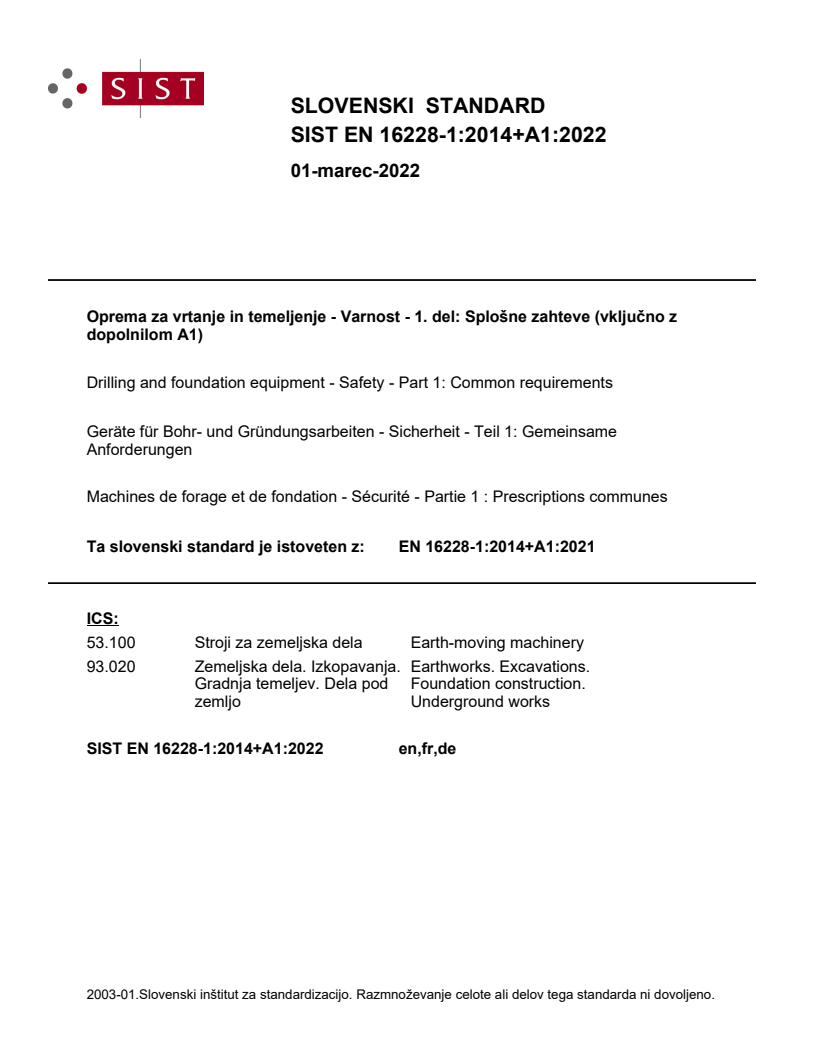
SLOVENSKI STANDARD
01-marec-2022
Oprema za vrtanje in temeljenje - Varnost - 1. del: Splošne zahteve (vključno z
dopolnilom A1)
Drilling and foundation equipment - Safety - Part 1: Common requirements
Geräte für Bohr- und Gründungsarbeiten - Sicherheit - Teil 1: Gemeinsame
Anforderungen
Machines de forage et de fondation - Sécurité - Partie 1 : Prescriptions communes
Ta slovenski standard je istoveten z: EN 16228-1:2014+A1:2021
ICS:
53.100 Stroji za zemeljska dela Earth-moving machinery
93.020 Zemeljska dela. Izkopavanja. Earthworks. Excavations.
Gradnja temeljev. Dela pod Foundation construction.
zemljo Underground works
2003-01.Slovenski inštitut za standardizacijo. Razmnoževanje celote ali delov tega standarda ni dovoljeno.
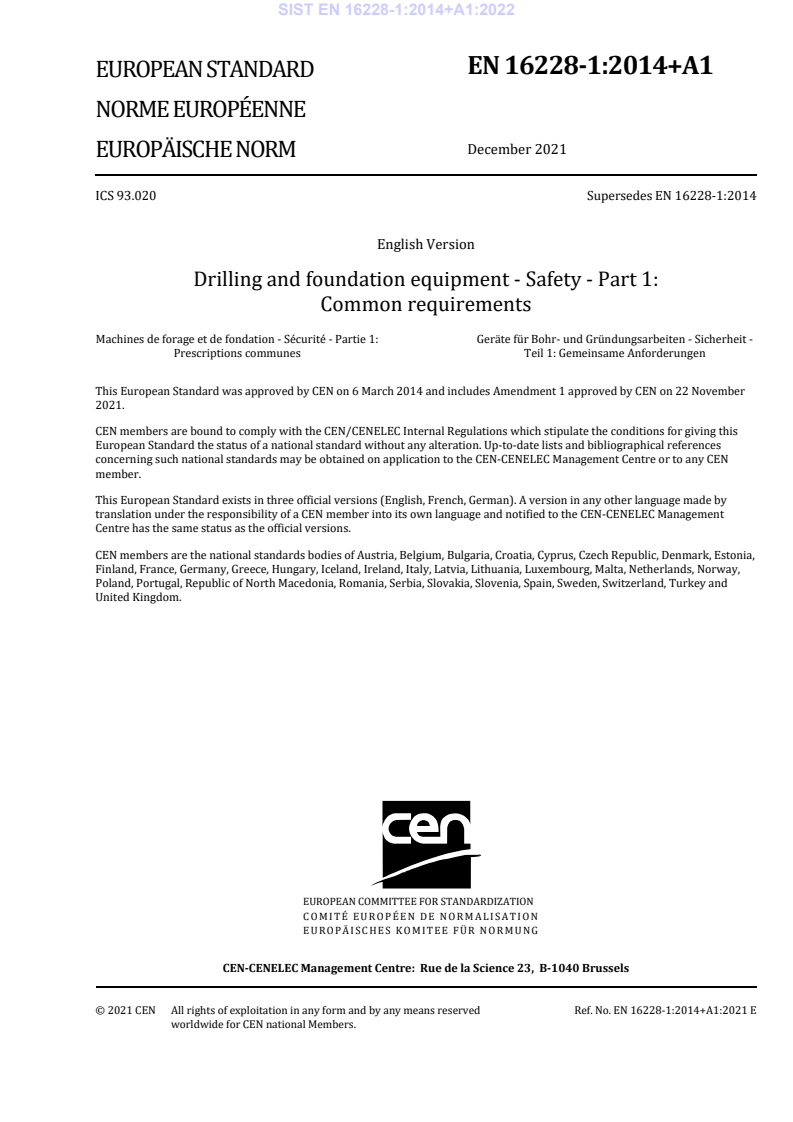
EN 16228-1:2014+A1
EUROPEAN STANDARD
NORME EUROPÉENNE
December 2021
EUROPÄISCHE NORM
ICS 93.020 Supersedes EN 16228-1:2014
English Version
Drilling and foundation equipment - Safety - Part 1:
Common requirements
Machines de forage et de fondation - Sécurité - Partie 1: Geräte für Bohr- und Gründungsarbeiten - Sicherheit -
Prescriptions communes Teil 1: Gemeinsame Anforderungen
This European Standard was approved by CEN on 6 March 2014 and includes Amendment 1 approved by CEN on 22 November
2021.
CEN members are bound to comply with the CEN/CENELEC Internal Regulations which stipulate the conditions for giving this
European Standard the status of a national standard without any alteration. Up-to-date lists and bibliographical references
concerning such national standards may be obtained on application to the CEN-CENELEC Management Centre or to any CEN
member.
This European Standard exists in three official versions (English, French, German). A version in any other language made by
translation under the responsibility of a CEN member into its own language and notified to the CEN-CENELEC Management
Centre has the same status as the official versions.
CEN members are the national standards bodies of Austria, Belgium, Bulgaria, Croatia, Cyprus, Czech Republic, Denmark, Estonia,
Finland, France, Germany, Greece, Hungary, Iceland, Ireland, Italy, Latvia, Lithuania, Luxembourg, Malta, Netherlands, Norway,
Poland, Portugal, Republic of North Macedonia, Romania, Serbia, Slovakia, Slovenia, Spain, Sweden, Switzerland, Turkey and
United Kingdom.
EUROPEAN COMMITTEE FOR STANDARDIZATION
COMITÉ EUROPÉEN DE NORMALISATION
EUROPÄISCHES KOMITEE FÜR NORMUNG
CEN-CENELEC Management Centre: Rue de la Science 23, B-1040 Brussels
© 2021 CEN All rights of exploitation in any form and by any means reserved Ref. No. EN 16228-1:2014+A1:2021 E
worldwide for CEN national Members.
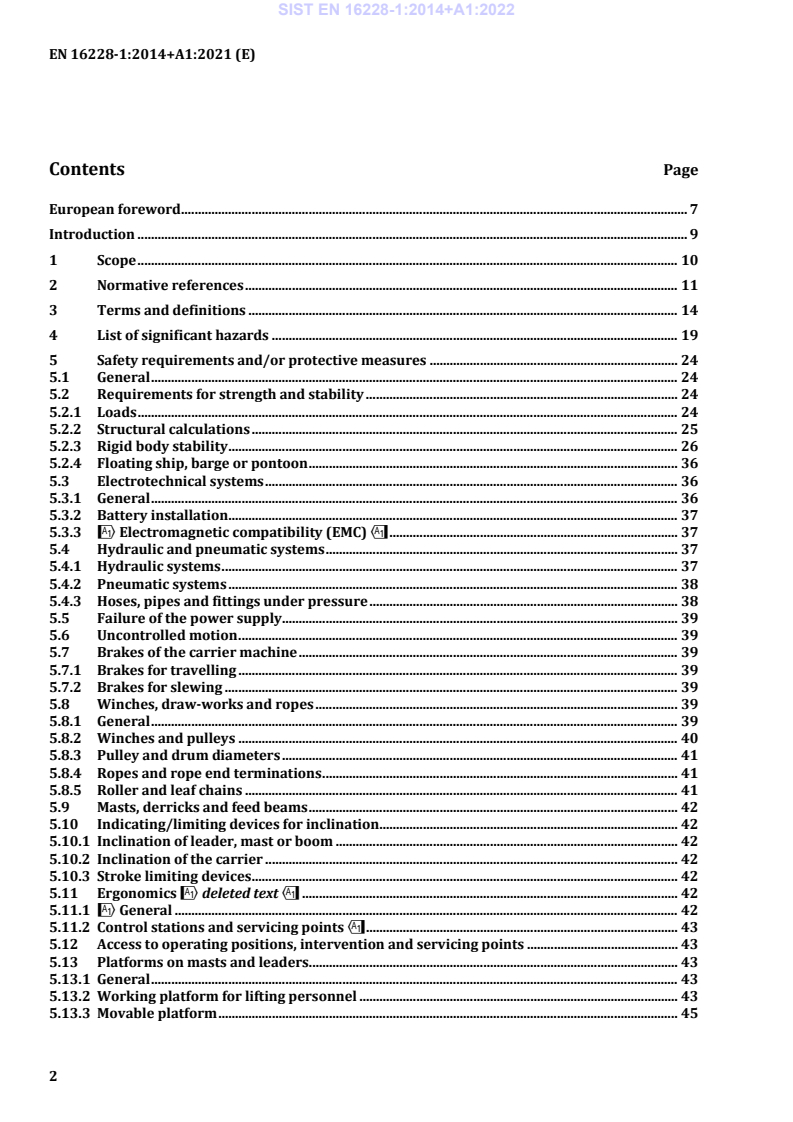
Contents Page
European foreword . 7
Introduction . 9
1 Scope . 10
2 Normative references . 11
3 Terms and definitions . 14
4 List of significant hazards . 19
5 Safety requirements and/or protective measures . 24
5.1 General . 24
5.2 Requirements for strength and stability . 24
5.2.1 Loads . 24
5.2.2 Structural calculations . 25
5.2.3 Rigid body stability . 26
5.2.4 Floating ship, barge or pontoon . 36
5.3 Electrotechnical systems . 36
5.3.1 General . 36
5.3.2 Battery installation . 37
5.3.3 !Electromagnetic compatibility (EMC)" . 37
5.4 Hydraulic and pneumatic systems . 37
5.4.1 Hydraulic systems . 37
5.4.2 Pneumatic systems . 38
5.4.3 Hoses, pipes and fittings under pressure . 38
5.5 Failure of the power supply . 39
5.6 Uncontrolled motion . 39
5.7 Brakes of the carrier machine . 39
5.7.1 Brakes for travelling . 39
5.7.2 Brakes for slewing . 39
5.8 Winches, draw-works and ropes . 39
5.8.1 General . 39
5.8.2 Winches and pulleys . 40
5.8.3 Pulley and drum diameters . 41
5.8.4 Ropes and rope end terminations . 41
5.8.5 Roller and leaf chains . 41
5.9 Masts, derricks and feed beams . 42
5.10 Indicating/limiting devices for inclination. 42
5.10.1 Inclination of leader, mast or boom . 42
5.10.2 Inclination of the carrier . 42
5.10.3 Stroke limiting devices . 42
5.11 Ergonomics !deleted text" . 42
5.11.1 !General . 42
5.11.2 Control stations and servicing points" . 43
5.12 Access to operating positions, intervention and servicing points . 43
5.13 Platforms on masts and leaders. 43
5.13.1 General . 43
5.13.2 Working platform for lifting personnel . 43
5.13.3 Movable platform . 45
5.14 Operating position(s) . 45
5.14.1 General . 45
5.14.2 Visibility . 48
5.15 Control systems . 49
5.15.1 General . 49
5.15.2 Required performance levels for safety related parts of control systems . 49
5.15.3 Starting . 51
5.15.4 Stopping . 51
5.16 Control devices . 52
5.16.1 General . 52
5.16.2 Inadvertent actuation of controls . 52
5.16.3 Controls for extending the crawlers (tracks) of the carrier machine. 53
5.17 Remotely controlled and automated drilling and foundation equipment . 53
5.17.1 General . 53
5.17.2 Operating position . 53
5.17.3 Emergency stop . 53
5.17.4 Control system . 53
5.18 Unmanned, automatically operated drilling and foundation equipment . 54
5.19 Retrieval, transportation, lifting and towing of the drilling and foundation
equipment and its parts . 54
5.19.1 Common use . 54
5.19.2 Retrieval/Towing . 54
5.19.3 Tie-down . 54
5.19.4 Lifting points . 54
5.19.5 Transportation . 54
5.19.6 !Locking of articulation" . 55
5.20 Handling of drilling tools . 55
5.21 Isolation of energy sources . 55
5.22 Hot and cold surfaces and sharp edges . 55
5.23 Protection against moving parts . 55
5.23.1 General . 55
5.23.2 Moving parts involved in the process . 55
5.23.3 Transmission parts . 60
5.23.4 Drilling and foundation equipment using threaded drill string connections . 60
5.23.5 Clamps and rod breaking clamps used in the drilling process . 60
5.23.6 Tools handling system . 61
5.24 Falling or ejected objects . 61
5.25 Lighting . 62
5.25.1 Working light . 62
5.25.2 Illumination when tramming or slewing . 62
5.25.3 Lighting inside the cab . 62
5.26 Fire prevention . 62
5.26.1 General . 62
5.26.2 Fire extinguishers . 62
5.26.3 Installation of fire extinguishers . 62
5.26.4 Fire prevention for fuel and hydraulic circuits . 63
5.27 Noise and vibration . 63
5.27.1 General . 63
5.27.2 Noise . 63
5.27.3 Vibration . 64
5.28 Exhaust gases and dust . 64
5.28.1 Engine exhausts . 64
5.28.2 Dust . 64
5.29 Maintenance . 64
5.30 Warning devices . 65
6 Verification of the safety requirements and/or protective measures . 65
6.1 General . 65
6.2 Testing . 71
6.2.1 General . 71
6.2.2 Tests . 71
7 Information for use . 73
7.1 Marking . 73
7.1.1 Data plate for drilling and foundation equipment . 73
7.1.2 Data plate for working platforms for lifting personnel and movable platforms . 73
7.2 Indicators . 73
7.2.1 Information indicators . 73
7.2.2 Warning signs for residual hazards. 73
7.2.3 Warning devices . 74
7.3 Instruction books for drilling and foundation equipment . 74
7.3.1 General . 74
7.3.2 Operator's manual . 75
7.3.3 Maintenance instructions . 81
7.3.4 Spare parts list . 82
Annex A (informative) List of drilling and foundation equipment . 83
A.1 General . 83
A.2 Illustrations . 84
Annex B (normative) Noise test code . 142
B.1 General . 142
B.2 Operation of the drilling and foundation equipment during noise tests . 142
B.2.1 General . 142
B.2.2 Multiple power units . 142
B.2.3 Fan speed . 143
B.2.4 Different types of drilling and foundation equipment . 143
B.3 Determination of the sound power level . 144
B.3.1 Basic noise emission standards . 144
B.3.2 Determination according to EN ISO 3744 . 145
B.4 Measurement of emission sound pressure level at the operator’s position . 145
B.4.1 General . 145
B.4.2 Performance of test at a fixed operator's position. 146
B.4.3 Performance of test for operator's and assistant(s) position for remote-controlled
machines . 146
B.4.4 Acceptance criteria of measurements . 146
B.5 Uncertainty of measurements . 146
B.6 Information to be recorded and reported . 146
B.7 Noise declaration . 147
Annex C (normative) Whole-body and hand-arm vibration test . 148
C.1 General . 148
C.2 Measurement . 148
Annex D (informative) Symbols and signs . 149
D.1 Introduction. 149
D.2 General safety and warning signs . 149
D.3 General control symbols . 151
D.4 Symbols for information . 152
D.5 Symbols to be used for the control of the engine, fuel, brake transmission systems
and hydraulic system . 153
D.6 Symbols to be used for the control of the drilling operation . 153
D.6.1 General symbols . 153
D.6.2 Symbols for general machine functions . 154
D.6.3 Rod handling system . 155
D.6.4 Mast erection and positioning . 156
D.6.5 Winch and slip rope drum . 159
D.6.6 Tramming . 160
D.7 Miscellaneous symbols . 160
Annex E (normative) Instruction selecting and fitting of wire rope grips for free fall
application . 162
E.1 General . 162
E.2 Installation . 162
E.3 Number of grips . 162
E.4 Tightening torque . 162
E.5 Detachable connections . 163
Annex F (normative) Ground pressure calculation for crawler mounted drilling and
foundation equipment . 165
F.1 General . 165
F.2 Calculation of ground pressures . 165
Annex G (normative) Test conditions of the stopping performances of the rotation of the
drilling head . 168
G.1 General . 168
G.2 Conditions of measure . 168
G.3 Measures implementation . 168
G.3.1 General . 168
G.3.2 Measurements . 169
G.3.3 Data to be recorded. 169
G.3.4 Evaluation of results . 169
Annex ZA (informative) !Relationship between this European Standard and the essential
requirements of Directive2006/42/EC aimed to be covered" . 170
Bibliography . 175
European foreword
This document (EN 16228-1:2014+A1:2021) has been prepared by Technical Committee CEN/TC 151
“Construction equipment and building material machines - Safety”, the secretariat of which is held by
DIN.
This European Standard shall be given the status of a national standard, either by publication of an
identical text or by endorsement, at the latest by June 2022 and conflicting national standards shall be
withdrawn at the latest by June 2022.
Attention is drawn to the possibility that some of the elements of this document may be the subject of
patent rights. CEN shall not be held responsible for identifying any or all such patent rights.
This document supersedes !EN 16228-1:2014".
This document includes Amendment 1 approved by CEN on 22 November 2021.
The start and finish of text introduced or altered by amendment is indicated in the text by tags !".
This document has been prepared under a Standardization Request given to CEN by the European
Commission and the European Free Trade Association, and supports essential requirements of EU
Directive(s) / Regulation(s).
For relationship with EU Directive(s) / Regulation(s), see informative Annex ZA, which is an integral
part of this document.
This European Standard is divided into several parts and covers drilling and foundation equipment.
Part 1 contains requirements that are/may be common to all drilling and foundation equipment. Other
parts contain additional requirements for specific machines that supplement or modify the
requirements of part 1. Compliance with the clauses of part 1 together with those of a relevant specific
part of this standard giving requirements for a particular machine provides one means of conforming
with the essential health and safety requirements of the Directive concerned.
When a relevant specific part does not exist, part 1 can help to establish the requirements for the
machine, but will not by itself provide a means of conforming to the relevant essential health and safety
requirements of the Directive.
This European Standard, EN 16228, Drilling and foundation equipment – Safety, consists of the following
parts:
— Part 1: Common requirements
— !Part 2: Mobile drill rigs for civil and geotechnical engineering in soil or soil and rock mixture"
— Part 3: Horizontal directional drilling equipment (HDD)
— Part 4: Foundation equipment
— Part 5: Diaphragm walling equipment
— Part 6: Jetting, grouting and injection equipment
— Part 7: Interchangeable auxiliary equipment
Any feedback and questions on this document should be directed to the users’ national standards body.
A complete listing of these bodies can be found on the CEN website.
According to the CEN-CENELEC Internal Regulations, the national standards organisations of the
following countries are bound to implement this European Standard: Austria, Belgium, Bulgaria,
Croatia, Cyprus, Czech Republic, Denmark, Estonia, Finland, France, Germany, Greece, Hungary, Iceland,
Ireland, Italy, Latvia, Lithuania, Luxembourg, Malta, Netherlands, Norway, Poland, Portugal, Republic of
North Macedonia, Romania, Serbia, Slovakia, Slovenia, Spain, Sweden, Switzerland, Turkey and the
United Kingdom.
Introduction
This European Standard is a type C standard as stated in EN ISO 12100.
The machinery concerned and the extent to which hazards are covered are indicated in the scope of this
standard.
When provisions of this type C standard are different from those which are stated in type A or B
standards, the provisions of this type C standard take precedence over the provisions of the other
standards, for drilling and foundation equipment that have been designed and built according to the
provisions of this type C standard.
1 Scope
This European Standard specifies the common safety requirements for drilling and foundation
equipment.
Part 1 of this European Standard deals with the significant hazards common to drilling and foundation
equipment (see Annex A), when they are used as intended and under the conditions of misuse which
are reasonably foreseeable by the manufacturer associated with the whole life time of the machine
(transport, assembly, dismantling, equipment in service and out of service, maintenance, moving on
site, storage, disabling and scrapping).
NOTE 1 The requirements specified in this part of the standard are common to two or more families of drilling
and foundation equipment.
This document gives safety requirements for all types of drilling and foundation equipment and is
intended to be used in conjunction with one of parts 2 to 7. These machine specific parts do not repeat
the requirements from part 1 but supplement or modify the requirements for the type of drilling and
foundation equipment in question.
For multipurpose machinery, the parts of the standard that cover the specific functions and applications
are used, e.g. a drilling machine also used as a piling machine will use the relevant requirements of
EN 16228-1, EN 16228-2, and EN 16228-4.
The following machines are excluded from the scope of this standard:
— tunnelling machines, unshielded tunnel boring machines and rodless shaft boring machines for
rock according to !EN 16191";
— raise boring machines;
— drill rigs used in oil and gas industry !;
— specialized mining machinery and equipment for opencast mining (e.g. rock drill rigs, blast hole
drills) (under the scope of CEN/TC 196);
— all underground mining machinery and equipment for the extraction of solid mineral substances
(e.g. rock drill rigs, raise boring machines, shaft boring machines, mining auger boring machines,
jumbos) as well as machinery and equipment for underground mine development (under the scope
of CEN/TC 196);
— core drilling machines on stand (covered by EN 12348);
— hand-held machines (in particular machines covered by ISO 11148-5)."
NOTE 2 Specific requirements for offshore applications are not covered by this European Standard.
Where a drilling or foundation equipment of fixed configuration that is not intended to be separated is
assembled using a carrier based on earth-moving equipment, agricultural equipment, or a crane, then
the completed assembly is !covered by this" standard.
Drilling and foundation equipment within the scope of EN 16228 parts 1 to 6 may include
interchangeable auxiliary equipment within the scope of EN 16228-7, either as an integral part of its
construction or as interchangeably fitted equipment.
!If drilling and foundation equipment is intended to be used in a potentially explosive atmosphere, or
in case of lightning risk, additional requirements will need to be met which are not covered by this
document.
This document is not applicable to drilling and foundation equipment manufactured before the date of
its publication."
2 Normative references
The following documents, in whole or in part, are normatively referenced in this document and are
indispensable for its application. For dated references, only the edition cited applies. For undated
references, the latest edition of the referenced document (including any amendments) applies.
EN 474-1:2006+A4:2013, Earth-moving machinery — Safety — Part 1: General requirements
EN 474-5:2006+A3:2013, Earth-moving machinery — Safety — Part 5: Requirements for hydraulic
excavators
!EN 614-1:2006+A1:2009, Safety of machinery — Ergonomic design principles — Part 1: Terminology
and general principles"
!EN 795:2016", Personal fall protection equipment — Anchor devices
!deleted text"
EN 1037:1995+A1:2008, Safety of machinery — Prevention of unexpected start-up
!deleted text"
EN 13411-6:2004+A1:2008, Terminations for steel wire ropes — Safety — Part 6: Asymmetric wedge
socket
EN 13411-7:2006+A1:2008, Terminations for steel wire ropes — Safety — Part 7: Symmetric wedge
socket
!deleted text"
!EN 13531:2001+A1:2008, Earth-moving machinery — Tip-over protection structure (TOPS) for
compact excavators — Laboratory tests and performance requirements (ISO 12117:1997, modified)"
!EN 60204-1:2018, Safety of machinery — Electrical equipment of machines — Part 1: General
requirements (IEC 60204-1:2016, modified)"
EN ISO 2860:2008, Earth-moving machinery — Minimum access dimensions (ISO 2860:1992)
EN ISO 2867:2011, Earth-moving machinery — Access systems (ISO 2867:2011)
EN ISO 3411:2007, Earth-moving machinery — Physical dimensions of operators and minimum operator
space envelope (ISO 3411:2007)
EN ISO 3449:2008, Earth-moving machinery — Falling-object protective structures — Laboratory tests
and performance requirements (ISO 3449:2005)
EN ISO 3450:2011, Earth-moving machinery — Wheeled or high-speed rubber-tracked machines —
Performance requirements and test procedures for brake systems (ISO 3450:2011)
EN ISO 3457:2008, Earth-moving machinery — Guards — Definitions and requirements (ISO 3457:2003)
!EN ISO 3471:2008, Earth-moving machinery — Roll-over protective structures — Laboratory tests
and performance requirements (ISO 3741:2008)"
EN ISO 3744:2010, Acoustics — Determination of sound power levels and sound energy levels of noise
sources using sound pressure — Engineering methods for an essentially free field over a reflecting plane
(ISO 3744:2010)
EN ISO 3747:2010, Acoustics — Determination of sound power levels and sound energy levels of noise
sources using sound pressure — Engineering/survey methods for use in situ in a reverberant environment
(ISO 3747:2010)
EN ISO 4413:2010, Hydraulic fluid power — General rules and safety requirements for systems and their
components (ISO 4413:2010)
EN ISO 4414:2010, Pneumatic fluid power — General rules and safety requirements for systems and their
components (ISO 4414:2010)
EN ISO 4871:2009, Acoustics — Declaration and verification of noise emission values of machinery and
equipment (ISO 4871:1996)
EN ISO 6682:2008, Earth-moving machinery — Zones of comfort and reach for controls (ISO 6682:1986,
including Amd 1:1989)
!deleted text"
EN ISO 7096:2008, Earth-moving machinery — Laboratory evaluation of operator seat vibration (ISO
7096:2000)
EN ISO 9614-2:1996, Acoustics — Determination of sound power levels of noise sources using sound
intensity — Part 2: Measurement by scanning (ISO 9614-2:1996)
EN ISO 11201:2010, Acoustics — Noise emitted by machinery and equipment — Determination of
emission sound pressure levels at a work station and at other specified positions in an essentially free field
over a reflecting plane with negligible environmental corrections (ISO 11201:2010)
EN ISO 11203:2009, Acoustics — Noise emitted by machinery and equipment — Determination of
emission sound pressure levels at a work station and at other specified positions from the sound power
level (ISO 11203:1995)
EN ISO 12100:2010, Safety of machinery — General principles for design — Risk assessment and risk
reduction (ISO 12100:2010)
EN ISO 13732-1:2008, Ergonomics of the thermal environment -— Methods for the assessment of human
responses to contact with surfaces — Part 1: Hot surfaces (ISO 13732-1:2006)
!EN ISO 13766-1:2018, Earth-moving and building construction machinery — Electromagnetic
compatibility (EMC) of machines with internal electrical power supply — Part 1: General EMC
requirements under typical electromagnetic environmental conditions (ISO 13766-1:2018)
EN ISO 13766-2:2018, Earth-moving and building construction machinery — Electromagnetic
compatibility (EMC) of machines with internal electrical power supply — Part 2: Additional EMC
requirements for functional safety (ISO 13766-2:2018)
EN ISO 13849-1:2015, Safety of machinery — Safety-related parts of control systems — Part 1: General
principles for design (ISO 13849-1:2015)
EN ISO 13850:2015, Safety of machinery — Emergency stop function — Principles for design
(ISO 13850:2015)
EN ISO 13855:2010, Safety of machinery — Positioning of safeguards with respect to the approach speeds
of parts of the human body (ISO 13855:2010)"
EN ISO 13856-1:2013, Safety of machinery — Pressure-sensitive protective devices — Part 1: General
principles for design and testing of pressure-sensitive mats and pressure-sensitive floors (ISO 13856-
1:2013)
EN ISO 13856-2:2013, Safety of machinery — Pressure-sensitive protective devices — Part 2: General
principles for design and testing of pressure-sensitive edges and pressure-sensitive bars (ISO 13856-
2:2013)
EN ISO 13856-3:2013, Safety of machinery — Pressure-sensitive protective devices — Part 3: General
principles for design and testing of pressure-sensiti
...