

SIST EN 15272-1:2007
(Main)Inland navigation vessels - Equipment for rope leading - Part 1: General requirements
- Abstract
This European Standard specifies general requirements for rope leading on inland navigation vessels.
This standard is an aid to selecting equipment for rope leading. It specifies general requirements for equipment for rope leading by means of fairleads, roller leads or rope leads as used, for example, for hauling, mooring and coupling inland navigation vessels under certain conditions.
- Status
- Published
- Publication Date
- 06-Sep-2007
- Technical Committee
- I13 - Imaginarni 13
- Current Stage
- 6060 - National Implementation/Publication (Adopted Project)
- Start Date
- 22-Aug-2007
- Due Date
- 27-Oct-2007
- Completion Date
- 07-Sep-2007


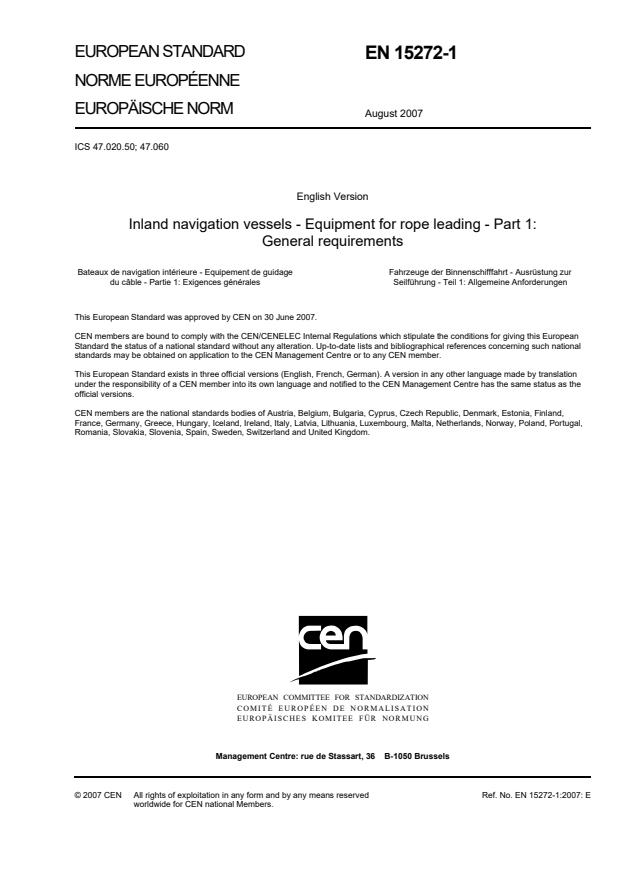
SIST EN 15272-1:2007 is the Slovenian standard identical to EN 15272-1:2007. It specifies general requirements for rope leading equipment on inland navigation vessels, including fairleads, roller fairleads and rope leads used for hauling, mooring and coupling under certain conditions. In practice, it is a selection and design guide for vessel builders, equipment suppliers and buyers who need rope-leading components matched to the ropes and loads in service.
What does SIST EN 15272-1:2007 specify?
SIST EN 15272-1:2007 specifies the general requirements for rope leading on inland navigation vessels. Its scope is limited to equipment used to guide ropes by means of fairleads, roller leads or rope leads.
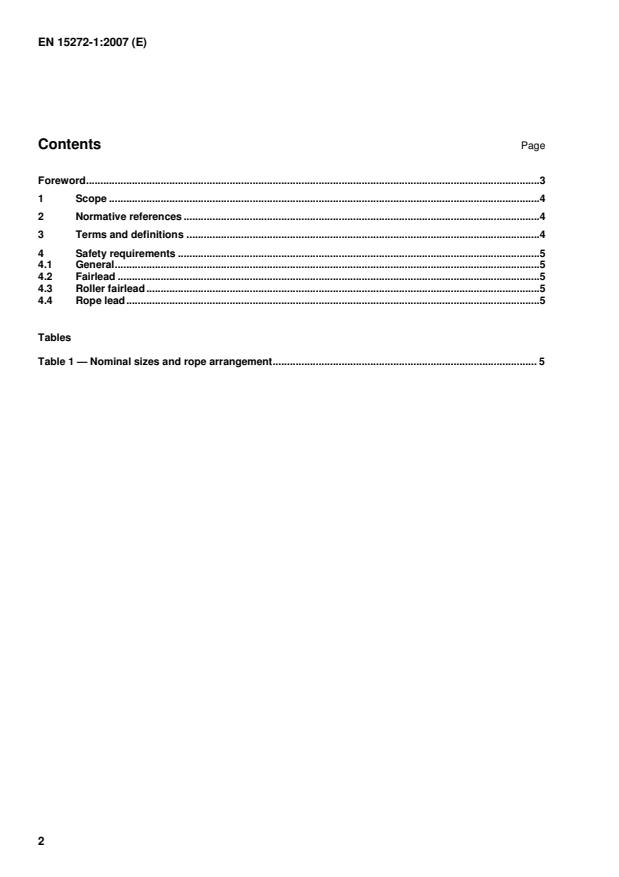
The document is organized into four clauses:
- Clause 1 - Scope
- Clause 2 - Normative references
- Clause 3 - Terms and definitions
- Clause 4 - Safety requirements, with 4.1 General, 4.2 Fairlead, 4.3 Roller fairlead and 4.4 Rope lead
The foreword also places this part in the EN 15272 series, which consists of Part 1 General requirements, Part 2 Fairlead, Part 3 Roller fairlead and Part 4 Rope lead.
What are the key requirements of SIST EN 15272-1:2007?
The main requirements are in Clause 4. SIST EN 15272-1:2007 requires rope-leading components and their fastenings to be safe for persons and suitable for the rope loads they will carry.
Safety and load capacity
Clause 4.1 states that the components of the rope-leading equipment shall not endanger persons. It also ties the design to the nominal sizes and maximum rope tensile loads given in Table 1. For a buyer or designer, this means the equipment cannot be selected by size alone - it must be matched to the intended rope type and load level.
Clause 4.1 also requires the whole rope leading system, including all component parts and their fastenings, to withstand the loads in Table 1 without deformation. In practice, this points to the need for a complete system check, not just a check of the visible guiding part.
Matching ropes to the equipment
Table 1 links nominal size, maximum rope diameter and maximum rope tensile load for steel wire rope and for synthetic fibre ropes covered by the referenced rope standards. The table note adds a selection rule for associated ropes: the minimum breaking load in the relevant rope standard should not exceed five times the maximum rope tensile load in the table. For practical use, this helps avoid pairing a rope with equipment that is too weak or too large for the intended service.
Use of the three rope-leading types
Clause 4.2 limits fairleads to leading ropes perpendicular to the fairlead axis. When the rope runs at other angles, a fairlead is only suitable together with other components as described in Clauses 4.3 and 4.4. This matters because fairleads are not a general-purpose solution for every lead direction.
Clause 4.3 states that roller fairleads are suitable for leading ropes, preferably steel ropes, in horizontal, vertical and oblique angles. Clause 4.4 states that rope leads are suitable for leading ropes, preferably synthetic fibre ropes, in the same range of angles. In practice, these clauses guide the choice between metal rope guidance and rope-friendly guide structures, depending on the rope material and the direction of pull.
What terms does SIST EN 15272-1:2007 define?
SIST EN 15272-1:2007 uses the terms and definitions from EN 13573 and adds its own key terms.
- equipment for rope leading - components used to help guide ropes.
- fairlead - a pedestal unit fairlead or fairlead cover pulley with a concave guide for leading ropes.
- roller fairlead - a rope-leading device made from horizontal and vertical rollers that guide the rope between them.
- rope lead - a structure in the bulwark or on deck, reinforced and lined to reduce damage to the rope.
These terms matter because the requirements in Clause 4 apply differently to each type of rope-leading component.
Who uses SIST EN 15272-1:2007?
SIST EN 15272-1:2007 is used by:
- inland navigation vessel designers and builders, when arranging rope-leading points on deck and in the bulwark
- equipment manufacturers, when designing fairleads, roller fairleads and rope leads
- shipyards and installers, when fitting rope-leading equipment and its fastenings
- buyers, quality managers and technical approvers, when checking rope compatibility and load suitability
- operators and maintenance teams, when assessing whether installed equipment matches the intended hauling, mooring and coupling tasks
Which standards are used with SIST EN 15272-1:2007?
- EN 13573 - provides the baseline terms and definitions used by this part and covers anchoring, coupling, towing, hauling and mooring systems.
- EN ISO 1140 - gives the rope standard for polyamide ropes referenced in Table 1.
- EN ISO 1141 - gives the rope standard for polyester ropes referenced in Table 1.
- EN ISO 1346 - gives the rope standard for polypropylene ropes referenced in Table 1.
- ISO 2408 - gives the minimum requirements for steel wire ropes referenced in Table 1.
- EN 15272-2, EN 15272-3 and EN 15272-4 - the companion parts of the same series for fairlead, roller fairlead and rope lead.
What does the SIST EN 15272-1:2007 document contain?
The document contains a short scope, a list of normative references, a definition section and a safety-requirements section. Its main technical content is in Clause 4, which sets the loading and safety principles for rope-leading equipment.
It also contains Table 1, which is used to match nominal size, rope diameter, rope family and maximum rope tensile load. That table is the practical selection aid in the standard.
The text distinguishes between fairleads, roller fairleads and rope leads, and explains how each one may be used with different rope directions and rope types. That structure makes the document useful for choosing equipment before detailed design or installation work.
Relations
- Effective Date
- 25-Aug-2026
- Effective Date
- 28-Jan-2026
- Effective Date
- 28-Jan-2026
- Refers
SIST EN ISO 1141:2021 - Fibre ropes - Polyester - 3-, 4-, 8- and 12-strand ropes (ISO 1141:2021) - Effective Date
- 28-Jan-2026
- Refers
SIST EN ISO 1140:2021 - Fibre ropes - Polyamide - 3-, 4-, 8- and 12-strand ropes (ISO 1140:2021) - Effective Date
- 28-Jan-2026
- Referred By
SIST EN 15272-4:2007 - Inland navigation vessels - Equipment for rope leading - Part 4: Rope lead - Effective Date
- 28-Jan-2026
- Referred By
SIST EN 15272-2:2007 - Inland navigation vessels - Equipment for rope leading - Part 2: Fairlead - Effective Date
- 28-Jan-2026
- Effective Date
- 28-Jan-2026
Get Certified
Connect with accredited certification bodies for this standard

DNV
DNV is an independent assurance and risk management provider.

Lloyd's Register
Lloyd's Register is a global professional services organisation specialising in engineering and technology.

FSC International
Forest Stewardship Council certification.
Sponsored listings
Frequently Asked Questions
SIST EN 15272-1:2007 is a standard published by the Slovenian Institute for Standardization (SIST). Its full title is "Inland navigation vessels - Equipment for rope leading - Part 1: General requirements". This standard covers: This European Standard specifies general requirements for rope leading on inland navigation vessels. This standard is an aid to selecting equipment for rope leading. It specifies general requirements for equipment for rope leading by means of fairleads, roller leads or rope leads as used, for example, for hauling, mooring and coupling inland navigation vessels under certain conditions.
This European Standard specifies general requirements for rope leading on inland navigation vessels. This standard is an aid to selecting equipment for rope leading. It specifies general requirements for equipment for rope leading by means of fairleads, roller leads or rope leads as used, for example, for hauling, mooring and coupling inland navigation vessels under certain conditions.
SIST EN 15272-1:2007 is classified under the following ICS (International Classification for Standards) categories: 47.020.50 - Deck equipment and installations; 47.060 - Inland navigation vessels. The ICS classification helps identify the subject area and facilitates finding related standards.
SIST EN 15272-1:2007 has the following relationships with other standards: It is inter standard links to SIST ISO 2408:2012, SIST EN ISO 1346:2021, SIST EN ISO 5366-1:2009, SIST EN ISO 1141:2021, SIST EN ISO 1140:2021, SIST EN 15272-4:2007, SIST EN 15272-2:2007, SIST EN 13573:2009. Understanding these relationships helps ensure you are using the most current and applicable version of the standard.
SIST EN 15272-1:2007 is available in PDF format for immediate download after purchase. The document can be added to your cart and obtained through the secure checkout process. Digital delivery ensures instant access to the complete standard document.
Standards Content (Sample)
2003-01.Slovenski inštitut za standardizacijo. Razmnoževanje celote ali delov tega standarda ni dovoljeno.Inland navigation vessels - Equipment for rope leading - Part 1: General requirementsPlovila za celinske vode - Vodilo za vrv - 1. del: Splošne zahteveBateaux de navigation intérieure - Equipement de guidage du câble - Partie 1: Exigences généralesFahrzeuge der Binnenschifffahrt - Ausrüstung zur Seilführung - Teil 1: Allgemeine AnforderungenTa slovenski standard je istoveten z:EN 15272-1:2007SIST EN 15272-1:2007en,de47.060Inland navigation vessels47.020.50Palubna oprema ter napraveDeck equipment and installationsICS:SLOVENSKI
STANDARDSIST EN 15272-1:200701-oktober-2007
EUROPEAN STANDARDNORME EUROPÉENNEEUROPÄISCHE NORMEN 15272-1August 2007ICS 47.020.50; 47.060 English VersionInland navigation vessels - Equipment for rope leading - Part 1:General requirementsBateaux de navigation intérieure - Equipement de guidagedu câble - Partie 1: Exigences généralesFahrzeuge der Binnenschifffahrt - Ausrüstung zurSeilführung - Teil 1: Allgemeine AnforderungenThis European Standard was approved by CEN on 30 June 2007.CEN members are bound to comply with the CEN/CENELEC Internal Regulations which stipulate the conditions for giving this EuropeanStandard the status of a national standard without any alteration. Up-to-date lists and bibliographical references concerning such nationalstandards may be obtained on application to the CEN Management Centre or to any CEN member.This European Standard exists in three official versions (English, French, German). A version in any other language made by translationunder the responsibility of a CEN member into its own language and notified to the CEN Management Centre has the same status as theofficial versions.CEN members are the national standards bodies of Austria, Belgium, Bulgaria, Cyprus, Czech Republic, Denmark, Estonia, Finland,France, Germany, Greece, Hungary, Iceland, Ireland, Italy, Latvia, Lithuania, Luxembourg, Malta, Netherlands, Norway, Poland, Portugal,Romania, Slovakia, Slovenia, Spain, Sweden, Switzerland and United Kingdom.EUROPEAN COMMITTEE FOR STANDARDIZATIONCOMITÉ EUROPÉEN DE NORMALISATIONEUROPÄISCHES KOMITEE FÜR NORMUNGManagement Centre: rue de Stassart, 36
B-1050 Brussels© 2007 CENAll rights of exploitation in any form and by any means reservedworldwide for CEN national Members.Ref. No. EN 15272-1:2007: E
Tables Table 1 — Nominal sizes and rope arrangement.5
...