

SIST EN 61249-2-22:2005
(Main)Materials for printed boards and other interconnecting structures -- Part 2-22: Reinforced base materials, clad and unclad - Modified non-halogenated epoxide woven E-glass laminated sheets of defined flammability (vertical burning test), copper-clad
General Information
- Abstract
This part of EN 61249 gives requirements for properties of modified non-halogenated epoxide woven E-glass laminated sheet 0,05 mm up to 3,2 mm, of defined flammability (vertical burning test), copper-clad. The flammability rating is achieved through the use of phosphorus compounds and/or aluminium hydroxide fire retardants contained as part of the polymeric structure. The glass transition temperature is defined to be between 150 °C to 190 °C.
- Status
- Published
- Publication Date
- 31-Aug-2005
- Technical Committee
- ITIV - Electronics assembly technology and Environmental standardization
- Current Stage
- 6060 - National Implementation/Publication (Adopted Project)
- Start Date
- 01-Sep-2005
- Due Date
- 01-Sep-2005
- Completion Date
- 01-Sep-2005

Overview - EN 61249-2-22:2005 (copper-clad)
EN 61249-2-22:2005 specifies requirements for modified non‑halogenated epoxide woven E‑glass laminated sheets, copper‑clad, used as base materials for printed circuit boards and other interconnecting structures. It covers laminate thicknesses from 0.05 mm to 3.2 mm, a defined flammability rating achieved by phosphorus compounds and/or aluminium hydroxide fire retardants, and a glass transition temperature (Tg) between 150 °C and 190 °C. The flammability classification is based on the vertical burning test.
Keywords: EN 61249-2-22, printed circuit board materials, copper‑clad laminate, non‑halogenated epoxide, E‑glass, flammability, vertical burning test, Tg.
Key topics and technical requirements
The standard defines material, construction and test requirements that PCB manufacturers and material suppliers use to ensure consistent performance:
- Resin system: Modified, non‑halogenated epoxide with integrated phosphorus and/or aluminium hydroxide retardants.
- Reinforcement: Woven E‑glass fabric type and layup requirements.
- Copper foil: Requirements for copper cladding used on the laminate.
- Dimensional and mechanical properties: Thickness tolerance (0.05–3.2 mm range), bow & twist, flexural strength, and punching/machining behavior.
- Electrical properties: Specified test methods and acceptance criteria for dielectric performance.
- Flammability: Defined vertical burning test procedures and classification tied to the non‑halogenated formulation.
- Thermal properties: Glass transition temperature (Tg) and cure factor evaluation (150–190 °C Tg range).
- Environmental and durability tests: Water absorption, measling, dimensional stability and bond strength (pull‑off/peel).
- Quality and compliance: Qualification and conformance inspection, certificates of conformance, marking and packaging requirements.
Practical applications and users
EN 61249-2-22 is used where non‑halogenated, flame‑retarded copper‑clad laminates are required for reliable PCB performance at elevated temperatures. Typical applications include:
- High‑reliability and consumer electronics PCBs requiring halogen‑free flame retardancy
- Automotive, industrial and telecommunications printed circuit boards where Tg of 150–190 °C is beneficial
- PCB substrate selection, procurement specifications and incoming material inspection
Who uses it:
- PCB laminate manufacturers and copper‑clad suppliers
- PCB fabricators and assembly houses
- Design engineers and procurement/specification teams
- Test laboratories and conformity assessors
Related standards
This part is one element of the IEC/EN 61249 family for PCB base materials. Relevant referenced documents include:
- IEC/EN 61189‑2 (test methods for materials)
- IEC 60194 (printed board design and terms)
- ISO 9000 / ISO 14001 (quality and environmental systems)
- Other EN 61249 parts covering different laminate chemistries (e.g., Parts 2‑7, 2‑21)
Use EN 61249-2-22 when specifying or evaluating non‑halogenated epoxide E‑glass copper‑clad laminates for electrical, thermal and flammability performance.
Relations
- Refers
SIST EN ISO 9000:2004 - Quality management systems - Fundamentals and vocabulary (ISO 9000:2000) - Effective Date
- 09-Feb-2026
- Effective Date
- 09-Feb-2026
- Effective Date
- 09-Feb-2026
- Effective Date
- 03-Feb-2026
- Effective Date
- 03-Feb-2026
- Effective Date
- 09-Feb-2026
- Effective Date
- 09-Feb-2026
- Referred By
SIST EN 115-1:2017 - Safety of escalators and moving walks - Part 1: Construction and installation - Effective Date
- 09-Feb-2026
- Effective Date
- 09-Feb-2026
- Effective Date
- 09-Feb-2026
- Effective Date
- 03-Feb-2026
- Effective Date
- 03-Feb-2026
- Effective Date
- 03-Feb-2026
- Referred By
SIST EN IEC 60598-1:2021 - Luminaires - Part 1: General requirements and tests (IEC 60598-1:2020) - Effective Date
- 03-Feb-2026
- Effective Date
- 03-Feb-2026
Frequently Asked Questions
SIST EN 61249-2-22:2005 is a standard published by the Slovenian Institute for Standardization (SIST). Its full title is "Materials for printed boards and other interconnecting structures -- Part 2-22: Reinforced base materials, clad and unclad - Modified non-halogenated epoxide woven E-glass laminated sheets of defined flammability (vertical burning test), copper-clad". This standard covers: This part of EN 61249 gives requirements for properties of modified non-halogenated epoxide woven E-glass laminated sheet 0,05 mm up to 3,2 mm, of defined flammability (vertical burning test), copper-clad. The flammability rating is achieved through the use of phosphorus compounds and/or aluminium hydroxide fire retardants contained as part of the polymeric structure. The glass transition temperature is defined to be between 150 °C to 190 °C.
This part of EN 61249 gives requirements for properties of modified non-halogenated epoxide woven E-glass laminated sheet 0,05 mm up to 3,2 mm, of defined flammability (vertical burning test), copper-clad. The flammability rating is achieved through the use of phosphorus compounds and/or aluminium hydroxide fire retardants contained as part of the polymeric structure. The glass transition temperature is defined to be between 150 °C to 190 °C.
SIST EN 61249-2-22:2005 is classified under the following ICS (International Classification for Standards) categories: 31.180 - Printed circuits and boards. The ICS classification helps identify the subject area and facilitates finding related standards.
SIST EN 61249-2-22:2005 has the following relationships with other standards: It is inter standard links to SIST EN ISO 9000:2004, SIST EN ISO 14001:1997, SIST EN 1171:2003, SIST EN 61189-2:2001, SIST EN 61249-5-1:2001, SIST EN 115-1:2009+A1:2010, SIST EN 81-22:2021, SIST EN 115-1:2017, SIST EN 81-41:2011, SIST EN 81-22:2014, SIST EN IEC 61400-4:2025, SIST EN 60352-5:2012, SIST EN IEC 60730-1:2025, SIST EN IEC 60598-1:2021, SIST EN 62752:2016. Understanding these relationships helps ensure you are using the most current and applicable version of the standard.
SIST EN 61249-2-22:2005 is available in PDF format for immediate download after purchase. The document can be added to your cart and obtained through the secure checkout process. Digital delivery ensures instant access to the complete standard document.
Standards Content (Sample)
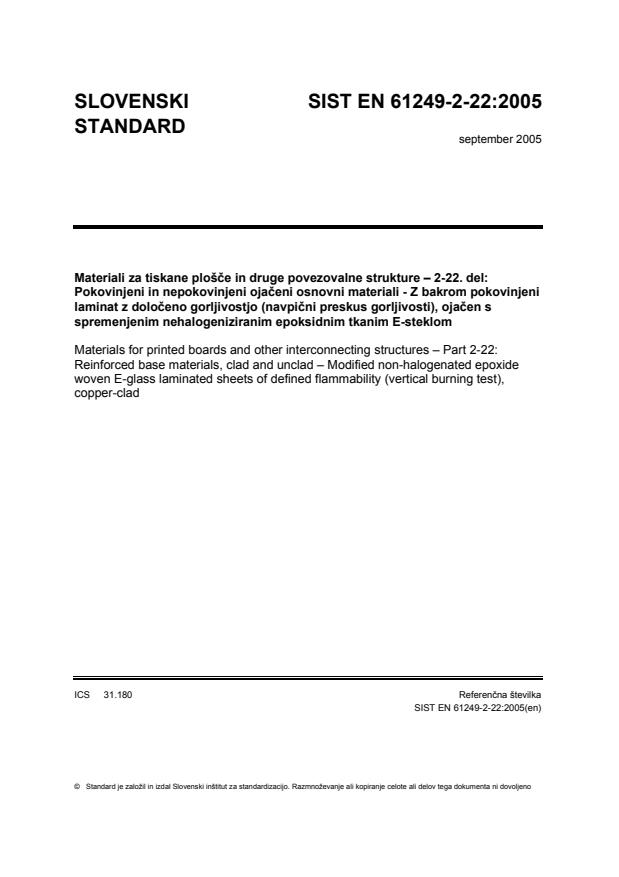
SLOVENSKI SIST EN 61249-2-22:2005
STANDARD
september 2005
Materiali za tiskane plošče in druge povezovalne strukture – 2-22. del:
Pokovinjeni in nepokovinjeni ojačeni osnovni materiali - Z bakrom pokovinjeni
laminat z določeno gorljivostjo (navpični preskus gorljivosti), ojačen s
spremenjenim nehalogeniziranim epoksidnim tkanim E-steklom
Materials for printed boards and other interconnecting structures – Part 2-22:
Reinforced base materials, clad and unclad – Modified non-halogenated epoxide
woven E-glass laminated sheets of defined flammability (vertical burning test),
copper-clad
ICS 31.180 Referenčna številka
© Standard je založil in izdal Slovenski inštitut za standardizacijo. Razmnoževanje ali kopiranje celote ali delov tega dokumenta ni dovoljeno
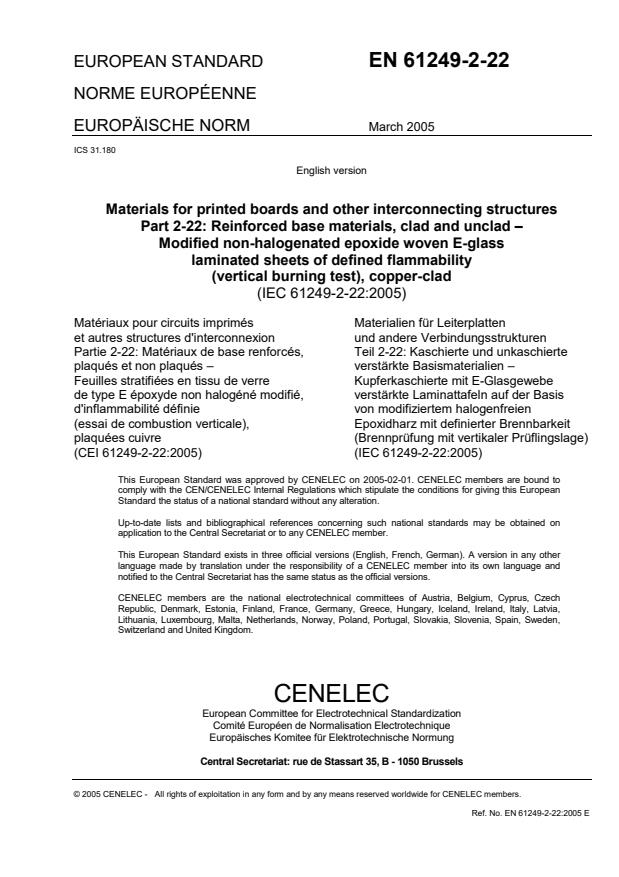
EUROPEAN STANDARD EN 61249-2-22
NORME EUROPÉENNE
EUROPÄISCHE NORM March 2005
ICS 31.180
English version
Materials for printed boards and other interconnecting structures
Part 2-22: Reinforced base materials, clad and unclad –
Modified non-halogenated epoxide woven E-glass
laminated sheets of defined flammability
(vertical burning test), copper-clad
(IEC 61249-2-22:2005)
Matériaux pour circuits imprimés Materialien für Leiterplatten
et autres structures d'interconnexion und andere Verbindungsstrukturen
Partie 2-22: Matériaux de base renforcés, Teil 2-22: Kaschierte und unkaschierte
plaqués et non plaqués – verstärkte Basismaterialien –
Feuilles stratifiées en tissu de verre Kupferkaschierte mit E-Glasgewebe
de type E époxyde non halogéné modifié, verstärkte Laminattafeln auf der Basis
d'inflammabilité définie von modifiziertem halogenfreien
(essai de combustion verticale), Epoxidharz mit definierter Brennbarkeit
plaquées cuivre (Brennprüfung mit vertikaler Prüflingslage)
(CEI 61249-2-22:2005) (IEC 61249-2-22:2005)
This European Standard was approved by CENELEC on 2005-02-01. CENELEC members are bound to
comply with the CEN/CENELEC Internal Regulations which stipulate the conditions for giving this European
Standard the status of a national standard without any alteration.
Up-to-date lists and bibliographical references concerning such national standards may be obtained on
application to the Central Secretariat or to any CENELEC member.
This European Standard exists in three official versions (English, French, German). A version in any other
language made by translation under the responsibility of a CENELEC member into its own language and
notified to the Central Secretariat has the same status as the official versions.
CENELEC members are the national electrotechnical committees of Austria, Belgium, Cyprus, Czech
Republic, Denmark, Estonia, Finland, France, Germany, Greece, Hungary, Iceland, Ireland, Italy, Latvia,
Lithuania, Luxembourg, Malta, Netherlands, Norway, Poland, Portugal, Slovakia, Slovenia, Spain, Sweden,
Switzerland and United Kingdom.
CENELEC
European Committee for Electrotechnical Standardization
Comité Européen de Normalisation Electrotechnique
Europäisches Komitee für Elektrotechnische Normung
Central Secretariat: rue de Stassart 35, B - 1050 Brussels
© 2005 CENELEC - All rights of exploitation in any form and by any means reserved worldwide for CENELEC members.
Ref. No. EN 61249-2-22:2005 E
Foreword
The text of document 91/494/FDIS, future edition 1 of IEC 61249-2-22, prepared by IEC TC 91,
Electronics assembly technology, was submitted to the IEC-CENELEC parallel vote and was
approved by CENELEC as EN 61249-2-22 on 2005-02-01.
The following dates were fixed:
– latest date by which the EN has to be implemented
at national level by publication of an identical
national standard or by endorsement (dop) 2005-11-01
– latest date by which the national standards conflicting
with the EN have to be withdrawn (dow) 2008-02-01
Annex ZA has been added by CENELEC.
__________
Endorsement notice
The text of the International Standard IEC 61249-2-22:2005 was approved by CENELEC as a
European Standard without any modification.
_________
- 3 - EN 61249-2-22:2005
Annex ZA
(normative)
Normative references to international publications
with their corresponding European publications
The following referenced documents are indispensable for the application of this document. For dated
references, only the edition cited applies. For undated references, the latest edition of the referenced
document (including any amendments) applies.
NOTE Where an international publication has been modified by common modifications, indicated by (mod), the relevant
EN/HD applies.
Publication Year Title EN/HD Year
IEC 60194 1999 Printed board design, manufacture and - -
assembly - Terms and definitions
IEC 61189-2 1997 Test methods for electrical materials, EN 61189-2 1997
printed boards and other interconnection + corr. August 1997
structures and assemblies
Part 2: Test methods for materials for
interconnection structures
IEC 61249-5-1 1995 Materials for interconnection structures EN 61249-5-1 1996
Part 5: Sectional specification set for
conductive foils and films with or without
coatings - Section 1: Copper foils (for the
manufacture of copper-clad base
materials)
ISO 9000 2000 Quality management systems - EN ISO 9000 2000
Fundamentals and vocabulary
ISO 11014-1 1994 Safety data sheet for chemical products - -
Part 1: Content and order of sections
ISO 14001 1996 Environmental management systems EN ISO 14001 1996
Specification with guidance for use
NORME CEI
INTERNATIONALE IEC
61249-2-22
INTERNATIONAL
Première édition
STANDARD
First edition
2005-01
Matériaux pour circuits imprimés
et autres structures d'interconnexion –
Partie 2-22:
Matériaux de base renforcés, plaqués et
non plaqués – Feuilles stratifiées en tissu
de verre de type E époxyde non halogéné
modifié, d'inflammabilité définie (essai de
combustion verticale), plaquées cuivre
Materials for printed boards
and other interconnecting structures –
Part 2-22:
Reinforced base materials clad and unclad –
Modified non-halogenated epoxide woven
E-glass laminated sheets of defined flammability
(vertical burning test), copper-clad
© IEC 2005 Droits de reproduction réservés ⎯ Copyright - all rights reserved
Aucune partie de cette publication ne peut être reproduite ni No part of this publication may be reproduced or utilized in any
utilisée sous quelque forme que ce soit et par aucun procédé, form or by any means, electronic or mechanical, including
électronique ou mécanique, y compris la photocopie et les photocopying and microfilm, without permission in writing from
microfilms, sans l'accord écrit de l'éditeur. the publisher.
International Electrotechnical Commission, 3, rue de Varembé, PO Box 131, CH-1211 Geneva 20, Switzerland
Telephone: +41 22 919 02 11 Telefax: +41 22 919 03 00 E-mail: inmail@iec.ch Web: www.iec.ch
CODE PRIX
Commission Electrotechnique Internationale PRICE CODE T
International Electrotechnical Commission
ɆɟɠɞɭɧɚɪɨɞɧɚɹɗɥɟɤɬɪɨɬɟɯɧɢɱɟɫɤɚɹɄɨɦɢɫɫɢɹ
Pour prix, voir catalogue en vigueur
For price, see current catalogue
61249-2-22¤ IEC:2005 – 3 –
CONTENTS
FOREWORD .7
1 Scope .13
2 Normative references .13
3 Materials and construction.15
3.1 Resin system.15
3.2 Metal foil .15
3.3 Reinforcement.15
4 Internal marking .15
5 Electrical properties.15
6 Non-electrical properties of the copper-clad laminate .17
6.1 Appearance of the copper-clad sheet.17
6.2 Appearance of the unclad face .21
6.3 Laminate thickness.21
6.4 Bow and twist .21
6.5 Properties related to the copper foil bond.23
6.6 Punching and machining.25
6.7 Dimensional stability.25
6.8 Sheet sizes .27
6.9 Cut panels.27
7 Non-electrical properties of the base material after complete removal of the
copper foil. .29
7.1 Appearance of the dielectric base material.29
7.2 Flexural strength .29
7.3 Flammability.31
7.4 Water absorption .31
7.5 Measling. .33
7.6 Glass transition temperature and cure factor.33
8 Quality assurance.35
8.1 Quality system.35
8.2 Responsibility for inspection .35
8.3 Qualification inspection .35
8.4 Quality conformance inspection .35
8.5 Certificate of conformance.35
8.6 Safety data sheet .35
9 Packaging and marking .37
10 Ordering information.37
Annex A (informative) Engineering information.39
Annex B (informative) Common laminate constructions .43
Annex C (informative) Guideline for qualification and conformance inspection .47
Bibliography .25
61249-2-22¤ IEC:2005 – 5 –
Table 1 – Electrical properties .17
Table 2 – Nominal thickness and tolerance of metal-clad laminate .21
Table 3 – Bow and twist requirements.23
Table 4 – Pull-off and peel strength requirements .25
Table 5 – Dimensional stability .27
Table 6 – Size tolerances for cut panels.27
Table 7 – Rectangularity of cut panels .29
Table 8 – Flexural strength requirements .31
Table 9 – Flammability requirements.31
Table 10– Water absorption requirements.33
Table 11 – Measling requirements .33
Table 12 – Glass transition temperature and cure factor requirements.33
61249-2-22¤ IEC:2005 – 7 –
INTERNATIONAL ELECTROTECHNICAL COMMISSION
___________
MATERIALS FOR PRINTED BOARDS
AND OTHER INTERCONNECTING STRUCTURES –
Part 2-22: Reinforced base materials clad and unclad –
Modified non-halogenated epoxide woven E-glass laminated sheets
of defined flammability (vertical burning test), copper-clad
FOREWORD
1) The International Electrotechnical Commission (IEC) is a worldwide organization for standardization comprising
all national electrotechnical committees (IEC National Committees). The object of IEC is to promote
international co-operation on all questions concerning standardization in the electrical and electronic fields. To
this end and in addition to other activities, IEC publishes International Standards, Technical Specifications,
Technical Reports, Publicly Available Specifications (PAS) and Guides (hereafter referred to as “IEC
Publication(s)”). Their preparation is entrusted to technical committees; any IEC National Committee interested
in the subject dealt with may participate in this preparatory work. International, governmental and non-
governmental organizations liaising with the IEC also participate in this preparation. IEC collaborates closely
with the International Organization for Standardization (ISO) in accordance with conditions determined by
agreement between the two organizations.
2) The formal decisions or agreements of IEC on technical matters express, as nearly as possible, an
international consensus of opinion on the relevant subjects since each technical committee has representation
from all interested IEC National Committees.
3) IEC Publications have the form of recommendations for international use and are accepted by IEC National
Committees in that sense. While all reasonable efforts are made to ensure that the technical content of IEC
Publications is accurate, IEC cannot be held responsible for the way in which they are used or for any
misinterpretation by any end user.
4) In order to promote international uniformity, IEC National Committees undertake to apply IEC Publications
transparently to the maximum extent possible in their national and regional publications. Any divergence
between any IEC Publication and the corresponding national or regional publication shall be clearly indicated in
the latter.
5) IEC provides no marking procedure to indicate its approval and cannot be rendered responsible for any
equipment declared to be in conformity with an IEC Publication.
6) All users should ensure that they have the latest edition of this publication.
7) No liability shall attach to IEC or its directors, employees, servants or agents including individual experts and
members of its technical committees and IEC National Committees for any personal injury, property damage or
other damage of any nature whatsoever, whether direct or indirect, or for costs (including legal fees) and
expenses arising out of the publication, use of, or reliance upon, this IEC Publication or any other IEC
Publications.
8) Attention is drawn to the Normative references cited in this publication. Use of the referenced publications is
indispensable for the correct application of this publication.
9) Attention is drawn to the possibility that some of the elements of this IEC Publication may be the subject of
patent rights. IEC shall not be held responsible for identifying any or all such patent rights.
International Standard IEC 61249-2-22 has been prepared by IEC technical committee 91:
Electronics assembly technology.
The text of this standard is based on the following documents:
FDIS Report on voting
91/494/FDIS 91/504/RVD
Full information on the voting for the approval of this standard can be found in the report on
voting indicated in the above table.
This publication has been drafted in accordance with the ISO/IEC Directives, Part 2.
61249-2-22¤ IEC:2005 – 9 –
IEC 61249-2 consists of the following parts, under the general title Materials for printed
boards and other interconnecting structures – Part 2: Reinforced base materials, clad and
unclad:
Part 2-1: Phenolic cellulose paper reinforced laminated sheets, economic grade, copper
clad
Part 2-2: Phenolic cellulose paper reinforced laminated sheets, high electrical grade,
copper-clad
Part 2-4: Polyester non-woven/woven fibreglass laminated sheets of defined flammability
(vertical burning test), copper-clad
Part 2-5: Brominated epoxide cellulose paper reinforced core/woven E-glass reinforced
surfaces laminate sheets of defined flammability (vertical burning test), copper-
clad
Part 2-6: Brominated epoxide non-woven/woven, E-glass reinforced laminated sheets of
defined flammability (vertical burning test), copper-clad
Part 2-7: Epoxide woven E-glass laminated sheet of defined flammability (vertical burning
test), copper-clad
Part 2-8: Modified brominated epoxide woven fibreglass reinforced laminated sheets of
defined flammability (vertical burning test), copper-clad
Part 2-9: Bismaleimide/triazine, modified epoxide or unmodified, woven E-glass reinforced
laminated sheets of defined flammability (vertical burning test), copper-clad
Part 2-10: Cyanate ester, brominated epoxide, modified or unmodified, woven E-glass
reinforced laminated sheets of defined flammability (vertical burning test), copper-
clad
Part 2-11: Polyimide, brominated epoxide modified or unmodified, woven E-glass reinforced
laminated sheets of defined flammability (vertical burning test), copper-clad
Part 2-12: Epoxide non-woven aramid laminate of defined flammability, copper-clad
Part 2-13: Cyanate ester non-woven aramid laminate of defined flammability, copper-clad
Part 2-18: Polyester non-woven fibreglass reinforced laminated sheet of defined flammability
(vertical burning test), copper-clad
Part 2-19: Epoxide cross-plied linear fibreglass-reinforced laminated sheets of defined flam-
mability (vertical burning test), copper-clad
Part 2-21: Non-halogenated epoxide woven E-glass reinforced laminated sheets of defined
flammability (vertical burning test), copper-clad
Part 2-22: Modified non-halogenated epoxide woven E-glass laminated sheets of defined
flammability (vertical burning test), copper-clad
Part 2-23: Non-halogenated phenolic, cellulose paper reinforced laminated sheets, economic
grade, copper-clad
Part 2-26: Non-halogenated epoxide, nonwoven/woven E-glass reinforced laminated sheets
of defined flammability (vertical burning test), copper-clad
61249-2-22¤ IEC:2005 – 11 –
The committee has decided that the contents of this publication will remain unchanged until
the maintenance result date indicated on the IEC web site under "http://webstore.iec.ch" in
the data related to the specific publication. At this date, the publication will be
• reconfirmed;
• withdrawn;
• replaced by a revised edition, or
• amended.
61249-2-22¤ IEC:2005 – 13 –
MATERIALS FOR PRINTED BOARDS
AND OTHER INTERCONNECTING STRUCTURES –
Part 2-22: Reinforced base materials clad and unclad –
Modified non-halogenated epoxide woven E-glass laminated sheets
of defined flammability (vertical burning test), copper-clad
1 Scope
This part of IEC 61249 gives requirements for properties of modified non-halogenated
epoxide woven E-glass laminated sheet 0,05 mm up to 3,2 mm, of defined flammability
(vertical burning test), copper-clad. The flammability rating is achieved through the use of
phosphorus compounds and/or aluminium hydroxide fire retardants contained as part of the
polymeric structure. The glass transition temperature is defined to be between 150 °C to
190 °C.
Some property requirements may have several classes of performance. The class desired
should be specified on the purchase order, otherwise the default class of material will be
supplied.
2 Normative references
The following referenced documents are indispensable for the application of this document.
For dated references, only the edition cited applies. For undated references, the latest edition
of the referenced document (including any amendments) applies.
IEC 60194:1999, Printed board design, manufacture and assembly – Terms and definitions
IEC 61189-2:1997,Test methods for electrical materials, printed boards and interconnection
structures and assemblies – Part 2: Test method for materials for interconnection structures
IEC 61249-5-1:1995, Materials for interconnection structures – Part 5: Sectional specification
set for conductive foils and films with and without coatings – Section 1: Copper foils (for the
manufacture of copper-clad base materials)
ISO 9000:2000, Quality management systems – Fundamentals and vocabulary
ISO 11014-1:1994, Safety data sheet for chemical products – Part 1: Content and order
of sections
ISO 14001:1996, Environmental management systems – Specification with guidance for use
61249-2-22¤ IEC:2005 – 15 –
3 Materials and construction
The sheet consists of an insulating base with metal-foil bonded to one side or both. Refer to
IEC 60194 for terms and definitions.
3.1 Resin system
Majority di-functional non-halogenated epoxide, modified non-halogenated epoxide, woven E-
glass laminate with a glass transition temperature of 150 °C to 190 °C.
–6
The maximum total halogens contained in the resin plus reinforcement matrix is 1 500 × 10
–6 –6
with a maximum chlorine of 900 × 10 and a maximum bromine of 900 × 10 .
Contrast agents may be added to enhance processing such as automated optical inspection
(AOI).
Its flame resistance is defined in terms of the flammability requirements of 7.3.
3.2 Metal foil
Copper as specified in IEC 61249-5-1.The preferred foils are electro-deposited of defined
ductility.
3.3 Reinforcement
Woven E-glass as specified in IEC 61249-6-3.
4 Internal marking
Not specified.
5 Electrical properties
The electrical property requirements are shown in Table 1.
61249-2-22¤ IEC:2005 – 17 –
Table 1 – Electrical properties
Test method
Property Requirement
(IEC 61189-2)
Resistance of foil 2E12 As specified in IEC 61249-5-1
Surface resistance after damp heat while in the humidity 2E03
≥10 000 MΩ
chamber (optional)
Surface resistance after damp heat and recovery 2E03 ≥50 000 MΩ
Volume resistivity after damp heat while in the humidity 2E04
≥5 000 MΩm
chamber (optional)
Volume resistivity af
...