

SIST EN IEC 62196-1:2023
(Main)Plugs, socket-outlets, vehicle connectors and vehicle inlets - Conductive charging of electric vehicles - Part 1: General requirements (IEC 62196-1:2022)
General Information
- Abstract
This part of IEC 62196 is applicable to EV plugs, EV socket-outlets, vehicle connectors, vehicle inlets, herein referred to as "accessories", and to cable assemblies for electric vehicles (EV) intended for use in conductive charging systems which incorporate control means, with a rated operating voltage not exceeding:
- 690 V AC 50 Hz to 60 Hz, at a rated current not exceeding 250 A;
- 1 500 V DC at a rated current not exceeding 800 A.
These accessories and cable assemblies are intended to be installed by instructed persons (IEV 195-04-02) or skilled persons (IEV 195-04-01) only.
These accessories and cable assemblies are intended to be used for circuits specified in IEC 61851 (all parts), which operate at different voltages and frequencies, and which can include extra-low voltage and communication signals.
These accessories and cable assemblies are intended to be used at an ambient temperature between −30 °C and +40 °C.
NOTE 1 In some countries, other requirements can apply.
NOTE 2 In the following country, −35 °C applies: SE.
NOTE 3 The manufacturer can enlarge the temperature range on the condition that the specified range information is provided.
These accessories are intended to be connected only to cables with copper or copper-alloy conductors.
The accessories covered by this document are intended for use in electric vehicle supply equipment in accordance with IEC 61851 (all parts).
This document does not apply to standard plug and socket-outlets used for mode 1 and mode 2 according to IEC 61851-1:2017, 6.2.
NOTE 4 In the following countries, mode 1 is not allowed: UK, US, CA, SG.
- Status
- Published
- Public Enquiry End Date
- 30-Mar-2020
- Publication Date
- 10-Apr-2023
- Technical Committee
- EPR - Electrical accessories
- Current Stage
- 6060 - National Implementation/Publication (Adopted Project)
- Start Date
- 28-Nov-2022
- Due Date
- 02-Feb-2023
- Completion Date
- 11-Apr-2023

Overview
SIST EN IEC 62196-1:2023 (identical to IEC 62196-1:2022 / EN IEC 62196-1:2022) defines the general requirements for plugs, socket‑outlets, vehicle connectors and vehicle inlets used for conductive charging of electric vehicles (EVs). It applies to these accessories and to cable assemblies intended for conductive charging systems that incorporate control means and operate within the following ratings:
- AC: up to 690 V AC (50–60 Hz), rated currents up to 250 A
- DC: up to 1 500 V DC, rated currents up to 800 A
This European/Slovenian standard supersedes the 2014/2015 edition and is intended for equipment to be installed by instructed or skilled persons only. It is aligned with the IEC 61851 EV charging system family and covers ambient use from −30 °C to +40 °C (note: Sweden applies −35 °C).
Key topics and technical requirements
The standard establishes requirements across the full lifecycle of conductive charging accessories, including:
- Ratings and classification (voltage ranges, preferred rated currents, interface types)
- Mechanical and electrical construction (terminals, current‑carrying parts, cable connections)
- Dimensions and interfaces for AC, DC and combined charging arrangements
- Protection against electric shock, contact sequencing, shutters and misassembly prevention
- Interlocks and switching devices (safety interlocks, pilot/auxiliary contacts)
- Insulation resistance, dielectric strength and breaking capacity
- Environmental and mechanical tests (temperature, ageing resistance of rubber/thermoplastics, degrees of protection/IP)
- Marking, identification and documentation for safe installation and operation
The standard explicitly limits conductor materials to copper or copper‑alloy and excludes standard household mode 1/2 plug/socket arrangements per IEC 61851‑1:2017 clause 6.2 (note some countries prohibit mode 1).
Practical applications and users
SIST EN IEC 62196-1 is essential for:
- Manufacturers of EV plugs, socket‑outlets, vehicle connectors, inlets and cable assemblies
- Charging station designers and system integrators developing AC and DC EV charging infrastructure
- Test laboratories and conformity assessors verifying safety, compatibility and performance
- Installers, electrical engineers and technical specifiers ensuring compliant installations in accordance with IEC 61851 series
Use cases include public and private EV charging points, onboard vehicle inlet designs, portable charging cables and industrial EV supply equipment.
Related standards
- IEC 62196‑2 (AC dimensional compatibility)
- IEC 62196‑3 (DC / combined AC/DC dimensional compatibility)
- IEC 61851 (series) - EV conductive charging systems
- EN/IEC standards referenced for tests and materials (e.g., IEC 60529 IP code, insulation and thermal tests)
Keywords: EV plugs, vehicle connectors, conductive charging, IEC 62196-1, charging infrastructure, EV socket-outlets, cable assemblies, AC charging, DC charging.
Relations
- Effective Date
- 22-Nov-2022
- Effective Date
- 09-Feb-2026
- Effective Date
- 09-Feb-2026
- Effective Date
- 09-Feb-2026
- Effective Date
- 03-Feb-2026
- Refers
SIST EN IEC 60269-1:2025 - Low-voltage fuses - Part 1: General requirements (IEC 60269-1:2024) - Effective Date
- 03-Feb-2026
- Effective Date
- 03-Feb-2026
- Effective Date
- 03-Feb-2026
- Effective Date
- 03-Feb-2026
- Effective Date
- 03-Feb-2026
- Effective Date
- 03-Feb-2026
- Effective Date
- 03-Feb-2026
- Refers
SIST EN IEC 61058-1:2018 - Switches for appliances - Part 1: General requirements (IEC 61058-1:2016) - Effective Date
- 03-Feb-2026
- Effective Date
- 03-Feb-2026
- Refers
SIST EN 61032:2001 - Protection of persons and equipment by enclosures - Probes for verification - Effective Date
- 03-Feb-2026
Get Certified
Connect with accredited certification bodies for this standard

TÜV Rheinland
TÜV Rheinland is a leading international provider of technical services.

TÜV SÜD
TÜV SÜD is a trusted partner of choice for safety, security and sustainability solutions.

DEKRA Certification Inc.
DEKRA US certification services.
Sponsored listings
Frequently Asked Questions
SIST EN IEC 62196-1:2023 is a standard published by the Slovenian Institute for Standardization (SIST). Its full title is "Plugs, socket-outlets, vehicle connectors and vehicle inlets - Conductive charging of electric vehicles - Part 1: General requirements (IEC 62196-1:2022)". This standard covers: This part of IEC 62196 is applicable to EV plugs, EV socket-outlets, vehicle connectors, vehicle inlets, herein referred to as "accessories", and to cable assemblies for electric vehicles (EV) intended for use in conductive charging systems which incorporate control means, with a rated operating voltage not exceeding: - 690 V AC 50 Hz to 60 Hz, at a rated current not exceeding 250 A; - 1 500 V DC at a rated current not exceeding 800 A. These accessories and cable assemblies are intended to be installed by instructed persons (IEV 195-04-02) or skilled persons (IEV 195-04-01) only. These accessories and cable assemblies are intended to be used for circuits specified in IEC 61851 (all parts), which operate at different voltages and frequencies, and which can include extra-low voltage and communication signals. These accessories and cable assemblies are intended to be used at an ambient temperature between −30 °C and +40 °C. NOTE 1 In some countries, other requirements can apply. NOTE 2 In the following country, −35 °C applies: SE. NOTE 3 The manufacturer can enlarge the temperature range on the condition that the specified range information is provided. These accessories are intended to be connected only to cables with copper or copper-alloy conductors. The accessories covered by this document are intended for use in electric vehicle supply equipment in accordance with IEC 61851 (all parts). This document does not apply to standard plug and socket-outlets used for mode 1 and mode 2 according to IEC 61851-1:2017, 6.2. NOTE 4 In the following countries, mode 1 is not allowed: UK, US, CA, SG.
This part of IEC 62196 is applicable to EV plugs, EV socket-outlets, vehicle connectors, vehicle inlets, herein referred to as "accessories", and to cable assemblies for electric vehicles (EV) intended for use in conductive charging systems which incorporate control means, with a rated operating voltage not exceeding: - 690 V AC 50 Hz to 60 Hz, at a rated current not exceeding 250 A; - 1 500 V DC at a rated current not exceeding 800 A. These accessories and cable assemblies are intended to be installed by instructed persons (IEV 195-04-02) or skilled persons (IEV 195-04-01) only. These accessories and cable assemblies are intended to be used for circuits specified in IEC 61851 (all parts), which operate at different voltages and frequencies, and which can include extra-low voltage and communication signals. These accessories and cable assemblies are intended to be used at an ambient temperature between −30 °C and +40 °C. NOTE 1 In some countries, other requirements can apply. NOTE 2 In the following country, −35 °C applies: SE. NOTE 3 The manufacturer can enlarge the temperature range on the condition that the specified range information is provided. These accessories are intended to be connected only to cables with copper or copper-alloy conductors. The accessories covered by this document are intended for use in electric vehicle supply equipment in accordance with IEC 61851 (all parts). This document does not apply to standard plug and socket-outlets used for mode 1 and mode 2 according to IEC 61851-1:2017, 6.2. NOTE 4 In the following countries, mode 1 is not allowed: UK, US, CA, SG.
SIST EN IEC 62196-1:2023 is classified under the following ICS (International Classification for Standards) categories: 29.120.30 - Plugs, socket-outlets, couplers; 43.120 - Electric road vehicles. The ICS classification helps identify the subject area and facilitates finding related standards.
SIST EN IEC 62196-1:2023 has the following relationships with other standards: It is inter standard links to SIST EN 62196-1:2015, SIST EN ISO 4521:2008, SIST EN ISO 1456:2009, SIST EN ISO 2081:2026, SIST EN IEC 62196-3:2023, SIST EN IEC 60269-1:2025, SIST EN IEC 60664-1:2020, SIST EN 60529:1997/A1:2000, SIST EN IEC 60947-3:2021, SIST EN IEC 60068-2-14:2024, SIST EN 60664-3:2017, SIST EN IEC 62196-2:2023, SIST EN IEC 61058-1:2018, SIST EN IEC 60695-2-11:2022, SIST EN 61032:2001. Understanding these relationships helps ensure you are using the most current and applicable version of the standard.
SIST EN IEC 62196-1:2023 is associated with the following European legislation: EU Directives/Regulations: 2014/35/EU; Standardization Mandates: M/468, M/511. When a standard is cited in the Official Journal of the European Union, products manufactured in conformity with it benefit from a presumption of conformity with the essential requirements of the corresponding EU directive or regulation.
SIST EN IEC 62196-1:2023 is available in PDF format for immediate download after purchase. The document can be added to your cart and obtained through the secure checkout process. Digital delivery ensures instant access to the complete standard document.
Standards Content (Sample)
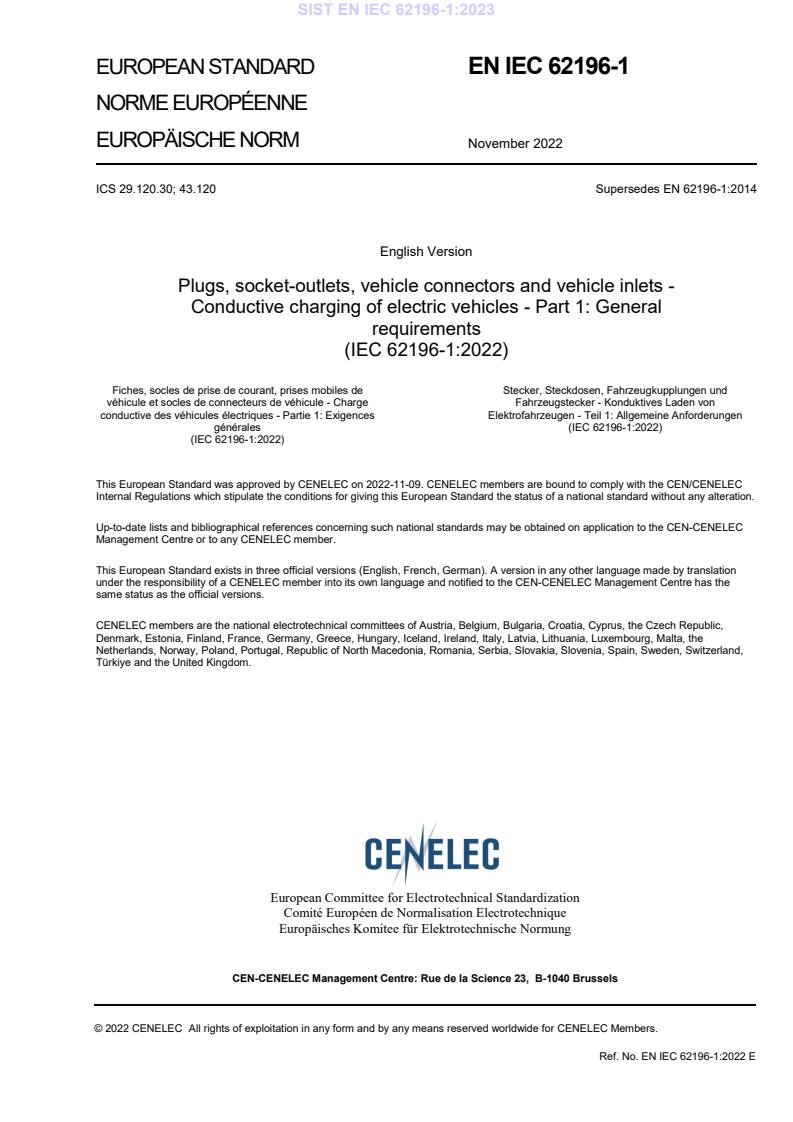
SLOVENSKI STANDARD
01-maj-2023
Nadomešča:
SIST EN 62196-1:2015
Vtiči, vtičnice, konektorji in uvodnice na vozilih - Kabelsko napajanje električnih
vozil - 1. del: Splošne zahteve (IEC 62196-1:2022)
Plugs, socket-outlets, vehicle connectors and vehicle inlets - Conductive charging of
electric vehicles - Part 1: General requirements (IEC 62196-1:2022)
Stecker, Steckdosen, Fahrzeugkupplungen und Fahrzeugstecker - Konduktives Laden
von Elektrofahrzeugen - Teil 1: Allgemeine Anforderungen (IEC 62196-1:2022)
Fiches, socles de prise de courant, prises mobiles de véhicule et socles de connecteurs
de véhicule - Charge conductive des véhicules électriques - Partie 1: Exigences
générales (IEC 62196-1:2022)
Ta slovenski standard je istoveten z: EN IEC 62196-1:2022
ICS:
29.120.30 Vtiči, vtičnice, spojke Plugs, socket-outlets,
couplers
43.120 Električna cestna vozila Electric road vehicles
2003-01.Slovenski inštitut za standardizacijo. Razmnoževanje celote ali delov tega standarda ni dovoljeno.
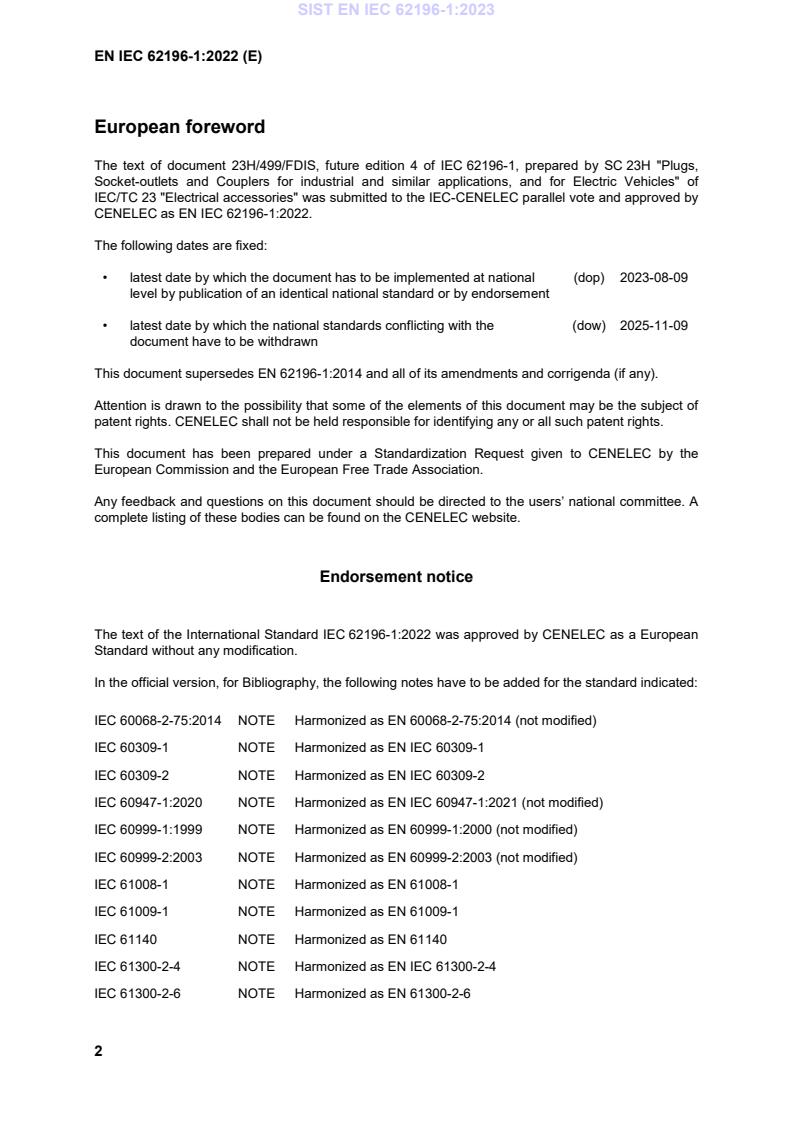
EUROPEAN STANDARD EN IEC 62196-1
NORME EUROPÉENNE
EUROPÄISCHE NORM November 2022
ICS 29.120.30; 43.120 Supersedes EN 62196-1:2014
English Version
Plugs, socket-outlets, vehicle connectors and vehicle inlets -
Conductive charging of electric vehicles - Part 1: General
requirements
(IEC 62196-1:2022)
Fiches, socles de prise de courant, prises mobiles de Stecker, Steckdosen, Fahrzeugkupplungen und
véhicule et socles de connecteurs de véhicule - Charge Fahrzeugstecker - Konduktives Laden von
conductive des véhicules électriques - Partie 1: Exigences Elektrofahrzeugen - Teil 1: Allgemeine Anforderungen
générales (IEC 62196-1:2022)
(IEC 62196-1:2022)
This European Standard was approved by CENELEC on 2022-11-09. CENELEC members are bound to comply with the CEN/CENELEC
Internal Regulations which stipulate the conditions for giving this European Standard the status of a national standard without any alteration.
Up-to-date lists and bibliographical references concerning such national standards may be obtained on application to the CEN-CENELEC
Management Centre or to any CENELEC member.
This European Standard exists in three official versions (English, French, German). A version in any other language made by translation
under the responsibility of a CENELEC member into its own language and notified to the CEN-CENELEC Management Centre has the
same status as the official versions.
CENELEC members are the national electrotechnical committees of Austria, Belgium, Bulgaria, Croatia, Cyprus, the Czech Republic,
Denmark, Estonia, Finland, France, Germany, Greece, Hungary, Iceland, Ireland, Italy, Latvia, Lithuania, Luxembourg, Malta, the
Netherlands, Norway, Poland, Portugal, Republic of North Macedonia, Romania, Serbia, Slovakia, Slovenia, Spain, Sweden, Switzerland,
Türkiye and the United Kingdom.
European Committee for Electrotechnical Standardization
Comité Européen de Normalisation Electrotechnique
Europäisches Komitee für Elektrotechnische Normung
CEN-CENELEC Management Centre: Rue de la Science 23, B-1040 Brussels
© 2022 CENELEC All rights of exploitation in any form and by any means reserved worldwide for CENELEC Members.
Ref. No. EN IEC 62196-1:2022 E
European foreword
The text of document 23H/499/FDIS, future edition 4 of IEC 62196-1, prepared by SC 23H "Plugs,
Socket-outlets and Couplers for industrial and similar applications, and for Electric Vehicles" of
IEC/TC 23 "Electrical accessories" was submitted to the IEC-CENELEC parallel vote and approved by
CENELEC as EN IEC 62196-1:2022.
The following dates are fixed:
• latest date by which the document has to be implemented at national (dop) 2023-08-09
level by publication of an identical national standard or by endorsement
• latest date by which the national standards conflicting with the (dow) 2025-11-09
document have to be withdrawn
This document supersedes EN 62196-1:2014 and all of its amendments and corrigenda (if any).
Attention is drawn to the possibility that some of the elements of this document may be the subject of
patent rights. CENELEC shall not be held responsible for identifying any or all such patent rights.
This document has been prepared under a Standardization Request given to CENELEC by the
European Commission and the European Free Trade Association.
Any feedback and questions on this document should be directed to the users’ national committee. A
complete listing of these bodies can be found on the CENELEC website.
Endorsement notice
The text of the International Standard IEC 62196-1:2022 was approved by CENELEC as a European
Standard without any modification.
In the official version, for Bibliography, the following notes have to be added for the standard indicated:
IEC 60068-2-75:2014 NOTE Harmonized as EN 60068-2-75:2014 (not modified)
IEC 60309-1 NOTE Harmonized as EN IEC 60309-1
IEC 60309-2 NOTE Harmonized as EN IEC 60309-2
IEC 60947-1:2020 NOTE Harmonized as EN IEC 60947-1:2021 (not modified)
IEC 60999-1:1999 NOTE Harmonized as EN 60999-1:2000 (not modified)
IEC 60999-2:2003 NOTE Harmonized as EN 60999-2:2003 (not modified)
IEC 61008-1 NOTE Harmonized as EN 61008-1
IEC 61009-1 NOTE Harmonized as EN 61009-1
IEC 61140 NOTE Harmonized as EN 61140
IEC 61300-2-4 NOTE Harmonized as EN IEC 61300-2-4
IEC 61300-2-6 NOTE Harmonized as EN 61300-2-6
IEC 61300-2-7 NOTE Harmonized as EN 61300-2-7
IEC 61439-1:2020 NOTE Harmonized as EN IEC 61439-1:2021 (not modified)
IEC 61540 NOTE Harmonized as HD 639 S1
IEC 61851 (series) NOTE Harmonized as EN IEC 61851 (series)
IEC 62752 NOTE Harmonized as EN 62752
Annex ZA
(normative)
Normative references to international publications
with their corresponding European publications
The following documents are referred to in the text in such a way that some or all of their content
constitutes requirements of this document. For dated references, only the edition cited applies. For
undated references, the latest edition of the referenced document (including any amendments)
applies.
NOTE 1 Where an International Publication has been modified by common modifications, indicated by (mod),
the relevant EN/HD applies.
NOTE 2 Up-to-date information on the latest versions of the European Standards listed in this annex is available
here: www.cenelec.eu.
Publication Year Title EN/HD Year
IEC 60068-2-14 - Environmental testing - Part 2-14: Tests - EN 60068-2-14 -
Test N: Change of temperature
IEC 60068-2-30 - Environmental testing - Part 2-30: Tests - EN 60068-2-30 -
Test Db: Damp heat, cyclic (12 h + 12 h
cycle)
IEC 60112 - Method for the determination of the proof EN IEC 60112 -
and the comparative tracking indices of solid
insulating materials
IEC 60227 series Polyvinyl chloride insulated cables of rated - -
voltages up to and including 450/750 V
IEC 60228 2004 Conductors of insulated cables EN 60228 2005
- - + corrigendum May 2005
IEC 60245-4 - Rubber insulated cables - Rated voltages up - -
to and including 450/750 V - Part 4: Cords
and flexible cables
IEC 60269-1 - Low-voltage fuses - Part 1: General EN 60269-1 -
requirements
IEC 60269-2 - Low-voltage fuses - Part 2: Supplementary HD 60269-2 -
requirements for fuses for use by authorized
persons (fuses mainly for industrial
application) - Examples of standardized
systems of fuses A to K
IEC 60309-4 2021 Plugs, fixed or portable socket-outlets and EN IEC 60309-4 2022
appliance inlets for industrial purposes -
Part 4: Switched socket-outlets with or
without interlock
IEC 60529 1989 Degrees of protection provided by EN 60529 1991
enclosures (IP Code)
- - + corrigendum May 1993
+ A1 1999 + A1 2000
+ A2 2013 + A2 2013
Publication Year Title EN/HD Year
IEC 60664-1 2020 Insulation coordination for equipment within EN IEC 60664-1 2020
low-voltage supply systems - Part 1:
Principles, requirements and tests
IEC 60664-3 - Insulation coordination for equipment within EN 60664-3 -
low-voltage systems - Part 3: Use of coating,
potting or moulding for protection against
pollution
IEC 60695-2-11 - Fire hazard testing - Part 2-11: Glowing/hot- EN IEC 60695-2-11 -
wire based test methods - Glow-wire
flammability test method for end products
(GWEPT)
IEC 60695-10-2 - Fire hazard testing - Part 10-2: Abnormal - -
heat - Ball pressure test method
IEC 60947-3 2020 Low-voltage switchgear and controlgear - EN IEC 60947-3 2021
Part 3: Switches, disconnectors, switch-
disconnectors and fuse-combination units
IEC 60947-5-1 - Low-voltage switchgear and controlgear - EN 60947-5-1 -
Part 5-1: Control circuit devices and
switching elements - Electromechanical
control circuit devices
IEC 61032 1997 Protection of persons and equipment by EN 61032 1998
enclosures - Probes for verification
IEC 61058-1 2016 Switches for appliances - Part 1: General EN IEC 61058-1 2018
requirements
IEC 61851-1 2017 Electric vehicle conductive charging system EN IEC 61851-1 2019
- Part 1: General requirements
1 2
IEC 61851-23 — Electric vehicle conductive charging system EN IEC 61851-23 —
- Part 23: DC electric vehicle supply
equipment
IEC 62196-2 2022 Plugs, socket-outlets, vehicle connectors - -
and vehicle inlets - Conductive charging of
electric vehicles - Part 2: Dimensional
compatibility requirements for AC pin and
contact-tube accessories
IEC 62196-3 2022 Plugs, socket-outlets, vehicle connectors - -
and vehicle inlets - Conductive charging of
electric vehicles - Part 3: Dimensional
compatibility requirements for DC and
AC/DC pin and contact-tube vehicle
couplers
ISO 1456 - Metallic and other inorganic coatings - EN ISO 1456 -
Electrodeposited coatings of nickel, nickel
plus chromium, copper plus nickel and of
copper plus nickel plus chromium
ISO 2081 - Metallic and other inorganic coatings - EN ISO 2081 -
Electroplated coatings of zinc with
supplementary treatments on iron or steel
Second edition under preparation. Stage at the time of publication: IEC PRVC 61851-23:2022.
Under preparation. Stage at the time of publication: prEN IEC 61851-23:2020.
Publication Year Title EN/HD Year
ISO 2093 - Electroplated coatings of tin; Specification - -
and test methods
ISO 4521 - Metallic and other inorganic coatings - EN ISO 4521 2008
Electrodeposited silver and silver alloy
coatings for engineering purposes -
Specification and test methods
IEC 62196-1 ®
Edition 4.0 2022-05
INTERNATIONAL
STANDARD
NORME
INTERNATIONALE
colour
inside
Plugs, socket-outlets, vehicle connectors and vehicle inlets – Conductive
charging of electric vehicles –
Part 1: General requirements
Fiches, socles de prise de courant, prises mobiles de véhicule et socles de
connecteurs de véhicule – Charge conductive des véhicules électriques –
Partie 1: Exigences générales
INTERNATIONAL
ELECTROTECHNICAL
COMMISSION
COMMISSION
ELECTROTECHNIQUE
INTERNATIONALE
ICS 29.120.30; 43.120 ISBN 978-2-8322-5218-5
– 2 – IEC 62196-1:2022 © IEC 2022
CONTENTS
FOREWORD . 6
INTRODUCTION . 8
1 Scope . 9
2 Normative references . 9
3 Terms and definitions . 11
4 General . 21
4.1 General requirements . 21
4.2 Components . 21
4.2.1 Ratings . 21
4.2.2 Mechanical assembly . 21
4.2.3 Current-carrying parts of incorporated components . 21
4.2.4 Electrical connections . 21
4.3 General notes on tests . 22
5 Ratings . 23
5.1 Preferred rated operating voltage ranges . 23
5.2 Preferred rated currents . 23
5.2.1 General . 23
5.2.2 Rated current for signal or control purposes . 24
5.2.3 Accessories not suitable for making and breaking an electrical circuit
under load . 24
5.2.4 Accessories suitable for, or not suitable for, making and breaking an
electrical circuit under load . 24
6 Connection between the power supply and the electric vehicle . 24
6.1 Interfaces . 24
6.2 Basic interface . 24
6.3 DC interface . 24
6.4 Combined interface . 24
7 Classification of accessories . 25
7.1 According to purpose . 25
7.2 According to the method of connecting the conductors . 25
7.3 According to serviceability . 25
7.4 According to electrical operation . 25
7.5 According to interface . 25
7.6 According to locking facilities . 25
7.7 According to interlock facilities . 25
7.8 According to the presence of shutter(s) . 25
8 Marking . 25
9 Dimensions. 28
10 Protection against electric shock . 29
10.1 General . 29
10.2 Accessories with shutters. 29
10.3 Contact sequencing and order of contact insertion and withdrawal . 32
10.4 Misassembly . 33
11 Size and colour of protective earthing and neutral conductors . 33
12 Provisions for earthing . 34
IEC 62196-1:2022 © IEC 2022 – 3 –
13 Terminals . 36
13.1 Common requirements . 36
13.2 Screw type terminals . 38
13.3 Mechanical tests on terminals . 40
14 Interlocks . 43
14.1 Accessories with interlock . 43
14.2 Accessories with integral switching device . 48
14.3 Control circuit devices and switching elements . 48
14.4 Pilot contacts and auxiliary circuits . 48
15 Resistance to ageing of rubber and thermoplastic material . 48
16 General construction . 49
17 Construction of EV socket-outlets – General . 53
18 Construction of EV plugs and vehicle connectors . 53
19 Construction of vehicle inlets . 54
20 Degrees of protection . 54
21 Insulation resistance and dielectric strength . 56
22 Breaking capacity . 57
23 Normal operation . 60
23.1 Mechanical, electrical, and thermal stresses and contaminants . 60
23.2 Load endurance test . 60
23.3 No-load endurance test . 61
23.4 Lid springs . 62
24 Temperature rise . 62
25 Flexible cables and their connection . 64
25.1 Strain relief . 64
25.2 Requirements for EV plugs and vehicle connectors . 64
25.2.1 Non-rewirable EV plugs and vehicle connectors. 64
25.2.2 Rewirable EV plugs and vehicle connectors . 64
25.3 EV plugs and vehicle connectors provided with a flexible cable . 65
26 Mechanical strength . 67
26.1 General . 67
26.2 Ball impact . 68
26.3 Drop test . 69
26.4 Flexing test . 70
26.5 Cable gland test . 72
26.6 Shutters . 73
26.7 Insulated end caps . 73
26.7.1 General . 73
26.7.2 Insulated end caps – Change of temperature test . 74
26.7.3 Insulated end caps – Pull test . 74
27 Screws, current-carrying parts and connections . 74
28 Creepage distances, clearances and distances through sealing compound . 77
29 Resistance to heat and to fire . 78
30 Corrosion and resistance to rusting . 79
31 Conditional short-circuit current . 80
31.1 General . 80
– 4 – IEC 62196-1:2022 © IEC 2022
31.2 Ratings and test conditions . 80
31.3 Test circuit . 81
31.4 Calibration . 84
31.5 Test procedure . 84
31.6 Behaviour of the equipment under test . 85
31.7 Acceptance conditions . 85
32 Electromagnetic compatibility . 85
32.1 Immunity . 85
32.2 Emission . 85
33 Vehicle drive over . 85
34 Thermal cycling . 86
34.1 General . 86
34.2 Initial temperature rise test . 86
34.3 Thermal cycling test . 86
34.4 Final temperature rise test . 86
35 Humidity exposure . 87
35.1 General . 87
35.2 Initial temperature rise test . 87
35.3 Humidity test . 87
35.4 Final temperature rise test . 87
36 Misalignment . 87
36.1 General . 87
36.2 Samples. 88
36.3 Misalignment test . 88
37 Contact endurance test . 90
37.1 Equipment . 90
37.2 Test sequence . 91
37.3 Compliance . 92
Bibliography . 94
Figure 1 – Diagram showing the use of the accessories . 12
Figure 2 – Lug terminals . 16
Figure 3 – Mantle terminals. 16
Figure 4 – Pillar terminals . 17
Figure 5 – Saddle terminals . 18
Figure 6 – Screw-type terminals . 19
Figure 7 – Stud terminals . 20
Figure 8 – Test piston . 28
Figure 9 – Gauge "A" for checking shutters . 31
Figure 10 – Gauge "B" for checking shutters . 32
Figure 11 – Gauges for testing insertability of round unprepared conductors having the
maximum specified cross-section . 39
Figure 12 – Equipment test arrangement . 41
Figure 13 – Apparatus for checking the withdrawal force. 46
Figure 14 – Verification of the latching device . 47
Figure 15 – Circuit diagrams for breaking capacity and normal operation tests . 59
IEC 62196-1:2022 © IEC 2022 – 5 –
Figure 16 – Points of measurement. 64
Figure 17 – Apparatus for testing the cable anchorage . 66
Figure 18 – Ball impact test . 68
Figure 19 – Arrangement for mechanical strength test for EV plugs and vehicle
connectors . 70
Figure 20 – Apparatus for flexing test . 72
Figure 21 – Diagram of the test circuit for the verification of short-circuit current
withstand of two-pole equipment on a single-phase AC or DC . 82
Figure 22 – Diagram of the test circuit for the verification of short-circuit current
withstand of three-pole equipment . 83
Figure 23 – Diagram of the test circuit for the verification of short-circuit current
withstand of four-pole equipment . 84
Figure 24 – Overview of the mechanical load test . 89
Figure 25 – Application of external mechanical load (mounted according to Figure 24) . 89
Figure 26 – Temperature rise criteria under external mechanical load . 90
Figure 27 – Forced-air circulating oven . 90
Figure 28 – Thermal cycling . 92
Figure 29 – Pass/fail based on temperature rise criteria . 93
Table 1 – Size for conductors . 34
Table 2 – Short-time test currents . 35
Table 3 – Values for flexing under mechanical load test . 42
Table 4 – Value for terminal pull test . 43
Table 5 – Withdrawal force with respect to ratings . 47
Table 6 – Cable length used to determine pull force on retaining means . 50
Table 7 – Test voltage for dielectric strength test . 57
Table 8 – Breaking capacity . 60
Table 9 – Normal operation . 61
Table 10 – Test current and nominal cross-sectional areas of copper conductors for
temperature rise test . 63
Table 11 – Pull force and torque test values for cable anchorage . 67
Table 12 – Summary of mechanical tests . 67
Table 13 – Impact energy for ball impact test . 69
Table 14 – Mechanical load flexing test . 71
Table 15 – Torque test values for glands . 73
Table 16 – Pulling force on insulated end caps . 74
Table 17 – Tightening torque for verification of mechanical strength of screw-type
terminals . 75
– 6 – IEC 62196-1:2022 © IEC 2022
INTERNATIONAL ELECTROTECHNICAL COMMISSION
____________
PLUGS, SOCKET-OUTLETS, VEHICLE CONNECTORS AND VEHICLE
INLETS – CONDUCTIVE CHARGING OF ELECTRIC VEHICLES –
Part 1: General requirements
FOREWORD
1) The International Electrotechnical Commission (IEC) is a worldwide organization for standardization comprising
all national electrotechnical committees (IEC National Committees). The object of IEC is to promote international
co-operation on all questions concerning standardization in the electrical and electronic fields. To this end and
in addition to other activities, IEC publishes International Standards, Technical Specifications, Technical Reports,
Publicly Available Specifications (PAS) and Guides (hereafter referred to as "IEC Publication(s)"). Their
preparation is entrusted to technical committees; any IEC National Committee interested in the subject dealt with
may participate in this preparatory work. International, governmental and non-governmental organizations liaising
with the IEC also participate in this preparation. IEC collaborates closely with the International Organization for
Standardization (ISO) in accordance with conditions determined by agreement between the two organizations.
2) The formal decisions or agreements of IEC on technical matters express, as nearly as possible, an international
consensus of opinion on the relevant subjects since each technical committee has representation from all
interested IEC National Committees.
3) IEC Publications have the form of recommendations for international use and are accepted by IEC National
Committees in that sense. While all reasonable efforts are made to ensure that the technical content of IEC
Publications is accurate, IEC cannot be held responsible for the way in which they are used or for any
misinterpretation by any end user.
4) In order to promote international uniformity, IEC National Committees undertake to apply IEC Publications
transparently to the maximum extent possible in their national and regional publications. Any divergence between
any IEC Publication and the corresponding national or regional publication shall be clearly indicated in the latter.
5) IEC itself does not provide any attestation of conformity. Independent certification bodies provide conformity
assessment services and, in some areas, access to IEC marks of conformity. IEC is not responsible for any
services carried out by independent certification bodies.
6) All users should ensure that they have the latest edition of this publication.
7) No liability shall attach to IEC or its directors, employees, servants or agents including individual experts and
members of its technical committees and IEC National Committees for any personal injury, property damage or
other damage of any nature whatsoever, whether direct or indirect, or for costs (including legal fees) and
expenses arising out of the publication, use of, or reliance upon, this IEC Publication or any other IEC
Publications.
8) Attention is drawn to the Normative references cited in this publication. Use of the referenced publications is
indispensable for the correct application of this publication.
9) Attention is drawn to the possibility that some of the elements of this IEC Publication may be the subject of patent
rights. IEC shall not be held responsible for identifying any or all such patent rights.
IEC 62196-1 has been prepared by subcommittee 23H: Plugs, socket-outlets and couplers for
industrial and similar applications, and for electric vehicles, of IEC technical committee 23:
Electrical accessories. It is an International Standard.
This fourth edition cancels and replaces the third edition published in 2014. This edition
constitutes a technical revision.
This edition includes the following significant technical changes with respect to the previous
edition:
a) deletion of references to universal AC and DC interfaces;
b) additional requirements for contact materials and plating;
c) changes to the temperature rise test to include additional points of measurement;
d) additional tests for accessories to address thermal stresses and stability, mechanical wear
and abuse, and exposure to contaminants;
IEC 62196-1:2022 © IEC 2022 – 7 –
e) relocation of information and requirements for DC charging to IEC 62196-3.
The text of this International Standard is based on the following documents:
Draft Report on voting
23H/499/FDIS 23H/503/RVD
Full information on the voting for its approval can be found in the report on voting indicated in
the above table.
The language used for the development of this International Standard is English.
This document was drafted in accordance with ISO/IEC Directives, Part 2, and developed in
accordance with ISO/IEC Directives, Part 1 and ISO/IEC Directives, IEC Supplement, available
at www.iec.ch/members_experts/refdocs. The main document types developed by IEC are
described in greater detail at www.iec.ch/standardsdev/publications.
A list of all parts in the IEC 62196 series, published under the general title Plugs, socket-outlets,
vehicle connectors and vehicle inlets – Conductive charging of electric vehicles, can be found
on the IEC website.
Subsequent parts of IEC 62196 deal with the requirements of particular types of accessories.
The clauses of those particular requirements supplement or modify the corresponding clauses
in this document.
In this document, the following print types are used:
– requirements proper: in roman type;
– test specifications: in italic type;
– notes: in smaller roman type.
The committee has decided that the contents of this document will remain unchanged until the
stability date indicated on the IEC website under webstore.iec.ch in the data related to the
specific document. At this date, the document will be
• reconfirmed,
• withdrawn,
• replaced by a revised edition, or
• amended.
IMPORTANT – The "colour inside" logo on the cover page of this document indicates that it
contains colours which are considered to be useful for the correct understanding of its
contents. Users should therefore print this document using a colour printer.
– 8 – IEC 62196-1:2022 © IEC 2022
INTRODUCTION
IEC 61851 (all parts) specifies requirements for electric vehicle (EV) conductive charging
systems.
IEC 62196 (all parts) specifies the requirements for plugs, socket-outlets, vehicle connectors,
vehicle inlets and cable assemblies as described in the IEC 61851 series.
Some charging can be achieved by direct connection from an electric vehicle to standard
socket-outlets connected to a supply network (mains or electrical grid).
Some modes of charging require a dedicated supply and charging equipment incorporating
control and communication circuits.
IEC 62196 (all parts) covers the mechanical, electrical and performance requirements for plugs,
socket-outlets, vehicle connectors and vehicle inlets for the connection between the EV supply
equipment and the electric vehicle.
The IEC 62196 series consists of the following parts:
– Part 1: General requirements, comprising clauses of a general character.
– Part 2: Dimensional compatibility and interchangeability requirements for AC pin and
contact-tube accessories.
– Part 3: Dimensional compatibility and interchangeability requirements for DC and AC/DC
pin and contact-tube vehicle couplers.
– Part 3-1: Vehicle connector, vehicle inlet and cable assembly intended to be used with a
thermal management system for DC charging.
– Part 4 : Dimensional compatibility and interchangeability requirements for DC pin and
contact-tube accessories for Class II or Class III applications.
– Part 6: Dimensional compatibility and interchangeability requirements for DC pin and
contact-tube couplers for applications using a system of protective electrical separation.
____________
Pending publication.
IEC 62196-1:2022 © IEC 2022 – 9 –
PLUGS, SOCKET-OUTLETS, VEHICLE CONNECTORS AND VEHICLE
INLETS – CONDUCTIVE CHARGING OF ELECTRIC VEHICLES –
Part 1: General requirements
1 Scope
This part of IEC 62196 is applicable to EV plugs, EV socket-outlets, vehicle connectors, vehicle
inlets, herein referred to as "accessories", and to cable assemblies for electric vehicles (EV)
intended for use in conductive charging systems which incorporate control means, with a rated
operating voltage not exceeding:
– 690 V AC 50 Hz to 60 Hz, at a rated current not exceeding 250 A;
– 1 500 V DC at a rated current not exceeding 800 A.
These accessories and cable assemblies are intended to be installed by instructed persons
(IEV 195-04-02) or skilled persons (IEV 195-04-01) only.
These accessories and cable assemblies are intended to be used for circuits specified in
IEC 61851 (all parts), which operate at different voltages and frequencies, and which can
include extra-low voltage and communication signals.
These accessories and cable assemblies are intended to be used at an ambient temperature
between −30 °C and +40 °C.
NOTE 1 In some countries, other requirements can apply.
NOTE 2 In the following country, −35 °C applies: SE.
NOTE 3 The manufacturer can enlarge the temperature range on the condition that the specified range information
is provided.
These accessories are intended to be connected only to cables with copper or copper-alloy
conductors.
The accessories covered by this document are intended for use in electric vehicle supply
equipment in accordance with IEC 61851 (all parts).
This document does not apply to standard plug and socket-outlets used for mode 1 and mode 2
according to IEC 61851-1:2017, 6.2.
NOTE 4 In the following countries, mode 1 is not allowed: UK, US, CA, SG.
2 Normative references
The following documents are referred to in the text in such a way that some or all of their content
constitutes requirements of this document. For dated references, only the edition cited applies.
For undated references, the latest edition of the referenced document (including any
amendments) applies.
IEC 60068-2-14, Environmental testing – Part 2-14: Tests – Test N: Change of temperature
IEC 60068-2-30, Environmental testing – Part 2-30: Tests – Test Db: Damp heat, cyclic
(12 h + 12 h cycle)
– 10 – IEC 62196-1:2022 © IEC 2022
IEC 60112, Method for the determination of the proof and the comparative tracking indices of
solid insulating materials
IEC 60227 (all parts), Polyvinyl chloride insulated cables of rated voltages up to and including
450/750 V
IEC 60228:2004, Conductors of insulated cables
IEC 60245-4, Rubber insulated cables – Rated voltages up to and including 450/750 V – Part 4:
Cords and flexible cables
IEC 60269-1, Low-voltage fuses – Part 1: General requirements
IEC 60269-2, Low-voltage fuse
...