

SIST EN 1669:1998
(Main)Aluminium and aluminium alloys - Test methods - Earing test for sheet and strip
- Abstract
This standard specifies the method for determining the ear height of sheet and strip of nominal thicknesses from 0,08 mm to 6 mm after deep drawing.
- Status
- Published
- Publication Date
- 31-Mar-1998
- Technical Committee
- INEK - Nonferrous metals
- Current Stage
- 6060 - National Implementation/Publication (Adopted Project)
- Start Date
- 01-Apr-1998
- Due Date
- 01-Apr-1998
- Completion Date
- 01-Apr-1998
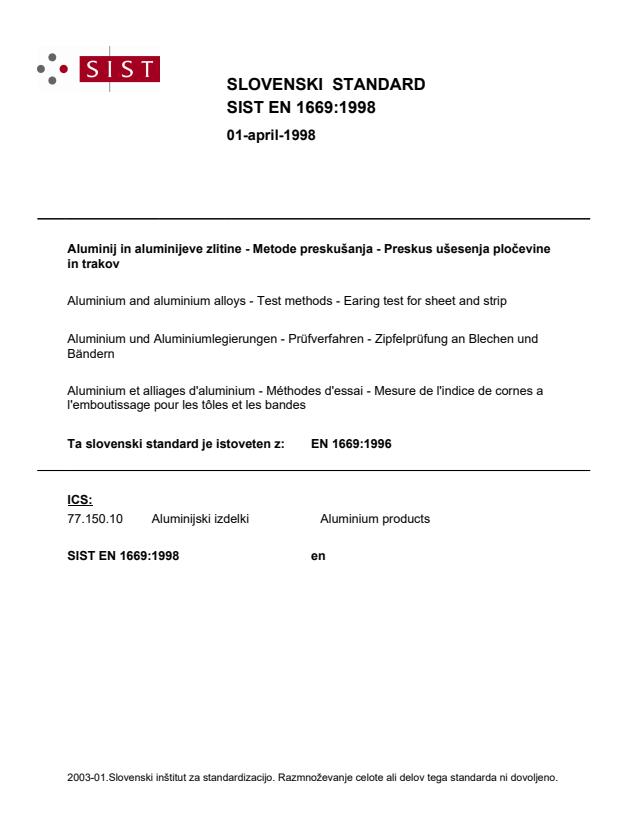

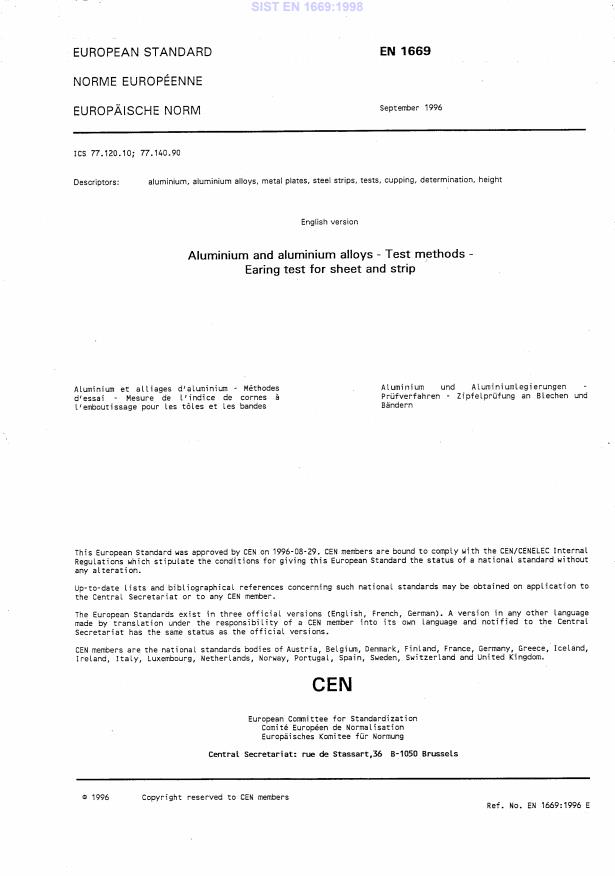
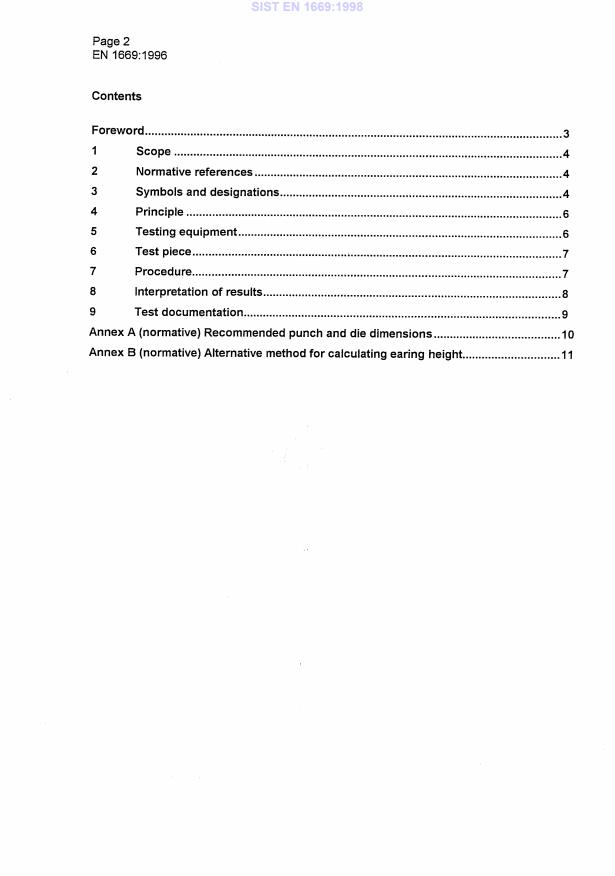
SIST EN 1669:1998 is the Slovenian standard for the earing test on aluminium and aluminium alloy sheet and strip, published by SIST and identical to EN 1669:1996. It specifies how to determine ear height after deep drawing for nominal thicknesses from 0,08 mm to 6 mm, so users can compare forming behaviour with a common method.
What does SIST EN 1669:1998 specify?
SIST EN 1669:1998 specifies a test method for measuring ear height in deep-drawn aluminium sheet and strip. The practical purpose is to give a common way to judge ear formation in flat wrought product.
- Material: aluminium and aluminium alloys.
- Product form: sheet and strip.
- Thickness range: nominal thicknesses from 0,08 mm to 6 mm.
- Forming step: the material is deep drawn before the measurement is taken.
- Measured result: ear height, used to describe the tendency of the material to form ears during drawing.
The front matter identifies the standard as a Slovenian version of EN 1669:1996 and classifies it under ICS 77.150.10, Aluminium products. For users, that means the document sits in the family of aluminium product test methods rather than a general metals handbook.
What are the key requirements of SIST EN 1669:1998?
SIST EN 1669:1998 focuses on the test method, not on product acceptance limits. The important points are the material, the product form, the thickness range, the forming operation, and the measurement outcome.
- The method applies to aluminium and aluminium alloys, so it is meant for light-metal flat products rather than steels or other metals.
- It covers both sheet and strip, which matters because mills, processors, and laboratories may handle either form.
- The nominal thickness range from 0,08 mm to 6 mm defines the products for which the method is intended.
- The test is based on deep drawing, so the material is formed into a shape that reveals uneven flow around the rim.
- The result is ear height, which gives a direct check on ear formation after forming.
- Because the document is a test method, users can compare different materials or batches using the same procedure and reporting approach.
In practice, this standard is useful when a buyer, processor, or lab wants a repeatable way to compare how sheet or strip behaves in a drawing operation. The ear height result helps show whether the material is likely to create uneven edges that may affect downstream trimming or forming.
What terms does SIST EN 1669:1998 define?
Ear height - the height of the ears that appear on the rim of a deep-drawn specimen, used as the test result.
Deep drawing - a forming operation that pulls sheet metal into a die, typically to make a cup-like part.
Sheet - flat aluminium product in the form of sheet, covered by the standard as a test specimen form.
Strip - flat aluminium product in the form of strip, also covered by the test method.
Nominal thickness - the thickness designation used to identify the applicable product range for the method.
Aluminium alloys - aluminium-based materials with alloying additions, included alongside aluminium in the scope.
Who uses SIST EN 1669:1998?
SIST EN 1669:1998 is used by aluminium product manufacturers, testing laboratories, and quality control teams. It is also relevant to buyers and specifiers who need a named method for comparing forming behaviour before accepting material for deep-drawing work.
In practice, these users apply the standard when they want a common test for sheet or strip supplied for forming. The method helps them document performance in a way that can be compared across suppliers, batches, or production runs.
What does the SIST EN 1669:1998 document contain?
SIST EN 1669:1998 contains the test method for determining ear height after deep drawing of aluminium and aluminium alloy sheet and strip. It is a focused test-method standard rather than a general product specification.
The document gives readers the framework for carrying out the earing test and using the ear-height result. That makes it useful for laboratory testing, process control, and material comparison.
The front matter also identifies the standard in English, German, and French, and places it in the aluminium products field under ICS 77.150.10. Read in practice, it is the reference a lab or processor would cite when they need a standardised earing test for flat aluminium products.
Relations
- Effective Date
- 28-Jan-2026
- Effective Date
- 28-Jan-2026
Get Certified
Connect with accredited certification bodies for this standard

Element Materials Technology
Materials testing and product certification.

Inštitut za kovinske materiale in tehnologije
Institute of Metals and Technology. Materials testing, metallurgical analysis, NDT.
Sponsored listings
Frequently Asked Questions
SIST EN 1669:1998 is a standard published by the Slovenian Institute for Standardization (SIST). Its full title is "Aluminium and aluminium alloys - Test methods - Earing test for sheet and strip". This standard covers: This standard specifies the method for determining the ear height of sheet and strip of nominal thicknesses from 0,08 mm to 6 mm after deep drawing.
This standard specifies the method for determining the ear height of sheet and strip of nominal thicknesses from 0,08 mm to 6 mm after deep drawing.
SIST EN 1669:1998 is classified under the following ICS (International Classification for Standards) categories: 77.150.10 - Aluminium products. The ICS classification helps identify the subject area and facilitates finding related standards.
SIST EN 1669:1998 has the following relationships with other standards: It is inter standard links to SIST EN 485-1:2008+A1:2010, SIST EN 485-1:2016. Understanding these relationships helps ensure you are using the most current and applicable version of the standard.
SIST EN 1669:1998 is available in PDF format for immediate download after purchase. The document can be added to your cart and obtained through the secure checkout process. Digital delivery ensures instant access to the complete standard document.
Standards Content (Sample)
2003-01.Slovenski inštitut za standardizacijo. Razmnoževanje celote ali delov tega standarda ni dovoljeno.Aluminium und Aluminiumlegierungen - Prüfverfahren - Zipfelprüfung an Blechen und BändernAluminium et alliages d'aluminium - Méthodes d'essai - Mesure de l'indice de cornes a l'emboutissage pour les tôles et les bandesAluminium and aluminium alloys - Test methods - Earing test for sheet and strip77.150.10Aluminijski izdelk
...