


SIST EN IEC 60974-10:2022/kFprA1:2025
(Amendment)Arc welding equipment - Part 10: Electromagnetic compatibility (EMC) requirements
Arc welding equipment - Part 10: Electromagnetic compatibility (EMC) requirements
Lichtbogenschweißeinrichtungen - Teil 10: Anforderungen an die elektromagnetische Verträglichkeit (EMV)
Matériel de soudage à l'arc - Partie 10: Exigences de compatibilité électromagnétique (CEM)
Oprema za obločno varjenje - 10. del: Zahteve za elektromagnetno združljivost (EMC) - Dopolnilo A1
General Information
- Status
- Not Published
- Public Enquiry End Date
- 28-Feb-2025
- Technical Committee
- I09 - Imaginarni 09
- Current Stage
- 5020 - Formal vote (FV) (Adopted Project)
- Start Date
- 16-Dec-2025
- Due Date
- 03-Feb-2026
Relations
- Effective Date
- 07-Nov-2023
Overview
SIST EN IEC 60974-10:2022/kFprA1:2025 is an important amendment to the international standard covering arc welding equipment, specifically Part 10 which addresses electromagnetic compatibility (EMC) requirements. Published by the CLC and developed under the International Electrotechnical Commission (IEC) technical committee TC 26, this amendment updates and aligns EMC assessment and test procedures for arc welding devices. The update reflects evolving technological practices and ensures compatibility with modern radio and electronic components often integrated into welding equipment.
The amendment harmonizes the latest EMC directives, introduces clearer criteria for portable equipment, and refines documentation and testing methods. It replaces prior versions of IEC 60974-10, consolidating requirements that manufacturers, testing laboratories, and regulatory bodies rely upon to confirm equipment compliance with EMC standards.
Key Topics
Scope and Inclusion of Radio-Enabled Equipment
This amendment expands the scope to explicitly include arc welding equipment with embedded radio transmit/receive functions (host equipment with radio functionality). It clarifies that while intentional radio transmissions fall under ITU regulations, the standard applies to all other emission requirements, including intermodulation effects between radio and non-radio subassemblies.Updated Terminology and Definitions
Important new terms such as "portable equipment," "equipment with radio functionality," "radio device," "radio module," and "radio transmitter" have been precisely defined. For example, “portable” refers to devices capable of being carried by a single person, which impacts testing setups and emission criteria.Test Instruments and Methods
The amendment specifies measurement instrumentation requirements in accordance with CISPR 16 series standards (CISPR 16-1-1, 16-1-2, and 16-1-4) to assess conducted and radiated electromagnetic emissions accurately. It describes artificial mains network (AMN) configurations, voltage probe characteristics, antenna types for different frequency ranges (from 30 MHz to several GHz), and coupling/decoupling network (CDN) usage to replicate real-world operational environments.Test Set-Up and Procedures
The document offers detailed instructions for configuring emission and immunity test setups for both portable and non-portable arc welding equipment. It includes guidance on positioning equipment under test (EUT), bundling excess cable lengths, ensuring standard distances between antennas and load, and simulating arc welding operation using conventional loads. Ancillary equipment like wire feeders and remote controls must also be tested following specified cable lengths and connection methods.Alignment with CISPR 11 7th Edition
The amendment aligns emission limits and measurement methods with the latest 7th edition of CISPR 11, ensuring consistent, up-to-date EMC handling for industrial, scientific, and medical (ISM) equipment categories that include arc welding apparatus.Documentation and Informative Annexes
Clause 8 on documentation for purchasers and users has been transformed into an informative annex, providing clearer guidance on necessary information accompanying equipment-supporting compliance, safe use, and regulatory adherence.
Applications
This amendment serves manufacturers of arc welding equipment, including:
- Welding machinery producers integrating radio modules for remote control or data exchange.
- Testing and certification laboratories conducting EMC evaluations on welding systems and ancillary components.
- Regulatory authorities enforcing EMC compliance within industrial and manufacturing settings.
- End-users and purchasers who require assurance that welding equipment meets internationally recognized standards for electromagnetic emissions and immunity.
By applying SIST EN IEC 60974-10:2022/kFprA1:2025, stakeholders ensure arc welding devices:
- Operate reliably in environments with sensitive electronics without causing or suffering from harmful electromagnetic interference.
- Meet strict regulatory requirements in multiple markets, reducing risks of non-compliance and costly delays.
- Support safety and operational integrity, vital for industrial welding applications where consistent performance is critical.
Related Standards
- IEC 60974-1 – Arc welding power sources; provides definitions and general requirements referenced in the amendment for conventional loads and testing methods.
- CISPR 11 (7th Edition) – Radio-frequency disturbance characteristics; industrial, scientific, and medical equipment limits and measurement methods, the core EMC measurement reference.
- CISPR 16 series – Specifications for EMC measurement instrumentation and methods, guiding accurate emissions assessment.
- IEC 61000-4-3 – Electromagnetic immunity testing using radiated RF electromagnetic fields, referenced for immunity assessment distances and setups.
- IEC 61000-4-6 – Immunity to conducted disturbances, influencing coupling/decoupling network requirements during testing.
Summary
SIST EN IEC 60974-10:2022/kFprA1:2025 Amendment 1 represents a significant technical update to EMC requirements for arc welding equipment, incorporating advanced test methods and expanded scope to include integrated radio functionalities. Adherence to this standard guarantees higher electromagnetic compatibility, ensuring safe, interference-free welding operations in increasingly electronic and radio-enabled industrial environments. Manufacturers and testing bodies should integrate the latest definitions, measurement techniques, and test configurations stipulated by this amendment to maintain compliance with international EMC regulations.

Frequently Asked Questions
SIST EN IEC 60974-10:2022/kFprA1:2025 is a draft published by the Slovenian Institute for Standardization (SIST). Its full title is "Arc welding equipment - Part 10: Electromagnetic compatibility (EMC) requirements". This standard covers: Arc welding equipment - Part 10: Electromagnetic compatibility (EMC) requirements
Arc welding equipment - Part 10: Electromagnetic compatibility (EMC) requirements
SIST EN IEC 60974-10:2022/kFprA1:2025 is classified under the following ICS (International Classification for Standards) categories: 25.160.30 - Welding equipment; 33.100.01 - Electromagnetic compatibility in general. The ICS classification helps identify the subject area and facilitates finding related standards.
SIST EN IEC 60974-10:2022/kFprA1:2025 has the following relationships with other standards: It is inter standard links to SIST EN IEC 60974-10:2022. Understanding these relationships helps ensure you are using the most current and applicable version of the standard.
SIST EN IEC 60974-10:2022/kFprA1:2025 is associated with the following European legislation: EU Directives/Regulations: 2014/30/EU, 2014/53/EU; Standardization Mandates: M/536, M/552. When a standard is cited in the Official Journal of the European Union, products manufactured in conformity with it benefit from a presumption of conformity with the essential requirements of the corresponding EU directive or regulation.
SIST EN IEC 60974-10:2022/kFprA1:2025 is available in PDF format for immediate download after purchase. The document can be added to your cart and obtained through the secure checkout process. Digital delivery ensures instant access to the complete standard document.
Standards Content (Sample)
SLOVENSKI STANDARD
SIST EN IEC 60974-10:2022/oprA1:2025
01-februar-2025
Oprema za obločno varjenje - 10. del: Zahteve za elektromagnetno združljivost
(EMC) - Dopolnilo A1
Arc welding equipment - Part 10: Electromagnetic compatibility (EMC) requirements
Lichtbogenschweißeinrichtungen - Teil 10: Anforderungen an die elektromagnetische
Verträglichkeit (EMV)
Matériel de soudage à l'arc - Partie 10: Exigences de compatibilité électromagnétique
(CEM)
Ta slovenski standard je istoveten z: EN IEC 60974-10:2021/prA1:2024
ICS:
25.160.30 Varilna oprema Welding equipment
33.100.01 Elektromagnetna združljivost Electromagnetic compatibility
na splošno in general
SIST EN IEC 60974-10:2022/oprA1:2025 en
2003-01.Slovenski inštitut za standardizacijo. Razmnoževanje celote ali delov tega standarda ni dovoljeno.
SIST EN IEC 60974-10:2022/oprA1:2025
SIST EN IEC 60974-10:2022/oprA1:2025
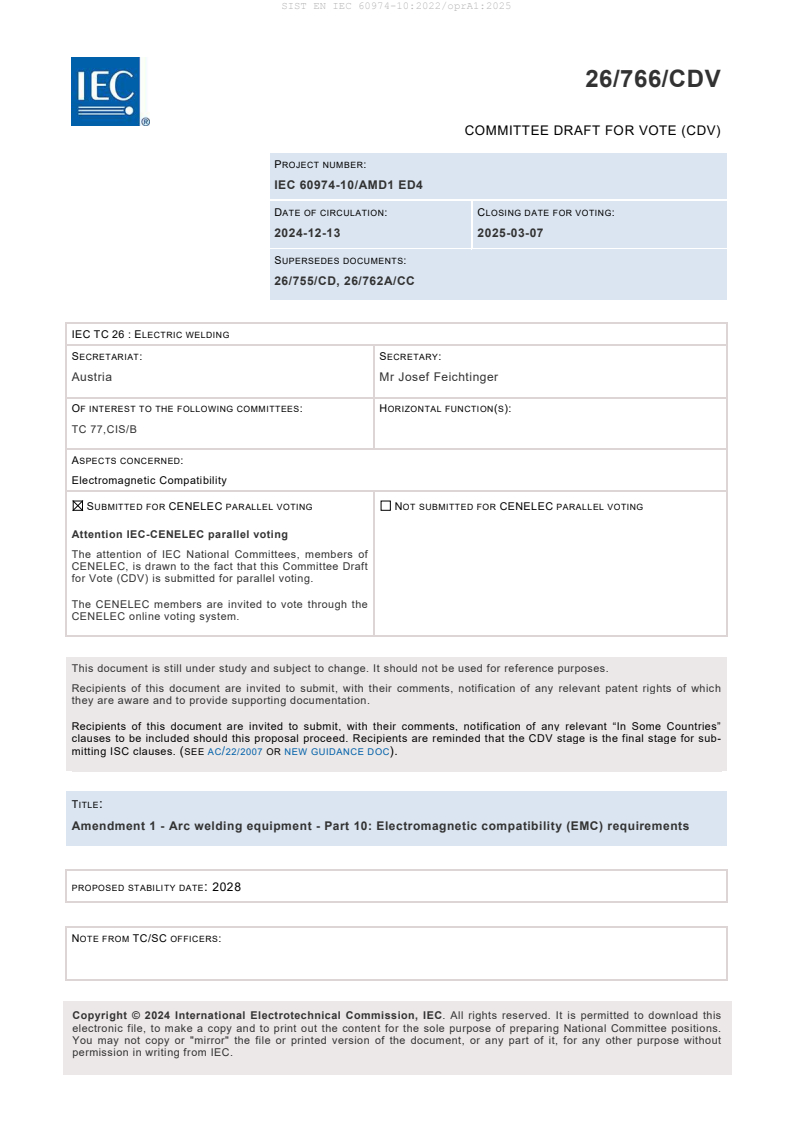
26/766/CDV
COMMITTEE DRAFT FOR VOTE (CDV)
PROJECT NUMBER:
IEC 60974-10/AMD1 ED4
DATE OF CIRCULATION: CLOSING DATE FOR VOTING:
2024-12-13 2025-03-07
SUPERSEDES DOCUMENTS:
26/755/CD, 26/762A/CC
IEC TC 26 : ELECTRIC WELDING
SECRETARIAT: SECRETARY:
Austria Mr Josef Feichtinger
OF INTEREST TO THE FOLLOWING COMMITTEES: HORIZONTAL FUNCTION(S):
TC 77,CIS/B
ASPECTS CONCERNED:
Electromagnetic Compatibility
SUBMITTED FOR CENELEC PARALLEL VOTING NOT SUBMITTED FOR CENELEC PARALLEL VOTING
Attention IEC-CENELEC parallel voting
The attention of IEC National Committees, members of
CENELEC, is drawn to the fact that this Committee Draft
for Vote (CDV) is submitted for parallel voting.
The CENELEC members are invited to vote through the
CENELEC online voting system.
This document is still under study and subject to change. It should not be used for reference purposes.
Recipients of this document are invited to submit, with their comments, notification of any relevant patent rights of which
they are aware and to provide supporting documentation.
Recipients of this document are invited to submit, with their comments, notification of any relevant “In Some Countries”
clauses to be included should this proposal proceed. Recipients are reminded that the CDV stage is the final stage for sub-
mitting ISC clauses. (SEE AC/22/2007 OR NEW GUIDANCE DOC).
TITLE:
Amendment 1 - Arc welding equipment - Part 10: Electromagnetic compatibility (EMC) requirements
PROPOSED STABILITY DATE: 2028
NOTE FROM TC/SC OFFICERS:
electronic file, to make a copy and to print out the content for the sole purpose of preparing National Committee positions.
You may not copy or "mirror" the file or printed version of the document, or any part of it, for any other purpose without
permission in writing from IEC.
SIST EN IEC 60974-10:2022/oprA1:2025
IEC CDV 60974-10/AMD1 ED4 © IEC 2024 2 26/766/CDV
1 INTERNATIONAL ELECTROTECHNICAL COMMISSION
2 ____________
4 Arc welding equipment –
6 Part 10: Electromagnetic compatibility (EMC) requirements
8 AMENDMENT 1
10 FOREWORD
11 1) The International Electrotechnical Commission (IEC) is a worldwide organization for standardization comprising
12 all national electrotechnical committees (IEC National Committees). The object of IEC is to promote
13 international co-operation on all questions concerning standardization in the electrical and electronic fields. To
14 this end and in addition to other activities, IEC publishes International Standards, Technical Specifications,
15 Technical Reports, Publicly Available Specifications (PAS) and Guides (hereafter referred to as “IEC
16 Publication(s)”). Their preparation is entrusted to technical committees; any IEC National Committee interested
17 in the subject dealt with may participate in this preparatory work. International, governmental and non-
18 governmental organizations liaising with the IEC also participate in this preparation. IEC collaborates closely
19 with the International Organization for Standardization (ISO) in accordance with conditions determined by
20 agreement between the two organizations.
21 2) The formal decisions or agreements of IEC on technical matters express, as nearly as possible, an international
22 consensus of opinion on the relevant subjects since each technical committee has representation from all
23 interested IEC National Committees.
24 3) IEC Publications have the form of recommendations for international use and are accepted by IEC National
25 Committees in that sense. While all reasonable efforts are made to ensure that the technical content of IEC
26 Publications is accurate, IEC cannot be held responsible for the way in which they are used or for any
27 misinterpretation by any end user.
28 4) In order to promote international uniformity, IEC National Committees undertake to apply IEC Publications
29 transparently to the maximum extent possible in their national and regional publications. Any divergence
30 between any IEC Publication and the corresponding national or regional publication shall be clearly indicated in
31 the latter.
32 5) IEC itself does not provide any attestation of conformity. Independent certification bodies provide conformity
33 assessment services and, in some areas, access to IEC marks of conformity. IEC is not responsible for any
34 services carried out by independent certification bodies.
35 6) All users should ensure that they have the latest edition of this publication.
36 7) No liability shall attach to IEC or its directors, employees, servants or agents including individual experts and
37 members of its technical committees and IEC National Committees for any personal injury, property damage or
38 other damage of any nature whatsoever, whether direct or indirect, or for costs (including legal fees) and
39 expenses arising out of the publication, use of, or reliance upon, this IEC Publication or any other IEC
40 Publications.
41 8) Attention is drawn to the Normative references cited in this publication. Use of the referenced publications is
42 indispensable for the correct application of this publication.
43 9) IEC draws attention to the possibility that the implementation of this document may involve the use of (a)
44 patent(s). IEC takes no position concerning the evidence, validity or applicability of any claimed patent rights in
45 respect thereof. As of the date of publication of this document, IEC had not received notice of (a) patent(s),
46 which may be required to implement this document. However, implementers are cautioned that this may not
47 represent the latest information, which may be obtained from the patent database available at
48 https://patents.iec.ch. IEC shall not be held responsible for identifying any or all such patent rights.
49 Amendment 1 to IEC 60974-10:2020 has been prepared by IEC technical committee TC 26:
50 Electric welding.
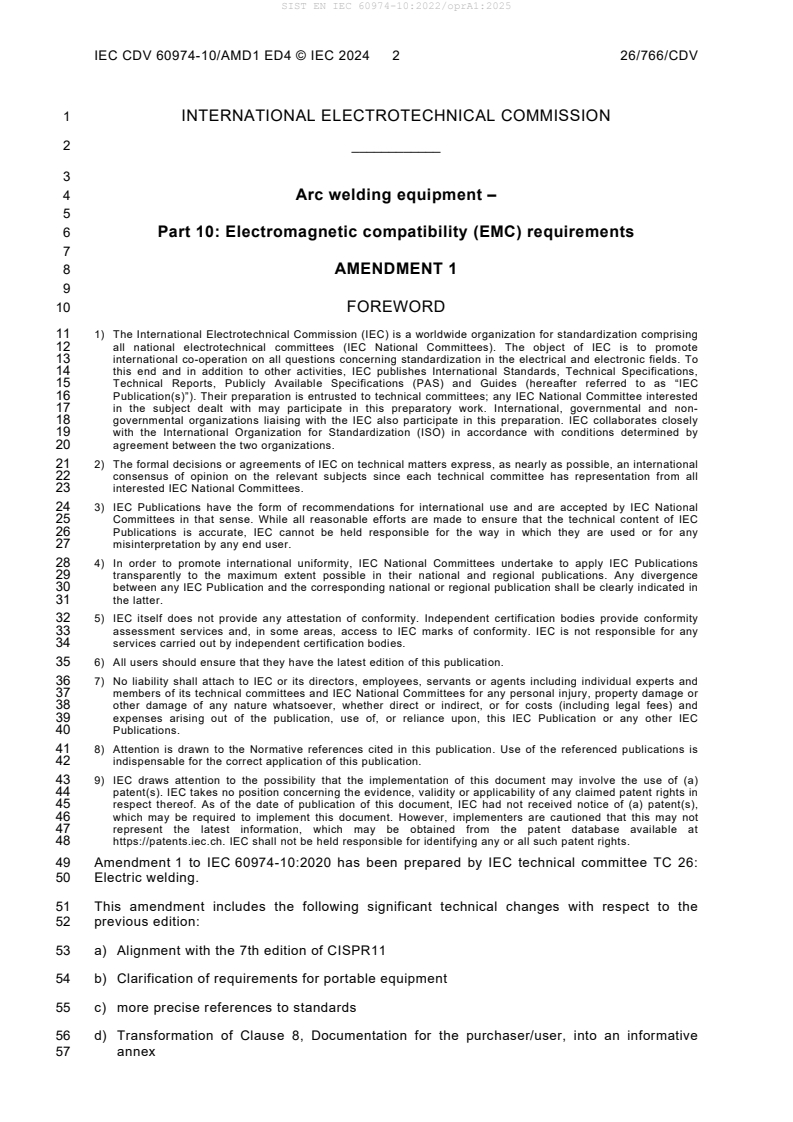
51 This amendment includes the following significant technical changes with respect to the
52 previous edition:
53 a) Alignment with the 7th edition of CISPR11
54 b) Clarification of requirements for portable equipment
55 c) more precise references to standards
56 d) Transformation of Clause 8, Documentation for the purchaser/user, into an informative
57 annex
SIST EN IEC 60974-10:2022/oprA1:2025
IEC CDV 60974-10/AMD1 ED4 © IEC 2024 3 26/766/CDV
58 The text of this Amendment is based on the following documents:
Draft Report on voting
XX/XX/XXXX XX/XX/XXX
60 Full information on the voting for its approval can be found in the report on voting indicated in
61 the above table.
62 The language used for the development of this Amendment is English.
63 This document was drafted in accordance with ISO/IEC Directives, Part 2, and developed in
64 accordance with ISO/IEC Directives, Part 1 and ISO/IEC Directives, IEC Supplement,
65 available at www.iec.ch/members_experts/refdocs. The main document types developed by
66 IEC are described in greater detail at www.iec.ch/publications/.
67 The committee has decided that the contents of this document will remain unchanged until the
68 stability date indicated on the IEC website under webstore.iec.ch in the data related to the
69 specific document. At this date, the document will be
70 • reconfirmed,
71 • withdrawn, or
72 • revised.
SIST EN IEC 60974-10:2022/oprA1:2025
IEC CDV 60974-10/AMD1 ED4 © IEC 2024 4 26/766/CDV
76 INTRODUCTION
78 ARC WELDING EQUIPMENT
80 Part 10: Electromagnetic compatibility (EMC) requirements
84 1 Scope
85 Replace the 2nd and 3rd paragraphs with:
86 Arc welding equipment which incorporates radio transmit/receive functions (host equipment
87 with radio functionality) is included in the scope of this document, see Annex E. However, the
88 emission requirements in this document are not intended to be applicable to the intentional
89 transmissions from a radio transmitter as defined by the ITU including their spurious
90 emissions.
91 NOTE 1 This exclusion only applies to emissions from the intentional radio transmitter. However, combination
92 emissions, for example emissions resulting from intermodulation between the radio and the non-radio
93 subassemblies of the ISM equipment, are not subject to this exclusion.
94 2 Normative references
95 Insert after the reference to CISPR 11:2015:
96 CISPR 11:202X, Industrial, scientific and medical equipment – Radio-frequency disturbance
97 characteristics – Limits and methods of measurement
98 3 Terms and definitions
99 3.8
100 Replace contents of this clause:
101 portable, adj
102 capable to be carried by one person
103 Note 1 to entry: Portability is typically specified by the equipment manufacturer based on the intended use and
104 the equipment design.
105 [SOURCE: IEC 60050-151:2001, 151-16-47, modified – The note to entry has been entirely
106 redrafted.]
107 Insert at the end of this clause:
108 3.12
109 equipment with radio functionality
110 non-radio equipment (host equipment) including one or more radio devices or radio modules
111 that can use host control function(s) and/or power supply
112 Note 1 to entry: The use of the included radio equipment can be for remote control (of the host equipment by an
113 external equipment or vice versa) or for data exchange with external equipment.
114 Note 2 to entry: A radio device or radio module can be plugged-in, built-in or external.
115 [SOURCE: CISPR 11:2024, 3.1.14]
116 3.13
117 radio device
118 assembly consisting of one or more radio transmitters and/or receivers, capable to function on
119 a stand-alone basis with or without additional accessories
SIST EN IEC 60974-10:2022/oprA1:2025
IEC CDV 60974-10/AMD1 ED4 © IEC 2024 5 26/766/CDV
120 Note 1 to entry: These accessories can be incorporated in the assembly or connected to it from outside.
121 Examples
122 [SOURCE: CISPR 11:2023X, 3.1.32]
123 3.14
124 radio module
125 assembly consisting of one or more radio transmitters and/or receivers, intended to be
126 incorporated in a host equipment
127 Note 1 to entry: A radio module can incorporate a power supply or any other accessories.
128 Note 2 to entry: A radio module can be plugged-in, built-in or external.
129 [SOURCE: CISPR 11:2023X, 3.1.33]
130 3.15
131 radio transmitter
132 device producing radio-frequency energy intended to be radiated by an antenna for the
133 purpose of radiocommunication or radiodetermination
134 [SOURCE: CISPR 11:2024, 3.1.34]
136 4.2 Measuring instruments
137 Replace the contents of this clause with the following text:
138 The measuring equipment shall comply with the requirements of CISPR 16-1-1:2019 Clause
139 4, CISPR 16-1-1:2019 Clauses 5 and 7 for the relevant detectors, and the standards referred
140 to in Table 6, Table 7 and Table 8 as applicable.
141 4.3 Artificial mains network
142 Replace the first paragraph with the following text:
143 Measurement of the mains terminal disturbance voltage shall be made using an artificial
144 mains network consisting of 50 Ω/50 µH or 50 Ω/50 µH + 5 Ω V-network as specified in
145 CISPR 16-1-2:2014 Clause 4.4 and CISPR 16-1-2:2014/AMD1:2017 Clauses 4.1, 4.2.
146 4.4 Voltage probe
147 Replace the contents of this clause with the following text:
148 A voltage probe as specified in CISPR 16-1-2:2014 Clause 5.2 shall be used when the
149 artificial mains network cannot be used. The probe is connected sequentially between each
150 line and the reference earth. The probe shall consist of a blocking capacitor and a resistor
151 such that the total resistance between the line and earth is at least 1 500 Ω. The effect on the
152 accuracy of measurement of the capacitor or any other device which may be used to protect
153 the measuring receiver against dangerous currents shall be either less than 1 dB or allowed
154 for in calibration.
155 4.5 Antennas
156 Replace the firth paragraph with the following text:
157 In the frequency range from 30 MHz to 1 GHz, the antenna(s) used shall be as specified in
158 CISPR 16-1-4:2019 Clause 4.5.
159 In the frequency range from 1 GHz to & GHz, the antenna(s) used shall be as specified in
160 CISPR 16-1-4:2019 Clause 4.6.
161 4.6 Coupling/decoupling network (CDN)
162 Replace the contents of this clause with the following text:
SIST EN IEC 60974-10:2022/oprA1:2025
IEC CDV 60974-10/AMD1 ED4 © IEC 2024 6 26/766/CDV
163 If a shielded chamber is required and the load is situated outside the shielded chamber, a
164 load-decoupling network connected to the outside load via suitable RF filters shall be used
165 inside the chamber. A 150 Ω CDN AF 2, as specified in IEC 61000-4-6:2013 Clause 6.2 and
166 Figure D.3 , suitable for the respective load current and voltage, shall be used. The RF-port of
167 the CDN shall be terminated with 50 Ω.
168 Any suitable coupling devices specified in CISPR 16-1-2:2014 Clause 6.2 and CISPR 16-
169 1-2:2014/AMD1:2017 Clause 6.2 may be used for the conducted emission assessment of
170 signal, control or measurement ports.
171 5 Test set-up for emission and immunity
172 5.1 General
173 Replace the contents of the first paragraph with the following text:
174 Emission and immunity testing of equipment that is not PORTABLE shall be carried out on
175 equipment configured in accordance with Figure 2. For PORTABLE equipment, the test set-ups
176 given in Figure 2 (EUT height larger than 40cm) and the test set-up given in Figure 3 (EUT up
177 to 40cm height) shall be used.
178 For PORTABLE equipment greater than or equal 40cm in height the test set-up given in Figure 2
179 shall be used.
180 For other PORTABLE equipment the test set-up given in Figure 3 shall be used
181 Arc welding equipment tested in one of these configurations shall be considered to have met
182 the necessary requirements of this document.
183 Insert after the 2nd paragraph:
184 Excess lengths of cables shall be bundled at the approximate centre of the cable. If it is
185 impractical to do so because of cable bulk or stiffness, the disposition of the excess cable
186 shall be precisely noted in the test report.
187 Replace the 2nd bullet in the list after the 3rd paragraph with:
188 • in Figure 2 and Figure 3, b shall be 0,3 to 0,4 m, as far as practicable.;
189 Replace the last bullet in the list after the 3rd paragraph with:
190 • in Figure 4, the horizontal distance c between the EUT and the conventional load shall be
191 1 m or less.
192 Replace Figure 4 with:
Key
1 Arc welding equipment 3 Test antenna (horizontal polarization shown)
2 Welding cables (bundled) 4 Conventional load or load decoupling network
SIST EN IEC 60974-10:2022/oprA1:2025
IEC CDV 60974-10/AMD1 ED4 © IEC 2024 7 26/766/CDV
e Separation distance between the equipment under test and the radiation centre of the antenna
i Distance between the equipment under test and nearest point of the antenna
c Distance between the EUT and the conventional load
195 Figure 1 – Top view of test set-up as shown in Error: Reference source not found
196 Replace Note 1 and Note 2 in Figure 2 with:
197 NOTE 1 Items 2, 3, and 4 are ancillary equipment, as applicable, and are typically positioned as specified by the
198 intended use.
199 NOTE 2 Insulation (item 9) is placed between items 1 and 3 if specified by the intended use.
200 Replace the 4th last paragraph with:
201 For electromagnetic radiation disturbance and EM field immunity tests using the test set-up as
202 given in Error: Reference source not found, the welding power source and conventional load
203 (or, if applicable, the load-decoupling network) shall be at one stationary position with respect
204 to the test antenna as shown in Figure 1. The separation distance e in Figure 1 is defined in
205 8.3 of CISPR 11:2015+AMD1:2016. The separation distance i in Figure 1 is defined in
206 IEC 61000-4-3:2006+AMD1:2007+AMD2:2010 Clause 7.
207 Replace the 3rd last paragraph with:
208 The cables shall be allowed to fall naturally to the ground plane. Excess cable length shall be
209 folded to form separate bundles not exceeding 0,3 m to 0,4 m in length, as far as practicable.
210 5.2 Load
211 During the tests, the arc welding operation is simulated by loading the equipment with a
212 conventional load as specified in IEC 60974-1:2017+AMD1:2019 Clause 3.1.18. For RF
213 emission tests that do not use a CDN, the conventional load shall be insulated by an
214 insulating mat (or blocks) not greater than 12 mm thick or insulated by its own under-gear if
215 appropriate.
216 5.3.1 Wire feeders
217 Replace first two sentences with:
218 Ancillary equipment shall be tested in conjunction with a welding power source. It shall be
219 connected, installed and configured consistent with the intended use.
220 5.3.2 Wire feeders
nd rd th
221 , 3 , and 4 paragraphs with:
Replace the 2
222 The welding cable connecting the wire feeder to the welding power source shall be 2 m in
223 length or longer, if required, to make the connection and be of suitable current rating. If a
224 welding cable in excess of 2 m is provided by the manufacturer, the excess cable length shall
225 be folded to form a bundle of 0,3 m to 0,4 m length, as far as practicable. A welding cable
226 connection less than 2 m long shall be permitted if this is supplied with the equipment.
227 The interconnection cable(s) between the wire feeder and the welding power source shall be
228 of the type and length consist
...
Questions, Comments and Discussion
Ask us and Technical Secretary will try to provide an answer. You can facilitate discussion about the standard in here.
Loading comments...