


SIST EN 13922:2020
(Main)Tanks for transport of dangerous goods - Service equipment for tanks - Overfill prevention systems for liquid fuels
Tanks for transport of dangerous goods - Service equipment for tanks - Overfill prevention systems for liquid fuels
This document specifies the following points regarding the minimum requirements for an overfill prevention system:
- functions;
- major components;
- characteristics;
- test methods.
This document is applicable to overfill prevention systems for liquid fuels having a flash point up to but not exceeding 100 °C, excluding liquefied petroleum gas (LPG).
NOTE Vapour path detection is not part of this standard but can be provided as an option.
Tanks für die Beförderung gefährlicher Güter - Bedienungsausrüstung von Tanks - Überfüllsicherungssysteme für flüssige Kraft- und Brennstoffe
Dieses Dokument legt Mindestanforderungen für ein Überfüllsicherungssystem zu den folgenden Punkten fest:
- Funktionen;
- Hauptkomponenten;
- Kennwerte;
- Prüfverfahren.
Dieses Dokument gilt für Überfüllsicherungssysteme für flüssige Kraft- und Brennstoffe mit einem Flammpunkt nicht über 100 °C, ausgenommen Flüssiggas (LPG).
ANMERKUNG Die Anzeige der Gasrückführung ist nicht Teil dieser Norm, kann aber als Option bereitgestellt werden.
Citernes destinées au transport de matières dangereuses - Équipement de service pour citernes - Dispositifs limiteurs de remplissage pour carburants pétroliers liquides
Le présent document spécifie les exigences minimales applicables à un dispositif limiteur de remplissage, qui se caractérise par des :
- fonctions ;
- composants principaux ;
- caractéristiques ;
- méthodes d’essai.
Ce document est applicable aux dispositifs limiteurs de remplissage destinés aux combustibles liquides dont le point d’éclair est inférieur ou égal à 100 °C, à l’exclusion du gaz de pétrole liquéfié (GPL).
NOTE La détection du raccordement du collecteur vapeurs n’entre pas dans le cadre de la présente norme, mais elle peut être fournie en option.
Cisterne za prevoz nevarnega blaga - Oprema za obratovanje cistern - Sistemi za preprečitev prepolnitve za tekoča goriva
General Information
- Status
- Withdrawn
- Public Enquiry End Date
- 06-May-2018
- Publication Date
- 05-Mar-2020
- Withdrawal Date
- 07-Nov-2022
- Technical Committee
- TLP - Pressure vessels
- Current Stage
- 9900 - Withdrawal (Adopted Project)
- Start Date
- 27-Oct-2022
- Due Date
- 19-Nov-2022
- Completion Date
- 08-Nov-2022
Relations
- Effective Date
- 01-Apr-2020
- Effective Date
- 01-Dec-2022
- Effective Date
- 01-Nov-2021


Frequently Asked Questions
SIST EN 13922:2020 is a standard published by the Slovenian Institute for Standardization (SIST). Its full title is "Tanks for transport of dangerous goods - Service equipment for tanks - Overfill prevention systems for liquid fuels". This standard covers: This document specifies the following points regarding the minimum requirements for an overfill prevention system: - functions; - major components; - characteristics; - test methods. This document is applicable to overfill prevention systems for liquid fuels having a flash point up to but not exceeding 100 °C, excluding liquefied petroleum gas (LPG). NOTE Vapour path detection is not part of this standard but can be provided as an option.
This document specifies the following points regarding the minimum requirements for an overfill prevention system: - functions; - major components; - characteristics; - test methods. This document is applicable to overfill prevention systems for liquid fuels having a flash point up to but not exceeding 100 °C, excluding liquefied petroleum gas (LPG). NOTE Vapour path detection is not part of this standard but can be provided as an option.
SIST EN 13922:2020 is classified under the following ICS (International Classification for Standards) categories: 13.300 - Protection against dangerous goods; 23.020.20 - Vessels and containers mounted on vehicles; 43.080.10 - Trucks and trailers. The ICS classification helps identify the subject area and facilitates finding related standards.
SIST EN 13922:2020 has the following relationships with other standards: It is inter standard links to SIST EN 13922:2011, SIST EN 13922:2020+A1:2022, SIST EN 13922:2020/oprA1:2021. Understanding these relationships helps ensure you are using the most current and applicable version of the standard.
SIST EN 13922:2020 is associated with the following European legislation: EU Directives/Regulations: 2008/68/EC; Standardization Mandates: M/086. When a standard is cited in the Official Journal of the European Union, products manufactured in conformity with it benefit from a presumption of conformity with the essential requirements of the corresponding EU directive or regulation.
SIST EN 13922:2020 is available in PDF format for immediate download after purchase. The document can be added to your cart and obtained through the secure checkout process. Digital delivery ensures instant access to the complete standard document.
Standards Content (Sample)
SLOVENSKI STANDARD
01-april-2020
Nadomešča:
SIST EN 13922:2011
Cisterne za prevoz nevarnega blaga - Oprema za obratovanje cistern - Sistemi za
preprečitev prepolnitve za tekoča goriva
Tanks for transport of dangerous goods - Service equipment for tanks - Overfill
prevention systems for liquid fuels
Tanks für die Beförderung gefährlicher Güter - Bedienungsausrüstung von Tanks -
Überfüllsicherungssysteme für flüssige Kraft- und Brennstoffe
Citernes destinées au transport de matières dangereuses - Équipement de service pour
citernes - Dispositifs limiteurs de remplissage pour carburants pétroliers liquides
Ta slovenski standard je istoveten z: EN 13922:2020
ICS:
13.300 Varstvo pred nevarnimi Protection against dangerous
izdelki goods
23.020.20 Posode in vsebniki, montirani Vessels and containers
na vozila mounted on vehicles
43.080.10 Tovornjaki in priklopniki Trucks and trailers
2003-01.Slovenski inštitut za standardizacijo. Razmnoževanje celote ali delov tega standarda ni dovoljeno.
EN 13922
EUROPEAN STANDARD
NORME EUROPÉENNE
February 2020
EUROPÄISCHE NORM
ICS 13.300; 23.020.20 Supersedes EN 13922:2011
English Version
Tanks for transport of dangerous goods - Service
equipment for tanks - Overfill prevention systems for
liquid fuels
Citernes destinées au transport de matières Tanks für die Beförderung gefährlicher Güter -
dangereuses - Équipement de service pour citernes - Bedienungsausrüstung von Tanks -
Dispositifs limiteurs de remplissage pour carburants Überfüllsicherungssysteme für flüssige Kraft- und
pétroliers liquides Brennstoffe
This European Standard was approved by CEN on 1 December 2019.
CEN members are bound to comply with the CEN/CENELEC Internal Regulations which stipulate the conditions for giving this
European Standard the status of a national standard without any alteration. Up-to-date lists and bibliographical references
concerning such national standards may be obtained on application to the CEN-CENELEC Management Centre or to any CEN
member.
This European Standard exists in three official versions (English, French, German). A version in any other language made by
translation under the responsibility of a CEN member into its own language and notified to the CEN-CENELEC Management
Centre has the same status as the official versions.
CEN members are the national standards bodies of Austria, Belgium, Bulgaria, Croatia, Cyprus, Czech Republic, Denmark, Estonia,
Finland, France, Germany, Greece, Hungary, Iceland, Ireland, Italy, Latvia, Lithuania, Luxembourg, Malta, Netherlands, Norway,
Poland, Portugal, Republic of North Macedonia, Romania, Serbia, Slovakia, Slovenia, Spain, Sweden, Switzerland, Turkey and
United Kingdom.
EUROPEAN COMMITTEE FOR STANDARDIZATION
COMITÉ EUROPÉEN DE NORMALISATION
EUROPÄISCHES KOMITEE FÜR NORMUNG
CEN-CENELEC Management Centre: Rue de la Science 23, B-1040 Brussels
© 2020 CEN All rights of exploitation in any form and by any means reserved Ref. No. EN 13922:2020 E
worldwide for CEN national Members.
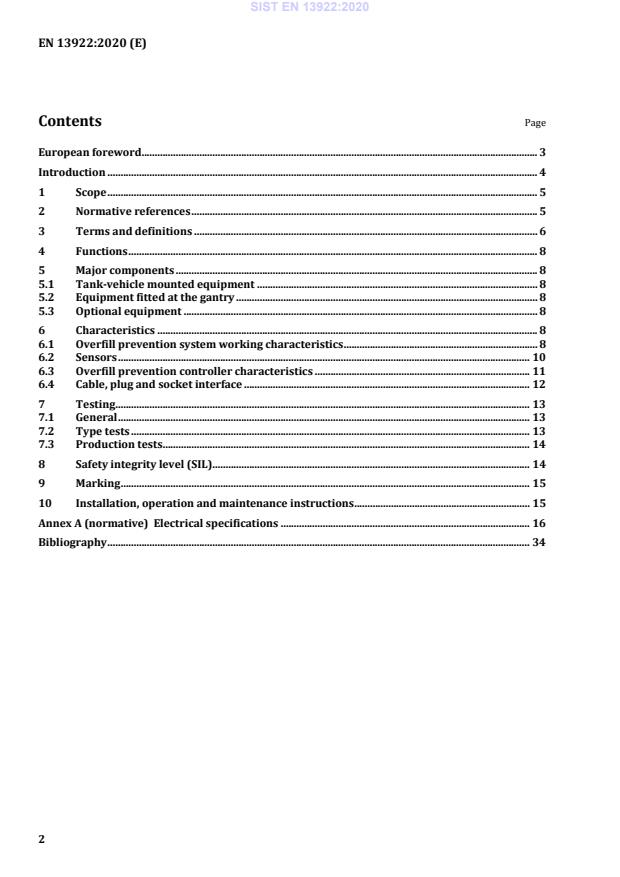
Contents Page
European foreword . 3
Introduction . 4
1 Scope . 5
2 Normative references . 5
3 Terms and definitions . 6
4 Functions . 8
5 Major components . 8
5.1 Tank-vehicle mounted equipment . 8
5.2 Equipment fitted at the gantry . 8
5.3 Optional equipment . 8
6 Characteristics . 8
6.1 Overfill prevention system working characteristics . 8
6.2 Sensors . 10
6.3 Overfill prevention controller characteristics . 11
6.4 Cable, plug and socket interface . 12
7 Testing . 13
7.1 General . 13
7.2 Type tests . 13
7.3 Production tests . 14
8 Safety integrity level (SIL) . 14
9 Marking . 15
10 Installation, operation and maintenance instructions . 15
Annex A (normative) Electrical specifications . 16
Bibliography . 34
European foreword
This document (EN 13922:2020) has been prepared by Technical Committee CEN/TC 296 “Tanks for
the transport of dangerous goods”, the secretariat of which is held by AFNOR.
This European Standard shall be given the status of a national standard, either by publication of an
identical text or by endorsement, at the latest by August 2020, and conflicting national standards shall
be withdrawn at the latest by February 2022.
Attention is drawn to the possibility that some of the elements of this document may be the subject of
patent rights. CEN shall not be held responsible for identifying any or all such patent rights.
This document supersedes EN 13922:2011.
In comparison with the 2011 edition, the following fundamental changes were made:
— safety integrity level (SIL) added;
— requirements and tests for electromagnetic compatibility (EMC) revised;
— temperature for the sensors extended to +60 °C;
— electrical requirements in 6.3.7 expanded for clarification;
— waveform signal changed to waveform pulse throughout the standard;
— Annex A tables and figures revised to reflect installed base;
— the word "peak" was added in Table A.3 before "sensor current" only for clarification;
— referred standards updated.
According to the CEN-CENELEC Internal Regulations, the national standards organisations of the
following countries are bound to implement this European Standard: Austria, Belgium, Bulgaria,
Croatia, Cyprus, Czech Republic, Denmark, Estonia, Finland, France, Germany, Greece, Hungary, Iceland,
Ireland, Italy, Latvia, Lithuania, Luxembourg, Malta, Netherlands, Norway, Poland, Portugal, Republic of
North Macedonia, Romania, Serbia, Slovakia, Slovenia, Spain, Sweden, Switzerland, Turkey and the
United Kingdom.
Introduction
The overfill prevention system prevents the maximum filling level of a compartment of a tank-vehicle
from being exceeded by interrupting the filling operation on the loading site.
It is not the function of an overfill prevention system to prevent volume or weight overloading. The
function of the overfill prevention system is the final means of containing the loaded product within a
compartment and preventing a dangerous condition. It is therefore of critical importance that all
components have a high degree of reliability and that all European gantries provide a compatible
system with the tank-vehicles.
Not all the components of an overfill prevention system are necessarily supplied by one manufacturer
but may include cross-compatible parts supplied by different manufacturers/suppliers. However, cross-
compatibility does not mean interchangeability.
1 Scope
This document specifies the following points regarding the minimum requirements for an overfill
prevention system:
— functions;
— major components;
— characteristics;
— test methods.
This document is applicable to overfill prevention systems for liquid fuels having a flash point up to but
not exceeding 100 °C, excluding liquefied petroleum gas (LPG).
NOTE Vapour path detection is not part of this standard but can be provided as an option.
2 Normative references
The following documents are referred to in the text in such a way that some or all of their content
constitutes requirements of this document. For dated references, only the edition cited applies. For
undated references, the latest edition of the referenced document (including any amendments) applies.
EN 590, Automotive fuels - Diesel - Requirements and test methods
EN 60079-0, Explosive atmospheres - Part 0: Equipment - General requirements (IEC 60079-0)
EN 60079-11, Explosive atmospheres - Part 11: Equipment protection by intrinsic safety “i”
(IEC 60079-11)
EN 60079-14, Explosive atmospheres - Part 14: Electrical installations design, selection and erection IEC
60079-14)
EN 61000-4-3, Electromagnetic compatibility (EMC) - Part 4-3: Testing and measurement techniques -
Radiated, radio-frequency, electromagnetic field immunity test (IEC 61000-4-3)
EN 61000-6-4, Electromagnetic compatibility (EMC) - Part 6-4: Generic standards - Emission standard for
industrial environments (IEC 61000-6-4)
EN 61508-1, Functional safety of electrical/electronic/programmable electronic safety-related systems -
Part 1: General requirements (IEC 61508-1)
EN 61511-1, Functional safety - Safety instrumented systems for the process industry sector — Part 1:
Framework, definitions, system, hardware and application programming Requirements (IEC 61511-1)
3 Terms and definitions
For the purposes of this document, the following terms and definitions apply.
ISO and IEC maintain terminological databases for use in standardization at the following addresses:
— IEC Electropedia: available at http://www.electropedia.org/
— ISO Online browsing platform: available at https://www.iso.org/obp
3.1
overfill prevention system
sensors or sensor circuits, interface plug/socket, overfill prevention controller and all connecting
wiring and cables
3.2
cross-compatibility
ability of one part of the overfill prevention system to be able to work safely and satisfactorily with
another part of the overfill prevention system although the parts are supplied by different
manufacturers
3.3
dry sensor
state of the sensor when not immersed in liquid
3.4
effective cycle time
period taken for the overfill prevention system to identify a fault condition and switch to a non-
permissive state
3.5
fail-safe
switching to a non-permissive state if any single component failure in the overfill prevention system
renders the overfill prevention system unable to detect an overfill or loss of earth connection
3.6
five-wire system
system which uses five wire interface signals for liquid level detection
3.7
gantry control system
system which controls the loading of product into the tank-vehicle
3.8
gantry control system reaction time
period commencing when the overfill prevention controller's output changes to non-permissive state
and ending with the cessation of all product flow after the closure of the gantry control valve
3.9
interoperable
ability of different parts of the overfill prevention system to operate together, and a functional aspect of
cross-compatibility
3.10
warm-up time
period to switch to a permissive state after plug connection is made to a tank-vehicle socket with no
sensor immersed in liquid
3.11
non-permissive
output state of the overfill prevention controller which disables liquid flow
3.12
overfill prevention controller
device mounted at the gantry which connects to the tank-vehicle and which provides a permissive
signal or non-permissive signal to the gantry control system
3.13
overfill prevention system response time
period commencing when a sensor becomes wet and ending when the controller output switches to
non-permissive signal
3.14
permissive
output state of the overfill prevention controller which enables liquid flow
3.15
self-checking
automatic and continuous checking of the integrity of an overfill prevention system’s components to
verify its ability to perform its minimum functions
3.16
sensor
device and any associated circuit mounted on or in a tank-vehicle’s compartment and connected to
interface socket which provides the wet or dry signal to the overfill prevention controller
Note 1 to entry: Wet signal includes all other conditions than the dry signal.
3.17
sensor circuit
sensor not directly wired to the interface socket but using intermediate components/electronics to
transfer the sensor output to the interface socket
3.18
two-wire system
system which uses two-wire interface signals for liquid level detection
3.19
wet sensor
state of a sensor just sufficiently submerged in liquid to initiate a change in signal output from dry to
wet
4 Functions
4.1 To prevent overfilling of the tank-vehicle's compartment by providing a fail-safe output to a
gantry control system.
4.2 To provide a failsafe monitored earthing connection from the gantry to the tank-vehicle's shell via
a bonding connection to the tank-vehicle's chassis.
4.3 To provide visual indication of the status of the overfill prevention system.
5 Major components
5.1 Tank-vehicle mounted equipment
The following equipment shall be installed on the tank-vehicle as a minimum:
— one sensor or sensor circuit per compartment;
— one 10 pin socket;
— wiring to the sensors;
— earthing provision.
5.2 Equipment fitted at the gantry
The overfill prevention equipment mounted on the tank truck is operable when the following
equipment is installed at a loading gantry:
— overfill prevention controller;
— one 10 pin plug and cable for connection to tank-vehicle socket.
5.3 Optional equipment
The overfill prevention system can provide the vapour collection detection safety interlock which
prevents loading unless the vapour collection hose is connected to the tank-vehicle and the vapour
transfer valve(s) is (are) open.
6 Characteristics
6.1 Overfill prevention system working characteristics
6.1.1 Overfill
The overfill prevention system shall be an electronic system, gantry based and gantry operated. The
interface wiring shall be suitable for a two-wire or a five-wire overfill prevention system and the gantry
based controller shall automatically detect the difference between either overfill prevention system
through a standardized 10 pin plug and socket — see Figures A.2 and A.3 — and perform its functions.
Electrical specifications for the interface are included in Annex A.
The overfill prevention controller shall only provide a permissive signal to permit loading if, once
connected, there is no system fault and no sensor is wet.
Upon an overfill condition or the detection of any overfill prevention system or controller fault, the
controller shall switch to non-permissive state.
The overfill prevention system shall be fail safe and shall be self-checking. The effective cycle time
between self-checks shall be less than the overfill response time.
The overfill prevention response time shall not exceed 700 ms.
The overfill prevention system shall be capable of handling up to and including the following number of
compartments for each type of installation:
— Two-wire system 8 compartments;
— Five-were system 12 compartments.
No signals other than those defined in the standard are allowed.
6.1.2 Earthing
The overfill prevention system shall provide an electrical connection from the gantry earth to the tank-
vehicle chassis via the cable and connection plug and socket and shall continuously verify this
connection throughout the loading operation.
To comply with the transport regulations (ADR), a good electrical connection from the tank vehicle
chassis to earth shall be established before tanks are filled or emptied.
Should the electrical resistance of the connection exceed a maximum of 10 kΩ, the gantry controller
shall switch to non-permissive state.
6.1.3 Severe environmental condition
Where the overfill prevention system is subjected to temperatures outside the specified temperature
range all applicable temperature values shall be extended. All other requirements shall remain
unchanged.
6.1.4 Requirements for electromagnetic compatibility (EMC)
The overfill prevention system shall fulfil the requirements of:
— EN 61000-6-4 for emission;
— EN 61000-4-3 for immunity.
6.1.5 Circuit interlock (optional)
When included within the overfill prevention system, the circuit interlock (switch) shall provide the
function of the vapour collection detection interlock described in 5.3 and shall be connected as shown
in Figures A.4 and A.5.
6.1.6 Electrical interface
At the plug/socket interface each sensor or sensor circuit shall be suited for controller's intrinsically
safe parameters. The electrical connections of the 10-pin-socket shall comply with Table A.16.
The cable used shall comply with Table A.9 and EN 60079-14.
6.1.7 Interoperability of sensors
Sensors connected directly to the 10-pin socket as shown in Figures A.4 and A.5, shall be interoperable,
but not necessarily mechanically interchangeable.
Sensors connected indirectly (i.e. through an additional electronic device) to the 10-pin socket as shown
in Figures A.4 and A.5, may not be interoperable.
6.1.8 Tank vehicle identification device (optional)
When included with the overfill prevention system, a tank vehicle identification device shall provide a
unique identification number using a 1-wire protocol, as shown in Figures A.4 and A.5.
6.2 Sensors
6.2.1 General
Any of the following types of sensors may be used:
— two-wire system: negative temperature coefficient (NTC) thermistor, optic or other compatible
device;
— five-wire system: optic or other compatible device;
— sensor circuit.
6.2.2 Two-wire system
Thermistor sensors shall have a NTC and shall work in the temperature range from −20 °C to +50 °C.
Thermistor sensors have a warm-up time which shall not exceed 75 s with the thermistor sensor at an
ambient temperature of −20 °C.
NOTE 1 Optic sensors or other compatible sensors have a negligible warm-up time.
Two-wire sensors can be used on tank-vehicles with no more than 8 compartments. The overfill
prevention controller shall always monitor 8 sensors and stop all loading if any sensor detects an
overfill. Tank-vehicles equipped with two-wire sensors with less than 8 compartments shall employ an
electronic dummy sensor for the unused channels of the controller.
These dummies shall form part of the tank-vehicle mounted equipment.
The electronic dummy sensor shall generate a permissive signal when it is connected to a controller.
The signal shall correspond to a wave form as shown in Figure A.1 with the values according to
Table A.4.
A two-wire optic or other compatible sensor shall work in the temperature range from −20 °C to +60 °C.
When connected to a gantry controller, a dry sensor shall generate a permissive signal, which shall
correspond to a wave form as shown in Figure A.1 with the values according to Table A.4.
NOTE 2 Sensor operating temperature range is different from ambient temperature range because of the effect
of direct sunlight on the tank.
6.2.3 Five-wire system
A five-wire optic sensor or other compatible sensors shall work in the temperature range from −20 °C
to +60 °C. When connected to a gantry controller, a dry sensor shall generate a permissive signal, which
shall correspond to a wave form as shown in Figure A.1 with the values according to Table A.1.
NOTE Sensor operating temperature range is different from ambient temperature range because of the effect
of direct sunlight on the tank.
6.2.4 Sensor circuit
A sensor circuit shall comply with the requirements according to 6.2.2 and 6.2.3 as applicable.
6.2.5 Response time
The reaction time from sensor going wet to the change of state of the signal at the interface socket shall
not exceed 250 ms.
6.2.6 Materials of construction
The manufacturer shall provide with the equipment a full material specification for those parts that
may come into contact with the liquid.
6.2.7 Design
If sensors have adjustment for their setting then they shall be designed, or provision made, to prevent
unauthorized adjustment.
6.2.8 Pressure rating
Sensors, sensor heads and all associated parts shall, when installed in the tank shell:
— be designed to be vapour and liquid tight in any orientation, at any pressure within the pressure
range of the tank to which they are fitted, and
— not leak when subjected to the hydraulic test pressure of the tank to which they are fitted.
6.3 Overfill prevention controller characteristics
6.3.1 Interface
The controller shall be fitted with the 10 pin plug (Figure A.3) and cable.
The controller shall be able to be connected to and communicate with both two-wire or five-wire
circuits. The controller shall generate the specified wave forms (Annex A, Figure A.1, Tables A.2 and
A.5) as applicable to the type of circuit to which it is connected.
To be able to auto-select the correct system to be used, the controller shall initiate an interrogation of
the tank vehicle system upon connection to the tank vehicle. During this period the controller outputs at
the plug/socket interface may not match those specified in Table A.16 for the specific type of system
installed. However, the voltage, current and power levels used shall not exceed those specified in 6.3.7.
6.3.2 Outputs
The normal output condition shall be non-permissive state. The output(s) shall switch to permissive
state only when all correct input conditions are satisfied.
At least one potential-free contact normally open output contact shall be provided. Other types of
outputs may be provided.
6.3.3 Response time
The response delay time from the change of state of the signal at the interface to the overfill prevention
controller's output going non-permissive shall not exceed 450 ms.
6.3.4 Status indicators
The controller shall provide, as a minimum, separate visual status indicators:
— output non-permissive signal, colour RED;
— output permissive signal, colour GREEN;
— earth connection status;
— wet sensor identification.
6.3.5 Materials of construction
The materials of the controller shall be suitable for the installed location.
6.3.6 Temperature range
The design operating temperature of the controller shall be −20 °C to +50 °C.
6.3.7 Electrical requirements
The overfill prevention controller's intrinsically safe parameters per output at the interface shall not
exceed:
— U = 14,5 V C = 10 µF;
0 0
— I = 250 mA L = 80 µH;
0 0
— P = 0,700 W.
In the event of ground failure the voltage between any two pins of the connector shall not exceed 14,5 V.
Minimum requirements for explosion protection per output at the interface shall be:
Ex ia IIA according to EN 60
...
Questions, Comments and Discussion
Ask us and Technical Secretary will try to provide an answer. You can facilitate discussion about the standard in here.
Loading comments...