


SIST EN 1069-1:2017+A1:2019
(Main)Water slides - Part 1: Safety requirements and test methods
Water slides - Part 1: Safety requirements and test methods
This European Standard is applicable to all water slides installed in swimming pools of public use.
This Standard specifies general safety requirements for water slides in swimming pools of public use and specific requirements for defined types of water slides. These specific safety requirements are also applicable to undefined types as far as possible.
These requirements concern safety and the technical rules for design, calculation and testing.
Wasserrutschen - Teil 1: Sicherheitstechnische Anforderungen und Prüfverfahren
Diese Europäische Norm gilt für alle in öffentlichen genutzten Schwimmbädern eingebauten Wasserrutschen.
Diese Norm legt allgemeine sicherheitstechnische Anforderungen an alle Typen von Wasserrutschen in öffentlichen Schwimm¬bädern und besondere Anforderungen an definierte Wasserrutschen-Typen fest. Diese spezifischen sicherheitstechnischen Anforderungen sind, so weit wie möglich, auch auf nicht definierte Typen anzuwenden.
Diese Anforderungen betreffen die Sicherheit und die technischen Regeln für Ausführung, Berechnung und Prüfung von Wasserrutschen.
Toboggans aquatiques - Partie 1: Exigences de sécurité et méthodes d'essai
La présente Norme européenne est applicable à tous les toboggans aquatiques installés dans les piscines à usage public.
La présente norme spécifie des exigences générales de sécurité pour les toboggans aquatiques dans les piscines à usage public et des exigences spécifiques pour des types définis de toboggans aquatiques. Autant que possible, ces exigences spécifiques de sécurité sont également applicables à des types non définis.
Ces exigences portent sur la sécurité et les règles techniques de conception, de calcul et d'essais.
Vodni tobogani - 1. del: Varnostne zahteve in preskusne metode
Ta evropski standard se uporablja za vse vodne tobogane, ki so nameščeni v javnih plavalnih bazenih. Ta standard določa splošne varnostne zahteve za vodne tobogane v javnih plavalnih bazenih in posebne zahteve za določene vrste vodnih toboganov. Te posebne varnostne zahteve se uporabljajo tudi za nerazvrščene vrste toboganov, če je to le mogoče.
Te zahteve se nanašajo na varnost in tehnična pravila za projektiranje, izračunavanje in preskušanje.
General Information
- Status
- Published
- Publication Date
- 16-Jul-2019
- Technical Committee
- SPO - Sports
- Current Stage
- 6060 - National Implementation/Publication (Adopted Project)
- Start Date
- 09-Jul-2019
- Due Date
- 13-Sep-2019
- Completion Date
- 17-Jul-2019
Relations
- Effective Date
- 01-Sep-2019
- Consolidates
kSIST EN 1069-1:2017/FprA1:2019 - Water slides - Part 1: Safety requirements and test methods - Effective Date
- 18-Jan-2023
- Effective Date
- 18-Jan-2023
- Effective Date
- 09-Jul-2024
Overview
EN 1069-1:2017+A1:2019 - Water slides: Part 1: Safety requirements and test methods is a CEN European Standard that specifies general safety, design, calculation and testing requirements for water slides installed in public-use swimming pools. Approved by CEN (amendment A1 in 2019), the standard covers classification of slide types, materials and construction, structural design, user safety features, and formal test methods including practical test runs and reporting.
Key topics and technical requirements
The standard addresses the full lifecycle of a public water slide project, with technical topics including:
- Classification and types - definitions for multiple slide types (Types 1–10) and sub‑types to guide specific safety measures.
- Materials and construction - selection, durability, manufacturer/installer responsibilities and certificate requirements.
- Design and structural analysis - design guidelines, preliminary risk analysis, construction documentation and static calculations (loads, actions, combinations).
- Access, platforms and fall protection - stairs, stepladders, platforms, handrails and protection against falling; slip resistance requirements.
- Slide geometry and dynamics - sliding path design, maximum allowable accelerations, tubes/covered sections and interference between users.
- Start, landing and splashdown areas - requirements for start sections, landing devices, splashdown depth and clearance zones.
- Water supply and flow - water flow rate and distribution as it affects safe operation.
- Safety details - entrapment prevention, surface finishes, corners/edges, accessories and ride‑enhancement devices.
- Testing and validation - technical checks, physical test runs with slide testers, measurement of acceleration and speed, and formal test reports.
- Marking and documentation - designation, markings and documentation to accompany installations.
Practical applications
EN 1069-1 is used to ensure that water slides in public pools are designed, constructed and tested to reduce injury risk and comply with European safety expectations. Typical uses:
- Design and engineering of new water slides (architects, structural engineers, slide designers)
- Manufacturing and materials selection (fabricators, composite/metal suppliers)
- Installation and commissioning (installers, contractors)
- Safety verification, testing and certification (test laboratories, notified bodies)
- Operation, maintenance and inspection (pool operators, facility managers, safety inspectors)
- Regulatory compliance and procurement (local authorities, risk assessors)
Related standards and references
EN 1069-1 includes normative references and should be used alongside applicable national regulations and other EN standards for pools, electrical installations and construction. For implementation, consult your national standards body or CEN member for the up‑to‑date list of related documents and national adoptions of EN 1069-1:2017+A1:2019.


Frequently Asked Questions
SIST EN 1069-1:2017+A1:2019 is a standard published by the Slovenian Institute for Standardization (SIST). Its full title is "Water slides - Part 1: Safety requirements and test methods". This standard covers: This European Standard is applicable to all water slides installed in swimming pools of public use. This Standard specifies general safety requirements for water slides in swimming pools of public use and specific requirements for defined types of water slides. These specific safety requirements are also applicable to undefined types as far as possible. These requirements concern safety and the technical rules for design, calculation and testing.
This European Standard is applicable to all water slides installed in swimming pools of public use. This Standard specifies general safety requirements for water slides in swimming pools of public use and specific requirements for defined types of water slides. These specific safety requirements are also applicable to undefined types as far as possible. These requirements concern safety and the technical rules for design, calculation and testing.
SIST EN 1069-1:2017+A1:2019 is classified under the following ICS (International Classification for Standards) categories: 97.220.40 - Outdoor and water sports equipment. The ICS classification helps identify the subject area and facilitates finding related standards.
SIST EN 1069-1:2017+A1:2019 has the following relationships with other standards: It is inter standard links to SIST EN 1069-1:2017, kSIST EN 1069-1:2017/FprA1:2019, SIST EN 1069-1:2017, oSIST prEN 1069-1:2025. Understanding these relationships helps ensure you are using the most current and applicable version of the standard.
SIST EN 1069-1:2017+A1:2019 is associated with the following European legislation: EU Directives/Regulations: TP080. When a standard is cited in the Official Journal of the European Union, products manufactured in conformity with it benefit from a presumption of conformity with the essential requirements of the corresponding EU directive or regulation.
SIST EN 1069-1:2017+A1:2019 is available in PDF format for immediate download after purchase. The document can be added to your cart and obtained through the secure checkout process. Digital delivery ensures instant access to the complete standard document.
Standards Content (Sample)
SLOVENSKI STANDARD
01-september-2019
Nadomešča:
SIST EN 1069-1:2017
Vodni tobogani - 1. del: Varnostne zahteve in preskusne metode
Water slides - Part 1: Safety requirements and test methods
Wasserrutschen - Teil 1: Sicherheitstechnische Anforderungen und Prüfverfahren
Toboggans aquatiques - Partie 1: Exigences de sécurité et méthodes d'essai
Ta slovenski standard je istoveten z: EN 1069-1:2017+A1:2019
ICS:
97.220.40 Oprema za športe na Outdoor and water sports
prostem in vodne športe equipment
2003-01.Slovenski inštitut za standardizacijo. Razmnoževanje celote ali delov tega standarda ni dovoljeno.
EN 1069-1:2017+A1
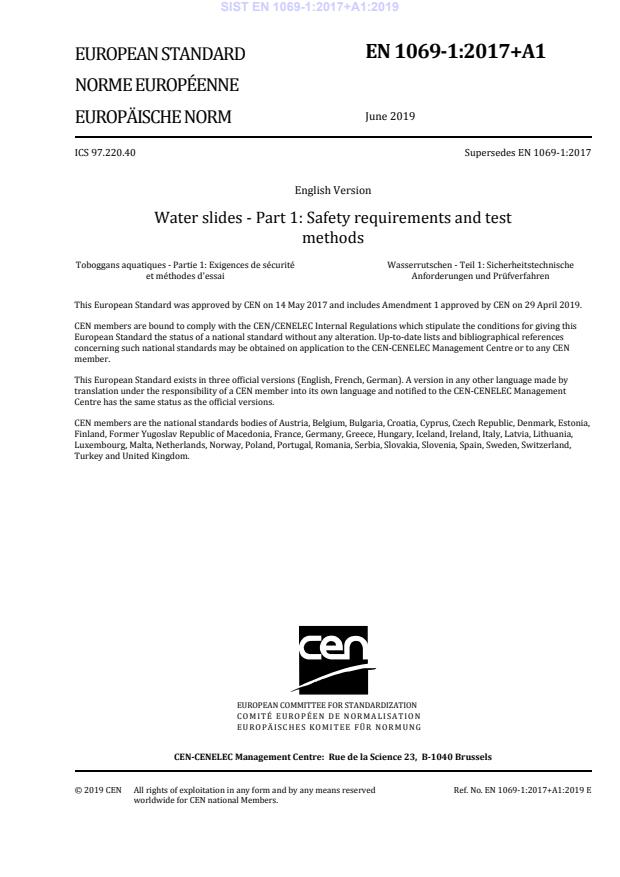
EUROPEAN STANDARD
NORME EUROPÉENNE
June 2019
EUROPÄISCHE NORM
ICS 97.220.40 Supersedes EN 1069-1:2017
English Version
Water slides - Part 1: Safety requirements and test
methods
Toboggans aquatiques - Partie 1: Exigences de sécurité Wasserrutschen - Teil 1: Sicherheitstechnische
et méthodes d'essai Anforderungen und Prüfverfahren
This European Standard was approved by CEN on 14 May 2017 and includes Amendment 1 approved by CEN on 29 April 2019.
CEN members are bound to comply with the CEN/CENELEC Internal Regulations which stipulate the conditions for giving this
European Standard the status of a national standard without any alteration. Up-to-date lists and bibliographical references
concerning such national standards may be obtained on application to the CEN-CENELEC Management Centre or to any CEN
member.
This European Standard exists in three official versions (English, French, German). A version in any other language made by
translation under the responsibility of a CEN member into its own language and notified to the CEN-CENELEC Management
Centre has the same status as the official versions.
CEN members are the national standards bodies of Austria, Belgium, Bulgaria, Croatia, Cyprus, Czech Republic, Denmark, Estonia,
Finland, Former Yugoslav Republic of Macedonia, France, Germany, Greece, Hungary, Iceland, Ireland, Italy, Latvia, Lithuania,
Luxembourg, Malta, Netherlands, Norway, Poland, Portugal, Romania, Serbia, Slovakia, Slovenia, Spain, Sweden, Switzerland,
Turkey and United Kingdom.
EUROPEAN COMMITTEE FOR STANDARDIZATION
COMITÉ EUROPÉEN DE NORMALISATION
EUROPÄISCHES KOMITEE FÜR NORMUNG
CEN-CENELEC Management Centre: Rue de la Science 23, B-1040 Brussels
© 2019 CEN All rights of exploitation in any form and by any means reserved Ref. No. EN 1069-1:2017+A1:2019 E
worldwide for CEN national Members.
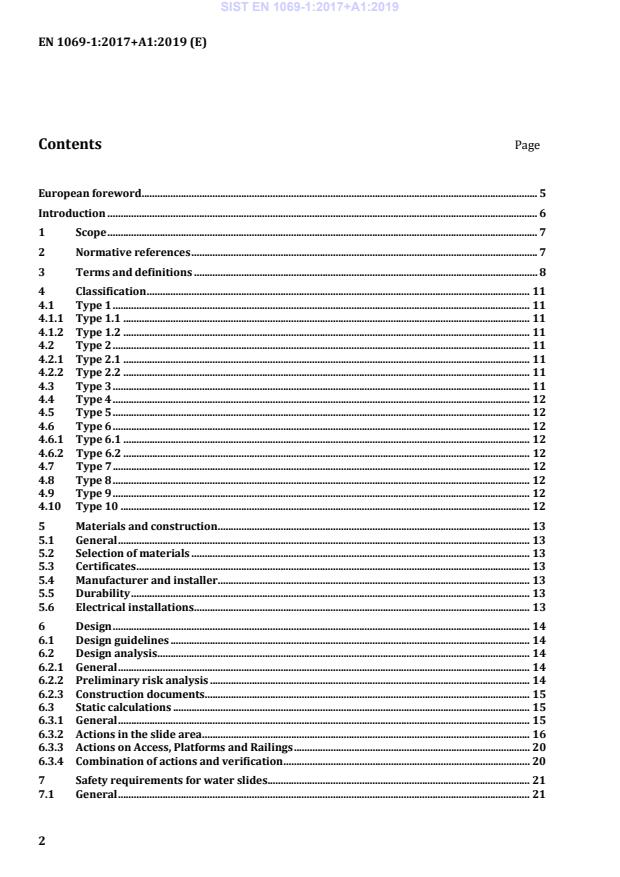
Contents Page
European foreword . 5
Introduction . 6
1 Scope . 7
2 Normative references . 7
3 Terms and definitions . 8
4 Classification . 11
4.1 Type 1 . 11
4.1.1 Type 1.1 . 11
4.1.2 Type 1.2 . 11
4.2 Type 2 . 11
4.2.1 Type 2.1 . 11
4.2.2 Type 2.2 . 11
4.3 Type 3 . 11
4.4 Type 4 . 12
4.5 Type 5 . 12
4.6 Type 6 . 12
4.6.1 Type 6.1 . 12
4.6.2 Type 6.2 . 12
4.7 Type 7 . 12
4.8 Type 8 . 12
4.9 Type 9 . 12
4.10 Type 10 . 12
5 Materials and construction . 13
5.1 General . 13
5.2 Selection of materials . 13
5.3 Certificates . 13
5.4 Manufacturer and installer. 13
5.5 Durability . 13
5.6 Electrical installations . 13
6 Design . 14
6.1 Design guidelines . 14
6.2 Design analysis . 14
6.2.1 General . 14
6.2.2 Preliminary risk analysis . 14
6.2.3 Construction documents. 15
6.3 Static calculations . 15
6.3.1 General . 15
6.3.2 Actions in the slide area . 16
6.3.3 Actions on Access, Platforms and Railings . 20
6.3.4 Combination of actions and verification . 20
7 Safety requirements for water slides. 21
7.1 General . 21
7.2 Entrapment . 21
7.3 Surfaces . 21
7.3.1 General . 21
7.3.2 Surface of the slide proper . 21
7.4 Corners and edges . 21
7.5 Access to water slides. 21
7.5.1 General . 21
7.5.2 Stairs . 22
7.5.3 Stepladders . 22
7.5.4 Platform . 22
7.5.5 Protection against falling . 22
7.5.6 Slip resistance . 24
7.6 Start section for Types 2 to 10 . 24
7.7 Slide proper . 25
7.7.1 General . 25
7.7.2 Sliding path . 25
7.7.3 Maximum acceleration on a sliding person . 25
7.8 Tubes and covered sections . 25
7.9 Final part. 25
7.9.1 General . 25
7.9.2 Landing device/Landing area. 26
7.10 Splashdown areas . 27
7.11 Accessories . 27
7.11.1 Covers. 27
7.11.2 Ride enhancement devices . 27
7.11.3 Other constituent parts . 28
7.12 Water supply . 29
7.12.1 General . 29
7.12.2 Water flow rate . 30
7.13 Interference between users . 30
7.14 Interference between users and non-users . 30
8 Additional safety requirements for Types 1 to 10 . 31
8.1 Slide proper . 31
8.1.1 Type 1 . 31
8.1.2 Type 2 . 31
8.1.3 Type 3 . 33
8.1.4 Type 4 . 33
8.1.5 Type 5 . 33
8.1.6 Type 6 . 34
8.1.7 Type 7 . 34
8.1.8 Type 8 . 35
8.1.9 Type 9 . 35
8.1.10 Type 10 . 35
8.2 Splashdown area . 35
8.2.1 Acceleration . 35
8.2.2 General and specific pools . 35
8.2.3 Requirements for landing . 36
8.3 Clearance zones . 38
9 Check and test runs . 39
9.1 General . 39
9.2 Technical and physical checks . 39
9.3 Practical test . 39
9.3.1 General . 39
9.3.2 Slide tester . 39
9.3.3 Sliding conditions . 39
9.3.4 Acceleration and speed measurements . 40
9.4 Test report . 40
10 Designation and marking . 41
10.1 Designation. 41
10.2 Marking . 41
Annex A (normative) Splashdown areas . 42
Annex B (normative) Use of stainless steels for water slides . 49
B.1 General . 49
B.2 Indoor swimming pools with disinfection with chlorine . 49
B.2.1 General . 49
B.2.2 Materials without regular cleaning . 49
B.2.3 Materials with regular cleaning . 50
B.2.3.1 General . 50
B.2.3.2 Cleaning concept. 50
B.2.3.3 Execution of the regular cleaning . 50
B.2.3.4 Regular inspection . 50
B.2.4 Outdoor swimming pools with disinfection with chlorine . 50
B.3 Coatings and paintings . 51
Annex C (normative) Design loads, accesses and platforms . 52
C.1 Vertical imposed loads . 52
C.2 Horizontal imposed loads . 52
C.3 Stiffness . 53
C.4 Stairs . 53
Annex D (informative) Acceleration and speed measurements . 55
D.1 Test devices . 55
D.1.1 General . 55
D.1.2 Acceleration measuring device . 55
D.1.3 Maximum speed measuring device . 55
D.2 Description of the acceleration test method . 55
Bibliography . 56
European foreword
This document (EN 1069-1:2017+A1:2019) has been prepared by Technical Committee CEN/TC 136
“Sports, playground and other recreational facilities and equipment”, the secretariat of which is held by
DIN.
This European Standard shall be given the status of a national standard, either by publication of an
identical text or by endorsement, at the latest by December 2019, and conflicting national standards
shall be withdrawn at the latest by December 2019.
Attention is drawn to the possibility that some of the elements of this document may be the subject of
patent rights. CEN [and/or CENELEC] shall not be held responsible for identifying any or all such patent
rights.
This document includes Amendment 1 approved by CEN on 2019-03-29.
This document supersedes !EN 1069-1:2017".
The start and finish of text introduced or altered by amendment is indicated in the text by tags !".
EN 1069, Water slides, consists of the following parts:
— Part 1: Safety requirements and test methods
— Part 2: Instructions
!deleted text"
According to the CEN-CENELEC Internal Regulations, the national standards organisations of the
following countries are bound to implement this European Standard: Austria, Belgium, Bulgaria,
Croatia, Cyprus, Czech Republic, Denmark, Estonia, Finland, Former Yugoslav Republic of Macedonia,
France, Germany, Greece, Hungary, Iceland, Ireland, Italy, Latvia, Lithuania, Luxembourg, Malta,
Netherlands, Norway, Poland, Portugal, Romania, Serbia, Slovakia, Slovenia, Spain, Sweden, Switzerland,
Turkey and the United Kingdom.
Introduction
The market for water slides is extremely wide and specific and still developing. It is impossible to define
an all-embracing safety specification, including dimensions and design requirements as required by a
standard, without limiting the design possibilities and preventing innovative and new but safe products.
This European Standard is intended to establish safety requirements and design guidance rules to serve
anyone involved with water slides, especially designers, manufacturers, operators and users, to ensure
safe and more efficient products. Its basic approach is the consciousness that the sliding action usually
implies for the users a higher risk level than using a pool. For certain aspects of design, manufacturing,
installation, operation and use only specific guidelines, without any technical specification, are given,
which should be taken into consideration and be fulfilled in order to ensure safety for operators and
users.
1 Scope
This European Standard is applicable to all water slides installed in swimming pools of public use.
This Standard specifies general safety requirements for water slides in swimming pools of public use
and specific requirements for defined types of water slides. These specific safety requirements are also
applicable to undefined types as far as possible.
These requirements concern safety and the technical rules for design, calculation and testing.
2 Normative references
!The following documents are referred to in the text in such a way that some or all of their content
constitutes requirements of this document. For dated references, only the edition cited applies. For
undated references, the latest edition of the referenced document (including any amendments)
applies."
EN 1069-2:2017, Water slides — Part 2: Instructions
EN 1990, Eurocode - Basis of structural design
EN 1991-1-1, Eurocode 1: Actions on structures - Part 1-1: General actions - Densities, self-weight, imposed
loads for buildings
EN 1991-1-3:2003, Eurocode 1 - Actions on structures - Part 1-3: General actions - Snow loads
EN 1991-1-4, Eurocode 1: Actions on structures - Part 1-4: General actions - Wind actions
EN 10088-1, Stainless steels - Part 1: List of stainless steels
EN 10088-2, Stainless steels - Part 2: Technical delivery conditions for sheet/plate and strip of corrosion
resisting steels for general purposes
EN 10204:2004, Metallic products - Types of inspection documents
EN 13451-1:2011+A1:2016, Swimming pool equipment - Part 1: General safety requirements and test
methods
EN 13451-2, Swimming pool equipment - Part 2: Additional specific safety requirements and test methods
for ladders, stepladders and handle bends
EN 13451-3, Swimming pool equipment — Part 3: Additional specific safety requirements and test
methods for inlets and outlets and water/air based water leisure features
EN 15288-1:2008+A1:2010, Swimming pools - Part 1: Safety requirements for design
EN 15288-2, Swimming pools - Part 2: Safety requirements for operation
EN 22768-1, General tolerances - Part 1: Tolerances for linear and angular dimensions without individual
tolerance indications (ISO 2768-1)
EN ISO 9606-1, Qualification testing of welders - Fusion welding - Part 1: Steels (ISO 9606-1)
EN ISO 13857:2008, Safety of machinery - Safety distances to prevent hazard zones being reached by
upper and lower limbs (ISO 13857:2008)
EN ISO/IEC 17025, General requirements for the competence of testing and calibration laboratories
(ISO/IEC 17025)
3 Terms and definitions
For the purposes of this document, the following terms and definitions apply.
!ISO and IEC maintain terminological databases for use in standardization at the following addresses:
• IEC Electropedia: available at http://www.electropedia.org/
• ISO Online browsing platform: available at http://www.iso.org/obp"
3.1
pool/swimming pool
facility, with one or more water areas, intended for swimming, leisure or other water-based physical
activities
[SOURCE: EN 15288-1:2008+A1:2010, 3.1]
3.2
public use
use of an installation open to everyone or to a defined group of users, not designated solely for the
owner's/proprietor's/operator's family and guests independently from paying an entrance fee
[SOURCE: EN 15288-1:2008+A1:2010, 3.5]
Note 1 to entry: Pools serving houses rented for private use are not of public use.
3.3
water slide
piece of equipment or installation with a sliding surface on which the user slides with water as a
friction- and/or speed-reducing medium; the user slides freely or with the use of a ride enhancement
device
Note 1 to entry: On some water slides the user can also be pushed e.g. by a water stream.
Note 2 to entry: For classification see Clause 4.
3.4
platform
area providing access to the start section
3.5
start section
area where the user enters the slide proper and takes the sliding position
3.6
slide proper
area intended for sliding
3.7
final part
part of the slide proper designed to prepare the user for landing, plus the subsequent parts/areas which
allow landing
Note 1 to entry: Subsequent parts can be splashdown area, catch unit, sofa, etc.
3.8
landing
conclusion of sliding action
Note 1 to entry: Types of conclusion can be fall, surf landing into water, being slowed down and stopped in a
catch unit or sofa.
3.9
surf landing
kind of landing which implies the action of being guided from the end of the final part, independently
from its design, to intentionally surf on the water surface of the pool as a design feature
3.10
catch unit
integral part of a water slide, which brings the rider to a halt in his sliding position
Note 1 to entry: See Figure 1.
EXAMPLE
Key
1 water line
Figure 1 — Example of typical catch unit
3.11
sofa unit
integral part of a water slide, which slows down the rider on the sliding surface and moves him
additionally sideways out of the sliding path of the following users
Note 1 to entry: See Figure 2.
EXAMPLE
Key
1 water line
Figure 2 — Example of typical sofa unit
3.12
splashdown area
specific pool or area which is part of a general purpose pool, in which the user lands from the end of the
slide, and is brought to a halt in the water
3.13
water level
defined operating water surface in the landing area
3.14
drop
section of the slide proper, tilted with an inclination greater than those of adjacent sections
3.15
tube
closed section, not necessarily circular in cross section, of a water slide, with a fully utilisable sliding
surface
3.16
cover
device to enclose an open slide, not intended for sliding
3.17
riser
extension for the slide proper, intended for sliding
3.18
wave screen
device, placed within the clearance zone, to control spilling water
3.19
ride enhancement device
device to slide on or in, designed for a particular water slide
3.20
barrier
device to restrict users from falling over, under or through it
3.21
average inclination
inclination x in percent (%) calculated with the formula
x (h× 100)/ l
where
h is the height between start section and beginning of final part, in metres;
l is the developed length of the slide proper excluding the final part, in metres
3.22
clearance zone
controlled space around the user on the slide proper and of the final part, designed to prevent the
impact of the users with obstacles
4 Classification
4.1 Type 1
4.1.1 Type 1.1
Straight slides for children not exceeding 1,0 m in height from start section to water level and with an
average inclination ≤ 70 % may be designed in the form of a single slide or a wide slide (more than one
user at the same time).
4.1.2 Type 1.2
Straight single-track slide for children with an average inclination of ≤ 70 % and a height of
1 000 mm < h ≤ 3 000 mm from start section to water level.
4.2 Type 2
4.2.1 Type 2.1
Curved single-track slide for children with an average inclination of ≤ 70 % and a height of ≤ 3 000 mm
from start section to water level.
4.2.2 Type 2.2
Helical single-track slide for children with an average inclination of ≤ 70 % and a height of ≤ 3 000 mm
from start section to water level, where the radius of the slide is constant and in the same direction.
4.3 Type 3
Single-track slide, with an average inclination of maximum 13 %, excluding the final part. The average
speed of the users shall be ≤ 5 m/s. The maximum speed of the users shall be ≤ 8 m/s.
=
4.4 Type 4
Speed single-track slide with an average inclination between 13 % and 20 %, excluding the final part.
The average speed of the users shall be ≤ 10 m/s. The maximum speed of the users shall be ≤ 14 m/s.
4.5 Type 5
High-speed single-track slide with an average inclination of at least 20 %, excluding the final part. The
maximum speed of the users may be > 14 m/s.
4.6 Type 6
4.6.1 Type 6.1
Multi-track slide with separate parallel tracks (straight or curved), with an average inclination of
maximum 13 %, one beside the other over the full length. The average speed of the users shall
be ≤ 5 m/s. The maximum speed of the users shall be ≤ 8 m/s.
4.6.2 Type 6.2
Multi-track slide with separate parallel tracks (straight or curved), with an average inclination of
between 13 % and 25 %, excluding the final part. The average speed of the users shall be ≤ 10 m/s. The
maximum speed of the users shall be ≤ 14 m/s.
4.7 Type 7
Wide straight slide with a maximum inclination of 35 %, not exceeding 8 m in height above water level
and 7,7 m above the ground. The maximum speed of the users shall be ≤ 8 m/s.
4.8 Type 8
Single-track slide with longitudinal descending and ascending gradients where the user also slides
upwards, sometimes helped by a jet of water or by a specific device.
4.9 Type 9
Wide, straight, single-track slide providing a free transversal oscillating sliding path while sliding in
direction to the end of the slide. The maximum speed of the users shall be ≤ 14 m/s.
4.10 Type 10
A combination slide where the user exits from a slide of another type into a circular bowl and descends
in a spiral path, before either free falling through a hole at the bottom into the splashdown area, or
entering an additional slide.
5 Materials and construction
5.1 General
Any material may be used for the construction of water slides, supports and ride enhancement devices,
provided that it fulfils the requirements of this standard.
5.2 Selection of materials
All materials and finishes used shall be:
a) suitable for the selected use, the respective surroundings and conditions;
b) in accordance with the relevant standards/regulations;
c) able to withstand conditions of high humidity with occasional saturation and/or corrosiveness;
d) not encouraging the growth of bacteria.
The use of stressed stainless steel which could be subjected to stress corrosion shall be avoided, unless
it can be inspected and regularly cleaned. Where stainless steel is used, the grade used shall be in
accordance with Annex B.
The materials shall not contain substances which are assigned the following Risk-phrase at
concentrations exceeding 0,1 % (see Regulation (EU) Nr. 1272/2008):
— N317 may cause an allergic skin reaction.
5.3 Certificates
Certificates for safety critical building materials (e.g. load bearing materials) shall:
— be in accordance with the relevant standards/regulations;
— comply at least with EN 10204:2004, test report “Type 2.2”.
5.4 Manufacturer and installer
The manufacturer and the installer shall ensure that persons engaged in the construction and the
installation of the water slide are competent to carry out the work, and that welders are suitably
qualified and accepted according to EN ISO 9606-1. Any assembling, modification, adjustment or
alteration of parts shall only be done by persons with appropriate experience and skills.
5.5 Durability
The designer shall specify the method of protection or frequency of inspection. All components shall be
protected to minimize degradation caused by corrosion or rot by an approved method. The quality of
protection shall depend on the use of the components. Where hollow section structural steel is used,
internal corrosion shall be considered.
5.6 Electrical installations
The relevant national and European regulations for electrical installations in and at buildings (e.g.
swimming pool, swimming pool surround) apply.
NOTE See HD 60364–7-702.
6 Design
6.1 Design guidelines
The design of a water slide, as a standard model or a one-off installation conforming to the client's
specifications, shall consider:
— EN 15288-1, especially the preliminary risk assessment, and EN 15288-2;
— the users the slide is destined to;
— users with special needs.
In the design document's possible/allowed user groups, their characteristics and limits shall be
indicated.
NOTE Various risks can be involved in using a water slide, e.g. ejection from the slide, impacts, falls, burns, or
entrapment. For guidance to a risk assessment, see EN 15288–2 and EN 1069–2.
6.2 Design analysis
6.2.1 General
Water slides shall be treated as structures, Type 1 and Type 2 water slides only when applicable.
Attention is drawn to the statutory requirements e.g. with regard to means of access and means of
support.
6.2.2 Preliminary risk analysis
A preliminary risk analysis shall be performed by the designer at the design stage for every water slide,
with the purpose of identifying possible hazards and hazardous situations that could occur by its use,
paying attention to the fact that the riding of water slides can be a vigorous physical activity and the
risks associated are greater than those usually encountered in a swimming pool. Furthermore, water
slides may not be safe for use by people with reduced ability, be it temporary or permanent. The risk
assessment shall also take into account the balance between risks and prevention costs and ensure the
conformity of the design to this standard and to all valid national regulations.
Some typical issues to be considered are:
— type of water slide;
— intended users;
— implementation of the slide into a new swimming pool complex;
— integration of the slide into an existing facility;
— distance control (e.g. interference between users);
— access control (e.g. interference between users and non-users);
— hazards related to the slide proper including those coming from possible vandalism especially parts
freely accessible;
— hazards related to the landing;
— risky behaviours of the users;
— surroundings;
— traffic to and from the slide;
— influence of the use of the water slide on the regular operation of the whole facility.
The risks shall be assessed against the safety of user groups, especially of those with special needs.
This assessment is even more important for water slides not yet classified in this standard, and shall
also consider the specific safety requirements given in Clause 8, to comply with them as far as possible.
The results of the preliminary risk assessment shall be made available to the slide tester who will
perform the practical test, see 9.3.
6.2.3 Construction documents
Construction documents shall be provided to the customer, which shall include all the documents
required for the assessment of stability and operational safety of the water slide, and complying with
this standard.
The construction documents for Type 3 to Type 10 shall include as a minimum:
— type of water slide;
— declaration of conformity to this European Standard for the construction;
— full design and fabrication drawings;
— statement about intended use;
— construction method statement;
— comprehensive stress and stability analysis as required by the Eurocodes;
— description of special features of the water slide;
— description and dimensions of any clearance zones;
— specification of all materials;
— specification of electrical installation;
— any restrictions related to the users.
NOTE Type 1 and Type 2 water slides can require a simplified documentation.
6.3 Static calculations
6.3.1 General
The structural analysis of the complete slide including the supports shall be performed using the safety
concept according to Eurocode EN 1990 and associated parts using the partial factor method according
to Tables 1, 2 and 3 and the combination factors according to Table 4.
Table 1 — Partial factors for Ultimate Limit combinations
Permanent Actions Variable Actions
unfavourable favourable Leading variable action Accompanying action
γ = 1,35 γ = 1,00 γ = 1,50 γ = 1,50
G,i G,i Q,1 Q,i
Table 2 — Partial factors for serviceability combinations
Permanent Actions Variable Actions
unfavourable favourable Leading variable action Accompanying action
γ = 1,00 γ = 1,00 γ = 1,00 γ = 1,00
G,i G,i Q,1 Q,i
Table 3 — Partial factors for combinations of accidental actions
Permanent Actions Variable Actions
unfavourable favourable Leading variable action Accompanying action
γ = 1,00 γ = 1,00 γ = 1,00 γ = 1,00
G,i G,i Q,1 Q,i
Table 4 — Combination factors ψ , ψ and ψ
0 1 2
Action ψ ψ ψ
0 1 2
Snow loads
- Sites located at altitude > 1000 m a.s.L 0,35 0,25 0,1
- Sites located at altitude < 1000 m a.s.L 0,25 0,1 0
Wind loads 0,30 0,1 0
Temperature changes 0,30 0,25 0
NOTE In some European countries, a certificate on the correct construction of the water slide by an
inspection body can be required to certify that the entire construction of the water slide and the way it is erected
complies with all relevant standards and laws.
6.3.2 Actions in the slide area
6.3.2.1 Self-weight G
k
The self-weight of each part of the slide has to be determined by an expert using calculations or tests of
the material of each part.
The self-weight is a permanent action with the duration "perm
...
Questions, Comments and Discussion
Ask us and Technical Secretary will try to provide an answer. You can facilitate discussion about the standard in here.
Loading comments...