

SIST EN 13706-2:2003
(Main)Reinforced plastics composites - Specifications for pultruded profiles - Part 2: Methods of test and general requirements
- Abstract
This Part 2 of ENxxxx defines the general requirements applicable to the specification of all types of pultruded profiles falling within the scope of this specification as defined in Part 1 of the standard. This Part 2 of ENxxxx describes the procedures to be followed in the preparation of test specimens for the determination of mechanical properties required for the designation in Part 1 and the technical specification in Part 3. This Part 2 of ENxxxx also defines the test methods to be used to determine both the designated and the specified properties given in Parts 1 & 3 respectively.
- Status
- Published
- Publication Date
- 30-Apr-2003
- Technical Committee
- IPMA - Polimer materials and products
- Current Stage
- 6060 - National Implementation/Publication (Adopted Project)
- Start Date
- 01-May-2003
- Due Date
- 01-May-2003
- Completion Date
- 01-May-2003

SIST EN 13706-2:2003 is the Slovenian standard for reinforced plastics composites used as pultruded profiles, aligned with EN 13706-2:2002. It sets the general requirements, specimen preparation rules, and test methods used to specify and verify profile properties in EN 13706. Manufacturers, laboratories, and customers use it to check appearance, dimensions, workmanship, and the mechanical properties needed for designation and technical specification.
What does SIST EN 13706-2:2003 specify?
SIST EN 13706-2:2003 applies to all pultruded profiles within the scope of EN 13706-1 and defines how they are checked and tested. The document is organized into clauses 1 to 8, with Annexes A to G covering acceptance criteria, test methods, and recommended methods.
| Annex | What it covers |
|---|---|
| A | Visual defects, descriptions, and acceptance levels |
| B | Dimensional tolerances for pultruded profiles |
| C | Workmanship requirements |
| D | Determination of effective flexural modulus |
| E | Determination of pin bearing strength |
| F | Recommended test methods for particular requirements |
| G | Determination of flexural, shear, and torsional stiffness properties |
Annexes A to E are normative, and Annexes F and G are informative. In practice, that means the first group sets requirements and the second group helps users choose additional tests.
What are the key requirements of SIST EN 13706-2:2003?
Appearance, dimensions, and workmanship
SIST EN 13706-2:2003 requires pultrusions to meet the visual defect limits in Annex A, the dimensional tolerances in Annex B, and the workmanship requirements in Annex C. This matters because a profile can look acceptable but still fail if defects, thickness, straightness, or reinforcement layout affect performance.
Annex A classifies defects such as cracks, delamination, porosity, stop marks, and under cure, and gives acceptance levels for each. Annex B covers wall thickness, flatness, profile height and width, angle, straightness, and twist. Annex C addresses reinforcement geometry, including mat overlaps, splices, and roving splices, so production planning has to control how reinforcement is placed and joined.
Sampling, conformity, and re-testing
Clause 5 requires the manufacturer to measure properties under a recognized quality control scheme and document them in a certificate of conformity. When a customer asks for it, the certificate must identify the obligatory properties from EN 13706-3 and any agreed optional tests, and it must comply with EN 10204. If a quality dispute arises, the material is re-tested using sampling and test conditions agreed between customer and supplier.
In practice, this is the part that connects production with acceptance. It tells buyers what evidence they can request and tells suppliers what records they need to keep.
Specimen preparation and full-section testing
Clause 6 says test specimens should be cut from the profile when the geometry allows it; otherwise, test plates may be used to simulate the pultrusion for design or qualification work. Plates are made to ISO 1268-6 and should match the profile as closely as possible in material, construction, and production conditions. Specimens must be cut with care, kept away from edges and section changes, and prepared without edge damage that could distort results.
Clause 6.3 also requires a full-section test to determine the effective full section flexural modulus needed by EN 13706-3, using Annex D. That matters when the behavior of the whole profile, not just a coupon, is needed for design.
Property list and test methods
Clause 7 and Tables 1 and 2 link properties to test methods. The mandatory list includes full section flexural modulus, tensile modulus and strength in axial and transverse directions, pin bearing strength in axial and transverse directions, flexural strength, and interlaminar shear strength. The optional list, agreed between customer and supplier, includes compression strength, fibre content by weight, density, Poisson’s ratio, thermal expansion, and in-plane shear modulus.
This is the core selection tool in the standard. It helps a buyer or lab decide which properties are part of the specification and which methods to use to prove them.
Marking
Clause 8 requires each package to be identified with the designation code, product type, section dimensions, quantity or total length, and gross and net pallet weight. That supports traceability in storage, delivery, and site receipt.
What changed in SIST EN 13706-2:2003 from the previous edition?
SIST EN 13706-2:2003 corresponds to EN 13706-2:2002.
What terms does SIST EN 13706-2:2003 define?
- Pultrusion - A continuous process that pulls fibrous reinforcement, impregnated with synthetic resin, through a heated die to form the final profile shape.
- Pultruded profile - A linear composite product made continuously by pultrusion, usually with a constant cross-section.
- Structural - A load-bearing application where the profile is part of a load-bearing system and meets the minimum properties of grade E17 in EN 13706-3:2002.
- Reinforcement layer - A discrete layer of reinforcement made from one fibre format, such as rovings, mat, or fabric.
- Transverse reinforcement - Reinforcement placed to provide properties across the pultrusion direction.
- Pin bearing strength - The stress calculated from the maximum load on a specimen loaded by a close-fitting pin.
- Effective flexural modulus (Eeff) - The modulus obtained by dividing flexural stiffness by the second moment of area.
Who uses SIST EN 13706-2:2003?
SIST EN 13706-2:2003 is used by pultruded profile manufacturers, quality control teams, and test laboratories. It is also used by customers, buyers, and technical specifiers who need to define acceptance criteria and verify delivered material.
Typical tasks include:
- qualifying a profile design
- preparing test plates and coupons
- checking visual defects and dimensional compliance
- running mechanical tests for designation and technical specification
- issuing or reviewing certificates of conformity
- resolving quality disputes through agreed re-testing
Which standards are used with SIST EN 13706-2:2003?
- EN 13706-1 - Defines the designation of pultruded profiles and sets the scope used by this part.
- EN 13706-3 - Gives the specific requirements and the obligatory properties referenced in the certificate of conformity.
- EN 10204 - Sets the requirements for inspection documents used for the certificate of conformity.
- EN ISO 472 - Provides plastics vocabulary used for terms and definitions.
- EN ISO 527-4 - Provides tensile test conditions for fibre-reinforced plastics composites.
- EN ISO 14125 - Provides the flexural test method used for flexural strength.
- EN ISO 14130 - Provides the short-beam method for apparent interlaminar shear strength.
- ISO 1268-6 - Gives the method for producing test plates by pultrusion moulding.
- ISO 5893 - Sets requirements for tensile, flexural, and compression test machines.
What does the SIST EN 13706-2:2003 document contain?
SIST EN 13706-2:2003 contains the acceptance criteria for appearance, dimensional tolerances, and workmanship, plus the rules for sampling and specimen preparation. It also contains test methods and calculation procedures for effective flexural modulus, pin bearing strength, and, in the informative annexes, flexural, shear, torsional, thermal, chemical, environmental, fire, and electrical properties.
The document includes tables of defects, tolerances, and property-to-method links, along with figures for test setups and plots for interpreting stiffness results. Annex D gives the full-section flexural test method and calculation approach, Annex E gives the pin bearing test, and Annex G gives two methods for stiffness properties. These parts are mainly used for design verification, quality control, and qualification testing.
Relations
- Effective Date
- 28-Jan-2026
- Effective Date
- 28-Jan-2026
- Effective Date
- 28-Jan-2026
- Effective Date
- 28-Jan-2026
- Effective Date
- 28-Jan-2026
- Effective Date
- 28-Jan-2026
- Effective Date
- 28-Jan-2026
- Effective Date
- 28-Jan-2026
- Effective Date
- 28-Jan-2026
- Effective Date
- 28-Jan-2026
Get Certified
Connect with accredited certification bodies for this standard

DIN CERTCO
DIN Group product certification.

Smithers Quality Assessments
US management systems and product certification.
Sponsored listings
Frequently Asked Questions
SIST EN 13706-2:2003 is a standard published by the Slovenian Institute for Standardization (SIST). Its full title is "Reinforced plastics composites - Specifications for pultruded profiles - Part 2: Methods of test and general requirements". This standard covers: This Part 2 of ENxxxx defines the general requirements applicable to the specification of all types of pultruded profiles falling within the scope of this specification as defined in Part 1 of the standard. This Part 2 of ENxxxx describes the procedures to be followed in the preparation of test specimens for the determination of mechanical properties required for the designation in Part 1 and the technical specification in Part 3. This Part 2 of ENxxxx also defines the test methods to be used to determine both the designated and the specified properties given in Parts 1 & 3 respectively.
This Part 2 of ENxxxx defines the general requirements applicable to the specification of all types of pultruded profiles falling within the scope of this specification as defined in Part 1 of the standard. This Part 2 of ENxxxx describes the procedures to be followed in the preparation of test specimens for the determination of mechanical properties required for the designation in Part 1 and the technical specification in Part 3. This Part 2 of ENxxxx also defines the test methods to be used to determine both the designated and the specified properties given in Parts 1 & 3 respectively.
SIST EN 13706-2:2003 is classified under the following ICS (International Classification for Standards) categories: 83.120 - Reinforced plastics. The ICS classification helps identify the subject area and facilitates finding related standards.
SIST EN 13706-2:2003 has the following relationships with other standards: It is inter standard links to SIST EN ISO 472:2014, SIST EN ISO 14125:1999, SIST EN 10204:2004, SIST EN 1307:2014, SIST EN ISO 527-4:2023, SIST EN ISO 14130:1999, SIST EN 13706-3:2003, SIST EN 13706-1:2003, SIST-TS CEN/TS 19101:2023, SIST EN 14396:2004. Understanding these relationships helps ensure you are using the most current and applicable version of the standard.
SIST EN 13706-2:2003 is available in PDF format for immediate download after purchase. The document can be added to your cart and obtained through the secure checkout process. Digital delivery ensures instant access to the complete standard document.
Standards Content (Sample)
2003-01.Slovenski inštitut za standardizacijo. Razmnoževanje celote ali delov tega standarda ni dovoljeno.Verstärkte Kunststoffverbundwerkstoffe - Spezifikationen für pultrudierte Profile - Teil 2: Prüfverfahren und allgemeine AnforderungenComposites en plastiques renforcés - Spécification pour les profilés pultrudés - Partie 2: Méthodes d'essai et exigences généralesReinforced plastics composites - Specifications for pultruded profiles - Part 2: Methods of test and general requirements83.120Reinforced plasticsICS:Ta slovenski standard je istoveten z:EN 13706-2:2002SIST EN 13706-2:2003en01-maj-2003SIST EN 13706-2:2003SLOVENSKI
STANDARD
EUROPEAN STANDARDNORME EUROPÉENNEEUROPÄISCHE NORMEN 13706-2October 2002ICS 83.120; 83.140.99English versionReinforced plastics composites - Specifications for pultrudedprofiles - Part 2: Methods of test and general requirementsComposites en plastique renforcé - Spécification pour lesprofilés pultrudés - Partie 2: Méthodes d'essai et exigencesgénéralesVerstärkte Kunststoffverbundwerkstoffe - Spezifikationenfür pultrudierte Profile - Teil 2: Prüfverfahren undallgemeine AnforderungenThis European Standard was approved by CEN on 16 September 2002.CEN members are bound to comply with the CEN/CENELEC Internal Regulations which stipulate the conditions for giving this EuropeanStandard the status of a national standard without any alteration. Up-to-date lists and bibliographical references concerning such nationalstandards may be obtained on application to the Management Centre or to any CEN member.This European Standard exists in three official versions (English, French, German). A version in any other language made by translationunder the responsibility of a CEN member into its own language and notified to the Management Centre has the same status as the officialversions.CEN members are the national standards bodies of Austria, Belgium, Czech Republic, Denmark, Finland, France, Germany, Greece,Iceland, Ireland, Italy, Luxembourg, Malta, Netherlands, Norway, Portugal, Spain, Sweden, Switzerland and United Kingdom.EUROPEAN COMMITTEE FOR STANDARDIZATIONCOMITÉ EUROPÉEN DE NORMALISATIONEUROPÄISCHES KOMITEE FÜR NORMUNGManagement Centre: rue de Stassart, 36
B-1050 Brussels© 2002 CENAll rights of exploitation in any form and by any means reservedworldwide for CEN national Members.Ref. No. EN 13706-2:2002 ESIST EN 13706-2:2003
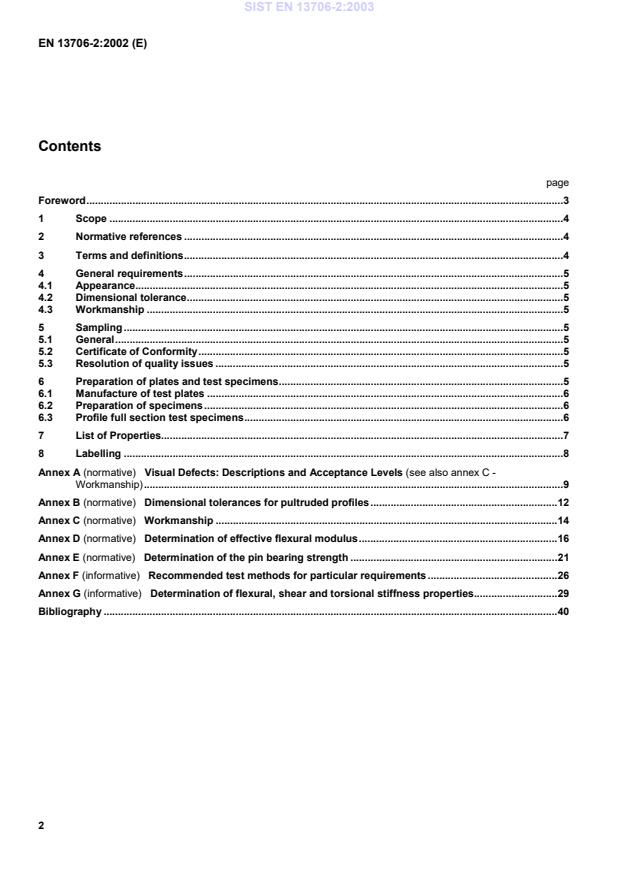
Visual Defects: Descriptions and Acceptance Levels (see also annex C -Workmanship).9Annex B (normative)
Dimensional tolerances for pultruded profiles.12Annex C (normative)
Workmanship.14Annex D (normative)
Determination of effective flexural modulus.16Annex E (normative)
Determination of the pin bearing strength.21Annex F (informative)
Recommended test methods for particular requirements.26Annex G (informative)
Determination of flexural, shear and torsional stiffness properties.29Bibliography.40SIST EN 13706-2:2003
...