

SIST EN 302 571 V1.1.1:2008
Intelligent Transport Systems (ITS) - Radiocommunications equipment operating in the 5 855 MHz to 5 925 MHz frequency band - Harmonized EN covering essential requirements of article 3.2 of the R&TTE Directive
- Abstract
Candidate Harmonised Standard under the R&TTE Directive article 3.2 covering requirements and essential radio test suites of the technical parameters for vehicle to vehicle and vehicle to roadside/infrastructure in the 5,85 GHz to 5,925 GHz range. The EN shall cover Physical Layer and MAC Layer parameters to avoid harmful interference. Special emphasis on requirements from European regulations involving spectrum management. This work supports the eSafety initiative This work is in co-operation with ISO TC 204 (Intelligent Transport Systems) ISO IS 21215.
The present document applies to communications using radio transmitters and receivers for Intelligent Transport Systems (ITS). ITS communications may comprise vehicle-to-vehicle, vehicle-to-roadside and roadside-to-vehicle.
The equipment is comprised of a transmitter and associated encoder and modulator and/or a receiver and associated demodulator and decoder. The types of equipment covered by the present document are as follows:
• OnBoard Equipment (OBE equipment fitted with an integral or dedicated antenna(s), intended for use in vehicles);
• Road Side Equipment (RSE equipment fitted with an antenna socket, integral or dedicated antenna(s), normally used as a fixed station).
- Status
- Published
- Public Enquiry End Date
- 31-Mar-2008
- Publication Date
- 22-Oct-2008
- Technical Committee
- MOC - Mobile Communications
- Current Stage
- 6060 - National Implementation/Publication (Adopted Project)
- Start Date
- 03-Oct-2008
- Due Date
- 08-Dec-2008
- Completion Date
- 23-Oct-2008
- Mandate
- M/284
Buy Documents
ETSI EN 302 571 V0.0.2 (2007-12) - Intelligent Transport Systems (ITS); Radiocommunications equipment operating in the 5 855 MHz to 5 925 MHz frequency band; Harmonized EN covering essential requirements of article 3.2 of the R&TTE Directive
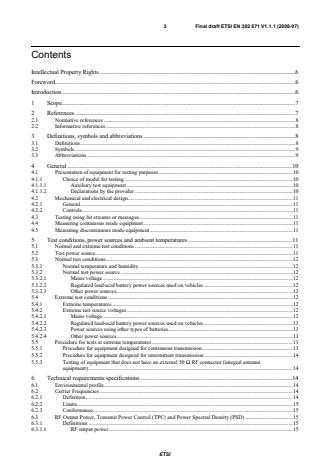
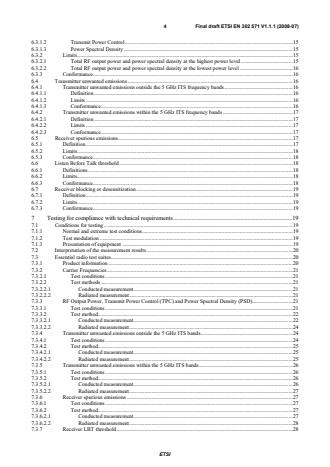
ETSI EN 302 571 V1.1.1 (2008-07) - Intelligent Transport Systems (ITS); Radiocommunications equipment operating in the 5 855 MHz to 5 925 MHz frequency band; Harmonized EN covering the essential requirements of article 3.2 of the R&TTE Directive
ETSI EN 302 571 V1.1.1 (2008-09) - Intelligent Transport Systems (ITS); Radiocommunications equipment operating in the 5 855 MHz to 5 925 MHz frequency band; Harmonized EN covering the essential requirements of article 3.2 of the R&TTE Directive

SIST EN 302 571 V1.1.1:2008 is a Harmonized European Standard for Intelligent Transport Systems (ITS) radiocommunications equipment in the 5 855 MHz to 5 925 MHz band. It specifies the essential radio requirements and test suites used to assess vehicle-to-vehicle, vehicle-to-roadside and roadside-to-vehicle equipment under article 3.2 of the R&TTE Directive. The document is aimed at manufacturers, test laboratories, and conformity teams for OnBoard Equipment (OBE) and Road Side Equipment (RSE).
What does SIST EN 302 571 V1.1.1:2008 specify?
SIST EN 302 571 V1.1.1:2008 specifies radio requirements for ITS communications equipment operating in the 5 855 MHz to 5 925 MHz range. It covers both transmit and receive functions and is written so that equipment can be assessed for harmful interference and spectrum use in practice.
The scope includes communications using radio transmitters and receivers for ITS, including vehicle-to-vehicle, vehicle-to-roadside and roadside-to-vehicle links. The equipment covered consists of a transmitter with encoder and modulator and/or a receiver with demodulator and decoder.
| Annex | What it covers |
|---|---|
| Annex A | HS Requirements and conformance Test specifications Table (HS-RTT) |
| Annex B | Test sites and arrangements for radiated measurements |
| Annex C | General description of measurement |
| Annex D | The EN title in the official languages |
| Annex E | Bibliography |
The main body is organized into clauses on scope, references, definitions, general test presentation, test conditions, technical requirements, and compliance testing. In practice, this structure tells a reader both what the equipment must do and how laboratories are expected to check it.
What are the key requirements of SIST EN 302 571 V1.1.1:2008?
SIST EN 302 571 V1.1.1:2008 focuses on a small set of radio performance points that matter most for ITS coexistence: channel placement, output power, unwanted emissions, receiver emissions, and channel access behavior. Clause 7 then turns those requirements into the required test suites.
Equipment presentation for testing, clause 4.1. The provider must declare operating frequencies, operating conditions and power requirements, and supply technical documentation and operating manuals. This matters because the laboratory cannot choose valid test conditions without knowing how the equipment is intended to operate.
Mechanical and electrical design, clause 4.2. The equipment is to be designed and built to minimize harmful interference, and user access to controls that could worsen interference must be prevented. In practice, this pushes critical radio settings away from casual adjustment.
Test conditions and power sources, clause 5. The standard defines normal and extreme temperature, humidity and supply-voltage conditions for testing, including special handling for vehicle battery supplies. This matters because ITS equipment must be checked both in ordinary service conditions and under stressed operating conditions.
Carrier frequencies, clause 6.2. The equipment must operate on the nominal carrier frequencies defined in the standard, and the actual carrier centre frequency must stay within the allowed frequency accuracy. For a buyer or engineer, this is the basic check that the radio stays on the intended ITS channel.
RF output power, Transmit Power Control (TPC) and Power Spectral Density (PSD), clause 6.3. The standard requires a TPC range from the highest to the lowest power level and sets limits for both overall output power and spectral density at those extremes. That means the radio must not radiate more energy than allowed, and if it supports power control, the full range has to behave correctly.
Transmitter unwanted emissions and receiver spurious emissions, clauses 6.4 and 6.5. The standard limits emissions both outside the 5 GHz ITS band and within the band, and it also limits receiver spurious emissions in receive mode. This is the part that protects other spectrum users and nearby ITS channels from interference.
Listen Before Talk (LBT) threshold and receiver blocking, clauses 6.6 and 6.7. These requirements apply only to equipment operating in 5 855 MHz to 5 875 MHz. LBT checks whether a channel is free before transmit, while blocking checks whether the receiver still works when strong unwanted signals are present; both are central to shared-channel operation.
Compliance testing, clause 7 and Annex A. The standard assigns each requirement to an essential test in the HS-RTT table and explains when conducted or radiated methods are used. For compliance work, Annex A is the roadmap from requirement to test.
What terms does SIST EN 302 571 V1.1.1:2008 define?
- available channel - A channel that has been identified as free for use after an LBT check.
- channel - The amount of spectrum used by one ITS device on one of the defined carrier frequencies.
- dedicated antenna - A removable antenna supplied and tested with the radio equipment as an indispensable part of it.
- integral antenna - An antenna built into the equipment as a fixed part and not disconnectable by the user.
- Listen Before Talk (LBT) - A monitoring method that checks RF channel activity before transmitting.
- Transmit Power Control (TPC) - A technique that adjusts transmitter output power to reduce interference to other users.
- Power Spectral Density (PSD) - The mean equivalent isotropically radiated power per unit bandwidth during a transmission burst.
Who uses SIST EN 302 571 V1.1.1:2008?
SIST EN 302 571 V1.1.1:2008 is used by manufacturers of ITS radio equipment, including vehicle-mounted units and roadside units. It is also used by test laboratories that measure frequency accuracy, output power, emissions and receiver behavior.
Quality and compliance teams use it to build technical files, choose test samples and define representative configurations for type testing. Buyers and system integrators use it when they need to confirm that a supplier’s ITS radio fits the required band, antenna type and power-control behavior.
Which standards are used with SIST EN 302 571 V1.1.1:2008?
- ETSI TR 100 028 - Provides the uncertainty framework used for the radio measurement results reported under this standard.
- CISPR 16 - Provides specifications for radio disturbance and immunity measuring apparatus and methods, supporting the measurement setup.
- ETSI EG 201 399 - Gives the modular structure used when producing candidate Harmonized Standards under the R&TTE Directive.
- ETSI TR 102 070-2 - Supports application of harmonized standards to multi-radio and combined radio and non-radio equipment, which is relevant when ITS equipment is part of a larger system.
What does the SIST EN 302 571 V1.1.1:2008 document contain?
The document contains detailed test conditions, technical requirement clauses and compliance test procedures for ITS radio equipment. It includes tables for channel frequencies, power and emission limits, and LBT and blocking criteria, plus a requirements-to-tests matrix in Annex A.
Annex B describes radiated-measurement sites, including open air test sites and anechoic chambers, and gives the role of test antennas and substitution antennas. Annex C explains conducted, radiated and substitution measurements, and the main clauses provide step-by-step methods for carrier frequency checks, output power and PSD measurement, unwanted emissions, receiver emissions, LBT threshold and blocking tests.
For test reporting, the standard requires measurement uncertainty to be recorded and tied to the measurement methods used. In practice, that makes the report usable for conformity assessment, audit trails and repeated lab comparisons.
Buy Documents
ETSI EN 302 571 V0.0.2 (2007-12) - Intelligent Transport Systems (ITS); Radiocommunications equipment operating in the 5 855 MHz to 5 925 MHz frequency band; Harmonized EN covering essential requirements of article 3.2 of the R&TTE Directive
ETSI EN 302 571 V1.1.1 (2008-07) - Intelligent Transport Systems (ITS); Radiocommunications equipment operating in the 5 855 MHz to 5 925 MHz frequency band; Harmonized EN covering the essential requirements of article 3.2 of the R&TTE Directive
ETSI EN 302 571 V1.1.1 (2008-09) - Intelligent Transport Systems (ITS); Radiocommunications equipment operating in the 5 855 MHz to 5 925 MHz frequency band; Harmonized EN covering the essential requirements of article 3.2 of the R&TTE Directive
Get Certified
Connect with accredited certification bodies for this standard

BSI Group
BSI (British Standards Institution) is the business standards company that helps organizations make excellence a habit.

NYCE
Mexican standards and certification body.

ANCE
Mexican certification and testing association.
Sponsored listings
Frequently Asked Questions
SIST EN 302 571 V1.1.1:2008 is a standard published by the Slovenian Institute for Standardization (SIST). Its full title is "Intelligent Transport Systems (ITS) - Radiocommunications equipment operating in the 5 855 MHz to 5 925 MHz frequency band - Harmonized EN covering essential requirements of article 3.2 of the R&TTE Directive". This standard covers: Candidate Harmonised Standard under the R&TTE Directive article 3.2 covering requirements and essential radio test suites of the technical parameters for vehicle to vehicle and vehicle to roadside/infrastructure in the 5,85 GHz to 5,925 GHz range. The EN shall cover Physical Layer and MAC Layer parameters to avoid harmful interference. Special emphasis on requirements from European regulations involving spectrum management. This work supports the eSafety initiative This work is in co-operation with ISO TC 204 (Intelligent Transport Systems) ISO IS 21215. The present document applies to communications using radio transmitters and receivers for Intelligent Transport Systems (ITS). ITS communications may comprise vehicle-to-vehicle, vehicle-to-roadside and roadside-to-vehicle. The equipment is comprised of a transmitter and associated encoder and modulator and/or a receiver and associated demodulator and decoder. The types of equipment covered by the present document are as follows: • OnBoard Equipment (OBE equipment fitted with an integral or dedicated antenna(s), intended for use in vehicles); • Road Side Equipment (RSE equipment fitted with an antenna socket, integral or dedicated antenna(s), normally used as a fixed station).
Candidate Harmonised Standard under the R&TTE Directive article 3.2 covering requirements and essential radio test suites of the technical parameters for vehicle to vehicle and vehicle to roadside/infrastructure in the 5,85 GHz to 5,925 GHz range. The EN shall cover Physical Layer and MAC Layer parameters to avoid harmful interference. Special emphasis on requirements from European regulations involving spectrum management. This work supports the eSafety initiative This work is in co-operation with ISO TC 204 (Intelligent Transport Systems) ISO IS 21215. The present document applies to communications using radio transmitters and receivers for Intelligent Transport Systems (ITS). ITS communications may comprise vehicle-to-vehicle, vehicle-to-roadside and roadside-to-vehicle. The equipment is comprised of a transmitter and associated encoder and modulator and/or a receiver and associated demodulator and decoder. The types of equipment covered by the present document are as follows: • OnBoard Equipment (OBE equipment fitted with an integral or dedicated antenna(s), intended for use in vehicles); • Road Side Equipment (RSE equipment fitted with an antenna socket, integral or dedicated antenna(s), normally used as a fixed station).
SIST EN 302 571 V1.1.1:2008 is classified under the following ICS (International Classification for Standards) categories: 33.060.01 - Radiocommunications in general; 35.240.60 - IT applications in transport. The ICS classification helps identify the subject area and facilitates finding related standards.
SIST EN 302 571 V1.1.1:2008 is associated with the following European legislation: EU Directives/Regulations: 1999/5/EC, TRRTP124; Standardization Mandates: M/284. When a standard is cited in the Official Journal of the European Union, products manufactured in conformity with it benefit from a presumption of conformity with the essential requirements of the corresponding EU directive or regulation.
SIST EN 302 571 V1.1.1:2008 is available in PDF format for immediate download after purchase. The document can be added to your cart and obtained through the secure checkout process. Digital delivery ensures instant access to the complete standard document.
Standards Content (Sample)
Draft ETSI EN 302 571 V0.0.2 (2007-12)
Harmonized European Standard (Telecommunications series)
Intelligent Transport Systems (ITS);
Radiocommunications equipment operating
in the 5 855 MHz to 5 925 MHz frequency band;
Harmonized EN covering essential requirements
of article 3.2 of the R&TTE Directive
2 Draft ETSI EN 302 571 V0.0.2 (2007-12)
Reference
DEN/ERM-TG37-007
Keywords
ITS, CALM, radio, regulation, transport
ETSI
650 Route des Lucioles
F-06921 Sophia Antipolis Cedex - FRANCE
Tel.: +33 4 92 94 42 00 Fax: +33 4 93 65 47 16
Siret N° 348 623 562 00017 - NAF 742 C
Association à but non lucratif enregistrée à la
Sous-Préfecture de Grasse (06) N° 7803/88
Important notice
Individual copies of the present document can be downloaded from:
http://www.etsi.org
The present document may be made available in more than one electronic version or in print. In any case of existing or
perceived difference in contents between such versions, the reference version is the Portable Document Format (PDF).
In case of dispute, the reference shall be the printing on ETSI printers of the PDF version kept on a specific network drive
within ETSI Secretariat.
Users of the present document should be aware that the document may be subject to revision or change of status.
Information on the current status of this and other ETSI documents is available at
http://portal.etsi.org/tb/status/status.asp
If you find errors in the present document, please send your comment to one of the following services:
http://portal.etsi.org/chaircor/ETSI_support.asp
Copyright Notification
No part may be reproduced except as authorized by written permission.
The copyright and the foregoing restriction extend to reproduction in all media.
© European Telecommunications Standards Institute 2007.
All rights reserved.
TM TM TM TM
DECT , PLUGTESTS , UMTS , TIPHON , the TIPHON logo and the ETSI logo are Trade Marks of ETSI registered
for the benefit of its Members.
TM
3GPP is a Trade Mark of ETSI registered for the benefit of its Members and of the 3GPP Organizational Partners.
ETSI
3 Draft ETSI EN 302 571 V0.0.2 (2007-12)
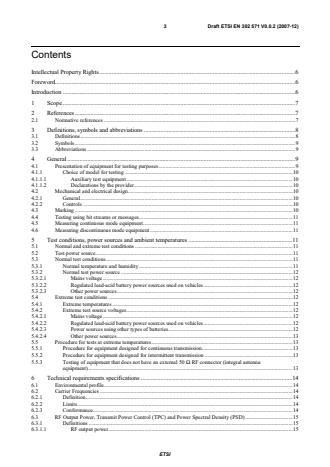
Contents
Intellectual Property Rights.6
Foreword.6
Introduction .6
1 Scope.7
2 References.7
2.1 Normative references.7
3 Definitions, symbols and abbreviations .8
3.1 Definitions.8
3.2 Symbols.9
3.3 Abbreviations.9
4 General.9
4.1 Presentation of equipment for testing purposes.9
4.1.1 Choice of model for testing .10
4.1.1.1 Auxiliary test equipment .10
4.1.1.2 Declarations by the provider .10
4.2 Mechanical and electrical design.10
4.2.1 General.10
4.2.2 Controls.10
4.3 Marking.10
4.4 Testing using bit streams or messages.11
4.5 Measuring continuous mode equipment.11
4.6 Measuring discontinuous mode equipment .11
5 Test conditions, power sources and ambient temperatures .11
5.1 Normal and extreme test conditions .11
5.2 Test power source.11
5.3 Normal test conditions.11
5.3.1 Normal temperature and humidity.11
5.3.2 Normal test power source .12
5.3.2.1 Mains voltage.12
5.3.2.2 Regulated lead-acid battery power sources used on vehicles.12
5.3.2.3 Other power sources.12
5.4 Extreme test conditions .12
5.4.1 Extreme temperatures.12
5.4.2 Extreme test source voltages.12
5.4.2.1 Mains voltage.12
5.4.2.2 Regulated lead-acid battery power sources used on vehicles.12
5.4.2.3 Power sources using other types of batteries.12
5.4.2.4 Other power sources.13
5.5 Procedure for tests at extreme temperatures.13
5.5.1 Procedure for equipment designed for continuous transmission.13
5.5.2 Procedure for equipment designed for intermittent transmission .13
5.5.3 Testing of equipment that does not have an external 50 Ω RF connector (integral antenna
equipment) .13
6 Technical requirements specifications .14
6.1 Environmental profile.14
6.2 Carrier Frequencies.14
6.2.1 Definition.14
6.2.2 Limits.14
6.2.3 Conformance.14
6.3 RF Output Power, Transmit Power Control (TPC) and Power Spectral Density (PSD) .15
6.3.1 Definitions.15
6.3.1.1 RF output power.15
ETSI
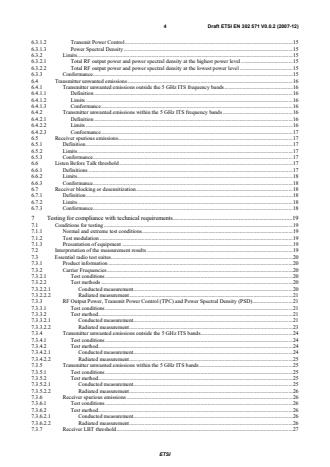
4 Draft ETSI EN 302 571 V0.0.2 (2007-12)
6.3.1.2 Transmit Power Control.15
6.3.1.3 Power Spectral Density.15
6.3.2 Limits.15
6.3.2.1 Total RF output power and power spectral density at the highest power level .15
6.3.2.2 Total RF output power and power spectral density at the lowest power level .15
6.3.3 Conformance.15
6.4 Transmitter unwanted emissions .16
6.4.1 Transmitter unwanted emissions outside the 5 GHz ITS frequency bands.16
6.4.1.1 Definition.16
6.4.1.2 Limits.16
6.4.1.3 Conformance.16
6.4.2 Transmitter unwanted emissions within the 5 GHz ITS frequency bands .16
6.4.2.1 Definition.16
6.4.2.2 Limits.16
6.4.2.3 Conformance.17
6.5 Receiver spurious emissions.17
6.5.1 Definition.17
6.5.2 Limits.17
6.5.3 Conformance.17
6.6 Listen Before Talk threshold.17
6.6.1 Definitions.17
6.6.2 Limits.18
6.6.3 Conformance.18
6.7 Receiver blocking or desensitization.18
6.7.1 Definition.18
6.7.2 Limits.18
6.7.3 Conformance.18
7 Testing for compliance with technical requirements.19
7.1 Conditions for testing .19
7.1.1 Normal and extreme test conditions.19
7.1.2 Test modulation.19
7.1.3 Presentation of equipment .19
7.2 Interpretation of the measurement results .19
7.3 Essential radio test suites.20
7.3.1 Product information.20
7.3.2 Carrier Frequencies.20
7.3.2.1 Test conditions.20
7.3.2.2 Test methods .20
7.3.2.2.1 Conducted measurement.20
7.3.2.2.2 Radiated measurement.21
7.3.3 RF Output Power, Transmit Power Control (TPC) and Power Spectral Density (PSD).21
7.3.3.1 Test conditions.21
7.3.3.2 Test method.21
7.3.3.2.1 Conducted measurement.21
7.3.3.2.2 Radiated measurement.23
7.3.4 Transmitter unwanted emissions outside the 5 GHz ITS bands.24
7.3.4.1 Test conditions.24
7.3.4.2 Test method.24
7.3.4.2.1 Conducted measurement.24
7.3.4.2.2 Radiated measurement.25
7.3.5 Transmitter unwanted emissions within the 5 GHz ITS bands.25
7.3.5.1 Test conditions.25
7.3.5.2 Test method.25
7.3.5.2.1 Conducted measurement.25
7.3.5.2.2 Radiated measurement.26
7.3.6 Receiver spurious emissions.26
7.3.6.1 Test conditions.26
7.3.6.2 Test method.26
7.3.6.2.1 Conducted measurement.26
7.3.6.2.2 Radiated measurement.26
7.3.7 Receiver LBT threshold.27
ETSI
5 Draft ETSI EN 302 571 V0.0.2 (2007-12)
7.3.7.1 Test conditions.27
7.3.7.2 Test method.27
7.3.8 Receiver blocking or desensitization .27
7.3.8.1 Test conditions.27
7.3.8.2 Test method.28
Annex A (normative): HS Requirements and conformance Test specifications Table (HS-
RTT).29
Annex B (normative): Test sites and arrangements for radiated measurements.31
B.1 Test sites.31
B.1.1 Open air test sites .31
B.1.2 Anechoic chamber.32
B.1.2.1 General.32
B.1.2.2 Description.32
B.1.2.3 Influence of parasitic reflections.32
B.1.2.4 Calibration and mode of use .33
B.2 Test antenna.34
B.3 Substitution antenna .35
Annex C (normative): General description of measurement .36
C.1 Conducted measurements.36
C.2 Radiated measurements.36
C.3 Substitution measurement .37
Annex D (informative): The EN title in the official languages .38
Annex E (informative): Bibliography.39
History .40
ETSI
6 Draft ETSI EN 302 571 V0.0.2 (2007-12)
Intellectual Property Rights
IPRs essential or potentially essential to the present document may have been declared to ETSI. The information
pertaining to these essential IPRs, if any, is publicly available for ETSI members and non-members, and can be found
in ETSI SR 000 314: "Intellectual Property Rights (IPRs); Essential, or potentially Essential, IPRs notified to ETSI in
respect of ETSI standards", which is available from the ETSI Secretariat. Latest updates are available on the ETSI Web
server (http://webapp.etsi.org/IPR/home.asp).
Pursuant to the ETSI IPR Policy, no investigation, including IPR searches, has been carried out by ETSI. No guarantee
can be given as to the existence of other IPRs not referenced in ETSI SR 000 314 (or the updates on the ETSI Web
server) which are, or may be, or may become, essential to the present document.
Foreword
This Harmonized European Standard (Telecommunications series) has been produced by ETSI Technical Committee
Electromagnetic compatibility and Radio spectrum Matters (ERM), and is now submitted for the Public Enquiry phase
of the ETSI standards Two-step Approval Procedure.
The present document has been produced by ETSI in response to a mandate from the European Commission issued
under Council Directive 98/34/EC (as amended) laying down a procedure for the provision of information in the field of
technical standards and regulations.
The present document is intended to become a Harmonized Standard, the reference of which will be published in the
Official Journal of the European Communities referencing the Directive 1999/5/EC of the European Parliament and of
the Council of 9 March 1999 on radio equipment and telecommunications terminal equipment and the mutual
recognition of their conformity ("the R&TTE Directive").
Technical specifications relevant to Directive 1999/5/EC are given in annex A.
Equipment compliant with the present document can be intended for fitment into road vehicles, therefore it is subject to
automotive EMC type approval and has to comply with Directive 95/54/EC . For use on vehicles outside the scope of
Directive 95/54/EC compliance with an EMC directive/standard appropriate for that use is required.
Proposed national transposition dates
Date of latest announcement of this EN (doa): 3 months after ETSI publication
Date of latest publication of new National Standard
or endorsement of this EN (dop/e): 6 months after doa
Date of withdrawal of any conflicting National Standard (dow): 18 months after doa
Introduction
The present document is part of a set of standards developed by ETSI and is designed to fit in a modular structure to
cover all radio and telecommunications terminal equipment within the scope of the R&TTE Directive. The modular
structure is shown in EG 201 399 (see bibliography).
ETSI
7 Draft ETSI EN 302 571 V0.0.2 (2007-12)
1 Scope
The present document applies to communications using radio transmitters and receivers for Intelligent Transport
Systems (ITS). ITS communications may comprise vehicle-to-vehicle, vehicle-to-roadside and roadside-to-vehicle.
Table 1: Radiocommunications service frequency bands
Radiocommunications service frequency bands
Transmit 5 855 MHz to 5 925 MHz
Receive 5 855 MHz to 5 925 MHz
The equipment is comprised of a transmitter and associated encoder and modulator and/or a receiver and associated
demodulator and decoder. The types of equipment covered by the present document are as follows:
• OnBoard Equipment (OBE equipment fitted with an integral or dedicated antenna(s), intended for use in
vehicles);
• Road Side Equipment (RSE equipment fitted with an antenna socket, integral or dedicated antenna(s),
normally used as a fixed station).
2 References
References are either specific (identified by date of publication and/or edition number or version number) or
non-specific.
• For a specific reference, subsequent revisions do not apply.
• Non-specific reference may be made only to a complete document or a part thereof and only in the following
cases:
- if it is accepted that it will be possible to use all future changes of the referenced document for the purposes
of the referring document;
- for informative references.
Referenced documents which are not found to be publicly available in the expected location might be found at
http://docbox.etsi.org/Reference.
For online referenced documents, information sufficient to identify and locate the source shall be provided. Preferably,
the primary source of the referenced document should be cited, in order to ensure traceability. Furthermore, the
reference should, as far as possible, remain valid for the expected life of the document. The reference shall include the
method of access to the referenced document and the full network address, with the same punctuation and use of upper
case and lower case letters.
NOTE: While any hyperlinks included in this clause were valid at the time of publication ETSI cannot guarantee
their long term validity.
2.1 Normative references
The following referenced documents are indispensable for the application of the present document. For dated
references, only the edition cited applies. For non-specific references, the latest edition of the referenced document
(including any amendments) applies.
[1] ETSI TR 100 028 (2001-12) (all parts): "Electromagnetic compatibility and Radio spectrum
Matters (ERM); Uncertainties in the measurement of mobile radio equipment characteristics".
[2] CISPR 16 (2006) , (parts 1-1, 1-4 and 1-5): "Specifications for radio disturbance and immunity
measuring apparatus and methods; Part 1: Radio disturbance and immunity measuring apparatus".
ETSI
8 Draft ETSI EN 302 571 V0.0.2 (2007-12)
3 Definitions, symbols and abbreviations
3.1 Definitions
For the purposes of the present document, the following terms and definitions apply:
available channel: channel identified as available for use as an Operating Channel having performed a "listen before
talk check" first
channel: amount of spectrum used by a single ITS device operating on one of the carrier frequencies listed in table 2 of
the present document
control channel: used for the exchange of information required for the management of the ITS communication system,
in particular for the transmission power control, routing of messages and announcement of applications provided on the
different service channels
dedicated antenna: removable antenna supplied and tested with the radio equipment, designed as an indispensable part
of the equipment
NOTE: The dedicated antenna has been designed or developed for one or more specific types of equipment. It is
the combination of dedicated antenna and radio equipment that is expected to be compliant with the
regulations.
integral antenna: antenna designed as a fixed part of the equipment, without the use of an external connector and as
such which can not be disconnected from the equipment by the user
NOTE: An integral antenna may be fitted internally or externally.
Listen Before Talk (LBT): monitoring method in which the RF channel is checked for activity before transmitting
low latency service messages: latency is the time delay associated with the process of information exchange in the
communication network
NOTE: Low latency safety applications require a minimum delay which should be at least lower than for
messages of standard safety applications.
non-safety applications: have no impact on road safety or traffic efficiency
NOTE: This type of application comprises the entertainment of vehicle-occupants, vehicle maintenance, drive-
through payment etc.
radiated measurements: measurements which involve the absolute measurement of a radiated field
safety service/applications: provide information to vehicles to avoid potentially dangerous traffic situations or to
reduce the seriousness of accidents
NOTE: In the broader sense applications for traffic efficiency can be considered in the category of safety
applications, because measures for traffic efficiency usually reduce the probability of accidents.
service channel: provides the exchange of messages for applications
Transmit Power Control (TPC): technique in which the transmitter output power is controlled resulting in reduced
interference to other users
Transmit Power Control range: power range over which the TPC is able to control the transmitter output power
ETSI
9 Draft ETSI EN 302 571 V0.0.2 (2007-12)
3.2 Symbols
For the purposes of the present document, the following symbols apply:
dB decibel
dBi antenna gain relative to isotropic radiator in decibel
dBc decibel relative to carrier power
E electrical field strength
f frequency
f nominal centre frequency
c
G antenna gain
PH highest power level
R distance
T maximum temperature
max
T minimum temperature
min
Tx on effective transmitter on-time
Tx off effective transmitter off-time
V maximum voltage
max
V minimum voltage
min
Ω ohm
µs microsecond
3.3 Abbreviations
For the purposes of the present document, the following abbreviations apply:
CEPT European Conference of Postal and Telecommunications Administrations
CW Carrier Wave
DC Direct Current
e.i.r.p. equivalent isotropically radiated power
EC European Commission
EMC Electro Magnetic Compatibility
HS Harmonized Standard
ITS Intelligent Transport Systems
LBT Listen Before Talk
OBE On Board Equipment
-6
ppm parts per million = 10
PSD Power Spectral Density
RF Radio Frequency
RSE Road Side Equipment
TPC Transmit Power Control
UUT Unit Under Test
4 General
4.1 Presentation of equipment for testing purposes
Each equipment submitted for testing shall fulfil the requirements of the present document on all frequencies over
which it is intended to operate.
The provider shall declare the frequency ranges, the range of operating conditions and power requirements as
applicable, to establish the appropriate test conditions.
Additionally, technical documentation and operating manuals, sufficient to make the test, shall be supplied.
ETSI
10 Draft ETSI EN 302 571 V0.0.2 (2007-12)
4.1.1 Choice of model for testing
The provider shall provide one or more samples of the equipment, as appropriate for testing.
Stand-alone equipment shall be offered by the provider complete with any ancillary equipment needed for testing.
If an equipment has several optional features, considered not to affect the RF parameters then the tests need only to be
performed on the equipment configured with the combination of features considered to be the most complex, as
proposed by the provider and agreed by the test laboratory.
If channel bundling as identified in clause 6.2.1 is implemented then tests need to be performed on the equipment using
higher channel bandwidth than 10 MHz. Where practicable, equipment offered for testing shall provide a 50 Ω
connector for conducted RF power level measurements.
In the case of a dedicated integral antenna equipment, if the equipment does not have a internal permanent 50 Ω
connector then it is permissible to supply a second sample of the equipment with a temporary antenna connector fitted
to facilitate testing.
The performance of the equipment submitted for testing shall be representative of the performance of the corresponding
production model.
The equipment may contain digital circuit elements, radio circuit elements and other elements whose performance is not
covered by the present document. These elements of the equipment shall meet the appropriate performance
requirements for those components, as specified in other standards.
For example, an ITS device which may be connected to other telematik systems should meet at least the requirements of
the present document (for the elements of the device concerned with radio communications), and the requirements of a
standard for EMC compatibility of the other equipment for the elements of the device which are not concerned with
radio communications.
NOTE: For further information on this topic see TR 102 070-2 (see bibliography).
4.1.1.1 Auxiliary test equipment
All necessary test signal sources, setting up instructions and other product information shall accompany the equipment
when it is submitted for testing.
4.1.1.2 Declarations by the provider
The provider shall declare the necessary information of the equipment with respect to all technical requirements set by
the present document.
4.2 Mechanical and electrical design
4.2.1 General
The equipment shall be designed, constructed and manufactured with the aim of minimizing harmful interference to
other equipment and services.
4.2.2 Controls
Those controls, which if maladjusted, might increase the interfering potentialities of the equipment shall not be
accessible for adjustment by the user.
4.3 Marking
The equipment shall be marked in a visible place. This marking shall be legible, tamperproof and durable.
The marking shall be in accordance with EC Directives and/or CEPT decisions or recommendations as appropriate.
ETSI
11 Draft ETSI EN 302 571 V0.0.2 (2007-12)
4.4 Testing using bit streams or messages
The manufacturer may elect to have the equipment tested using bit streams or data packets.
4.5 Measuring continuous mode equipment
In the case of measurements performed on equipment designed to operate only in continuous mode, requirements such
as "equipment shall be set in continuous mode" shall be interpreted as "equipment shall be used in its normal
transmission mode (in this case, the continuous mode)".
4.6 Measuring discontinuous mode equipment
When it is specified that the transmission shall be continuous for the duration of the measurement(s), the transmitter
under test shall be set to operate in continuous mode. If this is not possible, the measurements shall be carried out in a
period shorter than the duration of the transmitted burst. It may be necessary to extend the duration of the burst.
When measurements are made in discontinuous mode, the reported values can be average values. This averaging shall
be made using a set of measurements, each of these measurements being made during a burst or a part of it.
5 Test conditions, power sources and ambient
temperatures
5.1 Normal and extreme test conditions
Testing shall be made under normal test conditions, and also, where stated, under extreme test conditions.
The test conditions and procedures shall be as specified in clauses 5.2 to 5.5.
5.2 Test power source
During testing the power source of the equipment shall be replaced by a test power source capable of producing normal and
extreme test voltages as specified in clauses 5.3.2 and 5.4.2. The internal impedance of the test power source shall be low
enough for its effect on the test results to be negligible. For the purpose of tests, the voltage of the power source shall be
measured at the input terminals of the equipment.
For battery operated equipment the battery shall be removed and the test power source shall be applied as close to the
battery terminals as practicable.
During tests of DC powered equipment the power source voltages shall be maintained within a tolerance of < ±1 %
relative to the voltage at the beginning of each test. The value of this tolerance is critical for power measurements, using
a smaller tolerance will provide better measurement uncertainty values.
5.3 Normal test conditions
5.3.1 Normal temperature and humidity
The normal temperature and humidity conditions for tests shall be any convenient combination of temperature and humidity
within the following ranges:
• temperature: +15 °C to +35 °C;
• relative humidity: 20 % to 75 %.
ETSI
12 Draft ETSI EN 302 571 V0.0.2 (2007-12)
When it is impracticable to carry out the tests under these conditions, a note to this effect, stating the ambient temperature
and relative humidity during the tests, shall be added to the test report.
5.3.2 Normal test power source
5.3.2.1 Mains voltage
The normal test voltage for equipment to be connected to the mains shall be the nominal mains voltage. For the purpose of
the present document, the nominal voltage shall be the declared voltage or any of the declared voltages for which the
equipment was designed.
The frequency of the test power source corresponding to the ac mains shall be between 49 Hz and 51 Hz.
5.3.2.2 Regulated lead-acid battery power sources used on vehicles
When the radio equipment is intended for operation from the usual types of regulated lead-acid battery power source used on
vehicles the normal test voltage shall be 1,1 times the nominal voltage of the battery (e.g. for nominal voltages of 6 V and
12 V, these are 6,6 V and 13,2 V respectively).
5.3.2.3 Other power sources
For operation from other power sources or types of battery (primary or secondary), the normal test voltage shall be that
declared by the equipment manufacturer.
5.4 Extreme test conditions
5.4.1 Extreme temperatures
For tests at extreme temperatures, measurements shall be made in accordance with the procedures specified in
clause 5.5, at the upper and lower temperatures:
• temperature: -30 °C to +70 °C;
The manufacturer can also declare which extreme conditions the equipment is intended to be installed in. In this case
the upper temperature can be above +70 °C and the lower temperature can be below -30 °C as declared by the
manufacturer.
5.4.2 Extreme test source voltages
5.4.2.1 Mains voltage
The extreme test voltage for equipment to be connected to an ac mains source shall be the nominal mains voltage ±10 %.
5.4.2.2 Regulated lead-acid battery power sources used on vehicles
When the equipment is intended for operation from the usual types of regulated lead-acid battery power sources used on
vehicles the extreme test voltages shall be 1,3 and 0,9 times the nominal voltage of the battery (e.g. for a nominal voltage of
6 V, these are 7,8 V and 5,4 V respectively and for a nominal voltage of 12 V, these are 15,6 V and 10,8 V respectively).
5.4.2.3 Power sources using other types of batteries
The lower extreme test voltages for equipment with power sources using batteries shall be as follows:
- for the nickel metal-hydride, leclanché or lithium type: 0,85 times the nominal battery voltage;
- for the mercury or nickel-cadmium type: 0,9 times the nominal battery voltage.
No upper extreme test voltages apply.
ETSI
13 Draft ETSI EN 302 571 V0.0.2 (2007-12)
In the case where no upper extreme test voltage the nominal voltage is applicable, the corresponding four extreme test
conditions are:
• Vmin/Tmin, Vmin/Tmax;
• (Vmax - nominal)/Tmin,(Vmax = nominal)/Tmax.
5.4.2.4 Other power sources
For equipment using other power sources, or capable of being operated from a variety of power sources, the extreme test
voltages shall be those declared by the equipment manufacturer.
5.5 Procedure for tests at extreme temperatures
Before measurements are made the equipment shall have reached thermal balance in the test chamber. The equipment shall
be switched off during the temperature stabilizing period.
In the case of equipment containing temperature stabilization circuits designed to operate continuously, the temperature
stabilization circuits may be switched on for 15 minutes after thermal balance has been obtained, and the equipment shall
then meet the specified requirements. For such equipment the manufacturer shall provide for the power source circuit
feeding the crystal oven to be independent of the power source for the rest of the equipment.
If the thermal balance is not checked by measurements, a temperature stabilizing period of at least one hour, or a longer
period as may be decided by the testing laboratory, shall be allowed. The sequence of measurements shall be chosen, and the
humidity content in the test chamber shall be controlled so that excessive condensation does not occur.
5.5.1 Procedure for equipment designed for continuous transmission
If the manufacturer states that the equipment is designed for continuous transmission, the test procedure shall be as follows.
Before tests at the upper extreme temperature, the equipment shall be placed in the test chamber, and left until thermal
balance is attained. The equipment shall then be switched on in the transmit condition for a period of half an hour, after
which the equipment shall meet the specified requirements.
Before tests at the lower extreme temperature, the equipment shall be left in the test chamber until thermal balance is
attained, then switched to the standby or receive condition for a period of one minute, after which the equipment shall meet
the specified requirements.
5.5.2 Procedure for equipment designed for intermittent transmission
...
Final draft ETSI EN 302 571 V1.1.1 (2008-07)
Harmonized European Standard (Telecommunications series)
Intelligent Transport Systems (ITS);
Radiocommunications equipment operating
in the 5 855 MHz to 5 925 MHz frequency band;
Harmonized EN covering the essential requirements
of article 3.2 of the R&TTE Directive
2 Final draft ETSI EN 302 571 V1.1.1 (2008-07)
Reference
DEN/ERM-TG37-007
Keywords
CALM, ITS, radio, regulation, transport
ETSI
650 Route des Lucioles
F-06921 Sophia Antipolis Cedex - FRANCE
Tel.: +33 4 92 94 42 00 Fax: +33 4 93 65 47 16
Siret N° 348 623 562 00017 - NAF 742 C
Association à but non lucratif enregistrée à la
Sous-Préfecture de Grasse (06) N° 7803/88
Important notice
Individual copies of the present document can be downloaded from:
http://www.etsi.org
The present document may be made available in more than one electronic version or in print. In any case of existing or
perceived difference in contents between such versions, the reference version is the Portable Document Format (PDF).
In case of dispute, the reference shall be the printing on ETSI printers of the PDF version kept on a specific network drive
within ETSI Secretariat.
Users of the present document should be aware that the document may be subject to revision or change of status.
Information on the current status of this and other ETSI documents is available at
http://portal.etsi.org/tb/status/status.asp
If you find errors in the present document, please send your comment to one of the following services:
http://portal.etsi.org/chaircor/ETSI_support.asp
Copyright Notification
No part may be reproduced except as authorized by written permission.
The copyright and the foregoing restriction extend to reproduction in all media.
© European Telecommunications Standards Institute 2008.
All rights reserved.
TM TM TM TM
DECT , PLUGTESTS , UMTS , TIPHON , the TIPHON logo and the ETSI logo are Trade Marks of ETSI registered
for the benefit of its Members.
TM
3GPP is a Trade Mark of ETSI registered for the benefit of its Members and of the 3GPP Organizational Partners.
ETSI
3 Final draft ETSI EN 302 571 V1.1.1 (2008-07)
Contents
Intellectual Property Rights.6
Foreword.6
Introduction .6
1 Scope.7
2 References.7
2.1 Normative references.8
2.2 Informative references.8
3 Definitions, symbols and abbreviations .8
3.1 Definitions.8
3.2 Symbols.9
3.3 Abbreviations.9
4 General.10
4.1 Presentation of equipment for testing purposes.10
4.1.1 Choice of model for testing .10
4.1.1.1 Auxiliary test equipment .10
4.1.1.2 Declarations by the provider .10
4.2 Mechanical and electrical design.11
4.2.1 General.11
4.2.2 Controls.11
4.3 Testing using bit streams or messages.11
4.4 Measuring continuous mode equipment.11
4.5 Measuring discontinuous mode equipment .11
5 Test conditions, power sources and ambient temperatures .11
5.1 Normal and extreme test conditions .11
5.2 Test power source.11
5.3 Normal test conditions.12
5.3.1 Normal temperature and humidity.12
5.3.2 Normal test power source .12
5.3.2.1 Mains voltage.12
5.3.2.2 Regulated lead-acid battery power sources used on vehicles.12
5.3.2.3 Other power sources.12
5.4 Extreme test conditions .12
5.4.1 Extreme temperatures.12
5.4.2 Extreme test source voltages.12
5.4.2.1 Mains voltage.12
5.4.2.2 Regulated lead-acid battery power sources used on vehicles.13
5.4.2.3 Power sources using other types of batteries.13
5.4.2.4 Other power sources.13
5.5 Procedure for tests at extreme temperatures.13
5.5.1 Procedure for equipment designed for continuous transmission.13
5.5.2 Procedure for equipment designed for intermittent transmission .14
5.5.3 Testing of equipment that does not have an external 50 Ω RF connector (integral antenna
equipment) .14
6 Technical requirements specifications .14
6.1 Environmental profile.14
6.2 Carrier Frequencies.14
6.2.1 Definition.14
6.2.2 Limits.15
6.2.3 Conformance.15
6.3 RF Output Power, Transmit Power Control (TPC) and Power Spectral Density (PSD) .15
6.3.1 Definitions.15
6.3.1.1 RF output power.15
ETSI
4 Final draft ETSI EN 302 571 V1.1.1 (2008-07)
6.3.1.2 Transmit Power Control.15
6.3.1.3 Power Spectral Density .15
6.3.2 Limits.15
6.3.2.1 Total RF output power and power spectral density at the highest power level .15
6.3.2.2 Total RF output power and power spectral density at the lowest power level .16
6.3.3 Conformance.16
6.4 Transmitter unwanted emissions .16
6.4.1 Transmitter unwanted emissions outside the 5 GHz ITS frequency bands.16
6.4.1.1 Definition.16
6.4.1.2 Limits.16
6.4.1.3 Conformance.16
6.4.2 Transmitter unwanted emissions within the 5 GHz ITS frequency bands .17
6.4.2.1 Definition.17
6.4.2.2 Limits.17
6.4.2.3 Conformance.17
6.5 Receiver spurious emissions.17
6.5.1 Definition.17
6.5.2 Limits.18
6.5.3 Conformance.18
6.6 Listen Before Talk threshold .18
6.6.1 Definitions.18
6.6.2 Limits.18
6.6.3 Conformance.18
6.7 Receiver blocking or desensitization.19
6.7.1 Definition.19
6.7.2 Limits.19
6.7.3 Conformance.19
7 Testing for compliance with technical requirements.19
7.1 Conditions for testing .19
7.1.1 Normal and extreme test conditions.19
7.1.2 Test modulation.19
7.1.3 Presentation of equipment .19
7.2 Interpretation of the measurement results .20
7.3 Essential radio test suites.20
7.3.1 Product information.20
7.3.2 Carrier Frequencies.21
7.3.2.1 Test conditions.21
7.3.2.2 Test methods .21
7.3.2.2.1 Conducted measurement.21
7.3.2.2.2 Radiated measurement.21
7.3.3 RF Output Power, Transmit Power Control (TPC) and Power Spectral Density (PSD).21
7.3.3.1 Test conditions.21
7.3.3.2 Test method.22
7.3.3.2.1 Conducted measurement.22
7.3.3.2.2 Radiated measurement.24
7.3.4 Transmitter unwanted emissions outside the 5 GHz ITS bands.24
7.3.4.1 Test conditions.24
7.3.4.2 Test method.25
7.3.4.2.1 Conducted measurement.25
7.3.4.2.2 Radiated measurement.25
7.3.5 Transmitter unwanted emissions within the 5 GHz ITS bands.26
7.3.5.1 Test conditions.26
7.3.5.2 Test method.26
7.3.5.2.1 Conducted measurement.26
7.3.5.2.2 Radiated measurement.27
7.3.6 Receiver spurious emissions.27
7.3.6.1 Test conditions.27
7.3.6.2 Test method.27
7.3.6.2.1 Conducted measurement.27
7.3.6.2.2 Radiated measurement.28
7.3.7 Receiver LBT threshold.28
ETSI
5 Final draft ETSI EN 302 571 V1.1.1 (2008-07)
7.3.7.1 Test conditions.28
7.3.7.2 Test method.28
7.3.8 Receiver blocking or desensitization .28
7.3.8.1 Test conditions.28
7.3.8.2 Test method.29
Annex A (normative): HS Requirements and conformance Test specifications Table (HS-
RTT).30
Annex B (normative): Test sites and arrangements for radiated measurements.32
B.1 Test sites.32
B.1.1 Open air test sites .32
B.1.2 Anechoic chamber.33
B.1.2.1 General.33
B.1.2.2 Description.33
B.1.2.3 Influence of parasitic reflections.33
B.1.2.4 Calibration and mode of use .34
B.2 Test antenna.35
B.3 Substitution antenna .36
Annex C (normative): General description of measurement .37
C.1 Conducted measurements.37
C.2 Radiated measurements.37
C.3 Substitution measurement .38
Annex D (informative): The EN title in the official languages .39
Annex E (informative): Bibliography.40
History .41
ETSI
6 Final draft ETSI EN 302 571 V1.1.1 (2008-07)
Intellectual Property Rights
IPRs essential or potentially essential to the present document may have been declared to ETSI. The information
pertaining to these essential IPRs, if any, is publicly available for ETSI members and non-members, and can be found
in ETSI SR 000 314: "Intellectual Property Rights (IPRs); Essential, or potentially Essential, IPRs notified to ETSI in
respect of ETSI standards", which is available from the ETSI Secretariat. Latest updates are available on the ETSI Web
server (http://webapp.etsi.org/IPR/home.asp).
Pursuant to the ETSI IPR Policy, no investigation, including IPR searches, has been carried out by ETSI. No guarantee
can be given as to the existence of other IPRs not referenced in ETSI SR 000 314 (or the updates on the ETSI Web
server) which are, or may be, or may become, essential to the present document.
Foreword
This Harmonized European Standard (Telecommunications series) has been produced by ETSI Technical Committee
Electromagnetic compatibility and Radio spectrum Matters (ERM), and is now submitted for the Vote phase of the
ETSI standards Two-step Approval Procedure.
The present document has been produced by ETSI in response to a mandate from the European Commission issued
under Council Directive 98/34/EC (as amended) [i.1] laying down a procedure for the provision of information in the
field of technical standards and regulations.
The present document is intended to become a Harmonized Standard, the reference of which will be published in the
Official Journal of the European Communities referencing the Directive 1999/5/EC of the European Parliament and of
the Council of 9 March 1999 on radio equipment and telecommunications terminal equipment and the mutual
recognition of their conformity ("the R&TTE Directive") [i.2].
Technical specifications relevant to Directive 1999/5/EC [i.2] are given in annex A.
Equipment compliant with the present document can be intended for fitment into road vehicles, therefore it is subject to
automotive EMC type approval and Directive 95/54/EC [i.3]. For use on vehicles outside the scope of Directive
95/54/EC [i.3], compliance with an EMC directive/standard appropriate for that use is required.
Proposed national transposition dates
Date of latest announcement of this EN (doa): 3 months after ETSI publication
Date of latest publication of new National Standard
or endorsement of this EN (dop/e): 6 months after doa
Date of withdrawal of any conflicting National Standard (dow): 18 months after doa
Introduction
The present document is part of a set of standards developed by ETSI and is designed to fit in a modular structure to
cover all radio and telecommunications terminal equipment within the scope of the R&TTE Directive. The modular
structure is shown in EG 201 399 [i.4].
ETSI
7 Final draft ETSI EN 302 571 V1.1.1 (2008-07)
1 Scope
The present document applies to communications using radio transmitters and receivers for Intelligent Transport
Systems (ITS). ITS communications may comprise vehicle-to-vehicle, vehicle-to-roadside and roadside-to-vehicle.
Table 1: Radiocommunications service frequency bands
Radiocommunications service frequency bands
Transmit 5 855 MHz to 5 925 MHz
Receive 5 855 MHz to 5 925 MHz
The equipment is comprised of a transmitter and associated encoder and modulator and/or a receiver and associated
demodulator and decoder. The types of equipment covered by the present document are as follows:
• OnBoard Equipment (OBE equipment fitted with an integral or dedicated antenna(s), intended for use in
vehicles);
• Road Side Equipment (RSE equipment fitted with an antenna socket, integral or dedicated antenna(s),
normally used as a fixed station).
2 References
References are either specific (identified by date of publication and/or edition number or version number) or
non-specific.
• For a specific reference, subsequent revisions do not apply.
• Non-specific reference may be made only to a complete document or a part thereof and only in the following
cases:
- if it is accepted that it will be possible to use all future changes of the referenced document for the
purposes of the referring document;
- for informative references.
Referenced documents which are not found to be publicly available in the expected location might be found at
http://docbox.etsi.org/Reference.
For online referenced documents, information sufficient to identify and locate the source shall be provided. Preferably,
the primary source of the referenced document should be cited, in order to ensure traceability. Furthermore, the
reference should, as far as possible, remain valid for the expected life of the document. The reference shall include the
method of access to the referenced document and the full network address, with the same punctuation and use of upper
case and lower case letters.
NOTE: While any hyperlinks included in this clause were valid at the time of publication ETSI cannot guarantee
their long term validity.
ETSI
8 Final draft ETSI EN 302 571 V1.1.1 (2008-07)
2.1 Normative references
The following referenced documents are indispensable for the application of the present document. For dated
references, only the edition cited applies. For non-specific references, the latest edition of the referenced document
(including any amendments) applies.
[1] ETSI TR 100 028 (2001-12) (all parts): "Electromagnetic compatibility and Radio spectrum
Matters (ERM); Uncertainties in the measurement of mobile radio equipment characteristics".
[2] CISPR 16, (parts 1-1 (2007), 1-4 (2008) and 1-5 (2003)): "Specifications for radio disturbance and
immunity measuring apparatus and methods; Part 1: Radio disturbance and immunity measuring
apparatus".
2.2 Informative references
The following referenced documents are not essential to the use of the ETSI deliverable but they assist the user with
regard to a particular subject area. For non-specific references, the latest version of the referenced document (including
any amendments) applies.
[i.1] Directive 98/34/EC of the European Parliament and of the Council of 22 June 1998 laying down a
procedure for the provision of information in the field of technical standards and regulations.
[i.2] Directive 1999/5/EC of the European Parliament and of the Council of 9 March 1999 on radio
equipment and telecommunications terminal equipment and the mutual recognition of their
conformity (R&TTE Directive).
[i.3] Commission Directive 95/54/EC of 31 October 1995 adapting to technical progress Council
Directive 72/245/EEC on the approximation of the laws of the Member States relating to the
suppression of radio interference produced by spark-ignition engines fitted to motor vehicles and
amending Directive 70/156/EEC on the approximation of the laws of the Member States relating
to the type-approval of motor vehicles and their trailers.
[i.4] ETSI EG 201 399 (V2.1.1): "Electromagnetic compatibility and Radio spectrum Matters (ERM);
A guide to the production of candidate Harmonized Standards for application under the R&TTE
Directive".
[i.5] ETSI TR 102 070-2 (V1.1.1): "Electromagnetic compatibility and Radio spectrum Matters (ERM);
Guide to the application of harmonized standards to multi-radio and combined radio and non-radio
equipment; Part 2: Effective use of the radio frequency spectrum".
3 Definitions, symbols and abbreviations
3.1 Definitions
For the purposes of the present document, the following terms and definitions apply:
available channel: channel identified as available for use as an Operating Channel having performed a "listen before
talk check" first
channel: amount of spectrum used by a single ITS device operating on one of the carrier frequencies listed in table 2 of
the present document
dedicated antenna: removable antenna supplied and tested with the radio equipment, designed as an indispensable part
of the equipment
NOTE: The dedicated antenna has been designed or developed for one or more specific types of equipment. It is
the combination of dedicated antenna and radio equipment that is expected to be compliant with the
regulations.
ETSI
9 Final draft ETSI EN 302 571 V1.1.1 (2008-07)
integral antenna: antenna designed as a fixed part of the equipment, without the use of an external connector and as
such which can not be disconnected from the equipment by the user
NOTE: An integral antenna may be fitted internally or externally.
Listen Before Talk (LBT): monitoring method in which the RF channel is checked for activity before transmitting
radiated measurements: measurements which involve the absolute measurement of a radiated field
Transmit Power Control (TPC): technique in which the transmitter output power is controlled resulting in reduced
interference to other users
Transmit Power Control range: power range over which the TPC is able to control the transmitter output power
3.2 Symbols
For the purposes of the present document, the following symbols apply:
dB decibel
dBi antenna gain relative to isotropic radiator in decibel
dBc decibel relative to carrier power
E electrical field strength
f frequency
f nominal centre frequency
c
G antenna gain
PH highest power level
R distance
T maximum temperature
max
T minimum temperature
min
Tx on effective transmitter on-time
Tx off effective transmitter off-time
V maximum voltage
max
V minimum voltage
min
Ω ohm
µs microsecond
3.3 Abbreviations
For the purposes of the present document, the following abbreviations apply:
CW Continuous Wave
DC Direct Current
e.r.p. effective radiated power
e.i.r.p. equivalent isotropically radiated power
EC European Commission
EMC Electro Magnetic Compatibility
HS Harmonized Standard
ITS Intelligent Transport Systems
LBT Listen Before Talk
OBE On Board Equipment
-6
ppm parts per million = 10
PSD Power Spectral Density
RF Radio Frequency
RSE Road Side Equipment
RSU Road Side Unit
TPC Transmit Power Control
UUT Unit Under Test
ETSI
10 Final draft ETSI EN 302 571 V1.1.1 (2008-07)
4 General
4.1 Presentation of equipment for testing purposes
Each equipment submitted for testing shall fulfil the requirements of the present document on all frequencies over
which it is intended to operate.
The provider shall declare the frequency ranges, the range of operating conditions and power requirements as
applicable, to establish the appropriate test conditions.
Additionally, technical documentation and operating manuals, sufficient to make the test, shall be supplied.
4.1.1 Choice of model for testing
The provider shall provide one or more samples of the equipment, as appropriate for testing.
Stand-alone equipment shall be offered by the provider complete with any ancillary equipment needed for testing.
If an equipment has several optional features considered not to affect the RF parameters, then the tests need only to be
performed on the equipment configured with the combination of features considered to be the most complex, as
proposed by the provider and agreed by the test laboratory.
If channel bundling as identified in clause 6.2.1 is implemented, then tests need to be performed on the equipment using
higher channel bandwidth than 10 MHz. Where practicable, equipment offered for testing shall provide a 50 Ω
connector for conducted RF power level measurements.
In the case of a dedicated integral antenna equipment, if the equipment does not have an internal permanent 50 Ω
connector, then it is permissible to supply a second sample of the equipment with a temporary antenna connector fitted
to facilitate testing.
The performance of the equipment submitted for testing shall be representative of the performance of the corresponding
production model.
The equipment may contain digital circuit elements, radio circuit elements and other elements whose performance is not
covered by the present document. These elements of the equipment shall meet the appropriate performance
requirements for those components, as specified in other standards.
An ITS device which is combined with other system(s) should meet at least the requirements of the present document
(for the elements of the device concerned with radio communications), and the requirements of any relevant standard
for EMC compatibility of the other equipment for the elements of the device which are not concerned with radio
communications.
EXAMPLE: An ITS communications device combined with a navigation system.
NOTE: For further information on this topic see TR 102 070-2 [i.5].
4.1.1.1 Auxiliary test equipment
All necessary test signal sources, setting up instructions and other product information shall accompany the equipment
when it is submitted for testing.
4.1.1.2 Declarations by the provider
The provider shall declare the necessary information of the equipment with respect to all technical requirements set by
the present document.
ETSI
11 Final draft ETSI EN 302 571 V1.1.1 (2008-07)
4.2 Mechanical and electrical design
4.2.1 General
The equipment shall be designed, constructed and manufactured with the aim of minimizing harmful interference to
other equipment and services.
4.2.2 Controls
Those controls, which if maladjusted, might increase the interfering potentialities of the equipment shall not be
accessible for adjustment by the user.
4.3 Testing using bit streams or messages
The manufacturer may elect to have the equipment tested using bit streams or data packets.
4.4 Measuring continuous mode equipment
In the case of measurements performed on equipment designed to operate only in continuous mode, requirements such
as "equipment shall be set in continuous mode" shall be interpreted as "equipment shall be used in its normal
transmission mode (in this case, the continuous mode)".
4.5 Measuring discontinuous mode equipment
When it is specified that the transmission shall be continuous for the duration of the measurement(s), the transmitter
under test shall be set to operate in continuous mode. If this is not possible, the measurements shall be carried out in a
period shorter than the duration of the transmitted burst. It may be necessary to extend the duration of the burst.
When measurements are made in discontinuous mode, the reported values can be average values. This averaging shall
be made using a set of measurements, each of these measurements being made during a burst or a part of it.
5 Test conditions, power sources and ambient
temperatures
5.1 Normal and extreme test conditions
Testing shall be made under normal test conditions, and also, where stated, under extreme test conditions.
The test conditions and procedures shall be as specified in clauses 5.2 to 5.5.
5.2 Test power source
During testing the power source of the equipment shall be replaced by a test power source capable of producing normal and
extreme test voltages as specified in clauses 5.3.2 and 5.4.2. The internal impedance of the test power source shall be low
enough for its effect on the test results to be negligible. For the purpose of tests, the voltage of the power source shall be
measured at the input terminals of the equipment.
For battery operated equipment the battery shall be removed and the test power source shall be applied as close to the
battery terminals as practicable.
During tests of DC powered equipment the power source voltages shall be maintained within a tolerance of < ±1 %
relative to the voltage at the beginning of each test. The value of this tolerance is critical for power measurements, using
a smaller tolerance will provide better measurement uncertainty values.
ETSI
12 Final draft ETSI EN 302 571 V1.1.1 (2008-07)
5.3 Normal test conditions
5.3.1 Normal temperature and humidity
The normal temperature and humidity conditions for tests shall be any convenient combination of temperature and humidity
within the following ranges:
• temperature: +15 °C to +35 °C;
• relative humidity: 20 % to 75 %.
When it is impracticable to carry out the tests under these conditions, a note to this effect, stating the ambient temperature
and relative humidity during the tests, shall be added to the test report.
5.3.2 Normal test power source
5.3.2.1 Mains voltage
The normal test voltage for equipment to be connected to the mains shall be the nominal mains voltage. For the purpose of
the present document, the nominal voltage shall be the declared voltage or any of the declared voltages for which the
equipment was designed.
The frequency of the test power source corresponding to the ac mains shall be between 49 Hz and 51 Hz.
5.3.2.2 Regulated lead-acid battery power sources used on vehicles
When the radio equipment is intended for operation from the usual types of regulated lead-acid battery power source used on
vehicles the normal test voltage shall be 1,1 times the nominal voltage of the battery (e.g. for nominal voltages of 6 V and
12 V, these are 6,6 V and 13,2 V respectively).
5.3.2.3 Other power sources
For operation from other power sources or types of battery (primary or secondary), the normal test voltage shall be that
declared by the equipment manufacturer.
5.4 Extreme test conditions
5.4.1 Extreme temperatures
For tests at extreme temperatures, measurements shall be made in accordance with the procedures specified in
clause 5.5, at the upper and lower temperatures:
• temperature: -30 °C to +70 °C;
The manufacturer can also declare which extreme conditions the equipment is intended to be installed in. In this case
the upper temperature can be above +70 °C and the lower temperature can be below -30 °C as declared by the
manufacturer.
5.4.2 Extreme test source voltages
5.4.2.1 Mains voltage
The extreme test voltage for equipment to be connected to an ac mains source shall be the nominal mains voltage ±10 %.
ETSI
13 Final draft ETSI EN 302 571 V1.1.1 (2008-07)
5.4.2.2 Regulated lead-acid battery power sources used on vehicles
When the equipment is intended for operation from the usual types of regulated lead-acid battery power sources used on
vehicles the extreme test voltages shall be 1,3 and 0,9 times the nominal voltage of the battery (e.g. for a nominal voltage of
6 V, these are 7,8 V and 5,4 V respectively and for a nominal voltage of 12 V, these are 15,6 V and 10,8 V respectively).
5.4.2.3 Power sources using other types of batteries
The lower extreme test voltages for equipment with power sources using batteries shall be as follows:
- for the nickel metal-hydride, leclanché or lithium type: 0,85 times the nominal battery voltage;
- for the mercury or nickel-cadmium type: 0,9 times the nominal battery voltage.
No upper extreme test voltages apply.
In the case where there is no upper extreme test voltage the nominal voltage is applicable, the corresponding four
extreme test conditions are:
• Vmin/Tmin, Vmin/Tmax;
• (Vnominal)/Tmin,(Vnominal)/Tmax.
5.4.2.4 Other power sources
For equipment using other power sources, or capable of being operated from a variety of power sources, the extreme test
voltages shall be those declared by the equipment manufacturer.
5.5 Procedure for tests at extreme temperatures
Before measurements are made the equipment shall have reached thermal balance in the test chamber. The equipment shall
be switched off during the temperature stabilizing period.
In the case of equipment containing temperature stabilization circuits designed to operate continuously, the temperature
stabilization circuits may be switched on for 15 minutes after thermal balance has been obtained, and the equipment shall
then meet the specified requirements. For such equipment the manufacturer shall provide for the power source circuit
feeding the crystal oven to be independent of the power source for the rest of the equipment.
If the thermal balance is not checked by measurements, a temperature stabilizing period of at least one hour, or a longer
period as may be decided by the testing laboratory, shall be allowed. The sequence of measurements shall be chosen, and the
humidity content in the test chamber shall be controlled so that excessive condensation does not occur.
5.5.1 Procedure for equipment designed for continuous transmission
If the manufacturer states that the equipment is designed for continuous transmission, the test procedure shall be as follows.
Before tests at the upper extreme temperature, the equipment shall be placed in the test chamber, and left until thermal
balance is attained. The equipment shall then be switched on in the transmit condition for a period of half an hour, after
which the equipment shall meet the specified requirements.
Before tests at the lower extreme tempera
...
Harmonized European Standard (Telecommunications series)
Intelligent Transport Systems (ITS);
Radiocommunications equipment operating
in the 5 855 MHz to 5 925 MHz frequency band;
Harmonized EN covering the essential requirements
of article 3.2 of the R&TTE Directive
2 ETSI EN 302 571 V1.1.1 (2008-09)
Reference
DEN/ERM-TG37-007
Keywords
CALM, ITS, radio, regulation, transport
ETSI
650 Route des Lucioles
F-06921 Sophia Antipolis Cedex - FRANCE
Tel.: +33 4 92 94 42 00 Fax: +33 4 93 65 47 16
Siret N° 348 623 562 00017 - NAF 742 C
Association à but non lucratif enregistrée à la
Sous-Préfecture de Grasse (06) N° 7803/88
Important notice
Individual copies of the present document can be downloaded from:
http://www.etsi.org
The present document may be made available in more than one electronic version or in print. In any case of existing or
perceived difference in contents between such versions, the reference version is the Portable Document Format (PDF).
In case of dispute, the reference shall be the printing on ETSI printers of the PDF version kept on a specific network drive
within ETSI Secretariat.
Users of the present document should be aware that the document may be subject to revision or change of status.
Information on the current status of this and other ETSI documents is available at
http://portal.etsi.org/tb/status/status.asp
If you find errors in the present document, please send your comment to one of the following services:
http://portal.etsi.org/chaircor/ETSI_support.asp
Copyright Notification
No part may be reproduced except as authorized by written permission.
The copyright and the foregoing restriction extend to reproduction in all media.
© European Telecommunications Standards Institute 2008.
All rights reserved.
TM TM TM TM
DECT , PLUGTESTS , UMTS , TIPHON , the TIPHON logo and the ETSI logo are Trade Marks of ETSI registered
for the benefit of its Members.
TM
3GPP is a Trade Mark of ETSI registered for the benefit of its Members and of the 3GPP Organizational Partners.
ETSI
3 ETSI EN 302 571 V1.1.1 (2008-09)
Contents
Intellectual Property Rights.6
Foreword.6
Introduction .6
1 Scope.7
2 References.7
2.1 Normative references.8
2.2 Informative references.8
3 Definitions, symbols and abbreviations .8
3.1 Definitions.8
3.2 Symbols.9
3.3 Abbreviations.9
4 General.10
4.1 Presentation of equipment for testing purposes.10
4.1.1 Choice of model for testing .10
4.1.1.1 Auxiliary test equipment .10
4.1.1.2 Declarations by the provider .10
4.2 Mechanical and electrical design.11
4.2.1 General.11
4.2.2 Controls.11
4.3 Testing using bit streams or messages.11
4.4 Measuring continuous mode equipment.11
4.5 Measuring discontinuous mode equipment .11
5 Test conditions, power sources and ambient temperatures .11
5.1 Normal and extreme test conditions .11
5.2 Test power source.11
5.3 Normal test conditions.12
5.3.1 Normal temperature and humidity.12
5.3.2 Normal test power source .12
5.3.2.1 Mains voltage.12
5.3.2.2 Regulated lead-acid battery power sources used on vehicles.12
5.3.2.3 Other power sources.12
5.4 Extreme test conditions .12
5.4.1 Extreme temperatures.12
5.4.2 Extreme test source voltages.12
5.4.2.1 Mains voltage.12
5.4.2.2 Regulated lead-acid battery power sources used on vehicles.13
5.4.2.3 Power sources using other types of batteries.13
5.4.2.4 Other power sources.13
5.5 Procedure for tests at extreme temperatures.13
5.5.1 Procedure for equipment designed for continuous transmission.13
5.5.2 Procedure for equipment designed for intermittent transmission .14
5.5.3 Testing of equipment that does not have an external 50 Ω RF connector (integral antenna
equipment) .14
6 Technical requirements specifications .14
6.1 Environmental profile.14
6.2 Carrier Frequencies.14
6.2.1 Definition.14
6.2.2 Limits.15
6.2.3 Conformance.15
6.3 RF Output Power, Transmit Power Control (TPC) and Power Spectral Density (PSD) .15
6.3.1 Definitions.15
6.3.1.1 RF output power.15
ETSI
4 ETSI EN 302 571 V1.1.1 (2008-09)
6.3.1.2 Transmit Power Control.15
6.3.1.3 Power Spectral Density.15
6.3.2 Limits.15
6.3.2.1 Total RF output power and power spectral density at the highest power level .15
6.3.2.2 Total RF output power and power spectral density at the lowest power level .16
6.3.3 Conformance.16
6.4 Transmitter unwanted emissions .16
6.4.1 Transmitter unwanted emissions outside the 5 GHz ITS frequency bands.16
6.4.1.1 Definition.16
6.4.1.2 Limits.16
6.4.1.3 Conformance.16
6.4.2 Transmitter unwanted emissions within the 5 GHz ITS frequency bands .17
6.4.2.1 Definition.17
6.4.2.2 Limits.17
6.4.2.3 Conformance.17
6.5 Receiver spurious emissions.17
6.5.1 Definition.17
6.5.2 Limits.18
6.5.3 Conformance.18
6.6 Listen Before Talk threshold.18
6.6.1 Definitions.18
6.6.2 Limits.18
6.6.3 Conformance.18
6.7 Receiver blocking or desensitization.19
6.7.1 Definition.19
6.7.2 Limits.19
6.7.3 Conformance.19
7 Testing for compliance with technical requirements.19
7.1 Conditions for testing .19
7.1.1 Normal and extreme test conditions.19
7.1.2 Test modulation.19
7.1.3 Presentation of equipment .19
7.2 Interpretation of the measurement results .20
7.3 Essential radio test suites.20
7.3.1 Product information.20
7.3.2 Carrier Frequencies.21
7.3.2.1 Test conditions.21
7.3.2.2 Test methods .21
7.3.2.2.1 Conducted measurement.21
7.3.2.2.2 Radiated measurement.21
7.3.3 RF Output Power, Transmit Power Control (TPC) and Power Spectral Density (PSD).21
7.3.3.1 Test conditions.21
7.3.3.2 Test method.22
7.3.3.2.1 Conducted measurement.22
7.3.3.2.2 Radiated measurement.24
7.3.4 Transmitter unwanted emissions outside the 5 GHz ITS bands.24
7.3.4.1 Test conditions.24
7.3.4.2 Test method.25
7.3.4.2.1 Conducted measurement.25
7.3.4.2.2 Radiated measurement.25
7.3.5 Transmitter unwanted emissions within the 5 GHz ITS bands.26
7.3.5.1 Test conditions.26
7.3.5.2 Test method.26
7.3.5.2.1 Conducted measurement.26
7.3.5.2.2 Radiated measurement.27
7.3.6 Receiver spurious emissions.27
7.3.6.1 Test conditions.27
7.3.6.2 Test method.27
7.3.6.2.1 Conducted measurement.27
7.3.6.2.2 Radiated measurement.28
7.3.7 Receiver LBT threshold.28
ETSI
5 ETSI EN 302 571 V1.1.1 (2008-09)
7.3.7.1 Test conditions.28
7.3.7.2 Test method.28
7.3.8 Receiver blocking or desensitization .28
7.3.8.1 Test conditions.28
7.3.8.2 Test method.29
Annex A (normative): HS Requirements and conformance Test specifications Table (HS-
RTT).30
Annex B (normative): Test sites and arrangements for radiated measurements.32
B.1 Test sites.32
B.1.1 Open air test sites .32
B.1.2 Anechoic chamber.33
B.1.2.1 General.33
B.1.2.2 Description.33
B.1.2.3 Influence of parasitic reflections.33
B.1.2.4 Calibration and mode of use .34
B.2 Test antenna.35
B.3 Substitution antenna .36
Annex C (normative): General description of measurement .37
C.1 Conducted measurements.37
C.2 Radiated measurements.37
C.3 Substitution measurement .38
Annex D (informative): The EN title in the official languages .39
Annex E (informative): Bibliography.40
History .41
ETSI
6 ETSI EN 302 571 V1.1.1 (2008-09)
Intellectual Property Rights
IPRs essential or potentially essential to the present document may have been declared to ETSI. The information
pertaining to these essential IPRs, if any, is publicly available for ETSI members and non-members, and can be found
in ETSI SR 000 314: "Intellectual Property Rights (IPRs); Essential, or potentially Essential, IPRs notified to ETSI in
respect of ETSI standards", which is available from the ETSI Secretariat. Latest updates are available on the ETSI Web
server (http://webapp.etsi.org/IPR/home.asp).
Pursuant to the ETSI IPR Policy, no investigation, including IPR searches, has been carried out by ETSI. No guarantee
can be given as to the existence of other IPRs not referenced in ETSI SR 000 314 (or the updates on the ETSI Web
server) which are, or may be, or may become, essential to the present document.
Foreword
This Harmonized European Standard (Telecommunications series) has been produced by ETSI Technical Committee
Electromagnetic compatibility and Radio spectrum Matters (ERM).
The present document has been produced by ETSI in response to a mandate from the European Commission issued
under Council Directive 98/34/EC (as amended) [i.1] laying down a procedure for the provision of information in the
field of technical standards and regulations.
The present document is intended to become a Harmonized Standard, the reference of which will be published in the
Official Journal of the European Communities referencing the Directive 1999/5/EC of the European Parliament and of
the Council of 9 March 1999 on radio equipment and telecommunications terminal equipment and the mutual
recognition of their conformity ("the R&TTE Directive") [i.2].
Technical specifications relevant to Directive 1999/5/EC [i.2] are given in annex A.
Equipment compliant with the present document can be intended for fitment into road vehicles, therefore it is subject to
automotive EMC type approval and Directive 95/54/EC [i.3]. For use on vehicles outside the scope of Directive
95/54/EC [i.3], compliance with an EMC directive/standard appropriate for that use is required.
National transposition dates
Date of adoption of this EN: 8 September 2008
Date of latest announcement of this EN (doa): 31 December 2008
Date of latest publication of new National Standard
or endorsement of this EN (dop/e): 30 June 2009
Date of withdrawal of any conflicting National Standard (dow): 30 June 2010
Introduction
The present document is part of a set of standards developed by ETSI and is designed to fit in a modular structure to
cover all radio and telecommunications terminal equipment within the scope of the R&TTE Directive. The modular
structure is shown in EG 201 399 [i.4].
ETSI
7 ETSI EN 302 571 V1.1.1 (2008-09)
1 Scope
The present document applies to communications using radio transmitters and receivers for Intelligent Transport
Systems (ITS). ITS communications may comprise vehicle-to-vehicle, vehicle-to-roadside and roadside-to-vehicle.
Table 1: Radiocommunications service frequency bands
Radiocommunications service frequency bands
Transmit 5 855 MHz to 5 925 MHz
Receive 5 855 MHz to 5 925 MHz
The equipment is comprised of a transmitter and associated encoder and modulator and/or a receiver and associated
demodulator and decoder. The types of equipment covered by the present document are as follows:
• OnBoard Equipment (OBE equipment fitted with an integral or dedicated antenna(s), intended for use in
vehicles);
• Road Side Equipment (RSE equipment fitted with an antenna socket, integral or dedicated antenna(s),
normally used as a fixed station).
2 References
References are either specific (identified by date of publication and/or edition number or version number) or
non-specific.
• For a specific reference, subsequent revisions do not apply.
• Non-specific reference may be made only to a complete document or a part thereof and only in the following
cases:
- if it is accepted that it will be possible to use all future changes of the referenced document for the
purposes of the referring document;
- for informative references.
Referenced documents which are not found to be publicly available in the expected location might be found at
http://docbox.etsi.org/Reference.
For online referenced documents, information sufficient to identify and locate the source shall be provided. Preferably,
the primary source of the referenced document should be cited, in order to ensure traceability. Furthermore, the
reference should, as far as possible, remain valid for the expected life of the document. The reference shall include the
method of access to the referenced document and the full network address, with the same punctuation and use of upper
case and lower case letters.
NOTE: While any hyperlinks included in this clause were valid at the time of publication ETSI cannot guarantee
their long term validity.
ETSI
8 ETSI EN 302 571 V1.1.1 (2008-09)
2.1 Normative references
The following referenced documents are indispensable for the application of the present document. For dated
references, only the edition cited applies. For non-specific references, the latest edition of the referenced document
(including any amendments) applies.
[1] ETSI TR 100 028 (2001-12) (all parts): "Electromagnetic compatibility and Radio spectrum
Matters (ERM); Uncertainties in the measurement of mobile radio equipment characteristics".
[2] CISPR 16, (parts 1-1 (2007), 1-4 (2008) and 1-5 (2003)): "Specifications for radio disturbance and
immunity measuring apparatus and methods; Part 1: Radio disturbance and immunity measuring
apparatus".
2.2 Informative references
The following referenced documents are not essential to the use of the ETSI deliverable but they assist the user with
regard to a particular subject area. For non-specific references, the latest version of the referenced document (including
any amendments) applies.
[i.1] Directive 98/34/EC of the European Parliament and of the Council of 22 June 1998 laying down a
procedure for the provision of information in the field of technical standards and regulations.
[i.2] Directive 1999/5/EC of the European Parliament and of the Council of 9 March 1999 on radio
equipment and telecommunications terminal equipment and the mutual recognition of their
conformity (R&TTE Directive).
[i.3] Commission Directive 95/54/EC of 31 October 1995 adapting to technical progress Council
Directive 72/245/EEC on the approximation of the laws of the Member States relating to the
suppression of radio interference produced by spark-ignition engines fitted to motor vehicles and
amending Directive 70/156/EEC on the approximation of the laws of the Member States relating
to the type-approval of motor vehicles and their trailers.
[i.4] ETSI EG 201 399 (V2.1.1): "Electromagnetic compatibility and Radio spectrum Matters (ERM);
A guide to the production of candidate Harmonized Standards for application under the R&TTE
Directive".
[i.5] ETSI TR 102 070-2 (V1.1.1): "Electromagnetic compatibility and Radio spectrum Matters (ERM);
Guide to the application of harmonized standards to multi-radio and combined radio and non-radio
equipment; Part 2: Effective use of the radio frequency spectrum".
3 Definitions, symbols and abbreviations
3.1 Definitions
For the purposes of the present document, the following terms and definitions apply:
available channel: channel identified as available for use as an Operating Channel having performed a "listen before
talk check" first
channel: amount of spectrum used by a single ITS device operating on one of the carrier frequencies listed in table 2 of
the present document
dedicated antenna: removable antenna supplied and tested with the radio equipment, designed as an indispensable part
of the equipment
NOTE: The dedicated antenna has been designed or developed for one or more specific types of equipment. It is
the combination of dedicated antenna and radio equipment that is expected to be compliant with the
regulations.
ETSI
9 ETSI EN 302 571 V1.1.1 (2008-09)
integral antenna: antenna designed as a fixed part of the equipment, without the use of an external connector and as
such which can not be disconnected from the equipment by the user
NOTE: An integral antenna may be fitted internally or externally.
Listen Before Talk (LBT): monitoring method in which the RF channel is checked for activity before transmitting
radiated measurements: measurements which involve the absolute measurement of a radiated field
Transmit Power Control (TPC): technique in which the transmitter output power is controlled resulting in reduced
interference to other users
Transmit Power Control range: power range over which the TPC is able to control the transmitter output power
3.2 Symbols
For the purposes of the present document, the following symbols apply:
dB decibel
dBi antenna gain relative to isotropic radiator in decibel
dBc decibel relative to carrier power
E electrical field strength
f frequency
f nominal centre frequency
c
G antenna gain
PH highest power level
R distance
T maximum temperature
max
T minimum temperature
min
Tx on effective transmitter on-time
Tx off effective transmitter off-time
V maximum voltage
max
V minimum voltage
min
Ω ohm
µs microsecond
3.3 Abbreviations
For the purposes of the present document, the following abbreviations apply:
CW Continuous Wave
DC Direct Current
e.r.p. effective radiated power
e.i.r.p. equivalent isotropically radiated power
EC European Commission
EMC Electro Magnetic Compatibility
HS Harmonized Standard
ITS Intelligent Transport Systems
LBT Listen Before Talk
OBE On Board Equipment
-6
ppm parts per million = 10
PSD Power Spectral Density
RF Radio Frequency
RSE Road Side Equipment
RSU Road Side Unit
TPC Transmit Power Control
UUT Unit Under Test
ETSI
10 ETSI EN 302 571 V1.1.1 (2008-09)
4 General
4.1 Presentation of equipment for testing purposes
Each equipment submitted for testing shall fulfil the requirements of the present document on all frequencies over
which it is intended to operate.
The provider shall declare the frequency ranges, the range of operating conditions and power requirements as
applicable, to establish the appropriate test conditions.
Additionally, technical documentation and operating manuals, sufficient to make the test, shall be supplied.
4.1.1 Choice of model for testing
The provider shall provide one or more samples of the equipment, as appropriate for testing.
Stand-alone equipment shall be offered by the provider complete with any ancillary equipment needed for testing.
If an equipment has several optional features considered not to affect the RF parameters, then the tests need only to be
performed on the equipment configured with the combination of features considered to be the most complex, as
proposed by the provider and agreed by the test laboratory.
If channel bundling as identified in clause 6.2.1 is implemented, then tests need to be performed on the equipment using
higher channel bandwidth than 10 MHz. Where practicable, equipment offered for testing shall provide a 50 Ω
connector for conducted RF power level measurements.
In the case of a dedicated integral antenna equipment, if the equipment does not have an internal permanent 50 Ω
connector, then it is permissible to supply a second sample of the equipment with a temporary antenna connector fitted
to facilitate testing.
The performance of the equipment submitted for testing shall be representative of the performance of the corresponding
production model.
The equipment may contain digital circuit elements, radio circuit elements and other elements whose performance is not
covered by the present document. These elements of the equipment shall meet the appropriate performance
requirements for those components, as specified in other standards.
An ITS device which is combined with other system(s) should meet at least the requirements of the present document
(for the elements of the device concerned with radio communications), and the requirements of any relevant standard
for EMC compatibility of the other equipment for the elements of the device which are not concerned with radio
communications.
EXAMPLE: An ITS communications device combined with a navigation system.
NOTE: For further information on this topic see TR 102 070-2 [i.5].
4.1.1.1 Auxiliary test equipment
All necessary test signal sources, setting up instructions and other product information shall accompany the equipment
when it is submitted for testing.
4.1.1.2 Declarations by the provider
The provider shall declare the necessary information of the equipment with respect to all technical requirements set by
the present document.
ETSI
11 ETSI EN 302 571 V1.1.1 (2008-09)
4.2 Mechanical and electrical design
4.2.1 General
The equipment shall be designed, constructed and manufactured with the aim of minimizing harmful interference to
other equipment and services.
4.2.2 Controls
Those controls, which if maladjusted, might increase the interfering potentialities of the equipment shall not be
accessible for adjustment by the user.
4.3 Testing using bit streams or messages
The manufacturer may elect to have the equipment tested using bit streams or data packets.
4.4 Measuring continuous mode equipment
In the case of measurements performed on equipment designed to operate only in continuous mode, requirements such
as "equipment shall be set in continuous mode" shall be interpreted as "equipment shall be used in its normal
transmission mode (in this case, the continuous mode)".
4.5 Measuring discontinuous mode equipment
When it is specified that the transmission shall be continuous for the duration of the measurement(s), the transmitter
under test shall be set to operate in continuous mode. If this is not possible, the measurements shall be carried out in a
period shorter than the duration of the transmitted burst. It may be necessary to extend the duration of the burst.
When measurements are made in discontinuous mode, the reported values can be average values. This averaging shall
be made using a set of measurements, each of these measurements being made during a burst or a part of it.
5 Test conditions, power sources and ambient
temperatures
5.1 Normal and extreme test conditions
Testing shall be made under normal test conditions, and also, where stated, under extreme test conditions.
The test conditions and procedures shall be as specified in clauses 5.2 to 5.5.
5.2 Test power source
During testing the power source of the equipment shall be replaced by a test power source capable of producing normal and
extreme test voltages as specified in clauses 5.3.2 and 5.4.2. The internal impedance of the test power source shall be low
enough for its effect on the test results to be negligible. For the purpose of tests, the voltage of the power source shall be
measured at the input terminals of the equipment.
For battery operated equipment the battery shall be removed and the test power source shall be applied as close to the
battery terminals as practicable.
During tests of DC powered equipment the power source voltages shall be maintained within a tolerance of < ±1 %
relative to the voltage at the beginning of each test. The value of this tolerance is critical for power measurements, using
a smaller tolerance will provide better measurement uncertainty values.
ETSI
12 ETSI EN 302 571 V1.1.1 (2008-09)
5.3 Normal test conditions
5.3.1 Normal temperature and humidity
The normal temperature and humidity conditions for tests shall be any convenient combination of temperature and humidity
within the following ranges:
• temperature: +15 °C to +35 °C;
• relative humidity: 20 % to 75 %.
When it is impracticable to carry out the tests under these conditions, a note to this effect, stating the ambient temperature
and relative humidity during the tests, shall be added to the test report.
5.3.2 Normal test power source
5.3.2.1 Mains voltage
The normal test voltage for equipment to be connected to the mains shall be the nominal mains voltage. For the purpose of
the present document, the nominal voltage shall be the declared voltage or any of the declared voltages for which the
equipment was designed.
The frequency of the test power source corresponding to the ac mains shall be between 49 Hz and 51 Hz.
5.3.2.2 Regulated lead-acid battery power sources used on vehicles
When the radio equipment is intended for operation from the usual types of regulated lead-acid battery power source used on
vehicles the normal test voltage shall be 1,1 times the nominal voltage of the battery (e.g. for nominal voltages of 6 V and
12 V, these are 6,6 V and 13,2 V respectively).
5.3.2.3 Other power sources
For operation from other power sources or types of battery (primary or secondary), the normal test voltage shall be that
declared by the equipment manufacturer.
5.4 Extreme test conditions
5.4.1 Extreme temperatures
For tests at extreme temperatures, measurements shall be made in accordance with the procedures specified in
clause 5.5, at the upper and lower temperatures:
• temperature: -30 °C to +70 °C;
The manufacturer can also declare which extreme conditions the equipment is intended to be installed in. In this case
the upper temperature can be above +70 °C and the lower temperature can be below -30 °C as declared by the
manufacturer.
5.4.2 Extreme test source voltages
5.4.2.1 Mains voltage
The extreme test voltage for equipment to be connected to an ac mains source shall be the nominal mains voltage ±10 %.
ETSI
13 ETSI EN 302 571 V1.1.1 (2008-09)
5.4.2.2 Regulated lead-acid battery power sources used on vehicles
When the equipment is intended for operation from the usual types of regulated lead-acid battery power sources used on
vehicles the extreme test voltages shall be 1,3 and 0,9 times the nominal voltage of the battery (e.g. for a nominal voltage of
6 V, these are 7,8 V and 5,4 V respectively and for a nominal voltage of 12 V, these are 15,6 V and 10,8 V respectively).
5.4.2.3 Power sources using other types of batteries
The lower extreme test voltages for equipment with power sources using batteries shall be as follows:
- for the nickel metal-hydride, leclanché or lithium type: 0,85 times the nominal battery voltage;
- for the mercury or nickel-cadmium type: 0,9 times the nominal battery voltage.
No upper extreme test voltages apply.
In the case where there is no upper extreme test voltage the nominal voltage is applicable, the corresponding four
extreme test conditions are:
• Vmin/Tmin, Vmin/Tmax;
• (Vnominal)/Tmin,(Vnominal)/Tmax.
5.4.2.4 Other power sources
For equipment using other power sources, or capable of being operated from a variety of power sources, the extreme test
voltages shall be those declared by the equipment manufacturer.
5.5 Procedure for tests at extreme temperatures
Before measurements are made the equipment shall have reached thermal balance in the test chamber. The equipment shall
be switched off during the temperature stabilizing period.
In the case of equipment containing temperature stabilization circuits designed to operate continuously, the temperature
stabilization circuits may be switched on for 15 minutes after thermal balance has been obtained, and the equipment shall
then meet the specified requirements. For such equipment the manufacturer shall provide for the power source circuit
feeding the crystal oven to be independent of the power source for the rest of the equipment.
If the thermal balance is not checked by measurements, a temperature stabilizing period of at least one hour, or a longer
period as may be decided by the testing laboratory, shall be allowed. The sequence of measurements shall be chosen, and the
humidity content in the test chamber shall be controlled so that excessive condensation does not occur.
5.5.1 Procedure for equipment designed for continuous transmission
If the manufacturer states that the equipment is designed for continuous transmission, the test procedure shall be as follows.
Before tests at the upper extreme temperature, the equipment shall be placed in the test chamber, and left until thermal
balance is attained. The equipment shall then be switched on in the transmit condition for a period of half an hour, after
which the equipment shall meet the specified requirements.
Before tests at the lower extreme temperature, the equipment shall be left in the test chamber until thermal balance is
attained, then switched to the standby or receive condition for a period of one minute, after which the equipment shall meet
the specified requirements.
ETSI
...
2003-01.Slovenski inštitut za standardizacijo. Razmnoževanje celote ali delov tega standarda ni dovoljeno.Intelligent Transport Systems (ITS) -
Radiocommunications equipment operating in the 5 855 MHz to 5 925 MHz frequency band - Harmonized EN covering essential requirements of article 3.2 of the R&TTE Directive35.240.60Uporabniške rešitve IT v transportu in trgoviniIT applications in transport and trade33.060.01Radijske komunikacije na splošnoRadiocommunications in generalICS:Ta slovenski standard je istoveten z:EN 302 571 Version 1.1.1SIST EN 302 571 V1.1.1:2008en01-december-2008SIST EN 302 571 V1.1.1:2008SLOVENSKI
STANDARD
ETSI ETSI EN 302 571 V1.1.1 (2008-09) 2
Reference DEN/ERM-TG37-007 Keywords CALM, ITS, radio, regulation, transport ETSI 650 Route des Lucioles F-06921 Sophia Antipolis Cedex - FRANCE
Tel.: +33 4 92 94 42 00
Fax: +33 4 93 65 47 16
Siret N° 348 623 562 00017 - NAF 742 C Association à but non lucratif enregistrée à la Sous-Préfecture de Grasse (06) N° 7803/88
Important notice Individual copies of the present document can be downloaded from: http://www.etsi.org The present document may be made available in more than one electronic version or in print. In any case of existing or perceived difference in contents between such versions, the reference version is the Portable Document Format (PDF). In case of dispute, the reference shall be the printing on ETSI printers of the PDF version kept on a specific network drive within ETSI Secretariat. Users of the present document should be aware that the document may be subject to revision or change of status. Information on the current status of this and other ETSI documents is available at http://portal.etsi.org/tb/status/status.asp If you find errors in the present document, please send your comment to one of the following services: http://portal.etsi.org/chaircor/ETSI_support.asp Copyright Notification No part may be reproduced except as authorized by written permission. The copyright and the foregoing restriction extend to reproduction in all media.
© European Telecommunications Standards Institute 2008. All rights reserved.
DECTTM, PLUGTESTSTM, UMTSTM, TIPHONTM, the TIPHON logo and the ETSI logo are Trade Marks of ETSI registered for the benefit of its Members. 3GPPTM is a Trade Mark of ETSI registered for the benefit of its Members and of the 3GPP Organizational Partners. SIST EN 302 571 V1.1.1:2008
ETSI ETSI EN 302 571 V1.1.1 (2008-09) 3
Contents Intellectual Property Rights.6 Foreword.6 Introduction.6 1 Scope.7 2 References.7 2.1 Normative references.8 2.2 Informative references.8 3 Definitions, symbols and abbreviations.8 3.1 Definitions.8 3.2 Symbols.9 3.3 Abbreviations.9 4 General.10 4.1 Presentation of equipment for testing purposes.10 4.1.1 Choice of model for testing.10 4.1.1.1 Auxiliary test equipment.10 4.1.1.2 Declarations by the provider.10 4.2 Mechanical and electrical design.11 4.2.1 General.11 4.2.2 Controls.11 4.3 Testing using bit streams or messages.11 4.4 Measuring continuous mode equipment.11 4.5 Measuring discontinuous mode equipment.11 5 Test conditions, power sources and ambient temperatures.11 5.1 Normal and extreme test conditions.11 5.2 Test power source.11 5.3 Normal test conditions.12 5.3.1 Normal temperature and humidity.12 5.3.2 Normal test power source.12 5.3.2.1 Mains voltage.12 5.3.2.2 Regulated lead-acid battery power sources used on vehicles.12 5.3.2.3 Other power sources.12 5.4 Extreme test conditions.12 5.4.1 Extreme temperatures.12 5.4.2 Extreme test source voltages.12 5.4.2.1 Mains voltage.12 5.4.2.2 Regulated lead-acid battery power sources used on vehicles.13 5.4.2.3 Power sources using other types of batteries.13 5.4.2.4 Other power sources.13 5.5 Procedure for tests at extreme temperatures.13 5.5.1 Procedure for equipment designed for continuous transmission.13 5.5.2 Procedure for equipment designed for intermittent transmission.14 5.5.3 Testing of equipment that does not have an external 50 Ω RF connector (integral antenna equipment).14 6 Technical requirements specifications.14 6.1 Environmental profile.14 6.2 Carrier Frequencies.14 6.2.1 Definition.14 6.2.2 Limits.15 6.2.3 Conformance.15 6.3 RF Output Power, Transmit Power Control (TPC) and Power Spectral Density (PSD).15 6.3.1 Definitions.15 6.3.1.1 RF output power.15 SIST EN 302 571 V1.1.1:2008
ETSI ETSI EN 302 571 V1.1.1 (2008-09) 4
6.3.1.2 Transmit Power Control.15 6.3.1.3 Power Spectral Density.15 6.3.2 Limits.15 6.3.2.1 Total RF output power and power spectral density at the highest power level.15 6.3.2.2 Total RF output power and power spectral density at the lowest power level.16 6.3.3 Conformance.16 6.4 Transmitter unwanted emissions.16 6.4.1 Transmitter unwanted emissions outside the 5 GHz ITS frequency bands.16 6.4.1.1 Definition.16 6.4.1.2 Limits.16 6.4.1.3 Conformance.16 6.4.2 Transmitter unwanted emissions within the 5 GHz ITS frequency bands.17 6.4.2.1 Definition.17 6.4.2.2 Limits.17 6.4.2.3 Conformance.17 6.5 Receiver spurious emissions.17 6.5.1 Definition.17 6.5.2 Limits.18 6.5.3 Conformance.18 6.6 Listen Before Talk threshold.18 6.6.1 Definitions.18 6.6.2 Limits.18 6.6.3 Conformance.18 6.7 Receiver blocking or desensitization.19 6.7.1 Definition.19 6.7.2 Limits.19 6.7.3 Conformance.19 7 Testing for compliance with technical requirements.19 7.1 Conditions for testing.19 7.1.1 Normal and extreme test conditions.19 7.1.2 Test modulation.19 7.1.3 Presentation of equipment.19 7.2 Interpretation of the measurement results.20 7.3 Essential radio test suites.20 7.3.1 Product information.20 7.3.2 Carrier Frequencies.21 7.3.2.1 Test conditions.21 7.3.2.2 Test methods.21 7.3.2.2.1 Conducted measurement.21 7.3.2.2.2 Radiated measurement.21 7.3.3 RF Output Power, Transmit Power Control (TPC) and Power Spectral Density (PSD).21 7.3.3.1 Test conditions.21 7.3.3.2 Test method.22 7.3.3.2.1 Conducted measurement.22 7.3.3.2.2 Radiated measurement.24 7.3.4 Transmitter unwanted emissions outside the 5 GHz ITS bands.24 7.3.4.1 Test conditions.24 7.3.4.2 Test method.25 7.3.4.2.1 Conducted measurement.25 7.3.4.2.2 Radiated measurement.25 7.3.5 Transmitter unwanted emissions within the 5 GHz ITS bands.26 7.3.5.1 Test conditions.26 7.3.5.2 Test method.26 7.3.5.2.1 Conducted measurement.26 7.3.5.2.2 Radiated measurement.27 7.3.6 Receiver spurious emissions.27 7.3.6.1 Test conditions.27 7.3.6.2 Test method.27 7.3.6.2.1 Conducted measurement.27 7.3.6.2.2 Radiated measurement.28 7.3.7 Receiver LBT threshold.28 SIST EN 302 571 V1.1.1:2008
ETSI ETSI EN 302 571 V1.1.1 (2008-09) 5
7.3.7.1 Test conditions.28 7.3.7.2 Test method.28 7.3.8 Receiver blocking or desensitization.28 7.3.8.1 Test conditions.28 7.3.8.2 Test method.29 Annex A (normative): HS Requirements and conformance Test specifications Table (HS-RTT).30 Annex B (normative): Test sites and arrangements for radiated measurements.32 B.1 Test sites.32 B.1.1 Open air test sites.32 B.1.2 Anechoic chamber.33 B.1.2.1 General.33 B.1.2.2 Description.33 B.1.2.3 Influence of parasitic reflections.33 B.1.2.4 Calibration and mode of use.34 B.2 Test antenna.35 B.3 Substitution antenna.36 Annex C (normative): General description of measurement.37 C.1 Conducted measurements.37 C.2 Radiated measurements.37 C.3 Substitution measurement.38 Annex D (informative): The EN title in the official languages.39 Annex E (informative): Bibliography.40 History.41
ETSI ETSI EN 302 571 V1.1.1 (2008-09) 6
Intellectual Property Rights IPRs essential or potentially essential to the present document may have been declared to ETSI. The information pertaining to these essential IPRs, if any, is publicly available for ETSI members and non-members, and can be found in ETSI SR 000 314: "Intellectual Property Rights (IPRs); Essential, or potentially Essential, IPRs notified to ETSI in respect of ETSI standards", which is available from the ETSI Secretariat. Latest updates are available on the ETSI Web server (http://webapp.etsi.org/IPR/home.asp). Pursuant to the ETSI IPR Policy, no investigation, including IPR searches, has been carried out by ETSI. No guarantee can be given as to the existence of other IPRs not referenced in ETSI SR 000 314 (or the updates on the ETSI Web server) which are, or may be, or may become, essential to the present document. Foreword This Harmonized European Standard (Telecommunications series) has been produced by ETSI Technical Committee Electromagnetic compatibility and Radio spectrum Matters (ERM). The present document has been produced by ETSI in response to a mandate from the European Commission issued under Council Directive 98/34/EC (as amended) [i.1] laying down a procedure for the provision of information in the field of technical standards and regulations. The present document is intended to become a Harmonized Standard, the reference of which will be published in the Official Journal of the European Communities referencing the Directive 1999/5/EC of the European Parliament and of the Council of 9 March 1999 on radio equipment and telecommunications terminal equipment and the mutual recognition of their conformity ("the R&TTE Directive") [i.2]. Technical specifications relevant to Directive 1999/5/EC [i.2] are given in annex A. Equipment compliant with the present document can be intended for fitment into road vehicles, therefore it is subject to automotive EMC type approval and Directive 95/54/EC [i.3]. For use on vehicles outside the scope of Directive 95/54/EC [i.3], compliance with an EMC directive/standard appropriate for that use is required.
National transposition dates Date of adoption of this EN: 8 September 2008 Date of latest announcement of this EN (doa): 31 December 2008 Date of latest publication of new National Standard or endorsement of this EN (dop/e):
30 June 2009 Date of withdrawal of any conflicting National Standard (dow): 30 June 2010
Introduction The present document is part of a set of standards developed by ETSI and is designed to fit in a modular structure to cover all radio and telecommunications terminal equipment within the scope of the R&TTE Directive. The modular structure is shown in EG 201 399 [i.4]. SIST EN 302 571 V1.1.1:2008
ETSI ETSI EN 302 571 V1.1.1 (2008-09) 7
1 Scope The present document applies to communications using radio transmitters and receivers for Intelligent Transport Systems (ITS). ITS communications may comprise vehicle-to-vehicle, vehicle-to-roadside and roadside-to-vehicle.
Table 1: Radiocommunications service frequency bands
Radiocommunications service frequency bands Transmit
5 855 MHz to 5 925 MHz Receive
5 855 MHz to 5 925 MHz
The equipment is comprised of a transmitter and associated encoder and modulator and/or a receiver and associated demodulator and decoder. The types of equipment covered by the present document are as follows: • OnBoard Equipment (OBE equipment fitted with an integral or dedicated antenna(s), intended for use in vehicles); • Road Side Equipment (RSE equipment fitted with an antenna socket, integral or dedicated antenna(s), normally used as a fixed station). 2 References References are either specific (identified by date of publication and/or edition number or version number) or non-specific. • For a specific reference, subsequent revisions do not apply. • Non-specific reference may be made only to a complete document or a part thereof and only in the following cases: - if it is accepted that it will be possible to use all future changes of the referenced document for the purposes of the referring document; - for informative references. Referenced documents which are not found to be publicly available in the expected location might be found at http://docbox.etsi.org/Reference. For online referenced documents, information sufficient to identify and locate the source shall be provided. Preferably, the primary source of the referenced document should be cited, in order to ensure traceability. Furthermore, the reference should, as far as possible, remain valid for the expected life of the document. The reference shall include the method of access to the referenced document and the full network address, with the same punctuation and use of upper case and lower case letters. NOTE: While any hyperlinks included in this clause were valid at the time of publication ETSI cannot guarantee their long term validity. SIST EN 302 571 V1.1.1:2008
ETSI ETSI EN 302 571 V1.1.1 (2008-09) 8
2.1 Normative references The following referenced documents are indispensable for the application of the present document. For dated references, only the edition cited applies. For non-specific references, the latest edition of the referenced document (including any amendments) applies. [1] ETSI TR 100 028 (2001-12) (all parts): "Electromagnetic compatibility and Radio spectrum Matters (ERM); Uncertainties in the measurement of mobile radio equipment characteristics". [2] CISPR 16, (parts 1-1 (2007), 1-4 (2008) and 1-5 (2003)): "Specifications for radio disturbance and immunity measuring apparatus and methods; Part 1: Radio disturbance and immunity measuring apparatus". 2.2 Informative references The following referenced documents are not essential to the use of the ETSI deliverable but they assist the user with regard to a particular subject area. For non-specific references, the latest version of the referenced document (including any amendments) applies. [i.1] Directive 98/34/EC of the European Parliament and of the Council of 22 June 1998 laying down a procedure for the provision of information in the field of technical standards and regulations. [i.2] Directive 1999/5/EC of the European Parliament and of the Council of 9 March 1999 on radio equipment and telecommunications terminal equipment and the mutual recognition of their conformity (R&TTE Directive). [i.3] Commission Directive 95/54/EC of 31 October 1995 adapting to technical progress Council Directive 72/245/EEC on the approximation of the laws of the Member States relating to the suppression of radio interference produced by spark-ignition engines fitted to motor vehicles and amending Directive 70/156/EEC on the approximation of the laws of the Member States relating to the type-approval of motor vehicles and their trailers. [i.4] ETSI EG 201 399 (V2.1.1): "Electromagnetic compatibility and Radio spectrum Matters (ERM); A guide to the production of candidate Harmonized Standards for application under the R&TTE Directive". [i.5] ETSI TR 102 070-2 (V1.1.1): "Electromagnetic compatibility and Radio spectrum Matters (ERM); Guide to the application of harmonized standards to multi-radio and combined radio and non-radio equipment; Part 2: Effective use of the radio frequency spectrum". 3 Definitions, symbols and abbreviations 3.1 Definitions For the purposes of the present document, the following terms and definitions apply: available channel: channel identified as available for use as an Operating Channel having performed a "listen before talk check" first channel: amount of spectrum used by a single ITS device operating on one of the carrier frequencies listed in table 2 of the present document dedicated antenna: removable antenna supplied and tested with the radio equipment, designed as an indispensable part of the equipment NOTE: The dedicated antenna has been designed or developed for one or more specific types of equipment. It is the combination of dedicated antenna and radio equipment that is expected to be compliant with the regulations. SIST EN 302 571 V1.1.1:2008
ETSI ETSI EN 302 571 V1.1.1 (2008-09) 9
integral antenna: antenna designed as a fixed part of the equipment, without the use of an external connector and as such which can not be disconnected from the equipment by the user NOTE: An integral antenna may be fitted internally or externally. Listen Before Talk (LBT): monitoring method in which the RF channel is checked for activity before transmitting radiated measurements: measurements which involve the absolute measurement of a radiated field Transmit Power Control (TPC): technique in which the transmitter output power is controlled resulting in reduced interference to other users Transmit Power Control range: power range over which the TPC is able to control the transmitter output power 3.2 Symbols For the purposes of the present document, the following symbols apply: dB decibel dBi antenna gain relative to isotropic radiator in decibel dBc decibel relative to carrier power E electrical field strength f frequency fc nominal centre frequency G antenna gain PH highest power level R distance Tmax maximum temperature Tmin minimum temperature Tx on effective transmitter on-time Tx off effective transmitter off-time Vmax maximum voltage Vmin minimum voltage Ω ohm µs microsecond 3.3 Abbreviations For the purposes of the present document, the following abbreviations apply: CW Continuous Wave DC Direct Current e.r.p. effective radiated power e.i.r.p. equivalent isotropically radiated power EC European Commission EMC Electro Magnetic Compatibility HS Harmonized Standard ITS Intelligent Transport Systems LBT Listen Before Talk OBE On Board Equipment ppm parts per million = 10-6 PSD Power Spectral Density RF Radio Frequency RSE Road Side Equipment RSU Road Side Unit TPC Transmit Power Control UUT Unit Under Test SIST EN 302 571 V1.1.1:2008
ETSI ETSI EN 302 571 V1.1.1 (2008-09) 10 4 General 4.1 Presentation of equipment for testing purposes Each equipment submitted for testing shall fulfil the requirements of the present document on all frequencies over which it is intended to operate. The provider shall declare the frequency ranges, the range of operating conditions and power requirements as applicable, to establish the appropriate test conditions. Additionally, technical documentation and operating manuals, sufficient to make the test, shall be supplied. 4.1.1 Choice of model for testing The provider shall provide one or more samples of the equipment, as appropriate for testing. Stand-alone equipment shall be offered by the provider complete with any ancillary equipment needed for testing. If an equipment has several optional features considered not to affect the RF parameters, then the tests need only to be performed on the equipment configured with the combination of features considered to be the most complex, as proposed by the provider and agreed by the test laboratory. If channel bundling as identified in clause 6.2.1 is implemented, then tests need to be performed on the equipment using higher channel bandwidth than 10 MHz. Where practicable, equipment offered for testing shall provide a 50 Ω connector for conducted RF power level measurements. In the case of a dedicated integral antenna equipment, if the equipment does not have an internal permanent 50 Ω connector, then it is permissible to supply a second sample of the equipment with a temporary antenna connector fitted to facilitate testing. The performance of the equipment submitted for testing shall be representative of the performance of the corresponding production model. The equipment may contain digital circuit elements, radio circuit elements and other elements whose performance is not covered by the present document. These elements of the equipment shall meet the appropriate performance requirements for those components, as specified in other standards. An ITS device which is combined with other system(s) should meet at least the requirements of the present document (for the elements of the device concerned with radio communications), and the requirements of any relevant standard for EMC compatibility of the other equipment for the elements of the device which are not concerned with radio communications.
EXAMPLE: An ITS communications device combined with a navigation system. NOTE: For further information on this topic see TR 102 070-2 [i.5]. 4.1.1.1 Auxiliary test equipment All necessary test signal sources, setting up instructions and other product information shall accompany the equipment when it is submitted for testing. 4.1.1.2 Declarations by the provider The provider shall declare the necessary information of the equipment with respect to all technical requirements set by the present document. SIST EN 302 571 V1.1.1:2008
ETSI ETSI EN 302 571 V1.1.1 (2008-09) 11 4.2 Mechanical and electrical design 4.2.1 General The equipment shall be designed, constructed and manufactured with the aim of minimizing harmful interference to other equipment and services. 4.2.2 Controls Those controls, which if maladjusted, might increase the interfering potentialities of the equipment shall not be accessible for adjustment by the user. 4.3 Testing using bit streams or messages The manufacturer may elect to have the equipment tested using bit streams or data packets. 4.4 Measuring continuous mode equipment In the case of measurements performed on equipment designed to operate only in continuous mode, requirements such as "equipment shall be set in continuous mode" shall be interpreted as "equipment shall be used in its normal transmission mode (in this case, the continuous mode)". 4.5 Measuring discontinuous mode equipment When it is specified that the transmission shall be continuous for the duration of the measurement(s), the transmitter under test shall be set to operate in continuous mode. If this is not possible, the measurements shall be carried out in a period shorter than the duration of the transmitted burst. It may be necessary to extend the duration of the burst. When measurements are made in discontinuous mode, the reported values can be average values. This averaging shall be made using a set of measurements, each of these measurements being made during a burst or a part of it. 5 Test conditions, power sources and ambient temperatures 5.1 Normal and extreme test conditions Testing shall be made under normal test conditions, and also, where stated, under extreme test conditions. The test conditions and procedures shall be as specified in clauses 5.2 to 5.5. 5.2 Test power source During testing the power source of the equipment shall be replaced by a test power source capable of producing normal and extreme test voltages as specified in clauses 5.3.2 and 5.4.2. The internal impedance of the test power source shall be low enough for its effect on the test results to be negligible. For the purpose of tests, the voltage of the power source shall be measured at the input terminals of the equipment. For battery operated equipment the battery shall be removed and the test power source shall be applied as close to the battery terminals as practicable. During tests of DC powered equipment the power source voltages shall be maintained within a tolerance of < ±1 % relative to the voltage at the beginning of each test. The value of this tolerance is critical for power measurements, using a smaller tolerance will provide better measurement uncertainty values. SIST EN 302 571 V1.1.1:2008
ETSI ETSI EN 302 571 V1.1.1 (2008-09) 12 5.3 Normal test conditions 5.3.1 Normal temperature and humidity The normal temperature and humidity conditions for tests shall be any convenient combination of temperature and humidity within the following ranges: • temperature: +15 °C to +35 °C; • relative humidity: 20 % to 75 %. When it is impracticable to carry out the tests under these conditions, a note to this effect, stating the ambient temperature and relative humidity during the tests, shall be added to the test report. 5.3.2 Normal test power source 5.3.2.1 Mains voltage The normal test voltage for equipment to be connected to the mains shall be the nominal mains voltage. For the purpose of the present document, the nominal voltage shall be the declared voltage or any of the declared voltages for which the equipment was designed. The frequency of the test power source corresponding to the ac mains shall be between 49 Hz and 51 Hz. 5.3.2.2 Regulated lead-acid battery power sources used on vehicles When the radio equipment is intended for operation from the usual types of regulated lead-acid battery power source used on vehicles the normal test voltage shall be 1,1 times the nominal voltage of the battery (e.g. for nominal voltages of 6 V and 12 V, these are 6,6 V and 13,2 V respectively). 5.3.2.3 Other power sources For operation from other power sources or types of battery (primary or secondary), the normal test voltage shall be that declared by the equipment manufacturer. 5.4 Extreme test conditions 5.4.1 Extreme temperatures For tests at extreme temperatures, measurements shall be made in accordance with the procedures specified in clause 5.5, at the upper and lower temperatures: • temperature: -30 °C to +70 °C; The manufacturer can also declare which extreme conditions the equipment is intended to be installed in. In this case the upper temperature can be above +70 °C and the lower temperature can be below -30 °C as declared by the manufacturer. 5.4.2 Extreme test source voltages 5.4.2.1 Mains voltage The extreme test voltage for equipment to be connected to an ac mains source shall be the nominal mains voltage ±10 %. SIST EN 302 571 V1.1.1:2008
ETSI ETSI EN 302 571 V1.1.1 (2008-09) 13 5.4.2.2 Regulated lead-acid battery power sources used on vehicles When the equipment is intended for operation from the usual types of regulated lead-acid battery power sources used on vehicles the extreme test voltages shall be 1,3 and 0,9 times the nominal voltage of the battery (e.g. for a nominal voltage of 6 V, these are 7,8 V and 5,4 V respectively and for a nominal voltage of 12 V, these are 15,6 V and 10,8 V respectively). 5.4.2.3 Power sources using other types of batteries The lower extreme test voltages for equipment with power sources using batteries shall be as follows: - for the nickel metal-hydride, leclanché or lithium type: 0,85 times the nominal battery voltage; - for the mercury or nickel-cadmium type: 0,9 times the nominal battery voltage. No upper extreme test voltages apply. In the case where there is no upper extreme test voltage the nominal voltage is applicable, the corresponding four extreme test conditions are: • Vmin/Tmin, Vmin/Tmax; • (Vnominal)/Tmin,(Vnominal)/Tmax. 5.4.2.4 Other power sources For equipment using other power sources, or capable of being operated from a variety of power sources, the extreme test voltages shall be those declared by the equipment manufacturer.
5.5 Procedure for tests at extreme temperatures Before measurements are made the equipment shall have reached thermal balance in the test chamber. The equipment shall be switched off during the temperature stabilizing period. In the case of equipment containing temperature stabilization circuits designed to operate continuously, the temperature stabilization circuits may be switched on for 15 minutes after thermal balance has been obtained, and the equipment shall then meet the specified requirements. For such equipment the manufacturer shall provide for the power source circuit feeding the crystal oven to be independent of the power source for the rest of the equipment. If the thermal balance is not checked by measurements, a temperature stabilizing period of at least one hour, or a longer period as may be decided by the testing laboratory, shall be allowed. The sequence of measurements shall be chosen, and the humidity content in the test chamber shall be controlled so that excessive condensation does not occur. 5.5.1 Procedure for equipment designed for continuous transmission If the manufacturer states that the equipment is designed for continuous transmission, the test procedure shall be as follows. Before tests at the upper extreme temperature, the equipment shall be placed in the test chamber, and left until thermal balance is attained. The equipment shall then be switched on in the transmit condition for a period of half an hour, after which the equipment shall meet the specified requirements. Before tests at the lower extreme temperature, the equipment shall be left in the test chamber until thermal balance is attained, then switched to the standby or receive condition for a period of one minute, after which the equipment shall meet the specified requirements. SIST EN 302 571 V1.1.1:2008
ETSI ETSI EN 302 571 V1.1.1 (2008-09) 14 5.5.2 Procedure for equipment designed for intermittent transmission If the manufacturer states that the equipment is designed for intermittent transmi
...