

kSIST FprHD 60364-8-81:2025
(Main)Low-voltage electrical installations - Part 8-81: Functional aspects - Energy efficiency
General Information
- Abstract
IEC 60364-8-81:2026 provides additional requirements, measures and recommendations for the design, erection, operation and verification of all types of low-voltage electrical installation including local production and storage of energy for optimizing the overall efficient use of electricity.
It introduces requirements, recommendations and methods for the design and the energy efficiency (EE) assessment of an electrical installation within the framework of an energy efficiency management approach in order to get the best permanent functionally equivalent service for the lowest electrical energy consumption and the optimal availability and acceptable cost-effectiveness.
These requirements, recommendations and methods apply, within the scope of the IEC 60364 series, for new installations and modification of existing installations.
This document is applicable to the electrical installation of a building or system and does not apply to products. The energy efficiency of products and their operational requirements are covered by the relevant product standards.
It is possible that another standard provides specific requirements for a particular system or installation application (e.g. manufacturing system covered by ISO 20140 series).
This document does not specifically provide requirements for building automation systems. The contribution of building automation systems to improve energy efficiency of the installation is considered.
This group energy efficiency publication is primarily intended to be used as an energy efficiency standard for the low-voltage electrical installations mentioned in the scope, but is also intended to be used by technical committees in the preparation of publications, in accordance with the principles laid down in IEC Guide 118
This first edition cancels and replaces the second edition of IEC 60364-8-1 published in 2019. This edition constitutes a technical revision.
This edition includes the following significant technical changes with respect to the previous edition:
a) modified numbering that allows IEC 60364-7 subparts to amend this document;
b) alignment of the definitions with IEC 60050-826;
c) introduction of minimum energy moment method in Annex A;
d) improvements in Annex B
- Status
- Not Published
- Public Enquiry End Date
- 29-Apr-2025
- Technical Committee
- ELI - Electrical and communication installations
- Current Stage
- 5020 - Formal vote (FV) (Adopted Project)
- Start Date
- 28-Nov-2025
- Due Date
- 16-Jan-2026
- Completion Date
- 01-Dec-2025

Overview
kSIST FprHD 60364-8-81:2025, titled Low-voltage electrical installations - Part 8-81: Functional aspects - Energy efficiency, is a key standard developed by SIST, aligning with IEC 60364-8-81:2026. This standard provides comprehensive requirements, methods, and recommendations for the design, erection, operation, and verification of low-voltage electrical installations, including the integration of local energy production and storage, all with the goal of optimizing energy efficiency (EE).
Focused on both new and existing electrical installations within buildings and systems, the standard establishes a structured approach to maximize energy efficiency by guiding the entire lifecycle of installations. It is not applicable to individual products, which are covered by separate product-specific standards. The document also complements building automation systems, recognizing their role in enhancing installation energy efficiency.
Key Topics
Design and Erection for Energy Efficiency
- Provides detailed requirements and methodologies for optimizing the layout (e.g., transformer and switchboard locations) and reducing energy losses.
- Introduces active and passive measures for efficient energy usage, including selection and installation of equipment, load management, and electrical zoning.
Energy Efficiency Assessment and Classification
- Implements a framework for assessing installations using clearly defined energy efficiency classes.
- Recommends a lifecycle approach: initial assessment, ongoing monitoring, and improvement actions.
Energy Management Approach
- Encourages an energy efficiency management system, integrating measurement, monitoring, and data analysis to provide ongoing feedback on electrical performance.
- Describes user interfaces and systems (EEMS) to enable efficient control and demand response.
Adaptation and Cost-Effectiveness
- Supports both technical and economic optimization, allowing users to balance low energy consumption with functional requirements and cost efficiency.
- Addresses improvements in the refurbishment of existing installations for significant energy savings.
Alignment with International Standards
- Harmonizes terminology and definitions with IEC and ISO vocabularies.
- Integrates with ISO 50001 and references related standards for measurements, monitoring, and management.
Technical Updates in This Edition
- Improved organization and alignment with other IEC 60364 subparts
- New minimum energy moment method and updated best practices
Applications
This standard is highly relevant for professionals involved in:
- Design and Development: Electrical engineers and designers use the standard to ensure new or modified installations are energy efficient from the outset.
- Operation and Maintenance: Facility managers and maintenance teams rely on its recommendations for ongoing optimization, measurement, and verification to maintain or improve energy efficiency.
- Refurbishment Projects: Building owners and operators can apply the guidance to upgrade existing installations, contributing to sustainability and reduced operational costs.
- Integration of Distributed Energy Resources: The document supports the incorporation of local electricity generation (such as photovoltaic systems) and energy storage solutions, including the corresponding requirements for their efficient management.
- Energy Managers: Assists energy managers in implementing energy efficiency strategies and compliance with broader management systems like ISO 50001.
Related Standards
For comprehensive compliance and to broaden your energy efficiency management strategy, consider the following related standards:
- IEC 60364 Series: General requirements for electrical installations (all parts).
- IEC 60688: Electrical measuring transducers for AC/DC quantities.
- IEC 61557-12: Power metering and monitoring devices (PMDs).
- IEC 61869-2: Current transformers - additional requirements.
- IEC 62053-21/22: Electricity metering equipment - particular requirements.
- IEC 62974-1: Monitoring and measuring systems for data collection and analysis.
- IEC Guide 118: Guidance on including energy efficiency in electrotechnical standards.
- ISO 50001: Energy management systems-requirements with guidance for use (for broader energy management integration).
- ISO 20140 Series: Energy efficiency of manufacturing systems (specific application).
Practical Value
Adoption of kSIST FprHD 60364-8-81:2025 helps organizations achieve:
- Reduced Energy Consumption and associated costs
- Enhanced Operational Performance via systematic energy monitoring and management
- Compliance with International Best Practices for sustainable electrical installations
- Increased Value of Buildings through improved efficiency ratings and reduced environmental impact
By following this standard, stakeholders ensure their low-voltage electrical installations are robust, future-proof, and aligned with global energy efficiency goals.
Relations
- Effective Date
- 17-Mar-2026
- Effective Date
- 17-Mar-2026
Get Certified
Connect with accredited certification bodies for this standard

DNV
DNV is an independent assurance and risk management provider.

BSI Group
BSI (British Standards Institution) is the business standards company that helps organizations make excellence a habit.

Bureau Veritas
Bureau Veritas is a world leader in laboratory testing, inspection and certification services.
Sponsored listings
Frequently Asked Questions
kSIST FprHD 60364-8-81:2025 is a draft published by the Slovenian Institute for Standardization (SIST). Its full title is "Low-voltage electrical installations - Part 8-81: Functional aspects - Energy efficiency". This standard covers: IEC 60364-8-81:2026 provides additional requirements, measures and recommendations for the design, erection, operation and verification of all types of low-voltage electrical installation including local production and storage of energy for optimizing the overall efficient use of electricity. It introduces requirements, recommendations and methods for the design and the energy efficiency (EE) assessment of an electrical installation within the framework of an energy efficiency management approach in order to get the best permanent functionally equivalent service for the lowest electrical energy consumption and the optimal availability and acceptable cost-effectiveness. These requirements, recommendations and methods apply, within the scope of the IEC 60364 series, for new installations and modification of existing installations. This document is applicable to the electrical installation of a building or system and does not apply to products. The energy efficiency of products and their operational requirements are covered by the relevant product standards. It is possible that another standard provides specific requirements for a particular system or installation application (e.g. manufacturing system covered by ISO 20140 series). This document does not specifically provide requirements for building automation systems. The contribution of building automation systems to improve energy efficiency of the installation is considered. This group energy efficiency publication is primarily intended to be used as an energy efficiency standard for the low-voltage electrical installations mentioned in the scope, but is also intended to be used by technical committees in the preparation of publications, in accordance with the principles laid down in IEC Guide 118 This first edition cancels and replaces the second edition of IEC 60364-8-1 published in 2019. This edition constitutes a technical revision. This edition includes the following significant technical changes with respect to the previous edition: a) modified numbering that allows IEC 60364-7 subparts to amend this document; b) alignment of the definitions with IEC 60050-826; c) introduction of minimum energy moment method in Annex A; d) improvements in Annex B
IEC 60364-8-81:2026 provides additional requirements, measures and recommendations for the design, erection, operation and verification of all types of low-voltage electrical installation including local production and storage of energy for optimizing the overall efficient use of electricity. It introduces requirements, recommendations and methods for the design and the energy efficiency (EE) assessment of an electrical installation within the framework of an energy efficiency management approach in order to get the best permanent functionally equivalent service for the lowest electrical energy consumption and the optimal availability and acceptable cost-effectiveness. These requirements, recommendations and methods apply, within the scope of the IEC 60364 series, for new installations and modification of existing installations. This document is applicable to the electrical installation of a building or system and does not apply to products. The energy efficiency of products and their operational requirements are covered by the relevant product standards. It is possible that another standard provides specific requirements for a particular system or installation application (e.g. manufacturing system covered by ISO 20140 series). This document does not specifically provide requirements for building automation systems. The contribution of building automation systems to improve energy efficiency of the installation is considered. This group energy efficiency publication is primarily intended to be used as an energy efficiency standard for the low-voltage electrical installations mentioned in the scope, but is also intended to be used by technical committees in the preparation of publications, in accordance with the principles laid down in IEC Guide 118 This first edition cancels and replaces the second edition of IEC 60364-8-1 published in 2019. This edition constitutes a technical revision. This edition includes the following significant technical changes with respect to the previous edition: a) modified numbering that allows IEC 60364-7 subparts to amend this document; b) alignment of the definitions with IEC 60050-826; c) introduction of minimum energy moment method in Annex A; d) improvements in Annex B
kSIST FprHD 60364-8-81:2025 is classified under the following ICS (International Classification for Standards) categories: 13.020.01 - Environment and environmental protection in general; 27.015 - Energy efficiency. Energy conservation in general; 91.140.50 - Electricity supply systems. The ICS classification helps identify the subject area and facilitates finding related standards.
kSIST FprHD 60364-8-81:2025 has the following relationships with other standards: It is inter standard links to SIST HD 60364-8-1:2019, SIST HD 60364-8-1:2019/AC:2019. Understanding these relationships helps ensure you are using the most current and applicable version of the standard.
kSIST FprHD 60364-8-81:2025 is available in PDF format for immediate download after purchase. The document can be added to your cart and obtained through the secure checkout process. Digital delivery ensures instant access to the complete standard document.
Standards Content (Sample)
SLOVENSKI STANDARD
oSIST prHD 60364-8-81:2025
01-april-2025
Nizkonapetostne električne inštalacije - 8-81. del: Funkcionalni vidiki - Energetska
učinkovitost
Low-voltage electrical installations - Part 8-81: Functional aspects - Energy efficiency
Installations électriques à basse tension - Partie 8-81: Aspects fonctionnels - Efficacité
énergétique
Ta slovenski standard je istoveten z: prHD 60364-8-81:2025
ICS:
27.015 Energijska učinkovitost. Energy efficiency. Energy
Ohranjanje energije na conservation in general
splošno
91.140.50 Sistemi za oskrbo z elektriko Electricity supply systems
oSIST prHD 60364-8-81:2025 en
2003-01.Slovenski inštitut za standardizacijo. Razmnoževanje celote ali delov tega standarda ni dovoljeno.
oSIST prHD 60364-8-81:2025
oSIST prHD 60364-8-81:2025
64/2743/CDV
COMMITTEE DRAFT FOR VOTE (CDV)
PROJECT NUMBER:
IEC 60364-8-81 ED1
DATE OF CIRCULATION: CLOSING DATE FOR VOTING:
2025-02-07 2025-05-02
SUPERSEDES DOCUMENTS:
64/2669/CD, 64/2732/CC
IEC TC 64 : ELECTRICAL INSTALLATIONS AND PROTECTION AGAINST ELECTRIC SHOCK
SECRETARIAT: SECRETARY:
Germany Mr Wolfgang Niedenzu
OF INTEREST TO THE FOLLOWING COMMITTEES: HORIZONTAL FUNCTION(S):
TC 2,SC 22G,TC 23,SC 23E,SC 23K,TC 65,TC 69,TC TC 64 Horizontal Group Energy Efficiency
82,TC 85,TC 120,TC 121,SC 121A,SC 121B,PC 128
ASPECTS CONCERNED:
Energy Efficiency
SUBMITTED FOR CENELEC PARALLEL VOTING NOT SUBMITTED FOR CENELEC PARALLEL VOTING
Attention IEC-CENELEC parallel voting
The attention of IEC National Committees, members of
CENELEC, is drawn to the fact that this Committee Draft for
Vote (CDV) is submitted for parallel voting.
The CENELEC members are invited to vote through the
CENELEC online voting system.
This document is still under study and subject to change. It should not be used for reference purposes.
Recipients of this document are invited to submit, with their comments, notification of any relevant patent rights of which t hey are
aware and to provide supporting documentation.
Recipients of this document are invited to submit, with their comments, notification of any relevant “In Some Countries” clau ses
to be included should this proposal proceed. Recipients are reminded that the CDV stage is the final stage for submitting ISC
clauses. (SEE AC/22/2007 OR NEW GUIDANCE DOC).
TITLE:
Low-voltage electrical installations - Part 8-81: Functional aspects - Energy efficiency
PROPOSED STABILITY DATE: 2030
NOTE FROM TC/SC OFFICERS:
electronic file, to make a copy and to print out the content for the sole purpose of preparing National Committee positions. You
may not copy or "mirror" the file or printed version of the document, or any part of it, for any other purpose without permis sion
in writing from IEC.
oSIST prHD 60364-8-81:2025
64/2743/CDV 2 IEC 60364-8-81 ED1 © IEC 2025
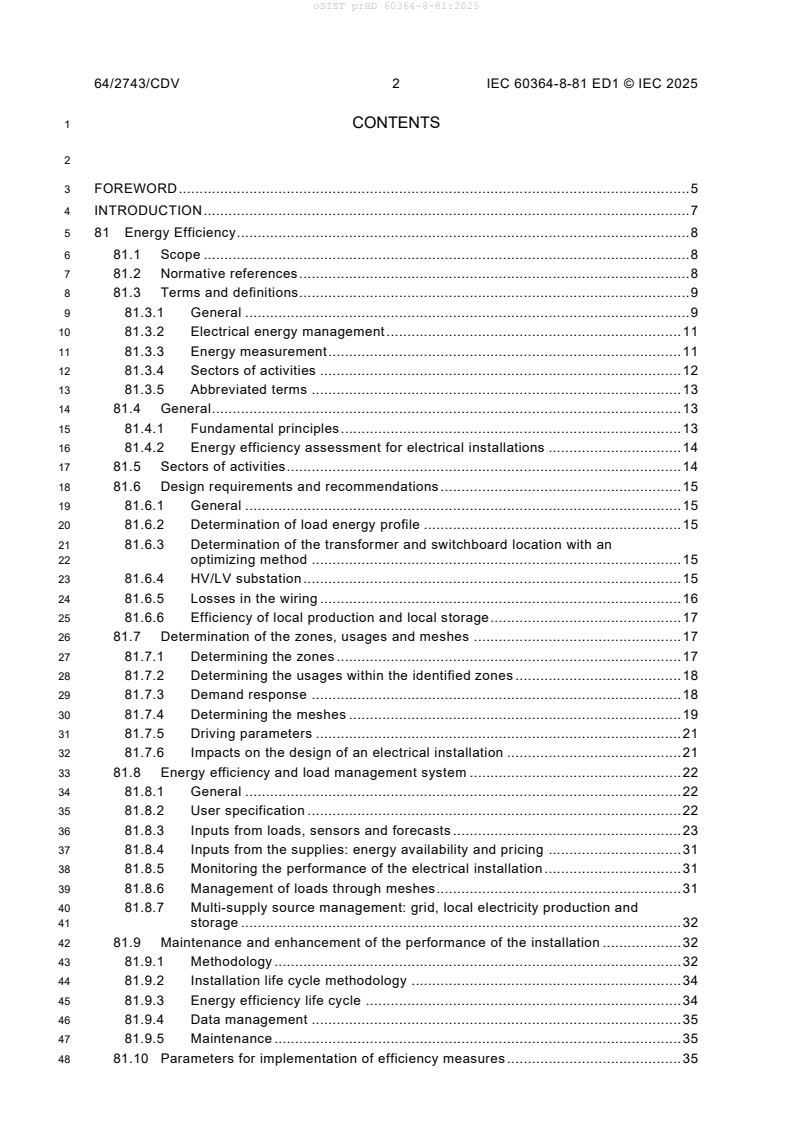
1 CONTENTS
3 FOREWORD . 5
4 INTRODUCTION . 7
5 81 Energy Efficiency . 8
6 81.1 Scope . 8
7 81.2 Normative references . 8
8 81.3 Terms and definitions. 9
9 81.3.1 General . 9
10 81.3.2 Electrical energy management . 11
11 81.3.3 Energy measurement . 11
12 81.3.4 Sectors of activities . 12
13 81.3.5 Abbreviated terms . 13
14 81.4 General . 13
15 81.4.1 Fundamental principles . 13
16 81.4.2 Energy efficiency assessment for electrical installations . 14
17 81.5 Sectors of activities . 14
18 81.6 Design requirements and recommendations . 15
19 81.6.1 General . 15
20 81.6.2 Determination of load energy profile . 15
21 81.6.3 Determination of the transformer and switchboard location with an
22 optimizing method . 15
23 81.6.4 HV/LV substation . 15
24 81.6.5 Losses in the wiring . 16
25 81.6.6 Efficiency of local production and local storage. 17
26 81.7 Determination of the zones, usages and meshes . 17
27 81.7.1 Determining the zones . 17
28 81.7.2 Determining the usages within the identified zones . 18
29 81.7.3 Demand response . 18
30 81.7.4 Determining the meshes . 19
31 81.7.5 Driving parameters . 21
32 81.7.6 Impacts on the design of an electrical installation . 21
33 81.8 Energy efficiency and load management system . 22
34 81.8.1 General . 22
35 81.8.2 User specification . 22
36 81.8.3 Inputs from loads, sensors and forecasts . 23
37 81.8.4 Inputs from the supplies: energy availability and pricing . 31
38 81.8.5 Monitoring the performance of the electrical installation . 31
39 81.8.6 Management of loads through meshes. 31
40 81.8.7 Multi-supply source management: grid, local electricity production and
41 storage . 32
42 81.9 Maintenance and enhancement of the performance of the installation . 32
43 81.9.1 Methodology . 32
44 81.9.2 Installation life cycle methodology . 34
45 81.9.3 Energy efficiency life cycle . 34
46 81.9.4 Data management . 35
47 81.9.5 Maintenance . 35
48 81.10 Parameters for implementation of efficiency measures . 35
oSIST prHD 60364-8-81:2025
IEC 60364-8-81 ED1 © IEC 2025 3 64/2743/CDV
49 81.10.1 General . 35
50 81.10.2 Efficiency measures . 35
51 81.11 Energy efficiency actions . 40
52 Annex A (informative) Determination of transformer and switchboard location . 42
53 A.1 Barycentre method . 42
54 A.2 Total load barycentre . 45
55 A.2.1 General . 45
56 A.2.2 Sub-distribution board locations . 46
57 A.2.3 Iterative process . 46
58 A.3 Method of average route length . 46
59 A.4 Minimum Energy Moment Method . 49
60 A.4.1 General . 49
61 A.4.2 Calculation of Load Center Coordinates . 49
62 A.4.3 Minimum Total Energy Moment and Minimum Average Load Distance of
63 the System . 50
64 A.4.4 Example . 50
65 A.4.5 Principle Derivation . 51
66 Annex B (normative) Method to assess the energy efficiency of an electrical
67 installation . 54
68 B.1 General . 54
69 B.2 Electrical installation efficiency classes . 54
70 B.3 Determination of the electrical installation efficiency class . 54
71 B.3.1 General . 54
72 B.3.2 Industrial, commercial buildings and infrastructures . 55
73 B.3.3 Residential . 70
74 Annex C (informative) List of notes concerning certain countries . 77
75 Bibliography . 78
77 Figure 1 – Energy efficiency and load management system overview . 22
78 Figure 2 – Electrical distribution scheme . 25
79 Figure 3 – Example of measurement equipment selection in an installation . 28
80 Figure 4 – Iterative process for electrical energy efficiency management . 33
81 Figure A.1 – Example 1: floor plan of production plant with the planned loads and
82 calculated barycentre . 44
83 Figure A.2 – Example 2: barycentre calculated . 45
84 Figure A.3 – Example of location of the barycentre in an industrial building . 46
85 Figure A.4 – Example of location of the barycentre using the average route length
86 method . 48
87 Figure A.5 – Example of location using the minimum Total Energy Moment and
88 Minimum Average Load Distance of the System . 50
89 Figure A.6 – relationship between the system’s total energy moment and the system’s
90 minimum energy moment . 53
91 Figure B.1 – Level of efficiency of the electrical installation efficiency classes . 54
93 Table 1 – Measurement applications . 24
94 Table 2 – Overview of the needs for power metering and monitoring . 25
95 Table 3 – Process for electrical energy efficiency management and responsibilities . 33
oSIST prHD 60364-8-81:2025
64/2743/CDV 4 IEC 60364-8-81 ED1 © IEC 2025
96 Table A.1 – Cable length for supply of DB . 47
97 Table B.1 – Electrical installation efficiency classes . 55
98 Table B.2 – Energy efficiency measures . 56
99 Table B.3 – Determination of energy consumption: coverage . 57
100 Table B.4 – Main substation: consumption . 57
101 Table B.5 – Main substation: location . 58
102 Table B.6 – Method of average route length . 58
103 Table B.7 – Voltage drop . 59
104 Table B.8 – Efficiency of transformer . 60
105 Table B.9 – Efficiency of fixed installed current using equipment . 60
106 Table B.10 – Zone . 61
107 Table B.11 – Usage . 61
108 Table B.12 – Demand response: coverage . 62
109 Table B.13 – Demand response: duration . 62
110 Table B.14 – Meshes . 62
111 Table B.15 – Measurement by usages . 63
112 Table B.16 – Occupancy coverage . 64
113 Table B.17 – Occupancy measurement . 64
114 Table B.18 – Energy management system (EEMS) . 64
115 Table B.19 – HVAC control . 65
116 Table B.20 – Lighting control . 65
117 Table B.21 – Performance maintenance process . 66
118 Table B.22 – Frequency of the performance verification process. 66
119 Table B.23 – Data management . 66
120 Table B.24 – Working point of transformer . 67
121 Table B.25 – Presence of continuous monitoring for large energy using systems . 67
122 Table B.26 – Power factor. 68
123 Table B.27 – THD . 68
U
124 Table B.28 – THD . 69
I
125 Table B.29 – Renewable energy . 69
126 Table B.30 – Electrical energy storage . 70
127 Table B.31 – Energy efficiency measures parameters . 70
128 Table B.32 – Determination of energy consumption . 71
129 Table B.33 – Zones. 72
130 Table B.34 – Demand response coverage . 72
131 Table B.35 – Meshes . 73
132 Table B.36 – HVAC control . 73
133 Table B.37 – Lighting control . 74
134 Table B.38 – Measurement by usages . 74
135 Table B.39 – Renewable energy . 75
136 Table B.40 – Electrical energy storage . 75
137 Table B.41 – Degree of self-sufficiency . 76
oSIST prHD 60364-8-81:2025
IEC 60364-8-81 ED1 © IEC 2025 5 64/2743/CDV
139 INTERNATIONAL ELECTROTECHNICAL COMMISSION
140 ____________
142 LOW-VOLTAGE ELECTRICAL INSTALLATIONS –
144 Part 8-81: Functional aspects - Energy efficiency
148 FOREWORD
149 1) The International Electrotechnical Commission (IEC) is a worldwide organization for standardization comprising
150 all national electrotechnical committees (IEC National Committees). The object of IEC is to promote international
151 co-operation on all questions concerning standardization in the electrical and electronic fields. To this end and
152 in addition to other activities, IEC publishes International Standards, Technical Specifications, Technical Reports,
153 Publicly Available Specifications (PAS) and Guides (hereafter referred to as "IEC Publication(s)"). Their
154 preparation is entrusted to technical committees; any IEC National Committee interested in the subject dealt with
155 may participate in this preparatory work. International, governmental and non-governmental organizations liaising
156 with the IEC also participate in this preparation. IEC collaborates closely with the International Organization for
157 Standardization (ISO) in accordance with conditions determined by agreement between the two organizations.
158 2) The formal decisions or agreements of IEC on technical matters express, as nearly as possible, an international
159 consensus of opinion on the relevant subjects since each technical committee has representation from all
160 interested IEC National Committees.
161 3) IEC Publications have the form of recommendations for international use and are accepted by IEC National
162 Committees in that sense. While all reasonable efforts are made to ensure that the technical content of IEC
163 Publications is accurate, IEC cannot be held responsible for the way in which they are used or for any
164 misinterpretation by any end user.
165 4) In order to promote international uniformity, IEC National Committees undertake to apply IEC Publications
166 transparently to the maximum extent possible in their national and regional publications. Any divergence between
167 any IEC Publication and the corresponding national or regional publication shall be clearly indicated in the latter.
168 5) IEC itself does not provide any attestation of conformity. Independent certification bodies provide conformity
169 assessment services and, in some areas, access to IEC marks of conformity. IEC is not responsible for any
170 services carried out by independent certification bodies.
171 6) All users should ensure that they have the latest edition of this publication.
172 7) No liability shall attach to IEC or its directors, employees, servants or agents including individual experts and
173 members of its technical committees and IEC National Committees for any personal injury, property damage or
174 other damage of any nature whatsoever, whether direct or indirect, or for costs (including legal fees) and
175 expenses arising out of the publication, use of, or reliance upon, this IEC Publication or any other IEC
176 Publications.
177 8) Attention is drawn to the Normative references cited in this publication. Use of the referenced publications is
178 indispensable for the correct application of this publication.
179 9) IEC draws attention to the possibility that the implementation of this document may involve the use of (a)
180 patent(s). IEC takes no position concerning the evidence, validity or applicability of any claimed patent rights in
181 respect thereof. As of the date of publication of this document, IEC had not received notice of (a) patent(s), which
182 may be required to implement this document. However, implementers are cautioned that this may not represent
183 the latest information, which may be obtained from the patent database available at https://patents.iec.ch shall
184 not be held responsible for identifying any or all such patent rights.
185 International Standard IEC 60364-8-81 has been prepared by IEC technical committee 64:
186 Electrical installations and protection against electric shock.
187 This first edition cancels and replaces the second edition of IEC 60364-8-1 published in 2019.
188 This edition constitutes a technical revision.
189 This edition includes the following significant technical changes with respect to the previous
190 edition:
191 a) Numbering for allowing parts 7 to amend this document;
192 b) Alignment of the definitions with IEV 826;
193 c) Introduction of minimum energy moment method in the Annex A;
oSIST prHD 60364-8-81:2025
64/2743/CDV 6 IEC 60364-8-81 ED1 © IEC 2025
194 d) Improvements in Annex B;
195 The text of this International Standard is based on the following documents:
Draft Report on voting
XX/XX/FDIS XX/XX/RVD
197 Full information on the voting for its approval can be found in the report on voting indicated in
198 the above table.
199 The language used for the development of this International Standard is English.
200 This document was drafted in accordance with ISO/IEC Directives, Part 2, and developed in
201 accordance with ISO/IEC Directives, Part 1 and ISO/IEC Directives, IEC Supplement, available
202 at www.iec.ch/members_experts/refdocs. The main document types developed by IEC are
203 described in greater detail at www.iec.ch/publications.
204 The committee has decided that the contents of this document will remain unchanged until the
205 stability date indicated on the IEC website under webstore.iec.ch in the data related to the
206 specific document. At this date, the document will be
207 • reconfirmed,
208 • withdrawn,
209 • replaced by a revised edition, or
210 • amended.
oSIST prHD 60364-8-81:2025
IEC 60364-8-81 ED1 © IEC 2025 7 64/2743/CDV
212 INTRODUCTION
214 The optimization of electrical energy usage can be facilitated by appropriate design and
215 installation considerations. An electrical installation can provide the required level of service
216 and safety for the lowest electrical consumption. This is considered by designers as a general
217 requirement of their design procedures in order to establish the best use of electrical energy.
218 In addition to the many parameters taken into account in the design of electrical installations,
219 more importance is nowadays focused on reducing losses within the system and its use. The
220 design of the whole installation has therefore to take into account inputs from users, suppliers
221 and utilities.
222 It is important that this document covers existing electrical installations in buildings, in addition
223 to new installations. It is in the refurbishment of existing buildings that significant overall
224 improvements in energy efficiency can be achieved.
225 The optimization of the use of electricity is based on energy efficiency management which is
226 based on the price of electricity, electrical consumption and real-time adaptation. Efficiency is
227 checked by measurement during the whole life of the electrical installation. This helps identify
228 opportunities for any improvements and corrections. Improvements and corrections may be
229 implemented by redesign or equipment replacement. The aim is to provide a design for an
230 efficient electrical installation which allows an energy management process to suit the user’s
231 needs, and in accordance with an acceptable investment. This document first introduces the
232 different measures to ensure an energy efficient installation based on kWh saving. It then
233 provides guidance on giving priority to the measures depending on the return of investment; i.e.
234 the saving of electrical energy and reducing of electrical power costs divided by the amount of
235 investment.
236 This document is intended to provide requirements and recommendations for the electrical part
237 of the energy management system addressed by ISO 50001.
238 It introduces requirements, recommendations and methods for the design and the energy
239 efficiency assessment of an electrical installation within the framework of an energy efficiency
240 management approach in order to get the best permanent functionally equivalent service for
241 the lowest electrical energy consumption and the most acceptable energy availability and
242 economic balance.
243 The assessment method described in Annex B based on the electrical energy efficiency of the
244 installation allows a classification of energy efficiency installation according to the following
245 levels:
247 NOTE Account can be taken, if appropriate, of induced works (civil works, compartmentalization) and the necessity
248 to expect, or not, the modifiability of the installation.
249 This document introduces requirements and recommendations to design the adequate
250 installation in order to give the ability to improve the management of the energy performance
251 of the installation by the tenant/user or for example the energy manager.
252 All requirements and recommendations of this part of IEC 60364 enhance the requirements
253 contained in Parts 1 to 8 of the IEC 60364 series.
oSIST prHD 60364-8-81:2025
64/2743/CDV 8 IEC 60364-8-81 ED1 © IEC 2025
254 LOW-VOLTAGE ELECTRICAL INSTALLATIONS –
256 Part 8-81: Functional aspects - Energy efficiency
260 81 Energy Efficiency
261 81.1 Scope
262 This part of IEC 60364 provides additional requirements, measures and recommendations for
263 the design, erection, operation and verification of all types of low voltage electrical installation
264 including local production and storage of energy for optimizing the overall efficient use of
265 electricity.
266 It introduces requirements, recommendations and methods for the design and the energy
267 efficiency (EE) assessment of an electrical installation within the framework of an energy
268 efficiency management approach in order to get the best permanent functionally equivalent
269 service for the lowest electrical energy consumption and the most acceptable energy availability
270 and economic balance.
271 These requirements, recommendations and methods apply, within the scope of the IEC 60364
272 (all parts), for new installations and modification of existing installations.
273 This document is applicable to the electrical installation of a building or system and does not
274 apply to products. The energy efficiency of products and their operational requirements are
275 covered by the relevant product standards.
276 Where another standard provides specific requirements for a particular system or installation
277 application (e.g. manufacturing system covered by ISO 20140 (all parts)), those requirements
278 may supersede this document.
279 This document does not specifically provide requirements for building automation systems.
280 Contribution of building automation systems to improve energy efficiency of the installation is
281 considered.
282 This group energy efficiency publication is primarily intended to be used as an energy efficiency
283 standard for the low voltage electrical installations mentioned in Clause 1, but is also intended
284 to be used by technical committees in the preparation of standards, in accordance with the
285 principles laid down in IEC Guide 118.
286 81.2 Normative references
287 The following documents are referred to in the text in such a way that some or all of their content
288 constitutes requirements of this document. For dated references, only the edition cited applies.
289 For undated references, the latest edition of the referenced document (including any
290 amendments) applies.
291 IEC 60688, Electrical measuring transducers for converting AC and DC electrical quantities to
292 analogue or digital
293 IEC 61557-12:2018, Electrical safety in low voltage distribution systems up to 1 000 V AC and
294 1 500 V DC - Equipment for testing, measuring or monitoring of protective measures - Part 12:
295 Power metering and monitoring devices (PMD)
oSIST prHD 60364-8-81:2025
IEC 60364-8-81 ED1 © IEC 2025 9 64/2743/CDV
296 IEC 61869-2, Instrument transformers – Part 2: Additional requirements for current
297 transformers
298 IEC 62053-21, Electricity metering equipment (a.c.) – Particular requirements – Part 21: Static
299 meters for active energy (classes 1 and 2)
300 IEC 62053-22, Electricity metering equipment (a.c.) – Particular requirements – Part 22: Static
301 meters for active energy (classes 0,2 S and 0,5 S)
302 IEC 62974-1, Monitoring and measuring systems used for data collection, gathering and
303 analysis – Part 1: Device requirements
304 IEC Guide 118, Inclusion of energy efficiency aspects in electrotechnical publications
305 81.3 Terms and definitions
306 For the purposes of this document, the following terms and definitions apply.
307 ISO and IEC maintain terminology databases for use in standardization at the following
308 addresses:
309 • IEC Electropedia: available at https://www.electropedia.org/
310 • ISO Online browsing platform: available at https://www.iso.org/obp
311 81.3.1 General
312 81.3.1.1
313 zone
314 area (or surface) defining a part of an installation
2 2
315 Note 1 to entry: Examples of a zone can be a kitchen of 20 m or a storage area of 500 m .
316 81.3.1.2
317 current-using equipment
318 electric equipment intended to convert electric energy into another form of energy , for example
319 light, heat, mechanical energy
320 [SOURCE: IEC 60050-826:2004, 826-16-02]
321 81.3.1.3
322 electrical installation
323 assembly of associated electric equipment having co-ordinated characteristics to fulfil specific
324 purposes
325 [SOURCE: IEC 60050-826:2004, 826-10-01]
326 81.3.1.4
327 usage
328 type of application for which electricity is used
329 EXAMPLE Lighting, heating.
330 81.3.1.5
331 load energy profile
332 figure representing the energy consumption (Y-axis) within a period of time (X-axis) based on
333 measurements for a mesh or a group of meshes
334 EXAMPLE Hourly consumption of energy for a period of a week.
oSIST prHD 60364-8-81:2025
64/2743/CDV 10 IEC 60364-8-81 ED1 © IEC 2025
335 81.3.1.6
336 power demand profile
337 figure representing the power demand (Y-axis) for a given integration period within a period of
338 time (X-axis) based on measurements for a mesh or a group of meshes
339 81.3.1.7
340 electrical energy efficiency
341 EEE
342 optimized usage of electrical energy
343 Note 1 to entry: The optimization includes both technical, economic and environmental aspects.
344 [SOURCE: IEC 60050-826:2022, 826-19-01]
346 81.3.1.8
347 mesh
348 one or more circuits of the electrical installation for one or more zones including one or more
349 services supplying a group of electrical equipment for the purpose of electrical energy efficiency
350 81.3.1.9
351 active electrical energy efficiency measures
352 operational measure(s) either manually or automatically controlled for optimizing the energy
353 usage of the electrical installation
354 EXAMPLE Thermostat control, occupancy lighting control, building optimization control systems.
355 [SOURCE: IEC 60050-826:2022, 826-19-02, modified – EXAMPLE has been added]
356 81.3.1.10
357 passive electrical energy efficiency measures
358 measures for optimizing the energy usage of the electrical installation by selection and erection
359 of electrical equipment other than control equipment
360 EXAMPLE Selection and location of transformer, cross section of cables, routing of wiring system, sub-division of
361 circuits.
362 [SOURCE: IEC 60050-826:2022, 826-19-03, modified – EXAMPLE has been added]
363 81.3.1.11
364 electrical installation efficiency class
365 defined level of energy efficiency for an electrical installation
366 Note 1 to entry: See Annex B.
367 81.3.1.12
368 driving parameter
369 external factors that affect energy efficiency
370 EXAMPLE Regulation, environmental conditions, occupancy, energy prices and management requirements, mode
371 of operation, duty cycle, load curves, state, operating, parameters, indoor temperature, lighting levels, production
372 volume.
373 81.3.1.13
374 barycentre method
375 procedure to optimize the position of energy source(s) and loads in consideration of energy
376 efficiency
oSIST prHD 60364-8-81:2025
IEC 60364-8-81 ED1 © IEC 2025 11 64/2743/CDV
377 81.3.1.14
378 EE assessment
379 process to determine the electrical installation efficiency class of an installation
380 81.3.2 Electrical energy management
381 81.3.2.1
382 electrical energy management system
383 EEMS
384 system monitoring, operating, controlling and managing energy resources and loads of the
385 installations
386 81.3.2.2
387 load shedding
388 method(s) of optimizing demand by controlling the electrical loads for variable periods of time
389 81.3.2.3
390 demand response
391 changes in electric usage by end-user customers from their normal consumption patterns in
392 response to changes in the price of electricity over time, or to incentive payments designed to
393 induce lower electricity use at times of high wholesale market prices or when system reliability
394 is jeopardized
395 81.3.2.4
396 user interface
397 means that allow the user to monitor and/or control the electrical installation, locally or remotely
398 EXAMPLE Visual or audible signal, local display, remote display, push button.
399 81.3.3 Energy measurement
400 81.3.3.1
401 measurement
402 process of obtaining value(s) that can be attributed to a quantity
403 81.3.3.2
404 monitoring
405 continuing procedure for the collection and assessment of pertinent information, including
406 measurements, for the purpose of identifying deviations and determining the effectiveness of
407 the plans and procedures
408 [SOURCE: IEC 60050-881:1983, 881-16-02, modified — Addition of “identifying deviations and”
409 deletion of "for radiation protection".]
410 81.3.3.3
411 power metering and monitoring device
412 PMD
413 combination in one or more devices of several functional modules dedicated to metering and
414 monitoring electrical parameters in energy distribution systems or electrical installations, used
415 for applications such as energy efficiency, power monitoring and network performance
416 Note 1 to entry: This note applies to the French language only.
417 81.3.3.4
418 billing
419 process that allows energy suppliers or their representatives to invoice their customers
420 according to a defined contract
421 Note 1 to entry: These applications can be covered by international standards, regulations such as MID in Europe
422 or NMI in Australia, and/or utility specifications.
oSIST prHD 60364-8-81:2025
64/2743/CDV 12 IEC 60364-8-81 ED1 © IEC 2025
423 81.3.3.5
424 sub-billing
425 process that allows the property manager to allocate an energy invoice from the energy supplier
426 and charges as appropriate to specific tenants
427 81.3.3.6
428 cost allocation
429 process that allows a facility manager to account for energy costs from internal cost centres
430 that consume energy
431 EXAMPLE Process line, test and inspection, administration.
432 81.3.3.7
433 estimation
434 process of judging one or more values that can be attributed to a quantity
435 Note 1 to entry: Estimation by a competent person can provide data of a reasonable accuracy.
436 81.3.3.8
437 forecast
438 estimate of the expected value of a parameter at a given future date
439 81.3.3.9
440 total harmonic distortion of the voltage wave
441 THD
U
442 ratio of the RMS value of the harmonic content of an alternating quantity (voltage) to the RMS
443 value of the fundamental component of the quantity (voltage)
444 81.3.3.10
445 total harmonic distortion of the current wave
446 THD
I
447 ratio of the RMS value of the harmonic content of an alternating quantity (current) to the RMS
448 value of the fundamental component of the quantity (current)
449 81.3.3.11
450 Degree day
451 A unit used to determine the heating requirements of buildings, representing a fall of one degree
452 below a specified average outdoor temperature (usually 18°C) for one day
453 81.3.4 Sectors of activities
454 81.3.4.1
455 residential installations
456 premises designed and constructed for private habitation and including associated areas
457 Note 1 to entry: Associated areas include common areas, garages, gardens, pools.
458 81.3.4.2
459 commercial installations
460 premises designed and constructed for commercial operations
461 EXAMPLE Offices, retail, distribution centres, public buildings, banks, hotels, hospitals, schools.
462 81.3.4.3
463 industrial installations
464 premises designed and constructed for manufacturing and processing operations
465 EXAMPLE Factories, workshops.
oSIST prHD 60364-8-81:2025
IEC 60364-8-81 ED1 © IEC 2025 13 64/2743/CDV
466 81.3.4.4
467 infrastructure installations
468 systems or premises designed and constructed for transport or utility operations
469 EXAMPLE Airport terminals, port facilities, transport facilities.
470 81.3.5 Abbreviated terms
471 BS bonus
472 DB distribution board
473 DSO distribution system operator
474 EEE Electrical energy efficiency
475 EM energy management
476 HVAC heating, ventilation and air conditioning
477 ICT information and communications technologies
478 KPI key performance indicator
479 MA performance maintenance
480 PDS power drive system
481 PEI peak efficiency index
482 PM power monitoring
483 PMD power metering and monitoring device
484 PV photovoltaic
485 THD total harmonic distortion
486 UPS uninterruptible power supplies
487 81.4 General
488 81.4.1 Fundamental principles
489 81.4.1.1 Safety of the electrical installation
490 The requirements and recommendations of this part of IEC 60364 shall not impair requirements
491 included in other parts of the IEC 60364 series.
492 81.4.1.2 Availability of electrical energy and user decision
493 Energy efficiency management shall not reduce electrical availability and/or services or
494 operation below the level desired by the user.
495 The electrical installation shall have provisions for overriding the energy efficiency management
496 settings according to the user’s decision.
497 EXAMPLE 1 If someone is ill, the user can decide to heat the room to a higher temperature, even during peak
498 consumption.
499 EXAMPLE 2 If a company receives an urgent delivery order, there can be a need for the workshop to operate at an
500 unexpected hour.
501 81.4.1.3 Design principles
502 The design principles of this document take into account the following aspects:
503 – load energy profile (active and reactive energy);
504 – availability of local generation (PV, wind turbine, generator, etc.) and storage;
505 – reduction of energy losses in the electrical installation;
oSIST prHD 60364-8-81:2025
64/2743/CDV 14 IEC 60364-8-81 ED1 © IEC 2025
506 – the arrangement of the circuits with regard to energy efficiency (meshes, see 81.7.4);
507 – the customer's power use distribution over time;
508 – the tariff structure offered by the supplier of the electrical energy;
509 maintaining the quality of service and the performance of the electrical installation.
510 In order to verify the achievement of electrical energy efficiency measures, an overall energy
511 efficiency assessment should be made.
512 81.4.2 Energy efficiency assessment for electrical installations
513 81.4.2.1 General
514 Assessment of installations shall be performed according to Annex BError! Reference source n
515 ot found. This assessment should be achieved preferably by measurement. It can be
516 alternatively achieved by calculation.
517 The frequency of periodic inspection of an installation shall be determined having regard to the
518 type of installation and equipment, its use and operation, the frequency and quality of
519 maintenance, factors liable to influence energy efficiency and the external influences to which
520 it is subjected. The results and recommendations of the previous report, if any, shall be taken
521 into account.
522 The maximum interval for follow-up assessment should not exceed:
523 – five years for commercial;
524 – three years for industrial and infrastructure.
525 81.4.2.2 Action plan following an assessment according to Annex B
526 Where assessment is performed on a new installation and the assessment identified an
527 electrical installation efficiency class lower than required, the identified variances shall be
528 corrected.
529 Where periodic assessment identifies the electrical installation efficiency class is not at the
530 expected level, an action
...