

SIST EN 14878:2008
(Main)Textiles - Burning behaviour of children's nightwear - Specification
General Information
- Abstract
This European Standard specifies requirements for the burning behaviour of children’s nightwear and nightwear fabrics intended for such garments when tested in accordance with EN 1103 but without the washing procedure.
- Status
- Published
- Publication Date
- 17-Feb-2008
- Technical Committee
- ITEK - Textile and textile products
- Current Stage
- 6060 - National Implementation/Publication (Adopted Project)
- Start Date
- 07-Feb-2008
- Due Date
- 13-Apr-2008
- Completion Date
- 18-Feb-2008



Overview
EN 14878:2007 - Textiles: Burning behaviour of children's nightwear - Specification is a European CEN standard that defines how to assess and classify the burning behaviour of children’s nightwear and fabrics used for such garments. Testing is performed using the EN 1103 test procedure (time of flame spread and surface flash) but without the EN 1103 washing/cleansing step, and results are used to assign fabric/garment classes that guide safety, design and labelling.
Key topics and technical requirements
- Scope: Applies to children’s nightwear (including bathrobes, dressing gowns, night shirts, dresses and pyjamas). Babies’ nightwear (under 6 months) is excluded from testing (Class C: not tested).
- Test method: Measure surface flash and time of flame spread in accordance with EN 1103; tests are performed on garments/fabrics as received (no washing).
- Sampling: At least one representative sample with three specimens in the machine direction and three in the cross direction. Multi-layer assemblies must be tested in the arrangement used in the garment.
- Classification (Table 1):
- Class A (children’s nightwear, NOT pyjamas): No surface flash; 3rd marker thread (520 mm) must not be severed in less than 15 s.
- Class B (children’s pyjamas): No surface flash; 3rd marker thread not severed in less than 10 s.
- Class C (babies’ nightwear): Not tested.
- Statistical rules: If ≥2 of 6 specimens fall into a lower class, the material is that lower class. If 1 of 6 is lower, test three additional specimens in the same direction to decide class.
- Design limits for pyjamas: Constraints on hem circumference, length below crotch, trouser leg tapering, and sleeve cuff widths to reduce ignition risk (details in Clause 10).
- Flame retardants & toxicology: Manufacturers/retailers are responsible for ensuring any chemical flame retardant used is assessed for toxicity/ecotoxicity and durable for the garment’s expected life.
- Labelling (Annex A): If labelled, the label should display “WARNING – keep away from fire” in red and indicate the Fabric Class A, B or C EN 14878.
- Test report requirements: Must include lab name, product identification, class result, reference to EN 14878 and EN 1103 edition used, deviations, date and relevant test details.
Applications and who uses this standard
- Textile and children’s nightwear manufacturers - design, material selection, production compliance.
- Product safety and compliance teams / retailers - ensure garments placed on the EU market meet flammability requirements and labelling guidance.
- Test laboratories - perform EN 1103-based tests and classify fabrics/garments per EN 14878.
- Designers & product managers - apply design constraints and risk assessment guidance to reduce ignition hazards.
- Regulators and standards bodies - harmonise national rules with European requirements.
Related standards and references
- EN 1103 - detailed procedure to determine burning behaviour (test method referenced).
- EN 13402-1 and EN 13402-3 - sizing guidance referenced for measurements.
- Directive 2001/95/EC (General Product Safety) and national provisions (e.g., UK Nightwear (Safety) Regulations 1985) are noted as related regulatory context.
Relations
- Effective Date
- 28-Jan-2026
- Corrected By
SIST EN 14878:2007/AC:2009 - Textiles - Burning behaviour of children's nightwear - Specification - Effective Date
- 01-Apr-2009
Get Certified
Connect with accredited certification bodies for this standard

CIS Institut d.o.o.
Personal Protective Equipment (PPE) certification body. Notified Body NB-2890 for EU Regulation 2016/425 PPE.

Kiwa BDA Testing
Building and construction product certification.
Kmetijski inštitut Slovenije
Agricultural Institute of Slovenia. Soil testing, plant health, agricultural product analysis.
Sponsored listings
Frequently Asked Questions
SIST EN 14878:2008 is a standard published by the Slovenian Institute for Standardization (SIST). Its full title is "Textiles - Burning behaviour of children's nightwear - Specification". This standard covers: This European Standard specifies requirements for the burning behaviour of children’s nightwear and nightwear fabrics intended for such garments when tested in accordance with EN 1103 but without the washing procedure.
This European Standard specifies requirements for the burning behaviour of children’s nightwear and nightwear fabrics intended for such garments when tested in accordance with EN 1103 but without the washing procedure.
SIST EN 14878:2008 is classified under the following ICS (International Classification for Standards) categories: 13.220.40 - Ignitability and burning behaviour of materials and products; 61.020 - Clothes; 97.190 - Equipment for children. The ICS classification helps identify the subject area and facilitates finding related standards.
SIST EN 14878:2008 has the following relationships with other standards: It is inter standard links to SIST EN 1103:2006, SIST EN 14878:2007/AC:2009. Understanding these relationships helps ensure you are using the most current and applicable version of the standard.
SIST EN 14878:2008 is associated with the following European legislation: Standardization Mandates: M/304. When a standard is cited in the Official Journal of the European Union, products manufactured in conformity with it benefit from a presumption of conformity with the essential requirements of the corresponding EU directive or regulation.
SIST EN 14878:2008 is available in PDF format for immediate download after purchase. The document can be added to your cart and obtained through the secure checkout process. Digital delivery ensures instant access to the complete standard document.
Standards Content (Sample)
2003-01.Slovenski inštitut za standardizacijo. Razmnoževanje celote ali delov tega standarda ni dovoljeno.Textiles - Burning behaviour of children's nightwear - SpecificationTextiles - Comportement au feu des vetements de nuit des enfants - SpécificationTextilien - Brennverhalten von Kindernachtwäsche - AnforderungenTa slovenski standard je istoveten z:EN 14878:2007SIST EN 14878:2008en,fr,de97.19061.02013.220.40ICS:SLOVENSKI
STANDARDSIST EN 14878:200801-marec-2008
EUROPEAN STANDARDNORME EUROPÉENNEEUROPÄISCHE NORMEN 14878May 2007ICS 61.020; 97.190 English VersionTextiles - Burning behaviour of children's nightwear -SpecificationTextiles - Comportement au feu des vêtements de nuit desenfants - SpécificationTextilien - Brennverhalten von Kindernachtwäsche -AnforderungenThis European Standard was approved by CEN on 26 April 2007.CEN members are bound to comply with the CEN/CENELEC Internal Regulations which stipulate the conditions for giving this EuropeanStandard the status of a national standard without any alteration. Up-to-date lists and bibliographical references concerning such nationalstandards may be obtained on application to the CEN Management Centre or to any CEN member.This European Standard exists in three official versions (English, French, German). A version in any other language made by translationunder the responsibility of a CEN member into its own language and notified to the CEN Management Centre has the same status as theofficial versions.CEN members are the national standards bodies of Austria, Belgium, Bulgaria, Cyprus, Czech Republic, Denmark, Estonia, Finland,France, Germany, Greece, Hungary, Iceland, Ireland, Italy, Latvia, Lithuania, Luxembourg, Malta, Netherlands, Norway, Poland, Portugal,Romania, Slovakia, Slovenia, Spain, Sweden, Switzerland and United Kingdom.EUROPEAN COMMITTEE FOR STANDARDIZATIONCOMITÉ EUROPÉEN DE NORMALISATIONEUROPÄISCHES KOMITEE FÜR NORMUNGManagement Centre: rue de Stassart, 36
B-1050 Brussels© 2007 CENAll rights of exploitation in any form and by any means reservedworldwide for CEN national Members.Ref. No. EN 14878:2007: E
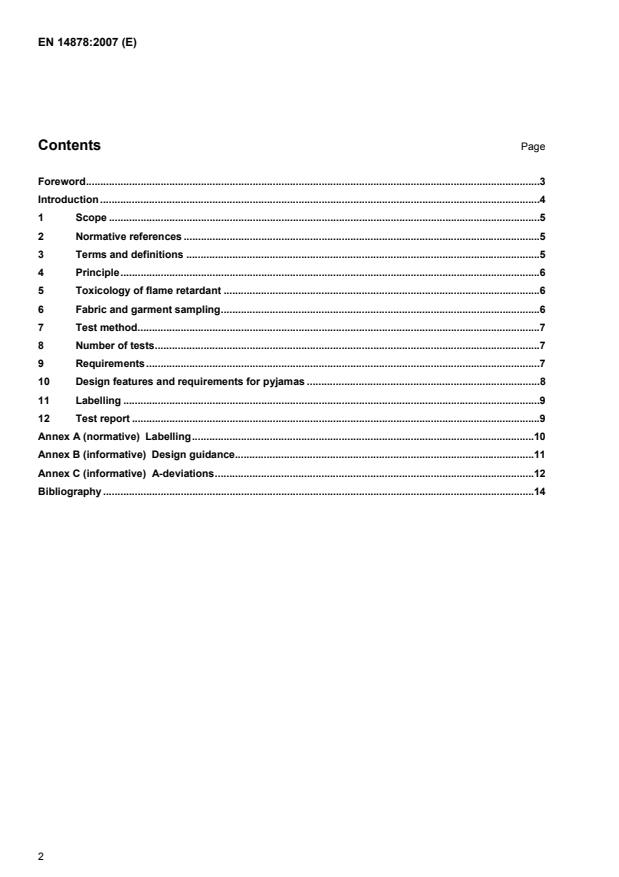
Labelling.10 Annex B (informative)
Design guidance.11 Annex C (informative)
A-deviations.12 Bibliography.14
On the basis that babies of this age are not yet mobile, i.e. they are unable to crawl or walk, the risk was considered low. The principle upon which this standard is based is the acceptance that most, but not all, fabrics used in the manufacture of children’s nightwear will ignite when exposed to a small flame.
On this premise therefore, there is no requirement for a specific ignitability test.
The specification requires that the parameters of time of flame spread and surface flash are measured using a specified test procedure (EN 1103). The risk of fire may be diminished in some situations by the use of a suitable flame retardant. However, the application of a flame retardant could be considered to present a health risk.
Both points of view were discussed in the feasibility study, prepared under a Mandate (M/263) that preceded the Standardization Mandate.
Following the publication and implementation of this standard in CEN countries, there should be an 18 month transition period from the date of availability, to allow manufacturers to develop and produce garments that conform to the standards.
The period is also to allow the supply chain, from manufacturer to the consumer, to be cleared on non-conforming garments. According to the CEN/CENELEC Internal Regulations, the national standards organizations of the following countries are bound to implement this European Standard: Austria, Belgium, Bulgaria, Cyprus, Czech Republic, Denmark, Estonia, Finland, France, Germany, Greece, Hungary, Iceland, Ireland, Italy, Latvia, Lithuania, Luxembourg, Malta, Netherlands, Norway, Poland, Portugal, Romania, Slovakia, Slovenia, Spain, Sweden, Switzerland and United Kingdom.
Within the scope of this specification it is not possible to cover all the potential hazards that may create an unsafe garment; conversely, indefinable specific hazards in certain styles/design of garment may not present a risk.
It is therefore recommended that an individual risk assessment is carried out on any garment in order to ensure that it does not present a hazard to the wearer and can therefore be deemed to be a ‘safe’ garment.
This includes the use of applied flame retardant treatments.
Durability of such finishes will require assessment.
No European Standard method addressing durability of such treatments has yet been established.
1 Scope This European Standard specifies requirements for the burning behaviour of children’s nightwear and nightwear fabrics intended for such garments when tested in accordance with EN 1103 but without the washing procedure.
2 Normative references
The following referenced documents are indispensable for the application of this document. For dated references, only the edition cited applies. For undated references, the latest edition of the referenced document (including any amendments) applies. EN 1103, Textiles - Fabrics for apparel - Detailed procedure to determine the burning behaviour 3 Terms and definitions For the purposes of this document, the terms and definitions given in EN 1103 and the following apply. 3.1 nightwear garments that are either sold as nightwear or intended to be worn as nightwear, e.g. bathrobes, dressing gowns, night shirts, nightdresses and pyjamas 3.1.1 babies’ nightwear nightwear intended to be worn by babies (see 3.3) 3.1.2 children’s nightwear nightwear intended to be worn by children (see 3.4) 3.2 pyjamas either two or several piece nightwear garment comprising trouser, shorts or briefs and top.
It may also comprise one-piece pyjama type with top integral to trouser.
The trouser may be with or without feet 3.3 babies
babies up to six (6) months of age and having a height up to 68 cm
3.4 children young persons over six (6) months and up to the age of fourteen (14) years. Girls having a height between 68 cm and 176 cm and boys between 68 cm and 182 cm 3.5 specimens representative pieces of the product which are tested together with any lining/substrate or treatment
The properties of time of flame spread and surface flash are evaluated by submitting a sample to the application of a specified test method contained in EN 1103.
EN 1103 contains a cleansing procedure which is not applied to any test material covered by this standard as a single wash has been found to have little or no effect on finishes used on nightwear. 5 Toxicology of flame retardant A flame retardant is a substance used to impart improved fire behaviour to a material.
When a flame retardant is applied to a textile to be used in nightwear conforming to this standard, it will be the responsibility of the manufacturer/retailer placing the chemically treated flame retardant nightwear on the European market to ensure the finish being used has been adequately assessed for risk of toxicity and/or eco toxicity and is considered safe for its intended use by the EU Scientific Committee on Health and Environmental Risks (SCHER). Any flame retardant used to impart a degree of reduction of any of the measured parameters shall be able to provide this reduction during the expected life of the garmen
...