

kSIST FprEN 13598-2:2026
(Main)Plastics piping systems for non-pressure underground drains and sewers - Unplasticized poly(vinyl chloride) (PVC-U), polypropylene (PP) and polyethylene (PE) - Part 2: Specifications for manholes and inspection chambers
- Abstract
This document specifies the definitions and requirements for unplasticized polyvinyl chloride (PVC-U), polypropylene (PP) and polyethylene (PE) manholes and inspection chambers having a base with a flow channel and joints to the piping system, intended for use in non-pressure underground drains and sewers for wastewater, up to a maximum depth of 6 m from ground level to the invert of the flow channel.
This document is applicable to manholes and inspection chambers, intended for use buried in the ground outside a building structure, reflected by the marking of products by “U”.
This document is applicable to manholes and inspection chambers intended for use in pedestrian or vehicular trafficked areas.
NOTE 1 Products complying with this document can also be used in non-traffic areas.
NOTE 2 Products complying with this document can be installed without additional static calculation.
Manhole and inspection chamber components complying with this document can be manufactured by various methods e.g. extrusion, injection moulding, rotational moulding, low-pressure moulding or factory fabricated.
Manholes and inspection chambers complying with this document are made from a prescribed set of components that are assembled together or manufactured as a single unit.
NOTE 3 The complete manhole or inspection chamber assembly includes items which are not specified in this document (for example near surface or surface components such as covers, frames and gratings complying with the relevant part of EN 124 [1]).
NOTE 4 Manholes and inspection chambers can be subject to national regulations and / or local provisions.
- Status
- Not Published
- Public Enquiry End Date
- 30-Jan-2026
- Technical Committee
- PCV - Plastic pipes, fittings and valves
- Current Stage
- 5020 - Formal vote (FV) (Adopted Project)
- Start Date
- 19-Oct-2026
- Due Date
- 07-Dec-2026
- Completion Date
- 19-Oct-2026

kSIST FprEN 13598-2:2026 is a SIST publication of a draft European Standard for plastics piping systems for non-pressure underground drains and sewers. It specifies definitions, material requirements, dimensions, test methods, marking and documentation for PVC-U, PP and PE manholes and inspection chambers used in buried wastewater applications outside buildings.
What does kSIST FprEN 13598-2:2026 specify?
kSIST FprEN 13598-2:2026 covers manholes and inspection chambers with a base that has a flow channel and joints to the piping system. It applies to installations in non-pressure underground drains and sewers for wastewater, up to a maximum depth of 6 m from ground level to the invert of the flow channel.
The document applies to products marked with application area code “U”, meaning buried use outside a building structure. It also applies to products intended for pedestrian or vehicular trafficked areas, and it notes that compliant products can also be used in non-traffic areas.
The standard does not cover sewage pump chambers, valve chambers and similar products. It is organized into clauses on scope, normative references, terms and definitions, symbols and abbreviations, material, general characteristics, geometry, mechanical and physical characteristics, performance requirements, sealing rings, marking, and additional documentation, followed by four normative annexes.
| Annex | What it covers |
|---|---|
| Annex A | Test method for durability |
| Annex B | Test method for structural integrity of bases |
| Annex C | Test method for impact resistance of bases |
| Annex D | Utilization of recyclates |
What are the key requirements of kSIST FprEN 13598-2:2026?
kSIST FprEN 13598-2:2026 sets out a complete product and test framework for manholes and inspection chambers. In practice, it tells a manufacturer what materials may be used, how the parts are to be dimensioned and tested, and what must appear on the product marking and in the installation guide.
Materials and allowable feedstock
Clause 5 requires components to be made from PVC-U, PP or PE. Virgin material, reworked material and recyclates are permitted, but recyclates must comply with Annex D. This matters because a producer must control the formulation and keep proof that recycled content and additives still meet the performance requirements.
Clause 5 also separates the material requirements for bases, risers, cones and telescopic adaptors. Some parts can be accepted without extra testing when they are made from material or formulations already shown to comply with the relevant earlier tables. That reduces duplicate testing, but only when the material pedigree is clear.
Appearance and geometry
Clause 6 requires internal and external surfaces to be smooth, clean and free from defects that could affect compliance. Clause 7 requires the manufacturer to declare geometrical characteristics and tolerances, and all dimensions must be measured in accordance with EN ISO 3126.
For manholes, the riser diameter is used for designation, and the clear opening of the cover is tied to EN 124. For inspection chambers, the riser diameter also defines the nominal size. This is important when selecting access equipment, matching covers and confirming that the chamber suits the intended site layout.
Base connections, steps and ladders
Clause 7 requires base connections to pipework to be compatible with the intended pipe standards and to keep the invert continuous within defined tolerances when factory tested. The standard also sets requirements for steps, permanently fixed ladders and ladder fixing provisions. In practice, this controls how easily the chamber connects to the network and how safely personnel can enter or inspect it.
Plastic steps have minimum width, projection and spacing requirements, while metal steps must comply with EN 13101. Permanently fixed ladders and fixing provisions must comply with EN 14396. That means access hardware is not left to local improvisation - it is tied to recognized ladder and step standards.
Mechanical and physical performance
Clause 8 requires the base, riser, telescopic adaptor and steps to meet mechanical test requirements. For bases, the standard uses structural integrity, impact resistance and impact strength tests; for risers and telescopic adaptors, it uses ring stiffness; for steps, it uses load-bearing and pull-out resistance.
Clause 9 covers physical characteristics and, for factory fabricated components, requires watertightness testing. Clause 10 then extends this to the assembled system, including base-to-pipe, base-to-riser, riser-to-riser and other component joints. For a buyer or installer, this means the chamber is evaluated as a system, not only as separate parts.
Joint tightness and groundwater performance
Clause 10 requires all joints covered by the document to meet the leak-tight requirements for gravity systems in EN 476. The tests include water-pressure and air-pressure checks, angular deflection checks, and a water-fill test for the assembly.
The standard also links performance to the declared maximum height of groundwater above invert, H. This matters on site because the chamber must resist groundwater and maintain watertightness under the stated installation conditions.
Marking and documentation
Clause 12 requires marking on bases and on separately sold components such as cones, risers and telescopic adaptors. The marking includes the standard number, manufacturer identification, material, sizes and relevant performance information such as maximum allowed groundwater height and maximum installation depth.
The installation guide must include bedding and side-fill compaction advice, the specified cover solution with classification class, the intended pipe sizes, a description of the assembled chamber, intended use, and ladder or steps if applicable. That gives installers the information they need to place and connect the product correctly.
What terms does kSIST FprEN 13598-2:2026 define?
- Application area code “U” - the code for buried use more than 1 m from the building to which the system is connected.
- Manhole - a chamber with a removable cover that allows personnel entry, with a riser of at least 800 mm minimum inside diameter.
- Inspection chamber - a chamber with a removable cover for cleaning and inspection equipment, but not personnel entry, with a riser of at least 200 mm minimum outer diameter.
- Base - the bottom part of the chamber, including the flow channel and the direct connection to buried pipework.
- Flow channel - the open continuation of the sewer network inside the chamber that supports directional changes while maintaining hydraulic performance.
- Riser - the component connected to the base that defines the nominal size of the chamber.
- Telescopic adaptor - the top component that allows adjustment of the surface component and helps accommodate settlement.
- Recyclate - plastics material made by recycling pre-consumer and post-consumer plastics products.
Who uses kSIST FprEN 13598-2:2026?
kSIST FprEN 13598-2:2026 is used by manufacturers of PVC-U, PP and PE manholes and inspection chambers, especially those making parts by extrusion, injection moulding, rotational moulding, low-pressure moulding or factory fabrication. It is also used by test laboratories, certification bodies, specifiers, utility buyers, contractors and quality managers working on external sewage systems.
In practice, these users apply the standard to choose materials, design chamber geometry, verify compatibility with pipes and covers, run durability and watertightness tests, and prepare product marking and installation instructions. It is relevant wherever buried non-pressure wastewater drainage systems need manholes or inspection chambers with defined performance.
What changed in kSIST FprEN 13598-2:2026 from the previous edition?
kSIST FprEN 13598-2:2026 supersedes EN 13598-2:2020. The foreword lists these main technical changes:
- terminology updated to align with the TC155 Oslo agreement and EN 14541-1, with additional terms and definitions added;
- material clauses and Annex D updated;
- format of units and symbols in tables updated.
Which standards are used with kSIST FprEN 13598-2:2026?
kSIST FprEN 13598-2:2026 relies on several companion standards for materials, parts and testing. EN 476 sets general requirements for drain and sewer components, while EN 681-1 to EN 681-4 cover elastomeric seal materials.
For product compatibility and material control, the document uses EN 1401-1, EN 1852-1, EN 12666-1, EN 13476-2, EN 13476-3 and EN 14758-1. For access hardware it refers to EN 13101:2002 and EN 14396. For test methods it uses EN ISO 3126, EN ISO 13254, EN ISO 13259:2020, EN ISO 13263, EN ISO 13266, EN ISO 13267:2023 and EN ISO 13268, together with EN ISO 1183-1/-2, EN ISO 1133-1, EN ISO 11357-6, EN ISO 1158, EN ISO 2507-1, EN ISO 3451-1/-5, EN ISO 527-2, EN ISO 9967:2016 and EN ISO 13229.
Annex D also draws on EN 15344:2025, CEN/TS 17627, EN 12099, EN ISO 9001, CEN/TS 16010 and CEN/TS 16011 for recyclate control and sampling.
What does the kSIST FprEN 13598-2:2026 document contain?
The document contains a material framework in Clause 5, including durability requirements for bases, risers, cones and telescopic adaptors, plus a separate section for sealing ring retaining components. It also contains geometry and access requirements, including chamber dimensions, pipe connection dimensions, steps, ladders and fixing provisions.
The performance section includes mechanical tables for bases, risers, telescopic adaptors and steps, plus watertightness requirements for factory fabricated components and assembled systems. The annexes provide the test procedures behind durability, structural integrity and impact resistance, and Annex D provides the rules for using recyclates.
Relations
- Effective Date
- 09-Oct-2024
Get Certified
Connect with accredited certification bodies for this standard

Institut za varilstvo d.o.o. (Welding Institute)
Slovenia's leading welding institute since 1952. ISO 3834, EN 1090, pressure equipment certification, NDT personnel, welder qualification. Only IIW Au

Zavod za gradbeništvo Slovenije (ZAG) - Inšpekcija
ZAG inspection body for construction products, structures, and materials.
Sponsored listings
Frequently Asked Questions
kSIST FprEN 13598-2:2026 is a draft published by the Slovenian Institute for Standardization (SIST). Its full title is "Plastics piping systems for non-pressure underground drains and sewers - Unplasticized poly(vinyl chloride) (PVC-U), polypropylene (PP) and polyethylene (PE) - Part 2: Specifications for manholes and inspection chambers". This standard covers: This document specifies the definitions and requirements for unplasticized polyvinyl chloride (PVC-U), polypropylene (PP) and polyethylene (PE) manholes and inspection chambers having a base with a flow channel and joints to the piping system, intended for use in non-pressure underground drains and sewers for wastewater, up to a maximum depth of 6 m from ground level to the invert of the flow channel. This document is applicable to manholes and inspection chambers, intended for use buried in the ground outside a building structure, reflected by the marking of products by “U”. This document is applicable to manholes and inspection chambers intended for use in pedestrian or vehicular trafficked areas. NOTE 1 Products complying with this document can also be used in non-traffic areas. NOTE 2 Products complying with this document can be installed without additional static calculation. Manhole and inspection chamber components complying with this document can be manufactured by various methods e.g. extrusion, injection moulding, rotational moulding, low-pressure moulding or factory fabricated. Manholes and inspection chambers complying with this document are made from a prescribed set of components that are assembled together or manufactured as a single unit. NOTE 3 The complete manhole or inspection chamber assembly includes items which are not specified in this document (for example near surface or surface components such as covers, frames and gratings complying with the relevant part of EN 124 [1]). NOTE 4 Manholes and inspection chambers can be subject to national regulations and / or local provisions.
This document specifies the definitions and requirements for unplasticized polyvinyl chloride (PVC-U), polypropylene (PP) and polyethylene (PE) manholes and inspection chambers having a base with a flow channel and joints to the piping system, intended for use in non-pressure underground drains and sewers for wastewater, up to a maximum depth of 6 m from ground level to the invert of the flow channel. This document is applicable to manholes and inspection chambers, intended for use buried in the ground outside a building structure, reflected by the marking of products by “U”. This document is applicable to manholes and inspection chambers intended for use in pedestrian or vehicular trafficked areas. NOTE 1 Products complying with this document can also be used in non-traffic areas. NOTE 2 Products complying with this document can be installed without additional static calculation. Manhole and inspection chamber components complying with this document can be manufactured by various methods e.g. extrusion, injection moulding, rotational moulding, low-pressure moulding or factory fabricated. Manholes and inspection chambers complying with this document are made from a prescribed set of components that are assembled together or manufactured as a single unit. NOTE 3 The complete manhole or inspection chamber assembly includes items which are not specified in this document (for example near surface or surface components such as covers, frames and gratings complying with the relevant part of EN 124 [1]). NOTE 4 Manholes and inspection chambers can be subject to national regulations and / or local provisions.
kSIST FprEN 13598-2:2026 is classified under the following ICS (International Classification for Standards) categories: 23.040.05 - Pipelines and its parts for external sewage systems; 23.040.20 - Plastics pipes; 93.030 - External sewage systems. The ICS classification helps identify the subject area and facilitates finding related standards.
kSIST FprEN 13598-2:2026 has the following relationships with other standards: It is inter standard links to SIST EN 13598-2:2020. Understanding these relationships helps ensure you are using the most current and applicable version of the standard.
kSIST FprEN 13598-2:2026 is available in PDF format for immediate download after purchase. The document can be added to your cart and obtained through the secure checkout process. Digital delivery ensures instant access to the complete standard document.
Standards Content (Sample)
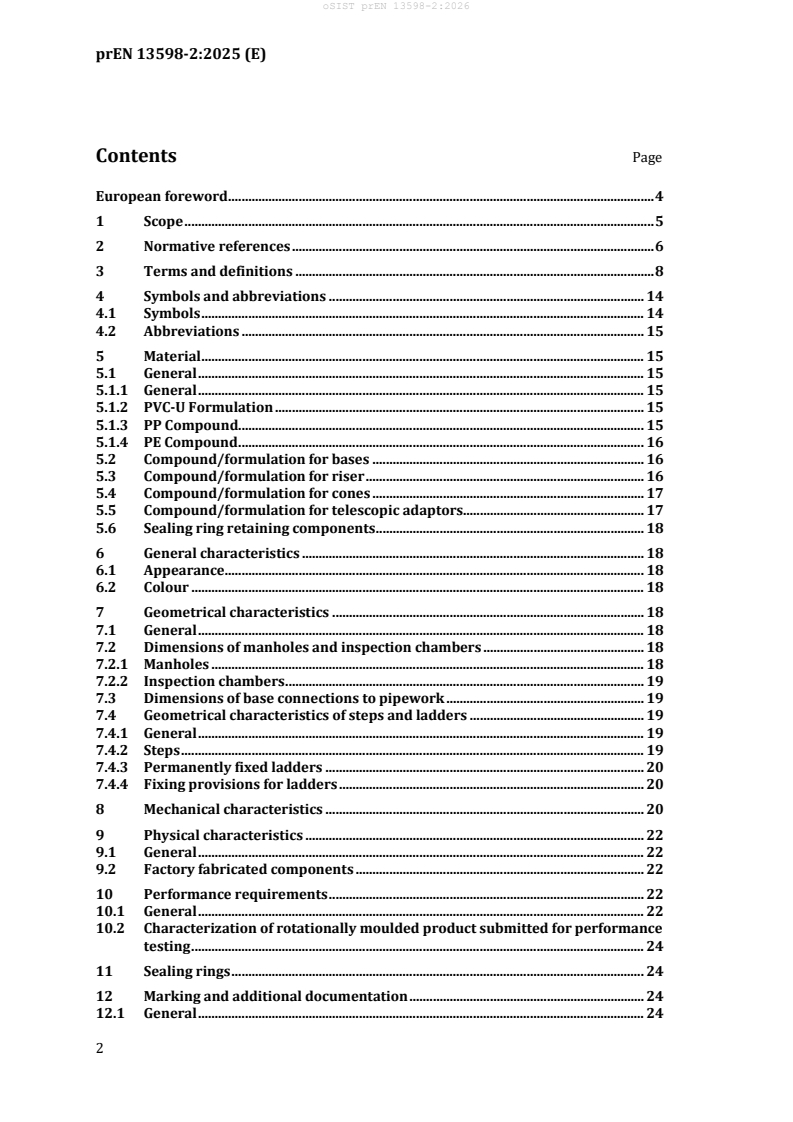
Contents
- 1 Scope
- 2 Normative references
- 3 Terms and definitions
- 3.1 application area code “U”
- 3.2 drain
- 3.3 sewer
- 3.4 wastewater
- 3.4.1 foul wastewater
- 3.4.2 surface water
- 3.4.3 domestic wastewater
- 3.4.4 industrial wastewater
- 3.5 manhole
- 3.6 inspection chamber
- 3.7 base
- 3.8 flow channel
- 3.9 benching
- 3.10 riser
- 3.11 telescopic adaptor
- 3.12 cone
- 3.13 surface component
- 3.14 near-surface component
- 3.15 cover solution
- 3.16 assembly
- 3.17 invert
- 3.18 maximum height of groundwater above invert
- 3.19 factory fabricated component
- 3.20 virgin material
- 3.21 reworked material
- 3.22 pre-consumer material
- 3.23 post-consumer material
- 3.24 recyclate
- 3.25 agreed specification
- 4 Symbols and abbreviations
- 4.1 Symbols
- 4.2 Abbreviations
- 5 Material
- 5.1 General
- 5.2 Compound/formulation for bases
- 5.3 Compound/formulation for riser
- 5.4 Compound/formulation for cones
- 5.5 Compound/formulation for telescopic adaptors
- 5.6 Sealing ring retaining components
- 6 General characteristics
- 6.1 Appearance
- 6.2 Colour
- 7 Geometrical characteristics
- 7.1 General
- 7.2 Dimensions of manholes and inspection chambers
- 7.3 Dimensions of base connections to pipework
- 7.4 Geometrical characteristics of steps and ladders
- 8 Mechanical characteristics
- 9 Physical characteristics
- 9.1 General
- 9.2 Factory fabricated components
- 10 Performance requirements
- 10.1 General
- 10.2 Characterization of rotationally moulded product submitted for
- 11 Sealing rings
- 12 Marking and additional documentation
- 12.1 General
- 12.2 Marking of bases
- 12.3 Minimum marking of components other than bases
- 12.4 Additional documentation
- Annex A
- Annex B
- Annex C
- Annex D
- Bibliography
1 Scope
This document is part of a System Standard for plastics piping systems of a particular material for a specified application.
System Standards are based on the results of the work being undertaken in ISO/TC 138 “Plastics pipes, fittings and valves for the transport of fluids”, which is a Technical Committee of the International Organization for Standardization (ISO).
They are supported by separate standards on test methods to which references are made throughout the System Standard.
The System Standards are consistent with general standards on functional requirements and on recommended practice for installation.
This document does not cover sewage pump chambers, valve chambers and similar products. This document specifies the definitions and requirements for unplasticized polyvinyl chloride (PVC-U), polypropylene (PP) and polyethylene (PE) manholes and inspection chambers having a base with a flow channel and their joints to the piping system, intended for use in non-pressure underground drains and sewers for wastewater, up to a maximum depth of 6 m from ground level to the invert of the flow channel.
This document is applicable to manholes and inspection chambers, intended for use buried in the ground outside a building structure only; reflected by the marking of products by “U”. This document is applicable to manholes and inspection chambers intended for use in pedestrian or vehicular trafficked areas.
NOTE 2 Products complying with this document can also be used in non-traffic areas. NOTE 3 Products complying with this document can be installed in underground applications without additional static calculation.
Manhole and inspection chamber components can be manufactured by various methods e.g. extrusion, injection moulding, rotational moulding, low-pressure moulding or factory fabricated. Manholes and inspection chambers complying with EN 13598-2 are made from a prescribed set of components that are assembled together or manufactured as a single unit. NOTE 4 The complete manhole or inspection chamber assembly also includes items which are not specified in this document (for example near surface or surface components such as covers, frames and gratings complying with the relevant part of EN 124[1]).
NOTE 5 Manholes and inspection chambers can be subject to national regulations and / or local provisions.
oSIST prEN 13598-2:2026 prEN 13598-2:2025 (E)
2 Normative references
The following documents are referred to in the text in such a way that some or all of their content constitutes requirements of this document. For dated references, only the edition cited applies. For undated references, the latest edition of the referenced document (including any amendments) applies.
EN 476, General requirements for components used in drains and sewers EN 681-1, Elastomeric seals — Materials requirements for pipe joint seals used in water and drainage applications — Part 1: Vulcanized rubber EN 681-2, Elastomeric Seals — Materials requirements for pipe joint seals used in water and drainage applications — Part 2: Thermoplastic elastomers EN 681-3, Elastomeric seals — Materials requirements for pipe joint seals used in water and drainage applications — Part 3: Cellular materials of vulcanized rubber EN 681-4, Elastomeric seals — Materials requirements for pipe joint seals used in water and drainage applications — Part 4: Cast polyurethane sealing elements EN 1401-1, Plastics piping systems for non-pressure underground drainage and sewerage — Unplasticized polyvinyl chloride (PVC-U) — Part 1: Specifications for pipes, fittings and the system EN 1852-1, Plastics piping systems for non-pressure underground drainage and sewerage — Polypropylene (PP) — Part 1: Specifications for pipes, fittings and the system EN 12099, Plastics piping systems — Polyethylene piping materials and components — Determination of volatile content EN 12666-1, Plastics piping systems for non-pressure underground drainage and sewerage Polyethylene (PE) — Part 1: Specifications for pipes, fittings and the system EN 13101:2002, Steps for underground man entry chambers — Requirements, marking, testing and evaluation of conformity EN 13476 (all parts) Plastics piping systems for non-pressure underground drainage and sewerage - Structured-wall piping systems of unplasticized polyvinyl chloride (PVC-U), polypropylene (PP) and polyethylene (PE) EN 13476-2, Plastics piping systems for non-pressure underground drainage and sewerage — Structured-wall piping systems of unplasticized polyvinyl chloride (PVC-U), polypropylene (PP) and polyethylene (PE) — Part 2: Specifications for pipes and fittings with smooth internal and external surface and the system, Type A EN 13476-3, Plastics piping systems for non-pressure underground drainage and sewerage — Structured-wall piping systems of unplasticized polyvinyl chloride (PVC-U), polypropylene (PP) and polyethylene (PE) — Part 3: Specifications for pipes and fittings with smooth internal and profiled external surface and the system, Type B EN 14396, Fixed ladders for manholes EN 14758-1, Plastics piping systems for non-pressure underground drainage and sewerage — Polypropylene with mineral modifiers (PP-MD) — Part 1: Specifications for pipes, fittings and the system
oSIST prEN 13598-2:2026 prEN 13598-2:2025 (E) EN 15344:2025, Plastics — Recycled plastics — Characterisation of Polyethylene (PE) recyclates CEN/TS 17627, Plastics — Recycled plastics — Determination of solid contaminants content EN ISO 527-2, Plastics — Determination of tensile properties — Test conditions for moulding and extrusion plastics (ISO 527-2) EN ISO 1043-1, Plastics — Symbols and abbreviated terms — Part 1: Basic polymers and their special characteristics (ISO 1043-1) EN ISO 1133-1, Plastics — Determination of the melt mass-flow rate (MFR) and melt volume-flow rate (MVR) of thermoplastics — Part 1: Standard method (ISO 1133-1) EN ISO 1158, Plastics — Vinyl chloride homopolymers and copolymers — Determination of chlorine content (ISO 1158) EN ISO 1183-1, Plastics — Methods for determining the density of non-cellular plastics — Part 1:
Immersion method, liquid pyknometer method and titration method (ISO 1183-1) EN ISO 1183-2, Plastics — Methods for determining the density of non-cellular plastics — Part 2:
Density gradient column method (ISO 1183-2) EN ISO 2507-1, Thermoplastics pipes and fittings — Vicat softening temperature — Part 1: General test method (ISO 2507-1) EN ISO 3126, Plastics piping systems — Plastics components — Determination of dimensions (ISO 3126) EN ISO 3127, Thermoplastics pipes — Determination of resistance to external blows — Round-theclock method (ISO 3127) EN ISO 3451-1, Plastics — Determination of ash — Part 1: General methods (ISO 3451-1) EN ISO 3451-5, Plastics — Determination of ash — Part 5: Polyvinyl chloride (ISO 3451-5) EN ISO 9967:2016, Thermoplastics pipes — Determination of creep ratio (ISO 9967:2016) EN ISO 11357-6, Plastics — Differential scanning calorimetry (DSC) — Part 6: Determination of oxidation induction time (isothermal OIT) and oxidation induction temperature (dynamic OIT) (ISO 11357-6) EN ISO 13229, Thermoplastics piping systems for non-pressure applications — Unplasticized polyvinyl chloride (PVC-U) pipes and fittings — Determination of the viscosity number and K-value (ISO 13229) EN ISO 13254, Thermoplastics piping systems for non-pressure applications — Test method for watertightness (ISO 13254) EN ISO 13259:2020, Thermoplastics piping systems for underground non-pressure applications — Test method for leaktightness of elastomeric sealing ring type joints (ISO 13259:2020) EN ISO 13263, Thermoplastics piping systems for non-pressure underground drainage and sewerage — Thermoplastics fittings — Test method for impact strength (ISO 13263)
oSIST prEN 13598-2:2026 prEN 13598-2:2025 (E) EN ISO 13266, Thermoplastics piping systems for non-pressure underground drainage and sewerage — Thermoplastics shafts or risers for inspection chambers and manholes — Determination of resistance against surface and traffic loading (ISO 13266) EN ISO 13267:2023, Thermoplastics piping systems for non-pressure underground drainage and sewerage — Thermoplastics inspection chamber and manhole bases — Test methods for buckling resistance (ISO 13267:2022) EN ISO 13268, Thermoplastics piping systems for non-pressure underground drainage and sewerage — Thermoplastics shafts or risers for inspection chambers and manholes — Determination of ring stiffness (ISO 13268)
3 Terms and definitions
For the purposes of this document, the terms, definitions and abbreviations given in EN ISO 1043-1 and the following apply.
ISO and IEC maintain terminology databases for use in standardization at the following addresses:
- IEC Electropedia: available at https://www.electropedia.org/
- ISO Online browsing platform: available at https://www.iso.org/obp/ui
3.1 application area code “U”
code for the area more than 1 m from the building to which the buried piping system is connected
3.2 drain
pipeline, usually underground, designed to carry wastewater from a source to a sewer [SOURCE: EN 16323:2014, 2.2.3.1]
3.3 sewer
pipeline or other construction, usually underground, designed to carry wastewater from more than one source [SOURCE: EN 16323:2014, 2.2.3.12]
3.4 wastewater
water composed of any combination of water discharged from domestic, industrial or commercial premises, surface run-off and accidentally any sewer infiltration water [SOURCE: EN 16323:2014, 2.3.10.65, modified – sewage (deprecated) deleted]
3.4.1 foul wastewater
wastewater comprising domestic wastewater and/or industrial wastewater [SOURCE: EN 16323:2014, 2.1.2.6]
oSIST prEN 13598-2:2026 prEN 13598-2:2025 (E)
3.4.2 surface water
water from precipitation, which has not seeped into the ground and is discharged to the drain or sewer system directly from the ground or from exterior building surfaces [SOURCE: EN 16323:2014, 2.1.1.3, modified – Reference to Figure 1 deleted]
3.4.3 domestic wastewater
water polluted by the human life, including water discharged from kitchens, laundry rooms, lavatories, bathrooms, toilets and similar facilities [SOURCE: EN 16323:2014, 2.1.2.3, modified – sewage (deprecated) deleted]
3.4.4 industrial wastewater
wastewater discharge resulting from any industrial or commercial activity [SOURCE: EN 16323:2014, 2.1.2.7 modified – trade wastewater (deprecated) and trade effluent (deprecated) deleted]
3.5 manhole
chamber with a removable cover constructed in a drain or sewer to permit entry by personnel, with a riser of 800 mm minimum inside diameter Note 1 to entry: Figure 1 shows typical manholes.
Note 2 to entry: See EN 476 for dimensions of non-circular manholes. Note 3 to entry: Manholes are subject to national safety regulations and / or local provisions regarding man-entry limitations.
3.6 inspection chamber
chamber with a removable cover constructed in a drain or sewer that permits the introduction of cleaning and inspection equipment from surface level, but does not provide access for personnel, with a riser of 200 mm minimum outer diameter Note 1 to entry: Figure 2 shows typical inspection chambers.
Note 2 to entry: See EN 476 for non-circular chambers.
3.7 base
bottom part of a manhole or inspection chamber, allowing direct connection to buried drain or sewer pipes and including integrally formed flow channels with benching as appropriate Note 1 to entry: In case of a one-piece manhole or inspection chamber, for testing purposes the base component ends at a distance of minimum 300 mm measured from the top of the main channel. Above 300 mm the section should be considered as a riser and tested accordingly. Note 2 to entry: Bases having a spherical design may be used. National regulations can apply.
oSIST prEN 13598-2:2026 prEN 13598-2:2025 (E)
3.8 flow channel
open and accessible continuation of the sewer network in a manhole or inspection chamber to allow directional changes maintaining the hydraulic performance of a sewer system Note 1 to entry: The term flow profile is also used.
3.9 benching
sloped surface adjacent to the channel in a manhole or inspection chamber
3.10 riser
component which is connected onto a base and which defines the nominal size of the manhole or inspection chamber Note 1 to entry: The riser can be supplied either as one or more separate items, for site jointing to the base, or integrated with the base.
Note 2 to entry: In case of a one-piece manhole or inspection chamber, for testing purposes the riser component starts at a distance of minimum 300 mm measured from the top of the main channel. Below 300 mm the section should be considered as a base and tested accordingly.
3.11 telescopic adaptor
part of the assembly on top of the riser or cone that allows adjustment of the surface component or near surface component Note 1 to entry: Telescopic adaptors allow accommodation of settlement during lifetime and eliminate the transmission of vehicular loading down the riser.
3.12 cone
adapter allowing change in diameter, close to ground level
3.13 surface component
components such as covers, frames and gratings that are located at the surface level and which comply with the relevant part of EN 124
3.14 near-surface component
component intended to spread vehicular loading directly to the soil and/or provide a seating for the cover and its frame
3.15 cover solution
a set of components comprising at least surface components and near surface components
3.16 assembly
items collectively forming a manhole or inspection chamber Note 1 to entry: See typical examples in Figures 1 and 2.
oSIST prEN 13598-2:2026 prEN 13598-2:2025 (E)
3.17 invert
lowest point of the internal surface of the barrel of a pipe or channel at any cross section
3.18 maximum height of groundwater above invert
H w height of water column, expressed in meters above the invert that the manhole or inspection chamber can withstand during use
3.19 factory fabricated component
component produced from pipe and/or from injection-or rotomoulded sub-components by thermoforming, adhesive joint, welding or mechanical jointing
3.20 virgin material
plastics material in the form of pellets, granules, powder, floc, etc. that has not been subjected to use or processing other than that required for its initial manufacture Note 1 to entry: Does not contain any reworked plastics material and/or plastics recyclate. Note 2 to entry: Also referred to as “primary material” or “primary plastics feedstock” Note 3 to entry: It is understood that the addition of additives such as stabilizers and pigments is still resulting into a virgin (plastics) material.
[SOURCE: ISO 472:2013, 2.1231, modified – Note 1 to entry, Note 2 to entry and Note 3 to entry added]
3.21 reworked material
plastics material from rejected unused products or trimmings capable of being reclaimed within the same process that generated it Note 1 to entry: Reworked material does not change the status of the feedstock. Note 2 to entry: This definition does not cover the conditions for the use of reworked material, which can be found in the applicable product standard.
Note 3 to entry: Previously referred to as “own reprocessed material”
3.22 pre-consumer material
plastics material diverted from the waste stream during a manufacturing process, excluding reworked (plastics) material Note 1 to entry: Previously referred to as “post-industrial material”. Note 2 to entry: Different categories of pre-consumer material may be considered in the applicable product standard.
[SOURCE: ISO 14021:2016, 7.8.1.1 modified – “plastics” added, text deleted after “rework” and 2 Notes to entry introduced]
oSIST prEN 13598-2:2026 prEN 13598-2:2025 (E)
3.23 post-consumer material
plastics material generated by households or by commercial, industrial and institutional facilities in their role as end-users of the product which can no longer be used for its intended purpose Note 1 to entry: This includes returns of material from the distribution chain. Note 2 to entry: Different categories of post-consumer material may be considered in the applicable product standard.
[SOURCE: ISO 14021:2016, 7.8.1.1 modified – “plastics” added, last sentence changed into Note 1 to entry and Note 2 to entry introduced]
3.24 recyclate
plastics material resulting from the recycling of pre-consumer and post-consumer plastics products Note 1 to entry: Also referred to as “secondary raw material” or “recycled plastics” or “regenerate”. Note 2 to entry: Recycling can be chemical, physical or mechanical. [SOURCE: ISO 472:2013, 2.1705, modified – Note 1 to entry and Note 2 to entry deleted, new Note 1 to entry and Note 2 to entry introduced and “plastic waste” changed into “pre-consumer and post-consumer plastics products”]
3.25 agreed specification
specification of the relevant material characteristics agreed between the supplier of the recylate and the pipe and/or fitting manufacturer Note 1 to entry: The agreed specification is often considered in the context of certification by a third party organization [SOURCE: EN 16323:2014, 2.3.10.65, modified – sewage (deprecated) deleted]
oSIST prEN 13598-2:2026 prEN 13598-2:2025 (E)
Key a surface components (not covered by this 1 inlet document) b near surface component (not covered by this 2 outlet document) c telescopic adaptor 3 invert d cone 4 inside diameter e1 riser 5 benching e2 considered as riser 6 flow channel f1 base f2 considered as base g connection h provision for ladder i ladder or steps Figure 1 — Typical manholes
oSIST prEN 13598-2:2026 prEN 13598-2:2025 (E)
Key a surface components (not covered by this 1 inlet document) b near surface component (not covered by this 2 outlet document) c telescopic adaptor 3 invert e riser 4 inside diameter
e considered as riser 5 benching
f1 base 6 flow channel f2 considered as base g connection Figure 2 — Typical inspection chambers
4 Symbols and abbreviations
4.1 Symbols
For the purposes of this document, the following symbols apply. d nominal outside diameter n d mean outside diameter em dsm mean inside diameter of socket H maximum height of groundwater above invert w
oSIST prEN 13598-2:2026 prEN 13598-2:2025 (E)
4.2 Abbreviations
For the purposes of this document, the following abbreviations apply. MFR melt mass-flow rate OIT oxidation induction time PE polyethylene PP polypropylene PVC-U unplasticized poly(vinyl chloride)
5 Material
5.1 General
5.1.1 General
Components of manholes and inspection chambers may be manufactured from different compounds/formulations.
The material shall be one of the following: unplasticized polyvinyl chloride (PVC-U), polypropylene (PP) or polyethylene (PE).
The use of material, that has been classified as re-worked material in this document or in other standards according to Table 2, originating from the same compound/formulation, is permitted without additional requirements.
NOTE 1 If a component comprises of sub-components of mixed materials (e.g PP and PVC-U) or the subcomponents are generated using different processes, care is to be taken to ensure separation prior to use as reworked material.
...