

SIST EN 13272-1:2020
(Main)Railway applications - Electrical lighting for rolling stock in public transport systems - Part 1: Heavy rail
General Information
- Abstract
This document contains performance requirements and recommendations for electrical lighting systems in the interiors of public transport heavy rail units, under all operating and emergency conditions.
This document applies only to new units.
The application of this document for retro-fitting of existing units is subject to agreement between Contractors.
This document also defines the requirements for testing and conformity assessment.
This document does not address lighting installed in instruments or controls.
This document does not address the requirements of lighting of boarding aids, e.g. moving entrance stairs or lifts.
This document does not address lighting installed for indication or effect purposes, including flashing lights and decorative lighting.
NOTE 1 The requirements for interior lighting for urban rail units can be found in EN 13272-2.
NOTE 2 The requirements for cab instrument lighting for heavy rail units can be found in EN 16186-2.
- Status
- Published
- Public Enquiry End Date
- 22-Nov-2017
- Publication Date
- 19-Jan-2020
- Technical Committee
- IŽNP - Reilway applications
- Current Stage
- 6060 - National Implementation/Publication (Adopted Project)
- Start Date
- 24-Oct-2019
- Due Date
- 29-Dec-2019
- Completion Date
- 20-Jan-2020



Overview
EN 13272-1:2019 is a CEN European standard that specifies performance requirements and recommendations for electrical interior lighting in heavy rail rolling stock used in public transport systems. The document covers lighting under normal, reduced, stand-by and emergency conditions and defines requirements for testing and conformity assessment. It applies to new heavy rail units (retro‑fits require contractor agreement) and excludes instrument/control lighting, boarding-aid lighting (e.g., moving steps), and decorative/indicator lighting.
Key topics and technical requirements
- Scope and applicability
- Applies only to new heavy rail units; retro-fitting is contractual.
- Distinguishes heavy rail requirements from urban rail (EN 13272-2) and cab instrument lighting (EN 16186-2).
- Performance criteria
- Illuminance (average lux levels) and uniformity targets for seating areas, reading zones, corridors and vestibules. (EN 13272‑1 includes tables with minimum illuminance and uniformity values for high-speed/long-distance and other units; e.g., seating areas often require 100–150 lx with defined uniformity ranges.)
- Glare limitation, colour temperature (CCT) and colour rendering requirements to support visual performance, comfort and safety.
- Lighting modes
- Definitions and requirements for general lighting, stand-by and emergency lighting (for high-speed and long-distance units, general lighting must remain available for at least 10 minutes after main power loss).
- Support for reduced lighting strategies for comfort and energy efficiency.
- Design, measurement and testing
- Requirements for measuring equipment, specified measuring points, light loss factor considerations, and test pulse characteristics.
- Conformity assessment and documentation obligations (contractual statements and test evidence).
- Safety and photobiological aspects
- References to IEC/EN standards for LED modules, photobiological safety and colour metrics (e.g., EN 62031, EN 62471, ISO/IEC vocabulary).
Applications and who uses it
EN 13272-1:2019 is used by:
- Rolling stock manufacturers and system integrators - to design compliant interior lighting systems.
- Lighting and electrical designers - to specify luminaires, LED modules and control strategies.
- Train operators and procurement teams - to set acceptance criteria and contractual obligations.
- Test laboratories and conformity assessors - to carry out measurements and certification.
- Regulators and standardization bodies - to align national regulations with CEN requirements.
Practical uses include selection of luminaires, setting acceptance tests for new trains, defining emergency lighting durations, and ensuring passenger comfort, safety and energy-efficient operation.
Related standards
- EN 13272-2 (Urban rail interior lighting)
- EN 16186-2 (Cab instrument lighting for heavy rail)
- EN 62031, EN 62471, ISO 8995-1 and IEC terminology references
Keywords: EN 13272-1:2019, electrical lighting, rolling stock, heavy rail, interior lighting, illuminance, uniformity, emergency lighting, CEN, conformity assessment.
Relations
- Effective Date
- 20-Nov-2019
- Effective Date
- 09-Feb-2026
- Refers
SIST EN 62031:2008 - LED modules for general lighting - Safety specifications (IEC 62031:2008) - Effective Date
- 09-Feb-2026
- Refers
SIST EN 62471:2008 - Photobiological safety of lamps and lamp systems (IEC 62471:2006, modified) - Effective Date
- 09-Feb-2026
- Effective Date
- 28-Jan-2026
- Effective Date
- 28-Jan-2026
- Effective Date
- 28-Jan-2026
- Effective Date
- 28-Jan-2026
- Effective Date
- 28-Jan-2026
- Effective Date
- 28-Jan-2026
- Effective Date
- 28-Jan-2026
- Effective Date
- 28-Jan-2026
- Effective Date
- 28-Jan-2026
- Effective Date
- 28-Jan-2026
- Effective Date
- 28-Jan-2026
Get Certified
Connect with accredited certification bodies for this standard

DIBt (Deutsches Institut für Bautechnik)
German Institute for Building Technology.
DIN CERTCO
DIN Group product certification.
IRIS Certification (UNIFE)
International Railway Industry Standard certification.
Sponsored listings
Frequently Asked Questions
SIST EN 13272-1:2020 is a standard published by the Slovenian Institute for Standardization (SIST). Its full title is "Railway applications - Electrical lighting for rolling stock in public transport systems - Part 1: Heavy rail". This standard covers: This document contains performance requirements and recommendations for electrical lighting systems in the interiors of public transport heavy rail units, under all operating and emergency conditions. This document applies only to new units. The application of this document for retro-fitting of existing units is subject to agreement between Contractors. This document also defines the requirements for testing and conformity assessment. This document does not address lighting installed in instruments or controls. This document does not address the requirements of lighting of boarding aids, e.g. moving entrance stairs or lifts. This document does not address lighting installed for indication or effect purposes, including flashing lights and decorative lighting. NOTE 1 The requirements for interior lighting for urban rail units can be found in EN 13272-2. NOTE 2 The requirements for cab instrument lighting for heavy rail units can be found in EN 16186-2.
This document contains performance requirements and recommendations for electrical lighting systems in the interiors of public transport heavy rail units, under all operating and emergency conditions. This document applies only to new units. The application of this document for retro-fitting of existing units is subject to agreement between Contractors. This document also defines the requirements for testing and conformity assessment. This document does not address lighting installed in instruments or controls. This document does not address the requirements of lighting of boarding aids, e.g. moving entrance stairs or lifts. This document does not address lighting installed for indication or effect purposes, including flashing lights and decorative lighting. NOTE 1 The requirements for interior lighting for urban rail units can be found in EN 13272-2. NOTE 2 The requirements for cab instrument lighting for heavy rail units can be found in EN 16186-2.
SIST EN 13272-1:2020 is classified under the following ICS (International Classification for Standards) categories: 45.060.01 - Railway rolling stock in general; 91.160.10 - Interior lighting. The ICS classification helps identify the subject area and facilitates finding related standards.
SIST EN 13272-1:2020 has the following relationships with other standards: It is inter standard links to SIST EN 13272:2012, SIST EN 62031:2008/A2:2015, SIST EN 62031:2008, SIST EN 62471:2008, SIST EN 3852:2004, SIST EN 1367-2:2010, SIST EN 16584-1:2025, SIST EN 16334:2014, SIST EN 16584-1:2017, SIST EN 16584-3:2025, SIST EN 17168:2021, SIST EN 14752:2025, SIST EN 14752:2015, SIST EN 13272-2:2020, SIST EN 45545-4:2024. Understanding these relationships helps ensure you are using the most current and applicable version of the standard.
SIST EN 13272-1:2020 is associated with the following European legislation: EU Directives/Regulations: 2008/57/EC, 2016/797/EU; Standardization Mandates: M/483. When a standard is cited in the Official Journal of the European Union, products manufactured in conformity with it benefit from a presumption of conformity with the essential requirements of the corresponding EU directive or regulation.
SIST EN 13272-1:2020 is available in PDF format for immediate download after purchase. The document can be added to your cart and obtained through the secure checkout process. Digital delivery ensures instant access to the complete standard document.
Standards Content (Sample)
SLOVENSKI STANDARD
01-februar-2020
Nadomešča:
SIST EN 13272:2012
Železniške naprave - Električna razsvetljava v železniških vozilih za javne
prevozne sisteme - 1. del: Železniška vozila za višje osne pritiske
Railway applications - Electrical lighting for rolling stock in public transport systems - Part
1: Heavy rail
Bahnanwendungen - Elektrische Beleuchtung in Schienenfahrzeugen des öffentlichen
Verkehrs - Teil 1: Vollbahnen
Applications ferroviaires - Éclairage électrique pour matériel roulant des systèmes de
transport public - Partie 1 : Rail lourd
Ta slovenski standard je istoveten z: EN 13272-1:2019
ICS:
45.060.01 Železniška vozila na splošno Railway rolling stock in
general
91.160.10 Notranja razsvetljava Interior lighting
2003-01.Slovenski inštitut za standardizacijo. Razmnoževanje celote ali delov tega standarda ni dovoljeno.
EN 13272-1
EUROPEAN STANDARD
NORME EUROPÉENNE
October 2019
EUROPÄISCHE NORM
ICS 45.060.01; 91.160.10 Supersedes EN 13272:2012
English Version
Railway applications - Electrical lighting for rolling stock
in public transport systems - Part 1: Heavy rail
Applications ferroviaires - Éclairage électrique pour Bahnanwendungen - Elektrische Beleuchtung in
matériel roulant des systèmes de transport public - Schienenfahrzeugen des öffentlichen Verkehrs - Teil 1:
Partie 1 : Rail lourd Vollbahnen
This European Standard was approved by CEN on 19 August 2019.
CEN members are bound to comply with the CEN/CENELEC Internal Regulations which stipulate the conditions for giving this
European Standard the status of a national standard without any alteration. Up-to-date lists and bibliographical references
concerning such national standards may be obtained on application to the CEN-CENELEC Management Centre or to any CEN
member.
This European Standard exists in three official versions (English, French, German). A version in any other language made by
translation under the responsibility of a CEN member into its own language and notified to the CEN-CENELEC Management
Centre has the same status as the official versions.
CEN members are the national standards bodies of Austria, Belgium, Bulgaria, Croatia, Cyprus, Czech Republic, Denmark, Estonia,
Finland, France, Germany, Greece, Hungary, Iceland, Ireland, Italy, Latvia, Lithuania, Luxembourg, Malta, Netherlands, Norway,
Poland, Portugal, Republic of North Macedonia, Romania, Serbia, Slovakia, Slovenia, Spain, Sweden, Switzerland, Turkey and
United Kingdom.
EUROPEAN COMMITTEE FOR STANDARDIZATION
COMITÉ EUROPÉEN DE NORMALISATIO N
EUROPÄISCHES KOMITEE FÜR NORMUN G
CEN-CENELEC Management Centre: Rue de la Science 23, B-1040 Brussels
© 2019 CEN All rights of exploitation in any form and by any means reserved Ref. No. EN 13272-1:2019 E
worldwide for CEN national Members.
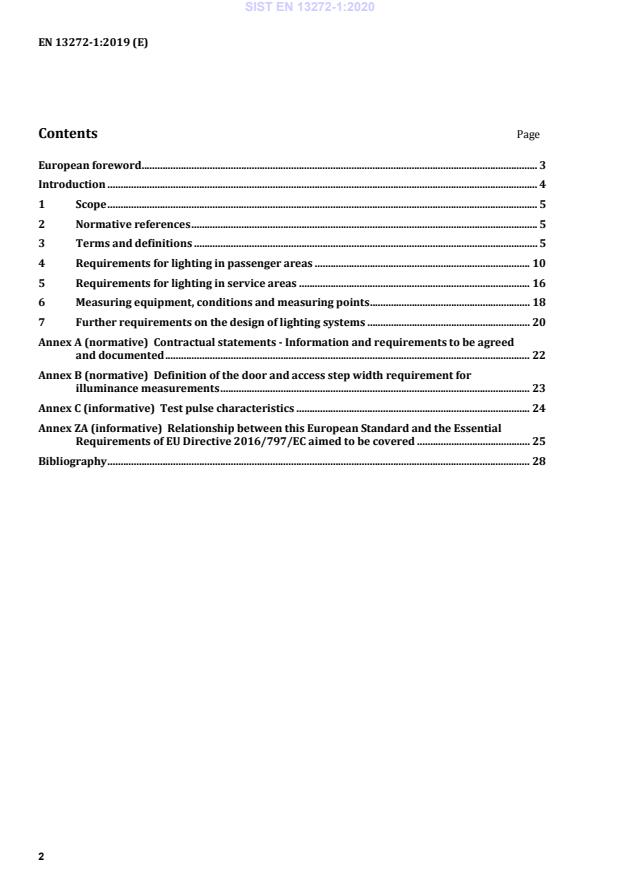
Contents Page
European foreword . 3
Introduction . 4
1 Scope . 5
2 Normative references . 5
3 Terms and definitions . 5
4 Requirements for lighting in passenger areas . 10
5 Requirements for lighting in service areas . 16
6 Measuring equipment, conditions and measuring points . 18
7 Further requirements on the design of lighting systems . 20
Annex A (normative) Contractual statements - Information and requirements to be agreed
and documented . 22
Annex B (normative) Definition of the door and access step width requirement for
illuminance measurements . 23
Annex C (informative) Test pulse characteristics . 24
Annex ZA (informative) Relationship between this European Standard and the Essential
Requirements of EU Directive 2016/797/EC aimed to be covered . 25
Bibliography . 28
European foreword
This document (EN 13272-1:2019) has been prepared by Technical Committee CEN/TC 256 “Railway
applications”, the secretariat of which is held by DIN.
This European Standard shall be given the status of a national standard, either by publication of an
identical text or by endorsement, at the latest by April 2020, and conflicting national standards shall be
withdrawn at the latest by April 2020.
Attention is drawn to the possibility that some of the elements of this document may be the subject of
patent rights. CEN shall not be held responsible for identifying any or all such patent rights.
This document, together with EN 13272-2:2019, supersedes EN 13272:2012.
The main changes with respect to EN 13272:2012 are:
— technical requirements have been brought in line with the applicable TSIs;
— requirements permitting new lighting technologies.
This series of documents Railway applications — Electrical lighting for rolling stock in public transport
systems consists of the following parts:
— Part 1: Heavy rail (this document);
— Part 2: Urban rail.
This document has been prepared under a mandate given to CEN by the European Commission and the
European Free Trade Association, and supports essential requirements of Directive 2016/797/EC.
For relationship with Directive 2016/797/EC, see informative Annex ZA, which is an integral part of
this document.
According to the CEN-CENELEC Internal Regulations, the national standards organisations of the
following countries are bound to implement this European Standard: Austria, Belgium, Bulgaria,
Croatia, Cyprus, Czech Republic, Denmark, Estonia, Finland, France, Germany, Greece, Hungary, Iceland,
Ireland, Italy, Latvia, Lithuania, Luxembourg, Malta, Netherlands, Norway, Poland, Portugal, Republic of
North Macedonia, Romania, Serbia, Slovakia, Slovenia, Spain, Sweden, Switzerland, Turkey and the
United Kingdom.
Introduction
This document sets out the requirements for interior lighting for heavy rail units.
This document was revised following the creation of EN 13272-2 for urban rail vehicles. This document
was re-named to make a clear distinction between heavy rail and urban rail. Additionally, Annex ZA was
updated for the current status of TSIs.
1 Scope
This document contains performance requirements and recommendations for electrical lighting
systems in the interiors of public transport heavy rail units, under all operating and emergency
conditions.
This document applies only to new units.
The application of this document for retro-fitting of existing units is subject to agreement between
Contractors.
This document also defines the requirements for testing and conformity assessment.
This document does not address lighting installed in instruments or controls.
This document does not address the requirements of lighting of boarding aids, e.g. moving entrance
stairs or lifts.
This document does not address lighting installed for indication or effect purposes, including flashing
lights and decorative lighting.
NOTE 1 The requirements for interior lighting for urban rail units can be found in EN 13272–2.
NOTE 2 The requirements for cab instrument lighting for heavy rail units can be found in EN 16186–2.
2 Normative references
The following documents are referred to in the text in such a way that some or all of their content
constitutes requirements of this document. For dated references, only the edition cited applies. For
undated references, the latest edition of the referenced document (including any amendments) applies.
IEC 60050-845:1987/AMD1:2016, International Electrotechnical Vocabulary Chapter 845: Lighting
ISO 8995-1:2002, Lighting of work places — Part 1: Indoor
EN 62031:2008+A2:2015, LED modules for general lighting - Safety specifications
EN 62471:2008, Photobiological safety of lamps and lamp systems
IEC/TR 62778, Application of IEC 62471 for the assessment of blue light hazard to light sources and
luminaires
3 Terms and definitions
For the purposes of this document, the following terms and definitions apply.
ISO and IEC maintain terminological databases for use in standardization at the following addresses:
• IEC Electropedia: available at http://www.electropedia.org/
• ISO Online browsing platform: available at https://www.iso.org/obp
3.1 General
3.1.1
high speed unit
heavy rail unit designed to operate at speeds equal to or greater than 250 km/h
IEC 60050-845:1987/AMD1:2016 is identical to CIE Publication No. CIE S 017/E:2011.
Note 1 to entry: The intention is to accord with Commission Regulation 1299/2014 Table 45.
3.1.2
long distance unit
heavy rail unit designed for services other than regional, commuter and suburban
Note 1 to entry: The intention is to accord with Commission Regulation 1299/2014 Table 45.
3.1.3
other unit
heavy rail unit which is neither a high speed unit nor a long distance unit
Note 1 to entry: The intention is to accord with Commission Regulation 1299/2014 Table 45.
3.1.4
unit
generic term used to name the rolling stock; a unit may be composed of several vehicles
Note 1 to entry: This definition is derived from Commission Regulation 1302/2014.
3.1.5
vehicle
railway vehicle that runs on its own wheels on railway lines, with or without traction
Note 1 to entry: This definition is derived from Directive 2016/797/EC.
3.1.6
passenger area
area designed for passenger use
3.1.7
service area
area intended to be occupied by service personnel only
3.1.8
seating area
passenger area intended for seated persons, including wheelchair spaces
3.1.9
standing area
unobstructed part of a passenger area which can be used by standing persons or standing persons at
the location of tip-up seats
Note 1 to entry: This definition is derived from EN 15663:2017+A1:2018.
3.1.10
open gangway
wide gangway designed to be occupied by passengers
3.1.11
gangway
gangway that is only used to pass from one vehicle to another
3.1.12
vestibule
area between the exterior door(s) and the passenger area designed for access and egress from the
vehicle
Note 1 to entry: In the case of high-speed units, the vestibule is not designed to accommodate passengers.
3.1.13
vehicle access step
first fixed part of the floor threshold inside the vehicle
3.1.14
lamp
light source used for the creation of light in a luminaire
Note 1 to entry: Lamps include tungsten, halogen, fluorescent, electroluminescent, LED, OLED and laser diode
technologies.
3.1.15
luminaire
complete assembly with associated fixings, fittings and electrical connections for the control of light
delivery, excluding the lamp or lamps
Note 1 to entry: A more detailed definition is given in EN 12665, and the ILV item 17–707.
3.1.16
luminance
L
luminous intensity of the light emitted in a given direction from an element of a surface, divided by the
area of the element projected in the same direction
Note 1 to entry: Unit: candela per square metre (cd/m ).
Note 2 to entry: A more detailed definition is given in EN 12665, and the ILV item 17–711.
3.1.17
luminous flux
Φ
quantity derived from radiant flux (radiant power) by evaluating the radiation according to the spectral
sensitivity of the human eye (as defined by the CIE standard photometric observer)
Note 1 to entry: Unit: lumen (lm).
Note 2 to entry: It is the light power emitted by a source.
Note 3 to entry: Adapted from EN 12665.
3.1.18
Illuminance
E
ratio of the luminous flux incident on a surface to the area of the illuminated surface
Note 1 to entry: Unit: lux (lx) = lm/m .
Note 2 to entry: Illuminance was previously known as the illumination level or value.
Note 3 to entry: The orientation of the surface may be defined, e.g. horizontal, vertical.
3.1.19
average illuminance
E
av
illuminance averaged over the specified surface
Note 1 to entry: Unit: lux (lx).
Note 2 to entry: Adapted from EN 12665.
Note 3 to entry: In practice this may be derived either from the total luminous flux falling on the surface divided
by the total area of the surface, or alternatively from an arithmetic average of the illuminances at a representative
number of points on the surface.
3.1.20
illuminance uniformity
ratio of the least favourable illuminance to the average illuminance within the specified measurement
surface
Note 1 to entry: The least favourable illuminance may be either the minimum or maximum illuminance over all
the measurement points.
3.1.21
correlated colour temperature
T
cp
CCT
temperature of the Planckian radiator whose perceived colour most closely resembles that of the given
stimulus at the same brightness and under specified viewing conditions
Note 1 to entry: Unit: Kelvin (K).
Note 2 to entry: Adapted from EN 12665.
Note 3 to entry: A more detailed definition is given in ILV item 17–258.
3.1.22
SDCM
standard deviation colour matching
deviation, defined in terms of just perceptible colour differences using ‘MacAdam ellipses’ as defined in
the CIE 1964 colour space
Note 1 to entry: The SDCM scale, runs from 0 to 10, where 1–3 normally covers environments with high
demands on colour matching.
Note 2 to entry: The CIE 1964 colour space, also known as CIEUVW, permits analysis of colour difference using
the SDCM method.
3.1.23
colour rendering
effect of an illuminant on the reflective colour of objects by comparison with their reflective colour
under a reference light source
Note 1 to entry: Adapted from IEC 60050-845:1987/AMD1:2016.
3.1.24
light loss factor
ratio of the average illuminance of the illuminated surface after a certain period of use of a lighting
installation to the average illuminance obtained under the same conditions for the installation
considered conventionally as new
Note 1 to entry: Adapted from IEC 60050-845:1987/AMD1:2016.
3.1.25
unified glare rating
CIE discomfort glare measure
3.1.26
contractor
organizations responsible for
— the design, manufacture or supply of the lighting system (may also be referred to as the ‘supplier’);
and
— the purchase, installation or use of the lighting system (may also be referred to as the ‘customer’)
3.2 Types of lighting
3.2.1
general lighting
lighting of an interior provided for normal operation
3.2.2
stand-by lighting
lighting condition below the level of general lighting provided for a specified time limit, taking supply
interruptions into account
3.2.3
emergency lighting
lighting provided for a specified minimum time limit when the general or the stand-by lighting fails
3.2.4
reduced lighting
level of illumination as a design feature for passenger comfort and energy conservation
4 Requirements for lighting in passenger areas
4.1 General lighting
4.1.1 General
The quality of lighting influences visual performance, performance attitude, safety at work and general
well-being.
The lighting for rolling stock in heavy rail systems shall enable a range of visual tasks to be performed.
The requirements to be met by the lighting system are based on the following criteria:
— illuminance;
— uniformity;
— limitation of glare;
— colour temperature and colour rendering.
General lighting shall achieve the values set out in Table 1 or Table 2.
Where agreed between contractors, it is permissible for the general lighting system to adapt to the
ambient lighting, provided that the contribution from the general lighting system plus that from the
ambient lighting achieves the values set out in Table 1 or Table 2.
General lighting shall be provided in normal operation without interruption.
For high speed and long distance units, in the event of loss of the main power supply, general lighting
shall be provided for a period of not less than 10 min.
A lighting system can only satisfy specified requirements if all criteria mentioned above have been
taken into account. Depending on the type and level of the difficulty of the visual task, orientation of
seating, or of the type of accommodation to be lit, priority may be given to one or more of these criteria.
4.1.2 Illuminance and uniformity
Different requirements are made concerning the general lighting for rolling stock in heavy rail systems
according to the service and/or location. Two classes of vehicles are defined: (a) high speed and long
distance units and (b) other units.
a) For high speed and long distance units, the minimum value of the average illuminance and
uniformity requirements shall be in accordance with Table 1.
b) For other units, the minimum value of the average illuminance and uniformity requirements shall
be in accordance with Table 2.
c) By agreement between contractors, the requirements for high speed and long distance units may be
applied to other units.
This concept is taken from Commission Regulation 1302/2014 Clause 4.2.2.10 (2)
Table 1 — Minimum values of average illuminance
and target uniformity for high speed and long distance units
Location a b
Illuminance Uniformity
E
av
in lx
Seating areas where no ≥ 150 0,7 to 1,3
additional reading lights are
c
provided
Seating area with reading ≥ 100 0,7 to 1,3
c
lights which are switched off
d
Reading zone, where reading ≥ 150 0,7 to 1,3
lights are provided, with the
general lighting switched off
Side corridors and aisles, at ≥ 50 0,5 to 2,5
floor level
Side corridors and aisles, at ≥ 75 0,5 to 2,5
0,8 m above floor level
e ≥ 75 0,8 to 1,2
Vestibules
f ≥ 75 not applicable
Vehicle access steps
Toilets, general ≥ 100 not applicable
Toilets, wash-basin ≥ 150 not applicable
Steps and stairs ≥ 75 0,8 to 1,2
Standing areas, ≥ 75 0,5 to 2,5
multifunctional areas, open
gangways
Gangways g not applicable
≥ 5
Tables ≥ 150 0,7 to 1,3
a
The values for illuminance are minimum values and may be increased by agreement
between contractors.
b
This is defined locally within specific areas of the vehicle, for example seating area
between doors to be evaluated separately from that between the doors and car-end.
c
Where the average illuminance is greater than 220 lx, the uniformity range 0,7 to 1,5 shall
apply.
d
In the case of seating areas in dining vehicles, the uniformity requirements shall not apply
and alternative illuminance levels may be agreed between contractors.
e
With additional but switched-off lighting at the vehicle access step.
f
Measured at 3 locations to be agreed between contractors, across the central 80 % of the
width of the vehicle access step, according to Annex B (normative).
g
This is normally achieved by light spillage from adjacent areas.
Table 2 — Minimum values of average illuminance
and target uniformity for other units
Location a b
Illuminance Uniformity
E
av
in lx
Seating areas ≥ 150 0,7 to 1,3
Standing areas, open ≥ 50 0,5 to 2,5
gangways
Aisles at floor level ≥ 50 0,5 to 2,5
Aisles at 0, 8 m above floor ≥ 75 0,5 to 2,5
level
c ≥ 75 0,8 to 1,2
Vestibules
d ≥ 75 not applicable
Vehicle access steps
a
The values for illuminance are minimum values and may be increased by agreement
between contractors.
b
This is defined locally within specific areas of the vehicle, for example seating area
between doors to be evaluated separately from that between the doors and car-end.
c
With additional but switched-off lighting at the vehicle access step.
d
Measured at 3 locations to be agreed between contractors, across the central 80 % of the
width of the vehicle access step, according to Annex B (normative).
If a toilet is included, then the requirements of Table 1 ‘Toilets’ shall apply.
The values of illuminance given in this clause shall be achieved in the different locations in accordance
with the measuring points in 6.5.
4.1.3 Glare limitation
The lighting system shall be designed to minimize glare and to avoid glare from night time reflections in
windows. The glare rating for the lighting system, when calculated using the Unified Glare Rating (UGR)
tabular method set out in ISO 8995-1 shall be not greater than 22.
4.1.4 Correlated colour temperature
The correlated colour temperature of the lamps used for general lighting shall be between 2 800 K and
7 000 K.
NOTE 1 For reasons of visual comfort, colour temperatures above 5 000 K are not advisable.
For lighting system with fixed colour temperature characteristics, the range of correlated colour
temperatures for the lamps in a given part of a unit shall be not greater than 3 SDCM.
NOTE 2 The given part of a unit may be one vehicle of that unit.
In the case of lighting systems with adjustable colour temperature characteristics, the above SDCM
requirement shall apply to the nominal CCT value for all parts of the system.
NOTE 3 An example of an adjustable colour temperature system is a system with lower and upper CCT limits of
3 000 and 5 000 K, achieved by the mixing of two different types of ‘white’ LED.
4.1.5 Colour rendering
The ability of a light source to render colours of surfaces accurately is important for safety and comfort.
The Colour Rendering Index R of the light sources as defined in IEC 60050-845:1987/AMD1:2016, shall
a
be ≥ 80 or colour rendering group 1B.
4.1.6 Illuminance in vehicles for night service
In vehicles that are intended predominantly for night service, the lighting shall be arranged to meet
particular requirements concerning minimum illuminance.
— In passenger seating areas, the emergency lighting illuminance requirements of 4.3.3 shall apply.
— In sleeping compartments, individual subdued sleeping lighting should be provided. Where
provided, general light switches shall be internally lit.
4.1.7 Reduced lighting
For energy conservation or for passenger comfort, a proportion of the general lighting may be switched
off or be reduced (for example by dimming the whole or parts of the system) in passenger seating areas.
Where provided, the requirements for reduced lighting shall be as follows:
The minimum lighting requirement shall be the emergency lighting illuminance requirements of 4.3.3.
In passenger access areas (e.g. vestibules, stairways, corridors) the illuminance and uniformity shall be
in accordance with Table 1 or Table 2, as applicable. Where provided for passenger use, general light
switches shall be internally lit.
4.1.8 Lighting control functions
For special tasks, e.g. cleaning and lamp testing, it is recommended that a dedicated switching device is
provided at a place in the vehicle that is convenient to the service people.
4.1.9 Photobiological safety
Lighting systems shall comply with the requirements of EN 62031:2008, Clause 22.
The blue light hazard shall be not higher than risk group 1 (Low-Risk) as defined in EN 62471:2008.
4.2 Stand-by lighting
Stand-by lighting is not mandatory. However, where provided, the duration of stand-by lighting shall be
agreed between contractors. Unless otherwise agreed between contractors, stand-by lighting
illuminance shall be a minimum of 30 % of the general lighting illuminance.
4.3 Emergency lighting
4.3.1 General
Emergency lighting shall be provided to operate in the event of the switching off or failure of general or
stand-by lighting. Luminaires of the general lighting system may be used for the emergency lighting
system.
The emergency lighting shall be designed to enable continued occupation or safe egress from the
vehicle, including the exit route. The emergency lighting shall be designed to illuminate the exit signs
and the associated equipment.
The emergency lighting system shall provide the light necessary to enable passengers to move inside
vehicles and leave vehicles and in particular to recognize the presence of obstacles.
Where required according to agreement between contractors, the emergency lighting system shall
continue to operate after being subjected to two successive test pulses in accordance with Annex C,
when mounted in a manner representative of its installation in a vehicle. Reduced visibility due to
airborne particles, caused by smoke or dust, should be taken into account in the design of emergency
lighting.
The emergency lighting shall be arranged to ensure that it will be switched on automatically and cannot
be made ineffective by passengers.
4.3.2 Power supply
The luminaires of the emergency lighting system shall be supplied from the energy storage system by at
least one power supply line which is independent from the general lighting system, such that the
emergency lighting remains operational in the event of the failure of the general lighting power supply
line.
NOTE 1 This ensures that the emergency lighting system remains operational in the event of failure of the
general lighting system supply.
NOTE 2 The normal arrangement is one common energy storage system and at least one separate power
supply line for the emergency lighting. Each power supply line has its own circuit breaker arrangement.
The power supply shall be designed so that in the event of a fire, a minimum of 50 % of the emergency
lighting in the vehicles not affected by fire shall be maintained for a period of time not less than 20 min,
or a period of time greater than 20 min by agreement between contractors.
4.3.3 Illuminance
The minimum value of the average emergency illuminance shall be 5 lx at floor level along the centre
line of the escape route.
The minimum value at the vehicle access step shall be 40 lx (when body side door is open).
Safety signs may be made of photoluminescent material conforming to the requirements of DIN 67510
or an equivalent publicly available standard. Where photoluminescent signs are used, the minimum
value of illuminance over the surface of the exit signage shall be 50 lx under general lighting.
NOTE This ensures the correct functioning of photoluminescent
...