

SIST ISO 704:2023
(Main)Terminology work -- Principles and methods
General Information
- Abstract
This document establishes the basic principles and methods for preparing and compiling terminologies both inside and outside the framework of standardization. It describes the links between objects, concepts, definitions and designations. It also establishes general principles for the formation of terms and proper names and the writing of definitions.
This document is applicable to terminology work in scientific, technological, industrial, legal, administrative and other fields of knowledge.
This document does not stipulate rules for the presentation of terminological entries in International Standards, which are treated in ISO 10241-1 and ISO 10241-2.
- Status
- Published
- Public Enquiry End Date
- 14-Oct-2021
- Publication Date
- 29-Nov-2022
- Technical Committee
- IDT - Information, documentation, language and terminology
- Current Stage
- 6060 - National Implementation/Publication (Adopted Project)
- Start Date
- 03-Nov-2022
- Due Date
- 08-Jan-2023
- Completion Date
- 30-Nov-2022
Buy Documents



ISO 704:2022 - Terminology work — Principles and methods Released:5. 07. 2022
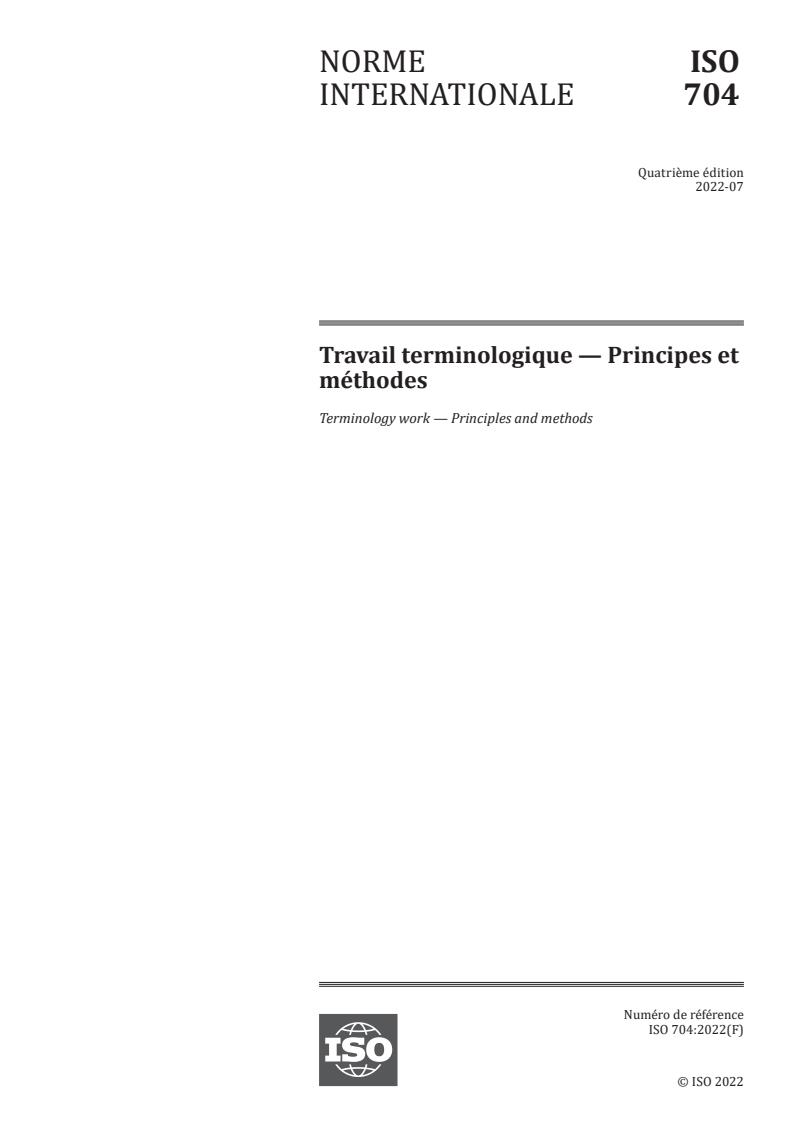

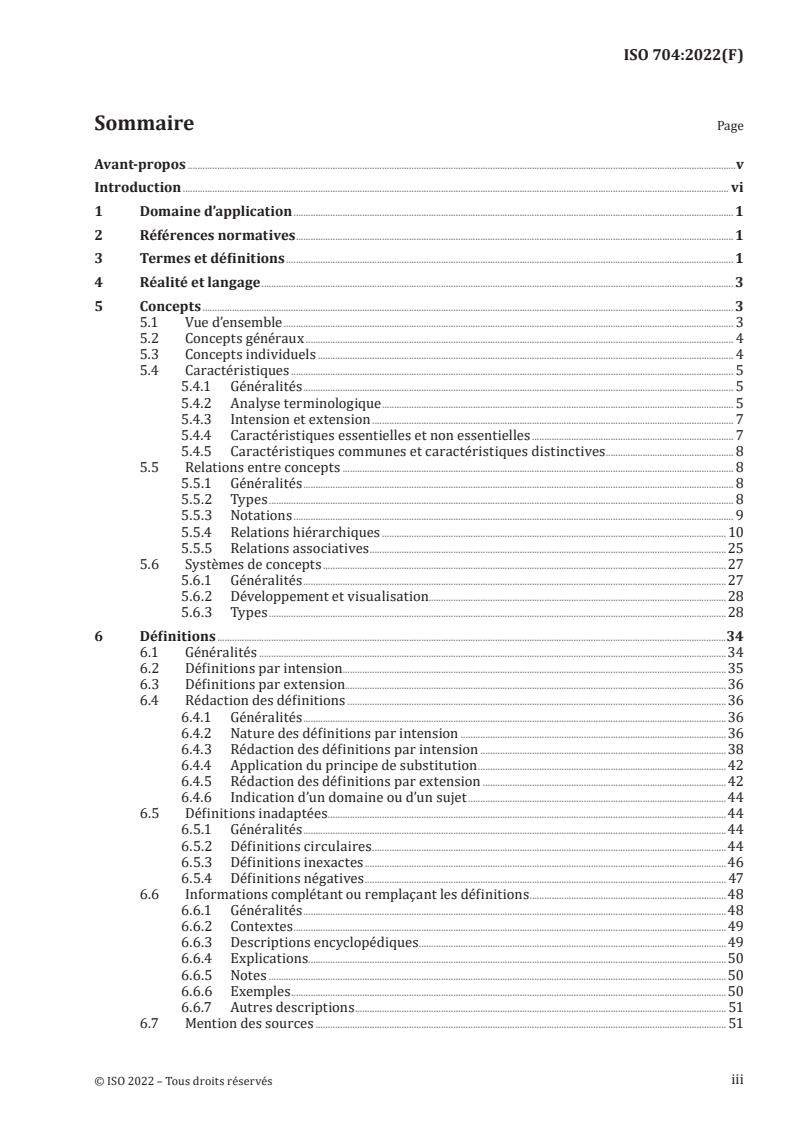
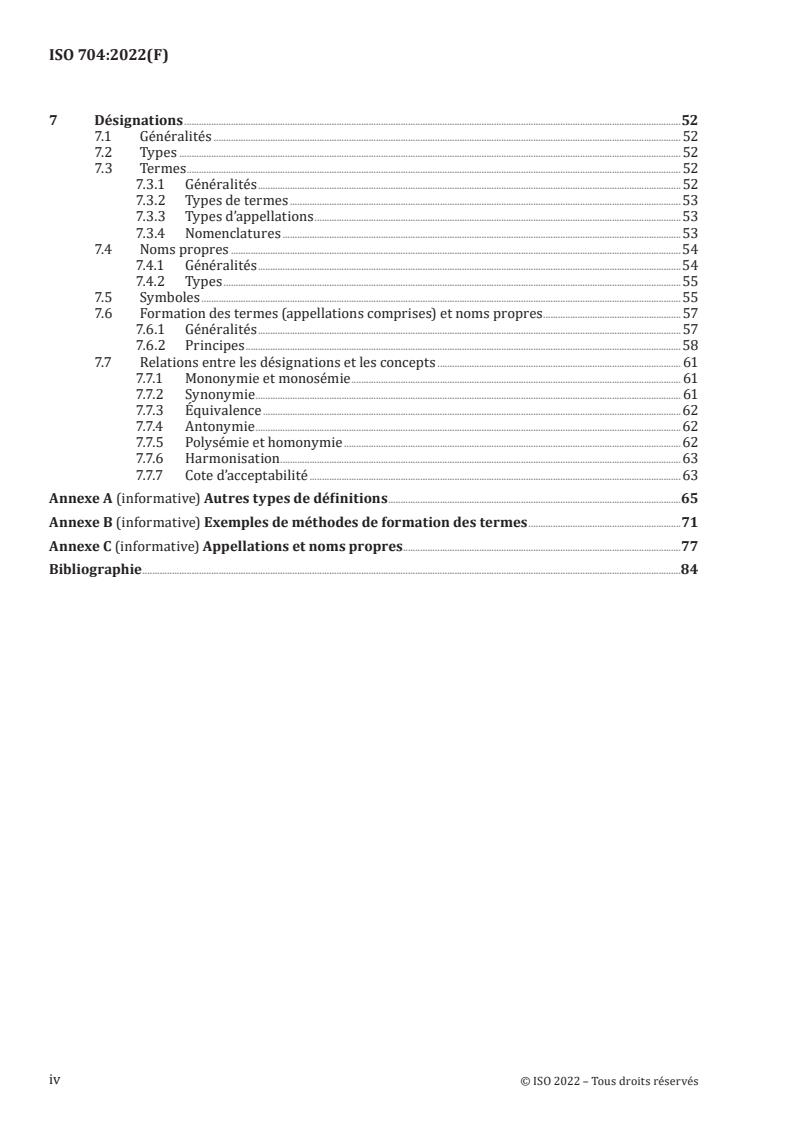
ISO 704:2022 - Terminology work — Principles and methods Released:5. 07. 2022
Overview
SIST ISO 704:2023 - Terminology work: Principles and methods defines the foundational principles and methods for creating, analysing and managing terminologies across scientific, technological, industrial, legal, administrative and other fields. The standard clarifies the relationships between objects, concepts, definitions and designations, and sets out general principles for the formation of terms and proper names and the writing of definitions. It is aligned with ISO terminology standards and replaces the previous edition (ISO 704:2009).
Key topics and technical content
SIST ISO 704:2023 addresses core terminological activities and contains guidance on:
- Concepts and concept systems: types of concepts, characteristics (intension/extension), concept relations (hierarchical and associative) and visualization of concept systems.
- Definitions: principles for intensional and extensional definitions, writing clear definitions, detecting deficient (circular/inaccurate/negative) definitions, and indicating domain or source information.
- Designations: types of designations including terms, appellations, proper names and symbols; relations between designations and concepts (mononymy, synonymy, polysemy, equivalence, antonymy).
- Term formation: principles and methods for creating terms and proper names, and guidance on acceptability and harmonization.
- Supplementary material: use of contexts, encyclopaedic descriptions, examples and explanatory notes to support definitions.
- Standards linkage: references and harmonization with related ISO documents (e.g., ISO 1087 concept vocabulary and ISO 24156-1 concept models).
Note: SIST ISO 704:2023 does not prescribe the presentation format of terminological entries in International Standards (see ISO 10241-1 and ISO 10241-2 for presentation rules).
Practical applications and users
This standard is practical for professionals and organizations involved in:
- Terminology management and lexicography
- Technical and standards committees developing domain vocabularies
- Knowledge engineers and ontology developers creating concept models
- Translators, technical writers and editors ensuring consistent term use
- Regulatory, legal and administrative bodies compiling precise term lists
- R&D and industry teams standardizing product, process and safety terminology
Practical benefits include improved clarity of technical communication, consistent term formation, better interoperability of data and documentation, and a reliable basis for multilingual terminology management.
Related standards
- ISO 1087 - Vocabulary of terminology
- ISO 24156-1 - Concept modeling (introduced into the latest edition)
- ISO 10241-1 / ISO 10241-2 - Presentation rules for terminological entries in International Standards
Using SIST ISO 704:2023 ensures terminological work follows internationally recognized principles and methods, supporting clearer definitions, harmonized terminology and better knowledge exchange across disciplines.
Relations
- Effective Date
- 01-Jan-2023
Buy Documents
ISO 704:2022 - Terminology work — Principles and methods Released:5. 07. 2022
ISO 704:2022 - Terminology work — Principles and methods Released:5. 07. 2022
Frequently Asked Questions
SIST ISO 704:2023 is a standard published by the Slovenian Institute for Standardization (SIST). Its full title is "Terminology work -- Principles and methods". This standard covers: This document establishes the basic principles and methods for preparing and compiling terminologies both inside and outside the framework of standardization. It describes the links between objects, concepts, definitions and designations. It also establishes general principles for the formation of terms and proper names and the writing of definitions. This document is applicable to terminology work in scientific, technological, industrial, legal, administrative and other fields of knowledge. This document does not stipulate rules for the presentation of terminological entries in International Standards, which are treated in ISO 10241-1 and ISO 10241-2.
This document establishes the basic principles and methods for preparing and compiling terminologies both inside and outside the framework of standardization. It describes the links between objects, concepts, definitions and designations. It also establishes general principles for the formation of terms and proper names and the writing of definitions. This document is applicable to terminology work in scientific, technological, industrial, legal, administrative and other fields of knowledge. This document does not stipulate rules for the presentation of terminological entries in International Standards, which are treated in ISO 10241-1 and ISO 10241-2.
SIST ISO 704:2023 is classified under the following ICS (International Classification for Standards) categories: 01.020 - Terminology (principles and coordination). The ICS classification helps identify the subject area and facilitates finding related standards.
SIST ISO 704:2023 has the following relationships with other standards: It is inter standard links to SIST ISO 704:2013. Understanding these relationships helps ensure you are using the most current and applicable version of the standard.
SIST ISO 704:2023 is available in PDF format for immediate download after purchase. The document can be added to your cart and obtained through the secure checkout process. Digital delivery ensures instant access to the complete standard document.
Standards Content (Sample)
SLOVENSKI STANDARD
01-januar-2023
Nadomešča:
SIST ISO 704:2013
Terminološko delo - Načela in metode
Terminology work -- Principles and methods
Travail terminologique -- Principes et méthodes
Ta slovenski standard je istoveten z: ISO 704:2022
ICS:
01.020 Terminologija (načela in Terminology (principles and
koordinacija) coordination)
2003-01.Slovenski inštitut za standardizacijo. Razmnoževanje celote ali delov tega standarda ni dovoljeno.
INTERNATIONAL ISO
STANDARD 704
Fourth edition
2022-07
Terminology work — Principles and
methods
Travail terminologique — Principes et méthodes
Reference number
© ISO 2022
All rights reserved. Unless otherwise specified, or required in the context of its implementation, no part of this publication may
be reproduced or utilized otherwise in any form or by any means, electronic or mechanical, including photocopying, or posting on
the internet or an intranet, without prior written permission. Permission can be requested from either ISO at the address below
or ISO’s member body in the country of the requester.
ISO copyright office
CP 401 • Ch. de Blandonnet 8
CH-1214 Vernier, Geneva
Phone: +41 22 749 01 11
Email: copyright@iso.org
Website: www.iso.org
Published in Switzerland
ii
Contents Page
Foreword .v
Introduction . vi
1 Scope . 1
2 Normative references . 1
3 Terms and definitions . 1
4 Reality and language . 2
5 Concepts . 3
5.1 Overview . 3
5.2 General concepts . 3
5.3 Individual concepts . 4
5.4 Characteristics. 4
5.4.1 General . 4
5.4.2 Terminological analysis . 5
5.4.3 Intension and extension . 7
5.4.4 Essential characteristics and non-essential characteristics . 7
5.4.5 Shared characteristics and delimiting characteristics . 7
5.5 Concept relations . 8
5.5.1 General . 8
5.5.2 Types . 8
5.5.3 Notations . 8
5.5.4 Hierarchical relations . 9
5.5.5 Associative relations .23
5.6 Concept systems . 25
5.6.1 General . 25
5.6.2 Development and visualization . 25
5.6.3 Types . 26
6 Definitions .33
6.1 General . 33
6.2 Intensional definitions . 33
6.3 Extensional definitions .34
6.4 Writing definitions.34
6.4.1 General .34
6.4.2 Nature of intensional definitions .34
6.4.3 Writing intensional definitions . 35
6.4.4 Applying the substitution principle .39
6.4.5 Writing extensional definitions .39
6.4.6 Indicating a domain or subject . 41
6.5 Deficient definitions . 41
6.5.1 General . 41
6.5.2 Circular definitions . 42
6.5.3 Inaccurate definitions. 43
6.5.4 Negative definitions .44
6.6 Information supplementing or replacing definitions . 45
6.6.1 General . 45
6.6.2 Contexts. 45
6.6.3 Encyclopaedic descriptions .46
6.6.4 Explanations.46
6.6.5 Notes . 47
6.6.6 Examples . 47
6.6.7 Other descriptions . 47
6.7 Indicating sources .48
iii
7 Designations .48
7.1 General .48
7.2 Types .48
7.3 Terms.49
7.3.1 General .49
7.3.2 Types of terms .49
7.3.3 Types of appellations .49
7.3.4 Nomenclatures .50
7.4 Proper names .50
7.4.1 General .50
7.4.2 Types . 51
7.5 Symbols . 51
7.6 Formation of terms (including appellations) and proper names .53
7.6.1 General .53
7.6.2 Principles .54
7.7 Relations between designations and concepts . 57
7.7.1 Mononymy and monosemy . 57
7.7.2 Synonymy . 57
7.7.3 Equivalence . 57
7.7.4 Antonymy .58
7.7.5 Polysemy and homonymy .58
7.7.6 Harmonization .58
7.7.7 Acceptability rating .58
Annex A (informative) Other types of definitions .60
Annex B (informative) Examples of term formation methods .65
Annex C (informative) Appellations and proper names .70
Bibliography .77
iv
Foreword
ISO (the International Organization for Standardization) is a worldwide federation of national standards
bodies (ISO member bodies). The work of preparing International Standards is normally carried out
through ISO technical committees. Each member body interested in a subject for which a technical
committee has been established has the right to be represented on that committee. International
organizations, governmental and non-governmental, in liaison with ISO, also take part in the work.
ISO collaborates closely with the International Electrotechnical Commission (IEC) on all matters of
electrotechnical standardization.
The procedures used to develop this document and those intended for its further maintenance are
described in the ISO/IEC Directives, Part 1. In particular, the different approval criteria needed for the
different types of ISO documents should be noted. This document was drafted in accordance with the
editorial rules of the ISO/IEC Directives, Part 2 (see www.iso.org/directives).
Attention is drawn to the possibility that some of the elements of this document may be the subject of
patent rights. ISO shall not be held responsible for identifying any or all such patent rights. Details of
any patent rights identified during the development of the document will be in the Introduction and/or
on the ISO list of patent declarations received (see www.iso.org/patents).
Any trade name used in this document is information given for the convenience of users and does not
constitute an endorsement.
For an explanation of the voluntary nature of standards, the meaning of ISO specific terms and
expressions related to conformity assessment, as well as information about ISO’s adherence to
the World Trade Organization (WTO) principles in the Technical Barriers to Trade (TBT), see
www.iso.org/iso/foreword.html.
This document was prepared by Technical Committee ISO/TC 37, Language and terminology,
Subcommittee SC 1, Principles and methods.
This fourth edition cancels and replaces the third edition (ISO 704:2009), which has been technically
revised.
The main changes are as follows:
— the structure and content have been adapted based on ISO 1087;
— concept models in accordance with ISO 24156-1 have been introduced;
— clauses on associative concept relations have been extended;
— appellations and proper names are treated more comprehensively and more systematically;
— where necessary, existing examples have been adapted or replaced, and new examples have been
introduced.
Any feedback or questions on this document should be directed to the user’s national standards body. A
complete listing of these bodies can be found at www.iso.org/members.html.
v
Introduction
0.1 Overview
This document specifies state-of-the-art principles and methods of terminology work. According to
ISO 1087:2019, 3.5.1, terminology work is “work concerned with the systematic collection, description,
processing and presentation of concepts and their designations” in various domains and subjects. It is
multidisciplinary and draws support from several disciplines (e.g. logic, epistemology, philosophy of
science, linguistics, translation studies, information science, cognitive science). It combines elements
from many theoretical approaches that deal with the description, ordering and transfer of knowledge.
Terminology work according to this document is concerned with terminology used for unambiguous
communication in natural language, in particular special languages. The goal of terminology work as
described in this document is, thus, a clarification and standardization of terminology for communication
between humans. Terminology work can also support knowledge modelling, information modelling,
data modelling and classification, but this document does not cover these fields.
This document is intended to standardize the essential elements for terminology work. The general
purposes of this document are to provide a common theoretical framework and to explain how this
framework should be implemented by organizations or individuals involved in terminology work. This
document also provides the fundamentals for terminology science teaching and training, in particular
for the training of terminologists or terminology workers.
Thus, this document is intended to provide assistance to those carrying out various terminology
work activities. The principles and methods should be observed not only for the manipulation of
terminological information but also in the planning and decision-making involved in managing
terminology. The main activities include, but are not limited to, the following:
— identifying concepts and concept relations;
— analysing and structuring concept fields on the basis of identified concepts and concept relations;
— analysing and developing concept systems on the basis of concept fields;
— visualizing concept systems, for example by means of traditional concept diagrams or Unified
Modeling Language-based concept models;
— defining concepts;
— assigning linguistic or non-linguistic designations to concepts;
— creating and maintaining terminology resources, principally in print and electronic media
(terminography).
Objects, concepts, definitions and designations are fundamental to terminology work and therefore
form the basis of this document. Objects are perceived or conceived and abstracted into concepts.
Concepts are represented by designations and/or definitions. The set of designations and concepts
belonging to one special language constitutes the terminology of a specific domain or subject.
For referencing objects, concepts, definitions and designations in accordance with the current state of
the art, the following wording conventions are used in this document:
— Objects:
— are perceived or conceived;
— are abstracted into or conceptualized as concepts.
— Concepts:
— depict or correspond to objects or groups of objects;
vi
— are represented or expressed by linguistic or non-linguistic designations or by definitions;
— are connected by concept relations and organized into concept systems that are structured
according to concept relations.
— Definitions:
— define, represent or describe concepts.
— Designations:
— designate or represent concepts;
— are assigned to concepts;
— refer to objects.
Figure 1 illustrates these wording conventions in graphical form.
Figure 1 — Graphical illustration of wording conventions
0.2 Notations
In running text of this document, the following notations are used starting with Clause 4:
— terms designating concepts defined in ISO 1087 and in this document are in italics;
— other terms and proper names are indicated by double quotation marks;
— objects, concepts, properties, characteristics, types of characteristics and criteria of subdivision are
indicated by single quotation marks;
— examples are boxed;
— symbols do not have any specific markup.
These notations are intended to facilitate the distinction between different types of references and
other text throughout this document.
The examples in this document have been chosen for illustrative purposes and are specific to the
language(s) in question. Translation into other languages can necessitate the selection of other examples
to illustrate the points.
vii
INTERNATIONAL STANDARD ISO 704:2022(E)
Terminology work — Principles and methods
1 Scope
This document establishes the basic principles and methods for preparing and compiling terminologies
both inside and outside the framework of standardization. It describes the links between objects,
concepts, definitions and designations. It also establishes general principles for the formation of terms
and proper names and the writing of definitions.
This document is applicable to terminology work in scientific, technological, industrial, legal,
administrative and other fields of knowledge.
This document does not stipulate rules for the presentation of terminological entries in International
Standards, which are treated in ISO 10241-1 and ISO 10241-2.
2 Normative references
The following documents are referred to in the text in such a way that some or all of their content
constitutes requirements of this document. For dated references, only the edition cited applies. For
undated references, the latest edition of the referenced document (including any amendments) applies.
ISO 1087, Terminology work and terminology science — Vocabulary
3 Terms and definitions
For the purposes of this document, the terms and definitions given in ISO 1087 and the following apply.
ISO and IEC maintain terminology databases for use in standardization at the following addresses:
— ISO Online browsing platform: available at https:// www .iso .org/ obp
— IEC Electropedia: available at https:// www .electropedia .org/
3.1
domain
subject field
field of special knowledge
Note 1 to entry: The borderlines and the granularity of a domain are determined from a purpose-related point of
view. If a domain is subdivided, the result is again a domain.
EXAMPLE 1 The domain of chemistry can be subdivided into pure chemistry and applied chemistry.
EXAMPLE 2 Amongst others, the domains of agriculture and food production relate to the subject of cereals.
[SOURCE: ISO 1087:2019, 3.1.4, modified — Examples added.]
3.2
subject
area of interest or expertise
Note 1 to entry: A subject may touch upon two or more domains (3.1).
EXAMPLE The subject of cereals relates to various domains such as agriculture and food production.
[SOURCE: ISO 1087:2019, 3.1.5, modified — Note 1 to entry added (from ISO 10241-1:2011, 3.3.2) and
example added.]
3.3
intensional definition
definition that conveys the intension of a concept by stating the immediate superordinate concept and
the delimiting characteristic(s)
EXAMPLE 1 optical mouse: computer mouse in which movement is detected by light sensors.
EXAMPLE 2 mechanical mouse: computer mouse in which movement is detected by rollers and a ball.
Note 1 to entry: Intensional definitions are preferable to other types of definitions because they clearly reveal
the delimiting characteristics of a concept within a concept system: they should be used whenever possible.
[SOURCE: ISO 1087:2019, 3.3.2, modified — “generic concept” replaced by “superordinate concept” in
the definition, “movements are” replaced by “movement is” in the Examples, and “delimiting” added
before “characteristics” in Note 1 to entry.]
3.4
terminological entry
concept entry
collection of terminological data related to only one concept
Note 1 to entry: A terminological entry prepared in accordance with the principles and methods given in this
document follows the same structural principles whether it is monolingual or multilingual.
[SOURCE: ISO 1087:2019, 3.6.2, modified — “concept entry” added as an admitted term, and “ISO 704”
replaced by “this document” in Note 1 to entry.]
3.5
full form
designation that is complete
EXAMPLE “solid-state drive” is the full form of “SSD”.
[SOURCE: ISO 10241-1:2011, 3.4.1.2.3, modified — “complete representation of a” removed before
“designation” and “that is complete” added after “designation” in the definition, example replaced.]
3.6
terminologist
expert who performs terminology work as a main function of a professional activity
[SOURCE: ISO 12616-1:2021, 3.30]
3.7
terminology worker
person whose role is to perform terminology work as an ancillary function of other professional
activities
[SOURCE: ISO 12616-1:2021, 3.29]
4 Reality and language
In terminology work, an object is anything perceivable or conceivable. Some objects, such as a given
‘engine’, ‘sheet of paper’ or ‘diamond’, are material. Other objects, such as a given ‘conversion ratio’
or ‘project planning’, are immaterial. Still other objects, for example a given ‘unicorn’ or ‘scientific
hypothesis’, are imagined. Discussions on whether an object actually exists in reality are unproductive
and should thus be avoided. Attention should be focused on how one deals with objects for the purposes
of communication.
Objects are made up of and identified by their properties (see 5.4.1, Example), but neither information
on properties of specific objects nor information on the objects themselves is commonly recorded in
terminology resources. However, in some cases, such as terminology work in support of technical
documentation, objects or their properties can be represented.
5 Concepts
5.1 Overview
In communication, not every individual object in the world is differentiated and named. Instead,
through observation and a process called conceptualization, objects are grouped into categories. These
categories correspond to units of knowledge called concepts. Concepts are made up of characteristics
(see 5.4.2, Example 2). They are represented in various forms of communication (object → concept →
communication). This document does not deal with all concepts represented in natural language, but
only with those belonging to domains or subjects.
In terminology work, concepts shall be considered units of knowledge that correspond to objects or
groups of objects. Concepts are not to be confused with immaterial or imagined objects: objects in a given
situation are observed and conceptualized mentally and then a designation is assigned to the concept
rather than to the objects themselves. The link between an object and its corresponding designation or
definition is made through the concept, a higher level of abstraction.
Terminology work requires an understanding of the conceptualization that underpins human knowledge
in a domain or subject. Because terminology work always deals with special language, the concept is
viewed in the first place as a unit of knowledge. The concepts contextualized in the special language
of a given domain or subject can be represented in various forms of human communication. In natural
language, concepts can be represented by linguistic designations, i.e. terms and proper names, or by non-
linguistic designations, i.e. symbols. They can also be represented by definitions. In formal language,
concepts can be represented by codes or formulae, while they can also be represented by icons, pictures,
diagrams, graphic illustrations, sound clips, video or other multimedia representations. Concepts can
also be represented with the human body as they are in signed language.
Different domains or subjects view the same objects differently. When necessary, the same objects can be
abstracted in different ways, and the resulting concept(s) can be represented by different definitions for
different target audiences.
EXAMPLE
Concept Domain Definition
‘water’ chemistry molecule-composed compound of two atoms of hydrogen and one atom of oxygen
physics chemical compound that is colourless, odourless and tasteless, and that is
naturally found in solid state at temperatures at and below 0 °C, in liquid state
at temperatures between 0 °C and 100 °C, and as vapour at temperatures above
100 °C under standard atmospheric pressure
biology liquid chemical substance that is essential to all known forms of life
5.2 General concepts
When a concept depicts a potentially unlimited number of objects that form a group by reason of shared
properties, the concept is called a general concept. Designations of general concepts take the form of terms
(including appellations) or symbols.
EXAMPLE
Terms “hard disk”, “liquidity”
® ® 1) ® 1)
Appellations “Adobe Acrobat X Pro” , “Nokia 7 Plus ” , “HNO ”
Symbols ©, W
1)
Adobe® Acrobat® X Pro is a trademark of Adobe Systems and Nokia 7 Plus® is a trademark of Nokia Cor-
poration. This information is given for the convenience of users of this document and does not constitute an
endorsement by ISO of the product named.
5.3 Individual concepts
When a concept corresponds to a unique object or to a composition of entities considered to form a
unique object, the concept is called an individual concept. The designation of an individual concept takes
the form of a proper name or a symbol.
EXAMPLE 1
® 2)
Proper names “United Nations”, “IBM ”
Symbols
(used to designate ‘Africa’), (used to designate ‘Statue of Liberty’)
2) ®
IBM is a trademark of International Business Machines Corporation. This information is given for the
convenience of users of this document and does not constitute an endorsement by ISO of the product named.
Proper names represent individual concepts and shall thus be distinguished from terms that represent
general concepts. When an individual concept is expressed by a proper name that includes a linking
element such as “and”, it is still considered one individual concept.
EXAMPLE 2
The proper name “North, Central and South America” refers to a single object that is a whole with three parts
(a single region made up of the three parts). Thus, it represents one individual concept. Conversely, the three
proper names “North America”, “Central America” and “South America” represent three separate individual
concepts.
EXAMPLE 3
The proper name “Canadian Radio-television and Telecommunications Commission” refers to a single object,
not two, i.e. not to the ‘Canadian Radio-television Commission’ and the ‘Canadian Telecommunications
Commission’.
5.4 Characteristics
5.4.1 General
Conceptualization plays a pivotal role in organizing human knowledge because it provides the means for
recognizing objects and for grouping them into meaningful categories in a particular domain or subject.
To categorize an object for the purposes of conceptualization, it is necessary to identify its properties.
Objects considered as sharing the same properties are grouped into categories. Once similar objects, or
occasionally a single object, are viewed as meaningful categories, the relevant properties are abstracted
into characteristics. The characteristics are then combined as a set in the formation of a concept.
Thus, objects in the real world are identified by their properties (see the Example below). The properties
are then abstracted into characteristics and the objects are abstracted into concepts made up of the
characteristics. Characteristics are qualifiers and narrow the intension of a superordinate concept (see
5.5.4.2.1).
NOTE The concept ‘property’ in the domain of information technology is different from the concept
‘characteristic’ as used in this document.
EXAMPLE
The relations between object, property, characteristic and concept can be further elucidated by the
following statements:
— each object has at least one property;
— each relevant property is abstracted into a characteristic;
— each concept is comprised of at least one characteristic;
— each object is abstracted into at least one concept.
5.4.2 Terminological analysis
Based on the process of conceptualization according to 5.4.1, terminological analysis requires:
— identifying the domain or subject;
— identifying the properties possessed by objects in the domain or subject;
— determining those properties that are abstracted into characteristics;
— determining how the characteristics combine to form a concept;
— identifying relations with other concepts in the domain or subject;
— writing or identifying and analysing definitions;
— assigning a designation to the concept.
The properties that belong to objects can themselves be objects. Similarly, the characteristics that make
up a concept can themselves be concepts, sometimes within the same domain or subject, sometimes not.
Depending on the domain or subject concerned, terminological analysis should start with those concepts
corresponding to material objects. The relevant characteristics are more easily abstracted given that
the properties of those objects can be physically observed or examined.
A terminologist or terminology worker can begin by analysing content that describes objects by means
of designations. By analysing relevant content, the terminologist or terminology worker can get an
understanding of the properties of the various objects, so as to determine which properties need to be
abstracted into characteristics.
If the objects in Example 1 below are contextualized in the field of information technology, these
particular objects are recognized as belonging to the set of objects that has been conceptualized as
‘optical mouse’. In the process of conceptualization, the relevant properties of all the objects in the
category are abstracted into characteristics.
EXAMPLE 1
The objects represented by the visual representations below have the following properties:
— ‘being a device’; — ‘being a device’; — ‘being a device’;
— ‘being ivory-coloured’; — ‘being blue and grey’; — ‘being black and grey’;
— ‘being hand-manoeuvred along a — ‘being hand-manoeuvred — ‘being hand-manoeuvred along
firm, flat surface’; along a firm, flat surface’; a firm, flat surface’;
— ‘having three buttons’; — ‘having one button’; — ‘having two buttons’;
— ‘having an ivory-coloured wire — ‘having a grey wire for — ‘having a black wire for
for connecting to a computer’; connecting to a computer’; connecting to a computer’;
— ‘having a visible laser — ‘having a visible laser — ‘having an infrared
emitter’; emitter’; emitter’;
— ‘having light sensors that detect — ‘having light sensors that — ‘having light sensors that
movement’. detect movement’. detect movement’.
To facilitate terminological analysis, the properties of objects can be grouped into categories such as
part, function, composition, colour, shape, operation or location. Categories appropriate to the domain
or subject can be found from reference works and encyclopaedias, but any list should be used flexibly.
Also, it should be assumed that additional categories are likely to be needed to adequately represent all
the properties. For practical purposes, beginning with one of the more typical objects is recommended.
Characteristics shall be identified based on content about the domain or subject and this often requires
research. Experienced terminologists or terminology workers for whom the concept in question is clear
and straightforward may move directly to identifying the characteristics.
As illustrated in Example 2 below, those characteristics are applied to the entire set of objects as opposed
to the individual objects. Example 2 is the preliminary result of a terminological analysis with regard
to the concept ‘optical mouse’. Concepts corresponding to immaterial objects (e.g. ‘bankruptcy’) shall be
analysed along the same lines.
EXAMPLE 2
Concept: unit of knowledge based on the set of all optical mice
Designation (term): “optical mouse”
Properties of object 1 Properties of object 2 Properties of object 3 Characteristics
‘being ivory-coloured’ ‘being blue and grey’ ‘being black and grey’ ‘having colour’
‘being hand-manoeuvred ‘being hand-manoeuvred ‘being hand-manoeuvred ‘being hand-manoeuvred
along a firm, flat surface’ along a firm, flat surface’ along a firm, flat surface’ along a firm, flat surface’
‘having three buttons’ ‘having one button’ ‘having two buttons’ ‘having at least one button’
‘having an ivory-coloured ‘having a grey wire for ‘having a black wire for ‘having a wire for
wire for connecting to a connecting to a connecting to a computer’ connecting to a
computer’ computer’ computer’
‘having a visible laser ‘having a visible laser ‘having an infrared ‘having a light emitter’
emitter’ emitter’ emitter’
‘having light sensors that ‘having light sensors that ‘having light sensors that ‘having light sensors that
detect movement’ detect movement’ detect movement’ detect movement’
Characteristics shall be used in the analysis of concepts, the development of concept systems and the
writing of definitions. Where appropriate, they should have a bearing on the selection and formation of
designations. In selecting properties and characteristics, these purposes need to be borne in mind, since
the number of properties that distinguish one object from another is effectively infinite. For example, in
the case of ‘computer mice’, the property ‘place of manufacture’ need not be considered. An experienced
terminologist or terminology worker can anticipate what is likely to be required.
5.4.3 Intension and extension
The set of characteristics that make up the concept is the intension of the concept. The set of objects
conceptualized as a concept is the extension of the concept. The intension determines the extension.
EXAMPLE 1
As shown in 5.4.2, Example 2, the characteristics making up the intension of ‘optical mouse’ determine the
extension, i.e. the objects that qualify as ‘optical mice’.
EXAMPLE 2
The following characteristics make up the intension of ‘planet in the solar system’: ‘being in orbit around the
Sun’, ‘having sufficient mass to assume a hydrostatic equilibrium (nearly round) shape’ and ‘having cleared
the neighbourhood around its orbit’. These characteristics determine the extension, so the objects that qualify
as ‘planets in the solar system’ are the following celestial bodies: ‘Mercury’, ‘Venus’, ‘Earth’, ‘Mars’, ‘Jupiter’,
‘Saturn’, ‘Uranus’ and ‘Neptune’ (in ascending order by their distance from the sun).
SOURCE: Reference [65].
5.4.4 Essential characteristics and non-essential characteristics
Not all characteristics are equally important. For practical purposes, the essential characteristics of
the intension shall be the focus of terminological analysis and can differ between various domains or
subjects.
The essential characteristics of a concept, such as ‘wireless mouse’, shall be identified. The absence of
an essential characteristic in the course of terminological analysis leads to poor or even erroneous
understanding of the concept. In the example of the concept ‘wireless mouse’, if the characteristic
‘using a wireless light or sound connection’ is removed, the concept represents a different concept
corresponding to a different set of objects. Therefore, this is an essential characteristic.
On the other hand, if the characteristic ‘having colour’ is removed, the concept is not altered. Although
any material object ‘wireless mouse’ necessarily has a colour, it still qualifies as a ‘wireless mouse’
independent of the specific colour in question. Therefore, this characteristic is not indispensable to
understand the concept ‘wireless mouse’ and thus it is a non-essential characteristic. When the concept
in question is highly complex, it can be necessary to categorize characteristics explicitly as essential
characteristics and non-essential characteristics.
5.4.5 Shared characteristics and delimiting characteristics
After identifying the characteristics that make up the intension of a concept and the essential
characteristics, the terminological analysis shall be taken a step further. Each characteristic of the
concept under study shall be analysed with regard to othe
...
INTERNATIONAL ISO
STANDARD 704
Fourth edition
2022-07
Terminology work — Principles and
methods
Travail terminologique — Principes et méthodes
Reference number
© ISO 2022
All rights reserved. Unless otherwise specified, or required in the context of its implementation, no part of this publication may
be reproduced or utilized otherwise in any form or by any means, electronic or mechanical, including photocopying, or posting on
the internet or an intranet, without prior written permission. Permission can be requested from either ISO at the address below
or ISO’s member body in the country of the requester.
ISO copyright office
CP 401 • Ch. de Blandonnet 8
CH-1214 Vernier, Geneva
Phone: +41 22 749 01 11
Email: copyright@iso.org
Website: www.iso.org
Published in Switzerland
ii
Contents Page
Foreword .v
Introduction . vi
1 Scope . 1
2 Normative references . 1
3 Terms and definitions . 1
4 Reality and language . 2
5 Concepts . 3
5.1 Overview . 3
5.2 General concepts . 3
5.3 Individual concepts . 4
5.4 Characteristics. 4
5.4.1 General . 4
5.4.2 Terminological analysis . 5
5.4.3 Intension and extension . 7
5.4.4 Essential characteristics and non-essential characteristics . 7
5.4.5 Shared characteristics and delimiting characteristics . 7
5.5 Concept relations . 8
5.5.1 General . 8
5.5.2 Types . 8
5.5.3 Notations . 8
5.5.4 Hierarchical relations . 9
5.5.5 Associative relations .23
5.6 Concept systems . 25
5.6.1 General . 25
5.6.2 Development and visualization . 25
5.6.3 Types . 26
6 Definitions .33
6.1 General . 33
6.2 Intensional definitions . 33
6.3 Extensional definitions .34
6.4 Writing definitions.34
6.4.1 General .34
6.4.2 Nature of intensional definitions .34
6.4.3 Writing intensional definitions . 35
6.4.4 Applying the substitution principle .39
6.4.5 Writing extensional definitions .39
6.4.6 Indicating a domain or subject . 41
6.5 Deficient definitions . 41
6.5.1 General . 41
6.5.2 Circular definitions . 42
6.5.3 Inaccurate definitions. 43
6.5.4 Negative definitions .44
6.6 Information supplementing or replacing definitions . 45
6.6.1 General . 45
6.6.2 Contexts. 45
6.6.3 Encyclopaedic descriptions .46
6.6.4 Explanations.46
6.6.5 Notes . 47
6.6.6 Examples . 47
6.6.7 Other descriptions . 47
6.7 Indicating sources .48
iii
7 Designations .48
7.1 General .48
7.2 Types .48
7.3 Terms.49
7.3.1 General .49
7.3.2 Types of terms .49
7.3.3 Types of appellations .49
7.3.4 Nomenclatures .50
7.4 Proper names .50
7.4.1 General .50
7.4.2 Types . 51
7.5 Symbols . 51
7.6 Formation of terms (including appellations) and proper names .53
7.6.1 General .53
7.6.2 Principles .54
7.7 Relations between designations and concepts . 57
7.7.1 Mononymy and monosemy . 57
7.7.2 Synonymy . 57
7.7.3 Equivalence . 57
7.7.4 Antonymy .58
7.7.5 Polysemy and homonymy .58
7.7.6 Harmonization .58
7.7.7 Acceptability rating .58
Annex A (informative) Other types of definitions .60
Annex B (informative) Examples of term formation methods .65
Annex C (informative) Appellations and proper names .70
Bibliography .77
iv
Foreword
ISO (the International Organization for Standardization) is a worldwide federation of national standards
bodies (ISO member bodies). The work of preparing International Standards is normally carried out
through ISO technical committees. Each member body interested in a subject for which a technical
committee has been established has the right to be represented on that committee. International
organizations, governmental and non-governmental, in liaison with ISO, also take part in the work.
ISO collaborates closely with the International Electrotechnical Commission (IEC) on all matters of
electrotechnical standardization.
The procedures used to develop this document and those intended for its further maintenance are
described in the ISO/IEC Directives, Part 1. In particular, the different approval criteria needed for the
different types of ISO documents should be noted. This document was drafted in accordance with the
editorial rules of the ISO/IEC Directives, Part 2 (see www.iso.org/directives).
Attention is drawn to the possibility that some of the elements of this document may be the subject of
patent rights. ISO shall not be held responsible for identifying any or all such patent rights. Details of
any patent rights identified during the development of the document will be in the Introduction and/or
on the ISO list of patent declarations received (see www.iso.org/patents).
Any trade name used in this document is information given for the convenience of users and does not
constitute an endorsement.
For an explanation of the voluntary nature of standards, the meaning of ISO specific terms and
expressions related to conformity assessment, as well as information about ISO’s adherence to
the World Trade Organization (WTO) principles in the Technical Barriers to Trade (TBT), see
www.iso.org/iso/foreword.html.
This document was prepared by Technical Committee ISO/TC 37, Language and terminology,
Subcommittee SC 1, Principles and methods.
This fourth edition cancels and replaces the third edition (ISO 704:2009), which has been technically
revised.
The main changes are as follows:
— the structure and content have been adapted based on ISO 1087;
— concept models in accordance with ISO 24156-1 have been introduced;
— clauses on associative concept relations have been extended;
— appellations and proper names are treated more comprehensively and more systematically;
— where necessary, existing examples have been adapted or replaced, and new examples have been
introduced.
Any feedback or questions on this document should be directed to the user’s national standards body. A
complete listing of these bodies can be found at www.iso.org/members.html.
v
Introduction
0.1 Overview
This document specifies state-of-the-art principles and methods of terminology work. According to
ISO 1087:2019, 3.5.1, terminology work is “work concerned with the systematic collection, description,
processing and presentation of concepts and their designations” in various domains and subjects. It is
multidisciplinary and draws support from several disciplines (e.g. logic, epistemology, philosophy of
science, linguistics, translation studies, information science, cognitive science). It combines elements
from many theoretical approaches that deal with the description, ordering and transfer of knowledge.
Terminology work according to this document is concerned with terminology used for unambiguous
communication in natural language, in particular special languages. The goal of terminology work as
described in this document is, thus, a clarification and standardization of terminology for communication
between humans. Terminology work can also support knowledge modelling, information modelling,
data modelling and classification, but this document does not cover these fields.
This document is intended to standardize the essential elements for terminology work. The general
purposes of this document are to provide a common theoretical framework and to explain how this
framework should be implemented by organizations or individuals involved in terminology work. This
document also provides the fundamentals for terminology science teaching and training, in particular
for the training of terminologists or terminology workers.
Thus, this document is intended to provide assistance to those carrying out various terminology
work activities. The principles and methods should be observed not only for the manipulation of
terminological information but also in the planning and decision-making involved in managing
terminology. The main activities include, but are not limited to, the following:
— identifying concepts and concept relations;
— analysing and structuring concept fields on the basis of identified concepts and concept relations;
— analysing and developing concept systems on the basis of concept fields;
— visualizing concept systems, for example by means of traditional concept diagrams or Unified
Modeling Language-based concept models;
— defining concepts;
— assigning linguistic or non-linguistic designations to concepts;
— creating and maintaining terminology resources, principally in print and electronic media
(terminography).
Objects, concepts, definitions and designations are fundamental to terminology work and therefore
form the basis of this document. Objects are perceived or conceived and abstracted into concepts.
Concepts are represented by designations and/or definitions. The set of designations and concepts
belonging to one special language constitutes the terminology of a specific domain or subject.
For referencing objects, concepts, definitions and designations in accordance with the current state of
the art, the following wording conventions are used in this document:
— Objects:
— are perceived or conceived;
— are abstracted into or conceptualized as concepts.
— Concepts:
— depict or correspond to objects or groups of objects;
vi
— are represented or expressed by linguistic or non-linguistic designations or by definitions;
— are connected by concept relations and organized into concept systems that are structured
according to concept relations.
— Definitions:
— define, represent or describe concepts.
— Designations:
— designate or represent concepts;
— are assigned to concepts;
— refer to objects.
Figure 1 illustrates these wording conventions in graphical form.
Figure 1 — Graphical illustration of wording conventions
0.2 Notations
In running text of this document, the following notations are used starting with Clause 4:
— terms designating concepts defined in ISO 1087 and in this document are in italics;
— other terms and proper names are indicated by double quotation marks;
— objects, concepts, properties, characteristics, types of characteristics and criteria of subdivision are
indicated by single quotation marks;
— examples are boxed;
— symbols do not have any specific markup.
These notations are intended to facilitate the distinction between different types of references and
other text throughout this document.
The examples in this document have been chosen for illustrative purposes and are specific to the
language(s) in question. Translation into other languages can necessitate the selection of other examples
to illustrate the points.
vii
INTERNATIONAL STANDARD ISO 704:2022(E)
Terminology work — Principles and methods
1 Scope
This document establishes the basic principles and methods for preparing and compiling terminologies
both inside and outside the framework of standardization. It describes the links between objects,
concepts, definitions and designations. It also establishes general principles for the formation of terms
and proper names and the writing of definitions.
This document is applicable to terminology work in scientific, technological, industrial, legal,
administrative and other fields of knowledge.
This document does not stipulate rules for the presentation of terminological entries in International
Standards, which are treated in ISO 10241-1 and ISO 10241-2.
2 Normative references
The following documents are referred to in the text in such a way that some or all of their content
constitutes requirements of this document. For dated references, only the edition cited applies. For
undated references, the latest edition of the referenced document (including any amendments) applies.
ISO 1087, Terminology work and terminology science — Vocabulary
3 Terms and definitions
For the purposes of this document, the terms and definitions given in ISO 1087 and the following apply.
ISO and IEC maintain terminology databases for use in standardization at the following addresses:
— ISO Online browsing platform: available at https:// www .iso .org/ obp
— IEC Electropedia: available at https:// www .electropedia .org/
3.1
domain
subject field
field of special knowledge
Note 1 to entry: The borderlines and the granularity of a domain are determined from a purpose-related point of
view. If a domain is subdivided, the result is again a domain.
EXAMPLE 1 The domain of chemistry can be subdivided into pure chemistry and applied chemistry.
EXAMPLE 2 Amongst others, the domains of agriculture and food production relate to the subject of cereals.
[SOURCE: ISO 1087:2019, 3.1.4, modified — Examples added.]
3.2
subject
area of interest or expertise
Note 1 to entry: A subject may touch upon two or more domains (3.1).
EXAMPLE The subject of cereals relates to various domains such as agriculture and food production.
[SOURCE: ISO 1087:2019, 3.1.5, modified — Note 1 to entry added (from ISO 10241-1:2011, 3.3.2) and
example added.]
3.3
intensional definition
definition that conveys the intension of a concept by stating the immediate superordinate concept and
the delimiting characteristic(s)
EXAMPLE 1 optical mouse: computer mouse in which movement is detected by light sensors.
EXAMPLE 2 mechanical mouse: computer mouse in which movement is detected by rollers and a ball.
Note 1 to entry: Intensional definitions are preferable to other types of definitions because they clearly reveal
the delimiting characteristics of a concept within a concept system: they should be used whenever possible.
[SOURCE: ISO 1087:2019, 3.3.2, modified — “generic concept” replaced by “superordinate concept” in
the definition, “movements are” replaced by “movement is” in the Examples, and “delimiting” added
before “characteristics” in Note 1 to entry.]
3.4
terminological entry
concept entry
collection of terminological data related to only one concept
Note 1 to entry: A terminological entry prepared in accordance with the principles and methods given in this
document follows the same structural principles whether it is monolingual or multilingual.
[SOURCE: ISO 1087:2019, 3.6.2, modified — “concept entry” added as an admitted term, and “ISO 704”
replaced by “this document” in Note 1 to entry.]
3.5
full form
designation that is complete
EXAMPLE “solid-state drive” is the full form of “SSD”.
[SOURCE: ISO 10241-1:2011, 3.4.1.2.3, modified — “complete representation of a” removed before
“designation” and “that is complete” added after “designation” in the definition, example replaced.]
3.6
terminologist
expert who performs terminology work as a main function of a professional activity
[SOURCE: ISO 12616-1:2021, 3.30]
3.7
terminology worker
person whose role is to perform terminology work as an ancillary function of other professional
activities
[SOURCE: ISO 12616-1:2021, 3.29]
4 Reality and language
In terminology work, an object is anything perceivable or conceivable. Some objects, such as a given
‘engine’, ‘sheet of paper’ or ‘diamond’, are material. Other objects, such as a given ‘conversion ratio’
or ‘project planning’, are immaterial. Still other objects, for example a given ‘unicorn’ or ‘scientific
hypothesis’, are imagined. Discussions on whether an object actually exists in reality are unproductive
and should thus be avoided. Attention should be focused on how one deals with objects for the purposes
of communication.
Objects are made up of and identified by their properties (see 5.4.1, Example), but neither information
on properties of specific objects nor information on the objects themselves is commonly recorded in
terminology resources. However, in some cases, such as terminology work in support of technical
documentation, objects or their properties can be represented.
5 Concepts
5.1 Overview
In communication, not every individual object in the world is differentiated and named. Instead,
through observation and a process called conceptualization, objects are grouped into categories. These
categories correspond to units of knowledge called concepts. Concepts are made up of characteristics
(see 5.4.2, Example 2). They are represented in various forms of communication (object → concept →
communication). This document does not deal with all concepts represented in natural language, but
only with those belonging to domains or subjects.
In terminology work, concepts shall be considered units of knowledge that correspond to objects or
groups of objects. Concepts are not to be confused with immaterial or imagined objects: objects in a given
situation are observed and conceptualized mentally and then a designation is assigned to the concept
rather than to the objects themselves. The link between an object and its corresponding designation or
definition is made through the concept, a higher level of abstraction.
Terminology work requires an understanding of the conceptualization that underpins human knowledge
in a domain or subject. Because terminology work always deals with special language, the concept is
viewed in the first place as a unit of knowledge. The concepts contextualized in the special language
of a given domain or subject can be represented in various forms of human communication. In natural
language, concepts can be represented by linguistic designations, i.e. terms and proper names, or by non-
linguistic designations, i.e. symbols. They can also be represented by definitions. In formal language,
concepts can be represented by codes or formulae, while they can also be represented by icons, pictures,
diagrams, graphic illustrations, sound clips, video or other multimedia representations. Concepts can
also be represented with the human body as they are in signed language.
Different domains or subjects view the same objects differently. When necessary, the same objects can be
abstracted in different ways, and the resulting concept(s) can be represented by different definitions for
different target audiences.
EXAMPLE
Concept Domain Definition
‘water’ chemistry molecule-composed compound of two atoms of hydrogen and one atom of oxygen
physics chemical compound that is colourless, odourless and tasteless, and that is
naturally found in solid state at temperatures at and below 0 °C, in liquid state
at temperatures between 0 °C and 100 °C, and as vapour at temperatures above
100 °C under standard atmospheric pressure
biology liquid chemical substance that is essential to all known forms of life
5.2 General concepts
When a concept depicts a potentially unlimited number of objects that form a group by reason of shared
properties, the concept is called a general concept. Designations of general concepts take the form of terms
(including appellations) or symbols.
EXAMPLE
Terms “hard disk”, “liquidity”
® ® 1) ® 1)
Appellations “Adobe Acrobat X Pro” , “Nokia 7 Plus ” , “HNO ”
Symbols ©, W
1)
Adobe® Acrobat® X Pro is a trademark of Adobe Systems and Nokia 7 Plus® is a trademark of Nokia Cor-
poration. This information is given for the convenience of users of this document and does not constitute an
endorsement by ISO of the product named.
5.3 Individual concepts
When a concept corresponds to a unique object or to a composition of entities considered to form a
unique object, the concept is called an individual concept. The designation of an individual concept takes
the form of a proper name or a symbol.
EXAMPLE 1
® 2)
Proper names “United Nations”, “IBM ”
Symbols
(used to designate ‘Africa’), (used to designate ‘Statue of Liberty’)
2) ®
IBM is a trademark of International Business Machines Corporation. This information is given for the
convenience of users of this document and does not constitute an endorsement by ISO of the product named.
Proper names represent individual concepts and shall thus be distinguished from terms that represent
general concepts. When an individual concept is expressed by a proper name that includes a linking
element such as “and”, it is still considered one individual concept.
EXAMPLE 2
The proper name “North, Central and South America” refers to a single object that is a whole with three parts
(a single region made up of the three parts). Thus, it represents one individual concept. Conversely, the three
proper names “North America”, “Central America” and “South America” represent three separate individual
concepts.
EXAMPLE 3
The proper name “Canadian Radio-television and Telecommunications Commission” refers to a single object,
not two, i.e. not to the ‘Canadian Radio-television Commission’ and the ‘Canadian Telecommunications
Commission’.
5.4 Characteristics
5.4.1 General
Conceptualization plays a pivotal role in organizing human knowledge because it provides the means for
recognizing objects and for grouping them into meaningful categories in a particular domain or subject.
To categorize an object for the purposes of conceptualization, it is necessary to identify its properties.
Objects considered as sharing the same properties are grouped into categories. Once similar objects, or
occasionally a single object, are viewed as meaningful categories, the relevant properties are abstracted
into characteristics. The characteristics are then combined as a set in the formation of a concept.
Thus, objects in the real world are identified by their properties (see the Example below). The properties
are then abstracted into characteristics and the objects are abstracted into concepts made up of the
characteristics. Characteristics are qualifiers and narrow the intension of a superordinate concept (see
5.5.4.2.1).
NOTE The concept ‘property’ in the domain of information technology is different from the concept
‘characteristic’ as used in this document.
EXAMPLE
The relations between object, property, characteristic and concept can be further elucidated by the
following statements:
— each object has at least one property;
— each relevant property is abstracted into a characteristic;
— each concept is comprised of at least one characteristic;
— each object is abstracted into at least one concept.
5.4.2 Terminological analysis
Based on the process of conceptualization according to 5.4.1, terminological analysis requires:
— identifying the domain or subject;
— identifying the properties possessed by objects in the domain or subject;
— determining those properties that are abstracted into characteristics;
— determining how the characteristics combine to form a concept;
— identifying relations with other concepts in the domain or subject;
— writing or identifying and analysing definitions;
— assigning a designation to the concept.
The properties that belong to objects can themselves be objects. Similarly, the characteristics that make
up a concept can themselves be concepts, sometimes within the same domain or subject, sometimes not.
Depending on the domain or subject concerned, terminological analysis should start with those concepts
corresponding to material objects. The relevant characteristics are more easily abstracted given that
the properties of those objects can be physically observed or examined.
A terminologist or terminology worker can begin by analysing content that describes objects by means
of designations. By analysing relevant content, the terminologist or terminology worker can get an
understanding of the properties of the various objects, so as to determine which properties need to be
abstracted into characteristics.
If the objects in Example 1 below are contextualized in the field of information technology, these
particular objects are recognized as belonging to the set of objects that has been conceptualized as
‘optical mouse’. In the process of conceptualization, the relevant properties of all the objects in the
category are abstracted into characteristics.
EXAMPLE 1
The objects represented by the visual representations below have the following properties:
— ‘being a device’; — ‘being a device’; — ‘being a device’;
— ‘being ivory-coloured’; — ‘being blue and grey’; — ‘being black and grey’;
— ‘being hand-manoeuvred along a — ‘being hand-manoeuvred — ‘being hand-manoeuvred along
firm, flat surface’; along a firm, flat surface’; a firm, flat surface’;
— ‘having three buttons’; — ‘having one button’; — ‘having two buttons’;
— ‘having an ivory-coloured wire — ‘having a grey wire for — ‘having a black wire for
for connecting to a computer’; connecting to a computer’; connecting to a computer’;
— ‘having a visible laser — ‘having a visible laser — ‘having an infrared
emitter’; emitter’; emitter’;
— ‘having light sensors that detect — ‘having light sensors that — ‘having light sensors that
movement’. detect movement’. detect movement’.
To facilitate terminological analysis, the properties of objects can be grouped into categories such as
part, function, composition, colour, shape, operation or location. Categories appropriate to the domain
or subject can be found from reference works and encyclopaedias, but any list should be used flexibly.
Also, it should be assumed that additional categories are likely to be needed to adequately represent all
the properties. For practical purposes, beginning with one of the more typical objects is recommended.
Characteristics shall be identified based on content about the domain or subject and this often requires
research. Experienced terminologists or terminology workers for whom the concept in question is clear
and straightforward may move directly to identifying the characteristics.
As illustrated in Example 2 below, those characteristics are applied to the entire set of objects as opposed
to the individual objects. Example 2 is the preliminary result of a terminological analysis with regard
to the concept ‘optical mouse’. Concepts corresponding to immaterial objects (e.g. ‘bankruptcy’) shall be
analysed along the same lines.
EXAMPLE 2
Concept: unit of knowledge based on the set of all optical mice
Designation (term): “optical mouse”
Properties of object 1 Properties of object 2 Properties of object 3 Characteristics
‘being ivory-coloured’ ‘being blue and grey’ ‘being black and grey’ ‘having colour’
‘being hand-manoeuvred ‘being hand-manoeuvred ‘being hand-manoeuvred ‘being hand-manoeuvred
along a firm, flat surface’ along a firm, flat surface’ along a firm, flat surface’ along a firm, flat surface’
‘having three buttons’ ‘having one button’ ‘having two buttons’ ‘having at least one button’
‘having an ivory-coloured ‘having a grey wire for ‘having a black wire for ‘having a wire for
wire for connecting to a connecting to a connecting to a computer’ connecting to a
computer’ computer’ computer’
‘having a visible laser ‘having a visible laser ‘having an infrared ‘having a light emitter’
emitter’ emitter’ emitter’
‘having light sensors that ‘having light sensors that ‘having light sensors that ‘having light sensors that
detect movement’ detect movement’ detect movement’ detect movement’
Characteristics shall be used in the analysis of concepts, the development of concept systems and the
writing of definitions. Where appropriate, they should have a bearing on the selection and formation of
designations. In selecting properties and characteristics, these purposes need to be borne in mind, since
the number of properties that distinguish one object from another is effectively infinite. For example, in
the case of ‘computer mice’, the property ‘place of manufacture’ need not be considered. An experienced
terminologist or terminology worker can anticipate what is likely to be required.
5.4.3 Intension and extension
The set of characteristics that make up the concept is the intension of the concept. The set of objects
conceptualized as a concept is the extension of the concept. The intension determines the extension.
EXAMPLE 1
As shown in 5.4.2, Example 2, the characteristics making up the intension of ‘optical mouse’ determine the
extension, i.e. the objects that qualify as ‘optical mice’.
EXAMPLE 2
The following characteristics make up the intension of ‘planet in the solar system’: ‘being in orbit around the
Sun’, ‘having sufficient mass to assume a hydrostatic equilibrium (nearly round) shape’ and ‘having cleared
the neighbourhood around its orbit’. These characteristics determine the extension, so the objects that qualify
as ‘planets in the solar system’ are the following celestial bodies: ‘Mercury’, ‘Venus’, ‘Earth’, ‘Mars’, ‘Jupiter’,
‘Saturn’, ‘Uranus’ and ‘Neptune’ (in ascending order by their distance from the sun).
SOURCE: Reference [65].
5.4.4 Essential characteristics and non-essential characteristics
Not all characteristics are equally important. For practical purposes, the essential characteristics of
the intension shall be the focus of terminological analysis and can differ between various domains or
subjects.
The essential characteristics of a concept, such as ‘wireless mouse’, shall be identified. The absence of
an essential characteristic in the course of terminological analysis leads to poor or even erroneous
understanding of the concept. In the example of the concept ‘wireless mouse’, if the characteristic
‘using a wireless light or sound connection’ is removed, the concept represents a different concept
corresponding to a different set of objects. Therefore, this is an essential characteristic.
On the other hand, if the characteristic ‘having colour’ is removed, the concept is not altered. Although
any material object ‘wireless mouse’ necessarily has a colour, it still qualifies as a ‘wireless mouse’
independent of the specific colour in question. Therefore, this characteristic is not indispensable to
understand the concept ‘wireless mouse’ and thus it is a non-essential characteristic. When the concept
in question is highly complex, it can be necessary to categorize characteristics explicitly as essential
characteristics and non-essential characteristics.
5.4.5 Shared characteristics and delimiting characteristics
After identifying the characteristics that make up the intension of a concept and the essential
characteristics, the terminological analysis shall be taken a step further. Each characteristic of the
concept under study shall be analysed with regard to other relevant concepts. Similarities between
concepts are indicated by shared characteristics; differences that set a concept apart are signalled by
delimiting characteristics (see 5.5.4.2.1, Example 2).
The same characteristic of a concept can be delimiting with regard to one other concept but shared with
another concept. Analysing the similarities and differences between concepts results in identifying the
unique set of characteristics that make up a given concept.
Specification of this unique combination of characteristics situates the concept within a network of
concepts with similar or different characteristics. A concept system shall be structured according to
the relations between the concepts (see 5.6). The task of defining a concept requires knowledge of the
characteristics used to develop the concept system.
5.5 Conc
...
NORME ISO
INTERNATIONALE 704
Quatrième édition
2022-07
Travail terminologique — Principes et
méthodes
Terminology work — Principles and methods
Numéro de référence
DOCUMENT PROTÉGÉ PAR COPYRIGHT
© ISO 2022
Tous droits réservés. Sauf prescription différente ou nécessité dans le contexte de sa mise en œuvre, aucune partie de cette
publication ne peut être reproduite ni utilisée sous quelque forme que ce soit et par aucun procédé, électronique ou mécanique,
y compris la photocopie, ou la diffusion sur l’internet ou sur un intranet, sans autorisation écrite préalable. Une autorisation peut
être demandée à l’ISO à l’adresse ci-après ou au comité membre de l’ISO dans le pays du demandeur.
ISO copyright office
Case postale 401 • Ch. de Blandonnet 8
CH-1214 Vernier, Genève
Tél.: +41 22 749 01 11
E-mail: copyright@iso.org
Web: www.iso.org
Publié en Suisse
ii
Sommaire Page
Avant-propos .v
Introduction . vi
1 Domaine d’application . 1
2 Références normatives .1
3 Termes et définitions . 1
4 Réalité et langage . 3
5 Concepts . 3
5.1 Vue d’ensemble . 3
5.2 Concepts généraux . 4
5.3 Concepts individuels . 4
5.4 Caractéristiques . 5
5.4.1 Généralités . 5
5.4.2 Analyse terminologique . 5
5.4.3 Intension et extension . 7
5.4.4 Caractéristiques essentielles et non essentielles . 7
5.4.5 Caractéristiques communes et caractéristiques distinctives . 8
5.5 Relations entre concepts . 8
5.5.1 Généralités . 8
5.5.2 Types . 8
5.5.3 Notations . 9
5.5.4 Relations hiérarchiques . 10
5.5.5 Relations associatives .25
5.6 Systèmes de concepts . 27
5.6.1 Généralités . 27
5.6.2 Développement et visualisation.28
5.6.3 Types .28
6 Définitions .34
6.1 Généralités .34
6.2 Définitions par intension . . . 35
6.3 Définitions par extension. 36
6.4 Rédaction des définitions .36
6.4.1 Généralités .36
6.4.2 Nature des définitions par intension .36
6.4.3 Rédaction des définitions par intension .38
6.4.4 Application du principe de substitution . 42
6.4.5 Rédaction des définitions par extension . 42
6.4.6 Indication d’un domaine ou d’un sujet .44
6.5 Définitions inadaptées .44
6.5.1 Généralités .44
6.5.2 Définitions circulaires .44
6.5.3 Définitions inexactes .46
6.5.4 Définitions négatives . 47
6.6 Informations complétant ou remplaçant les définitions .48
6.6.1 Généralités .48
6.6.2 Contextes .49
6.6.3 Descriptions encyclopédiques .49
6.6.4 Explications.50
6.6.5 Notes . 50
6.6.6 Exemples . 50
6.6.7 Autres descriptions . 51
6.7 Mention des sources . 51
iii
7 Désignations .52
7.1 Généralités . 52
7.2 Types . 52
7.3 Termes . 52
7.3.1 Généralités . 52
7.3.2 Types de termes . 53
7.3.3 Types d’appellations .53
7.3.4 Nomenclatures .53
7.4 Noms propres .54
7.4.1 Généralités .54
7.4.2 Types . 55
7.5 Symboles . 55
7.6 Formation des termes (appellations comprises) et noms propres . 57
7.6.1 Généralités . 57
7.6.2 Principes .58
7.7 Relations entre les désignations et les concepts . 61
7.7.1 Mononymie et monosémie . 61
7.7.2 Synonymie . 61
7.7.3 Équivalence . 62
7.7.4 Antonymie . 62
7.7.5 Polysémie et homonymie . 62
7.7.6 Harmonisation .63
7.7.7 Cote d’acceptabilité .63
Annexe A (informative) Autres types de définitions .65
Annexe B (informative) Exemples de méthodes de formation des termes .71
Annexe C (informative) Appellations et noms propres .77
Bibliographie .84
iv
Avant-propos
L'ISO (Organisation internationale de normalisation) est une fédération mondiale d'organismes
nationaux de normalisation (comités membres de l'ISO). L'élaboration des Normes internationales est
en général confiée aux comités techniques de l'ISO. Chaque comité membre intéressé par une étude
a le droit de faire partie du comité technique créé à cet effet. Les organisations internationales,
gouvernementales et non gouvernementales, en liaison avec l'ISO participent également aux travaux.
L'ISO collabore étroitement avec la Commission électrotechnique internationale (IEC) en ce qui
concerne la normalisation électrotechnique.
Les procédures utilisées pour élaborer le présent document et celles destinées à sa mise à jour sont
décrites dans les Directives ISO/IEC, Partie 1. Il convient, en particulier, de prendre note des différents
critères d'approbation requis pour les différents types de documents ISO. Le présent document a
été rédigé conformément aux règles de rédaction données dans les Directives ISO/IEC, Partie 2 (voir
www.iso.org/directives).
L'attention est attirée sur le fait que certains des éléments du présent document peuvent faire l'objet de
droits de propriété intellectuelle ou de droits analogues. L'ISO ne saurait être tenue pour responsable
de ne pas avoir identifié de tels droits de propriété et averti de leur existence. Les détails concernant
les références aux droits de propriété intellectuelle ou autres droits analogues identifiés lors de
l'élaboration du document sont indiqués dans l'Introduction et/ou dans la liste des déclarations de
brevets reçues par l'ISO (voir www.iso.org/brevets).
Les appellations commerciales éventuellement mentionnées dans le présent document sont données
pour information, par souci de commodité, à l’intention des utilisateurs et ne sauraient constituer un
engagement.
Pour une explication de la nature volontaire des normes, la signification des termes et expressions
spécifiques de l'ISO liés à l'évaluation de la conformité, ou pour toute information au sujet de l'adhésion
de l'ISO aux principes de l’Organisation mondiale du commerce (OMC) concernant les obstacles
techniques au commerce (OTC), voir www.iso.org/avant-propos.
Le présent document a été élaboré par le comité technique ISO/TC 37, Langage et terminologie, sous-
comité SC 1, Principes et méthodes.
Cette quatrième édition annule et remplace la troisième édition (ISO 704:2009), qui a fait l’objet d’une
révision technique.
Les principales modifications sont les suivantes:
— adaptation de la structure et du contenu sur la base de l’ISO 1087;
— introduction de modèles conceptuels selon l’ISO 24156-1;
— approfondissement des articles sur les relations associatives entre concepts;
— traitement des appellations et des noms propres de manière plus complète et plus systématique;
— le cas échéant, adaptation ou remplacement des exemples existants et introduction de nouveaux
exemples.
Il convient que l’utilisateur adresse tout retour d’information ou toute question concernant le présent
document à l’organisme national de normalisation de son pays. Une liste exhaustive desdits organismes
se trouve à l’adresse www.iso.org/fr/members.html.
v
Introduction
0.1 Vue d’ensemble
Le présent document spécifie les principes et méthodes de référence en matière de travail
terminologique. Conformément à l’ISO 1087:2019, 3.5.1, le travail terminologique est l’« activité
portant sur la systématisation de la collecte, de la description, du traitement et de la présentation des
concepts et de leurs désignations » dans divers domaines et sujets. Il est pluridisciplinaire et se fonde
sur plusieurs disciplines (par exemple, logique, épistémologie, philosophie des sciences, linguistique,
études en traduction, sciences de l’information, sciences cognitives). Il combine les éléments provenant
de différentes approches théoriques traitant de la description, de l’organisation et du transfert des
connaissances.
Le travail terminologique au sens du présent document se rapporte à la terminologie utilisée en vue
de communications univoques dans les langues, et notamment les langues de spécialité. L’objectif du
travail terminologique, tel que décrit dans le présent document, est par conséquent la clarification et la
normalisation des terminologies pour la communication entre humains. Le travail terminologique peut
également servir à la modélisation des connaissances et des informations, ainsi qu’à la modélisation et
la classification des données; toutefois, le présent document ne couvre pas ces domaines.
Le présent document est destiné à normaliser les éléments essentiels du travail terminologique.
Les objectifs généraux du présent document sont de fournir un cadre théorique commun et d’expliquer
comment il convient que les organisations ou les personnes impliquées dans des activités de travail
terminologique mettent en œuvre ce cadre. Le présent document fournit également les bases pour
l’enseignement et la formation de la science de la terminologie, notamment pour la formation des
terminologues ou des travailleurs en terminologie.
Le présent document est, de ce fait, destiné à aider les personnes qui mènent diverses activités de
travail terminologique. Il convient que ses principes et méthodes soient observés non seulement lors
du traitement des données terminologiques, mais également lors de la planification et de la prise
de décisions relatives à la gestion terminologique. Les principales activités concernées incluent,
sans toutefois s’y limiter:
— l’identification des concepts et des relations entre concepts;
— l’analyse et la structuration des champs conceptuels à partir des concepts et des relations entre
concepts identifiés;
— l’analyse et le développement des systèmes de concepts à partir des champs conceptuels;
— la visualisation des systèmes de concepts, par exemple au moyen de schémas conceptuels
traditionnels ou de modèles conceptuels basés sur la notation UML (Unified Modeling Language);
— la définition des concepts;
— l’attribution de désignations linguistiques ou non linguistiques à des concepts;
— la création et le maintien de ressources terminologiques, essentiellement sur des supports imprimés
ou électroniques (terminographie).
Les objets, les concepts, les définitions et les désignations sont les éléments fondamentaux du travail
terminologique et forment par conséquent la base du présent document. Les objets sont perçus ou conçus
puis, par abstraction, ramenés à des concepts. Les concepts sont représentés par des désignations et/
ou des définitions. L’ensemble des désignations et des concepts appartenant à une langue de spécialité
constitue la terminologie d’un domaine ou sujet particulier.
vi
Pour faire référence aux objets, aux concepts, aux définitions et aux désignations conformément à
l’état actuel de la technique, les conventions de formulation suivantes ont été adoptées dans le présent
document:
— les objets:
— sont perçus ou conçus;
— sont abstraits ou conceptualisés sous forme de concepts;
— les concepts:
— décrivent ou correspondent à des objets ou à des groupes d’objets;
— sont représentés ou exprimés par des désignations linguistiques ou non linguistiques ou par
des définitions;
— sont reliés par des relations entre concepts et organisés en systèmes de concepts qui sont
structurés selon les relations entre concepts;
— les définitions:
— définissent, représentent ou décrivent des concepts;
— les désignations:
— désignent ou représentent des concepts;
— sont attribuées à des concepts;
— font référence à des objets.
La Figure 1 illustre ces conventions de formulation sous forme de graphique.
Figure 1 — Illustration graphique des conventions de formulation
0.2 Notations
Les notations suivantes sont utilisées tout au long du présent document à partir de l’Article 4:
— les termes désignant les concepts définis dans l’ISO 1087 et dans le présent document sont en
italiques;
— les autres termes et les noms propres sont signalés par des guillemets doubles;
vii
— les objets, concepts, propriétés, caractéristiques, types de caractéristiques et critères de subdivision
sont signalés par des guillemets simples;
— les exemples figurent dans des encadrés;
— les symboles n’ont pas de balisage spécifique.
Ces notations ont pour but de faciliter la distinction entre les différents types de références et le reste
du texte tout au long du présent document.
Les exemples figurant dans le présent document ont été choisis à des fins d’illustration et sont
spécifiques à ou aux langues concernées. Lors de la traduction dans d’autres langues, il peut être
nécessaire de choisir d’autres exemples pour illustrer les points en question.
viii
NORME INTERNATIONALE ISO 704:2022(F)
Travail terminologique — Principes et méthodes
1 Domaine d’application
Le présent document établit les principes fondamentaux et les méthodes permettant d’élaborer et
de compiler des terminologies, qu’il s’agisse d’activités menées dans le cadre de la normalisation ou
non. Il décrit les liens établis entre les objets, les concepts, les définitions et les désignations. Il énonce
également des principes généraux pour la formation des termes et noms propres et la rédaction des
définitions.
Le présent document s’applique au travail terminologique effectué dans les domaines scientifiques,
technologiques, industriels, juridiques, administratifs ainsi que dans d’autres domaines de connaissance.
Le présent document ne décrit pas les règles de présentation des articles terminologiques dans les
Normes internationales, qui sont traitées dans l’ISO 10241-1 et l’ISO 10241-2.
2 Références normatives
Les documents suivants sont cités dans le texte de sorte qu’ils constituent, pour tout ou partie de leur
contenu, des exigences du présent document. Pour les références datées, seule l’édition citée s’applique.
Pour les références non datées, la dernière édition du document de référence s'applique (y compris les
éventuels amendements).
ISO 1087, Travail terminologique et science de la terminologie — Vocabulaire
3 Termes et définitions
Pour les besoins du présent document, les termes et les définitions de l'ISO 1087 ainsi que les suivants
s’appliquent.
L’ISO et l’IEC tiennent à jour des bases de données terminologiques destinées à être utilisées en
normalisation, consultables aux adresses suivantes:
— ISO Online browsing platform: disponible à l’adresse https:// www .iso .org/ obp
— IEC Electropedia: disponible à l’adresse https:// www .electropedia .org/
3.1
domaine
branche spécialisée de la connaissance
Note 1 à l'article: Les limites et la granularité d’un domaine sont déterminées selon un point de vue particulier lié
à l’objectif visé. Si un domaine est subdivisé, le résultat est de nouveau un domaine.
EXEMPLE 1 Le domaine de la chimie peut être subdivisé en chimie pure et chimie appliquée.
EXEMPLE 2 Entre autres, les domaines de l’agriculture et de la production alimentaire concernent la question
des céréales.
[SOURCE: ISO 1087:2019, 3.1.4, modifié — Les exemples ont été ajoutés.]
3.2
sujet
domaine d’intérêt ou d’expertise
Note 1 à l'article: Un sujet peut concerner deux domaines (3.1) ou plus.
EXEMPLE Le sujet des céréales concerne divers domaines tels que l’agriculture et la production alimentaire.
[SOURCE: ISO 1087:2019, 3.1.5, modifié — La Note 1 à l’article a été ajoutée (issue de l’ISO 10241-1:2011,
3.3.2) et l’exemple a été ajouté.]
3.3
définition par intension
définition qui véhicule l’intension d’un concept en indiquant le concept superordonné immédiat et la ou
les caractéristiques distinctives
EXEMPLE 1 souris optique: souris d’ordinateur dont le mouvement est détecté par des capteurs de lumière.
EXEMPLE 2 souris mécanique: souris d’ordinateur dont le mouvement est détecté par des rouleaux et une
boule.
Note 1 à l'article: Les définitions par intension sont préférables à d’autres types de définitions car elles révèlent
clairement les caractéristiques distinctives d’un concept dans un système de concepts: il convient de les utiliser
chaque fois que possible.
[SOURCE: ISO 1087:2019, 3.3.2, modifié — « concept générique » a été remplacé par « concept
superordonné » dans la définition, « les mouvements sont détectés » a été remplacé par « le mouvement
est détecté » dans les Exemples, et « distinctives » a été ajouté après « caractéristiques » dans la Note 1
à l’article.]
3.4
article terminologique
article conceptuel
ensemble de données terminologiques relatives à un seul concept
Note 1 à l'article: Un article terminologique élaboré conformément aux principes et méthodes donnés dans le
présent document suit les mêmes principes de structuration, qu’il soit monolingue ou multilingue.
[SOURCE: ISO 1087:2019, 3.6.2, modifié — « article conceptuel » a été ajouté comme terme admis et
« l’ISO 704 » a été remplacé par « le présent document » dans la Note 1 à l’article.]
3.5
forme complète
désignation qui est complète
EXEMPLE « télévision à haute définition » est la forme complète de « TVHD ».
[SOURCE: ISO 10241-1:2011, 3.4.1.2.3, modifié — « représentation complète d’une » a été supprimé
devant « désignation » et « qui est complète » a été ajouté après « désignation » dans la définition;
l’exemple a été remplacé.]
3.6
terminologue
expert qui effectue un travail terminologique en tant que fonction principale d’une activité
professionnelle
[SOURCE: ISO 12616-1:2021, 3.30]
3.7
travailleur en terminologie
personne dont le rôle est d’effectuer un travail terminologique comme fonction complémentaire à
d’autres activités professionnelles
[SOURCE: ISO 12616-1:2021, 3.29]
4 Réalité et langage
En matière de travail terminologique, un objet est ce qui peut être perçu ou conçu. Certains objets, comme
un ‹ moteur ›, une ‹ feuille de papier › ou un ‹ diamant ›, sont matériels. D’autres objets, comme un ‹ taux
de conversion › ou une ‹ planification de projet ›, sont immatériels. D’autres objets encore, par exemple
une ‹ licorne › ou une ‹ hypothèse scientifique ›, sont imaginés. Les discussions sur le fait qu’un objet a
ou non une réalité sont stériles et il convient de ce fait de les éviter. Il convient plutôt de se concentrer
sur la manière dont les objets sont utilisés à des fins de communication.
Les objets sont composés de propriétés qui permettent de les identifier (voir Exemple en 5.4.1), mais
ce ne sont ni les informations relatives aux propriétés d’objets spécifiques ni les informations relatives
aux objets eux-mêmes que répertorient généralement les ressources terminologiques. Cependant, dans
certains cas comme le travail terminologique appuyant une documentation technique, des objets ou
leurs propriétés peuvent être représentés.
5 Concepts
5.1 Vue d’ensemble
En matière de communication, tous les objets de l’univers ne sont pas différenciés et ne portent pas
tous un nom. Une observation et un processus appelé conceptualisation permettent de regrouper les
objets par catégories. Ces catégories correspondent à des unités de connaissance appelées concepts.
Les concepts sont constitués de caractéristiques (voir 5.4.2, Exemple 2). Ils sont représentés dans
différentes formes de communication (objet → concept → communication). Le présent document ne
traite pas de tous les concepts représentés par la langue, mais uniquement de ceux relevant de domaines
ou de sujets déterminés.
Lors d’un travail terminologique, les concepts doivent être considérés comme des unités de connaissance
qui correspondent à des objets ou des groupes d’objets. Il ne faut pas confondre les concepts avec les
objets immatériels ou imaginés: dans un contexte donné, les objets sont observés et conceptualisés
mentalement; une désignation est ensuite attribuée au concept plutôt qu’aux objets eux-mêmes. Le lien
entre un objet et sa désignation ou définition s’effectue par l’intermédiaire du concept, c’est-à-dire un
niveau supérieur d’abstraction.
Le travail terminologique exige une compréhension de la conceptualisation sous-jacente à la
connaissance humaine dans un domaine ou un sujet donné. Comme le travail terminologique traite
toujours d’une langue de spécialité, le concept est considéré en premier lieu comme une unité de
connaissance. Les concepts contextualisés dans la langue de spécialité d’un domaine ou sujet donné
peuvent être représentés sous les différentes formes de la communication humaine. Dans une langue,
les concepts peuvent être représentés par des désignations linguistiques, c’est-à-dire des termes et noms
propres, ou par des désignations non linguistiques, c’est-à-dire des symboles. Ils peuvent également
être représentés par des définitions. Dans un langage formel, les concepts peuvent être représentés
par des codes ou des formules, mais aussi sous la forme d’icônes, d’images, de schémas, de graphiques,
de bandes audio ou vidéo ou de tout autre type de représentation multimédia. Les concepts peuvent
également être représentés par le corps humain comme dans le langage des signes.
Différents domaines ou sujets envisagent les mêmes objets différemment. Si nécessaire, les mêmes
objets peuvent être abstraits de différentes manières, et le ou les concepts qui en résultent peuvent être
représentés par différentes définitions pour différents publics cibles.
EXEMPLE
Concept Domaine Définition
‹ eau › chimie composé de molécules formées de deux atomes d’hydrogène et d’un atome d’oxygène
physique composé chimique incolore, inodore et insipide, présent naturellement à l’état solide
à des températures inférieures ou égales à 0 °C, à l’état liquide à des températures
comprises entre 0 °C et 100 °C, et sous forme de vapeur à des températures
supérieures à 100 °C dans des conditions normales de pression atmosphérique
biologie substance chimique liquide essentielle à toutes les formes de vie connues
5.2 Concepts généraux
Lorsqu’un concept décrit un nombre potentiellement illimité d’objets constituant un groupe en raison
de propriétés communes, il est appelé concept général. Les désignations de concepts généraux prennent la
forme de termes (y compris les appellations) ou de symboles.
EXEMPLE
Noms propres « disque dur », « liquidité »
® ® 1) ® 1)
Appellations « Adobe Acrobat X Pro » , « Nokia 7 Plus » , « HNO »
Symboles ©, W
1)
Adobe® Acrobat® X Pro est une marque d’Adobe Systems et Nokia 7 Plus® est une marque de Nokia
Corporation. La mention de ce nom de marque commerciale n’est faite qu’à titre d’indication pour l’utilisateur
du présent document et ne signifie nullement que l’ISO approuve ou recommande l’emploi de ce produit.
5.3 Concepts individuels
Lorsqu’un concept correspond à un objet unique ou à une composition d’entités considérées comme
formant un objet unique, le concept est appelé concept individuel. La désignation d’un concept individuel
prend la forme d’un nom propre ou d’un symbole.
EXEMPLE 1
® 2)
Noms propres « Nations Unies », « IBM »
Symboles
(pour désigner ‹ Afrique ›), (pour désigner ‹ Statue de la Liberté ›)
2) ®
IBM est une marque d’International Business Machines Corporation. La mention de ce nom de marque
commerciale n’est faite qu’à titre d’indication pour l’utilisateur du présent document et ne signifie nullement
que l’ISO approuve ou recommande l’emploi de ce produit.
Les noms propres représentent des concepts individuels et doivent donc être distingués des termes
qui représentent des concepts généraux. Lorsqu’un concept individuel est exprimé par un nom propre
incluant un élément de liaison tel que « et », il est toujours considéré comme un concept individuel.
EXEMPLE 2
Le nom propre « Amérique du Nord, centrale et du Sud » fait référence à un seul objet qui est un tout en trois
parties (une seule région composée de trois parties). De ce fait, il représente un concept individuel. À l’inverse,
les trois noms propres « Amérique du Nord », « Amérique centrale » et « Amérique du Sud » représentent trois
concepts individuels.
EXEMPLE 3
Le nom propre « Conseil de la radiodiffusion et des télécommunications canadiennes » fait référence à un seul
objet et non à deux (avec d’un côté le ‹ Conseil de la radiodiffusion canadienne › et de l’autre le ‹ Conseil des
télécommunications canadiennes ›).
5.4 Caractéristiques
5.4.1 Généralités
La conceptualisation joue un rôle primordial dans l’organisation de la connaissance humaine parce
qu’elle permet d’identifier les objets et de les regrouper en catégories de signification dans un domaine
ou un sujet particulier. Afin de catégoriser un objet en vue d’une conceptualisation, il est nécessaire
d’en déterminer les propriétés. Les objets perçus comme partageant les mêmes propriétés sont
regroupés en catégories. Une fois que des objets similaires, ou parfois un seul objet, sont considérés
comme des catégories de signification, les propriétés correspondantes sont, par abstraction, isolées en
caractéristiques. Les caractéristiques sont ensuite combinées sous forme d’ensemble pour la formation
d’un concept.
Si bien que les objets, dans la vie réelle, sont identifiés par leurs propriétés (voir Exemple ci-dessous).
Les propriétés sont alors isolées, par abstraction, en caractéristiques, et les objets sont ramenés,
par abstraction, à des concepts constitués de caractéristiques. Les caractéristiques sont des qualificatifs
qui précisent l’intension d’un concept superordonné (voir 5.5.4.2.1).
NOTE Le concept ‹ propriété › dans le domaine des technologies de l’information est différent du concept
‹ caractéristique › utilisé dans le présent document.
EXEMPLE
Les relations entre un objet, une propriété, une caractéristique et un concept peuvent être explicitées
comme suit:
— chaque objet a au moins une propriété;
— chaque propriété correspondante est isolée, par abstraction, en une caractéristique;
— chaque concept comprend au moins une caractéristique;
— chaque objet est ramené, par abstraction, à au moins un concept.
5.4.2 Analyse terminologique
Sur la base du processus de conceptualisation selon 5.4.1, l’analyse terminologique exige:
— de délimiter le domaine ou le sujet;
— d’identifier les propriétés que possèdent les objets dans le domaine ou sujet considéré;
— de déterminer les propriétés qui sont isolées, par abstraction, en caractéristiques;
— de déterminer comment les caractéristiques se combinent pour former un concept;
— d’identifier les relations avec d’autres concepts dans le domaine ou sujet;
— de rédiger ou d’identifier et d’analyser les définitions;
— d’attribuer une désignation au concept.
Les propriétés appartenant à des objets peuvent elles-mêmes être des objets. De même, les
caractéristiques qui composent un concept peuvent elles-mêmes être des concepts, parfois dans le même
domaine ou sujet, parfois non. En fonction du domaine ou sujet concerné, il convient de commencer
l’analyse terminologique par les concepts qui correspondent à des objets matériels. Il est plus facile d’en
isoler, par abstraction, les caractéristiques pertinentes étant donné que les propriétés desdits objets
peuvent être observées ou examinées physiquement.
Un terminologue ou un travailleur en terminologie peut commencer par analyser le contenu qui décrit
des objets au moyen de désignations. En analysant le contenu correspondant, le terminologue ou le
travailleur en terminologie peut comprendre les propriétés des différents objets afin de déterminer
quelles propriétés il convient d’isoler, par abstraction, en caractéristiques.
Si les objets de l’Exemple 1 ci-dessous ont pour contexte le domaine des technologies de l’information,
il est reconnu que ces objets spécifiques appartiennent à l’ensemble des objets conceptualisés en tant
que ‹ souris optique ›. Dans le cadre du processus de conceptualisation, les propriétés pertinentes de
tous les objets faisant partie de la catégorie en question sont isolées, par abstraction, en caractéristiques.
EXEMPLE 1
Les objets représentés par les représentations visuelles ci-dessous possèdent les propriétés suivantes:
— ‹ dispositif ›; — ‹ dispositif ›; — ‹ dispositif ›;
— ‹ de couleur ivoire ›; — ‹ bleue et grise ›; — ‹ noire et grise ›;
— ‹ déplacée manuellement sur une — ‹ déplacée manuellement sur — ‹ déplacée manuellement sur
surface rigide et plane ›; une surface rigide et plane ›; une surface rigide et plane ›;
— ‹ munie de trois boutons ›; — ‹ munie d’un bouton ›; — ‹ munie de deux boutons ›;
— ‹ reliée à un ordinateur par un — ‹ reliée à un ordinateur par un — ‹ reliée à un ordinateur par
câble de connexion de couleur câble de connexion gris ›; un câble de connexion noir ›;
ivoire ›;
— ‹ munie d’un émetteur laser — ‹ munie d’un émetteur laser — ‹ munie d’un émetteur
visible ›; visible ›; infrarouge ›;
— ‹ munie de capteurs optiques qui — ‹ munie de capteurs — ‹ munie de capteurs
détectent les mouvements ›. optiques qui détectent les optiques qui détectent les
mouvements ›. mouvements ›.
Pour faciliter cette analyse terminologique, les propriétés des objets peuvent être regroupées
en catégories (partie, fonction, composition, couleur, forme, fonctionnement ou emplacement).
Des catégories adaptées au domaine ou sujet sont disponibles dans les travaux de référence et les
encyclopédies; toutefois, il convient d’utiliser les listes avec souplesse. Il convient également de partir de
l’hypothèse que des catégories supplémentaires seront probablement nécessaires pour représenter de
façon adéquate toutes les propriétés. Pour des raisons pratiques, il est recommandé de commencer par
les objets les plus typiques. Les caractéristiques doivent être identifiées en fonction du contenu relatif au
domaine ou sujet, ce qui requiert souvent des travaux de recherche. Les terminologues ou travailleurs en
terminologie expérimentés, pour qui le concept étudié est clair et dépourvu d’ambiguïté, peuvent passer
directement à l’identification des caractéristiques.
Ces caractéristiques sont appliquées à l’ensemble complet d’objets par opposition à l’objet individuel,
comme l’illustre l’Exemple 2 ci-dessous. L’Exemple 2 est le résultat préliminaire d’une analyse
terminologique concernant le concept ‹ souris optique ›. Les concepts correspondant à des objets
immatériels (par exemple: ‹ banqueroute ›) doivent être analysés selon les mêmes principes.
EXEMPLE 2
Concept: unité de connaissance reposant sur l’ensemble de toutes les souris optiques
Désignation (terme): « souris optique »
Propriétés de l’objet 1 Propriétés de l’objet 2 Propriétés de l’objet 3 Caractéristiques
‹ de couleur ivoire › ‹ bleue et grise › ‹ noire et grise › ‹ a une couleur ›
‹ déplacée manuellement ‹ déplacée manuellement ‹ déplacée manuellement ‹ déplacée manuellement
sur une surface rigide et sur une surface rigide et sur une surface rigide et sur une surface rigide et
plane › plane › plane › plane ›
‹ munie de trois boutons › ‹ munie d’un bouton › ‹ munie de deux boutons › ‹ munie d’au moins un
bouton ›
‹ reliée à un ordinateur par ‹ reliée à un ordina- ‹ reliée à un ordinateur ‹ reliée à un ordinateur par
un câble de connexion de teur par un câble de par un câble de connexion un câble de connexion ›
couleur ivoire › connexion gris › noir ›
‹ munie d’un émetteur laser ‹ munie d’un émetteur ‹ munie d’un émetteur ‹ pourvue d’un émetteur
visible › laser visible › infrarouge › optique ›
‹ munie de capteurs ‹ munie de capteurs ‹ munie de capteurs ‹ munie de capteurs
optiques qui détectent les optiques qui détectent optiques qui détectent les optiques qui détectent les
mouvements › les mouvements › mouvements › mouvements ›
Les caractéristiques doivent servir à l’analyse des concepts, au développement des systèmes de concepts
et à la rédaction des définitions. Le cas échéant, il convient d’en tenir compte dans le choix et la formation
des désignations. Lors de la sélection des propriétés et des caractéristiques, il est nécessaire de garder
ces objectifs à l’esprit, car le nombr
...