

SIST EN 12150-2:2005
(Main)Glass in building - Thermally toughened soda lime silicate safety glass - Part 2: Evaluation of conformity/Product standard
- Abstract
This document covers the evaluation of conformity and the factory production control of flat thermally toughened soda lime silicate safety glass for use in buildings.
Note: For glass products with electrical wiring or connections for, e.g. alarm or heating purposes, other directives, e.g. Low Voltage Directive, may apply.
- Status
- Published
- Publication Date
- 28-Feb-2005
- Technical Committee
- STV - Steklo, svetloba in razsvetljava v gradbeništvu
- Current Stage
- 6060 - National Implementation/Publication (Adopted Project)
- Start Date
- 01-Mar-2005
- Due Date
- 01-Mar-2005
- Completion Date
- 01-Mar-2005
- Directive
- 305/2011 - Regulation (eu) No 305/2011 of the European Parliament and of the Council of 9 march 2011 laying down harmonised conditions for the marketing of construction products and repealing council directive 89/106/eecOJ Ref: C 259 OJ Date: 08-Aug-2014
89/106/EEC - Construction productsOJ Ref: C 139 OJ Date: 08-Jun-2005

SIST EN 12150-2:2005 is the Slovenian adoption of EN 12150-2:2004, published by SIST for the CEN system. It specifies evaluation of conformity and factory production control for flat thermally toughened soda lime silicate safety glass intended for use in buildings.
What does SIST EN 12150-2:2005 specify?
SIST EN 12150-2:2005 covers how a manufacturer shows that thermally toughened soda lime silicate safety glass meets the product definition and how production is controlled over time. A note flags that glass products with electrical wiring or connections may also fall under other directives.
The document is organized into six main clauses and four annexes:
| Annex | What it covers |
|---|---|
| Annex A | Normative factory production control requirements, marking, and inspection and test tables |
| Annex B | Informative tests for factory production control |
| Annex C | Informative voluntary involvement of third parties |
| Annex ZA | Informative EU Construction Products Directive mapping, conformity attestation, and CE marking |
What are the key requirements of SIST EN 12150-2:2005?
SIST EN 12150-2:2005 requires the manufacturer to maintain a product description for each product or product family. That description has to identify the standards claimed for compliance, and if coated glass changes during thermal toughening, the description must also cover the affected radiometric properties and durability. In practice, this is the document that fixes what is being made and what performance is being declared.
The glass products themselves have to conform to the definition and requirements of thermally toughened soda lime silicate safety glass in EN 12150-1. For the glass panes used as substrate, the document points to the EN 572 series, and it allows coated glass from the EN 1096 series or enamelled glass where applicable.
For performance characteristics, the document distinguishes between properties taken from the substrate and properties that have to be determined on the finished product. Fire resistance, reaction to fire, external fire behaviour, bullet resistance, explosion resistance, burglar resistance, pendulum body impact resistance, noise reduction, thermal properties, and radiation properties are each tied to a named test or classification standard. In practice, the manufacturer must know which declared properties apply to the intended use and then use the matching method.
Initial type testing (ITT) is part of conformity evaluation, together with factory production control (FPC). ITT may use existing accepted values, calculation methods, or test reports where permitted, but if a raw material or process change significantly affects a characteristic, the relevant type tests have to be repeated. That matters because the declared performance has to stay linked to the actual production route.
For thermally toughened glass, the initial type test for product definition includes mechanical strength measurement and fragmentation testing in accordance with EN 12150-1. The text also allows surface pre-stress measurement as a control tool, and for thermally toughened patterned glass it relies on product control in Annex A rather than a separate ITT route.
Factory production control has to be documented, staffed by trained personnel, and supported by a management representative, calibrated test equipment, and records. Annex A divides the checks into incoming material control, production control before toughening, and product control after toughening. It also requires routine checks such as dimensions, edge work, process conditions, fragmentation, and either surface pre-stress, mechanical strength, or a proxy test chosen by the manufacturer.
Continuous surveillance of FPC is required, and the frequency starts at twice per year for new facilities or facilities without an established system under this document. Repeated major non-conformances trigger increased follow-up and can lead to the products being treated as no longer conforming. That makes the document a live production-control standard, not a one-time approval.
Marking and product information are also part of conformity. The manufacturer must organize product characteristics, prepare a characteristics/performance identification paper, and use NPD where no performance is determined and the option is permitted. Annex ZA links those declarations to CE marking for products placed on the market under the EU Construction Products Directive.
What terms does SIST EN 12150-2:2005 define?
- Initial type testing (ITT) - The first demonstration that a product’s characteristics comply with the standard, using tests, calculations, accepted values, or test reports as allowed.
- Test report - A record of test results from a representative production sample or prototype.
- Product description - The documented definition of the product or family, including the relevant parameters and the characteristics affected by production.
- Significant change - A variation in performance beyond the permitted tolerance for a characteristic.
- Factory production control (FPC) - The manufacturer’s permanent internal control of production, including procedures, inspections, tests, and records.
- No performance determined (NPD) - The declared status used when a characteristic is not required to be declared for the intended use and the option is allowed.
- Characteristics/performance identification paper - The manufacturer’s document listing the declared values or classes for the product characteristics.
Who uses SIST EN 12150-2:2005?
Manufacturers of thermally toughened soda lime silicate safety glass use it to set up product control, testing, and marking. Quality managers and production engineers use it to write FPC procedures, choose inspection points, and keep the technical file current. Test laboratories and notified bodies use it when performing or witnessing type testing, surveillance, and certification tasks. Buyers, specifiers, and builders use it to understand which performances can be declared for glazing used in buildings.
Which standards are used with SIST EN 12150-2:2005?
| Standard | What it contributes |
|---|---|
| EN 12150-1 | Definition and description of thermally toughened soda lime silicate safety glass, plus the core product test requirements |
| EN 572-1, EN 572-2, EN 572-4, EN 572-5 | Base soda lime silicate glass products used as panes |
| EN 1096-1, EN 1096-2, EN 1096-3 | Coated glass definitions, requirements, and durability for relevant coating classes |
| EN 410 | Light, solar, and related radiation characteristics |
| EN 673 | Thermal transmittance calculation |
| EN 12898 | Emissivity determination when no declared value is available |
| EN 12600 | Pendulum body impact resistance and classification |
| EN 356 | Resistance against manual attack |
| EN 1063 | Bullet resistance |
| EN 13541 | Explosion resistance |
| EN 13501-1, EN 13501-2, prEN 13501-5 | Fire-related classification routes |
| prEN 13474 | Mechanical resistance of glass panes where applicable |
| EN 12758 | Direct airborne sound reduction |
| EN 1288-3 | Four-point bending strength test method used in Annex B |
What does the SIST EN 12150-2:2005 document contain?
The document contains the product description rules, the list of characteristics to be assessed, and the conformity-evaluation process. It also contains Annex A’s control tables for incoming materials, process control, and product control after toughening, including the required records and minimum frequencies. Annex B gives the factory-control test methods for strength measurement, optical surface pre-stress measurement, and fragmentation testing. Annex ZA maps the standard to EU construction-product requirements and shows how EC certificates, declarations of conformity, and CE marking information are to be arranged.
Relations
- Effective Date
- 28-Jan-2026
- Effective Date
- 28-Jan-2026
- Effective Date
- 28-Jan-2026
- Effective Date
- 28-Jan-2026
- Effective Date
- 28-Jan-2026
- Effective Date
- 28-Jan-2026
- Effective Date
- 28-Jan-2026
- Effective Date
- 28-Jan-2026
- Effective Date
- 28-Jan-2026
- Effective Date
- 28-Jan-2026
- Effective Date
- 28-Jan-2026
- Effective Date
- 28-Jan-2026
- Effective Date
- 28-Jan-2026
- Effective Date
- 28-Jan-2026
- Effective Date
- 28-Jan-2026
Frequently Asked Questions
SIST EN 12150-2:2005 is a standard published by the Slovenian Institute for Standardization (SIST). Its full title is "Glass in building - Thermally toughened soda lime silicate safety glass - Part 2: Evaluation of conformity/Product standard". This standard covers: This document covers the evaluation of conformity and the factory production control of flat thermally toughened soda lime silicate safety glass for use in buildings. Note: For glass products with electrical wiring or connections for, e.g. alarm or heating purposes, other directives, e.g. Low Voltage Directive, may apply.
This document covers the evaluation of conformity and the factory production control of flat thermally toughened soda lime silicate safety glass for use in buildings. Note: For glass products with electrical wiring or connections for, e.g. alarm or heating purposes, other directives, e.g. Low Voltage Directive, may apply.
SIST EN 12150-2:2005 is classified under the following ICS (International Classification for Standards) categories: 81.040.20 - Glass in building. The ICS classification helps identify the subject area and facilitates finding related standards.
SIST EN 12150-2:2005 has the following relationships with other standards: It is inter standard links to SIST EN 572-1:2012+A1:2016, SIST EN 13541:2012, SIST EN 12150-1:2001, SIST EN 572-2:2012, SIST EN 12898:2019, SIST EN 356:2000, SIST EN 13501-2:2023, SIST EN 1096-2:2012, SIST EN 673:2026, SIST EN 1096-3:2012, SIST EN 410:2011, SIST EN 572-5:2012, SIST EN 12758:2019+A1:2023, SIST EN 572-4:2012, SIST EN 12600:2004. Understanding these relationships helps ensure you are using the most current and applicable version of the standard.
SIST EN 12150-2:2005 is associated with the following European legislation: EU Directives/Regulations: 305/2011, 89/106/EEC; Standardization Mandates: M/135. When a standard is cited in the Official Journal of the European Union, products manufactured in conformity with it benefit from a presumption of conformity with the essential requirements of the corresponding EU directive or regulation.
SIST EN 12150-2:2005 is available in PDF format for immediate download after purchase. The document can be added to your cart and obtained through the secure checkout process. Digital delivery ensures instant access to the complete standard document.
Standards Content (Sample)
2003-01.Slovenski inštitut za standardizacijo. Razmnoževanje celote ali delov tega standarda ni dovoljeno.Glass in building - Thermally toughened soda lime silicate safety glass - Part 2: Evaluation of conformity/Product standardSteklo v gradbeništvu - Toplotno kaljeno natrij-kalcijevo silikatno varnostno steklo - 2. del: Ovrednotenje skladnosti/standard za izdelekVerre dans la construction - Verre de silicate sodo-calcique de sécurité trempé thermiquement - Partie 2 : Evaluation de la conformité/Norme de produitGlas im Bauwesen - Thermisch vorgespanntes Kalknatron-Einscheibensicherheitsglas - Teil 2: Konformitätsbewertung/Produktnorm81.040.20Steklo v gradbeništvuGlass in buildingICS:SIST EN 12150-2:2005enTa slovenski standard je istoveten z:EN 12150-2:200401-marec-2005SIST EN 12150-2:2005SLOVENSKI
STANDARD
EUROPEAN STANDARD NORME EUROPÉENNE EUROPÄISCHE NORM
EN 12150-2
October 2004 ICS 81.040.20
English version
Glass in building - Thermally toughened soda lime silicate safety glass - Part 2: Evaluation of conformity/Product standard
Verre dans la construction - Verre de silicate sodo-calcique de sécurité trempé thermiquement - Partie 2: Evaluation de la conformité
Glas im Bauwesen - Thermisch vorgespanntes Kalknatron-Einscheibensicherheitsglas - Teil 2: Konformitätsbewertung/Produktnorm This European Standard was approved by CEN on 27 May 2004.
CEN members are bound to comply with the CEN/CENELEC Internal Regulations which stipulate the conditions for giving this European Standard the status of a national standard without any alteration. Up-to-date lists and bibliographical references concerning such national standards may be obtained on application to the Central Secretariat or to any CEN member.
This European Standard exists in three official versions (English, French, German). A version in any other language made by translation under the responsibility of a CEN member into its own language and notified to the Central Secretariat has the same status as the official versions.
CEN members are the national standards bodies of Austria, Belgium, Cyprus, Czech Republic, Denmark, Estonia, Finland, France, Germany, Greece, Hungary, Iceland, Ireland, Italy, Latvia, Lithuania, Luxembourg, Malta, Netherlands, Norway, Poland, Portugal, Slovakia, Slovenia, Spain, Sweden, Switzerland and United Kingdom.
EUROPEAN COMMITTEE FOR STANDARDIZATION COMITÉ EUROPÉEN DE NORMALISATION EUROPÄISCHES KOMITEE FÜR NORMUNG
Management Centre: rue de Stassart, 36
B-1050 Brussels © 2004 CEN All rights of exploitation in any form and by any means reserved worldwide for CEN national Members. Ref. No. EN 12150-2:2004: E
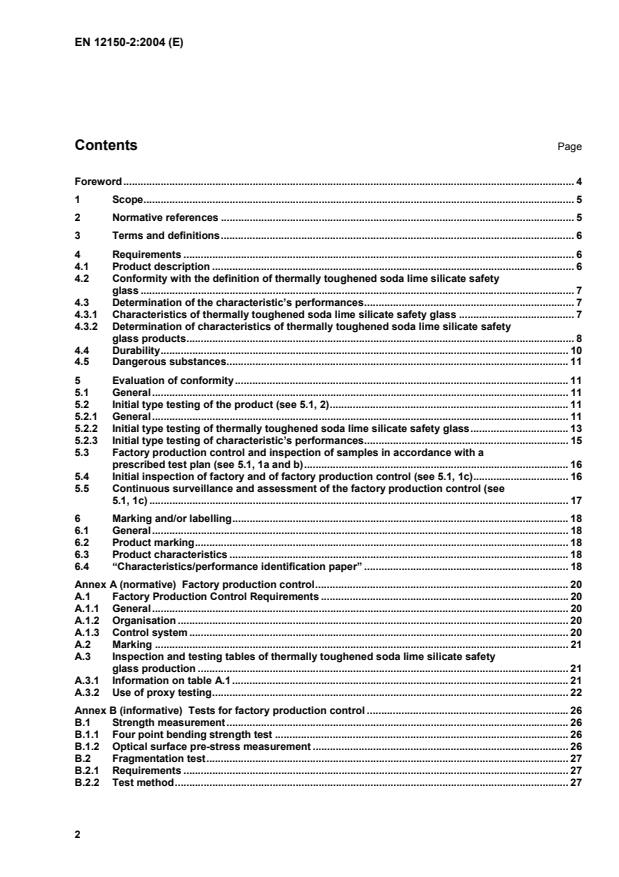
Factory production control.20 A.1 Factory Production Control Requirements.20 A.1.1 General.20 A.1.2 Organisation.20 A.1.3 Control system.20 A.2 Marking.21 A.3 Inspection and testing tables of thermally toughened soda lime silicate safety glass production.21 A.3.1 Information on table A.1.21 A.3.2 Use of proxy testing.22 Annex B (informative)
Tests for factory production control.26 B.1 Strength measurement.26 B.1.1 Four point bending strength test.26 B.1.2 Optical surface pre-stress measurement.26 B.2 Fragmentation test.27 B.2.1 Requirements.27 B.2.2 Test method.27
Annex C (informative)
Provisions for voluntary involvement of third party(ies).28 C.1 General.28 C.2 Voluntary tasks for third parties.28 C.3 Marking and labelling.28 Annex ZA (informative)
Clauses of this European Standard addressing the provisions of EU Construction Products Directive.29 ZA.1 Scope and relevant characteristics.29 ZA.2 Procedure(s) for the attestation of conformity of thermally toughened soda lime silicate safety glass products.31 ZA.2.1 System(s) of attestation of conformity.31 ZA.2.2 EC Certificate and Declaration of conformity.34 ZA.3 CE marking and labelling.36 Bibliography.39
1 Scope This document covers the evaluation of conformity and the factory production control of flat thermally toughened soda lime silicate safety glass for use in buildings.
Note: For glass products with electrical wiring or connections for, e.g. alarm or heating purposes, other directives, e.g. Low Voltage Directive, may apply.
2 Normative references The following referenced documents are indispensable for the application of this document. For dated references, only the edition cited applies. For undated references, the latest edition of the referenced document (including any amendments) applies. EN 356, Glass in building - Security glazing - Testing and classification of resistance against manual attack EN 410, Glass in building - Determination of luminous and solar characteristics of glazing EN 572 – 1, Glass in building - Basic soda lime silicate glass products – Part 1: Definition and general physical and mechanical properties EN 572 – 2, Glass in building - Basic soda lime silicate glass products – Part 2: -Float glass EN 572 – 4, Glass in building - Basic soda lime silicate glass products –Part 4: Drawn sheet glass EN 572 – 5, Glass in building - Basic soda lime silicate glass products – Part 5: Patterned glass EN 673, Glass in building – Determination of thermal transmittance (U value) – Calculation method EN 1063, Glass in building - Security glazing - Testing and classification of resistance against bullet attack EN 1096-1, Glass in building - Coated glass - Part 1: Definitions and classification EN 1096-2, Glass in building - Coated glass - Part 2: Requirements and test methods for class A, B and S coatings EN 1096-3, Glass in building - Coated glass - Part 3: Requirements and test methods for class C and D coatings EN 12150-1:2000, Glass in building – Thermally toughened soda lime silicate safety glass – Part 1: Definition and description EN 12600, Glass in building - Pendulum test - Impact test method and classification for flat glass
EN 12758, Glass in building - Glazing and airborne sound insulation – Product descriptions and determination of properties
EN 12898, Glass in building - Determination of the emissivity prEN 13474, Glass in building - Design of glass panes EN 13501-1, Fire classification of construction products and building elements – Part 1: Classification using test data from reaction to fire tests
data from fire exposure roof tests EN 13541, Glass in building - Security glazing - Testing and classification of resistance against explosion pressure 3 Terms and definitions For the purposes of this document, the terms and definitions given in EN 12150-1:2000 and the following apply. 3.1
initial type testing determination of the performance of a product (characteristic, durability), on the basis of either actual tests or other procedures (such as conventional, standardised, tabulated or general accepted values, standardised or recognised calculation methods, test reports when made available, …), in accordance with this document that demonstrates compliance with this document 3.2
test report document that covers the results of tests undertaken on a representative sample of
the
product from production
or on a prototype design of the product 3.3 product description document that details the relevant parameters, e.g. process conditions, structure, etc., for defining a product that complies with the standard. It includes specific reference(s) to characteristics that are modified by the production process 3.4 significant change variation in performance beyond the permitted tolerance for the characteristic 4 Requirements 4.1 Product description For conformity purposes the thermally toughened soda lime silicate glass manufacturer is responsible for the preparation and maintenance of the product description. This description shall describe the product and/or product families. Disclosure of the product description shall be at the discretion of the thermally toughened glass manufacturer or his agent except in the case of regulatory requirements. The description shall contain at least a normative part. The description may also contain an informative part, when the manufacturer foresees further development of the product. The normative part of the description shall contain the following minimum information: - a reference to EN 12150 parts 1 and 2 and all other standards with which the manufacturer claims compliance.
- the radiometric properties and durability of coated glass, i.e. coated glass that conforms with EN 1096-1, EN 1096-2, EN 1096-3, when those properties are changed, intentionally or unintentionally, by the thermal toughening process.
The definition of product families shall be consistent with the normative part of the product description. The substitution of materials shall maintain the conformity with the product description. The substituting material can be added to the product family and also the product description when compliance has been demonstrated. 4.2 Conformity with the definition of thermally toughened soda lime silicate safety glass Products shall conform to the definition and fulfil the requirements of thermally toughened soda lime silicate safety glass as defined in EN 12150-1. 4.3 Determination of the characteristic’s performances
4.3.1 Characteristics of thermally toughened soda lime silicate safety glass 4.3.1.1 General The characteristics of thermally toughened soda lime silicate safety glass are in general those of the glass substrate ( see 4.3.1.2). 4.3.1.2 Characteristics of the soda lime silicate glass panes used for the production of thermally toughened soda lime silicate safety glass Panes shall be made of soda lime silicate glass according to EN 572-1, EN 572-2, EN 572-4, EN 572-5. The panes may be coated according to EN 1096–1, EN 1096-2, EN 1096-3 and/or enamelled according to EN 12150-1. For the characteristics listed in table 1, for the soda lime silicate glass panes, generally accepted values or calculated values may be used.
Since the majority of the characteristics of table 1 are not changed significantly by the thermal toughening process they shall be used for thermally toughened soda lime silicate safety glass. The exceptions shall be the characteristic bending strength (fg,k) and the resistance against sudden temperature changes and temperature differentials.
Characteristic
Symbol
Unit
- density - hardness - Young's modulus - Poisson's ratio - Characteristic bending strength - Resistance against sudden temperature changes and temperature differentials
- Specific heat capacity - Coefficient of linear expansion - Thermal conductivity (for U-value) - Mean refractive index to visible radiation - Emissivity - Light transmittance - Solar direct transmittance - Total energy transmittance
ρ HK0,1/20 E µ fg,k
c α λ n ε τv τe g
kg/m³ GPa Pa Dimensionless Pa K
J/(kg.K) K-1 W/(m.K) Dimensionless Dimensionless Dimensionless Dimensionless Dimensionless
If some coatings, i.e. coated glass conforming with the EN 1096 series, when thermally toughened change their radiometric properties the manufacturer shall refer to the following for the determination of the appropriate characteristics, etc.: 4.3.2.11 for the emissivity; 4.3.2.12 for the light transmittance and reflectance; 4.3.2.13 for the solar energy transmittance; EN 1096-2 for the durability of A, B and S coatings; EN 1096-3 for the durability of C and D coatings. 4.3.2 Determination of characteristics of thermally toughened soda lime silicate safety glass products
If the thermally toughened glass manufacturer wishes to claim that any performance characteristic is independent of the production equipment used then the factory production control system shall be in accordance with this document including his specific process control conditions 4.3.2.1 Safety in the case of fire - Resistance to fire Fire resistance shall be determined and classified in accordance with EN 13501-2.
Note: EN 357 may be used as a classification reference specific to fire resistant glazed elements. 4.3.2.2 Safety in the case of fire - Reaction to fire Reaction to fire shall be determined and classified in accordance with EN 13501-1. Thermally toughened soda lime silicate safety glass products are products/materials that do not require to be tested for reaction to fire (e.g. Products/materials of Classes A1* according to Commission Decision 96/603/EC, as amended 2000/605/EC) 4.3.2.3 Safety in the case of fire - External fire behaviour Where the manufacturer wishes to declare external fire performance (e.g. when subject to regulatory requirements), the product shall be tested and classified in accordance with prEN 13501-5. Note: Compliance with this requirement is not possible until a version of prEN 13501-5 later than 2002 becomes available. 4.3.2.4 Safety in use - Bullet resistance: shatter properties and resistance to attack Bullet resistance shall be determined and classified in accordance with EN 1063. 4.3.2.5 Safety in use - Explosion resistance: impact behaviour and resistance to impact Explosion resistance shall be determined and classified in accordance with EN 13541. 4.3.2.6 Safety in use - Burglar resistance: shatter properties and resistance to attack Burglar resistance shall be determined and classified in accordance with EN 356. 4.3.2.7 Safety in use - Pendulum body impact resistance: shatter properties (safe breakability) and resistance to impact Pendulum body impact resistance shall be determined and classified in accordance with EN 12600. 4.3.2.8 Safety in use - Mechanical resistance: Resistance against sudden temperature changes and temperature differentials The resistance against sudden temperature changes and temperature differentials is a generally accepted value that is given in EN 12150-1 and shall be ensured by compliance with this document. 4.3.2.9 Safety in use - Mechanical resistance: Resistance against wind, snow, permanent load and/or imposed loads of the glass unit The mechanical resistance of thermally toughened soda lime silicate safety glass is a characteristic value that is given in EN 12150-1 and shall be ensured by compliance with this document. As long as on the concerned construction or building site no part of prEN 13474 is applicable then the current method of determining mechanical resistance in the country of destination shall be applied.
The manufactured or supplied thickness of thermally toughened soda lime silicate safety glass shall conform to the ordered thickness.
Subject to 5.2.1 the information supplied about the radiation properties of the incoming glass may be used if the thermal toughening process does not alter the values. 4.3.2.13 Energy conservation and heat retention - Radiation properties: Solar energy characteristics The solar energy transmittance and reflectance shall be determined in accordance with EN 410.
Subject to 5.2.1 the information supplied about the radiation properties of the incoming glass can be used if the thermal toughening process does not alter the values. 4.4 Durability When products conform to the definition of thermally toughened soda lime silicate glass as 4.2 then the characteristics’ performances in 4.3.2 are ensured during an economically reasonable working life. The durability of glass products including their characteristics, shall be ensured by the following: Compliance with this document Compliance with instructions from the glass product manufacturer or supplier
The manufacturer shall supply specific installation instructions or make reference to appropriate technical specifications. Note 1: The durability of glass products depends on:
building and construction movements due to various actions; building and construction vibrations due to various actions; deflection and racking of the glass support due to various actions;
glass support design (e.g. drainage of infiltrated water in the rebate, prevention of direct contact between glass support members and glass); accuracy of glass support and glass support member dimensions; quality of the assembling of glass support members up to a glass support; quality of installation of the glass support into or onto the buildings or constructions; glass support expansion due to adsorbed moisture from the air or other sources; the quality of installation of the glass product into or onto its support. 4.5 Dangerous substances Materials used in products shall not release any dangerous substances in excess of the maximum permitted levels specified in a relevant European Standard for the material or permitted in the national regulations of the Member State of destination. 5 Evaluation of conformity 5.1 General Evaluation of conformity in accordance with this document shall be as a result of FPC and ITT in accordance with this document 1) Factory production control;
This shall include the following:
...