

SIST EN 1011-5:2003
(Main)Welding - Recommendations for welding of metallic materials - Part 5: Welding of clad steel
General Information
- Abstract
This European standard specifies common instructions and requirements for the seam closing by overlay welding of clad steel/base metal joints.
- Status
- Published
- Publication Date
- 30-Nov-2003
- Technical Committee
- VAR - Welding
- Current Stage
- 6060 - National Implementation/Publication (Adopted Project)
- Start Date
- 01-Dec-2003
- Due Date
- 01-Dec-2003
- Completion Date
- 01-Dec-2003
- Directive
- 97/23/EC - Pressure equipment



Overview
EN 1011-5:2003 (CEN) - Welding - Recommendations for welding of metallic materials - Part 5: Welding of clad steel - provides practical guidance and common requirements for seam closing by overlay welding of clad steel / base metal joints. The standard applies to arc welding processes and electroslag strip cladding and covers welding of cladding deposits and the transition zones between parent metal and cladding. It does not cover some non‑ferrous claddings (for example titanium, tantalum, zirconium and their alloys). Mechanical design, corrosion performance criteria and specific acceptance criteria are addressed in the relevant application standards rather than in this document.
Key topics and technical requirements
- Materials: Definitions and considerations for clad steels, parent metal and cladding materials (stainless steels, nickel alloys, copper alloys, cobalt alloys).
- Welding processes: Recommendations for suitable arc welding processes and electroslag strip cladding; advice on single‑side and two‑side welding techniques.
- Joint preparation: Guidance referencing EN ISO 9692-4 for joint geometry and preparation; mechanical removal of thermally damaged zones after cutting.
- Welding consumables: Selection criteria to ensure compatibility with both cladding and parent metal; consideration of dilution and alloy loss/gain (effects on chemical composition and ferrite number).
- Dilution control: Emphasis on keeping dilution low while ensuring adequate penetration; methods to account for alloying changes between layers.
- Welding procedure specification and qualification: Requirements to follow prEN ISO 15609-1, prEN ISO 15607 and prEN ISO 15614-1 for procedure documentation and qualification.
- Preheat, interpass and PWHT: Measured according to EN ISO 13916; PWHT must consider both cladding and parent metal.
- Back shielding and contamination control: Use of back shielding gas (EN 439) for single‑side work and strict cleanliness to maintain corrosion resistance.
- Post‑weld cleaning and repair: Methods include brushing (stainless bristles), blasting (glass, stainless shot), pickling where required; special care to avoid formation of brittle phases in transition zones.
- Quality and testing: Reference to prEN ISO 5817 for imperfection acceptance levels and use of ferrite number measurement methods when specified.
Applications and users
Practical applications include repair and fabrication of cladded components such as chemical process vessels, piping, heat exchangers and erosion/corrosion‑resistant linings. Typical users:
- Welding engineers and procedure writers
- Fabricators and welding supervisors
- Quality control/inspection personnel
- Materials engineers and designers specifying cladded constructions
- Specifiers preparing welding and repair instructions
Related standards
- EN ISO 9692-4 (joint preparation for clad steels)
- prEN ISO 15607 / 15609-1 / 15614-1 (welding procedure specification & qualification)
- EN ISO 13916 (preheat measurement)
- prEN ISO 5817 (weld quality levels)
- EN 10088-1 (stainless steels list)
Keywords: EN 1011-5:2003, welding of clad steel, clad steels, overlay welding, welding consumables, dilution control, post-weld cleaning, welding procedure qualification, CEN standards.
Relations
- Effective Date
- 28-Jan-2026
- Effective Date
- 28-Jan-2026
- Effective Date
- 28-Jan-2026
- Effective Date
- 28-Jan-2026
- Effective Date
- 28-Jan-2026
- Effective Date
- 28-Jan-2026
- Effective Date
- 28-Jan-2026
- Effective Date
- 28-Jan-2026
- Effective Date
- 28-Jan-2026
- Effective Date
- 28-Jan-2026
- Effective Date
- 28-Jan-2026
- Effective Date
- 28-Jan-2026
- Effective Date
- 28-Jan-2026
- Effective Date
- 28-Jan-2026
Get Certified
Connect with accredited certification bodies for this standard

DVS-ZERT GmbH
German welding certification society.

Element Materials Technology
Materials testing and product certification.
Inštitut za kovinske materiale in tehnologije
Institute of Metals and Technology. Materials testing, metallurgical analysis, NDT.
Sponsored listings
Frequently Asked Questions
SIST EN 1011-5:2003 is a standard published by the Slovenian Institute for Standardization (SIST). Its full title is "Welding - Recommendations for welding of metallic materials - Part 5: Welding of clad steel". This standard covers: This European standard specifies common instructions and requirements for the seam closing by overlay welding of clad steel/base metal joints.
This European standard specifies common instructions and requirements for the seam closing by overlay welding of clad steel/base metal joints.
SIST EN 1011-5:2003 is classified under the following ICS (International Classification for Standards) categories: 25.160.10 - Welding processes; 77.080.20 - Steels. The ICS classification helps identify the subject area and facilitates finding related standards.
SIST EN 1011-5:2003 has the following relationships with other standards: It is inter standard links to SIST EN 10088-1:2024, SIST EN ISO 5817:2023, SIST EN ISO 15614-1:2017, SIST EN ISO 15609-1:2020, SIST EN ISO 15607:2020, SIST EN ISO 13916:2025, SIST EN 1011-3:2019, SIST EN ISO 9692-4:2004, SIST EN 15085-4:2008, SIST EN 15085-4:2023, SIST EN 1011-1:2009, SIST EN 12899-1:2008, SIST EN 1993-4-3:2007, SIST EN 1708-3:2012. Understanding these relationships helps ensure you are using the most current and applicable version of the standard.
SIST EN 1011-5:2003 is associated with the following European legislation: EU Directives/Regulations: 97/23/EC; Standardization Mandates: M/071. When a standard is cited in the Official Journal of the European Union, products manufactured in conformity with it benefit from a presumption of conformity with the essential requirements of the corresponding EU directive or regulation.
SIST EN 1011-5:2003 is available in PDF format for immediate download after purchase. The document can be added to your cart and obtained through the secure checkout process. Digital delivery ensures instant access to the complete standard document.
Standards Content (Sample)
2003-01.Slovenski inštitut za standardizacijo. Razmnoževanje celote ali delov tega standarda ni dovoljeno.MHNODSchweißen - Empfehlungen zum Schweißen metallischer Werkstoffe - Teil 5: Schweißen von plattierten StählenSoudage - Recommendations pour le soudage des matériaux métalliques - Partie 5: Soudage des aciers plaquésWelding - Recommendations for welding of metallic materials - Part 5: Welding of clad steel77.080.20JeklaSteels25.160.10Varilni postopki in varjenjeWelding processesICS:Ta slovenski standard je istoveten z:EN 1011-5:2003SIST EN 1011-5:2003en01-december-2003SIST EN 1011-5:2003SLOVENSKI
STANDARD
EUROPEAN STANDARDNORME EUROPÉENNEEUROPÄISCHE NORMEN 1011-5April 2003ICS 25.160.10English versionWelding - Recommendations for welding of metallic materials -Part 5: Welding of clad steelSoudage - Recommendations pour le soudage desmatériaux métalliques - Partie 5: Soudage des aciersplaquésSchweißen - Empfehlungen zum Schweißen metallischerWerkstoffe - Teil 5: Schweißen von plattierten StählenThis European Standard was approved by CEN on 28 February 2003.CEN members are bound to comply with the CEN/CENELEC Internal Regulations which stipulate the conditions for giving this EuropeanStandard the status of a national standard without any alteration. Up-to-date lists and bibliographical references concerning such nationalstandards may be obtained on application to the Management Centre or to any CEN member.This European Standard exists in three official versions (English, French, German). A version in any other language made by translationunder the responsibility of a CEN member into its own language and notified to the Management Centre has the same status as the officialversions.CEN members are the national standards bodies of Austria, Belgium, Czech Republic, Denmark, Finland, France, Germany, Greece,Hungary, Iceland, Ireland, Italy, Luxembourg, Malta, Netherlands, Norway, Portugal, Slovakia, Spain, Sweden, Switzerland and UnitedKingdom.EUROPEAN COMMITTEE FOR STANDARDIZATIONCOMITÉ EUROPÉEN DE NORMALISATIONEUROPÄISCHES KOMITEE FÜR NORMUNGManagement Centre: rue de Stassart, 36
B-1050 Brussels© 2003 CENAll rights of exploitation in any form and by any means reservedworldwide for CEN national Members.Ref. No. EN 1011-5:2003 ESIST EN 1011-5:2003
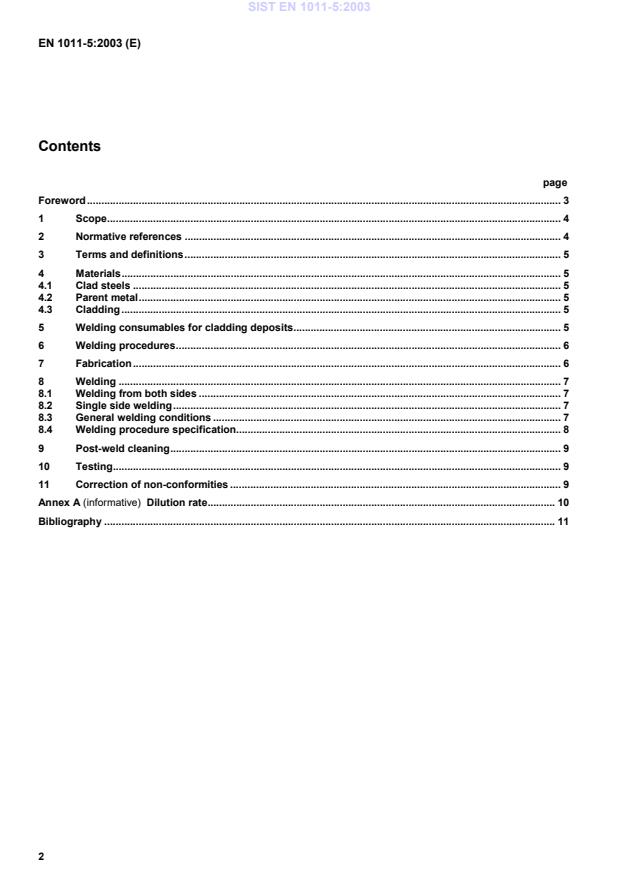
Dilution rate.10Bibliography.11SIST EN 1011-5:2003
...