


SIST EN 61000-6-3:2007/A1:2011/AC:2012
(Corrigendum)Electromagnetic compatibility (EMC) - Part 6-3: Generic standards - Emission standard for residential, commercial and light-industrial environments
Electromagnetic compatibility (EMC) - Part 6-3: Generic standards - Emission standard for residential, commercial and light-industrial environments
This part of IEC 61000 for EMC emission requirements applies to electrical and electronic apparatus intended for use in residential, commercial and light-industrial environments. Emission requirements in the frequency range 0 Hz to 400 GHz are covered. No measurement needs to be performed at frequencies where no requirement is specified. This generic EMC emission standard is applicable if no relevant dedicated product or productfamily EMC emission standard exists. This standard applies to apparatus intended to be directly connected to a low-voltage public mains network or connected to a dedicated DC source, which is intended to interface between the apparatus and the low-voltage public mains network. This standard applies also to apparatus which is battery operated or is powered by a non-public, but non-industrial, lowvoltage power distribution system if this apparatus is intended to be used in the locations described below. The environments encompassed by this standard are residential, commercial and lightindustrial locations, both indoor and outdoor. The following list, although not comprehensive, gives an indication of locations that are included: - residential properties, for example houses, apartments; - retail outlets, for example shops, supermarkets; - business premises, for example offices, banks; - areas of public entertainment, for example cinemas, public bars, dance halls; - outdoor locations, for example petrol stations, car parks, amusement and sports centres; - light-industrial locations, for example workshops, laboratories, service centres. Locations that are characterised by being supplied directly at low voltage from the public mains network are considered to be residential, commercial or light-industrial. The object of this standard is to define the emission test requirements for apparatus defined in the scope in relation to continuous and transient, conducted and radiated disturbances. The emission requirements have been selected so as to ensure that disturbances generated by apparatus operating normally in residential, commercial and light-industrial locations do not exceed a level which could prevent other apparatus from operating as intended. Fault conditions of apparatus are not taken into account. Not all disturbance phenomena have been included for testing purposes in this standard but only those considered as relevant for the equipment covered by this standard. These requirements represent essential electromagnetic compatibility emission requirements.
Elektromagnetische Verträglichkeit (EMV) - Teil 6-3: Fachgrundnormen - Störaussendung für Wohnbereich, Geschäfts- und Gewerbebereiche sowie Kleinbetriebe
Compatibilité électromagnétique (CEM) - Partie 6-3: Normes génériques - Norme sur l'émission pour les environnements résidentiels, commerciaux et de l'industrie légère
Elektromagnetna združljivost (EMC) - 6-3. del: Osnovni standardi - Standard oddajanja motenj v stanovanjskih, poslovnih in manj zahtevnih industrijskih okoljih - Dodatek A1 - Popravek AC
Ta del standarda IEC 61000 za zahteve glede oddajanja motenj v zvezi z elektromagnetno združljivostjo se uporablja za električne in elektronske naprave, ki so namenjene za uporabo v stanovanjskih, poslovnih in manj zahtevnih industrijskih okoljih. Zajema zahteve glede oddajanja motenj v frekvenčnem razponu od 0 Hz do 400 GHz. Za frekvence, za katere ni določenih zahtev, ni treba opraviti meritev. Ta generični standard oddajanja motenj v zvezi z elektromagnetno združljivostjo se uporablja, če ne obstaja ustrezen poseben standard oddajanja motenj v zvezi z elektromagnetno združljivostjo izdelka ali družine izdelkov. Ta standard se uporablja za naprave, ki so namenjene za neposredno povezavo z glavnim javnim nizkonapetostnim omrežjem ali povezavo s posebnim virom enosmernega toka, ki je namenjen povezavi med napravo in glavnim javnim nizkonapetostnim omrežjem. Ta standard se uporablja tudi za naprave, ki delujejo na baterije ali se napajajo iz zasebnega, vendar ne industrijskega, nizkonapetostnega sistema za distribucijo energije, če je naprava namenjena za uporabo na spodaj navedenih lokacijah. Ta standard zajema stanovanjske, poslovne in manj zahtevne industrijske lokacije, in sicer znotraj in na prostem. Na naslednjem seznamu so navedene nekatere od zajetih lokacij: – stanovanjski objekti, na primer hiše in stanovanja, – maloprodajna mesta, na primer trgovine in supermarketi, – poslovni objekti, na primer pisarne in banke, – javne zabaviščne površine, na primer kinodvorane, javni lokali in plesišča, – lokacije na prostem, na primer bencinski servisi, parkirišča ter zabaviščni in športni centri, – manj zahtevna industrijska okolja, na primer delavnice, laboratoriji in storitvena središča. Lokacije, ki se napajajo neposredno z nizko napetostjo iz glavnega javnega omrežja, se štejejo za stanovanjska, poslovna ali manj zahtevna industrijska okolja. Cilj tega standarda je opredeliti zahteve za preskus oddajanja motenj za naprave, ki so opredeljene za to področje uporabe, v zvezi s trajnimi in prehodnimi motnjami ter motnjami sevanja. Zahteve glede oddajanja motenj so izbrane tako, da zagotavljajo, da motnje, ki jih proizvedejo naprave pri normalnem delovanju v stanovanjskih, poslovnih in manj zahtevnih industrijskih okoljih, ne presežejo ravni, ki bi lahko drugim napravam preprečila delovanje, za katerega so namenjene. Motnje naprav se ne upoštevajo. Ta standard ne zajema vseh motenj za namene preskušanja, ampak le motnje, ki so pomembne za opremo, zajeto v tem standardu. Te zahteve predstavljajo osnovne zahteve glede oddajanja motenj v zvezi z elektromagnetno združljivostjo.
General Information
- Status
- Withdrawn
- Publication Date
- 20-Aug-2012
- Withdrawal Date
- 10-Apr-2024
- Technical Committee
- EMC - Electromagnetic compatibility
- Current Stage
- 9900 - Withdrawal (Adopted Project)
- Start Date
- 02-Apr-2024
- Due Date
- 25-Apr-2024
- Completion Date
- 11-Apr-2024
Relations
- Effective Date
- 01-May-2021
- Effective Date
- 01-Sep-2012





Frequently Asked Questions
SIST EN 61000-6-3:2007/A1:2011/AC:2012 is a corrigendum published by the Slovenian Institute for Standardization (SIST). Its full title is "Electromagnetic compatibility (EMC) - Part 6-3: Generic standards - Emission standard for residential, commercial and light-industrial environments". This standard covers: This part of IEC 61000 for EMC emission requirements applies to electrical and electronic apparatus intended for use in residential, commercial and light-industrial environments. Emission requirements in the frequency range 0 Hz to 400 GHz are covered. No measurement needs to be performed at frequencies where no requirement is specified. This generic EMC emission standard is applicable if no relevant dedicated product or productfamily EMC emission standard exists. This standard applies to apparatus intended to be directly connected to a low-voltage public mains network or connected to a dedicated DC source, which is intended to interface between the apparatus and the low-voltage public mains network. This standard applies also to apparatus which is battery operated or is powered by a non-public, but non-industrial, lowvoltage power distribution system if this apparatus is intended to be used in the locations described below. The environments encompassed by this standard are residential, commercial and lightindustrial locations, both indoor and outdoor. The following list, although not comprehensive, gives an indication of locations that are included: - residential properties, for example houses, apartments; - retail outlets, for example shops, supermarkets; - business premises, for example offices, banks; - areas of public entertainment, for example cinemas, public bars, dance halls; - outdoor locations, for example petrol stations, car parks, amusement and sports centres; - light-industrial locations, for example workshops, laboratories, service centres. Locations that are characterised by being supplied directly at low voltage from the public mains network are considered to be residential, commercial or light-industrial. The object of this standard is to define the emission test requirements for apparatus defined in the scope in relation to continuous and transient, conducted and radiated disturbances. The emission requirements have been selected so as to ensure that disturbances generated by apparatus operating normally in residential, commercial and light-industrial locations do not exceed a level which could prevent other apparatus from operating as intended. Fault conditions of apparatus are not taken into account. Not all disturbance phenomena have been included for testing purposes in this standard but only those considered as relevant for the equipment covered by this standard. These requirements represent essential electromagnetic compatibility emission requirements.
This part of IEC 61000 for EMC emission requirements applies to electrical and electronic apparatus intended for use in residential, commercial and light-industrial environments. Emission requirements in the frequency range 0 Hz to 400 GHz are covered. No measurement needs to be performed at frequencies where no requirement is specified. This generic EMC emission standard is applicable if no relevant dedicated product or productfamily EMC emission standard exists. This standard applies to apparatus intended to be directly connected to a low-voltage public mains network or connected to a dedicated DC source, which is intended to interface between the apparatus and the low-voltage public mains network. This standard applies also to apparatus which is battery operated or is powered by a non-public, but non-industrial, lowvoltage power distribution system if this apparatus is intended to be used in the locations described below. The environments encompassed by this standard are residential, commercial and lightindustrial locations, both indoor and outdoor. The following list, although not comprehensive, gives an indication of locations that are included: - residential properties, for example houses, apartments; - retail outlets, for example shops, supermarkets; - business premises, for example offices, banks; - areas of public entertainment, for example cinemas, public bars, dance halls; - outdoor locations, for example petrol stations, car parks, amusement and sports centres; - light-industrial locations, for example workshops, laboratories, service centres. Locations that are characterised by being supplied directly at low voltage from the public mains network are considered to be residential, commercial or light-industrial. The object of this standard is to define the emission test requirements for apparatus defined in the scope in relation to continuous and transient, conducted and radiated disturbances. The emission requirements have been selected so as to ensure that disturbances generated by apparatus operating normally in residential, commercial and light-industrial locations do not exceed a level which could prevent other apparatus from operating as intended. Fault conditions of apparatus are not taken into account. Not all disturbance phenomena have been included for testing purposes in this standard but only those considered as relevant for the equipment covered by this standard. These requirements represent essential electromagnetic compatibility emission requirements.
SIST EN 61000-6-3:2007/A1:2011/AC:2012 is classified under the following ICS (International Classification for Standards) categories: 33.100.10 - Emission. The ICS classification helps identify the subject area and facilitates finding related standards.
SIST EN 61000-6-3:2007/A1:2011/AC:2012 has the following relationships with other standards: It is inter standard links to SIST EN IEC 61000-6-3:2021, SIST EN 61000-6-3:2007/A1:2011. Understanding these relationships helps ensure you are using the most current and applicable version of the standard.
SIST EN 61000-6-3:2007/A1:2011/AC:2012 is associated with the following European legislation: EU Directives/Regulations: 1999/5/EC, 2004/108/EC, 2004/108/EU, 2014/30/EU, 2014/53/EU; Standardization Mandates: M/404, M/490, M/536, M/552. When a standard is cited in the Official Journal of the European Union, products manufactured in conformity with it benefit from a presumption of conformity with the essential requirements of the corresponding EU directive or regulation.
SIST EN 61000-6-3:2007/A1:2011/AC:2012 is available in PDF format for immediate download after purchase. The document can be added to your cart and obtained through the secure checkout process. Digital delivery ensures instant access to the complete standard document.
Standards Content (Sample)
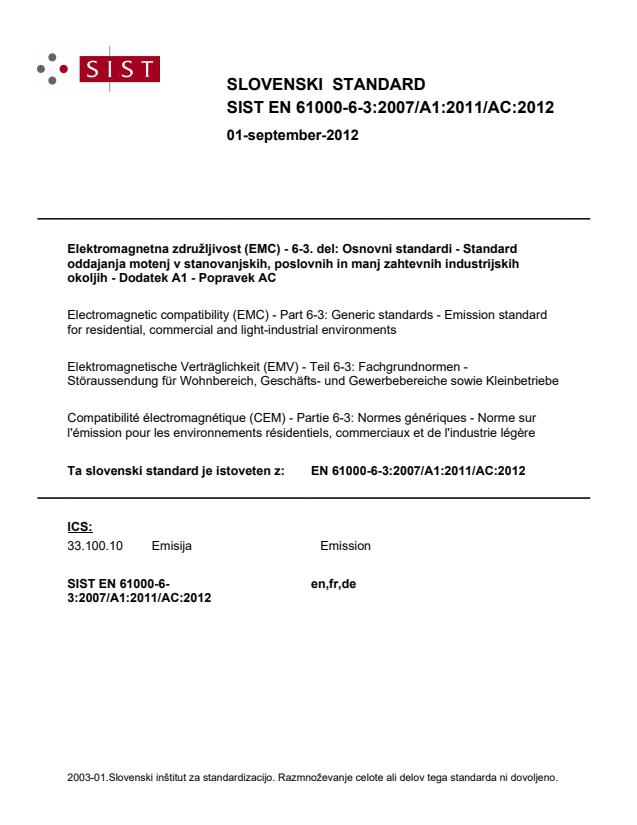
2003-01.Slovenski inštitut za standardizacijo. Razmnoževanje celote ali delov tega standarda ni dovoljeno.Elektromagnetna združljivost (EMC) - 6-3. del: Osnovni standardi - Standard oddajanja motenj v stanovanjskih, poslovnih in manj zahtevnih industrijskih okoljih - Dodatek A1 - Popravek ACElektromagnetische Verträglichkeit (EMV) - Teil 6-3: Fachgrundnormen - Störaussendung für Wohnbereich, Geschäfts- und Gewerbebereiche sowie KleinbetriebeCompatibilité électromagnétique (CEM) - Partie 6-3: Normes génériques - Norme sur l'émission pour les environnements résidentiels, commerciaux et de l'industrie légèreElectromagnetic compatibility (EMC)
...
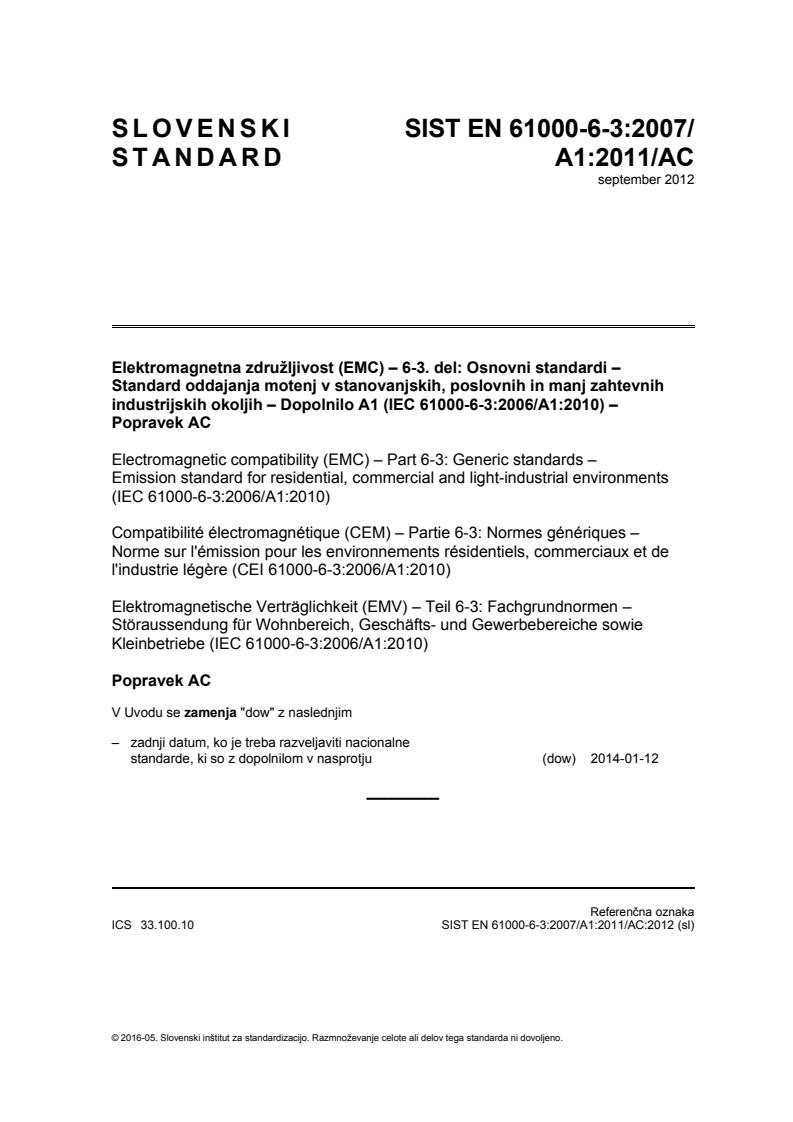
SLOVENSKI SIST EN 61000-6-3:2007/
STANDARD A1:2011/AC
september 2012
Elektromagnetna združljivost (EMC) – 6-3. del: Osnovni standardi –
Standard oddajanja motenj v stanovanjskih, poslovnih in manj zahtevnih
industrijskih okoljih – Dopolnilo A1 (IEC 61000-6-3:2006/A1:2010) –
Popravek AC
Electromagnetic compatibility (EMC) – Part 6-3: Generic standards –
Emission standard for residential, commercial and light-industrial environments
(IEC 61000-6-3:2006/A1:2010)
Compatibilité électromagnétique (CEM) – Partie 6-3: Normes génériques –
Norme sur l'émission pour les environnements résidentiels, commerciaux et de
l'industrie légère
...
Questions, Comments and Discussion
Ask us and Technical Secretary will try to provide an answer. You can facilitate discussion about the standard in here.
Loading comments...