

SIST EN 4632-001:2008
(Main)Aerospace series - Welded and brazed assemblies for aerospace constructions - Weldability and brazeability of materials - Part 001: General requirements
General Information
- Abstract
This standard defines weldability and brazeability degrees for metallic materials used in aerospace construction, for processes and techniques involving welding and brazing but excluding soldering.
It also defines rules to be observed to determine the degree of weldability and brazeability.
It is applicable without any restriction for the manufacturing of new parts and repair parts.
- Status
- Published
- Publication Date
- 02-Jun-2008
- Technical Committee
- I13 - Imaginarni 13
- Current Stage
- 6060 - National Implementation/Publication (Adopted Project)
- Start Date
- 21-May-2008
- Due Date
- 26-Jul-2008
- Completion Date
- 03-Jun-2008

Overview
EN 4632-001:2008 (CEN) - Part 001 of the Aerospace series - establishes general requirements for assessing the weldability and brazeability of metallic materials used in aerospace constructions. The standard defines four degrees of weldability and brazeability, gives rules and methods to determine those degrees, and applies equally to the manufacture of new parts and repair parts. Processes covered include welding and brazing (but explicitly exclude soldering).
Key topics
- Scope and applicability
- Defines weldability/brazeability degrees for metallic alloys used in aerospace.
- Applicable without restriction to production and repair.
- Degrees and definitions
- Degree 1: very good - no special precautions.
- Degree 2: good - special precautions may be needed.
- Degree 3: poor - requires development per part; not recommended.
- Degree 4: very bad - to be avoided.
- Rules and method
- Procedures to determine the degree when data are missing (new alloys, untested processes).
- Requirement that suppliers/repairers appoint a responsible person to document choices and test outcomes.
- Process classification
- Uses EN ISO 4063 process codes and provides welding/brazing process tables and symbols.
- Supporting material
- Annex A: normative recommendations for brazing and diffusion assemblies by material family (aluminium, steels, titanium, nickel/cobalt superalloys).
- Annex B/C: model sheets for recording material/process data and decisions.
Practical applications
- Use EN 4632-001:2008 to:
- Classify materials by their suitability for specific welding and brazing processes.
- Determine production controls, qualification tests, and precautions needed during fabrication and repair.
- Inform design decisions where the presence of welds/brazes affects structural performance.
- Standardize documentation on engineering drawings and procurement by referencing weldability/brazeability degrees.
- Typical practical outcomes:
- Selection of preheat, post-weld heat treatment, flux or filler recommendations for brazing/diffusion joints.
- Clear supplier/repairer responsibilities and traceable records for aerospace parts manufacturing and maintenance.
Who should use this standard
- Aerospace design and structural engineers
- Materials and metallurgical engineers
- Welding and brazing process engineers
- Procurement and quality managers for aerospace manufacturing and repair organizations
- Repair stations and certified repairers working on aircraft/spacecraft metallic components
Related standards
- EN ISO 4063 - Welding and allied processes (process codes)
- EN 515 - Aluminium temper designations
- EN 573-3 - Aluminium chemical composition (wrought products)
- EN 10052 - Vocabulary of heat treatment terms for ferrous products
- Other parts of the EN 4632 series (material family sheets and composition tables)
Using EN 4632-001:2008 helps ensure consistent, documented assessment of material joinability across design, manufacturing and repair workflows in aerospace, improving safety, traceability and producibility.
Relations
- Effective Date
- 12-Aug-2026
- Effective Date
- 25-Mar-2026
- Effective Date
- 28-Jan-2026
- Effective Date
- 28-Jan-2026
- Effective Date
- 28-Jan-2026
- Effective Date
- 28-Jan-2026
- Effective Date
- 28-Jan-2026
- Effective Date
- 28-Jan-2026
- Effective Date
- 28-Jan-2026
- Effective Date
- 28-Jan-2026
- Effective Date
- 28-Jan-2026
- Effective Date
- 28-Jan-2026
- Effective Date
- 28-Jan-2026
Get Certified
Connect with accredited certification bodies for this standard

BUREAU VERITAS Certification Germany
Bureau Veritas certification in Germany.

DVS-ZERT GmbH
German welding certification society.

Element Materials Technology
Materials testing and product certification.
Sponsored listings
Frequently Asked Questions
SIST EN 4632-001:2008 is a standard published by the Slovenian Institute for Standardization (SIST). Its full title is "Aerospace series - Welded and brazed assemblies for aerospace constructions - Weldability and brazeability of materials - Part 001: General requirements". This standard covers: This standard defines weldability and brazeability degrees for metallic materials used in aerospace construction, for processes and techniques involving welding and brazing but excluding soldering. It also defines rules to be observed to determine the degree of weldability and brazeability. It is applicable without any restriction for the manufacturing of new parts and repair parts.
This standard defines weldability and brazeability degrees for metallic materials used in aerospace construction, for processes and techniques involving welding and brazing but excluding soldering. It also defines rules to be observed to determine the degree of weldability and brazeability. It is applicable without any restriction for the manufacturing of new parts and repair parts.
SIST EN 4632-001:2008 is classified under the following ICS (International Classification for Standards) categories: 25.160.01 - Welding, brazing and soldering in general; 49.025.01 - Materials for aerospace construction in general. The ICS classification helps identify the subject area and facilitates finding related standards.
SIST EN 4632-001:2008 has the following relationships with other standards: It is inter standard links to SIST EN ISO 4885:2026, SIST EN 573-3:2026, SIST EN 573-3:2019+A2:2024, SIST EN 515:2017, SIST EN ISO 4885:2018, SIST EN ISO 4063:2023, SIST EN 4632-003:2010, SIST EN 4677-001:2012, SIST EN 4632-002:2008, SIST EN 4632-005:2010, SIST EN 4678:2011, SIST EN 4632-006:2014, SIST EN 4632-004:2014. Understanding these relationships helps ensure you are using the most current and applicable version of the standard.
SIST EN 4632-001:2008 is available in PDF format for immediate download after purchase. The document can be added to your cart and obtained through the secure checkout process. Digital delivery ensures instant access to the complete standard document.
Standards Content (Sample)
2003-01.Slovenski inštitut za standardizacijo. Razmnoževanje celote ali delov tega standarda ni dovoljeno.Aeronavtika - Varjeni in trdo spajkani sestavi za konstrukcije v aeronavtiki -
Varilnost in spajkalnost materialov - 001. del: Splošne zahteveLuft- und Raumfahrt - Schweiß- und Lötverbindungen für die Luft- und Raumfahrt -Schweißbarkeitsgrad und Lötbarkeitsgrad von Werkstoffen - Teil 001: AllgemeinesSérie aérospatiale - Assemblages soudés et brasés pour constructions aérospatiales - Soudabilité et brasabilité des matériaux - Partie 001 : GénéralitésAerospace series - Welded and brazed assemblies for aerospace constructions - Weldability and brazeability of materials - Part 001: General requirements49.025.01Materiali za letalsko in vesoljsko gradnjo na splošnoMaterials for aerospace construction in general25.160.01Varjenje, trdo in mehko spajkanje na splošnoWelding, brazing and soldering in generalICS:Ta slovenski standard je istoveten z:EN 4632-001:2008SIST EN 4632-001:2008en01-julij-2008SIST EN 4632-001:2008SLOVENSKI
STANDARD
EUROPEAN STANDARDNORME EUROPÉENNEEUROPÄISCHE NORMEN 4632-001April 2008ICS 49.025.01 English VersionAerospace series - Welded and brazed assemblies foraerospace constructions - Weldability and brazeability ofmaterials - Part 001: General requirementsSérie aérospatiale - Assemblages soudés et brasés pourconstructions aérospatiales - Soudabilité et brasabilité desmatériaux - Partie 001 : GénéralitésLuft- und Raumfahrt - Schweiß- und Lötverbindungen fürdie Luft- und Raumfahrt -Schweißbarkeitsgrad undLötbarkeitsgrad von Werkstoffen - Teil 001: AllgemeinesThis European Standard was approved by CEN on 7 March 2008.CEN members are bound to comply with the CEN/CENELEC Internal Regulations which stipulate the conditions for giving this EuropeanStandard the status of a national standard without any alteration. Up-to-date lists and bibliographical references concerning such nationalstandards may be obtained on application to the CEN Management Centre or to any CEN member.This European Standard exists in three official versions (English, French, German). A version in any other language made by translationunder the responsibility of a CEN member into its own language and notified to the CEN Management Centre has the same status as theofficial versions.CEN members are the national standards bodies of Austria, Belgium, Bulgaria, Cyprus, Czech Republic, Denmark, Estonia, Finland,France, Germany, Greece, Hungary, Iceland, Ireland, Italy, Latvia, Lithuania, Luxembourg, Malta, Netherlands, Norway, Poland, Portugal,Romania, Slovakia, Slovenia, Spain, Sweden, Switzerland and United Kingdom.EUROPEAN COMMITTEE FOR STANDARDIZATIONCOMITÉ EUROPÉEN DE NORMALISATIONEUROPÄISCHES KOMITEE FÜR NORMUNGManagement Centre: rue de Stassart, 36
B-1050 Brussels© 2008 CENAll rights of exploitation in any form and by any means reservedworldwide for CEN national Members.Ref. No. EN 4632-001:2008: ESIST EN 4632-001:2008
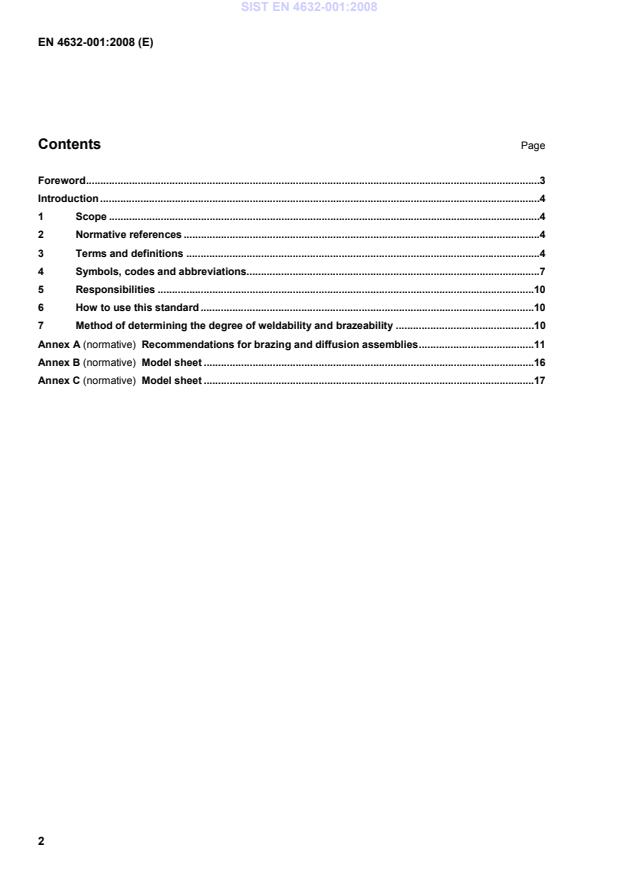
Recommendations for brazing and diffusion assemblies.11 Annex B (normative)
Model sheet.16 Annex C (normative)
Model sheet.17
(ISO 4063:1998) EN 515, Aluminium and aluminium alloys — Wrought products — Temper designations EN 573-3, Aluminium and aluminium alloys — Chemical composition and form of wrought products — Part 3: Chemical composition and form of products EN 10052, Vocabulary of heat treatment terms for ferrous products 3 Terms and definitions For the purposes of this document, the terms and definitions given in Publications on Welding and Welding Applications and issued by the International Council of the French Language and the following apply. 3.1 Weldability 3.1.1 concept of weldability it is considered that a metallic material is weldable to a given degree, by a given process and for a given application type, when it can be used to produce a weld provided that precautions corresponding to this degree are taken, and if the characteristics and consequences of the presence of the weld satisfy the required properties chosen as the basis for a judgement SIST EN 4632-001:2008
degree 1:
material with very good weldability for which no special precautions are necessary. To be used in preference. degree 2:
material with good weldability but which may require special precautions when welding (for example preheating, low advance speed, etc.).
degree 3:
material with poor weldability requiring development for each part type and which may involve manufacturing uncertainties. Not to be recommended. degree 4:
material with very bad weldability. To be avoided. 3.2 Brazeability 3.2.1 concept of brazeability it is considered that a metallic material is brazeable to a given degree, by a given process and for a given application type, when it can be used to produce brazing or a brazed-diffused joint, provided that precautions corresponding to this degree are taken, and if the characteristics and consequences of the presence of the brazing satisfy the required properties chosen as the basis for a judgement 3.2.2 brazeability degrees brazeability of materials is evaluated according to the following four degrees:
degree 1:
material with very good brazeability for which no special precautions are necessary. To be used in preference. degree 2:
material with good brazeability but which may require special precautions when brazing (for example electrolytic nickel flash before brazing, etc.). degree 3:
material with poor brazeability requiring development for each part type and which may involve manufacturing uncertainties. Not to be recommended. degree 4:
material with very bad brazeability. To be avoided. 3.3 Processes 3.3.1 welding and brazing the purpose of a welding operation is to make the material to be assembled continuous. In the case of a metallic material, continuity has to be achieved for the structure, but this does not necessarily imply homogeneity of the chemical composition (case of "heterogeneous" welds or brazing). The result of the operation is called a weld when two previously distinct parts are assembled together. If the operation is restricted to the addition of extra material to a part, it is called filling. A weld may be made without any external filler material (case of resistance welding, etc.), or with filler material. For metallic materials, a filler metal with a grade similar to that of the base metal (homogeneous weld) or different to the base metal (heterogeneous weld) may be used. In the case of a filler metal, the weld may be made in a single pass (one single pass of the heat source and the filler metal) or in several passes. Two major process categories can be distinguished: 1) welding or filling processes, with fusion of the edges of parts to be joined due to the thermal effect, 2) assembly, brazing or diffusion welding processes, for which the production temperature is less than the solidus temperature of parts to be joined; in this case, intermetallic diffusion phenomena are preponderant: diffusion welding when the operation takes place in the solid phase; brazing, when a liquid phase is obtained using a filler metal or is created in situ by metallurgical reaction. SIST EN 4632-001:2008
...