

SIST EN 16640:2017
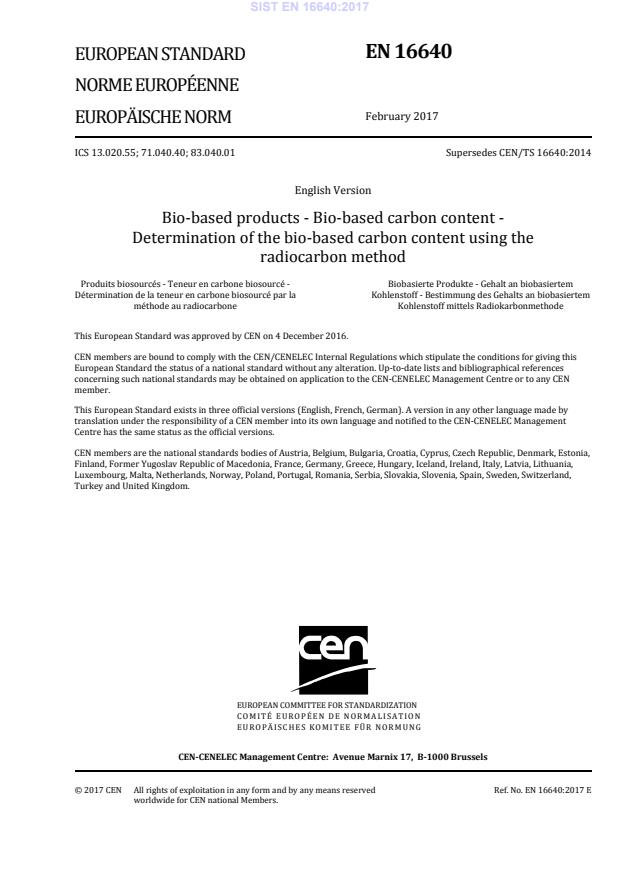
(Main)Bio-based products - Bio-based carbon content - Determination of the bio-based carbon content using the radiocarbon method
General Information
- Abstract
This European Standard specifies a method for the determination of the bio-based carbon content in products, based on the 14C content measurement.
This European Standard also specifies three test methods to be used for the determination of the 14C content from which the bio-based carbon content is calculated:
- Method A: Liquid scintillation-counter method (LSC) (normative);
- Method B: Beta-ionization (BI) (informative);
- Method C: Accelerator mass spectrometry (AMS) (normative).
The bio-based carbon content is expressed by a fraction of sample mass or as a fraction of the total carbon content. This calculation method is applicable to any product containing carbon, including bio composites.
NOTE This European standard does not provide the methodology for the calculation of the biomass content of a sample see prEN 16785-1 [5] and prEN 16785-2 [6].
- Status
- Published
- Public Enquiry End Date
- 29-Oct-2015
- Publication Date
- 15-May-2017
- Technical Committee
- I13 - Imaginarni 13
- Current Stage
- 6060 - National Implementation/Publication (Adopted Project)
- Start Date
- 03-May-2017
- Due Date
- 08-Jul-2017
- Completion Date
- 16-May-2017


Overview
EN 16640:2017 (CEN) specifies a standardized analytical route for determining the bio‑based carbon content of materials and products using the radiocarbon (14C) method. The method quantifies the fraction of carbon in a sample that is derived from contemporary biomass versus fossil sources by measuring the 14C content. Results may be reported as a fraction of sample mass or as a fraction of total carbon (TC). The procedure is applicable to any carbon‑containing product, including bio‑composites.
Key topics and technical requirements
- Measurement principle: Radiocarbon (14C) analysis to distinguish biogenic carbon from fossil carbon.
- Test methods included:
- Method A – Liquid scintillation-counter (LSC) (normative)
- Method C – Accelerator mass spectrometry (AMS) (normative)
- Method B – Beta‑ionization (BI) (informative)
- Sample handling and preparation:
- Sampling guidance (Annex A)
- Conversion of sample carbon to a suitable measurement form (combustion to CO2, benzene synthesis or direct absorption) (Annex B)
- Measurement and standardization:
- Protocols for LSC, BI and AMS measurement procedures, blanks, and calibration (Annexes C–E)
- Standardization methods to ensure comparability of 14C results across instruments and labs
- Calculations:
- Conversion of measured 14C content into bio‑based carbon content expressed per mass or per total carbon (see Clause 7)
- Reference values for 100% bio‑based carbon and example calculations
- Quality and reporting:
- Performance characteristics and uncertainty data (Annex F)
- Required content of the test report (Clause 9)
Applications and users
EN 16640:2017 is intended for:
- Analytical laboratories performing bio‑based carbon determinations
- Producers and suppliers of bio‑based materials and products who need certified content declarations
- Purchasers, certification bodies, regulators and inspection organizations requiring traceable test results
- Use cases include verification of bio‑based content claims for packaging, chemicals, plastics, composites and other products where distinguishing biomass vs fossil carbon is needed for labeling, procurement or regulatory compliance.
Related standards
- prEN 16785‑1 and prEN 16785‑2 - methodologies for calculating overall biomass content (note: EN 16640 does not provide biomass‑content calculation)
- EN 15440, EN ISO 13833 and CEN/TS 16137 - related analytical practices
- ASTM D6866 - compatible analytical approaches for determining biogenic carbon
Keywords: EN 16640:2017, bio‑based carbon content determination, radiocarbon method, 14C measurement, LSC, AMS, beta‑ionization, CEN, bio‑based products, biocomposites.
Relations
- Effective Date
- 01-Mar-2017
- Effective Date
- 28-Jan-2026
- Refers
SIST EN ISO 21654:2021 - Solid recovered fuels - Determination of calorific value (ISO 21654:2021) - Effective Date
- 28-Jan-2026
- Effective Date
- 28-Jan-2026
- Effective Date
- 28-Jan-2026
- Effective Date
- 28-Jan-2026
- Effective Date
- 28-Jan-2026
- Referred By
SIST EN 17035:2022 - Surface active agents - Bio-based surfactants - Requirements and test methods - Effective Date
- 28-Jan-2026
- Effective Date
- 28-Jan-2026
- Effective Date
- 28-Jan-2026
- Effective Date
- 24-May-2017
- Effective Date
- 15-May-2024
- Effective Date
- 01-Oct-2015
Get Certified
Connect with accredited certification bodies for this standard

BSI Group
BSI (British Standards Institution) is the business standards company that helps organizations make excellence a habit.

Bureau Veritas
Bureau Veritas is a world leader in laboratory testing, inspection and certification services.

DNV
DNV is an independent assurance and risk management provider.
Sponsored listings
Frequently Asked Questions
SIST EN 16640:2017 is a standard published by the Slovenian Institute for Standardization (SIST). Its full title is "Bio-based products - Bio-based carbon content - Determination of the bio-based carbon content using the radiocarbon method". This standard covers: This European Standard specifies a method for the determination of the bio-based carbon content in products, based on the 14C content measurement. This European Standard also specifies three test methods to be used for the determination of the 14C content from which the bio-based carbon content is calculated: - Method A: Liquid scintillation-counter method (LSC) (normative); - Method B: Beta-ionization (BI) (informative); - Method C: Accelerator mass spectrometry (AMS) (normative). The bio-based carbon content is expressed by a fraction of sample mass or as a fraction of the total carbon content. This calculation method is applicable to any product containing carbon, including bio composites. NOTE This European standard does not provide the methodology for the calculation of the biomass content of a sample see prEN 16785-1 [5] and prEN 16785-2 [6].
This European Standard specifies a method for the determination of the bio-based carbon content in products, based on the 14C content measurement. This European Standard also specifies three test methods to be used for the determination of the 14C content from which the bio-based carbon content is calculated: - Method A: Liquid scintillation-counter method (LSC) (normative); - Method B: Beta-ionization (BI) (informative); - Method C: Accelerator mass spectrometry (AMS) (normative). The bio-based carbon content is expressed by a fraction of sample mass or as a fraction of the total carbon content. This calculation method is applicable to any product containing carbon, including bio composites. NOTE This European standard does not provide the methodology for the calculation of the biomass content of a sample see prEN 16785-1 [5] and prEN 16785-2 [6].
SIST EN 16640:2017 is classified under the following ICS (International Classification for Standards) categories: 13.020.55 - Biobased products; 71.040.40 - Chemical analysis. The ICS classification helps identify the subject area and facilitates finding related standards.
SIST EN 16640:2017 has the following relationships with other standards: It is inter standard links to SIST-TS CEN/TS 16640:2014, SIST EN ISO 11011:2015, SIST EN ISO 21654:2021, SIST EN ISO 1716:2018, SIST-TS CEN/TS 17035:2018, SIST EN 16766:2018, SIST EN 16848:2017, SIST EN 17035:2022, SIST-TS CEN/TS 16766:2015, SIST EN 17228:2019, SIST EN 16640:2017/AC:2017, oSIST prEN 16640:2026, SIST-TS CEN/TS 16640:2014. Understanding these relationships helps ensure you are using the most current and applicable version of the standard.
SIST EN 16640:2017 is associated with the following European legislation: Standardization Mandates: M/492. When a standard is cited in the Official Journal of the European Union, products manufactured in conformity with it benefit from a presumption of conformity with the essential requirements of the corresponding EU directive or regulation.
SIST EN 16640:2017 is available in PDF format for immediate download after purchase. The document can be added to your cart and obtained through the secure checkout process. Digital delivery ensures instant access to the complete standard document.
Standards Content (Sample)
2003-01.Slovenski inštitut za standardizacijo. Razmnoževanje celote ali delov tega standarda ni dovoljeno.UDGLRRJOMLþQRPHWRGRBiobasierte Produkte - Gehalt an biobasiertem Kohlenstoff - Bestimmung des Gehalts an biobasiertem Kohlenstoff mittels RadiokarbonmethodeProduits biosourcés - Teneur en carbone biosourcé - Détermination de la teneur en carbone biosourcé par la méthode au radiocarboneBio-based products - Bio-based carbon content - Determination of the bio-based carbon content using the radiocarbon method71.040.40Kemijska analizaChemical analysis13.020.55Biološki izdelkiBiobased productsICS:Ta slovenski standard je istoveten z:EN 16640:2017SIST EN 16640:2017en,fr,de01-junij-2017SIST EN 16640:2017SLOVENSKI
STANDARDSIST-TS CEN/TS 16640:20141DGRPHãþD
EUROPEAN STANDARD NORME EUROPÉENNE EUROPÄISCHE NORM
EN 16640
February
t r s y
vEnglish Version
Bioæbased products æ Bioæbased carbon content æ Determination of the bioæbased carbon content using the radiocarbon method Produits biosourcés æ Teneur en carbone biosourcé æ Détermination de la teneur en carbone biosourcé par la méthode au radiocarbone
Biobasierte Produkte æ Gehalt an biobasiertem Kohlenstoff æ Bestimmung des Gehalts an biobasiertem Kohlenstoff mittels Radiokarbonmethode This European Standard was approved by CEN on
v December
t r s xä
egulations which stipulate the conditions for giving this European Standard the status of a national standard without any alterationä Upætoædate lists and bibliographical references concerning such national standards may be obtained on application to the CENæCENELEC Management Centre or to any CEN memberä
translation under the responsibility of a CEN member into its own language and notified to the CENæCENELEC Management Centre has the same status as the official versionsä
CEN members are the national standards bodies of Austriaá Belgiumá Bulgariaá Croatiaá Cyprusá Czech Republicá Denmarká Estoniaá Finlandá Former Yugoslav Republic of Macedoniaá Franceá Germanyá Greeceá Hungaryá Icelandá Irelandá Italyá Latviaá Lithuaniaá Luxembourgá Maltaá Netherlandsá Norwayá Polandá Portugalá Romaniaá Serbiaá Slovakiaá Sloveniaá Spainá Swedená Switzerlandá Turkey and United Kingdomä
EUROPEAN COMMITTEE FOR STANDARDIZATION COMITÉ EUROPÉEN DE NORMALISATION EUROPÄISCHES KOMITEE FÜR NORMUNG
CEN-CENELEC Management Centre:
Avenue Marnix 17,
B-1000 Brussels
t r s y CEN All rights of exploitation in any form and by any means reserved worldwide for CEN national Membersä Refä Noä EN
s x x v rã t r s y ESIST EN 16640:2017
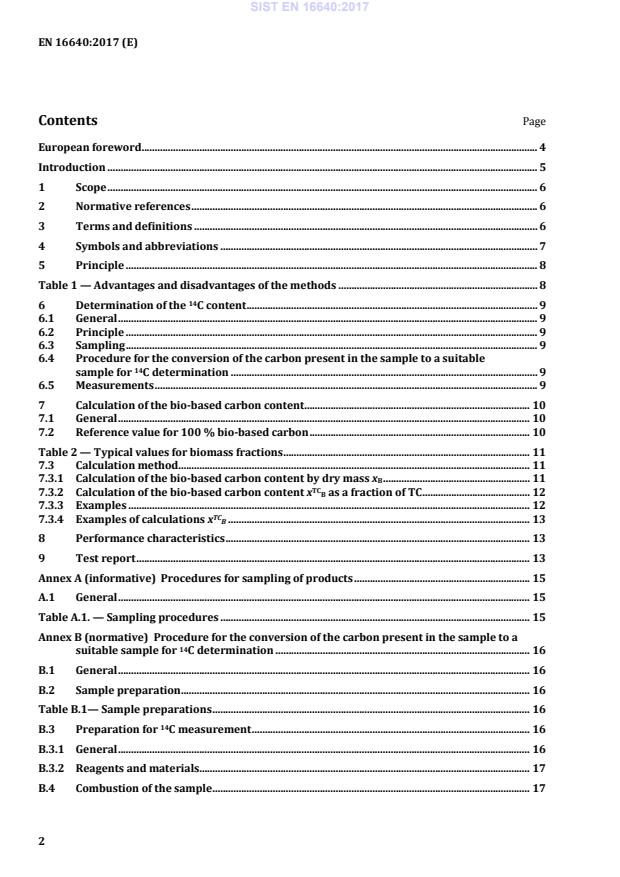
Procedures for sampling of products . 15 A.1 General . 15 Table A.1. — Sampling procedures . 15 Annex B (normative)
Procedure for the conversion of the carbon present in the sample to a suitable sample for 14C determination . 16 B.1 General . 16 B.2 Sample preparation . 16 Table B.1— Sample preparations . 16 B.3 Preparation for 14C measurement . 16 B.3.1 General . 16 B.3.2 Reagents and materials . 17 B.4 Combustion of the sample . 17 SIST EN 16640:2017
Method A - Liquid scintillation-counter method (LSC) . 21 C.1 General . 21 C.2 Principle . 21 C.3 Reagents and materials . 21 C.4 Apparatus . 21 C.5 Procedure . 22 C.5.1 General . 22 C.5.2 Benzene conversion . 22 C.5.3 Direct absorption of the CO2 in a carbamate solution . 22 C.5.4 Measurement . 22 C.5.5 Blank correction . 23 C.6 Calculation of the results . 23 Annex D (informative)
Method C - Beta-ionization (BI) . 24 D.1 General . 24 D.2 Principle . 24 D.3 Reagents and materials . 24 D.4 Apparatus . 25 D.5 Procedure . 25 D.6 Calculation of the results . 26 Annex E (normative)
Method B - Accelerator Mass Spectrometry (AMS) . 27 E.1 General . 27 E.2 Principle . 25 E.3 Reagents and materials . 27 E.4 Apparatus . 27 E.5 Procedure . 27 E.6 Calculation of the results . 28 Annex F (informative)
Performance characteristics . 29 Table F.1 — description of sample types . 29 Table F.2 — Performance data for 14C methods . 30 Bibliography . 31 SIST EN 16640:2017
1) A mandate is a standardization task embedded in European trade laws. Mandate M/492 is addressed to the European Standardization bodies, CEN, CENELEC and ETSI, for the development of horizontal European Standards for bio-based products. SIST EN 16640:2017
(BI) - Low background laboratory - Gas purification device 8 h to 24 h 0,2 % to 5 % Low For the 14C LSC measurement a Low Level Counter shall be used. The statistical scattering of the radioactive decay sets a limit, both for method A and B. Thereby both methods need a purified carbon dioxide, otherwise oxides of nitrogen from the combustion in the calorific bomb will result in counting losses by quenching and adulteration of the cocktail in case of LSC measurement. When using method A (LSC), samples with low bio-based carbon content (<10 %) can only be measured with sufficient precision using the benzene conversion procedure or, if applicable, direct LSC measurement, as described in Annex B. NOTE 2 At this moment compact new AMS equipment has become available. In a number of cases, no graphite conversion is required anymore. SIST EN 16640:2017
NOTE The pMC value of NIST SRM 4990 is set at 100, being equivalent to a 14C activity of 13,56 dpm/g C. 7.3.1.2 14C content determined by Method B (AMS) Calculate the bio-based carbon content by dry mass, xB, expressed as a percentage, using Formula (2): TCTCB()()100100pMCspMCsxxxREFREF===(2)=where=xTC is the total carbon content, expressed as a percentage, of the total dry mass of the sample; pMC(s) is the measured value, expressed in pMC, of the sample; SIST EN 16640:2017
7.3.2 Calculation of the bio-based carbon content xTCB as a fraction of TC Calculate the bio-based carbon content as a fraction of the total carbon content,TCBx, expressed as a percentage, using Formula (3): TCBBTC100xxx=×=(3)=where=xB is the bio-based carbon content by dry mass, expressed as a percentage; xTC is the total carbon content, expressed as a percentage, of the sample. 7.3.3 Examples EXAMPLE 1 Measurement according to Method A Sample made from pure wood (REF = 112 pMC, xTC = 48,0 %) Dry mass of sample: m = 1,010 g 14C activity = 7,34 dpm B7,3410047,8%11213,561,01100x=×=××=TCB47,810099,6%48,0x=×==EXAMPLE=2=Meas×rement=according=to=Method=B=Sample=made=from=xxx=(REF===112=pMC,=xTC = 52,0 %) NaOH solution: 1 M pMC(s) (Measured 14C value) = 61,7 pMC B61,71005228,6%112100x===TCB28,610055,0%52,0x=×==EXAMPLE=3=Calc×lation=of=bio-based=carbon=content=as=a=fraction=of=TC=P×re=bio-based=polymer=material=Sample=made=from=PLA=material:=(xTC===50,0=%;=xB===50=%)=SIST EN 16640:2017
Procedures for sampling of products A.1
General If available, product-sampling procedures for the determination of the total carbon content shall be used. If no such standard is available, a list of most suitable standards is given in Table A.1 as guidance. In the case of solid products, the sampling procedures mentioned in Table A.1 shall be used. If the procedure for solid product sampling is not available, then EN 15442 [8] or EN 15443 [9] shall be used. Table A.1. — Sampling procedures Products Sampling methods Solid products
Plastics, polymers ISO 10210 [10] Fuels EN 14780 [11], EN 14778 [12], EN 15442 [13], EN 15443 [14] ISO 13909 [15], ISO/NP 18135 [16], ISO 18283 [17], ISO 20904 [19], ASTM D7026–13 [20], Ceramics, glass, concrete, cement, construction materials / waste ASTM C172/C172M-10 [21], ASTM C224–78 [22], ASTM C322–09 [23], ASTM C1704/C1704M-09A [24], ASTM D3665–12 [25] Rubber ISO 1795 [26], ASTM D1485–07 [27] (2011), ASTM D6085–97 [28] (2011) Paper EN ISO 186 [29], EN 27213 [30], ASTM D2915–10 [31] Liquid products
Solvents ASTM D 268–01 [33] (2012), ASTM D802–02 [34] (2013), ASTM D3437–11 [35] Fuels ASTM D4057–12 [36], EN ISO 3170 [37], ASTM D4177–95 [38], EN ISO 3171 [39], ASTM D1265–11 [40], EN ISO 4257 [41], ISO 8943 [42], ASTM D233–12 [43], Gaseous products EN ISO 13833 [2] ISO 10715 [44] ASTM D7459–08 [45] Other suitable procedures EN ISO 15528 [46], ASTM D460–91 [47], ASTM D6866–12 [4], ASTM D7455–08 [48], ASTM D7718–11 [49], ASTM E300–03 [50] EPA 340/1–91–010 [51] ISO 5555:2001 [58] SIST EN 16640:2017
Procedure for the conversion of the carbon present in the sample to a suitable sample for 14C determination B.1 General In this annex, all steps are described to prepare samples for 14C determinations. In this way, a laboratory that is not equipped for 14C analysis can prepare their samples for distribution to laboratories that are equipped for 14C analysis. For the determination of the 14C content, the carbon that is present in the sample has to be converted to CO2. The conversion is done by combustion in oxygen. If necessary, a combustion aid can be used to ensure complete oxidation of the carbon to CO2. For a number of liquid samples, no conversion to CO2 is needed and direct measurement of the 14C content can be performed using LSC. B.2 Sample preparation For sample preparation procedures the following standards can be used: Table B.1— Sample preparations Products Sample preparation methods Solid products ISO 1928 [52], EN ISO 21068-2 [53], EN 15400, EN 15440 [1], CEN/TS 16137 [3], ASTM D6866 [4] Liquid products ASTM D6866 [4], ASTM D7455 [55], ASTM D5291 [56] Gaseous products EN ISO 13833 [2], ASTM D6866 [4] B.3 Preparation for 14C measurement B.3.1 General The 14C content of a bio-based product is determined on the CO2 produced by the sample combustion. For the conversion of the sample to CO2, used for the determination of the 14C content, the following three methods are allowed: — combustion in a calorimetric bomb; — combustion in a tube furnace; — combustion in a laboratory scale combustion apparatus. For gaseous samples, combustion in a calorimetric bomb is not applicable. Conversion of gaseous hydrocarbons to CO2 can be done at temperatures from 600 °C, using a suitable catalyst and absorption of the CO2 in a NaOH solution as described in B.3.2. SIST EN 16640:2017
...