

SIST EN 752:2017/kFprA1:2026
(Amendment)Drain and sewer systems outside buildings - Sewer system management
- Abstract
This European Standard specifies the objectives for drain and sewer systems outside buildings. It specifies the functional requirements for achieving these objectives and the principles for strategic and policy activities relating to planning, design, installation, operation, maintenance and rehabilitation. It is applicable to drain and sewer systems from the point where wastewater leaves a building, roof
drainage system, or paved area, to the point where it is discharged into a wastewater treatment plant or receiving water body.
The standard pays regard to the extremes of our changing climate and seeks to aknowledge the associated impacts on existing drain and sewer systems outside of buildings and futureproof associated aspects of those systems that are to be planned for and designed in the future. Drains and sewers below buildings are included provided that they do not form part of the drainage system for the building.
- Status
- Not Published
- Public Enquiry End Date
- 24-Sep-2025
- Technical Committee
- IOVO - Water supply and waste water engineering
- Current Stage
- 5020 - Formal vote (FV) (Adopted Project)
- Start Date
- 17-Nov-2026
- Due Date
- 05-Jan-2027
- Completion Date
- 17-Nov-2026

SIST EN 752:2017/kFprA1:2026 is the Slovenian draft amendment to EN 752:2017 from SIST and CEN. It updates the European standard for drain and sewer systems outside buildings, with a strong focus on sewer system management, climate-change resilience, and the planning, design, operation, maintenance and rehabilitation of external drainage systems. It is aimed at engineers, operators, authorities and contractors who need to manage stormwater, foul water and combined systems in practice.
What does SIST EN 752:2017/kFprA1:2026 specify?
SIST EN 752:2017/kFprA1:2026 applies to drain and sewer systems outside buildings from the point where wastewater leaves a building, roof drainage system or paved area to the point where it is discharged into a wastewater treatment plant or a receiving water body. Drains and sewers below buildings are included when they are not part of the building drainage system.
This amendment is organized as targeted changes to the Introduction, Scope, Clause 2 on normative references, Clause 3 on terms and definitions, Clause 4.5, Clause 5, Clause 6, Clause 7, Clause 8, Annex A, Annex D and the Bibliography. In practice, it updates the existing standard rather than replacing it, mainly to reflect climate-change-related planning and management needs.
What are the key requirements of SIST EN 752:2017/kFprA1:2026?
The amendment strengthens the standard around climate adaptation, flood risk, watertightness and the use of better local data. It also links sewer system management more closely to urban planning, environmental protection and safety requirements.
Climate resilience and flooding
- Clause 5.1.2 says hydraulic capacity shall allow for foreseeable increases in flow, including climate change impacts, over the design working life of the system. This means designers must allow for future rainfall and runoff changes, not only present-day conditions.
- Clause 5.1.9 requires existing drains, sewers and ancillary structures to be watertight, and new drains, sewers and ancillary systems to be located or designed to avoid inundation by overland flows or foreseeable surface flood waters. This matters for preventing infiltration, exfiltration and flood damage.
- New Clause 5.1.15 asks for climate change scenarios to be used where appropriate, with national climate change authorities consulted as needed. It highlights risks such as rising sea or river levels, changing weather patterns, ground saturation, groundwater changes and power or fuel security.
Urban design and environmental performance
- New Clause 5.1.16 introduces water-sensitive urban design. It ties drainage planning to water reuse, greening, biodiversity, heat control, flood reduction and a near-natural water balance.
- New Clause 5.1.17 defines blue-green infrastructure as a catchment network of surface waters, groundwater, stormwater measures and facilities, plus public and private green spaces. This gives planners a framework for combining drainage, landscape and climate protection.
- Clause 5.2.3 adds that the sensitivity of surcharge or expected sewer flooding frequency to changes in rainfall or sea level due to climate change should be considered. In practice, the designer needs to test how robust the system is under future conditions.
Planning, investigation and operation
- Clause 5.3.2.1 requires the most reliable climate change data for the specific location to be used. That supports decisions based on local evidence rather than generic assumptions.
- Clause 6.2.7 says hydraulic investigations can use surveys together with long-term performance data to detect climatic changes beyond initial expectations. This helps operators decide when adaptation or rehabilitation is needed.
- Clause 8.3.1 adds examination of local flood maps and historical flood records to preliminary investigations. Clause 8.4 also updates layout and profile requirements so flood risk, climate change modelling and inundation protection are considered early in design.
Safety and supporting frameworks
- Clause 7 updates the health and safety references to the relevant EU directives and regulations for noise, machinery, work equipment, PPE, manual handling, display screens, asbestos, temporary or mobile sites, working time, ATEX, work at height, vibration, chemical agents, carcinogens or mutagens and low voltage. This tells project teams which legal safety frameworks to align with during works.
What terms does SIST EN 752:2017/kFprA1:2026 define?
- Climate change - long-term shifts in temperatures and weather patterns; the note points out that human activities have been the main driver since the 1800s.
- Combined sewer overflow storm discharge - water discharged from a combined sewer overflow during heavy rainfall.
- Sustainable urban drainage or blue green infrastructure - a network of surface waters, groundwater, stormwater measures and facilities, together with public and private green spaces.
- Water-sensitive urban design - a land-planning and engineering approach that integrates the urban water cycle, including stormwater, groundwater, wastewater management and water supply, into urban design.
- Design working life - used in the amended clauses as the period over which resilience and capacity are assessed; the note says it can be significantly longer than design life.
Who uses SIST EN 752:2017/kFprA1:2026?
This amendment is used by sewer network operators, municipal engineers, drainage designers, civil engineers, environmental authorities, rehabilitation contractors and asset managers. It is also relevant to quality and safety managers who need to assess flood risk, climate adaptation, maintenance planning and compliance with related safety rules. The standard is particularly useful for work on external foul, surface water and combined sewer systems.
What changed in SIST EN 752:2017/kFprA1:2026 from the previous edition?
SIST EN 752:2017/kFprA1:2026 is a draft amendment to EN 752:2017. The stated changes are mainly textual updates and additions related to climate change, together with updated normative references and revised supporting references.
Key changes include:
- climate change added to the Introduction and Scope;
- new or revised definitions for climate change, combined sewer overflow storm discharge, sustainable urban drainage or blue green infrastructure, and water-sensitive urban design;
- stronger requirements for hydraulic capacity, watertightness, flood protection and climate resilience;
- added use of climate data, local flood records and long-term performance data;
- updated safety references, Annex A and the Bibliography;
- deletion of Annex D.
Which standards are used with SIST EN 752:2017/kFprA1:2026?
The amendment names these companion standards and parts:
- EN 13508 (all parts) - investigation and assessment of drain and sewer systems outside buildings.
- EN 14654 (all parts) - management and control of operational activities.
- EN 16932 (all parts) - pumping systems for drain and sewer systems outside buildings.
- EN 16933 (all parts) - design of drain and sewer systems outside buildings.
- EN 1295 (all parts) - structural design of buried pipelines under various loading conditions.
- EN 1610 - construction and testing of drains and sewers.
- EN 12889 - trenchless construction and testing of drains and sewers.
- EN 15885 - classification and characteristics of techniques for renovation and repair of drains and sewers.
- EN 14654-2 - rehabilitation, listed in the Bibliography as a related part.
What does the SIST EN 752:2017/kFprA1:2026 document contain?
The amendment updates the Introduction with climate-adaptation language and replaces the introductory figure. It also replaces Table 1 so the functional requirements are shown against public health, occupational health and safety, environmental protection and sustainable development.
The main body contains revised requirements and supporting notes for flooding, watertightness, hydraulic performance, climate-resilience planning, water-sensitive urban design and blue-green infrastructure. It also updates the planning and investigation clauses so flood maps, historical flood records and local climate-change modelling are considered in design work.
Annex A is modified for England, Annex D is deleted, and the Bibliography is updated to include EN 14654-2.
Relations
- Effective Date
- 28-Jan-2026
- Effective Date
- 28-Jan-2026
- Effective Date
- 28-Jan-2026
- Effective Date
- 26-Feb-2025
Get Certified
Connect with accredited certification bodies for this standard

Institut za varilstvo d.o.o. (Welding Institute)
Slovenia's leading welding institute since 1952. ISO 3834, EN 1090, pressure equipment certification, NDT personnel, welder qualification. Only IIW Au

Zavod za gradbeništvo Slovenije (ZAG) - Inšpekcija
ZAG inspection body for construction products, structures, and materials.
Sponsored listings
Frequently Asked Questions
SIST EN 752:2017/kFprA1:2026 is a draft published by the Slovenian Institute for Standardization (SIST). Its full title is "Drain and sewer systems outside buildings - Sewer system management". This standard covers: This European Standard specifies the objectives for drain and sewer systems outside buildings. It specifies the functional requirements for achieving these objectives and the principles for strategic and policy activities relating to planning, design, installation, operation, maintenance and rehabilitation. It is applicable to drain and sewer systems from the point where wastewater leaves a building, roof drainage system, or paved area, to the point where it is discharged into a wastewater treatment plant or receiving water body. The standard pays regard to the extremes of our changing climate and seeks to aknowledge the associated impacts on existing drain and sewer systems outside of buildings and futureproof associated aspects of those systems that are to be planned for and designed in the future. Drains and sewers below buildings are included provided that they do not form part of the drainage system for the building.
This European Standard specifies the objectives for drain and sewer systems outside buildings. It specifies the functional requirements for achieving these objectives and the principles for strategic and policy activities relating to planning, design, installation, operation, maintenance and rehabilitation. It is applicable to drain and sewer systems from the point where wastewater leaves a building, roof drainage system, or paved area, to the point where it is discharged into a wastewater treatment plant or receiving water body. The standard pays regard to the extremes of our changing climate and seeks to aknowledge the associated impacts on existing drain and sewer systems outside of buildings and futureproof associated aspects of those systems that are to be planned for and designed in the future. Drains and sewers below buildings are included provided that they do not form part of the drainage system for the building.
SIST EN 752:2017/kFprA1:2026 is classified under the following ICS (International Classification for Standards) categories: 23.040.05 - Pipeline and its parts for external sewage systems; 93.030 - External sewage systems. The ICS classification helps identify the subject area and facilitates finding related standards.
SIST EN 752:2017/kFprA1:2026 has the following relationships with other standards: It is inter standard links to SIST EN ISO 10256-2:2025, SIST EN ISO 10256-4:2025, SIST EN ISO 10256-3:2025, SIST EN 752:2017. Understanding these relationships helps ensure you are using the most current and applicable version of the standard.
SIST EN 752:2017/kFprA1:2026 is available in PDF format for immediate download after purchase. The document can be added to your cart and obtained through the secure checkout process. Digital delivery ensures instant access to the complete standard document.
Standards Content (Sample)
SLOVENSKI STANDARD
SIST EN 752:2017/oprA1:2025
01-september-2025
Sistemi za odvod odpadne vode in kanalizacijo zunaj zgradb - Upravljanje sistema
za kanalizacijo - Dopolnilo A1
Drain and sewer systems outside buildings - Sewer system management
Entwässerungssysteme außerhalb von Gebäuden - Management von
Abwassersystemen
Réseaux d’évacuation et d’assainissement à l’extérieur des bâtiments - Gestion du
réseau d’assainissement
Ta slovenski standard je istoveten z: EN 752:2017/prA1
ICS:
93.030 Zunanji sistemi za odpadno External sewage systems
vodo
SIST EN 752:2017/oprA1:2025 en,fr,de
2003-01.Slovenski inštitut za standardizacijo. Razmnoževanje celote ali delov tega standarda ni dovoljeno.
SIST EN 752:2017/oprA1:2025
SIST EN 752:2017/oprA1:2025
DRAFT
EUROPEAN STANDARD
EN 752:2017
NORME EUROPÉENNE
EUROPÄISCHE NORM
prA1
July 2025
ICS 93.030; 23.040.05
English Version
Drain and sewer systems outside buildings - Sewer system
management
Réseaux d'évacuation et d'assainissement à l'extérieur Entwässerungssysteme außerhalb von Gebäuden -
des bâtiments - Gestion du réseau d'assainissement Management von Abwassersystemen
This draft amendment is submitted to CEN members for enquiry. It has been drawn up by the Technical Committee CEN/TC 165.
This draft amendment A1, if approved, will modify the European Standard EN 752:2017. If this draft becomes an amendment,
CEN members are bound to comply with the CEN/CENELEC Internal Regulations which stipulate the conditions for inclusion of
this amendment into the relevant national standard without any alteration.
This draft amendment was established by CEN in three official versions (English, French, German). A version in any other
language made by translation under the responsibility of a CEN member into its own language and notified to the CEN-CENELEC
Management Centre has the same status as the official versions.
CEN members are the national standards bodies of Austria, Belgium, Bulgaria, Croatia, Cyprus, Czech Republic, Denmark, Estonia,
Finland, France, Germany, Greece, Hungary, Iceland, Ireland, Italy, Latvia, Lithuania, Luxembourg, Malta, Netherlands, Norway,
Poland, Portugal, Republic of North Macedonia, Romania, Serbia, Slovakia, Slovenia, Spain, Sweden, Switzerland, Türkiye and
United Kingdom.
Recipients of this draft are invited to submit, with their comments, notification of any relevant patent rights of which they are
aware and to provide supporting documentation.
Warning : This document is not a European Standard. It is distributed for review and comments. It is subject to change without
notice and shall not be referred to as a European Standard.
EUROPEAN COMMITTEE FOR STANDARDIZATION
COMITÉ EUROPÉEN DE NORMALISATION
EUROPÄISCHES KOMITEE FÜR NORMUNG
CEN-CENELEC Management Centre: Rue de la Science 23, B-1040 Brussels
© 2025 CEN All rights of exploitation in any form and by any means reserved Ref. No. EN 752:2017/prA1:2025 E
worldwide for CEN national Members.
SIST EN 752:2017/oprA1:2025
EN 752:2017/prA1:2025 (E)
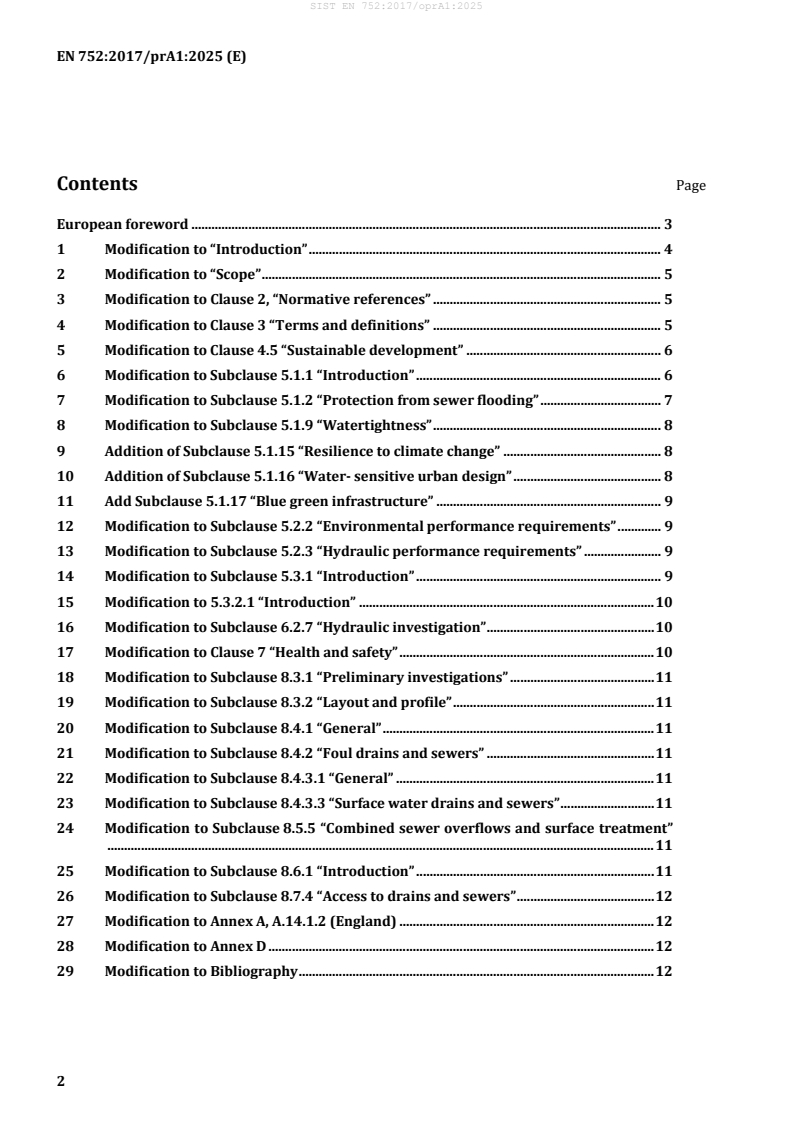
Contents Page
European foreword . 3
1 Modification to “Introduction” . 4
2 Modification to “Scope” . 5
3 Modification to Clause 2, “Normative references” . 5
4 Modification to Clause 3 “Terms and definitions” . 5
5 Modification to Clause 4.5 “Sustainable development” . 6
6 Modification to Subclause 5.1.1 “Introduction” . 6
7 Modification to Subclause 5.1.2 “Protection from sewer flooding” . 7
8 Modification to Subclause 5.1.9 “Watertightness” . 8
9 Addition of Subclause 5.1.15 “Resilience to climate change” . 8
10 Addition of Subclause 5.1.16 “Water- sensitive urban design” . 8
11 Add Subclause 5.1.17 “Blue green infrastructure” . 9
12 Modification to Subclause 5.2.2 “Environmental performance requirements” . 9
13 Modification to Subclause 5.2.3 “Hydraulic performance requirements” . 9
14 Modification to Subclause 5.3.1 “Introduction” . 9
15 Modification to 5.3.2.1 “Introduction” . 10
16 Modification to Subclause 6.2.7 “Hydraulic investigation” . 10
17 Modification to Clause 7 “Health and safety” . 10
18 Modification to Subclause 8.3.1 “Preliminary investigations” . 11
19 Modification to Subclause 8.3.2 “Layout and profile” . 11
20 Modification to Subclause 8.4.1 “General” . 11
21 Modification to Subclause 8.4.2 “Foul drains and sewers” . 11
22 Modification to Subclause 8.4.3.1 “General” . 11
23 Modification to Subclause 8.4.3.3 “Surface water drains and sewers” . 11
24 Modification to Subclause 8.5.5 “Combined sewer overflows and surface treatment”
................................................................................................................................................................... 11
25 Modification to Subclause 8.6.1 “Introduction” . 11
26 Modification to Subclause 8.7.4 “Access to drains and sewers” . 12
27 Modification to Annex A, A.14.1.2 (England) . 12
28 Modification to Annex D . 12
29 Modification to Bibliography . 12
SIST EN 752:2017/oprA1:2025
EN 752:2017/prA1:2025 (E)
European foreword
This document (EN 752:2017/prA1:2025) has been prepared by Technical Committee CEN/TC 165
“Waste water engineering”, the secretariat of which is held by DIN.
This document is currently submitted to the CEN Enquiry.
The principal changes in this amendment are broadly limited to various textual amendments and
additions relating to climate change.
SIST EN 752:2017/oprA1:2025
EN 752:2017/prA1:2025 (E)
1 Modification to “Introduction”
At the end of the 8th paragraph, add the following:
“Additionally, increased water resource scarcity or increased rainfall due to climate change determines
that rainwater recycling and sustainable discharge of stormwater should be a primary focus when
considering the planning, design, rehabilitation and management of drains and sewers outside of
buildings. Such approaches which will support drainage systems that serve local communities becoming
more sustainable and adaptive to the needs determined by our changing climate, through promoting
water sensitive urban development/design.”
In the 9th paragraph, replace “This concept” with “These concepts”, to read:
“These concepts are included in the approach of integrated sewer management.”
Replace the lists in the 12th and 13th paragraphs as follows:
“Design and construction standards include:
— EN 16932 (all parts), Drain and sewer systems outside buildings — Pumping systems,
— EN 16933 (all parts), Drain and sewer systems outside buildings — Design,
— EN 1295 (all parts), Structural design of buried pipelines under various conditions of loading,
— EN 1610, Construction and testing of drains and sewers,
— EN 12889, Trenchless construction and testing of drains and sewers,
— EN 15885, Classification and characteristics of techniques for renovation and repair of drains and
sewers.
Management and control standards include:
— EN 14654 (all parts), Drain and sewer systems outside buildings — Management and control of
activities.”
Replace Figure 1 with the following figure:
“
SIST EN 752:2017/oprA1:2025
EN 752:2017/prA1:2025 (E)
”
In the 2nd paragraph below Figure 1, replace “(No 305/2011)” with “(No xxx/2024)”
2 Modification to “Scope”
Add after the 2nd paragraph:
“This document pays regard to the extremes of the changing climate and seeks to acknowledge the
associated impacts on existing drain and sewer systems outside of buildings and futureproof associated
aspects of those systems that are to be planned for and designed in the future.”
3 Modification to Clause 2, “Normative references”
Replace “EN 13508-1, Investigation and assessment of drain and sewer systems outside buildings — Part 1:
General Requirements” with “EN 13508 (all parts), Drain and sewer systems outside buildings —
Investigation and assessment”
Replace “EN 14654-1, Management and control of operational activities in drain and sewer systems outside
buildings — Part 1: Cleaning” with “EN 14654 (all parts), Drain and sewer systems outside buildings —
Management and control of operational activities”.
Replace “prEN 16932 (all parts)” with “EN 16932 (all parts)”.
Replace “prEN 16933-2, Drain and sewer systems outside buildings — Design — Part 2: Hydraulic design”
with “EN 16933 (all parts), Drain and sewer systems outside buildings — Design”
4 Modification to Clause 3 “Terms and definitions”
Add the following new terms and definitions after 3.1, and renumber the subsequent definitions:
“3.2
climate change
long-term shifts in temperatures and weather patterns
Note 1 to entry: Such shifts can be natural, due to changes in the sun’s activity or large volcanic eruptions., however
since the 1800s, human activities have been the main driver of climate change, primarily due to the burning of fossil
fuels like coal, oil and gas
SIST EN 752:2017/oprA1:2025
EN 752:2017/prA1:2025 (E)
3.3
combined sewer overflow storm discharge
water discharged from a combined sewer overflow during heavy rainfall”
In the new definition 3.4 (former 3.2), add the following Note 1 to entry:
“Note 1 to entry: Design Working Life” can often be significantly longer than “design life” and is of critical
importance when calculating the longer-term resilience of drainage infrastructure, to, for example, climate change
impacts.”
[SOURCE: EN 1990:2002, modified to provide consistency with the terminology in EN 16323]”
Move definition 3.18 to after 3.4, so it becomes 3.5.
Add the following two new definitions at the end of the clause:
“3.23
sustainable urban drainage or blue green infrastructure
network of surface waters, groundwater, measures and facili
...