


SIST EN 12663-1:2010+A1:2015
(Main)Railway applications - Structural requirements of railway vehicle bodies - Part 1: Locomotives and passenger rolling stock (and alternative method for freight wagons)
Railway applications - Structural requirements of railway vehicle bodies - Part 1: Locomotives and passenger rolling stock (and alternative method for freight wagons)
This European Standard specifies minimum structural requirements for railway vehicle bodies.
This European Standard specifies the loads vehicle bodies should be capable of sustaining, identifies how material data should be used and presents the principles to be used for design validation by analysis and testing. This European Standard applies to locomotives and passenger rolling stock. EN 12663-2 provides the verification procedure for freight wagons and also refers to the methods in this standard as an alternative for freight wagons.
The railway vehicles are divided into categories which are defined only with respect to the structural requirements of the vehicle bodies. Some vehicles may not fit into any of the defined categories; the structural requirements for such railway vehicles should be part of the specification and be based on the principles presented in this European Standard.
The standard applies to all railway vehicles within the EU and EFTA territories. The specified requirements assume operating conditions and circumstances such as are prevalent in these countries.
In addition to the requirements of this European Standard the structure of all vehicles associated with passenger conveyance may generally be required to have features that will protect occupants in the case of collision accidents. These requirements are given in EN 15227.
Bahnanwendungen - Festigkeitsanforderungen an Wagenkästen von Schienenfahrzeugen - Teil 1: Lokomotiven und Personenfahrzeuge (und alternatives Verfahren für Güterwagen)
Diese Europäische Norm legt Mindestanforderungen an die Festigkeit von Wagenkästen für Schienenfahr¬zeuge fest.
Diese Europäische Norm gibt die Belastungen an, denen die Wagenkästen standhalten müssen. Sie legt fest, wie die Werkstoffdaten verwendet werden sollten und stellt die Prinzipien dar, die zur Validierung der Konstruktion durch Berechnung und Prüfung zu benutzen sind. Diese Europäische Norm gilt für Lokomotiven und Personenfahrzeuge. EN 12663-2 liefert das Nachweisverfahren für Güterwagen und verweist auch auf das Verfahren in dieser Norm als eine Alternative für Güterwagen.
Die Schienenfahrzeuge werden in Kategorien eingeteilt, die ausschließlich im Hinblick auf die Festigkeits-anforderungen der Wagenkästen festgelegt sind. Einige Schienenfahrzeuge passen möglicherweise in keine der definierten Kategorien; die Festigkeitsanforderungen an solche Schienenfahrzeuge sollten Teil der Spe¬zifikation sein und nach Grundsätzen, die in dieser Norm dargestellt sind, festgelegt werden.
Diese Europäische Norm gilt für alle Schienenfahrzeuge im Gebiet der EU und EFTA. Die angeführten Anfor-derungen setzen die vorherrschenden Betriebsbedingungen und -verhältnisse in diesen Ländern voraus.
Zusätzlich zu den Anforderungen dieser Europäischen Norm wird gewöhnlich gefordert, dass die Struktur aller Fahrzeuge in Verbindung mit Fahrgast-Beförderung Eigenschaften besitzen, die die Insassen im Fall von Kollisionsunfällen schützen. Diese Anforderungen werden in EN 15227 dargestellt.
Applications ferroviaires - Prescriptions de dimensionnement des structures de véhicules ferroviaires - Partie 1 : Locomotives et matériels roulants voyageurs (et méthode alternative pour wagons)
La présente Norme européenne définit les exigences minimales en matière de résistance requises pour toutes les structures de véhicules ferroviaires.
La présente Norme européenne spécifie les charges que les caisses des véhicules soient capables de supporter, identifie la manière dont les caractéristiques des matériaux soient prises en compte et présente les principes à utiliser pour la validation de la conception par des calculs et des essais. La présente norme européenne s’applique aux locomotives et matériel roulant voyageurs. L’EN 12663-2 fournit la procédure de vérification pour les wagons et présente aussi les méthodes de la présente norme européenne comme une alternative pour les wagons.
Les véhicules ferroviaires sont classés en différentes catégories qui sont uniquement définies par rapport aux exigences en matière de résistance des structures des véhicules. Certains véhicules peuvent ne pas s’inscrire dans une des catégories définies ; il convient que les exigences en matière de résistance des structures pour de tels véhicules ferroviaires fassent partie des spécifications et soient fondées sur les principes présentés dans la présente norme européenne.
La norme s’applique à tous les véhicules ferroviaires au sein de l’Union Européenne et des territoires de l’AELE. Les exigences spécifiées couvrent les conditions et les circonstances d’exploitation qui prévalent dans ces pays.
En plus des exigences de la présente norme, il est généralement admis que des exigences spécifient que la structure de tous les véhicules associés au transport de passagers puisse être pourvue de moyens permettant de protéger les occupants des véhicules en cas de collisions. Ces exigences sont spécifiées dans l’EN 15227.
Železniške naprave - Konstrukcijske zahteve za grode železniških vozil - 1. del: Lokomotive in potniška železniška vozila (tudi alternativna metoda za tovorne vagone)
Ta evropski standard določa minimalne konstrukcijske zahteve za grode železniških vozil.
Ta evropski standard določa obremenitve, ki naj bi jih grodi vozil vzdržali, določa način uporabe podatkov o materialu in predstavlja načela, ki jih je treba uporabiti pri potrjevanju konstrukcije z analizo in preskušanjem. Ta evropski standard se uporablja za lokomotive in potniška železniška vozila. Standard EN 12663-2 opredeljuje postopek preverjanja za tovorne vagone in kot njihovo alternativo upošteva tudi metode v tem standardu.
Železniška vozila so razdeljena v kategorije, ki so določene le glede na konstrukcijske zahteve za grode vozil. Nekatera vozila morda ne spadajo v nobeno od določenih kategorij; konstrukcijske zahteve za takšna železniška vozila naj bodo del specifikacije in naj temeljijo na načelih, predstavljenih v tem evropskem standardu.
Standard se uporablja za vsa železniška vozila na območju Evropske unije in Evropskega združenja za prosto trgovino. Navedene zahteve predvidevajo obratovalne pogoje in okoliščine, ki prevladujejo v teh državah.
Poleg zahtev tega evropskega standarda so lahko glede konstrukcije vseh vozil, ki so namenjena za prevoz potnikov, na splošno potrebne značilnosti, ki ščitijo potnike v primeru nesreč zaradi trčenja. Te zahteve so podane v standardu EN 15227.
General Information
- Status
- Withdrawn
- Publication Date
- 16-Dec-2014
- Withdrawal Date
- 10-Apr-2024
- Technical Committee
- IŽNP - Reilway applications
- Current Stage
- 9900 - Withdrawal (Adopted Project)
- Start Date
- 28-Mar-2024
- Due Date
- 20-Apr-2024
- Completion Date
- 11-Apr-2024
Relations
- Effective Date
- 01-May-2024
- Effective Date
- 18-Jan-2023
- Effective Date
- 01-Feb-2015
- Effective Date
- 01-Jan-2020


Frequently Asked Questions
SIST EN 12663-1:2010+A1:2015 is a standard published by the Slovenian Institute for Standardization (SIST). Its full title is "Railway applications - Structural requirements of railway vehicle bodies - Part 1: Locomotives and passenger rolling stock (and alternative method for freight wagons)". This standard covers: This European Standard specifies minimum structural requirements for railway vehicle bodies. This European Standard specifies the loads vehicle bodies should be capable of sustaining, identifies how material data should be used and presents the principles to be used for design validation by analysis and testing. This European Standard applies to locomotives and passenger rolling stock. EN 12663-2 provides the verification procedure for freight wagons and also refers to the methods in this standard as an alternative for freight wagons. The railway vehicles are divided into categories which are defined only with respect to the structural requirements of the vehicle bodies. Some vehicles may not fit into any of the defined categories; the structural requirements for such railway vehicles should be part of the specification and be based on the principles presented in this European Standard. The standard applies to all railway vehicles within the EU and EFTA territories. The specified requirements assume operating conditions and circumstances such as are prevalent in these countries. In addition to the requirements of this European Standard the structure of all vehicles associated with passenger conveyance may generally be required to have features that will protect occupants in the case of collision accidents. These requirements are given in EN 15227.
This European Standard specifies minimum structural requirements for railway vehicle bodies. This European Standard specifies the loads vehicle bodies should be capable of sustaining, identifies how material data should be used and presents the principles to be used for design validation by analysis and testing. This European Standard applies to locomotives and passenger rolling stock. EN 12663-2 provides the verification procedure for freight wagons and also refers to the methods in this standard as an alternative for freight wagons. The railway vehicles are divided into categories which are defined only with respect to the structural requirements of the vehicle bodies. Some vehicles may not fit into any of the defined categories; the structural requirements for such railway vehicles should be part of the specification and be based on the principles presented in this European Standard. The standard applies to all railway vehicles within the EU and EFTA territories. The specified requirements assume operating conditions and circumstances such as are prevalent in these countries. In addition to the requirements of this European Standard the structure of all vehicles associated with passenger conveyance may generally be required to have features that will protect occupants in the case of collision accidents. These requirements are given in EN 15227.
SIST EN 12663-1:2010+A1:2015 is classified under the following ICS (International Classification for Standards) categories: 45.060.20 - Trailing stock. The ICS classification helps identify the subject area and facilitates finding related standards.
SIST EN 12663-1:2010+A1:2015 has the following relationships with other standards: It is inter standard links to SIST EN 12663-1:2010+A2:2024, SIST EN 12663-1:2010/FprA1:2014, SIST EN 12663-1:2010, SIST EN 12663-1:2010+A1:2015/kFprA2:2023. Understanding these relationships helps ensure you are using the most current and applicable version of the standard.
SIST EN 12663-1:2010+A1:2015 is associated with the following European legislation: EU Directives/Regulations: 2008/57/EC, 2016/797/EU; Standardization Mandates: M/483. When a standard is cited in the Official Journal of the European Union, products manufactured in conformity with it benefit from a presumption of conformity with the essential requirements of the corresponding EU directive or regulation.
SIST EN 12663-1:2010+A1:2015 is available in PDF format for immediate download after purchase. The document can be added to your cart and obtained through the secure checkout process. Digital delivery ensures instant access to the complete standard document.
Standards Content (Sample)
2003-01.Slovenski inštitut za standardizacijo. Razmnoževanje celote ali delov tega standarda ni dovoljeno.Železniške naprave - Konstrukcijske zahteve za grode železniških vozil - 1. del: Lokomotive in potniška železniška vozila (tudi alternativna metoda za tovorne vagone)Bahnanwendungen - Festigkeitsanforderungen an Wagenkästen von Schienenfahrzeugen - Teil 1: Lokomotiven und Personenfahrzeuge (und alternatives Verfahren für Güterwagen)Applications ferroviaires - Prescriptions de dimensionnement des structures de véhicules ferroviaires - Partie 1 : Locomotives et matériels roulants voyageurs (et méthode alternative pour wagons)Railway applications - Structural requirements of railway vehicle bodies - Part 1: Locomotives and passenger rolling stock (and alternative method for freight wagons)45.060.20Železniški vagoniTrailing stockICS:Ta slovenski standard je istoveten z:EN 12663-1:2010+A1:2014SIST EN 12663-1:2010+A1:2015en,fr,de01-februar-2015SIST EN 12663-1:2010+A1:2015SLOVENSKI
STANDARD
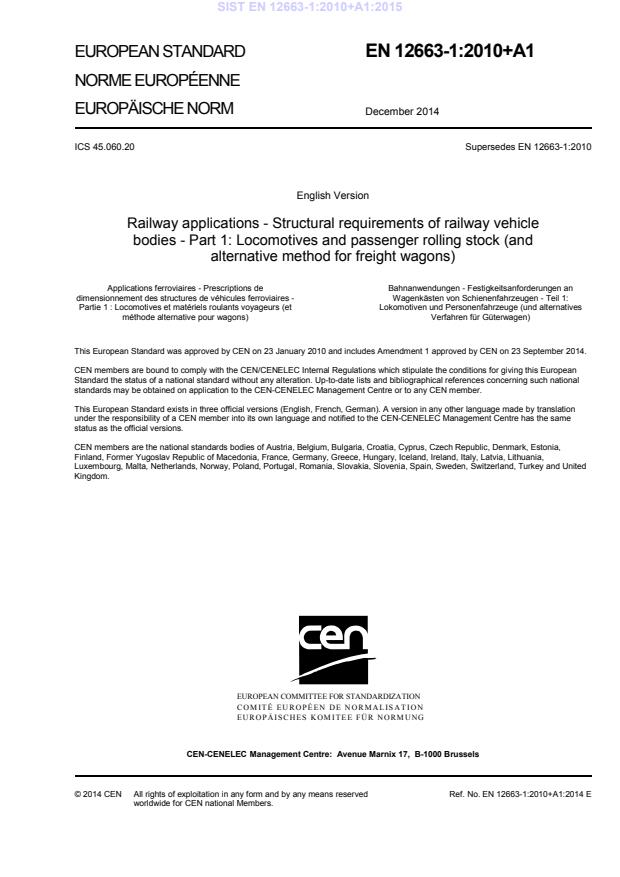
EUROPEAN STANDARD NORME EUROPÉENNE EUROPÄISCHE NORM
EN 12663-1:2010+A1
December 2014 ICS 45.060.20 Supersedes EN 12663-1:2010English Version
Railway applications - Structural requirements of railway vehicle bodies - Part 1: Locomotives and passenger rolling stock (and alternative method for freight wagons)
Applications ferroviaires - Prescriptions de dimensionnement des structures de véhicules ferroviaires -Partie 1 : Locomotives et matériels roulants voyageurs (et méthode alternative pour wagons)
Bahnanwendungen - Festigkeitsanforderungen an Wagenkästen von Schienenfahrzeugen - Teil 1: Lokomotiven und Personenfahrzeuge (und alternatives Verfahren für Güterwagen) This European Standard was approved by CEN on 23 January 2010 and includes Amendment 1 approved by CEN on 23 September 2014.
CEN members are bound to comply with the CEN/CENELEC Internal Regulations which stipulate the conditions for giving this European Standard the status of a national standard without any alteration. Up-to-date lists and bibliographical references concerning such national standards may be obtained on application to the CEN-CENELEC Management Centre or to any CEN member.
This European Standard exists in three official versions (English, French, German). A version in any other language made by translation under the responsibility of a CEN member into its own language and notified to the CEN-CENELEC Management Centre has the same status as the official versions.
CEN members are the national standards bodies of Austria, Belgium, Bulgaria, Croatia, Cyprus, Czech Republic, Denmark, Estonia, Finland, Former Yugoslav Republic of Macedonia, France, Germany, Greece, Hungary, Iceland, Ireland, Italy, Latvia, Lithuania, Luxembourg, Malta, Netherlands, Norway, Poland, Portugal, Romania, Slovakia, Slovenia, Spain, Sweden, Switzerland, Turkey and United Kingdom.
EUROPEAN COMMITTEE FOR STANDARDIZATION
COMITÉ EUROPÉEN DE NORMALISATION EUROPÄISCHES KOMITEE FÜR NORMUNG
CEN-CENELEC Management Centre:
Avenue Marnix 17,
B-1000 Brussels © 2014 CEN All rights of exploitation in any form and by any means reserved worldwide for CEN national Members. Ref. No. EN 12663-1:2010+A1:2014 ESIST EN 12663-1:2010+A1:2015
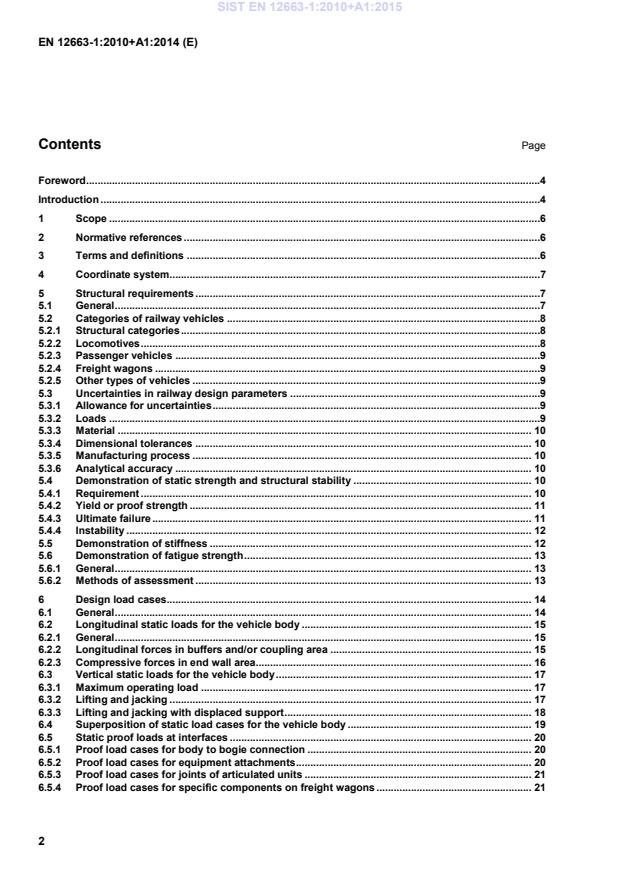
Treatment of local stress concentrations in analyses . 32 Annex B (informative)
Examples of proof load cases at articulation joints . 34 Annex ZA Annex ZA (informative)
Relationship between this European Standard and the Essential Requirements of EU Directive 2008/57/EC . 37 Bibliography . 40
Key 1 driving direction X longitudinal direction Y lateral direction Z vertical direction Figure 1 — Vehicle body coordinate system 5 Structural requirements 5.1 General Railway vehicle bodies shall withstand the maximum loads consistent with their operational requirements and achieve the required service life under normal operating conditions with an adequate probability of survival. The capability of the railway vehicle body to sustain required loads without permanent deformation and fracture shall be demonstrated by calculation and/or testing as described by the validation programme in Clause 9. The assessment shall be based on the following criteria: SIST EN 12663-1:2010+A1:2015
5.2.3 Passenger vehicles To this group belong all types of railway vehicles intended for the transport of passengers, ranging from main line vehicles, suburban and urban transit stock to tramways. Passenger vehicles are divided into five structural design categories into which all vehicles may be allocated. The five categories are listed below, with an indication of the types of vehicle generally associated with each: — Category P-I e.g. coaches; — Category P-II e.g. fixed units and coaches; — Category P-III e.g. underground, rapid transit vehicles and light railcar; — Category P-IV e.g. light duty metro and heavy duty tramway vehicles; — Category P-V e.g. tramway vehicles.
5.2.4 Freight wagons All freight wagons in this group are used for the transportation of goods. Two categories have been defined: — Category F-I e.g. vehicles which can be shunted without restriction; — Category F-II e.g. vehicles excluded in hump and loose shunting.
5.2.5 Other types of vehicles Some railway vehicles may not fit the descriptions associated with the above mentioned categories (e.g. the standard open bogie van for conveyance of motor vehicles may be treated as a P-I vehicle). The appropriate category for the structural requirements of such railway vehicles should be part of the specification. 5.3 Uncertainties in railway design parameters 5.3.1 Allowance for uncertainties The uncertainties described in the following clauses may be allowed for by adopting limiting values of parameters or by incorporating a safety factor into the design process. This safety factor, designated S, shall then be applied when comparing the calculated stresses to the permissible stress as indicated in 5.4. NOTE In the design process the following should be considered with respect to criticality of the component failure: consequence of failure, redundancy, accessibility for inspection, detection of component failure, maintenance interval, etc. The value of S shall be chosen to include the cumulative effect of all uncertainties not otherwise taken into account. 5.3.2 Loads All loads used as the basis for vehicle body design shall incorporate any necessary allowance for uncertainties in their values. The loads specified in Clause 6 include this allowance. If the design loads are derived from on-track tests or other sources of information an allowance for uncertainty shall be used. SIST EN 12663-1:2010+A1:2015
is the utilisation of the component; SIST EN 12663-1:2010+A1:2015
is the determined result from calculation or test; S
is a design safety factor (see 5.3); RL
is the permissible or limit value.
NOTE The equation is sometimes expressed as: SRR≥dL 5.4.2 Yield or proof strength Where the design is verified only by calculation, S1 shall be 1,15 for each individual load case. S1 may be taken as 1,0 where the design load cases are to be verified by test and/or correlation between test and calculation has been successfully established. Under the static load cases as defined in 6.1 to 6.5, the utilisation shall be less than or equal to 1 as given by the following equation: 11c≤=RSUσ where U
is the utilisation; S1
is the safety factor for yield or proof strength; R
is the material yield (ReH) or 0,2 % proof stress (Rp02), in newtons per square millimetre (N/mm2) (as defined in EN 10002-1) and taking into account any relevant effects as described in 5.3.3; 1c
is the calculated stress, in newtons per square millimetre (N/mm2).
In determining the stress levels in ductile materials, it is not necessary to satisfy the above criteria at features producing local stress concentration. If the analysis does incorporate local stress concentrations, then it is permissible for the theoretical stress to exceed the material yield or 0,2 % proof limit. The areas of local plastic deformation associated with stress concentrations shall be sufficiently small so as not to cause any significant permanent deformation when the load is removed. Methods of treatment of local stress concentrations during calculation are given in Annex A and during test are given in 8.2.2. 5.4.3 Ultimate failure It is necessary to provide a margin of safety between the exceptional design load and the load at which the structure will fail. This is achieved by introducing a safety factor S2 such that the utilisation shall be less than or equal to 1 as given by the following equation: 1m2c≤=RSUσ where U
is the utilisation; S2
is the safety factor for ultimate failure; SIST EN 12663-1:2010+A1:2015
is the material ultimate stress, in newtons per square millimetre (N/mm2) (as defined in EN 10002-1) and taking into account any relevant effects as described in 5.3.3; 1c
is the calculated stress, in newtons per square millimetre (N/mm2), under an exceptional load case.
Usually S2 = 1,5, but a value of S2 = 1,3 can be used where the design load cases are to be verified by test and/or correlation between test and calculation has been successfully established. The safety factor S2 can be reduced further when there are alternative load paths and these load paths comply with a safety factor of S2 = 1,3. The ultimate failure criterion does not apply for parts of the structure which are specifically designed to collapse in a controlled manner (e.g. as required by EN 15227). The treatment of stress concentration as indicated in 5.4.2 also applies in this case. However, the effect of stress concentration should be considered in more detail for brittle materials where local plastic yielding, as a mechanism for stress redistribution at the concentration, does not occur. 5.4.4 Instability Local instability, in the form of elastic buckling, is permissible provided alternative load paths exist and the yield or proof criteria are met. The vehicle structure shall have a margin of safety against an instability leading to general structural failure under exceptional loads. The utilisation (as given by the following equation) shall be less than or equal to 1 when the calculated stress or load is compared to the critical buckling stress or buckling load: 1cb3c≤=σσSU or 1cb3c≤=LSLU where U
is the utilisation; S3
is the safety factor for instability; 1cb
is the critical buckling stress, in newtons per square millimetre (N/mm2); 1c
is the calculated stress, in newtons per square millimetre (N/mm2); Lcb
is the critical buckling load, in newtons (N); Lc
is the calculated load, in newtons (N).
The safety factor shall be taken as S3 = 1,5. The instability criterion does not apply for parts of the structure which are specifically designed to collapse in a controlled manner (e.g. as required by EN 15227). 5.5 Demonstration of stiffness Stiffness limits ensure that the vehicle body remains within its required space envelope and unacceptable dynamic responses are avoided. Any specific requirements and the means for demonstration of stiffness shall be part of the specification. SIST EN 12663-1:2010+A1:2015
...
Questions, Comments and Discussion
Ask us and Technical Secretary will try to provide an answer. You can facilitate discussion about the standard in here.
Loading comments...