

SIST EN 50160:2023/A1:2025
(Amendment)Voltage characteristics of electricity supplied by public electricity networks
General Information
- Abstract
This document specifies the main characteristics of the voltage at a network user's supply terminals in public low voltage, medium, high, and extra-high voltage AC electricity networks under normal operating conditions. This document specifies the limits or values within which the voltage characteristics can be expected to remain at any supply terminal in public European electricity networks, only. Industrial networks are excluded from the scope of EN 50160.
NOTE 1 If non-public networks (e.g. residential quarters, energy communities, office centres, shopping centres) have similar end-users as public networks, it is strongly advised to apply the same requirements as for public networks.
This document does not apply under abnormal operating conditions, including the following:
a) a temporary supply arrangement to keep network users supplied during conditions arising as a result of a fault, maintenance and construction work, or to minimize the extent and duration of a loss of supply;
b) in the case of non-compliance of a network user's installation or equipment with the relevant standards or with the technical requirements for connection, established either by the public authorities or the network operator, including the limits for the emission of conducted disturbances;
NOTE 2 A network user’s installation can include load and generation.
c) in exceptional situations, in particular:
1) exceptional weather conditions and other natural disasters;
2) third party interference;
3) acts by public authorities,
4) industrial actions (subject to legal requirements);
5) force majeure;
6) power shortages resulting from external events.
The voltage characteristics given in this document refer to conducted disturbances in public electric power networks. They are not intended to be used as electromagnetic compatibility (EMC) levels or product emission limits.
Power quality is related to EMC in several ways - especially because compliance with power quality requirements depends on the control of cumulative effect of electromagnetic emissions from all/multiple equipment and/or installations. Therefore, the voltage characteristics given in this document gives guidance for specifying requirements in equipment product standards and in installation standards.
NOTE 3 The performance of equipment might be impaired if it is subjected to supply conditions which are not specified in the equipment product standard.
NOTE 4 This document can be superseded in total or in part by the terms of a contract between the individual network user and the network operator.
The sharing of complaint management and problem mitigation costs between the involved parties is outside the scope of EN 50160.
Measurement methods to be applied in this document are described in EN 61000-4-30.
- Status
- Published
- Public Enquiry End Date
- 09-Sep-2024
- Publication Date
- 17-Mar-2025
- Technical Committee
- NTF - Electricity energy supply systems
- Current Stage
- 6060 - National Implementation/Publication (Adopted Project)
- Start Date
- 15-Jan-2025
- Due Date
- 22-Mar-2025
- Completion Date
- 18-Mar-2025

Overview
SIST EN 50160:2023/A1:2025 is a crucial European standard issued by CLC that defines the voltage characteristics of electricity supplied by public electricity networks. This standard specifically covers voltage parameters at the supply terminals of low, medium, high, and extra-high voltage AC electricity networks under normal operating conditions within public European networks. It excludes industrial networks but recommends similar requirements for non-public networks with comparable end-users.
The standard guides utility providers and network users on voltage quality limits, ensuring stable and reliable electricity supply across Europe. It also clarifies measurement methods, referencing EN 61000-4-30, and emphasizes the importance of maintaining power quality while considering electromagnetic compatibility (EMC). SIST EN 50160:2023/A1:2025 provides a common framework for voltage monitoring and control, which is vital for sustaining efficient electrical grid operations.
Key Topics
- Voltage Limits Under Normal Conditions
- 95% of the 10-minute root mean square (rms) voltage values shall be within ±10% of the nominal voltage during any one-week period.
- All 10-minute rms values must fall within +10% / -15% of the nominal voltage (Un).
- Measurement and Evaluation
- Voltage measurements vary depending on system type: three-wire three-phase systems use line-to-line voltages; four-wire three-phase systems use line-to-neutral voltages; and single-phase connections consider the relevant supply voltage.
- Measurement methods are standardized according to EN 61000-4-30, ensuring consistency in data acquisition.
- Voltage Disturbances and Harmonics
- Limits are defined for negative phase sequence voltages, harmonics, and total harmonic distortion (THD).
- Typically, 95% of 10-minute rms values of harmonic voltages must not exceed specified percentages of the fundamental voltage.
- Exclusions and Exceptional Conditions
- The document applies only to normal operating conditions and excludes temporary supply arrangements during faults or maintenance, non-compliant user equipment, and exceptional events such as natural disasters or force majeure.
- Clarifications and Amendments
- This amendment improves clarity in definitions and measurements without significant technical changes.
- Updated clauses address voltage aggregation, harmonic limits, and measurement references.
Applications
SIST EN 50160:2023/A1:2025 serves as a foundational reference for utilities, distribution network operators, equipment manufacturers, and regulators involved in European public electricity supply:
- Power Quality Assessment
Utilities use the standard to monitor voltage quality and ensure compliance, which directly affects the reliability of power supply to residential, commercial, and public infrastructure customers. - Equipment and Installation Design
Product standards and installation regulations often reference EN 50160 voltage characteristics to specify performance requirements and EMC considerations, minimizing malfunctions caused by voltage anomalies. - Grid Planning and Maintenance
Network operators leverage the standard to design robust networks, optimize control strategies, and manage voltage disturbances proactively. - Regulatory Compliance
Authorities rely on the standard to set legal frameworks for voltage quality, facilitating complaint management and technical dispute resolution between suppliers and users.
The application of EN 50160 helps improve overall power system performance, reduces equipment damage risks, and supports harmonization across European electricity markets.
Related Standards
- EN 61000-4-30
Specifies measurement methods for power quality parameters, including voltage fluctuations, harmonics, and supply interruptions, ensuring accurate and repeatable data collection compliant with EN 50160. - IEC 61000 Series (Electromagnetic Compatibility)
These standards provide guidance on controlling electromagnetic disturbances influencing power quality and equipment performance. - National Electrical Installation Standards
Often incorporate EN 50160 voltage limits as part of their requirements for connection and interoperability of equipment within public electricity networks. - CENELEC Regulations and National Implementations
SIST EN 50160:2023/A1:2025 is harmonized across European countries through CENELEC, supporting coordinated national standardization and legal enforcement efforts.
Keywords: SIST EN 50160:2023/A1:2025, voltage characteristics, public electricity networks, power quality, European electricity standards, voltage limits, harmonics, rms voltage measurement, electromagnetic compatibility, public electricity supply, CLC standard, AC voltage networks, power system voltage parameters.
Relations
- Amends
SIST EN 50160:2023 - Voltage characteristics of electricity supplied by public distribution networks - Effective Date
- 01-Apr-2025
Get Certified
Connect with accredited certification bodies for this standard

IMQ S.p.A. (Certification)
Italian electrical product certification.

SLG Prüf- und Zertifizierungs GmbH
German testing and certification body.

UL Solutions
Global safety science company with testing, inspection and certification.
Sponsored listings
Frequently Asked Questions
SIST EN 50160:2023/A1:2025 is a amendment published by the Slovenian Institute for Standardization (SIST). Its full title is "Voltage characteristics of electricity supplied by public electricity networks". This standard covers: This document specifies the main characteristics of the voltage at a network user's supply terminals in public low voltage, medium, high, and extra-high voltage AC electricity networks under normal operating conditions. This document specifies the limits or values within which the voltage characteristics can be expected to remain at any supply terminal in public European electricity networks, only. Industrial networks are excluded from the scope of EN 50160. NOTE 1 If non-public networks (e.g. residential quarters, energy communities, office centres, shopping centres) have similar end-users as public networks, it is strongly advised to apply the same requirements as for public networks. This document does not apply under abnormal operating conditions, including the following: a) a temporary supply arrangement to keep network users supplied during conditions arising as a result of a fault, maintenance and construction work, or to minimize the extent and duration of a loss of supply; b) in the case of non-compliance of a network user's installation or equipment with the relevant standards or with the technical requirements for connection, established either by the public authorities or the network operator, including the limits for the emission of conducted disturbances; NOTE 2 A network user’s installation can include load and generation. c) in exceptional situations, in particular: 1) exceptional weather conditions and other natural disasters; 2) third party interference; 3) acts by public authorities, 4) industrial actions (subject to legal requirements); 5) force majeure; 6) power shortages resulting from external events. The voltage characteristics given in this document refer to conducted disturbances in public electric power networks. They are not intended to be used as electromagnetic compatibility (EMC) levels or product emission limits. Power quality is related to EMC in several ways - especially because compliance with power quality requirements depends on the control of cumulative effect of electromagnetic emissions from all/multiple equipment and/or installations. Therefore, the voltage characteristics given in this document gives guidance for specifying requirements in equipment product standards and in installation standards. NOTE 3 The performance of equipment might be impaired if it is subjected to supply conditions which are not specified in the equipment product standard. NOTE 4 This document can be superseded in total or in part by the terms of a contract between the individual network user and the network operator. The sharing of complaint management and problem mitigation costs between the involved parties is outside the scope of EN 50160. Measurement methods to be applied in this document are described in EN 61000-4-30.
This document specifies the main characteristics of the voltage at a network user's supply terminals in public low voltage, medium, high, and extra-high voltage AC electricity networks under normal operating conditions. This document specifies the limits or values within which the voltage characteristics can be expected to remain at any supply terminal in public European electricity networks, only. Industrial networks are excluded from the scope of EN 50160. NOTE 1 If non-public networks (e.g. residential quarters, energy communities, office centres, shopping centres) have similar end-users as public networks, it is strongly advised to apply the same requirements as for public networks. This document does not apply under abnormal operating conditions, including the following: a) a temporary supply arrangement to keep network users supplied during conditions arising as a result of a fault, maintenance and construction work, or to minimize the extent and duration of a loss of supply; b) in the case of non-compliance of a network user's installation or equipment with the relevant standards or with the technical requirements for connection, established either by the public authorities or the network operator, including the limits for the emission of conducted disturbances; NOTE 2 A network user’s installation can include load and generation. c) in exceptional situations, in particular: 1) exceptional weather conditions and other natural disasters; 2) third party interference; 3) acts by public authorities, 4) industrial actions (subject to legal requirements); 5) force majeure; 6) power shortages resulting from external events. The voltage characteristics given in this document refer to conducted disturbances in public electric power networks. They are not intended to be used as electromagnetic compatibility (EMC) levels or product emission limits. Power quality is related to EMC in several ways - especially because compliance with power quality requirements depends on the control of cumulative effect of electromagnetic emissions from all/multiple equipment and/or installations. Therefore, the voltage characteristics given in this document gives guidance for specifying requirements in equipment product standards and in installation standards. NOTE 3 The performance of equipment might be impaired if it is subjected to supply conditions which are not specified in the equipment product standard. NOTE 4 This document can be superseded in total or in part by the terms of a contract between the individual network user and the network operator. The sharing of complaint management and problem mitigation costs between the involved parties is outside the scope of EN 50160. Measurement methods to be applied in this document are described in EN 61000-4-30.
SIST EN 50160:2023/A1:2025 is classified under the following ICS (International Classification for Standards) categories: 29.020 - Electrical engineering in general; 29.240.01 - Power transmission and distribution networks in general. The ICS classification helps identify the subject area and facilitates finding related standards.
SIST EN 50160:2023/A1:2025 has the following relationships with other standards: It is inter standard links to SIST EN 50160:2023. Understanding these relationships helps ensure you are using the most current and applicable version of the standard.
SIST EN 50160:2023/A1:2025 is associated with the following European legislation: EU Directives/Regulations: 2003-01-2787. When a standard is cited in the Official Journal of the European Union, products manufactured in conformity with it benefit from a presumption of conformity with the essential requirements of the corresponding EU directive or regulation.
SIST EN 50160:2023/A1:2025 is available in PDF format for immediate download after purchase. The document can be added to your cart and obtained through the secure checkout process. Digital delivery ensures instant access to the complete standard document.
Standards Content (Sample)
SLOVENSKI STANDARD
01-april-2025
Značilnosti napetosti v javnih razdelilnih omrežjih - Dopolnilo A1
Voltage characteristics of electricity supplied by public electricity networks
Merkmale der Spannung in öffentlichen Energieversorgungsnetzen
Caractéristiques de la tension fournie par les réseaux publics d'electricité
Ta slovenski standard je istoveten z: EN 50160:2022/A1:2025
ICS:
29.240.01 Omrežja za prenos in Power transmission and
distribucijo električne energije distribution networks in
na splošno general
2003-01.Slovenski inštitut za standardizacijo. Razmnoževanje celote ali delov tega standarda ni dovoljeno.
EUROPEAN STANDARD EN 50160:2022/A1
NORME EUROPÉENNE
EUROPÄISCHE NORM January 2025
ICS 29.020
English Version
Voltage characteristics of electricity supplied by public electricity
networks
Caractéristiques de la tension fournie par les réseaux Merkmale der Spannung in öffentlichen
publics d'electricité Energieversorgungsnetzen
This amendment A1 modifies the European Standard EN 50160:2022; it was approved by CENELEC on 2023-12-29. CENELEC members
are bound to comply with the CEN/CENELEC Internal Regulations which stipulate the conditions for giving this amendment the status of a
national standard without any alteration.
Up-to-date lists and bibliographical references concerning such national standards may be obtained on application to the CEN-CENELEC
Management Centre or to any CENELEC member.
This amendment exists in three official versions (English, French, German). A version in any other language made by translation under the
responsibility of a CENELEC member into its own language and notified to the CEN-CENELEC Management Centre has the same status as
the official versions.
CENELEC members are the national electrotechnical committees of Austria, Belgium, Bulgaria, Croatia, Cyprus, the Czech Republic,
Denmark, Estonia, Finland, France, Germany, Greece, Hungary, Iceland, Ireland, Italy, Latvia, Lithuania, Luxembourg, Malta, the
Netherlands, Norway, Poland, Portugal, Republic of North Macedonia, Romania, Serbia, Slovakia, Slovenia, Spain, Sweden, Switzerland,
Türkiye and the United Kingdom.
European Committee for Electrotechnical Standardization
Comité Européen de Normalisation Electrotechnique
Europäisches Komitee für Elektrotechnische Normung
CEN-CENELEC Management Centre: Rue de la Science 23, B-1040 Brussels
© 2025 CENELEC All rights of exploitation in any form and by any means reserved worldwide for CENELEC Members.
Ref. No. EN 50160:2022/A1:2025 E
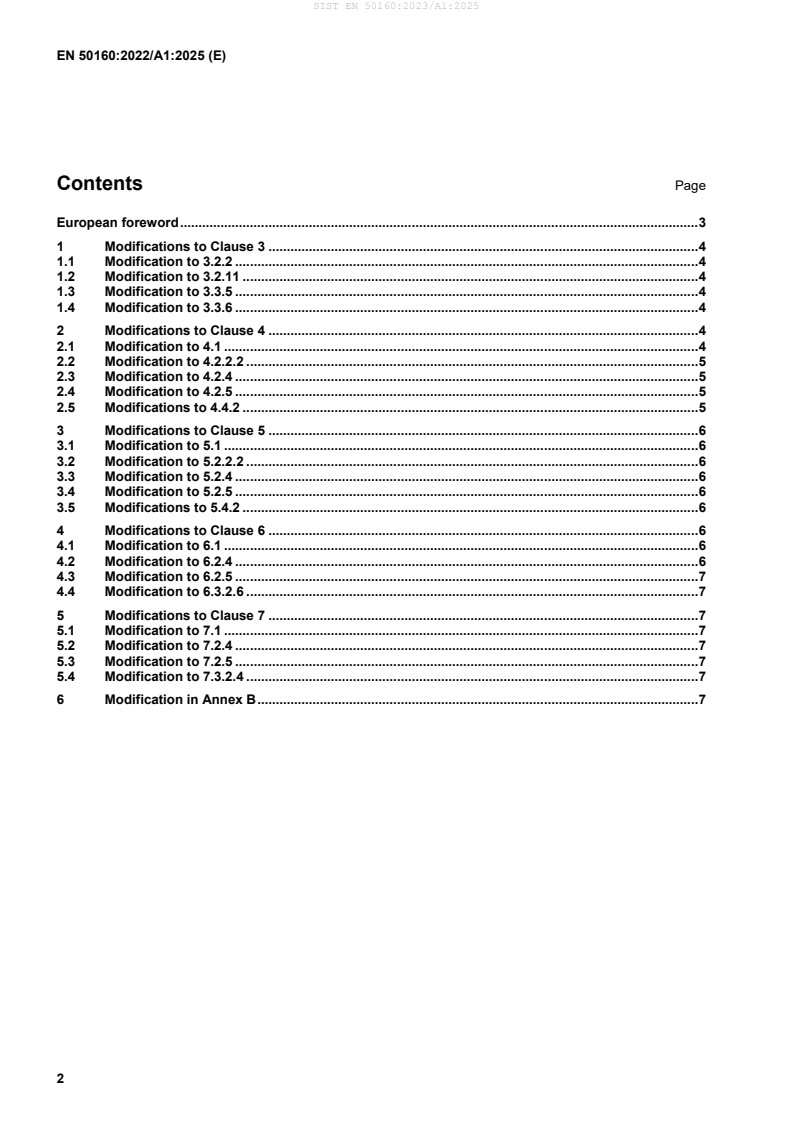
Contents Page
European foreword . 3
1 Modifications to Clause 3 . 4
1.1 Modification to 3.2.2 . 4
1.2 Modification to 3.2.11 . 4
1.3 Modification to 3.3.5 . 4
1.4 Modification to 3.3.6 . 4
2 Modifications to Clause 4 . 4
2.1 Modification to 4.1 . 4
2.2 Modification to 4.2.2.2 . 5
2.3 Modification to 4.2.4 . 5
2.4 Modification to 4.2.5 . 5
2.5 Modifications to 4.4.2 . 5
3 Modifications to Clause 5 . 6
3.1 Modification to 5.1 . 6
3.2 Modification to 5.2.2.2 . 6
3.3 Modification to 5.2.4 . 6
3.4 Modification to 5.2.5 . 6
3.5 Modifications to 5.4.2 . 6
4 Modifications to Clause 6 . 6
4.1 Modification to 6.1 . 6
4.2 Modification to 6.2.4 . 6
4.3 Modification to 6.2.5 . 7
4.4 Modification to 6.3.2.6 . 7
5 Modifications to Clause 7 . 7
5.1 Modification to 7.1 . 7
5.2 Modification to 7.2.4 . 7
5.3 Modification to 7.2.5 . 7
5.4 Modification to 7.3.2.4 . 7
6 Modification in Annex B . 7
...