

SIST EN 1999-1-1:2023/oprA1:2026
(Amendment)Eurocode 9 - Design of aluminium structures - Part 1-1: General rules
- Abstract
EN 1999-1-1 gives basic design rules for structures made of wrought aluminium alloys and limited guidance for cast alloys (see Clause 5 and Annex C).
This document does not cover the following, unless otherwise explicitly stated in this document:
- members with material thickness less than 0,6 mm;
- welded members with material thickness less than 1,5 mm;
- connections with:
- steel bolts and pins with diameter less than 5 mm;
- aluminium bolts and pins with diameter less than 8 mm;
- rivets and thread forming screws with diameter less than 3,9 mm.
- Status
- Not Published
- Public Enquiry End Date
- 28-May-2026
- Technical Committee
- KON - Structures
- Current Stage
- 4020 - Public enquire (PE) (Adopted Project)
- Start Date
- 30-Mar-2026
- Due Date
- 17-Aug-2026

SIST EN 1999-1-1:2023/oprA1:2026 is a CEN draft amendment to Eurocode 9, Part 1-1. It updates the general design rules for aluminium structures, with basic rules for wrought aluminium alloys and limited guidance for cast alloys. In practice, it is used with EN 1990-1 and the other Eurocodes for member design, joint modelling, buckling, welds, bridge details and composite aluminium-concrete members.
What does SIST EN 1999-1-1:2023/oprA1:2026 specify?
SIST EN 1999-1-1:2023/oprA1:2026 amends EN 1999-1-1:2023, which gives the basic design rules for structures made of wrought aluminium alloys and limited guidance for cast alloys. The base standard applies to aluminium structural design, while very thin members and very small fasteners are outside its general coverage unless the document states otherwise.
This draft amendment follows the structure of the base standard and revises the foreword, Introduction, Clauses 2 to 10, Annexes B, C, D, F, G, H, I, K, O, R, S, T and U, and the Bibliography.
| Annex | What it covers |
|---|---|
| B | Modelling, imperfections, limit state criteria and partial factors |
| C | General guidance for cast alloys |
| D | Durability issues such as contact with timber and immersion in water |
| F | Material stress-strain models |
| G | Plastic section modulus |
| H | Boundary values for the ultimate axial load |
| I | Cantilevers with uniform cross-sections symmetrical about the minor axis |
| K | Determination of ultimate bending moment |
| O | Tensile resistance |
| R | Design |
| S | Bridge-related rules, robustness, durability, fatigue and deck details |
| T | Connection classification, bolts, testing and gusset plate modelling |
| U | Composite aluminium-concrete beams and connectors |
What are the key requirements of SIST EN 1999-1-1:2023/oprA1:2026?
The main effect of SIST EN 1999-1-1:2023/oprA1:2026 is to tighten and clarify how aluminium members, joints, welds, plates, connections and composite members are modelled and checked. It also updates terminology, symbols, figures, tables and formulas so that the design rules are applied consistently.
Materials, terms and global analysis
- Clause 2 updates the normative reference to EN 1990-1, and the Introduction says EN 1999 is intended to be used with EN 1990-1 and the other Eurocodes. In practice, the aluminium rules are not stand-alone - they sit inside the wider Eurocode design basis.
- Clause 3.1 and Clause 3.2 revise terms, definitions and symbols, including the notation used for shear resistance, slip factors and material constants. That matters because the same calculation now has to be read with the updated symbols and definitions.
- Clause 7.1.2 distinguishes between semi-continuous and continuous joint models. Semi-continuous joints need both structural and stiffness properties of the joint components in the global analysis, while continuous joints use only the structural properties of the members. This affects how much joint flexibility must be modelled.
Members, welds and buckling
- Clause 8.1.4.4 clarifies when a cross-section part is treated as welded, including longitudinal welding at an edge or within the width. Transverse welds are treated differently, so section classification must follow the actual weld layout.
- Clauses 8.1.5 to 8.3.3 update local buckling resistance, HAZ softening, net area, buckling resistance, buckling curves and members containing localised welds. In practice, welded regions and the HAZ have to be considered explicitly when checking resistance and stability.
- Clauses 8.5, 8.7.6, 8.8 and 8.9 revise plate girder and orthotropic plate rules, including buckling loads, effective loaded length and shear force resistance. Designers need to use the revised formulas rather than earlier versions.
Connections, welds and testing
- Clause 10 updates shear connections, tension connections, bolt-channel joints, weld metal strength, HAZ resistance for fillet welds and bending about the weld seam axis. This affects the design resistance of fastened and welded joints.
- Clause 10.5.3.2 updates the bolt property classes used in the connection categories. That matters when selecting fasteners and checking whether a specific bolt class is acceptable for a given connection type.
- Clause 10.5.12.1 and Clause 10.6.2.7, together with Annex T, keep the design assisted by testing approach aligned with the revised connection rules. If testing is used, the measured displacements and resistance checks have to match the updated procedure.
Analysis annexes and composite members
- Annex B revises FE-modelling, use of imperfections, limit state criteria and partial factors. This is important for advanced analysis, because the modelling assumptions and acceptance checks are updated.
- Annex F revises the bi-linear, tri-linear and continuous stress-strain models, and the approximate evaluation of εuni,max. These models support nonlinear material analysis and resistance calculations.
- Annex S updates bridge-related guidance, including road bridges, foot bridges, fatigue loading, deck effects, surface finishing and integrated deck structures. It is relevant where aluminium is used in bridge decks or bridge members.
- Annex U revises composite aluminium-concrete beam design, including structural analysis, effective width, creep, shrinkage, cracking, plastic resistance and nonlinear theory. It also deletes Annex U.6.3 on innovative connectors, so composite design is focused on the remaining connector rules.
What terms does SIST EN 1999-1-1:2023/oprA1:2026 define?
- Member - The standard uses this term throughout for a structural element, and many earlier references to "component" are replaced by "member".
- Heat-affected zone (HAZ) - The part of the material affected by welding, where softening and reduced resistance have to be checked.
- Semi-continuous joint model - A joint model where both structural and stiffness properties of the joint components are included in global analysis.
- Continuous joint model - A joint model where only the structural properties of the members are included in global analysis.
- FE-modelling - Finite element modelling, which may be applied to the whole structure or to parts of it.
- Slip factor - A factor used in connection design, now described together with efficiency factor and correction factor.
- Weld metal - The welded material whose characteristic strength is used in Clause 10.6.2.2.
Who uses SIST EN 1999-1-1:2023/oprA1:2026?
SIST EN 1999-1-1:2023/oprA1:2026 is used by structural engineers, aluminium fabricators, bridge designers and checking engineers who design or verify aluminium structures. It is also relevant to quality managers, test laboratories and buyers who need to specify what has to be calculated, checked or tested for aluminium members, joints and composite members.
Typical uses include:
- design of wrought aluminium alloy structures
- limited design guidance for cast alloys
- joint modelling and global analysis
- weld, buckling and HAZ checks
- bridge decks and fatigue-related detailing
- composite aluminium-concrete beam design
What changed in SIST EN 1999-1-1:2023/oprA1:2026 from the previous edition?
SIST EN 1999-1-1:2023/oprA1:2026 amends EN 1999-1-1:2023. The amendment updates references to EN 1990-1 and later Eurocode parts, replaces "component" with "member" in many locations, and revises terms, symbols, clauses, tables, figures and formulas across the standard.
The most visible technical changes are in:
- Clause 7 on joint modelling
- Clause 8 on classification, buckling, weld effects and plate girders
- Clause 10 on connections and weld design
- Annex B on modelling and imperfections
- Annex F on material models
- Annex S on bridge-related design
- Annex T on connection testing and gusset plate modelling
- Annex U on composite aluminium-concrete members
The foreword also notes that some changes are purely editorial corrections.
Which standards are used with SIST EN 1999-1-1:2023/oprA1:2026?
SIST EN 1999-1-1:2023/oprA1:2026 is intended to be used with EN 1990-1 and the other Eurocodes named in the Introduction. The named standards are:
- EN 1990-1 - Basis of structural and geotechnical design - Part 1: New structures
- EN 1991 - Actions on structures
- EN 1992 - Design of concrete structures
- EN 1993 - Design of steel structures
- EN 1994 - Design of composite steel and concrete structures
- EN 1995 - Design of timber structures
- EN 1996 - Design of masonry structures
- EN 1997 - Geotechnical design
- EN 1998 - Design of structures for earthquake resistance
- EN 1999 - Design of aluminium structures
- EN 19100 - Design of structural glass
What does the SIST EN 1999-1-1:2023/oprA1:2026 document contain?
SIST EN 1999-1-1:2023/oprA1:2026 contains amendment text rather than a complete rewritten standard. It revises formulas, tables and figures in the main clauses and annexes, including updated section classification rules, buckling checks, connection rules and composite design formulas.
The document also contains:
- revised tables for material properties, buckling and connection categories
- replaced figures for net area, lacing systems, stress-strain models and bridge deck effects
- updated calculation procedures for welds, bolts, gusset plates and FE-based checks
- composite-design formulas and stress distributions in Annex U
- a bibliography update to align the cited documents with the revised text
These changes support design, checking, testing and analysis tasks for aluminium structures and aluminium-concrete composite members.
Relations
- Effective Date
- 28-Jan-2026
- Effective Date
- 28-Jan-2026
- Effective Date
- 28-Jan-2026
- Amends
kSIST FprEN 1999-1-1:2022 - Eurocode 9 - Design of aluminium structures - Part 1-1: General rules - Effective Date
- 30-Jul-2025
Get Certified
Connect with accredited certification bodies for this standard

DIBt (Deutsches Institut für Bautechnik)
German Institute for Building Technology.
DIN CERTCO
DIN Group product certification.

Aboma Certification B.V.
Specialized in construction, metal, and transport sectors.
Sponsored listings
Frequently Asked Questions
SIST EN 1999-1-1:2023/oprA1:2026 is a draft published by the Slovenian Institute for Standardization (SIST). Its full title is "Eurocode 9 - Design of aluminium structures - Part 1-1: General rules". This standard covers: EN 1999-1-1 gives basic design rules for structures made of wrought aluminium alloys and limited guidance for cast alloys (see Clause 5 and Annex C). This document does not cover the following, unless otherwise explicitly stated in this document: - members with material thickness less than 0,6 mm; - welded members with material thickness less than 1,5 mm; - connections with: - steel bolts and pins with diameter less than 5 mm; - aluminium bolts and pins with diameter less than 8 mm; - rivets and thread forming screws with diameter less than 3,9 mm.
EN 1999-1-1 gives basic design rules for structures made of wrought aluminium alloys and limited guidance for cast alloys (see Clause 5 and Annex C). This document does not cover the following, unless otherwise explicitly stated in this document: - members with material thickness less than 0,6 mm; - welded members with material thickness less than 1,5 mm; - connections with: - steel bolts and pins with diameter less than 5 mm; - aluminium bolts and pins with diameter less than 8 mm; - rivets and thread forming screws with diameter less than 3,9 mm.
SIST EN 1999-1-1:2023/oprA1:2026 is classified under the following ICS (International Classification for Standards) categories: 91.010.30 - Technical aspects; 91.080.17 - Aluminium structures. The ICS classification helps identify the subject area and facilitates finding related standards.
SIST EN 1999-1-1:2023/oprA1:2026 has the following relationships with other standards: It is inter standard links to SIST EN ISO 41017:2024, SIST-TP CEN ISO/TR 41016:2024, SIST-TP CEN ISO/TR 41030:2025, kSIST FprEN 1999-1-1:2022. Understanding these relationships helps ensure you are using the most current and applicable version of the standard.
SIST EN 1999-1-1:2023/oprA1:2026 is associated with the following European legislation: Standardization Mandates: M/515. When a standard is cited in the Official Journal of the European Union, products manufactured in conformity with it benefit from a presumption of conformity with the essential requirements of the corresponding EU directive or regulation.
SIST EN 1999-1-1:2023/oprA1:2026 is available in PDF format for immediate download after purchase. The document can be added to your cart and obtained through the secure checkout process. Digital delivery ensures instant access to the complete standard document.
Standards Content (Sample)
SLOVENSKI STANDARD
01-maj-2026
Evrokod 9 - Projektiranje konstrukcij iz aluminijevih zlitin - 1-1. del: Splošna pravila
Eurocode 9 - Design of aluminium structures - Part 1-1: General rules
Eurocode 9 - Bemessung und Konstruktion von Aluminiumtragwerken - Teil 1-1:
Allgemeine Bemessungsregeln
Eurocode 9 - Calcul des structures en aluminium - Partie 1-1: Règles générales
Ta slovenski standard je istoveten z: EN 1999-1-1:2023/prA1
ICS:
91.010.30 Tehnični vidiki Technical aspects
91.080.17 Aluminijaste konstrukcije Aluminium structures
2003-01.Slovenski inštitut za standardizacijo. Razmnoževanje celote ali delov tega standarda ni dovoljeno.
DRAFT
EUROPEAN STANDARD
EN 1999-1-1:2023
NORME EUROPÉENNE
EUROPÄISCHE NORM
prA1
March 2026
ICS 91.010.30; 91.080.17
English Version
Eurocode 9 - Design of aluminium structures - Part 1-1:
General rules
Eurocode 9 - Calcul des structures en aluminium - Eurocode 9 - Bemessung und Konstruktion von
Partie 1-1: Règles générales Aluminiumtragwerken - Teil 1-1: Allgemeine
Bemessungsregeln
This draft amendment is submitted to CEN members for enquiry. It has been drawn up by the Technical Committee CEN/TC 250.
This draft amendment A1, if approved, will modify the European Standard EN 1999-1-1:2023. If this draft becomes an
amendment, CEN members are bound to comply with the CEN/CENELEC Internal Regulations which stipulate the conditions for
inclusion of this amendment into the relevant national standard without any alteration.
This draft amendment was established by CEN in three official versions (English, French, German). A version in any other
language made by translation under the responsibility of a CEN member into its own language and notified to the CEN-CENELEC
Management Centre has the same status as the official versions.
CEN members are the national standards bodies of Austria, Belgium, Bulgaria, Croatia, Cyprus, Czech Republic, Denmark, Estonia,
Finland, France, Germany, Greece, Hungary, Iceland, Ireland, Italy, Latvia, Lithuania, Luxembourg, Malta, Netherlands, Norway,
Poland, Portugal, Republic of North Macedonia, Romania, Serbia, Slovakia, Slovenia, Spain, Sweden, Switzerland, Türkiye and
United Kingdom.
Recipients of this draft are invited to submit, with their comments, notification of any relevant patent rights of which they are
aware and to provide supporting documentation.
Warning : This document is not a European Standard. It is distributed for review and comments. It is subject to change without
notice and shall not be referred to as a European Standard.
EUROPEAN COMMITTEE FOR STANDARDIZATION
COMITÉ EUROPÉEN DE NORMALISATION
EUROPÄISCHES KOMITEE FÜR NORMUNG
CEN-CENELEC Management Centre: Rue de la Science 23, B-1040 Brussels
© 2026 CEN All rights of exploitation in any form and by any means reserved Ref. No. EN 1999-1-1:2023/prA1:2026 E
worldwide for CEN national Members.
EN 1999-1-1:2023/prA1:2026 (E)
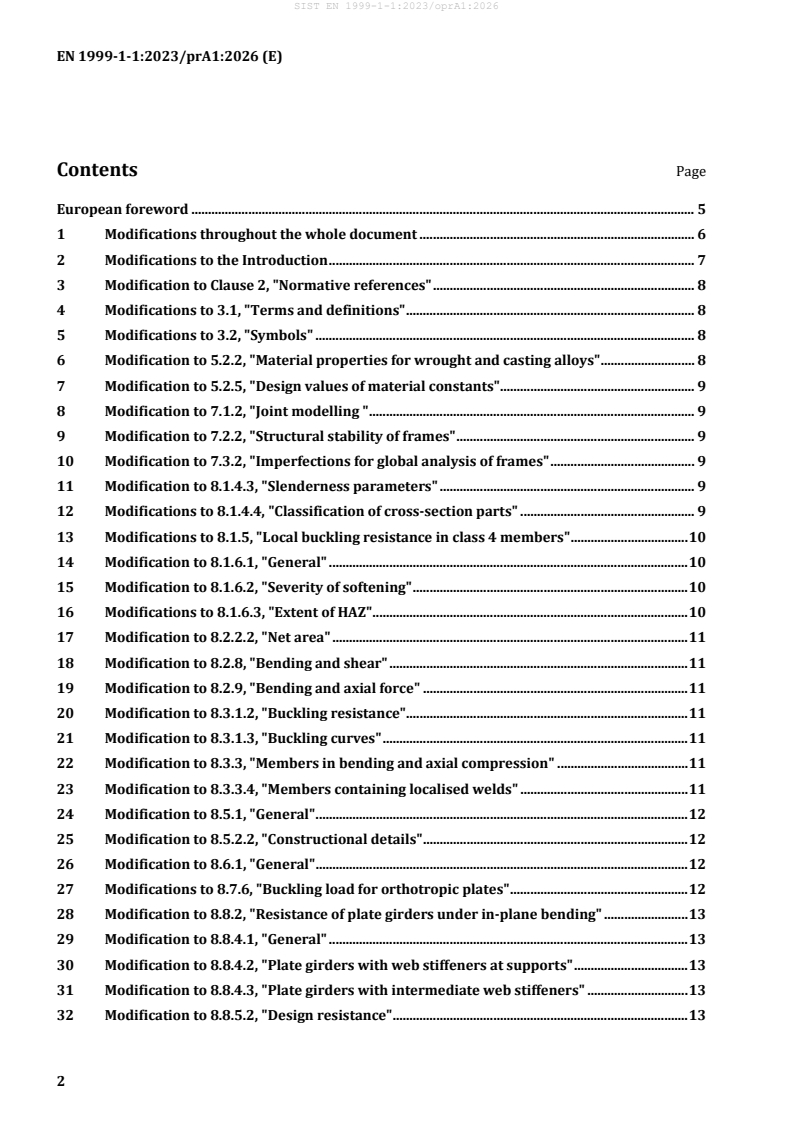
Contents Page
European foreword . 5
1 Modifications throughout the whole document . 6
2 Modifications to the Introduction . 7
3 Modification to Clause 2, "Normative references" . 8
4 Modifications to 3.1, "Terms and definitions" . 8
5 Modifications to 3.2, "Symbols" . 8
6 Modification to 5.2.2, "Material properties for wrought and casting alloys" . 8
7 Modification to 5.2.5, "Design values of material constants" . 9
8 Modification to 7.1.2, "Joint modelling " . 9
9 Modification to 7.2.2, "Structural stability of frames" . 9
10 Modification to 7.3.2, "Imperfections for global analysis of frames" . 9
11 Modification to 8.1.4.3, "Slenderness parameters" . 9
12 Modifications to 8.1.4.4, "Classification of cross-section parts" . 9
13 Modifications to 8.1.5, "Local buckling resistance in class 4 members" . 10
14 Modification to 8.1.6.1, "General" . 10
15 Modification to 8.1.6.2, "Severity of softening" . 10
16 Modifications to 8.1.6.3, "Extent of HAZ" . 10
17 Modification to 8.2.2.2, "Net area" . 11
18 Modification to 8.2.8, "Bending and shear" . 11
19 Modification to 8.2.9, "Bending and axial force" . 11
20 Modification to 8.3.1.2, "Buckling resistance" . 11
21 Modification to 8.3.1.3, "Buckling curves" . 11
22 Modification to 8.3.3, "Members in bending and axial compression" . 11
23 Modification to 8.3.3.4, "Members containing localised welds" . 11
24 Modification to 8.5.1, "General" . 12
25 Modification to 8.5.2.2, "Constructional details" . 12
26 Modification to 8.6.1, "General" . 12
27 Modifications to 8.7.6, "Buckling load for orthotropic plates" . 12
28 Modification to 8.8.2, "Resistance of plate girders under in-plane bending" . 13
29 Modification to 8.8.4.1, "General" . 13
30 Modification to 8.8.4.2, "Plate girders with web stiffeners at supports" . 13
31 Modification to 8.8.4.3, "Plate girders with intermediate web stiffeners" . 13
32 Modification to 8.8.5.2, "Design resistance" . 13
EN 1999-1-1:2023/prA1:2026 (E)
33 Modification to 8.8.5.5, "Effective loaded length" . 13
34 Modification to 8.8.8.1, "Rigid end post" . 13
35 Modification to 8.8.8.5, "Welds" . 13
36 Modifications to 8.9.3, "Shear force resistance" . 13
37 Modification to 10.5.3.1, "Shear connections" . 14
38 Modifications to 10.5.3.2, "Tension connections" . 14
39 Modification to 10.5.8.1, "General" . 14
40 Modifications to 10.5.10, "Single lap joints of flats with only one row of fasteners" . 14
41 Modification to 10.5.12.1, "General" . 14
42 Modification to 10.6.2.2, "Characteristic strength of weld metal" . 14
43 Modification to 10.6.2.5.3, "Design resistance of HAZ for fillet welds" . 14
44 Modification to 10.6.2.7, "Bending about the weld seam axis for single-sided fillet welds
and butt welds" . 14
45 Modification to 10.9.2, "Bolt-channel joints" . 14
46 Modifications to 10.10.3.1, "General" . 14
47 Modification to B.4, "Modelling". 15
48 Modifications to B.6, "Use of imperfections" . 15
49 Modifications to B.9, "Limit state criteria" . 15
50 Modification to B.10, "Partial factors" . 15
51 Modification to C.3, "General" . 15
52 Modification to D.5.4.3, "Contact with timber" . 15
53 Modification to D.5.4.5, "Immersion in water" . 15
54 Modifications to F.3.2.2, "Bi-linear model" . 15
55 Modifications to F.3.2.3, "Tri-linear model". 16
56 Modifications to F.3.3.3, "Continuous models in the form ε = ε (σ)" . 17
57 Modification to F.4, "Approximate evaluation of ε " . 17
uni,max
58 Modifications to G.10.1, "Plastic section modulus" . 18
59 Modifications to H.5, "Boundary values for the ultimate axial load" . 18
60 Modifications to I.3.4, "Cantilevers with uniform cross-sections symmetrical about the
minor axis" . 18
61 Modifications to K.3, "Determination of ultimate bending moment M " . 19
u
62 Modification to O.2, "Scope and field of application". 19
63 Modification to O.3, "Tensile resistance" . 19
64 Modifications to R.4, "Design" . 19
65 Modification to S.2, "Scope and field of application" . 19
66 Modification to S.4.1.1, "Robustness" . 19
67 Modifications to S.4.1.2, "Design service life". 20
EN 1999-1-1:2023/prA1:2026 (E)
68 Modification to S.6, "Durability" . 20
69 Modifications to S.7.2, "Imperfections" . 20
70 Modification to S.8.3, "Buckling resistance of members" . 20
71 Modifications to S.9.2.2, "Road bridges" . 20
72 Modifications to S.9.2.3, "Foot bridges" . 20
73 Modifications to S.10.2, "Fatigue loading" . 20
74 Modifications to S.11.2.2, "Effects of global and local actions on decks" . 21
75 Modifications to S.11.2.3, "Surface finishing" . 22
76 Modification to S.11.2.4, "Replacement of existing decks with aluminium decks" . 22
77 Modifications to S.11.2.6, "Composite deck structures" . 23
78 Modifications to S.11.3.1, "Configurations of aluminium deep girders" . 23
79 Modification to S.11.3.2, "Detailing" . 23
80 Modifications to T.4.2, "Connection classification according to axial stiffness" . 23
81 Modifications to T.4.3, "Connection classification according to axial strength" . 23
82 Modifications to T.4.4, "Connections with bolts in shear" . 23
83 Modification to T.4.5, "Design of connections assisted by testing" . 24
84 Modifications to T.5.1, "Stability checks" . 24
85 Modifications to T.5.2, "Buckling length of members connected by gusset plates" . 24
86 Modifications to T.5.4, "Modelling of gusset plate connections subjected to axial force and
bending" . 24
87 Modification to U.1, "Use of this Annex" . 25
88 Modification to U.2, "Scope and field of application" . 25
89 Modifications to U.3, "General and main problems" . 25
90 Modification to U.4, "Calculation of Internal Forces" . 25
91 Modifications to U.4.1.1, "General" . 25
92 Modifications to U.4.1.2, "Effective width (“shear lag”)" . 25
93 Modifications to U.4.2.1, "Creep, shrinkage and cracking of concrete". 26
94 Modifications to U.4.3, "Elastic analysis with redistribution" . 26
95 Modification to U.5.1, "General" . 26
96 Modifications to U.5.2.1, "Plastic resisting moment of a composite cross section" . 26
97 Modifications to U.5.2.2, "Bending resistance of composite section from nonlinear theory"
............................................................................................................................................................................. 27
98 Modifications to U.6.1, "General rules" . 28
99 Modifications to U.6.2, "Traditional connectors" . 28
100 Deletion of U.6.3, "Innovative connectors" . 28
101 Modification to Bibliography . 28
EN 1999-1-1:2023/prA1:2026 (E)
European foreword
This document (EN 1999-1-1:2023/prA1:2026) has been prepared by Technical Committee CEN/TC 250
“Structural Eurocodes”, the secretariat of which is held by BSI. CEN/TC 250 is responsible for all
Structural Eurocodes and has been assigned responsibility for structural and geotechnical design matters
by CEN.
This document is currently submitted to the CEN Enquiry.
This document will amend EN 1999-1-1:2023.
NOTE Some modifications are purely editorial corrections to improve the quality of the document and these
will not be tagged in the consolidated publication, as noted after the modification.
The first generation of EN Eurocodes was published between 2002 and 2007. This document forms part
of the second generation of the Eurocodes, which have been prepared under Mandate M/515 issued to
CEN by the European Commission and the European Free Trade Association.
The Eurocodes have been drafted to be used in conjunction with relevant execution, material, product
and test standards, and to identify requirements for execution, materials, products and testing that are
relied upon by the Eurocodes.
The Eurocodes recognize the responsibility of each Member State and have safeguarded their right to
determine values related to regulatory safety matters at national level through the use of National
Annexes.
EN 1999-1-1:2023/prA1:2026 (E)
1 Modifications throughout the whole document
Replace references to EN 1990 with EN 1990-1.
Replace references to EN 1990:2023 with EN 1990-1:2023+A1:2026.
Replace references to EN 1999-1-3:2023 with EN 1999-1-3:2023+A1:2026.
Replace references to EN 1999-1-4:2023 with EN 1999-1-4:2023+A1:2026.
Replace “component” with “member” in the following clauses:
Clause/ Paragraph/ Number of Note
Subclause Figure/ Table occurrences
1.1 (1) 2
3.1.9 1
4.1.2 (2) 1
5.2.1 (1) 3 One of the occurrences is in NOTE 3
5.2.1 Table 5.2 1 The occurrence is in the title of Table 5.2
5.2.3.2 Table 5.8 1 The occurrence is in footnote a
6 (3) 1
8.1.1 (1) 1
10.5.1 (11) 2
10.9.2 (1) 1 The occurrence is in the NOTE
A.3.2 (1) 5 Three of the occurrences are in the NOTE
A.3.2 (2) 1 The occurrence is in the NOTE
A.4 (2) 2
A.4 (3) 5 All five occurrences are in NOTE 2
A.4 (4) 3 One of the occurrences is in the NOTE
A.4 (5) 2
A.5 (1) 2 One of the occurrences is in NOTE 1
B.3 (1) 1
B.6 (4) 1
C.4.1.2 (1) 1
C.4.1.3 (2) 1
C.4.2.3 (1) 1
D.5.3 (2) 2
D.5.4.8 Table D.3 2 Both occurrences are in footnote e
E.3.1 (1) 1
E.3.1 (4) 1
EN 1999-1-1:2023/prA1:2026 (E)
Clause/ Paragraph/ Number of Note
Subclause Figure/ Table occurrences
N.2 (3) 1 “component” appears two times in this
paragraph. Replace only the second
occurrence.
P.5.1 (1) 1
Q.3 (1) 1
Q.3 (2) 3
R.2 (1) 1
R.4 (9) 1
S.5.1 1 The occurrence is in title of S.5.1
S.11.2.1 (2) 1
S.11.2.2 (2) 1 The occurrence is in NOTE 1
T.4.3 (6) 1
T.4.4 (4) 1
V.2 (1) 2 Both occurrences are in NOTE 2b
2 Modifications to the Introduction
In 0.1, replace the list with the following:
“
— EN 1990 Eurocode — Basis of structural and geotechnical design
— EN 1991 Eurocode 1 — Actions on structures
— EN 1992 Eurocode 2 — Design of concrete structures
— EN 1993 Eurocode 3 — Design of steel structures
— EN 1994 Eurocode 4 — Design of composite steel and concrete structures
— EN 1995 Eurocode 5 — Design of timber structures
— EN 1996 Eurocode 6 — Design of masonry structures
— EN 1997 Eurocode 7 — Geotechnical design
— EN 1998 Eurocode 8 — Design of structures for earthquake resistance
— EN 1999 Eurocode 9 — Design of aluminium structures
— EN 19100 Eurocode 10 — Design of structural glass
— New parts are under development, e.g. Eurocode for design of fibre-polymer composite structures
and design of tensioned membrane structures”.
EN 1999-1-1:2023/prA1:2026 (E)
In 0.2, replace the fourth paragraph with the following:
“For the design of new structures, EN 1999 (all parts) is intended to be used, for direct application,
together with EN 1990-1 and the other Eurocodes.”.
3 Modification to Clause 2, "Normative references"
Replace “EN 1990, Eurocode — Basis of structural and geotechnical design”
with
“EN 1990-1, Eurocode — Basis of structural and geotechnical design — Part 1: New structures”.
4 Modifications to 3.1, "Terms and definitions"
In the definition for term 3.1.4, add “and stiffness” after “structural” and delete Notes 1 and 2 to entry.
In the definition for term 3.1.5, delete Notes 1 and 2 to entry.
5 Modifications to 3.2, "Symbols"
Replace the definition of “F ” with the following:
vp,Rd
“design value of shear resistance of the screw for loads within -120° ≤ θ ≤ -60° (opposite the opening of
the groove)”.
Delete “L” and definition.
Delete “h” and definition.
Delete “u-u” and definition.
Delete “v-v” and definition.
Replace “β , β , β ” with “β , β ”.
1 2 3 2 3
Delete “δ ” and definition.
q
Replace “λ ” with “λ ”.
c1, c,l
Add “, correction factor” after “slip factor, efficiency factor” in the definition of “μ”.
Replace “ρ ” with “ρ ”.
c,1 c,l
Delete “σ ” and definition.
cr
Delete “σ ” and definition.
cr0
6 Modification to 5.2.2, "Material properties for wrought and casting alloys"
Replace “should” with “shall” in footnote c in Table 5.4.
EN 1999-1-1:2023/prA1:2026 (E)
7 Modification to 5.2.5, "Design values of material constants"
Replace “α” with “α ” in the fourth bullet point in (1).
T
8 Modification to 7.1.2, "Joint modelling "
Replace the second and third bullet points in (2) with the following:
“
— For semi-continuous joint model, the structural and stiffness properties of the joint components
need explicit consideration for its modelling in the global analysis;
— For continuous joint model, only the structural properties of the members need to be considered in
the global analysis.”.
9 Modification to 7.2.2, "Structural stability of frames"
Replace “lateral” with “torsional” in the second to last sentence in (6).
10 Modification to 7.3.2, "Imperfections for global analysis of frames"
λ
Replace “Note 2” with “Note 4” in the definition of “ ” in the key to Formula (7.7).
m
11 Modification to 8.1.4.3, "Slenderness parameters"
Add “stiffeners” at the end of the definition of “a” in the key to Figure 8.4.
12 Modifications to 8.1.4.4, "Classification of cross-section parts"
Add the following after (1) and renumber the following paragraph:
“(2) In Table 8.1 and Table 8.2, a cross-section part should be considered with welds if it contains
longitudinal welding at an edge or at any point within its width. Cross-s
...