

SIST EN 1992-2:2005
(Main)Eurocode 2 - Design of concrete structures - Part 2:Concrete bridges - Design and detailing rules
- Abstract
Complementary to Part 1. Varied general rules and additional detailed rules for the structural design of road, rail and footbridges using reinforced and/or prestressed concrete.
- Status
- Published
- Publication Date
- 30-Nov-2005
- Technical Committee
- KON - Structures
- Current Stage
- 6060 - National Implementation/Publication (Adopted Project)
- Start Date
- 01-Dec-2005
- Due Date
- 01-Dec-2005
- Completion Date
- 01-Dec-2005

SIST EN 1992-2:2005 is the Slovenian adoption of EN 1992-2:2005 from CEN. It gives the Eurocode 2 rules for designing and detailing road, rail and footbridges in plain, reinforced and prestressed concrete, and it is written for designers, constructors, clients, quality managers and authorities.
What does SIST EN 1992-2:2005 specify?
SIST EN 1992-2:2005 specifies bridge-specific design and detailing rules that complement EN 1992-1-1. It applies to bridges and parts of bridges made with normal and lightweight aggregates, and it organizes the subject from general design through execution stages.
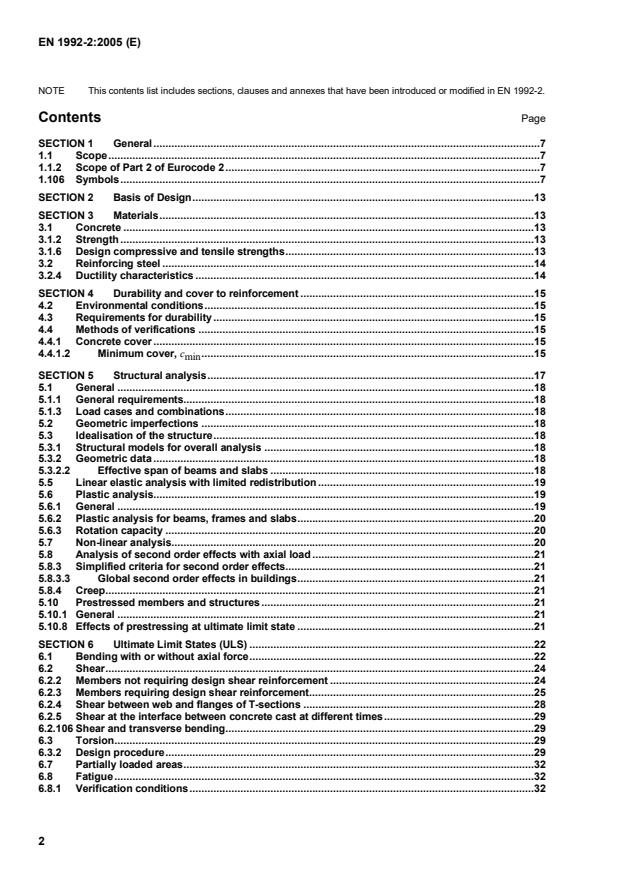
The document is structured into Sections 1 to 12 and Section 113, followed by Annexes A to QQ. In practice, that means it covers the whole bridge design chain: basis of design, materials, durability, analysis, ultimate and serviceability limit states, detailing, precast work, lightweight aggregate concrete, plain and lightly reinforced concrete, and execution-stage design.
| Annex | What it covers |
|---|---|
| A | Modification of partial factors for materials |
| B | Creep and shrinkage strain |
| C | Properties of reinforcement suitable for use with this Eurocode |
| D | Prestressing steel relaxation losses |
| E | Indicative strength classes for durability |
| F | Tension reinforcement in in-plane stress conditions |
| G | Soil structure interaction |
| H | Global second order effects |
| I | Flat slabs and shear walls |
| J | Detailing rules for particular situations |
| KK | Structural effects of time dependent behaviour of concrete |
| LL | Concrete shell elements |
| MM | Shear and transverse bending |
| NN | Damage equivalent stresses for fatigue verification |
| OO | Typical bridge discontinuity regions |
| PP | Safety format for non-linear analysis |
| Control of shear cracks within webs |
What are the key requirements of SIST EN 1992-2:2005?
Design basis, actions and national choices
SIST EN 1992-2:2005 is based on the limit state concept with partial factors, and it treats EN 1992-1-1 as the general base document for bridges. Clause 5.1.3 requires critical load cases and combinations to be checked so that the worst design condition is found in every relevant part of the structure.
A large number of clauses are left to National Annex choice. For a bridge project, that matters because the country-specific values control concrete classes, material factors, cover rules, redistribution limits, crack control limits and several detailing values.
Materials, durability and cover
SIST EN 1992-2:2005 sets bridge-oriented rules for concrete strength, reinforcing steel ductility and design strengths. Clause 3.1.6 defines the design compressive and tensile strengths, while 3.2.4 requires reinforcement ductility suited to bridge use.
Durability is treated as a bridge exposure issue, not just a material issue. Clause 4.2 requires the designer to consider water penetration, leakage from the carriageway, de-icing salts, waterproofing and abrasion, and Clause 4.4.1.2 adds special cover rules for interfaces with existing concrete and for bare road bridge decks.
Structural analysis and ULS
Clause 5 allows recognised time-dependent analysis methods for bridges, and Annex KK expands the treatment of creep, shrinkage and redistribution. Clause 5.2 gives bridge-specific imperfection rules, including an inclination model for members in compression, which matters because bridge geometry and execution tolerances influence stability.
At ULS, the standard covers bending, shear, torsion, partially loaded areas, fatigue and membrane elements. The shear rules in 6.2 distinguish members with and without design shear reinforcement, and Clauses 6.2.4 to 6.2.106 address web-to-flange shear, joints cast at different times, and shear-transverse bending interaction.
SLS, detailing and execution
For serviceability, Clause 7 covers stress limits, crack control and deflection control. Crack width limits depend on exposure class, and Clause 7.3.2 requires minimum reinforcement in tensile zones, including special treatment of flanged sections and shrinkage reinforcement.
Detailing clauses cover bundled bars, prestressing tendons, anchorage zones, couplers, beams, columns, deep beams, pile caps and lightweight aggregate concrete. Section 113 then requires the design to take construction stages into account whenever erection sequence, staged loading or rheological redistribution can affect stability, forces or geometry.
What terms does SIST EN 1992-2:2005 define?
- ULS means ultimate limit state, the safety check against collapse or loss of resistance.
- SLS means serviceability limit state, the check for stress, cracking, deformation and usability.
- LWAC means lightweight aggregate concrete, which has its own detailing rule for bar size and bundling.
- HSC means high strength concrete, for which Annex B gives a separate creep and shrinkage model.
- SFC means silica-fume concrete, which Annex B treats separately in delayed strain calculations.
- fcd is the design value of concrete compressive strength, used in resistance checks.
- fctd is the design value of concrete tensile strength, used for cracking and reinforcement checks.
Who uses SIST EN 1992-2:2005?
SIST EN 1992-2:2005 is used by bridge designers, structural engineers, contractors, checking engineers, clients and relevant authorities. It is also used by committees writing related structural, product, testing and execution standards. In practice, they use it to size bridge members, choose reinforcement and prestressing, check durability, define execution stages and set national parameters.
What changed in SIST EN 1992-2:2005 from the previous edition?
SIST EN 1992-2:2005 supersedes ENV 1992-2:1996. The foreword states that it is the European Standard version of Eurocode 2, with bridge-specific clauses added or modified relative to EN 1992-1-1.
Which standards are used with SIST EN 1992-2:2005?
- EN 1992-1-1 - provides the general Eurocode 2 rules that apply unless EN 1992-2 changes them.
- EN 1990 - provides the basis for load combinations, including Annex A2.
- EN 1991-2 - provides traffic actions and the dynamic factor referenced in the symbols.
- EN 1991-1-6 - provides actions during execution.
- EN 13670 - provides execution-related deviation classes referenced for geometric imperfections.
- EN 1997 - is named as a companion Eurocode for new structures.
- EN 1998 - is named as a companion Eurocode for new structures.
What does the SIST EN 1992-2:2005 document contain?
The document contains symbols, bridge-specific clauses and numerous formulas for design values, resistance checks and serviceability checks. It includes methods for shear, torsion, fatigue, prestressed members, crack control, and time-dependent effects such as creep and shrinkage.
It also contains annex methods for special cases, including membrane elements, shell elements, soil-structure interaction, non-linear analysis safety format, and typical bridge discontinuity regions. Several figures and equations support detailing and verification, such as crack control, shear models, anchorage zones and execution-stage effects.
Relations
- Effective Date
- 01-Dec-2005
- Effective Date
- 30-Mar-2028
- Referred By
SIST EN 1998-2:2006 - Eurocode 8 - Design of structures for earthquake resistance - Part 2: Bridges - Effective Date
- 28-Jan-2026
- Effective Date
- 28-Jan-2026
- Effective Date
- 28-Jan-2026
- Effective Date
- 01-Nov-2008
Get Certified
Connect with accredited certification bodies for this standard

DIBt (Deutsches Institut für Bautechnik)
German Institute for Building Technology.
DIN CERTCO
DIN Group product certification.
Zavod za gradbeništvo Slovenije (ZAG) - Inšpekcija
ZAG inspection body for construction products, structures, and materials.
Sponsored listings
Frequently Asked Questions
SIST EN 1992-2:2005 is a standard published by the Slovenian Institute for Standardization (SIST). Its full title is "Eurocode 2 - Design of concrete structures - Part 2:Concrete bridges - Design and detailing rules". This standard covers: Complementary to Part 1. Varied general rules and additional detailed rules for the structural design of road, rail and footbridges using reinforced and/or prestressed concrete.
Complementary to Part 1. Varied general rules and additional detailed rules for the structural design of road, rail and footbridges using reinforced and/or prestressed concrete.
SIST EN 1992-2:2005 is classified under the following ICS (International Classification for Standards) categories: 91.010.30 - Technical aspects; 91.080.40 - Concrete structures; 93.040 - Bridge construction. The ICS classification helps identify the subject area and facilitates finding related standards.
SIST EN 1992-2:2005 has the following relationships with other standards: It is inter standard links to SIST ENV 1992-2:2004, kSIST FprEN 1992-1-1:2023, SIST EN 1998-2:2006, SIST EN 16432-2:2017, SIST EN 15050:2007+A1:2012, SIST EN 1992-2:2005/AC:2008. Understanding these relationships helps ensure you are using the most current and applicable version of the standard.
SIST EN 1992-2:2005 is associated with the following European legislation: EU Directives/Regulations: 2005-01-4408, 305/2011, 89/106/EEC; Standardization Mandates: M/265, M/BC/CEN/89/11. When a standard is cited in the Official Journal of the European Union, products manufactured in conformity with it benefit from a presumption of conformity with the essential requirements of the corresponding EU directive or regulation.
SIST EN 1992-2:2005 is available in PDF format for immediate download after purchase. The document can be added to your cart and obtained through the secure checkout process. Digital delivery ensures instant access to the complete standard document.
Standards Content (Sample)
2003-01.Slovenski inštitut za standardizacijo. Razmnoževanje celote ali delov tega standarda ni dovoljeno.Eurocode 2 - Design of concrete structures - Concrete bridges - Design and detailing rulesEvrokod 2: Projektiranje betonskih konstrukcij – 2. del: Betonski mostovi – Projektiranje in pravila za konstruiranjeEurocode 2 - Calcul des structures en béton - Partie 2: Ponts en béton - Calcul et dispositions constructivesEurocode 2: Bemessung und Konstruktion von Stahlbeton- und Spannbetontragwerken - Teil 2: Betonbrücken - Bemessungs- und KonstruktionsregelnTa slovenski standard je istoveten z:EN 1992-2:2005SIST EN 1992-2:2005en93.040Gradnja mostovBridge construction91.080.40Betonske konstrukcijeConcrete structures91.010.30Technical aspectsICS:SIST ENV 1992-2:20041DGRPHãþDSLOVENSKI
STANDARDSIST EN 1992-2:200501-december-2005
EUROPEAN STANDARDNORME EUROPÉENNEEUROPÄISCHE NORMEN 1992-2October 2005ICS 93.040; 91.010.30; 91.080.40Supersedes ENV 1992-2:1996
English VersionEurocode 2 - Design of concrete structures - Concrete bridges -Design and detailing rulesEurocode 2 - Calcul des structures en béton - Partie 2:Ponts en béton - Calcul et dispositions constructivesEurocode 2 - Planung von Stahlbeton- undSpannbetontragwerken - Teil 2: Betonbrücken - Planungs-und AusführungsregelnThis European Standard was approved by CEN on 25 April 2005.CEN members are bound to comply with the CEN/CENELEC Internal Regulations which stipulate the conditions for giving this EuropeanStandard the status of a national standard without any alteration. Up-to-date lists and bibliographical references concerning such nationalstandards may be obtained on application to the Central Secretariat or to any CEN member.This European Standard exists in three official versions (English, French, German). A version in any other language made by translationunder the responsibility of a CEN member into its own language and notified to the Central Secretariat has the same status as the officialversions.CEN members are the national standards bodies of Austria, Belgium, Cyprus, Czech Republic, Denmark, Estonia, Finland, France,Germany, Greece, Hungary, Iceland, Ireland, Italy, Latvia, Lithuania, Luxembourg, Malta, Netherlands, Norway, Poland, Portugal, Slovakia,Slovenia, Spain, Sweden, Switzerland and United Kingdom.EUROPEAN COMMITTEE FOR STANDARDIZATIONCOMITÉ EUROPÉEN DE NORMALISATIONEUROPÄISCHES KOMITEE FÜR NORMUNGManagement Centre: rue de Stassart, 36
B-1050 Brussels© 2005 CENAll rights of exploitation in any form and by any means reservedworldwide for CEN national Members.Ref. No. EN 1992-2:2005: E
Modification of partial factors for materials.49ANNEX B (informative)
Creep and shrinkage strain.49ANNEX C (normative)
Properties of reinforcement suitable for use with this Eurocode.55ANNEX D (informative)
Detailed calculation method for prestressing steel relaxation losses.55Annex E (informative)
Indicative strength classes for durability.55Annex F (Informative)
Tension reinforcement expressions for in-plane stress conditions.56Annex G (informative)
Soil structure interaction.58Annex H (informative)
Global second order effects in structures.58Annex I (informative)
Analysis of flat slabs and shear walls.59
Detailing rules for particular situations.60Annex KK (informative)
Structural effects of time dependent behaviour of concrete.63Annex LL (informative)
Concrete shell elements.68Annex MM (informative)
Shear and transverse bending.75Annex NN (informative)
Damage equivalent stresses for fatigue verification.77ANNEX OO (informative)
Typical bridge discontinuity regions.86Annex PP (informative)
Safety format for non linear analysis.92Annex QQ (informative)
Control of shear cracks within webs.95
Part 2 of Eurocode 2 gives a basis for the design of bridges and parts of bridges in plain, reinforcedand prestressed concrete made with normal and light weight aggregates.(102)P
The following subjects are dealt with in Part 2.Section 1:GeneralSection 2:Basis of designSection 3:MaterialsSection 4:Durability and cover to reinforcementSection 5:Structural analysisSection 6:Ultimate limit statesSection 7:Serviceability limit statesSection 8:Detailing of reinforcement and prestressing tendons — GeneralSection 9:Detailing of members and particular rulesSection 10:Additional rules for precast concrete elements and structuresSection 11:Lightweight aggregate concrete structuresSection 12:Plain and lightly reinforced concrete structuresSection 113:Design for the execution stages1.106SymbolsFor the purpose of this standard, the following symbols apply.NOTEThe notation used is based on ISO 3898:1987. Symbols with unique meanings have been used as far aspossible. However, in some instances a symbol may have more than one meaning depending on the context.Latin upper case lettersAAccidental actionACross sectional areaAcCross sectional area of concreteActArea of concrete in tensile zoneApArea of a prestressing tendon or tendonsAsCross sectional area of reinforcementAs,minminimum cross sectional area of reinforcement
The strength classes (C) in this code are denoted by the characteristic cylinder strength fckdetermined at 28 days with a minimum value of Cmin and a maximum value of Cmax.NOTEThe values of Cmin and Cmax for use in a Country may be found in its National Annex. The recommendedvalues are C30/37 and C70/85 respectively.3.1.6Design compressive and tensile strengths(101)P
The value of the design compressive strength is defined asfcd = αcc fck/γC(3.15)
The value of the design tensile strength, fctd, is defined as:fctd = αct fctk,0,05/γCwhere:γCis the partial safety factor for concrete, see 2.4.2.4, andαctis a coefficient taking account of long term effects on the tensile strength and of unfavourable effects,resulting from the way the load is applied.NOTEThe value of αct for use in a Country should lie between 0,80 and 1,00 and may be found in its NationalAnnex. The recommended value of αct is 1,0.3.2 Reinforcing steel3.2.4Ductility characteristics(101)P
The reinforcement shall have adequate ductility as defined by the ratio of tensile strength to the yieldstress, (ft/fy)k and the elongation at maximum force, εuk.NOTEThe classes of reinforcement to be used in bridges in a Country may be found in its National Annex. Therecommended classes are Class B and Class C.
In considering the combinations of actions (see Section 6 and Annex A2 of EN 1990) the relevant loadcases shall be considered to enable the critical design conditions to be established at all sections, within thestructure or part of the structure considered.NOTESimplifications to the load arrangements for use in a Country may be found in its National Annex.Recommendations on simplifications are not given in this standard.5.2 Geometric imperfections(104)The provisions of (105) and (106) of this Part and (7) of EN 1992-1-1 apply to members with axialcompression and structures with vertical load. Numerical values are related to normal execution deviations(Class 1 in EN 13670). Where other execution deviations apply numerical values should be adjustedaccordingly.(105)Imperfections may be represented by an inclination, θl, given byθl = θ0 αh(5.101)whereθ0is the basic valueαhis the reduction factor for length or height:αh = l2; αh ≤ 1lis the length or height [m]NOTEThe value of θ0 to use in a Country may be found in its National Annex. The recommended value is 1/200.(106)For arch bridges, the shape of imperfections in the horizontal and vertical planes should be based onthe shape of the first horizontal and vertical buckling mode shape respectively. Each mode shape may beidealised by a sinusoidal profile. The amplitude should be taken as 2llθ=a, where l is the half wavelength.(8) and (9) of EN 1992-1-1 do not apply.5.3 Idealisation of the structure5.3.1 Structural models for overall analysis(2) and (6) of EN 1992-1-1 do not apply5.3.2 Geometric data5.3.2.2Effective span of beams and slabsNOTE(1), (2) and (3) of EN 1992-1-1 apply despite the fact that the title of the clause refers to buildings.
Methods based on plastic analysis should only be used for the check at ULS and only when permittedby National Authorities.
...