

SIST EN 15895:2025
(Main)Powder actuated hand-held fixing and hard marking tools - Safety requirements
General Information
- Abstract
This document covers safety requirements for powder actuated fixing and hard marking tools which operate with an intermediate member (piston) and are handled manually.
This document deals with all significant hazards (see Annex I), hazardous situations and events relevant to powder actuated fixing and hard marking tools, when they are used as intended and under conditions of misuse which are reasonably foreseeable (see Clause 4). It deals with the significant hazards in the different operating modes and intervention procedures as referred to in EN ISO 12100:2010, 5.4, 5.5, 5.6.
Although the safe use of powder actuated tools depends to an important extent on the use of appropriate cartridges and fasteners, this document is not formulating requirements for the cartridges and fasteners to be used with the tools (see Clause 6).
This document applies to tools designed for use with cartridges with casings made of metal or plastic and with solid propellant and containing a minor quantity of primer mix with a composition different from that of the main propellant.
This document applies to tools designed for use with single cartridges or with cartridges collated in disks or in strips.
The fixing tools in the scope are those intended for use with fasteners made from metal.
NOTE Information about cartridges can be found either in EN 16264:2014 or the publication of the Permanent International Commission for the Proof of Small Arms (C.I.P.).
This document is not applicable to powder actuated fixing and hard marking tools which are manufactured before this document’s date of publication.
- Status
- Published
- Public Enquiry End Date
- 24-Oct-2023
- Publication Date
- 23-Jul-2025
- Technical Committee
- I13 - Imaginarni 13
- Current Stage
- 6060 - National Implementation/Publication (Adopted Project)
- Start Date
- 23-Jul-2025
- Due Date
- 27-Sep-2025
- Completion Date
- 24-Jul-2025
- Directive
- 2006/42/EC - Directive 2006/42/EC of the European Parliament and of the Council of 17 May 2006 on machinery, and amending Directive 95/16/EC (recast)OJ Ref: L 2026/546, STANDARD TIPA C OJ Date: 13-Mar-2026

Overview
EN 15895:2025 is the CEN European standard that specifies safety requirements for powder actuated hand‑held fixing and hard‑marking tools that operate with an intermediate member (piston). It covers significant hazards, hazardous situations and events relevant to these tools during intended use and reasonably foreseeable misuse. The standard applies to tools designed for use with single cartridges or cartridges collated in disks or strips, and with cartridge casings of metal or plastic (solid propellant with a small primer mix). It supersedes EN 15895:2011+A1:2018 and aligns tool safety with updated design, testing and verification methods.
Key topics and technical requirements
- Scope and definitions: Clear terms and applicability for fixing and hard‑marking hand‑tools that use a piston.
- Design and construction: Enhanced safety‑related part requirements, pressure and temperature resistance, and compatibility with collated cartridges.
- Prevention of unintentional firing: Requirements and tests for operating safety, impact safety, drop safety and free‑firing safety.
- Internal ballistics and muzzle velocity: Limits and verification methods for piston and fastener velocities (fixing tools).
- Safe retention of the piston: Mechanical retention and verification tests to prevent piston ejection.
- Noise, recoil and exhaust: Requirements and test procedures to reduce noise emission, recoil (shock) and to control exhaust gas direction and hazardous emissions (e.g., CO, lead).
- Ergonomics and human factors: Handle design, trigger actuation and ergonomic guidance to reduce operator risk.
- Verification and testing: Detailed test methods (overpressure, drop, impact, velocity, noise, recoil) and system tests in normative annexes.
- Information for use and marking: Required user instructions, maintenance info, warnings and marking details; residual risk reporting.
- Annexes: Normative and informative annexes include test codes, safety dimensions, internal ballistics data and a list of significant hazards.
Practical applications
- Use EN 15895:2025 to design and manufacture safer powder‑actuated fixing and marking tools.
- Employ the verification and test procedures during product development, conformity assessment and quality control.
- Apply the ergonomic and information requirements to improve operator training, instructions and on‑site safety procedures.
- Reference the standard in procurement, risk assessments and compliance with EU machinery directives.
Who should use this standard
- Tool manufacturers and design engineers
- Safety and compliance engineers
- Test laboratories and conformity assessment bodies
- Health & safety authorities, trainers and site safety managers
- Purchasing/specification teams for construction and industrial operations
Related standards and guidance
- EN ISO 12100:2010 (risk assessment and machinery safety principles)
- EN 16264:2014 (cartridges for powder actuated tools) - compatibility guidance
- Directive 2006/42/EC (machinery directive) - see Annex ZA
- Publications of the Permanent International Commission for the Proof of Small Arms (C.I.P.) for cartridge information
Keywords: EN 15895:2025, powder actuated tools, safety requirements, hand‑held fixing, hard marking, cartridges, piston, CEN.
Relations
- Effective Date
- 18-Mar-2026
- Effective Date
- 09-Feb-2026
- Effective Date
- 09-Feb-2026
- Effective Date
- 28-Jan-2026
- Effective Date
- 28-Jan-2026
- Effective Date
- 28-Jan-2026
- Effective Date
- 28-Jan-2026
- Effective Date
- 28-Jan-2026
- Effective Date
- 28-Jan-2026
- Effective Date
- 28-Jan-2026
- Effective Date
- 28-Jan-2026
- Effective Date
- 28-Jan-2026
- Effective Date
- 18-Jan-2023
Get Certified
Connect with accredited certification bodies for this standard

DVS-ZERT GmbH
German welding certification society.
CARES (UK Certification Authority for Reinforcing Steels)
UK certification for reinforcing steels and construction.
EWF/IIW (European/International Welding Federation)
International welding personnel certification.
Sponsored listings
Frequently Asked Questions
SIST EN 15895:2025 is a standard published by the Slovenian Institute for Standardization (SIST). Its full title is "Powder actuated hand-held fixing and hard marking tools - Safety requirements". This standard covers: This document covers safety requirements for powder actuated fixing and hard marking tools which operate with an intermediate member (piston) and are handled manually. This document deals with all significant hazards (see Annex I), hazardous situations and events relevant to powder actuated fixing and hard marking tools, when they are used as intended and under conditions of misuse which are reasonably foreseeable (see Clause 4). It deals with the significant hazards in the different operating modes and intervention procedures as referred to in EN ISO 12100:2010, 5.4, 5.5, 5.6. Although the safe use of powder actuated tools depends to an important extent on the use of appropriate cartridges and fasteners, this document is not formulating requirements for the cartridges and fasteners to be used with the tools (see Clause 6). This document applies to tools designed for use with cartridges with casings made of metal or plastic and with solid propellant and containing a minor quantity of primer mix with a composition different from that of the main propellant. This document applies to tools designed for use with single cartridges or with cartridges collated in disks or in strips. The fixing tools in the scope are those intended for use with fasteners made from metal. NOTE Information about cartridges can be found either in EN 16264:2014 or the publication of the Permanent International Commission for the Proof of Small Arms (C.I.P.). This document is not applicable to powder actuated fixing and hard marking tools which are manufactured before this document’s date of publication.
This document covers safety requirements for powder actuated fixing and hard marking tools which operate with an intermediate member (piston) and are handled manually. This document deals with all significant hazards (see Annex I), hazardous situations and events relevant to powder actuated fixing and hard marking tools, when they are used as intended and under conditions of misuse which are reasonably foreseeable (see Clause 4). It deals with the significant hazards in the different operating modes and intervention procedures as referred to in EN ISO 12100:2010, 5.4, 5.5, 5.6. Although the safe use of powder actuated tools depends to an important extent on the use of appropriate cartridges and fasteners, this document is not formulating requirements for the cartridges and fasteners to be used with the tools (see Clause 6). This document applies to tools designed for use with cartridges with casings made of metal or plastic and with solid propellant and containing a minor quantity of primer mix with a composition different from that of the main propellant. This document applies to tools designed for use with single cartridges or with cartridges collated in disks or in strips. The fixing tools in the scope are those intended for use with fasteners made from metal. NOTE Information about cartridges can be found either in EN 16264:2014 or the publication of the Permanent International Commission for the Proof of Small Arms (C.I.P.). This document is not applicable to powder actuated fixing and hard marking tools which are manufactured before this document’s date of publication.
SIST EN 15895:2025 is classified under the following ICS (International Classification for Standards) categories: 25.140.99 - Other hand-held tools. The ICS classification helps identify the subject area and facilitates finding related standards.
SIST EN 15895:2025 has the following relationships with other standards: It is inter standard links to SIST ISO 2768-1:1999, SIST EN 61672-1:2014, SIST EN 61310-1:2008, SIST EN ISO 4871:2009, SIST EN ISO 13732-1:2008, SIST EN 12631:1999, SIST EN ISO 12100:2011, SIST EN ISO 11688-1:2009, SIST EN ISO 11201:2010, SIST EN 16264:2014, SIST EN 614-1:2006+A1:2009, SIST EN ISO 3744:2010, SIST EN 15895:2011+A1:2018. Understanding these relationships helps ensure you are using the most current and applicable version of the standard.
SIST EN 15895:2025 is associated with the following European legislation: EU Directives/Regulations: 2006/42/EC, EUR-PUB; Standardization Mandates: M/396. When a standard is cited in the Official Journal of the European Union, products manufactured in conformity with it benefit from a presumption of conformity with the essential requirements of the corresponding EU directive or regulation.
SIST EN 15895:2025 is available in PDF format for immediate download after purchase. The document can be added to your cart and obtained through the secure checkout process. Digital delivery ensures instant access to the complete standard document.
Standards Content (Sample)
SLOVENSKI STANDARD
01-september-2025
Ročna orodja za pritrjevanje in trdo označevanje s prašnim pogonom - Varnostne
zahteve
Powder actuated hand-held fixing and hard marking tools - Safety requirements
Pulverkraftbetriebene handgeführte Befestigungs- und Markierungswerkzeuge -
Sicherheitsanforderungen
Outils portatifs de scellement et de marquage actionnés par poudre - Prescriptions de
sécurité
Ta slovenski standard je istoveten z: EN 15895:2025
ICS:
25.140.99 Druga ročna orodja Other hand-held tools
2003-01.Slovenski inštitut za standardizacijo. Razmnoževanje celote ali delov tega standarda ni dovoljeno.
EN 15895
EUROPEAN STANDARD
NORME EUROPÉENNE
June 2025
EUROPÄISCHE NORM
ICS 25.140.99 Supersedes EN 15895:2011+A1:2018
English Version
Powder actuated hand-held fixing and hard marking tools -
Safety requirements
Outils portatifs de scellement et de marquage Pulverbetriebene handgeführte Befestigungs- und
actionnés par poudre - Exigences de sécurité Hartmarkierungswerkzeuge -
Sicherheitsanforderungen
This European Standard was approved by CEN on 4 May 2025.
CEN members are bound to comply with the CEN/CENELEC Internal Regulations which stipulate the conditions for giving this
European Standard the status of a national standard without any alteration. Up-to-date lists and bibliographical references
concerning such national standards may be obtained on application to the CEN-CENELEC Management Centre or to any CEN
member.
This European Standard exists in three official versions (English, French, German). A version in any other language made by
translation under the responsibility of a CEN member into its own language and notified to the CEN-CENELEC Management
Centre has the same status as the official versions.
CEN members are the national standards bodies of Austria, Belgium, Bulgaria, Croatia, Cyprus, Czech Republic, Denmark, Estonia,
Finland, France, Germany, Greece, Hungary, Iceland, Ireland, Italy, Latvia, Lithuania, Luxembourg, Malta, Netherlands, Norway,
Poland, Portugal, Republic of North Macedonia, Romania, Serbia, Slovakia, Slovenia, Spain, Sweden, Switzerland, Türkiye and
United Kingdom.
EUROPEAN COMMITTEE FOR STANDARDIZATION
COMITÉ EUROPÉEN DE NORMALISATION
EUROPÄISCHES KOMITEE FÜR NORMUNG
CEN-CENELEC Management Centre: Rue de la Science 23, B-1040 Brussels
© 2025 CEN All rights of exploitation in any form and by any means reserved Ref. No. EN 15895:2025 E
worldwide for CEN national Members.
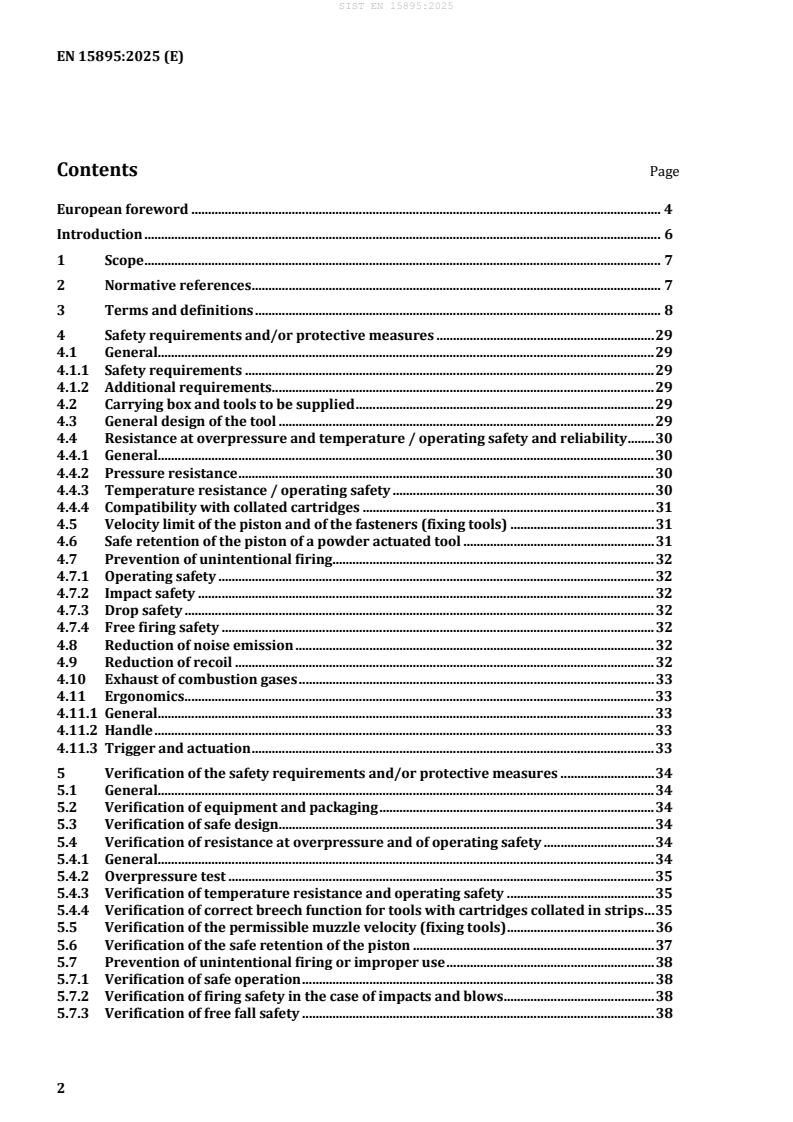
Contents Page
European foreword . 4
Introduction . 6
1 Scope . 7
2 Normative references . 7
3 Terms and definitions . 8
4 Safety requirements and/or protective measures . 29
4.1 General. 29
4.1.1 Safety requirements . 29
4.1.2 Additional requirements. 29
4.2 Carrying box and tools to be supplied . 29
4.3 General design of the tool . 29
4.4 Resistance at overpressure and temperature / operating safety and reliability . 30
4.4.1 General. 30
4.4.2 Pressure resistance . 30
4.4.3 Temperature resistance / operating safety . 30
4.4.4 Compatibility with collated cartridges . 31
4.5 Velocity limit of the piston and of the fasteners (fixing tools) . 31
4.6 Safe retention of the piston of a powder actuated tool . 31
4.7 Prevention of unintentional firing. 32
4.7.1 Operating safety . 32
4.7.2 Impact safety . 32
4.7.3 Drop safety . 32
4.7.4 Free firing safety . 32
4.8 Reduction of noise emission . 32
4.9 Reduction of recoil . 32
4.10 Exhaust of combustion gases . 33
4.11 Ergonomics . 33
4.11.1 General. 33
4.11.2 Handle . 33
4.11.3 Trigger and actuation . 33
5 Verification of the safety requirements and/or protective measures . 34
5.1 General. 34
5.2 Verification of equipment and packaging . 34
5.3 Verification of safe design. 34
5.4 Verification of resistance at overpressure and of operating safety . 34
5.4.1 General. 34
5.4.2 Overpressure test . 35
5.4.3 Verification of temperature resistance and operating safety . 35
5.4.4 Verification of correct breech function for tools with cartridges collated in strips . 35
5.5 Verification of the permissible muzzle velocity (fixing tools) . 36
5.6 Verification of the safe retention of the piston . 37
5.7 Prevention of unintentional firing or improper use . 38
5.7.1 Verification of safe operation . 38
5.7.2 Verification of firing safety in the case of impacts and blows . 38
5.7.3 Verification of free fall safety . 38
5.7.4 Verification of free firing safety . 39
5.8 Verification of the noise emission . 39
5.9 Verification of the recoil (shock) levels . 39
5.10 Verification of exhaust direction . 39
5.11 Verification of ergonomic design . 39
6 Information for use . 40
6.1 General . 40
6.2 Signals and warning device . 40
6.3 Accompanying documents . 40
6.3.1 General . 40
6.3.2 Information for the safe use . 41
6.3.3 Information for maintenance and servicing . 42
6.3.4 Information on noise emission . 42
6.3.5 Information on vibration . 43
6.4 Residual risks . 43
6.4.1 Emission of hazardous substances: Carbon monoxide . 43
6.4.2 Emission of hazardous substances: Lead . 43
6.5 Marking . 44
Annex A (normative) Values of combustion equation for the calculation of maximum gas
pressure p in the cartridge chamber according to 3.21 . 45
max
Annex B (informative) Volumes in cartridge and cartridge chamber relevant for the internal
ballistics of a powder actuated tool . 48
Annex C (informative) Example of testing procedures for determination of muzzle velocity
................................................................................................................................................................... 49
Annex D (normative) Testing for the verification of safe operation . 50
Annex E (normative) Noise test code . 52
Annex F (informative) Information on the ergonomic design of the handle . 62
Annex G (normative) Essential safety dimensions . 63
Annex H (normative) Testing for the verification of safe operation (system test) . 64
Annex I (informative) List of significant hazards . 65
Annex ZA (informative) Relationship between this European Standard and the essential
requirements of Directive 2006/42/EC aimed to be covered . 68
Bibliography . 70
European foreword
This document (EN 15895:2025) has been prepared by Technical Committee CEN/TC 213 “Powder
actuated hand-held tools - Safety”, the secretariat of which is held by SNV.
This European Standard shall be given the status of a national standard, either by publication of an
identical text or by endorsement, at the latest by December 2025, and conflicting national standards shall
be withdrawn at the latest by December 2025.
Attention is drawn to the possibility that some of the elements of this document may be the subject of
patent rights. CEN shall not be held responsible for identifying any or all such patent rights.
This document supersedes EN 15895:2011+A1:2018.
EN 15895:2011+A1:2018:
— applicability for single cartridge, collated cartridges in disks as well as collated cartridges in strips;
— enhanced design requirements for safety-related parts;
— improved compatibility with EN 16264:2014 to enable conformity assessments of new
tool/cartridge systems;
— updated requirements for drop tests;
— new and updated terms and definitions and enhanced drawings;
— new and updated standard references;
— updated informative Annex ZA.
This document has been prepared under a standardization request addressed to CEN by the European
Commission. The Standing Committee of the EFTA States subsequently approves these requests for its
Member States.
For the relationship with EU Legislation, see informative Annex ZA, which is an integral part of this
document.
This document has been drawn up in co-operation with representatives of manufacturers of cartridge-
operated hand-held tools and health and safety authorities (Schweizerische Unfallversicherung (SUVA)).
The “Permanent International Commission for the Proof of Small Arms, C.I.P.” has given substantial
contributions to this document. The C.I.P. regulations pertinent to powder actuated hand-held tools have
been largely integrated in this document.
Normative and informative annexes to this document are indicated in the contents list.
Any feedback and questions on this document should be directed to the users’ national standards body.
A complete listing of these bodies can be found on the CEN website.
According to the CEN-CENELEC Internal Regulations, the national standards organisations of the
following countries are bound to implement this European Standard: Austria, Belgium, Bulgaria, Croatia,
Cyprus, Czech Republic, Denmark, Estonia, Finland, France, Germany, Greece, Hungary, Iceland, Ireland,
Italy, Latvia, Lithuania, Luxembourg, Malta, Netherlands, Norway, Poland, Portugal, Republic of North
Macedonia, Romania, Serbia, Slovakia, Slovenia, Spain, Sweden, Switzerland, Türkiye and the United
Kingdom.
Introduction
This document specifies up-to-date requirements for powder actuated hand-held fixing and hard
marking tools. Requirements are mainly based on safety functions. This approach significantly increases
the design details of the safety aspects.
This document is a type C standard as stated in EN ISO 12100:2010.
The machinery concerned and the extent to which hazards, hazardous situations and hazardous events
are covered are indicated in the scope of this document. When provisions of this type C standard are
different from those which are stated in type A or B standards, the provisions of this type C standard take
precedence over the provisions of the other standards, for machines that have been designed and built
according to the provisions of this type C standard.
1 Scope
This document covers safety requirements for powder actuated fixing and hard marking tools which
operate with an intermediate member (piston) and are handled manually.
This document deals with all significant hazards (see Annex I), hazardous situations and events relevant
to powder actuated fixing and hard marking tools, when they are used as intended and under conditions
of misuse which are reasonably foreseeable (see Clause 4). It deals with the significant hazards in the
different operating modes and intervention procedures as referred to in EN ISO 12100:2010, 5.4, 5.5, 5.6.
Although the safe use of powder actuated tools depends to an important extent on the use of appropriate
cartridges and fasteners, this document is not formulating requirements for the cartridges and fasteners
to be used with the tools (see Clause 6).
This document applies to tools designed for use with cartridges with casings made of metal or plastic and
with solid propellant and containing a minor quantity of primer mix with a composition different from
that of the main propellant.
This document applies to tools designed for use with single cartridges or with cartridges collated in disks
or in strips.
The fixing tools in the scope are those intended for use with fasteners made from metal.
NOTE Information about cartridges can be found either in EN 16264:2014 or the publication of the Permanent
International Commission for the Proof of Small Arms (C.I.P.).
This document is not applicable to powder actuated fixing and hard marking tools which are
manufactured before this document’s date of publication.
2 Normative references
The following documents are referred to in the text in such a way that some or all of their content
constitutes requirements of this document. For dated references, only the edition cited applies. For
undated references, the latest edition of the referenced document (including any amendments) applies.
EN 614-1:2006+A1:2009, Safety of machinery — Ergonomic design principles — Part 1: Terminology and
general principles
EN 16264:2014, Pyrotechnic articles — Other pyrotechnic articles — Cartridges for powder actuated tools
EN 61310-1:2008, Safety of machinery — Indication, marking and actuation — Part 1: Requirements for
visual, acoustic and tactile signals (IEC 61310-1:2007)
EN 61672-1:2013, Electroacoustics — Sound level meters - Part 1: Specifications (IEC 61672-1:2013)
EN ISO 3744:2010, Acoustics — Determination of sound power levels and sound energy levels of noise
sources using sound pressure — Engineering methods for an essentially free field over a reflecting plane
(ISO 3744:2010)
EN ISO 4871:2009, Acoustics — Declaration and verification of noise emission values of machinery and
equipment (ISO 4871:1996)
EN ISO 11201:2010, Acoustics — Noise emitted by machinery and equipment — Determination of emission
sound pressure levels at a work station and at other specified positions in an essentially free field over a
reflecting plane with negligible environmental corrections (ISO 11201:2010)
EN ISO 11688-1:2009, Acoustics — Recommended practice for the design of low-noise machinery and
equipment — Part 1: Planning (ISO/TR 11688-1:1995)
EN ISO 12100:2010, Safety of machinery — General principles for design — Risk assessment and risk
reduction (ISO 12100:2010)
EN ISO 13732-1:2008, Ergonomics of the thermal environment — Methods for the assessment of human
responses to contact with surfaces — Part 1: Hot surfaces (ISO 13732-1:2006)
ISO 2768-1:1989, General tolerances — Part 1: Tolerances for linear and angular dimensions without
individual tolerance indications
3 Terms and definitions
For the purposes of this document, the terms and definitions given in EN ISO 12100:2010 and the
following apply.
ISO and IEC maintain terminology databases for use in standardization at the following addresses:
— IEC Electropedia: available at https://www.electropedia.org/
— ISO Online browsing platform: available at https://www.iso.org/obp
3.1
powder actuated tool
PAT
tool with a piston powered by the hot combustion gases from a cartridge and comprising powder
actuated fixing and hard marking tools
Note 1 to entry: Referred to as cartridge-operated fixing and other impact machinery in Directive 2006/42/EU,
Annex IV, Clause 18.
Note 2 to entry: Referred to as portable cartridge-operated fixing and other impact machinery in Regulation
(EU) 2023/1230, Annex I, Part A, Number 4.
3.1.1
tool for single cartridges
tool designed for the use of single cartridges
Note 1 to entry: Also called single-shot tools.
3.1.2
tool for collated cartridges
tool designed for the use of cartridges collated in disks or strips
Note 1 to entry: Also called tools for collated cartridges.
Note 2 to entry: Conventionally cartridges are collated in disks or strips.
3.2
fixing tool
tool to drive fasteners into base materials
3.3
hard marking tool
tool for embossing characters, symbols or letters on the surface of workpieces by means of punches, e.g.
made of hardened steel
3.4
universal tool
tool which is intended for use in any possible operating direction and which can be held with one or two
hands
3.5
stand-up tool
tool which is intended for the operating direction vertically downward and which is operated with both
hands and with the operator in a standing position
Note 1 to entry: A universal tool which is operated in the vertically downward operating direction with a long
auxiliary handle or in a fixture is not considered a stand-up tool.
3.6
pole tool
tool which is affixed to the end of a pole and which is intended exclusively for the operating direction
vertically upward and which is operated with both hands and with the operator in a standing position
Note 1 to entry: A universal tool affixed to a pole which is an accessory is not considered a pole tool.
3.7
cartridge
device which contains a primer mix and a propellant creating hot high-pressure combustion gas used to
drive the piston
Note 1 to entry: See Figure 1.
Figure 1 — Cartridge (example: calibre 6,8/11; external view and section)
3.7.1
single cartridge
cartridge intended to be inserted by hand in the cartridge chamber one at a time
3.7.2
collated cartridge
cartridge that is contained with a number of others in a means of collation, either a disk or a strip
3.7.3
proof cartridge
cartridge used exclusively for strength testing of tools and loaded with a stronger than usual propellant
charge
Note 1 to entry: See 5.4.2 and Annex A.
3.8
cartridge chamber
essentially cylindrical or conical bore in a powder actuated fixing or hard marking tool which contains
and supports the cartridge; located in the rear end of the piston guide
Note 1 to entry: The safety-relevant minimum allowable dimensions of the cartridge chamber correspond to the
cartridge calibre and are listed in Table G.1 (see also 3.8.1 and 3.8.2).
Note 2 to entry: In order to ensure correct chambering, the minimum dimensions of the cartridge chamber are
larger than or equal to the corresponding maximum allowable dimensions of the cartridge of the respective calibre.
EN 16264:2014 provides information on maximum cartridge dimensions.
3.8.1
cartridge chamber
tool for single cartridges
cartridge chamber designed to receive a single cartridge
Note 1 to entry: See Figure 2.
Key
P minimum diameter of cartridge chamber
L minimum length of cartridge chamber
R minimum axial depth of recess in cartridge chamber receiving rim of cartridge
R minimum diameter of recess in cartridge chamber receiving rim of cartridge
NOTE Adequate chambering in a tool for single cartridges is assured by observing the calibre-specific
dimensions of P1, L3, R, and R1 in the design of the tool.
Figure 2 — Cartridge chamber (tool for single cartridges)
3.8.2
cartridge chamber
tool for cartridges collated in disks
cartridge chamber designed to receive a cartridge collated in a disk
Note 1 to entry: See Figure 3.
Key
1 cartridge chamber
2 breech block with breech face (left)
P1 minimum diameter of cartridge chamber
L3 minimum length of cartridge chamber
R minimum axial depth of recess in cartridge chamber receiving rim of cartridge
R minimum diameter of recess in cartridge chamber receiving rim of cartridge
NOTE 1 Adequate chambering in a tool for disk collated cartridges is assured by observing the calibre-specific
dimensions of P1 and L3 in the design of the tool.
NOTE 2 R and R requirements as in a single-shot tool are less relevant in a disk collated tool as any deviation
from suitable R and R1 will lead to incomplete breech block closing and/or no actuation or inefficient percussion of
the cartridge.
Figure 3 — Cartridge collated in a disk (chambered)
3.8.3
cartridge chamber
tool for cartridges collated in strips
cartridge chamber designed to receive a cartridge collated in a strip
Note 1 to entry: See Figure 4.
Key
1 cartridge chamber
2 breech block with breech face (left)
NOTE 1 Adequate chambering in a tool for cartridges collated in strips is proven by the testing procedure in
Annex H and 5.4.4.
NOTE 2 In a tool for cartridges collated in strips, the dimensions of the cartridge chamber cannot be measured
on the tool. The collar of the collation strip surrounding the cartridge acts as a gasket between the cylindrical
cartridge and the conical cartridge chamber.
NOTE 3 The dimensions of the bore of the strip roughly correspond to the cartridge chamber dimensions in a
tool for single cartridges. However, to prevent loss of the cartridge and maintain its tight fit, the bore diameter is
designed and manufactured slightly tighter than the outer diameter (calibre) of the cartridge. The strip deforms and
retains the cartridge by the friction created by the undersize.
NOTE 4 Similarly, the conical outer surface of the collar corresponds approximately to the shape and dimensions
of the conical chamber bore of the tool.
NOTE 5 During chambering, the advancing breech face pushes the cartridge forward together with the strip and
compresses the strip against the cartridge chamber. The strip is slightly deformed and seals the chamber against
the breech face against the gas pressure which will build up after firing.
NOTE 6 Therefore, before firing and unlike in a tool for single cartridges, the cartridge does not necessarily make
contact with the cartridge chamber of the tool to create a gas-tight seal.
Figure 4 — Cartridge collated in a strip (chambered)
3.9
chambering
act of loading a cartridge into the chamber prior to firing the tool
Note 1 to entry: Correct chambering requires adequate and near-complete enclosure of the cartridge by
components of the tool so as to adequately support the cartridge walls and prevent the cartridge from rupturing
under the gas pressure.
3.10
calibre
designation of a cartridge, derived from the main dimensions and normally expressed in the form “body
diameter/length”
Note 1 to entry: Annex A lists calibres for PAT cartridges.
3.11
fastener
fixing device intended for use in a fixing tool
Note 1 to entry: The fixing device can be a nail, a threaded stud, an eyelet or a similar object intended to be
driven into a base material.
3.12
base material
material into which the fastener is driven
3.13
average muzzle velocity
v
mean arithmetic value of test element/piston velocity evaluated out of 10 single test values
Note 1 to entry: See 5.5.
3.14
maximum muzzle velocity
v
e
maximum test element/piston velocity to be expected calculated on the basis of the average
muzzle velocity and the standard deviation for the 10 tests
Note 1 to entry: See 5.5.
3.15
volumes
V
x
empty spaces inside the tool and / or the cartridge relevant for internal ballistics, i.e. determining the
maximum gas pressure p developed by the combustion of the propellant
max
Note 1 to entry: In single shot tools, the volumes can be directly calculated based on dimensional measurements in
*
combination with the volumes V and V tabulated in Annex A.
ET
h
Note 2 to entry: In case of tools for collated cartridges, volumes shall be calculated based on CAD analysis because
not all the relevant dimensions (or none of them) are represented in the tool, but in the collation system (compare
3.8.2, 3.8.3 and the informative Annex B for relations between the volumes defined in 3.16 to 3.24).
3.16
total volume
V
tot
sum of the volumes of the combustion chamber and the empty cartridge chamber as determined from
the design drawings or CAD models
Note 1 to entry: See Figure 5.
a) total volume V
tot
(tool for single cartridges)
b) total volume V
tot
(tool for cartridges collated in disks)
c) total volume V
tot
(tool for cartridges collated in strips)
Key
1 total volume Vtot
NOTE Vtot is a design-specific value.
Figure 5 — Total volume V
tot
3.17
minimum volume of the cartridge chamber
V
ET
volume of the smallest technically possible cartridge chamber for a given calibre and the maximum length
of the open cartridge, L
Note 1 to entry: See Figure 6.
a) minimum volume of the cartridge chamber V
ET
(tool for single cartridges)
(comp. Table G.1 for L )
b) minimum volume of the cartridge chamber V
ET
(tool for cartridges collated in disks)
(comp. Table G.1 for L )
c) minimum volume of the cartridge chamber V
ET
(tool for cartridges collated in strips)
(comp. Table G.1 for L )
Key
1 minimum volume of the cartridge chamber VET
L3 maximum length of the open cartridge
NOTE V and L are constant values for each calibre and are laid down in Table A.1 of Annex A.
ET 3
Figure 6 — Minimum volume of the cartridge chamber V
ET
3.18
minimum operational volume of the combustion chamber
V
a
volume consisting of the volume of the combustion chamber with the piston in its extreme top position
and the open volume in the piston head, if any
Note 1 to entry: See Figure 7.
a) minimum operational volume of the combustion chamber V
a
(tool for single cartridges)
(comp. Table G.1 for L )
b) minimum operational volume of the combustion chamber V
a
(tool for cartridges collated in disks)
(comp. Table G.1 for L )
c) minimum operational volume of the combustion chamber V
a
(tool for cartridges collated in strips)
(comp. Table G.1 for L )
Key
1 minimum operational volume of the combustion chamber Va
L3 maximum length of the open cartridge
NOTE V is a design-specific value and is calculated as the difference between the design-specific volume V
a tot
and the calibre-specific volume VET:
VV− V
a tot ET
Figure 7 — Minimum operational volume of the combustion chamber V
a
3.19
reduced volume of the cartridge chamber
*
V
h
volume of the minimum size cartridge chamber V minus the volumes of the cartridge casing and the
ET
propellant
Note 1 to entry: See Figure 8.
=
*
a) reduced volume of the cartridge chamber V
h
(tool for single cartridges)
(comp. Table G.1 for L )
*
b) reduced volume of the cartridge chamber V
h
(tool for cartridges collated in disks)
(comp. Table G.1 for L )
*
c) reduced volume of the cartridge chamber V
h
(tool for cartridges collated in strips)
(comp. Table G.1 for L )
Key
*
reduced volume of the cartridge chamber V
h
(L3) maximum length of the open cartridge
NOTE 1 Hatched area inside the cartridge denotes empty space between grains of propellant.
*
NOTE 2 V is a constant value for a given calibre laid down in Table A.1 of Annex A.
h
*
Figure 8 — Reduced volume of the cartridge chamber V
h
3.20
effective combustion volume
V
eff
effective (total) volume of all connecting voids between the cartridge and the piston before the firing of
the cartridge
Note 1 to entry: See Figure 9.
**
Note 2 to entry: The effective combustion volume is calculated by V = VV+= VV+ − V
eff h a h tot ET
a) effective combustion volume V
eff
(tool for single cartridges)
b) effective combustion volume V
eff
(tool for cartridges collated in disks)
c) effective combustion volume V
eff
(tool for cartridges collated in strips)
Key
1 effective combustion volume Veff
(L3) maximum length of the open cartridge
NOTE 1 Hatched area inside the cartridge denotes empty space between grains of propellant.
NOTE 2 V is the volume which in combination with the selected cartridge energy effectively determines the gas
eff
pressure generated in a tool.
NOTE 3 Veff is a design specific value.
Figure 9 — Effective combustion volume V
eff
3.21
maximum gas pressure
p
max
maximum value of combustion pressure in the cartridge chamber depending on the calibre and the
effective volume of the combustion chamber
Note 1 to entry: pmax is calculated according to the combustion equation
b
p aV⋅
max eff
*
with V VV+ as the effective combustion volume, thus
eff h a
b
*
p =aV⋅+ V
( )
max h a
Note 2 to entry: Table A.1 of Annex A contains all the necessary values of a, b, etc. per calibre.
Note 3 to entry: The maximum gas pressure p is a constant value per tool with its individual minimum
max
operational volume of the combustion chamber Va and thus its individual effective combustion volume Veff. It refers
to the strongest possible cartridge of the respective calibre.
=
=
3.22
reduced proof volume of the combustion chamber
V
E
reduced proof volume of the combustion chamber for resistance testing with an overpressure of 1,3 times
of the maximum gas pressure p
max
Note 1 to entry See Figure 10.
Note 2 to entry VE is calculated using the equation
*
bb
VV1,3 ⋅+ 1,3−⋅1 V
Eha
a) reduced proof volume of the combustion chamber V
E
(tool for single cartridges)
=
b) reduced proof volume of the combustion chamber V
E
(tool for cartridges collated in disks)
c) reduced proof volume of the combustion chamber V
E
(tool for cartridges collated in strips)
Key
1 reduced proof volume of the combustion chamber VE
L maximum length of the open cartridge
NOTE VV<
Ea
Figure 10 — Reduced proof volume of the combustion chamber V
E
3.23
system test
procedure for testing a tool for its suitability of operation with collated cartridges
Note 1 to entry: As described in the normative Annex H.
3.24
reduced system testing volume of the combustion chamber
V
S
reduced volume of the combustion chamber for system testing with an overpressure of 1,15 times of the
maximum gas pressure p of each tested cartridge energy
max
Note 1 to entry: See Figure 11.
Note 2 to entry: V is calculated using the equation
S
*
bb
V 1,,15 ⋅ V+ 1 15−⋅1 V
S ah
a) reduced system testing volume of the combustion chamber V
S
(tool for single cartridges)
=
b) reduced system testing volume of the combustion chamber V
S
(tool for cartridges collated in disks)
c) reduced system testing volume of the combustion chamber V
S
(tool for cartridges collated in strips)
Key
1 reduced system testing volume VS
L maximum length of the open cartridge
NOTE V <
Es a
Figure 11 — Reduced system testing volume of the combustion chamber V
S
3.25
A-weighted emission sound pressure level
L
pA
ten times the logarithm to the base 10 of the ratio of the square of the A-weighted emission sound
pressure, p, to the square of a reference value, p
Note 1 to entry: is expressed in decibels and the reference value, p , is 20 µPa.
L 0
pA
3.26
A-weighted single event emission sound pressure level in dB
L
EA
A-weighted and time-integrated emission sound pressure level of an isolated single sound event of
specified duration T (or specified measurement time interval T = t2 – t1 covering the single event),
normalized to reference time interval T = 1 s
Note 1 to entry: L is expressed in decibels and given by the following equation:
EA
p t
T ( )
1
L = 10lg dt dB
EA ∫
0 2
T
p
Note 2 to entry: The reference sound pressure is p = 20 µPa.
3.27
sound energy level in dB
L
J
ten times the logarithm to the base 10 of the ratio of the sound energy, J, radiated by the sound source
under test, to the reference sound energy, J
Note 1 to entry: L is expressed in decibels and given by the following equation
J
J
L = 10lg dB
J
J
where the reference value, J , is 1 pJ.
Note 2 to entry: The A-weighted sound energy level is denoted by LJA.
3.28
C-weighted peak emission sound pressure level in dB
L
pC, peak
ten times the logarithm to the base 10 of the ratio of the square of the peak emission sound pressure,
p , to the square of a reference value, p
peak 0
Note 1 to entry: L is expressed in decibels and the reference value, p0, is 20 µPa.
pC, peak
3.29
piston stopping device
dedicated component for preventing the piston from being ejected from the tool
Note 1 to entry: The piston stopping device is often an exchangeable wear part.
3.30
operation rate
number of driving processes per unit of time, e.g. per hour
3.31
fastener guide
front part of a powder-actuated tool with a bore coaxial with the piston, which serves as a
guide for the fastener
Note 1 to entry: Some tools are equipped with interchangeable fastener guides and associated pistons for
different fastening tasks.
4 Safety requirements and/or protective measures
4.1 General
4.1.1 Safety requirements
Powder actuated hand-held tools shall comply with the safety requirements and/or protective measures
of this clause.
4.1.2 Additional requirements
In addition, the tool shall be designed according to the principles of EN ISO 12100:2010 for relevant but
not significant hazards, which are not dealt with by this document.
4.2 Carrying box and tools to be supplied
Powder actuated fixing and hard marking tools shall be supplied with the following equipment:
a) specific tools required for maintenance and cleaning of the tool in compliance with the instruction
handbook;
b) solid box which can be protected/secured against unauthorized opening and having space for the
powder actuated tool, instructions for use, essential tools for daily maintenance and cleaning (e.g.
brushes), and protective accessories other than personal protective equipment, such as e.g. spall
guards. To protect the box against unauthorized opening, the box shall have a lock or allow the user
to affix a lock of his own choice, e.g. a padlock.
For verification see 5.2.
4.3 General design of the tool
4.3.1 General
Powder actuated fixing and marking tools shall be designed for correct and safe functioning with the
cartridges, collation systems and the fasteners or marking accessories for which they are intended.
4.3.2 Tools that are intended to be used in applications where spalls might occur shall have fixtures
where spall guards can be attached at the front end of the tool, e.g. the fastener guide. Matching spall
guards shall be made available by the manufacturer.
4.3.3 The design of the tool shall prevent errors that could be made when assembling and reassembling
parts of them if such errors can be a hazard.
Relevant errors in assembly are e.g.:
— assembling a tool with a wrong piston stopping device or without inserting a piston stopping device;
— assembling a tool without sufficiently tightening the thread joining the fastener guide and the main
tool body;
— fitting a guard with too much distance from the work surface.
The manufacturer shall indicate all the parts which can be disassembled and reassembled by the user
which could create a hazard if they were mounted incorrectly. These parts shall be designed such that
they cannot be assembled in a way that they create a hazard.
In particular, parts that shall be considered are:
— piston;
— piston stopping device;
— fastener guide;
— magazine (tools for collated fasteners);
— spall guard.
For verification see 5.3.3.
4.3.4 Essential dimensions
For single shot tools (tools for single cartridges), the safety-relevant dimensions of the cartridge chamber
P , L , R, and R shall match the dimensions of the related cartridges.
1 3 1
For tools with cartridges collated in disks, the safety-relevant dimensions P and L of the cartridge
1 3
chamber shall match the dimensions of the related cartridges.
For verification, see 5.3.4.
For tools with cartridges collated in strips, no verification of dimensions is required.
4.4 Resistance at overpressure and temperature / operating safety and reliability
4.4.1 General
The design of the tool shall ensure that the combustion pressure and the temperature do not cause
damage to the tool itself or to the system components which are directly affected by this pressure and
this temperature and are relevant for user safety.
4.4.2 Pressure resistance
The tool shall be able to withstand the highest pressures that can be expected without any deformation,
cracks or other defects.
For verification
...