

SIST EN 15520:2024
(Main)Thermal spraying - Recommendations for constructional design of components with thermally sprayed coatings
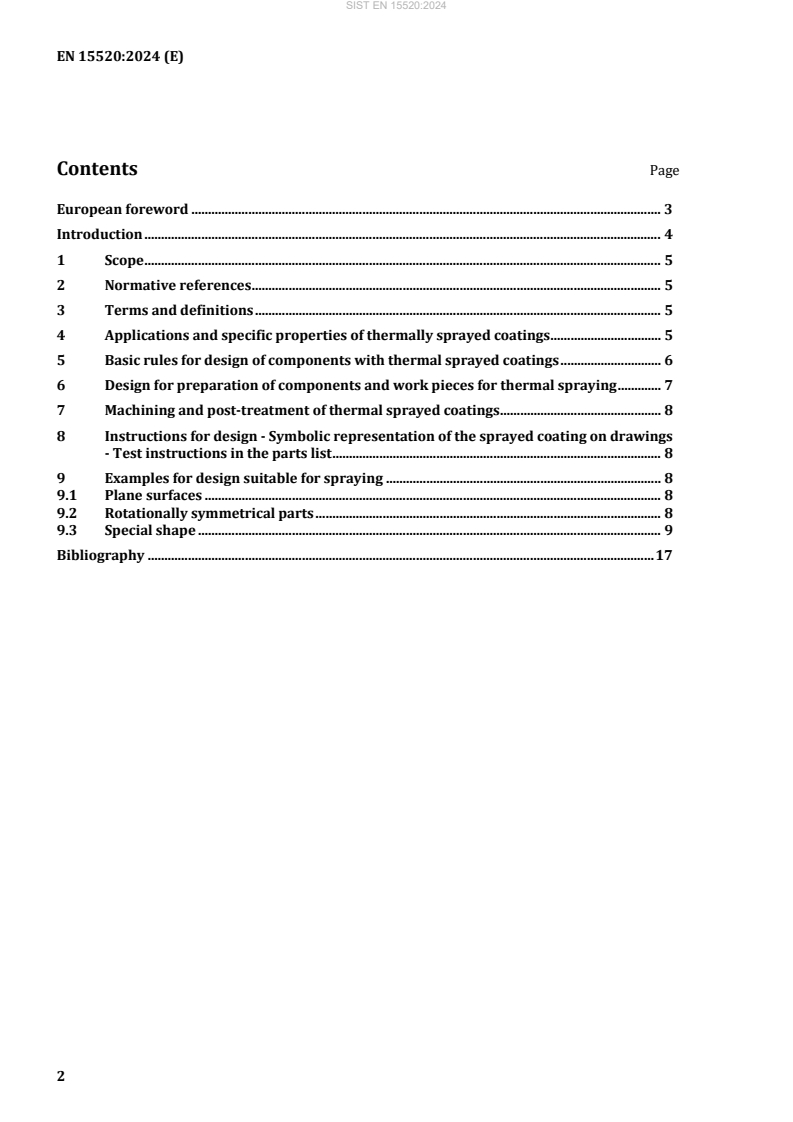
General Information
- Abstract
This document is applicable for thermal sprayed coatings. It contains basic recommendations for the design of components, which have to be completely or partially coated. The recommendations are applicable for new manufacturing as well as for repair of worn components. The coating can be of metallic, metal-ceramic, oxide-ceramic materials or polymers.
- Status
- Published
- Public Enquiry End Date
- 11-Apr-2023
- Publication Date
- 13-Aug-2024
- Technical Committee
- IPKZ - Protection of metals against corrosion
- Current Stage
- 6060 - National Implementation/Publication (Adopted Project)
- Start Date
- 01-Aug-2024
- Due Date
- 06-Oct-2024
- Completion Date
- 14-Aug-2024

Overview - EN 15520:2024 (Thermal spraying design recommendations)
EN 15520:2024, published by CEN, provides recommendations for the constructional design of components with thermally sprayed coatings. It applies to new manufacture and repair of parts coated wholly or partially with metallic, metal‑ceramic, oxide‑ceramic or polymer coatings. The standard replaces EN 15520:2007, updates normative references and figures, and was approved by CEN in June 2024.
Key topics and technical requirements
- Scope and purpose: Practical design guidance to ensure sprayability, bond quality and in‑service performance of thermally sprayed coatings.
- Coating characteristics: Notes that thermally sprayed coatings are typically micro‑porous, usually do not increase base‑metal strength, and that bond strength depends on mechanical adhesion unless post‑heat treatment (e.g., fused self‑fluxing alloys) creates diffusion bonding.
- Design rules (summarised):
- Ensure sufficient accessibility and visibility of areas to be sprayed (spray gun, spray distance and angle, manipulators).
- Avoid sharp edges and small internal radii - chamfer or round edges to prevent thin, damaged coatings and spalling.
- Maintain spray angle - the angle of incidence should not be less than 45° to preserve bond strength and coating structure.
- Minimise turbulence and spray shadows for internal bores, slots or blind holes; special internal spray guns can extend capabilities.
- Use masking for areas that must remain uncoated; specify masking and testing instructions on drawings/parts lists.
- Preparation, machining and post‑treatment: Final machining strategy (e.g., finish machining after spraying for partially coated items), post‑heat treatment considerations, and machining methods are discussed with references to relevant ISO standards.
- Documentation and drawings: Use symbolic representation per EN ISO 12671 and include detailed coating specification, pre‑treatments, test requirements (adhesive strength, hardness, etc.) in parts lists.
Practical applications and users
EN 15520:2024 is used to guide design and specification where thermal spraying is selected to:
- Improve wear resistance, corrosion protection, electrical/thermal properties, sliding behavior or provide thermal insulation.
Primary users include mechanical design engineers, surface‑engineering specialists, coatings specifiers, maintenance and repair technicians, procurement and quality managers, and standards writers.
Related standards
For complementary guidance, EN 15520 references and aligns with:
- EN ISO 12671 (symbolic representation on drawings)
- EN ISO 14921, EN ISO 17834 (application‑specific design)
- EN ISO 12944‑3, EN ISO 14713‑1, EN ISO 2063‑1/2 (corrosion protection and coating guidance)
- EN ISO 14924, EN ISO 14920 (machining/post‑treatment) and EN ISO 12670 (supply conditions).
EN 15520:2024 is a practical resource when specifying thermally sprayed coatings and integrating surface treatment requirements into component design and manufacturing documentation.
Relations
- Effective Date
- 18-Jan-2023
- Effective Date
- 28-Jan-2026
- Effective Date
- 28-Jan-2026
- Effective Date
- 28-Jan-2026
Get Certified
Connect with accredited certification bodies for this standard

DVS-ZERT GmbH
German welding certification society.
CARES (UK Certification Authority for Reinforcing Steels)
UK certification for reinforcing steels and construction.
EWF/IIW (European/International Welding Federation)
International welding personnel certification.
Sponsored listings
Frequently Asked Questions
SIST EN 15520:2024 is a standard published by the Slovenian Institute for Standardization (SIST). Its full title is "Thermal spraying - Recommendations for constructional design of components with thermally sprayed coatings". This standard covers: This document is applicable for thermal sprayed coatings. It contains basic recommendations for the design of components, which have to be completely or partially coated. The recommendations are applicable for new manufacturing as well as for repair of worn components. The coating can be of metallic, metal-ceramic, oxide-ceramic materials or polymers.
This document is applicable for thermal sprayed coatings. It contains basic recommendations for the design of components, which have to be completely or partially coated. The recommendations are applicable for new manufacturing as well as for repair of worn components. The coating can be of metallic, metal-ceramic, oxide-ceramic materials or polymers.
SIST EN 15520:2024 is classified under the following ICS (International Classification for Standards) categories: 25.220.20 - Surface treatment. The ICS classification helps identify the subject area and facilitates finding related standards.
SIST EN 15520:2024 has the following relationships with other standards: It is inter standard links to SIST EN 15520:2007, SIST EN ISO 12671:2021, SIST EN ISO 14921:2012, SIST EN ISO 14713-1:2010. Understanding these relationships helps ensure you are using the most current and applicable version of the standard.
SIST EN 15520:2024 is available in PDF format for immediate download after purchase. The document can be added to your cart and obtained through the secure checkout process. Digital delivery ensures instant access to the complete standard document.
Standards Content (Sample)
SLOVENSKI STANDARD
01-september-2024
Nadomešča:
SIST EN 15520:2007
Vroče brizganje - Priporočila za konstrukcijsko oblikovanje komponent s
prevlekami, nanesenimi z vročim brizganjem
Thermal spraying - Recommendations for constructional design of components with
thermally sprayed coatings
Thermisches Spritzen - Empfehlungen zum konstruktiven Gestalten von Bauteilen mit
thermisch gespritzten Schichten
Projection thermique - Recommandations relatives à la conception des éléments de
construction comportant un revêtement déposé par projection thermique
Ta slovenski standard je istoveten z: EN 15520:2024
ICS:
25.220.20 Površinska obdelava Surface treatment
2003-01.Slovenski inštitut za standardizacijo. Razmnoževanje celote ali delov tega standarda ni dovoljeno.
EN 15520
EUROPEAN STANDARD
NORME EUROPÉENNE
July 2024
EUROPÄISCHE NORM
ICS 25.220.20 Supersedes EN 15520:2007
English Version
Thermal spraying - Recommendations for constructional
design of components with thermally sprayed coatings
Projection thermique - Recommandations relatives à la Thermisches Spritzen - Empfehlungen zum
conception des éléments de construction comportant konstruktiven Gestalten von Bauteilen mit thermisch
un revêtement déposé par projection thermique gespritzten Schichten
This European Standard was approved by CEN on 17 June 2024.
CEN members are bound to comply with the CEN/CENELEC Internal Regulations which stipulate the conditions for giving this
European Standard the status of a national standard without any alteration. Up-to-date lists and bibliographical references
concerning such national standards may be obtained on application to the CEN-CENELEC Management Centre or to any CEN
member.
This European Standard exists in three official versions (English, French, German). A version in any other language made by
translation under the responsibility of a CEN member into its own language and notified to the CEN-CENELEC Management
Centre has the same status as the official versions.
CEN members are the national standards bodies of Austria, Belgium, Bulgaria, Croatia, Cyprus, Czech Republic, Denmark, Estonia,
Finland, France, Germany, Greece, Hungary, Iceland, Ireland, Italy, Latvia, Lithuania, Luxembourg, Malta, Netherlands, Norway,
Poland, Portugal, Republic of North Macedonia, Romania, Serbia, Slovakia, Slovenia, Spain, Sweden, Switzerland, Türkiye and
United Kingdom.
EUROPEAN COMMITTEE FOR STANDARDIZATION
COMITÉ EUROPÉEN DE NORMALISATION
EUROPÄISCHES KOMITEE FÜR NORMUNG
CEN-CENELEC Management Centre: Rue de la Science 23, B-1040 Brussels
© 2024 CEN All rights of exploitation in any form and by any means reserved Ref. No. EN 15520:2024 E
worldwide for CEN national Members.
Contents Page
European foreword . 3
Introduction . 4
1 Scope . 5
2 Normative references . 5
3 Terms and definitions . 5
4 Applications and specific properties of thermally sprayed coatings . 5
5 Basic rules for design of components with thermal sprayed coatings . 6
6 Design for preparation of components and work pieces for thermal spraying . 7
7 Machining and post-treatment of thermal sprayed coatings . 8
8 Instructions for design - Symbolic representation of the sprayed coating on drawings
- Test instructions in the parts list . 8
9 Examples for design suitable for spraying . 8
9.1 Plane surfaces . 8
9.2 Rotationally symmetrical parts . 8
9.3 Special shape . 9
Bibliography . 17
European foreword
This document (EN 15520:2024) has been prepared by Technical Committee CEN/TC 240 “Thermal
spraying and thermally sprayed coatings”, the secretariat of which is held by DIN.
This European Standard shall be given the status of a national standard, either by publication of an
identical text or by endorsement, at the latest by January 2025, and conflicting national standards shall
be withdrawn at the latest by January 2025 month year of DOW.
Attention is drawn to the possibility that some of the elements of this document may be the subject of
patent rights. CEN shall not be held responsible for identifying any or all such patent rights.
This document supersedes EN 15520:2007.
— normative references and bibliography updated;
— document editorially revised;
— Figures 2, 3 and 7 (now 8) revised and improved;
— new Figure 7 (Examples for technology to avoid sharp edges at coating run-out) added.
Any feedback and questions on this document should be directed to the users’ national standards body.
A complete listing of these bodies can be found on the CEN website.
According to the CEN-CENELEC Internal Regulations, the national standards organisations of the
following countries are bound to implement this European Standard: Austria, Belgium, Bulgaria, Croatia,
Cyprus, Czech Republic, Denmark, Estonia, Finland, France, Germany, Greece, Hungary, Iceland, Ireland,
Italy, Latvia, Lithuania, Luxembourg, Malta, Netherlands, Norway, Poland, Portugal, Republic of North
Macedonia, Romania, Serbia, Slovakia, Slovenia, Spain, Sweden, Switzerland, Türkiye and the United
Kingdom.
Introduction
Thermal spraying is applied to improve the surface properties of work pieces in order to increase the
wear resistance, the electrical conductivity or the electrical resistance, to achieve corrosion resistance for
the pertinent service conditions, to improve sliding behaviour or, to provide heat insulation.
Recommendations for thermal spraying are contained in EN ISO 12679.
1 Scope
This document is applicable for thermal sprayed coatings. It contains basic recommendations for the
design of components, which have to be completely or partially coated. The recommendations are
applicable for new manufacturing as well as for repair of worn components. The coating can be of
metallic, metal-ceramic, oxide-ceramic materials or polymers.
2 Normative references
The following documents are referred to in the text in such a way that some or all of their content
constitutes requirements of this document. For dated references, only the edition cited applies. For
undated references, the latest edition of the referenced document (including any amendments) applies.
EN ISO 12671, Thermal spraying — Thermally sprayed coatings — Symbolic representation on drawings
(ISO 12671)
3 Terms and definitions
No terms and definitions are listed in this document.
ISO and IEC maintain terminology databases for use in standardization at the following addresses:
— ISO Online browsing platform: available at https://www.iso.org/obp/
— IEC Electropedia: available at https://www.electropedia.org/
4 Applications and specific properties of thermally sprayed coatings
Due to their structure, thermal sprayed coatings possess properties which markedly distinguish them
from bulk materials. An appropriate basic structural design and a suitable parent metal have to bear any
mechanical loading. Usually, thermal sprayed coatings do not increase the strength of the parent work
piece.
Some process related features and specific properties of thermal sprayed coatings are summarized in
Table 1.
Table 1 — Process related features and specific properties of thermal sprayed coatings
Process related features Specific properties of thermal sprayed coating
Components made of almost every material can Not every spraying procedure is appropriate for all
be coated by thermal spraying. applications.
Coatings with properties completely different
—
from the parent material are possible.
Coatings can be sprayed with different spraying Usually the effect of the residual stress in the
materials side by side, one upon another, or coating rises with increasing coating thickness.
mixing into one another (graded coatings).
Usually the heat input caused by spraying is so If the coating is not post heat treated the bond
low, that it is possible to avoid structural strength mainly depends on mechanical adhesive
transformation or deformation. properties. If the coating is post heat treated the
bond strength depends on diffusion and the
The heat input by fusing self-fluxing alloys or
coating is densified.
diffusion annealing can cause structural
transformation or deformation.
The ability to apply the spraying process is Some geometric dimensions e.g. internal bores
practically independent of the size of the with too small a diameter can limit the spray
component. ability.
Components with complicated shapes can be Sprayed coatings are susceptible to edge loading,
coated, if appropriate spraying equipment is point and line loading and impact stresses.
used.
Areas of a component, which shall be free of
sprayed material can be protected, e.g. by —
masking.
The untreated surface of the coating provides a
—
good basis for painting or sealing.
Several thermal spraying processes can be
—
applied on site as well as in a workshop.
Coating properties e.g. porosity can be varied to Sprayed coatings are micro porous except for post
suit particular applications. heat treated self-fluxing alloy coatings.
5 Basic rules for design of components with thermal sprayed coatings
Without proper consider
...