

SIST EN 13173:2003
(Main)Cathodic protection for steel offshore floating structures
- Abstract
This EN defines the means to be used to cathodically protect the submerged metallic surfaces of steel offshore floating structures and appurtenances in sea water and saline mud.
- Status
- Published
- Publication Date
- 30-Nov-2003
- Technical Committee
- IPKZ - Protection of metals against corrosion
- Current Stage
- 6060 - National Implementation/Publication (Adopted Project)
- Start Date
- 01-Dec-2003
- Due Date
- 01-Dec-2003
- Completion Date
- 01-Dec-2003



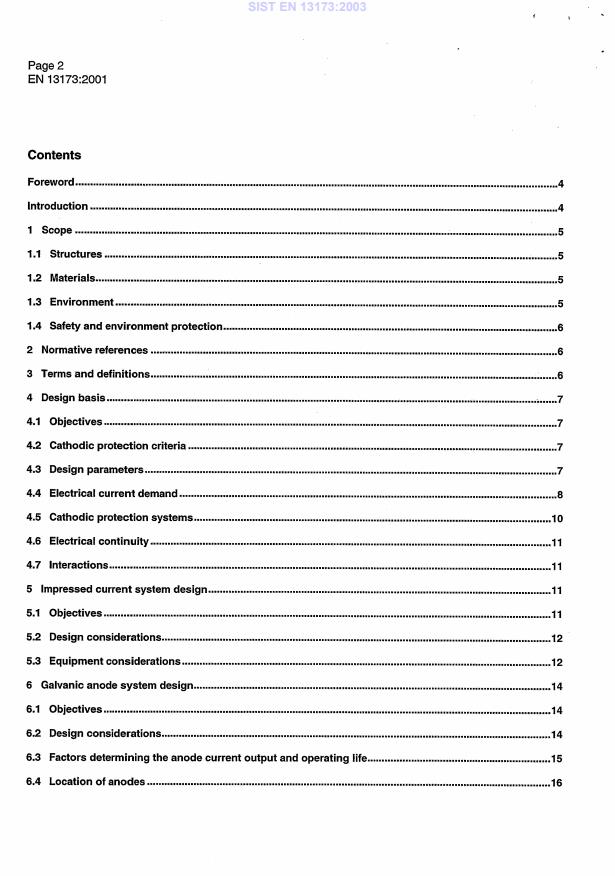
SIST EN 13173:2003 is a Slovenian standard from SIST for cathodic protection of steel offshore floating structures. It specifies the means to be used to protect submerged metallic surfaces, including appurtenances, in sea water and saline mud. Engineers, corrosion specialists, buyers and maintenance teams use it when they need a common basis for protecting offshore steel structure surfaces that stay below the waterline.
What does SIST EN 13173:2003 specify?
SIST EN 13173:2003 applies to cathodic protection for submerged metallic surfaces of steel offshore floating structures and their appurtenances in sea water and saline mud. In practice, the standard is about protecting the wetted metal parts of floating offshore steel assets that operate in marine and saline environments.
The front matter identifies the standard in several languages and gives its classification as a general standard related to shipbuilding and marine structures, with an additional metallic coatings classification. It also states that SIST EN 13173:2003 is identical to EN 13173:2001.
What are the key requirements of SIST EN 13173:2003?
The main point in SIST EN 13173:2003 is the protected object: submerged metallic surfaces of steel offshore floating structures. For users, that means the scope is not the full structure, but the metal areas exposed below the waterline.
The standard covers steel offshore floating structures.
In practice, this places the document in offshore and marine engineering, where the designer or owner needs a corrosion protection basis for floating steel assets.It also covers appurtenances.
That matters because attached items and fittings in the submerged zone need to be considered together with the main structure, not as separate afterthoughts.The environment includes sea water.
For a reader, this means the protection approach must suit a marine electrolyte, with all the corrosion conditions that follow from permanent immersion or repeated wetting.The environment also includes saline mud.
That is important for structures that may contact seabed deposits or mud zones, where protection needs can differ from open-water immersion.The standard is about the means to be used for cathodic protection.
In practical terms, readers use it as the document that frames the protection method for design, specification and procurement decisions.The focus is on submerged metallic surfaces.
This helps inspection and maintenance teams decide which parts of the structure fall inside the protection scope and need to be tracked as protected surfaces.
What terms does SIST EN 13173:2003 define?
Cathodic protection (CP) is the corrosion-control method addressed by the standard for submerged steel surfaces in marine service.
Steel offshore floating structures are floating offshore structures made of steel, which are the main assets covered by the standard.
Submerged metallic surfaces are the metal surfaces below the waterline that need cathodic protection in service.
Appurtenances are the attached parts and fittings associated with the structure that are included in the protection scope.
Sea water is the marine environment named by the standard as one of the service media for protection.
Saline mud is mud with salt content, which the standard treats as part of the protection environment.
Who uses SIST EN 13173:2003?
SIST EN 13173:2003 is used by offshore structural engineers, corrosion engineers, marine fabricators, coating and cathodic protection specialists, inspection teams and asset owners. It is relevant when they specify, design, review or maintain cathodic protection for steel floating offshore structures.
Buyers and technical specifiers use it to align procurement documents with the marine corrosion environment. Quality and maintenance teams use it to decide what submerged parts and appurtenances belong in the protection scope.
What changed in SIST EN 13173:2003 from the previous edition?
SIST EN 13173:2003 is identified as identical to EN 13173:2001. The document information given here presents that equivalence as the key relationship between the Slovenian standard and the referenced EN edition.
What does the SIST EN 13173:2003 document contain?
The document front matter gives the standard title in Slovene, German, French and English, together with the scope statement. It also lists the ICS classifications 47.020.01 and 25.220.40, linking the standard to shipbuilding and marine structures and to metallic coatings.
The document identifies itself as SIST EN 13173:2003 and states the equivalence to EN 13173:2001. For readers, that means the page is the official national presentation of the EN text for use in Slovenian standardization practice.
Relations
- Effective Date
- 28-Jan-2026
- Effective Date
- 28-Jan-2026
Get Certified
Connect with accredited certification bodies for this standard

DNV
DNV is an independent assurance and risk management provider.

Lloyd's Register
Lloyd's Register is a global professional services organisation specialising in engineering and technology.

DVS-ZERT GmbH
German welding certification society.
Sponsored listings
Frequently Asked Questions
SIST EN 13173:2003 is a standard published by the Slovenian Institute for Standardization (SIST). Its full title is "Cathodic protection for steel offshore floating structures". This standard covers: This EN defines the means to be used to cathodically protect the submerged metallic surfaces of steel offshore floating structures and appurtenances in sea water and saline mud.
This EN defines the means to be used to cathodically protect the submerged metallic surfaces of steel offshore floating structures and appurtenances in sea water and saline mud.
SIST EN 13173:2003 is classified under the following ICS (International Classification for Standards) categories: 25.220.40 - Metallic coatings; 47.020.01 - General standards related to shipbuilding and marine structures. The ICS classification helps identify the subject area and facilitates finding related standards.
SIST EN 13173:2003 has the following relationships with other standards: It is inter standard links to SIST EN 12473:2014, SIST EN 15257:2007. Understanding these relationships helps ensure you are using the most current and applicable version of the standard.
SIST EN 13173:2003 is available in PDF format for immediate download after purchase. The document can be added to your cart and obtained through the secure checkout process. Digital delivery ensures instant access to the complete standard document.
Standards Content (Sample)
2003-01.Slovenski inštitut za standardizacijo. Razmnoževanje celote ali delov tega standarda ni dovoljeno.Kathodischer Korrosionsschutz für schwimmende Offshore-Anlagen aus StahlProtection cathodique des structures en acier flottant en merCathodic protection for steel offshore floating structures47.020.01Splošni standardi v zvezi z ladjedelništvom in konstrukcijami na morjuGeneral standards related to shipbuilding and marine structures25.220.40Kovinske prevlekeMetallic coatingsICS:Ta slovenski standard je istoveten z:EN 13173:2001SIST EN 13173:2003en01-december-2003SIST EN 13173:200
...