

SIST EN 14012:2019
(Main)Postal services - Quality of service - Complaints handling principles
General Information
- Abstract
This European Standard specifies complaints handling principles related to domestic and international postal services. It applies to both national and cross border services. The standard also gives guidance for compensation and redress procedures.
This European Standard may be applied to all types of postal service both Universal service and non-universal service and by all types of postal organizations. It defines various types of complaints and establishes a methodology for handling complaints in order to improve the service given to postal users. It also gives guidance for complaints handling processes to be set up by postal service providers in order to improve quality of service.
This European Standard provides guidelines beyond the requirements given in ISO 10002 and ISO 9001 in order to consider both the effectiveness and efficiency of a complaint handling process, and consequently the potential for improvement of the performance of an organization. When compared to ISO 9001, the objectives of customer satisfaction and product quality are extended to include the satisfaction of interested parties and the performance of the organization.
This European Standard is applicable to the processes of the organization and consequently the quality management principles on which it is based can be deployed throughout the organization.
It should be noted that the number of complaints received might not be related to the level of service given. A large number of complaints may on the contrary reflect the effectiveness of the postal operator's complaint handling process.
- Status
- Published
- Public Enquiry End Date
- 30-Nov-2018
- Publication Date
- 03-Oct-2019
- Technical Committee
- I13 - Imaginarni 13
- Current Stage
- 6060 - National Implementation/Publication (Adopted Project)
- Start Date
- 01-Oct-2019
- Due Date
- 06-Dec-2019
- Completion Date
- 04-Oct-2019
- Directive
- 97/67/EC - Common rules for the development of the internal market of Community postal services and the improvement of quality of serviceOJ Ref: L 369 OJ Date: 19-Oct-2021


Overview - EN 14012:2019 (Postal services - Complaints handling principles)
EN 14012:2019 is a CEN European Standard that provides guidance on complaints handling for domestic and international postal services. Applicable to both universal and non‑universal services, it covers national and cross‑border scenarios, multiple‑operator mail flows and gives guidance on compensation and redress procedures. This edition (superseding EN 14012:2008) aligns with ISO 10002 and complements ISO 9001 by extending focus from customer satisfaction and product quality to the satisfaction of interested parties and organisational performance. The standard is intended as guidance - not a certification or regulatory instrument.
Key topics and technical focus
EN 14012:2019 structures complaints handling around practical process and quality management principles. Major areas include:
- Guiding principles and organisational commitment to complaint handling
- Complaint handling management and operation of the complaints process
- Complaint categories and classification (ownership, justification, reasons)
- Channels and communication for capture and notification of complaints (incl. accessibility for persons with disabilities and older persons)
- Responses and timescales for dealing with complainants
- Performance measurement, reporting and monitoring (measuring parameters and suggested reporting formats)
- Continual improvement and corrective actions tied to complaint data
- Annex J: postal‑specific guidance on damaged, delayed or lost items and mitigation activities
- Guidance on compensation and redress procedures and cross‑border responsibilities
Practical applications - who uses it and why
EN 14012:2019 is practical for:
- Postal operators and network managers designing or improving complaint handling systems
- Customer service managers, quality teams and complaints officers seeking standardised categorization, reporting and response templates
- Regulatory bodies and auditors who need to understand industry best practice (note: EN 14012 is guidance, not a regulatory mandate)
- Contract managers and business partners in multi‑operator mail flows to clarify responsibility for redress
- IT and CRM teams implementing complaint capture channels and analytics for performance improvement
Benefits and uses:
- Improve customer experience and resolution efficiency
- Standardise complaint categorization and reporting across national and cross‑border operations
- Inform compensation/redress policies using consistent principles
- Drive continual improvement using complaint data to reduce recurring failures (including damaged/delayed/lost mail)
Related standards and alignment
- ISO 10002 - guidelines for complaints handling (EN 14012 extends postal‑specific application)
- ISO 9001 - quality management (EN 14012 expands focus to interested parties and organisational performance)
EN 14012:2019 is a practical reference for postal service professionals seeking to implement effective, transparent and measurable complaints handling aligned with international quality practices.
Relations
- Effective Date
- 25-Sep-2019
- Effective Date
- 09-Feb-2026
- Effective Date
- 28-Jan-2026
- Effective Date
- 28-Jan-2026
- Effective Date
- 28-Jan-2026
- Effective Date
- 28-Jan-2026
- Effective Date
- 28-Mar-2018
Get Certified
Connect with accredited certification bodies for this standard

Great Wall Tianjin Quality Assurance Center
Established 1993, first batch to receive national accreditation with IAF recognition.
Hong Kong Quality Assurance Agency (HKQAA)
Hong Kong's leading certification body.

Innovative Quality Certifications Pvt. Ltd. (IQCPL)
Known for integrity, providing ethical & impartial Assessment & Certification. CMMI Institute Partner.
Sponsored listings
Frequently Asked Questions
SIST EN 14012:2019 is a standard published by the Slovenian Institute for Standardization (SIST). Its full title is "Postal services - Quality of service - Complaints handling principles". This standard covers: This European Standard specifies complaints handling principles related to domestic and international postal services. It applies to both national and cross border services. The standard also gives guidance for compensation and redress procedures. This European Standard may be applied to all types of postal service both Universal service and non-universal service and by all types of postal organizations. It defines various types of complaints and establishes a methodology for handling complaints in order to improve the service given to postal users. It also gives guidance for complaints handling processes to be set up by postal service providers in order to improve quality of service. This European Standard provides guidelines beyond the requirements given in ISO 10002 and ISO 9001 in order to consider both the effectiveness and efficiency of a complaint handling process, and consequently the potential for improvement of the performance of an organization. When compared to ISO 9001, the objectives of customer satisfaction and product quality are extended to include the satisfaction of interested parties and the performance of the organization. This European Standard is applicable to the processes of the organization and consequently the quality management principles on which it is based can be deployed throughout the organization. It should be noted that the number of complaints received might not be related to the level of service given. A large number of complaints may on the contrary reflect the effectiveness of the postal operator's complaint handling process.
This European Standard specifies complaints handling principles related to domestic and international postal services. It applies to both national and cross border services. The standard also gives guidance for compensation and redress procedures. This European Standard may be applied to all types of postal service both Universal service and non-universal service and by all types of postal organizations. It defines various types of complaints and establishes a methodology for handling complaints in order to improve the service given to postal users. It also gives guidance for complaints handling processes to be set up by postal service providers in order to improve quality of service. This European Standard provides guidelines beyond the requirements given in ISO 10002 and ISO 9001 in order to consider both the effectiveness and efficiency of a complaint handling process, and consequently the potential for improvement of the performance of an organization. When compared to ISO 9001, the objectives of customer satisfaction and product quality are extended to include the satisfaction of interested parties and the performance of the organization. This European Standard is applicable to the processes of the organization and consequently the quality management principles on which it is based can be deployed throughout the organization. It should be noted that the number of complaints received might not be related to the level of service given. A large number of complaints may on the contrary reflect the effectiveness of the postal operator's complaint handling process.
SIST EN 14012:2019 is classified under the following ICS (International Classification for Standards) categories: 03.240 - Postal services. The ICS classification helps identify the subject area and facilitates finding related standards.
SIST EN 14012:2019 has the following relationships with other standards: It is inter standard links to SIST EN 14012:2009, SIST ISO 10002:2018, SIST EN ISO 20028-1:2017, SIST EN ISO 20028-1:2020, SIST EN 14137:2004, SIST-TS CEN/TS 14773:2005, SIST EN 14012:2009. Understanding these relationships helps ensure you are using the most current and applicable version of the standard.
SIST EN 14012:2019 is associated with the following European legislation: EU Directives/Regulations: 97/67/EC; Standardization Mandates: M/240, M/312. When a standard is cited in the Official Journal of the European Union, products manufactured in conformity with it benefit from a presumption of conformity with the essential requirements of the corresponding EU directive or regulation.
SIST EN 14012:2019 is available in PDF format for immediate download after purchase. The document can be added to your cart and obtained through the secure checkout process. Digital delivery ensures instant access to the complete standard document.
Standards Content (Sample)
SLOVENSKI STANDARD
01-december-2019
Nadomešča:
SIST EN 14012:2009
Poštne storitve - Kakovost storitve - Načela ravnanja s pritožbami
Postal services - Quality of service - Complaints handling principles
Postalische Dienstleistungen - Dienstqualität - Grundsätze der Bearbeitung von
Beschwerden
Services postaux - Qualité du service - Principes de traitement des réclamations
Ta slovenski standard je istoveten z: EN 14012:2019
ICS:
03.240 Poštne storitve Postal services
2003-01.Slovenski inštitut za standardizacijo. Razmnoževanje celote ali delov tega standarda ni dovoljeno.
EN 14012
EUROPEAN STANDARD
NORME EUROPÉENNE
September 2019
EUROPÄISCHE NORM
ICS 03.240 Supersedes EN 14012:2008
English Version
Postal services - Quality of service - Complaints handling
principles
Services postaux - Qualité du service - Principes de Postalische Dienstleistungen - Dienstqualität -
traitement des réclamations Grundsätze der Bearbeitung von Beschwerden
This European Standard was approved by CEN on 5 August 2019.
CEN members are bound to comply with the CEN/CENELEC Internal Regulations which stipulate the conditions for giving this
European Standard the status of a national standard without any alteration. Up-to-date lists and bibliographical references
concerning such national standards may be obtained on application to the CEN-CENELEC Management Centre or to any CEN
member.
This European Standard exists in three official versions (English, French, German). A version in any other language made by
translation under the responsibility of a CEN member into its own language and notified to the CEN-CENELEC Management
Centre has the same status as the official versions.
CEN members are the national standards bodies of Austria, Belgium, Bulgaria, Croatia, Cyprus, Czech Republic, Denmark, Estonia,
Finland, France, Germany, Greece, Hungary, Iceland, Ireland, Italy, Latvia, Lithuania, Luxembourg, Malta, Netherlands, Norway,
Poland, Portugal, Republic of North Macedonia, Romania, Serbia, Slovakia, Slovenia, Spain, Sweden, Switzerland, Turkey and
United Kingdom.
EUROPEAN COMMITTEE FOR STANDARDIZATION
COMITÉ EUROPÉEN DE NORMALISATION
EUROPÄISCHES KOMITEE FÜR NORMUNG
CEN-CENELEC Management Centre: Rue de la Science 23, B-1040 Brussels
© 2019 CEN All rights of exploitation in any form and by any means reserved Ref. No. EN 14012:2019 E
worldwide for CEN national Members.
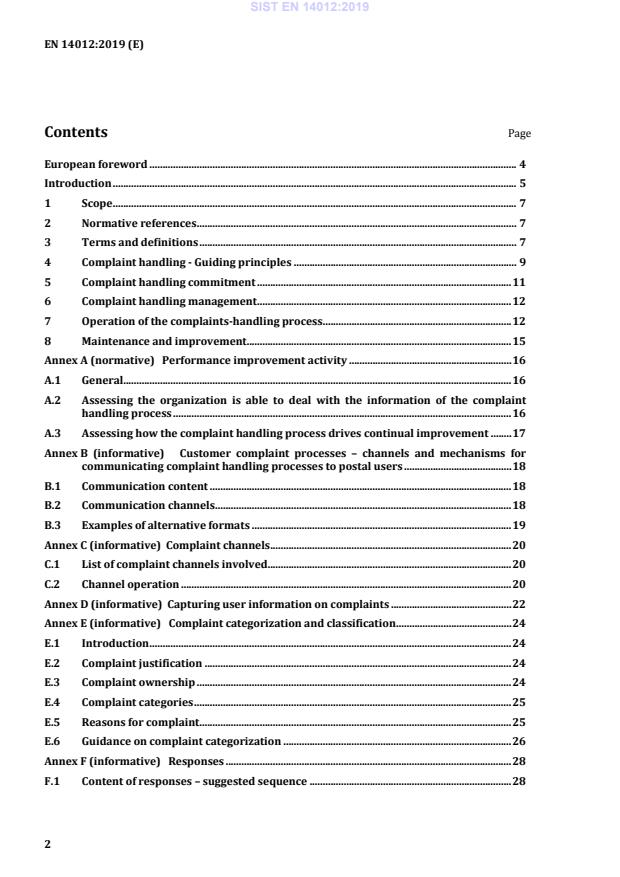
Contents Page
European foreword . 4
Introduction . 5
1 Scope . 7
2 Normative references . 7
3 Terms and definitions . 7
4 Complaint handling - Guiding principles . 9
5 Complaint handling commitment . 11
6 Complaint handling management . 12
7 Operation of the complaints-handling process . 12
8 Maintenance and improvement. 15
Annex A (normative) Performance improvement activity . 16
A.1 General. 16
A.2 Assessing the organization is able to deal with the information of the complaint
handling process . 16
A.3 Assessing how the complaint handling process drives continual improvement . 17
Annex B (informative) Customer complaint processes – channels and mechanisms for
communicating complaint handling processes to postal users . 18
B.1 Communication content . 18
B.2 Communication channels . 18
B.3 Examples of alternative formats . 19
Annex C (informative) Complaint channels . 20
C.1 List of complaint channels involved . 20
C.2 Channel operation . 20
Annex D (informative) Capturing user information on complaints . 22
Annex E (informative) Complaint categorization and classification . 24
E.1 Introduction . 24
E.2 Complaint justification . 24
E.3 Complaint ownership . 24
E.4 Complaint categories . 25
E.5 Reasons for complaint. 25
E.6 Guidance on complaint categorization . 26
Annex F (informative) Responses . 28
F.1 Content of responses – suggested sequence . 28
F.2 Issues to be considered can include. 28
F.3 Timescales for responses . 28
Annex G (informative) Complaint reporting . 29
G.1 General . 29
G.2 Timescales for reporting. 29
G.3 Report content . 29
G.4 Extra monitoring data . 30
Annex H (informative) Continual improvement . 31
H.1 Continual improvement of the complaint handling process . 31
H.2 Continual improvement of products and services. 31
Annex I (informative) Suggested reporting formats . 32
Annex J (informative) Damage to postal items . 39
J.1 Introduction . 39
J.2 Measurement of complaints . 39
J.3 Prevention actions . 52
J.4 Measurements . 53
J.5 Activities to mitigate impact of damages . 55
J.6 Parameters of postal items affecting the number of damages . 56
Bibliography . 57
European foreword
This document (EN 14012:2019) has been prepared by Technical Committee CEN/TC 331 “Postal
services”, the secretariat of which is held by NEN.
This European Standard shall be given the status of a national standard, either by publication of an
identical text or by endorsement, at the latest by March 2020, and conflicting national standards shall be
withdrawn at the latest by March 2020.
Attention is drawn to the possibility that some of the elements of this document may be the subject of
patent rights. CEN shall not be held responsible for identifying any or all such patent rights.
This document supersedes EN 14012:2008.
The content has been extensively revised to reflect:
— an increased requirement for postal operators and organizations to demonstrate a stronger focus on
providing a quality mail and associated complaint handling experience to postal users;
— limiting the number of measuring parameters; and
— stronger alignment with ISO 10002 adhering to the measuring method described in the first edition
of EN 14012 means that also the measuring requirements of this revised 2nd edition of EN 14012
are met. Annex G contains general information regarding measuring and reporting of complaints
based on the criteria described in the first edition of EN 14012 and included in Annex I. However,
this revised second edition of EN 14012 contains more requirements on improvements and
corrective actions.
According to the CEN-CENELEC Internal Regulations, the national standards organisations of the
following countries are bound to implement this European Standard: Austria, Belgium, Bulgaria, Croatia,
Cyprus, Czech Republic, Denmark, Estonia, Finland, France, Germany, Greece, Hungary, Iceland, Ireland,
Italy, Latvia, Lithuania, Luxembourg, Malta, Netherlands, Norway, Poland, Portugal, Republic of North
Macedonia, Romania, Serbia, Slovakia, Slovenia, Spain, Sweden, Switzerland, Turkey and the United
Kingdom.
Introduction
General
In 1992 the European Commission pointed out in its Green paper the need to establish common rules for
the development of community postal services and the improvement of quality of service. The
Commission identified requirements for quality of service measurement including the management and
measurement of complaints.
The 1997 Directive of the European Parliament and of the Council on common rules for the development
of the internal market of Community postal services and the improvement of quality of service, 97/67/CE
article 19, requires universal service providers to publish information once a year on the number of
complaints and the way they are dealt with. Complaints are requests given by users of the postal service
in order to communicate that they feel that the service provided has not met the standard they expect or
the standard the service provider has to comply with. It is recommended to investigate complaints in
order to verify if there is actual non-conformity with the service and to respond to the complainants.
Moreover, complaints are regarded as the instrument to protect users if the service provider does not
respect the commitments and promises it has made.
The service provider can use complaints in its continuous quality improvement of the postal service. The
level of complaints and the reasons for complaints provide important information about the satisfaction
of users with different aspects of the postal service. There needs to be commitment to effective
complaints-handling at all levels within the postal organization.
Development overview
An investigation carried out by the European postal regulators CERP in 2004 showed that the costs for
fully implementing the first edition of EN 14012:2003 were likely to be too high, even for postal service
organizations with existing established and sophisticated complaint management and measurement/
reporting systems. This prompted CEN/TC 331 to start a revision of the European Standard in 2005,
incorporating annexes about guidance for its use. This Third version of EN 14012 does not force those
who already are using EN 14012:2003 to change their measurement systems to comply with the
European Standard, but gives an opportunity to measure less extensively. This Third version is also
aligned with ISO 10002 on Complaints-handling and thus places more emphasis on the need for overall
quality improvements within the postal organizations.
Regulatory aspects, information about business sensitive information and special requirements for
Universal services have deliberately been left out of this European Standard. The reasons are that it is up
to the regulatory and governmental bodies, as well as in contracts between business partners, to refer to
business agreements and this European Standard, and to state which part has to be followed and for
which service.
National regulators may have more specific requirements than those given in this document.
Content description
This document provides guidelines beyond the requirements given in ISO 10002 and EN ISO 9001 in
order to consider both the effectiveness and efficiency of a complaint handling process, and consequently
the potential for improvement of the performance of an organization. When compared to EN ISO 9001,
the objectives of customer satisfaction and product quality are extended to include the satisfaction of
interested parties and the performance of the organization.
In this third edition of EN 14012, the general structure of ISO 10002 is followed. For general complaints-
handling rules that are not postal specific, references are made to the latest version of ISO 10002, which
may be revised independently of EN 14012.
The intention of the modified EN 14012 is to provide guidance on how to set up a complaints-handling
system for postal service operators. This leads to positive solutions for postal users who complain. It also
provides sufficient information about quality of service related to complaints.
Postal specific issues which will be taken into account are:
— many postal organization employees are in frequent contact with postal users during the delivery of
their core job and may be able to deal with complaints on the spot. Most of this contact is not
recognized as complaint handling contact and is therefore not formally recorded. (For example, a
postman conducting regular collection and delivery activity);
— cross border mail may generate cross border complaints where it may be difficult to establish which
postal operator is responsible;
— postal operations involving multiple operators carrying an item of mail will result in complaints
being made to organizations that may or may not be the responsibility of that organization;
— person who complains may not be the person who has paid for the service; for example, a recipient
of a mail item complaining about an incorrect delivery procedure;
— postal business in Europe is regulated by European and national regulatory law. This regulatory law
focuses primarily on the Universal Postal Service (which differs from Member State to Member
State);
— there is a new emphasis on e-commerce
— the Technical report on measuring and handling complaints concerning damaged, delayed or lost
postal items CEN/TR 16915:2015 is incorporated in this standard under Annex J.
1 Scope
This document specifies complaints-handling principles related to domestic and international postal
services. It applies to both national and cross border services. Attention is given to how to handle
complaints in multiple operator situations. The standard also gives guidance for compensation and
redress procedures.
This document can be applied to all types of postal service, both universal service and non-universal
service, and by all types of postal organizations. It defines various types of complaints and establishes a
methodology for handling complaints in order to improve the service given to postal users including
persons with disabilities and older persons. It also gives guidance for complaints-handling processes to
be set up by postal service providers in order to improve quality of service.
This document is applicable to the processes of the organization and consequently the quality
management principles on which it is based can be deployed throughout the organization. The focus of
this document is the achievement of ongoing improvement, measured through the satisfaction of
customers and other interested parties.
It is important to note that the number of complaints received might not be related to the level of service
given. A large number of complaints on the contrary could reflect the effectiveness of the postal operator's
complaint handling process.
This document consists of guidance and recommendations and is neither intended for certification,
regulatory or contractual use, nor as a guide to the implementation of EN ISO 9001.
2 Normative references
The following documents are referred to in the text in such a way that some or all of their content
constitutes requirements of this document. For dated references, only the edition cited applies. For
undated references, the latest edition of the referenced document (including any amendments) applies.
ISO 10002, Quality management — Customer satisfaction — Guidelines for complaints handling in
organizations
3 Terms and definitions
For the purposes of this document, the following terms and definitions apply.
ISO and IEC maintain terminological databases for use in standardization at the following addresses:
• IEC Electropedia: available at http://www.electropedia.org/
• ISO Online browsing platform: available at http://www.iso.org/obp
3.1
compensation
redress given to a complainant by a service provider
Note 1 to entry: Compensation rules are generally specified in the terms of business.
3.2
complainant
person, organization or its representative, making a complaint
3.3
complaint
expression of dissatisfaction made to an organization, related to its products, services, or the complaints-
handling process itself, where a response or resolution is explicitly or implicitly expected
Note 1 to entry: Organizations can have a more detailed definition of what comprises a complaint in their
respective complaint handling approaches.
[SOURCE: EN 10002:2018]
3.4
complaints-handling process
process starting at the receipt of a complaint through a series of actions resulting in a final response or
any necessary escalation
3.5
cross-border mail
mail distributed from one country to another country
[SOURCE: EN 14534:2016]
3.6
customer
natural or legal person having a business relationship with a postal operator
Note 1 to entry: A consumer who purchases postal services is a customer.
3.7
customer service
interaction of the organization with the user throughout the life cycle of a product or service
3.8
feedback
opinions, comments and expressions of interest in the products or services or the complaints-handling
process
3.9
final response
communication by means of which the service provider informs a complainant of the results of any
investigation caused by a complaint, and whether the complaint is considered to be justified or not
Note 1 to entry: A continued dialogue between the service provider and an unsatisfied customer, after the
complainant has been informed about the results of the investigation in the final response, is considered a new
complaint about complaint handling.
Note 2 to entry: Even if the complainant is still not satisfied with the content of the final response, the specific
complaint is solved by the final response.
3.10
justified complaint
complaint regarding a subject for which the service provider, after investigation if necessary, recognizes
that it may not have fulfilled its obligations in whole or in part
Note 1 to entry: Examples of the obligations of the service provider are its descriptions of products and prices, its
general terms of business and its regulatory and legal requirements.
3.11
multiple operators
carriage of mail that involves more than one operator from its introduction into the postal process to its
delivery
3.12
postal item
anything dispatched and/or to be delivered by a postal service provider
3.13
user
natural or legal person benefiting from postal services
Note 1 to entry: A sender or recipient of a postal item is a user.
Note 2 to entry: The concept of user is wider than customer.
Note 3 to entry: The concept of user includes persons with disabilities and older persons.
4 Complaint handling - Guiding principles
4.1 General
The overall reason to effectively manage, register and categorize complaints is to easily find information
about opportunities for improvement of the quality of products, services and processes. When choosing
activities for continual improvement, the organization should identify which causes of complaints that
are the most important to start to deal with.
The total volume of complaints and the reasons for those complaints should not be taken as the sole
measure of an organization’s performance. Many organizations positively generate complaints from
users, even in times of high service performance, to further drive service improvement. Comparing total
complaint volumes can be misleading. Complaint volumes should also be reviewed against other factors,
such as total volume of postal items.
Adherence to the guiding principles set out in 4.2 to 4.14 is recommended for delivering an effective
complaint handling process.
4.2 Visibility
Information about how and where to complain about postal services should be well publicized to postal
users.
4.3 Accessibility
A complaints-handling process should be easily accessible to all complainants and through a variety of
complaint access channels, so that no complainant would be disadvantaged. Information should be made
available on the details of making and resolving complaints. The complaints-handling process and
supporting information should be easy to access, understand and use by the widest range of users.
Wherever possible, accessibility to the complaints-handling process should be free of specific charge.
There shall be at least one free of specific charge access channel available to users who wish to contact
an organization to make a complaint.
4.4 Acceptability
A complaint can be accepted from the sender or the addressee of a postal item or service.
Complaints related to the postal service provision can also be accepted from third parties, authorized to
act on behalf of senders or recipients.
General complaints made by third parties about things not related to specific postal items may also be
accepted, even if they will not be classified in the complaints-handling system. Examples of such
complaints are wrongly parked cars, noisy mail delivery personnel etc.
For cross-border and multiple operator handling see Clause 4.13.
4.5 Responsiveness
Where the complaint cannot be dealt with immediately, receipt of each complaint should be
acknowledged to the complainant. On request complainants should be kept informed of the status of their
complaint through the complaints-handling process, including when to expect the next step or the final
response to their complaint.
4.6 Objectivity
Each complaint should be dealt with in an equitable, objective and unbiased manner through the
complaints-handling process and according to the standard complaint handling procedures in place.
4.7 Confidentiality
Personally identifiable information concerning the complainant should be available where needed, but
only for the purposes of addressing the complaint within the organization, and should be actively
protected from disclosure to any other source (either internally or externally) unless the complainant
expressly consents or requests for specific details to be disclosed.
4.8 User focused approach
The first goal of complaint handling is the complainant's satisfaction and the recovering of confidence in
the postal service to engender long-term loyalty to the postal organization involved.
Postal organizations should take account of users’ needs and expectations when designing and deploying
complaint handling processes. Complaint handling systems should be open to user feedback, and should
show commitment to helping the postal organization to resolve the root causes of complaints and to avoid
them re-occurring.
4.9 Auditability
Postal organizations should have documented procedures regarding complaint handling. These
procedures should be auditable, as and when required.
4.10 Continual improvement
The continual improvement of the overall quality of service is the main objective of the complaint
handling system, and using the information from the complaint handling process to improve the overall
quality of service should be a permanent objective of any postal organization.
Complaint handling processes should allow analysis of complaint causes.
Postal organizations’ complaint handling systems should be flexible to allow modifications, in order to
take into account changing technology, dynamic market conditions and changing user needs and
expectations.
4.11 Conformity with national and international framework
Organizational or national rules for complaints-handling may be more detailed than the procedures
outlined in this European Standard. Postal service organizations’ complaint handling processes should
be developed and deployed according to any existing national law.
4.12 Resolution of problem at local level
Responsibility for the reporting and resolution of the root cause of the complaint lies with the service-,
product- or process-owner in the organization responsible for the specific service failure or product
concerned.
Oral complaints that are solved ‘on the spot’ (outlet, distribution base or sorting centre) may not be
recorded.
4.13 Complaints on postal items handled by multiple operators (cross border or multi-
handled domestic mail)
The responsibility to handle a complaint is with the original operator, who is the contractor.
In the case of postal items being handled by multiple operators, any of the postal operators involved in
the supply chain should accept a complaint made by the user. Agreement on who is responsible should
be determined by procedures developed between multiple operators, but the responsibility for dealing
with the complainant until there is a resolution or transfer of the management of the complaint to the
right operator lies with the postal operator receiving the complaint.
If a postal operator receives a complaint where they have no part in the supply chain the complainant
should be informed about appropriate referral channels if possible. Complaints that obviously do not
refer to the postal operator that receives the complaint should not be accepted or counted in that
organization complaint data.
4.14 Compensation to users
Users are entitled to make claims for compensation if they perceive that the postal organization has not
met the product or service specification contained within the organization’s general terms of business.
The general terms of business should specify how, when and what level of compensation could be
expected to be paid.
5 Complaint handling commitment
Postal organizations should be committed to effective and efficient complaints-handling and the analysis
of complaints should contribute to the improvement of the organization’s products, services and
processes. It is particularly important that this is positively accepted and promoted by the postal
organization’s top management.
This commitment should be reflected in the definition, adoption and dissemination of policy and
procedures for the resolution of complaints. The policy should be made available to users and other
interested parties.
Management commitment should be shown by the provision of adequate resources, including training,
and by continually following up and analysing the complaint figures and how these have led to the
continual improvement of services, products and processes.
All personnel in contact with complainants should treat the complainants in a courteous manner and
promptly respond to their complaints, or direct them to the appropriate individual or service in the
organization that is able to respond to the complaint. All personnel should also:
— be aware of their roles, responsibilities and authorities in respect of complaints,
— be aware of what procedures to follow and what information to give to complainants.
All employees of the organization should be informed of the organization’s complaint handling
procedures and be able to effectively direct the complainant towards the relevant complaint handling
channels.
6 Complaint handling management
Postal organizations should plan and design an effective and efficient complaints-handling process in
order to improve the quality of the products and services provided.
Postal organizations should also take into account (and deploy where possible) good practices of other
organizations with regard to complaints-handling. The complaints-handling process should be linked to
and aligned with other processes of the quality management strategy of the organization.
7 Operation of the complaints-handling process
7.1 Communication
Information concerning how and when to make a complaint should be made available to users.
The information should be in clear language (e.g. use well-constructed sentences, use commonly used
vocabularies, and avoid jargon). Information and assistance in making a complaint should be provided in
whatever language the services were offered in. Alternative formats, such as large print, Braille or audio
(e.g. audible website) should be provided. Further examples of alternative formats can be found in
Annex B. No complainant should be disadvantaged when wishing to make a complaint.
Annex B contains recommendations on how users can access information on the organization’s complaint
handling processes, plus suggested information to be communicated to users.
7.2 Access to complaint handling processes
It is important that users can actually make complaints through a range of appropriate access channels.
Postal organizations should provide the means for any user to complain to the organization without
difficulty. At the first point of contact, for every possible access channel, users should be able to request
an alternative format that is accessible to their specific communication requirements.
Mobile postmen and postwomen, even if they are in contact with customers, may not be required to
receipt and register complaints but they should inform customers on how to make a complaint and direct
them to appropriate channels.
Annex B outlines recommended channels of access for users who wish to complain to a postal
organization, plus recommendations on how the channels could work in practice.
7.3 Timescales for users to make complaints
The postal organization should define, and communicate to users, a maximum time limit for complaints
to be made about postal products or services.
Complaints made to postal organizations shall be accepted between maximum and minimum time limits
for complaints as appropriate for the different kinds of products or services.
The timescales for users to make complaints may vary depending on the type of complaint the user
wishes to make. Different product or service failures will generate different maximum time limits for
users to make complaints. These timescales should be made clear in the information about how to make
a complaint. Users who request to communicate via an alternative format, shall not be disadvantaged due
to delays incurred in providing that alternative format.
When setting timescales, other national and international regulations such as UPU regulations should be
considered where appropriate.
7.4 Receipt of complaints
Upon receipt of a specific complaint it should be recorded with the necessary supporting information and
a unique identifier.
Complaint handling personnel should ask the complainant about all facts relevant to the complaint.
The record of the initial complaint should identify the remedy sought by the complainant and any other
detail necessary to assist effective handling of the complaint.
Annex C provides suggested complaint details that organizations should collect upon receipt of a
complaint.
7.5 Classification of complaints
There are many different types of complaints that are received by postal organizations. As well as logging
the complaint details, it also should be classified by its cause i.e. the type of problem the complainant is
complaining about.
Complaints can be received on a single mail item or service failure or be a general dissatisfaction and
could generate multiple complaints, which may or may not have the same cause.
Once a complaint has been accepted, postal organizations should ensure that the type(s) and cause(s) of
each complaint can be recorded in a way allowing for later analysis and input to continuous improvement
of the quality of products, services and processes.
Annex E contains suggested categorization and classification of types and causes of complaint.
7.6 Acknowledgement of complaints received
Receipt of each complaint should be acknowledged to the complainant in all cases where further enquiry
or research is necessary; if possible in the same format the complaint has been made. Acknowledgement
should be done as soon as possible but timescales will depend on the complaint channel used and
operational capability. The complainant shall be informed about maximum time scales within which a
response can be expected.
7.7 Tracking of complaints
The recorded complaint should be tracked from initial receipt through the entire process until the
complaint is closed. An up-to-date status should be made available to the complainant upon specific
request.
7.8 Investigation of complaints
Every reasonable effort should be made to investigate the relevant circumstances and the information
surrounding a complaint. However, the level of investigation should be commensurate with the
seriousness, frequency of occurrence and the severity of the complaint, and be related to the product or
service involved.
7.9 Response to complaints
Each complaint accepted by a postal organization should result in a response for the complainant within
a defined time scale. Responses to complaints should be provided in a format to the users so that they
can access, understand and use it.
Timescales for this activity will depend on the type of complaint, any investigations needed, the channel
used, operational capability, and as defined by the postal organization. Timescales will be different for
domestic, EU and international mail.
Annex F contains suggested ways that organizations can respond to complainants.
7.10 Claims for compensation
Customers are entitled to make claims for compensation if they perceive the organization has not met the
product or service specification contained within the postal organization’s general terms of business.
A request for compensation implies “an expression of dissatisfaction made to an organization, related to
the perceived failure of its products, services or policies”, and consequent investigations about it.
Therefore, each request for compensation implies a “complaint” and should be treated as such.
The postal service provider shall document and publicize the criteria, in accordance with its terms of
delivery, under which a failure of the postal service provider to fulfil its obligations shall lead to
compensation and how the level and form of the compensation will be determined.
There should be no requirement for a user wait for a final reply before making a request for
compensation. If this is done it should not prejudice the way the complaint is dealt with, as organizations
should investigate all direct compensation requests.
Compensation is bound by the general terms of business of each postal organization.
NOTE Compensation schemes vary between services and operators.
7.11 Communication of the decision
The decision regarding a complaint should be communicated to the complainant as soon as the decision
is taken.
7.12 Review of complaints and decisions
7.12.1 General
If the complainant is not satisfied with the decision and wants to pursue the complaint, the postal
organization should accept to review or to escalate the complaint.
7.12.2 Internal escalation
The postal organization should provide the complainant with information about any existing adequate
internal escalation channel to enable a complaint or claim to be reviewed and reassessed as necessary.
7.12.3 External escalation
If the complainant continues to demand a different outcome, the postal organization should advise the
complainant of the options open to the complainant. This should include reference to any existing
external bodies that the complainants can go to if they wish to do so.
7.13 Closing the record of a complaint
Closing the record of a complaint may only be done once the final response has been given.
If a complaint is re-opened or escalated, the incident shall only be counted once. In complaints-handling
information systems the re-opening or escalation of a complaint of the same incident may be substituted
by a new complaint but this should be linked with the old one.
7.14 Complaint reporting and performance improvement
7.14.1 Internal Reporting
Those responsible for complaint handling within the postal organization should be prepared to report
key elements of the complaint handling process to relevant internal audiences as an input into quality
improvement. See Annex G for examples of complaint reporting.
7.14.2 External Reporting
Terms and conditions for external reporting to relevant authorities may be defined by national
regulators.
7.15 Improvement activity
The complaint handling system shall provide information that can be used as input into planning actions
to improve the postal services as part of the quality improvement goals of any postal organization. (See
Annex A).
The postal organization shall be able to demonstrate how complaint handling data are used to improve
the quality of the postal organizations products and services. Corrective actions based on information
from the complaints-handling system shall be captured within the organization.
The complaint handling process shall provide data to those units dealing with service improvements in
order to drive development of improvement actions.
Annex G contains suggestions on the type of reports that postal organizations can produce and use
internally to drive quality improvement activity across the postal organization.
8 Maintenance and improvement
Postal operators shall document their complaints-handling process. Postal operators shall also establish
and implement procedures for recording complaints and responses, and for using these records and
managing them, whilst protecting personal information and ensuring confidentiality.
The complaint handling process shall be able to deliver data in such a way that the data can be easily used
in the overall quality assuring processes.
The continual improvement of the value of an organization’s complaints-handling shall be based not only
on the needs for improvement of the process, but also contributing to the overall improvement of all the
products and services of the organization.
Requests for accessible formats should be monitored to inform future planning and improvement of the
complaints-handling process.
In addition, postal operators shall take into account ISO 10002 in relation to maintenance and
improvement.
Mechanisms for driving continual improvement are outlined in Annex H.
Annex A
(normative)
Performance improvement activity
A.1 General
On an internal basis, all postal organizations shall implement a comprehensive and robust system to
deliver performance improvement opportunities arising from complaints made by postal users. The
improvement activities can be matched to any of the complaint indicators outlined in Annex G.
To demonstrate that complaint handling processes contribute to performance improvement, the
organization shall produce:
— qualitative report with the actions conducted or planned based on complaint information;
— quantitative report with indicators of action results linked with complaints
A.2 Assessing the organization is able to deal with the information of the
complaint handling process
A.2.1 Organization of complaint information dissemination:
a) all relevant departments of organizations that receive complaints information to analysis shall be
able to define corrective actions in sorting, delivery and customer relationship processes;
b) corrective action plans shall be documented to ensure continual improvement within the whole
organization. The responsibility for these actions may however lay outside the complaints
management system
A.2.2 Examples of complaint analysis contribution to performance improvement:
a) monitoring the processes:
analysis of complaints shall be integrated in each process reviews as entry data;
internal control service shall use analysis of complaints to identify and/or qualify the organization‘s
risks and to define internal control plans;
Complaint information shall be used by th
...