

SIST-TS CEN/TS 18055-1:2025
(Main)Postal services - Harmonized track and trace events - Part 1: Forward flow
General Information
- Abstract
The scope of this document is the forward flow of E-Commerce items. Starting point is arrival at a lo-gistic service provider, end point is the final delivery, or at least the attempt to final delivery.
The returns flows, either caused by unsuccessful delivery, "return to sender" or as a service for recipi-ents to send a received shipment back, are not covered by the forward events. To keep this document unambiguous and easy to understand, these return flows are excluded. Return flows may be covered in a separate technical specification.
Not in scope are the logistical flows within the facilities of the producers and sellers of the items. These fall outside the responsibility of the CEN/TC 331 domain.
Excluded as well, are all events necessary for an LSP to track items within its own facilities. It is up to the LSP how to run its business, and internal standards are in place for the management of internal process-es. Internal events are considered to be of no interest to a recipient, with the exception of some of the last mile events which are mentioned later in this document.
- Status
- Published
- Public Enquiry End Date
- 11-Sep-2024
- Publication Date
- 27-Nov-2024
- Technical Committee
- I13 - Imaginarni 13
- Current Stage
- 6060 - National Implementation/Publication (Adopted Project)
- Start Date
- 28-Nov-2024
- Due Date
- 02-Feb-2025
- Completion Date
- 28-Nov-2024

Overview
SIST-TS CEN/TS 18055-1:2025 is a technical specification developed by SIST in alignment with the European standardization framework (CEN/TS 18055-1:2024). This document provides guidelines for harmonizing track and trace events related to the forward flow of E-Commerce items in the postal and logistics sector. The scope covers the journey of goods from their arrival at the initial logistic service provider (LSP) to final delivery or attempted final delivery at the recipient's address. Returns, internal seller operations, and internal LSP procedures are outside the document’s scope.
Harmonized track and trace events in international e-commerce are essential for increasing transparency, fostering consumer trust, and supporting efficient supply chain communications. This standard is designed to deliver a minimum set of well-defined, recipient-focused progress updates that are easy to understand and implement across the industry.
Key Topics
- Standardized Track and Trace Events: The specification introduces a minimum set of nine (9) harmonized events for use by all logistic service providers, focusing on events that are meaningful to recipients of E-Commerce items.
- Recipient-Centric Approach: Unlike traditional technical standards that take the service provider’s viewpoint, this document defines milestones using consumer-friendly terminology and perspectives.
- Guiding Principles:
- Only actual, physical events are included; administrative or predictive events are excluded.
- Events must have already taken place-no pre-advice or forecasted status updates.
- Events are created when there is a change of responsibility or a significant update affecting the recipient.
- Border-crossing milestones are reported for transparency in cross-border shipments.
- Only externally relevant events are included; internal logistics events remain outside scope.
- Basic Data Set: For each event, the following data are required:
- What: Item identifier (e.g., tracking number)
- When: Date and time stamp (ISO 8601)
- Where: Country code (ISO 3166-1 alpha-2)
- Why: Event type description
Applications
SIST-TS CEN/TS 18055-1:2025 is highly relevant for:
- Postal Operators and Courier Services: Enables consistent, transparent sharing of item status across different organizations and systems, especially in cross-border scenarios.
- E-Commerce Platforms and Marketplaces: Facilitates streamlined integration of tracking updates, reducing consumer uncertainty and customer support inquiries.
- Recipients and Consumers: Provides clear, standardized updates on parcel progress, enhancing the customer experience and building trust in online and international shopping.
- System Integrators and IT Providers: Supports interoperability with established event lists and standards, helping integrate with existing global solutions.
- Industry Benchmarking: Offers a foundation for fair comparison of delivery performance and transit times across service providers.
While the primary focus is on cross-border e-commerce, the harmonized track and trace event model also benefits domestic deliveries and goods transported outside the scope of internet sales.
Related Standards
This specification is designed for compatibility and mapping with:
- UPU Track and Trace Events: Enables alignment with postal union event lists for international shipments.
- ISO/IEC 15459-1: Standard for globally unique identification of items.
- ISO 19988: Core business vocabulary for supply chain event tracking.
- UN/CEFACT Recommendation 24: International standardization for trade and transport status messages.
- ISO 8601: Date and time formatting.
- ISO 3166-1 alpha-2: Country codes.
SIST-TS CEN/TS 18055-1:2025 offers a practical, ready-to-implement framework for improving traceability, recipient confidence, and process efficiency across the postal and e-commerce industries. Its harmonized approach to track and trace is a step forward in supporting transparent, reliable international logistics for E-Commerce.
Get Certified
Connect with accredited certification bodies for this standard

Great Wall Tianjin Quality Assurance Center
Established 1993, first batch to receive national accreditation with IAF recognition.
Hong Kong Quality Assurance Agency (HKQAA)
Hong Kong's leading certification body.

Innovative Quality Certifications Pvt. Ltd. (IQCPL)
Known for integrity, providing ethical & impartial Assessment & Certification. CMMI Institute Partner.
Sponsored listings
Frequently Asked Questions
SIST-TS CEN/TS 18055-1:2025 is a technical specification published by the Slovenian Institute for Standardization (SIST). Its full title is "Postal services - Harmonized track and trace events - Part 1: Forward flow". This standard covers: The scope of this document is the forward flow of E-Commerce items. Starting point is arrival at a lo-gistic service provider, end point is the final delivery, or at least the attempt to final delivery. The returns flows, either caused by unsuccessful delivery, "return to sender" or as a service for recipi-ents to send a received shipment back, are not covered by the forward events. To keep this document unambiguous and easy to understand, these return flows are excluded. Return flows may be covered in a separate technical specification. Not in scope are the logistical flows within the facilities of the producers and sellers of the items. These fall outside the responsibility of the CEN/TC 331 domain. Excluded as well, are all events necessary for an LSP to track items within its own facilities. It is up to the LSP how to run its business, and internal standards are in place for the management of internal process-es. Internal events are considered to be of no interest to a recipient, with the exception of some of the last mile events which are mentioned later in this document.
The scope of this document is the forward flow of E-Commerce items. Starting point is arrival at a lo-gistic service provider, end point is the final delivery, or at least the attempt to final delivery. The returns flows, either caused by unsuccessful delivery, "return to sender" or as a service for recipi-ents to send a received shipment back, are not covered by the forward events. To keep this document unambiguous and easy to understand, these return flows are excluded. Return flows may be covered in a separate technical specification. Not in scope are the logistical flows within the facilities of the producers and sellers of the items. These fall outside the responsibility of the CEN/TC 331 domain. Excluded as well, are all events necessary for an LSP to track items within its own facilities. It is up to the LSP how to run its business, and internal standards are in place for the management of internal process-es. Internal events are considered to be of no interest to a recipient, with the exception of some of the last mile events which are mentioned later in this document.
SIST-TS CEN/TS 18055-1:2025 is classified under the following ICS (International Classification for Standards) categories: 03.240 - Postal services. The ICS classification helps identify the subject area and facilitates finding related standards.
SIST-TS CEN/TS 18055-1:2025 is associated with the following European legislation: EU Directives/Regulations: 97/67/EC; Standardization Mandates: M/590. When a standard is cited in the Official Journal of the European Union, products manufactured in conformity with it benefit from a presumption of conformity with the essential requirements of the corresponding EU directive or regulation.
SIST-TS CEN/TS 18055-1:2025 is available in PDF format for immediate download after purchase. The document can be added to your cart and obtained through the secure checkout process. Digital delivery ensures instant access to the complete standard document.
Standards Content (Sample)
SLOVENSKI STANDARD
01-januar-2025
Poštne storitve - Usklajeni dogodki sledenja in izsleditve - 1. del: Nadaljnji tok
Postal services - Harmonized track and trace events - Part 1: Forward flow
Postalische Dienstleistungen - Harmonisierte Sendungsverfolgungs-Ereignisse - Teil 1:
Weiterleitung
Ta slovenski standard je istoveten z: CEN/TS 18055-1:2024
ICS:
03.240 Poštne storitve Postal services
2003-01.Slovenski inštitut za standardizacijo. Razmnoževanje celote ali delov tega standarda ni dovoljeno.
CEN/TS 18055-1
TECHNICAL SPECIFICATION
SPÉCIFICATION TECHNIQUE
November 2024
TECHNISCHE SPEZIFIKATION
ICS 03.240
English Version
Postal services - Harmonized track and trace events - Part
1: Forward flow
Postalische Dienstleistungen - Harmonisierte
Sendungsverfolgungs-Ereignisse - Teil 1: Weiterleitung
This Technical Specification (CEN/TS) was approved by CEN on 13 October 2024 for provisional application.
The period of validity of this CEN/TS is limited initially to three years. After two years the members of CEN will be requested to
submit their comments, particularly on the question whether the CEN/TS can be converted into a European Standard.
CEN members are required to announce the existence of this CEN/TS in the same way as for an EN and to make the CEN/TS
available promptly at national level in an appropriate form. It is permissible to keep conflicting national standards in force (in
parallel to the CEN/TS) until the final decision about the possible conversion of the CEN/TS into an EN is reached.
CEN members are the national standards bodies of Austria, Belgium, Bulgaria, Croatia, Cyprus, Czech Republic, Denmark, Estonia,
Finland, France, Germany, Greece, Hungary, Iceland, Ireland, Italy, Latvia, Lithuania, Luxembourg, Malta, Netherlands, Norway,
Poland, Portugal, Republic of North Macedonia, Romania, Serbia, Slovakia, Slovenia, Spain, Sweden, Switzerland, Türkiye and
United Kingdom.
EUROPEAN COMMITTEE FOR STANDARDIZATION
COMITÉ EUROPÉEN DE NORMALISATION
EUROPÄISCHES KOMITEE FÜR NORMUNG
CEN-CENELEC Management Centre: Rue de la Science 23, B-1040 Brussels
© 2024 CEN All rights of exploitation in any form and by any means reserved Ref. No. CEN/TS 18055-1:2024 E
worldwide for CEN national Members.
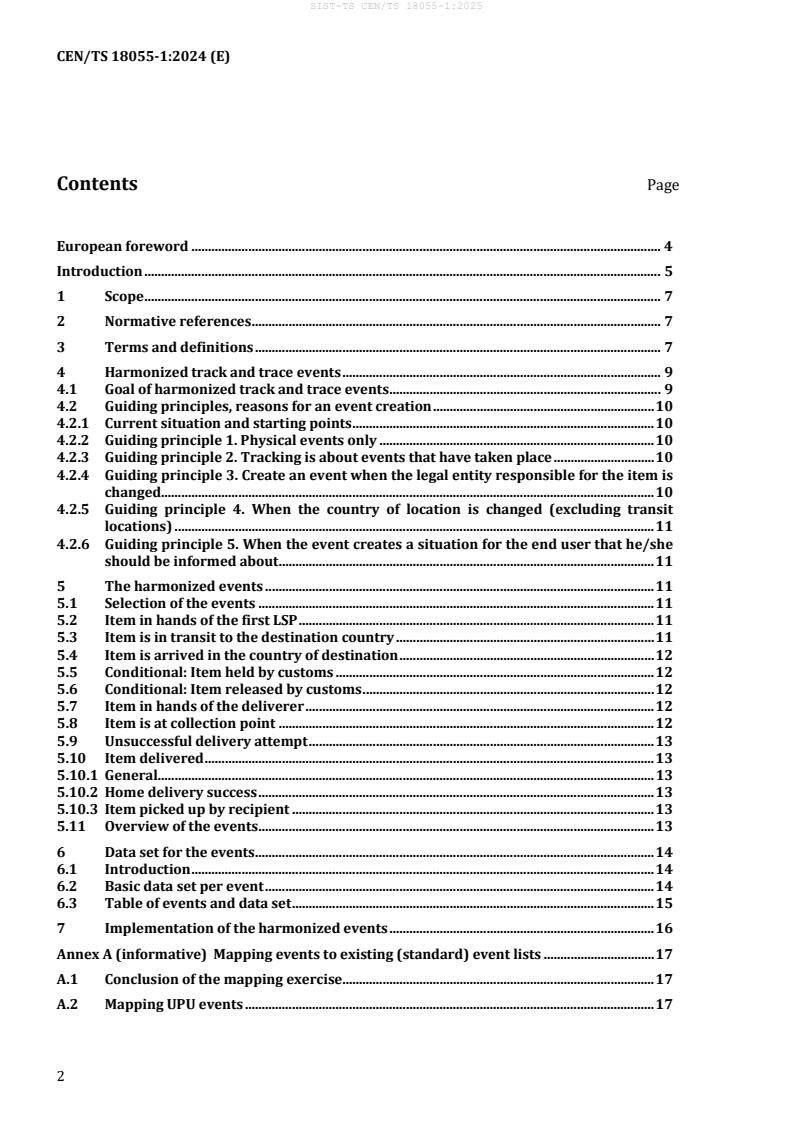
Contents Page
European foreword . 4
Introduction . 5
1 Scope . 7
2 Normative references . 7
3 Terms and definitions . 7
4 Harmonized track and trace events . 9
4.1 Goal of harmonized track and trace events . 9
4.2 Guiding principles, reasons for an event creation . 10
4.2.1 Current situation and starting points . 10
4.2.2 Guiding principle 1. Physical events only . 10
4.2.3 Guiding principle 2. Tracking is about events that have taken place . 10
4.2.4 Guiding principle 3. Create an event when the legal entity responsible for the item is
changed. 10
4.2.5 Guiding principle 4. When the country of location is changed (excluding transit
locations) . 11
4.2.6 Guiding principle 5. When the event creates a situation for the end user that he/she
should be informed about . 11
5 The harmonized events . 11
5.1 Selection of the events . 11
5.2 Item in hands of the first LSP . 11
5.3 Item is in transit to the destination country . 11
5.4 Item is arrived in the country of destination . 12
5.5 Conditional: Item held by customs . 12
5.6 Conditional: Item released by customs . 12
5.7 Item in hands of the deliverer . 12
5.8 Item is at collection point . 12
5.9 Unsuccessful delivery attempt . 13
5.10 Item delivered . 13
5.10.1 General. 13
5.10.2 Home delivery success . 13
5.10.3 Item picked up by recipient . 13
5.11 Overview of the events . 13
6 Data set for the events . 14
6.1 Introduction . 14
6.2 Basic data set per event . 14
6.3 Table of events and data set . 15
7 Implementation of the harmonized events . 16
Annex A (informative) Mapping events to existing (standard) event lists . 17
A.1 Conclusion of the mapping exercise . 17
A.2 Mapping UPU events . 17
A.3 Mapping ISO/IEC DIS 19988 CBV Core Business Vocabulary . 18
A.4 Mapping UN/CEFACT recommendation 24 . 18
Bibliography . 20
European foreword
This document (CEN/TS 18055-1:2024) has been prepared by Technical Committee CEN/TC 331 “Postal
services”, the secretariat of which is held by AFNOR.
Attention is drawn to the possibility that some of the elements of this document may be the subject of
patent rights. CEN shall not be held responsible for identifying any or all such patent rights.
Any feedback and questions on this document should be directed to the users’ national standards body.
A complete listing of these bodies can be found on the CEN website.
This document has been prepared under a standardization request addressed to CEN by the European
Commission. The Standing Committee of the EFTA States subsequently approves these requests for its
Member States.
According to the CEN/CENELEC Internal Regulations, the national standards organisations of the follow-
ing countries are bound to announce this Technical Specification: Austria, Belgium, Bulgaria, Croatia, Cy-
prus, Czech Republic, Denmark, Estonia, Finland, France, Germany, Greece, Hungary, Iceland, Ireland, It-
aly, Latvia, Lithuania, Luxembourg, Malta, Netherlands, Norway, Poland, Portugal, Republic of North Mac-
edonia, Romania, Serbia, Slovakia, Slovenia, Spain, Sweden, Switzerland, Türkiye and the United King-
dom.
Introduction
International track and trace capabilities are a crucial element of Cross border E-Commerce. Predicting
the delivery moment of an E-Commerce item can be difficult because the item may be long distances,
undergoing complex customs and security processes. Therefore, recipients are keen on following their
order via track and trace services.
These services, the provided events, their descriptions and the quality of these events differ per logistical
service provider (LSP).
This leads to an opaque supply chain with limited or no visibility on the progress of the E-Commerce item
on its way to its destination, causing uncertainty for the recipients, increasing call centre calls and costs
whilst reducing the trust in cross border E-Commerce services.
In some cases, over 20 events with unclear descriptions, or even repetitive descriptions that make no
sense to the intended recipient of the E-Commerce item are shared.
An increase of the quality of track and trace services with a focus on the recipient, will lead to an increase
of consumer trust and supply chain cost reductions. In turn, this will lead to growth of cross border E-
Commerce both internationally and domestically.
This document (being the result of a CEN project) will focus on events related to cross border
E-Commerce to and from Europe to and from non-European countries as well as cross border
E-Commerce within Europe. A generic increase of trust in cross border E-Commerce will be beneficial for
the flows within Europe, potentially leading to an increase in cross border trade within the European
Union.
The main purpose of this document is to provide a minimum set of progress updates (Events) that are
well-defined and easy to understand for the recipient of the E-Commerce items.
The starting point for this is the Consumer buying the goods from the E-Commerce seller. Therefore, in
this document, when describing the individual events related to the progress of the execution of the de-
livery of an E-Commerce item, the language we will use is the language of the Consumer.
This in contrast to most other technical specifications for events that take the perspective of the Logistic
Service Providers (LSP) and therefore assume a level of knowledge about transport and logistics opera-
tions that is simply not there with Consumers. Furthermore, this document aims to describe only the
events that deliver the most useful information to the recipient.
This document contains a list of nine (9) track and trace events for LSP’s to share with the recipients of
E-Commerce items to update them regarding the progress of delivery execution. Chapter 5 describes
these events in detail.
The document also includes a description of the basic data set for these events. Chapter 6 provides more
detail on that.
This short list of events (defined from the recipient perspective) can be a starting point for LSP’s currently
not providing any tracking events as well as a reference for LSP’s improving the transparency of their
track and trace solution.
Although this document has been developed with E-Commerce and cross border shipments in mind, har-
monization of track and trace events can benefit other logistic flows, such as domestic shipments and
direct (offline) shop orders.
Therefore, this document may be applicable for goods flows and parcel flows outside the scope of cross-
border E-Commerce that this document covers. E.g. a number of the events mentioned may be applied
also in domestic contexts and/or for transportation of goods that have been traded without using the
Internet.
In general, an LSP will have identified and defined events for itself. Therefore, we fully expect that LSPs
will need to translate or map their own events to the 9 events defined in this document.
In the addendum you will find a mapping of these nine events to a number of track and trace event lists
currently in wide use. The addendum is in no way intended to be comprehensive; many LSPs will need to
make the mapping from their own event set to the set in this document for themselves.
1 Scope
The scope of this document is the forward flow of E-Commerce items. Starting point is arrival at a logistic
service provider, end point is the final delivery, or at least the attempt to final delivery.
The returns flows, either caused by unsuccessful delivery, “return to sender” or as a service for recipients
to send a received shipment back, are not covered by the forward events. To keep this document unam-
biguous and easy to understand, these return flows are excluded. Return flows may be covered in a sep-
arate technical specification.
Not in scope are the logistical flows within the facilities of the producers and sellers of the items. These
fall outside the responsibility of the CEN/TC 331 domain.
Excluded as well, are all events necessary for an LSP to track items within its own facilities. It is up to the
LSP how to run its business, and internal standards are in place for the management of internal processes.
Internal events are considered to be of no interest to a recipient, with the exception of some of the last
mile events which are mentioned later in this document.
2 Normative references
There are no normative references in this document.
3 Terms and definitions
For the purposes of this document, the following terms and definitions apply.
ISO and IEC maintain terminology databases for use in standardization at the following addresses:
— ISO Online browsing platform: available at https://www.iso.org/obp/
— IEC Electropedia: available at https://www.electropedia.org/
3.1
E-Commerce
trading of goods over the Internet
Note 1 to entry: According to Britannica Money, E-Commerce covers “maintaining relationships and conducting
business transactions that include selling information, services, and goods by means of computer telecommunica-
tions networks. It consists of business-to-consumer and business-to-business commerce as well as internal organi-
zational transactions that support those activities.”
Note 2 to entry: Within this document we have simplified the definition to better fit the context of this document.
3.2
E-Commerce company
company engaged in E-Commerce
Note 1 to entry: Examples include, but are not limited to, manufacturers, shops, web-shops, e-merchants, plat-
forms, marketplaces, intermediaries, and information service providers.
3.3
E-Commerce item
package containing products bought/sold as part of an E-Commerce transaction
Note 1 to entry: This definition means that this document covers a specific sub-set of services provided within the
UPU context. Refer to UPU standards and documentation for the determination of that sub-set.
3.4
Logistic Service Provider
LSP
organisation that provides transport and logistic services
Note 1 to entry: In this document this includes postal operators, couriers, express and parcel carrying operators.
In case there is some kind of temporary storage involved in the end-to-end journey, the storage service provider is
also included in the term LSP.
3.5
recipient
person to whom the parcel is destined, whose name and address are written in the addressee zone on the
shipping label
[SOURCE: CEN/TR 18085:2024]
3.6
journey
set of consecutive transport movements and other logistics activities needed to move
the goods or items from the seller’s facility to the buyer’s (recipient) facility as specified in the Sales Order
(Trade transaction)
3.7
transport movement
conveyance (physical carriage) of people, goods, or other objects from place to place
[SOURCE: UN/CEFACT: https://unece.org/DAM/cefact/rsm/RSM_CargoTracingAndTrack-
ing_v0.2.1.pdf#page=9]
3.8
transportation hub
place of any size where cargo or goods are exchanged between vehicles and/or between modes of
transport
3.9
first mile
transportation of goods from a seller’s premises or warehouse to the next hub from where the goods are
forwarded
Note 1 to entry: This transportation may be done by the seller itself. E.g. MSMEs or private senders may take their
E-Commerce item to a Post Offices or Parcel Shop, which is then considered the first transportation hub in the items
journey to the buyer/recipient.
3.10
last mile
final part of a journey of goods (e.g. an E-Commerce item) comprising the movement to the final destina-
tion from a transportation hub near to that destination
Note 1 to entry: A collection point is considered to be the end of the journey when the goods are picked up by a
recipient. Transportation from the collection point to the recipient premises is then under the responsibility of the
recipient.
3.11
collection point
place where the intended recipient of goods/items may retrieve those goods/items
Note 1 to entry: Places include but are not limited to post offices, stores with a service desk, and so-called “parcel
lockers”.
3.12
first mile operator
LSP responsible for executing the first mile transportation
3.13
last mile operator
LSP responsible for executing the last mile transportation
4 Harmonized track and trace events
4.1 Goal of harmonized track and trace events
The goal of this document is to introduce a minimum set of track and trace events that are consistent,
easy to provide and easy to understand for recipients and buyers of cross border
E-Commerce goods. Standard events, provided to a recipient with a meaning that is completely independ-
ent of the logistic service provider and easily understood, bring a level of comfort to the recipient and
leads to a more transparent supply chain from a consumer perspective.
This will lead to an increase of consumer trust, which is beneficial to all parties in the supply chain.
To achieve this increased level of comfort and consumer trust, this document document applies the below
criteria to determine which events have to be in the minimum set.
1) Comfort for consumers/recipients
The event will provide recipients with clear information on the whereabouts of their packet/parcel.
In case all LSP’s provide the same events as defined in this document, the consumer/recipient does not
have to interpret or translate events depending on the LSP. The LSP carries the responsibility for trans-
lating its own events into the events defined in this document. Providing the same events to the recipient,
regardless of the LSP (Logistics Service Provider) who logged the milestone, will generically increase the
trust in cross border E-Commerce.
This will lead to fewer questions from the recipient, which will reduce (call centre) costs for the LSP’s.
2) Ease for e-Merchants and platforms to share events
A standardized set of events makes it easier for E-merchant to share these with their customers, inde-
pendent of the LSP’s the e-Merchant is dealing with.
The e-Merchant may insist that the LSPs they work with provide as a minimum, the events as defined in
this document to them.
3) Fair comparison of services, e.g. transit times
Transit times are built up by the time passing between the occurrence of events. If logistic service pro-
viders use different events and different definitions it is harder to compare their services. Calculations
based on different events will lead to different outcomes. The same goes for the calculation of CO emis-
sions.
4.2 Guiding principles, reasons for an event creation
4.2.1 Current situation and starting points
Track and trace events currently share
...