

SIST EN ISO 23063:2025
(Main)Foundry machinery - Safety requirements for high pressure die casting machines (ISO 23063:2024)
General Information
- Abstract
This document applies to high pressure die casting machines:
a) hot-chamber die casting machines (horizontal die closing system);
b) horizontal cold-chamber die casting machines (horizontal die closing system).
This document applies to high pressure die casting units, i.e. high pressure die casting machines (HPDCM), and their interfaces with the following ancillary equipment:
a) die;
b) melting, holding and dosing furnaces (see ISO 13577-1:2016);
c) metal feeding equipment;
d) inserting and removal devices;
e) spraying appliances;
f) heating and cooling devices for the die.
This ancillary equipment itself is not covered.
Additional risks arising from the material being cast are not covered.
This document does not apply to either low pressure die casting machines or gravity die casting machines, or both.
This document deals with all significant hazards, hazardous situations and events relevant to pressure die casting machines when used as intended and under conditions of misuse which are reasonably foreseeable by the manufacturer (see Clause 4).
This includes hazards coming from intentional interactions as well as unintentional but foreseeable interactions between movable parts of the machine and persons.
This document provides the requirements to be met by the manufacturer to ensure the safety of persons and property during transport, commissioning, use, de-commissioning and maintenance periods, as well as in the event of foreseeable failures or malfunctions that can occur in the equipment.
- Status
- Published
- Public Enquiry End Date
- 31-Jul-2020
- Publication Date
- 24-Aug-2025
- Technical Committee
- I13 - Imaginarni 13
- Current Stage
- 6060 - National Implementation/Publication (Adopted Project)
- Start Date
- 08-Aug-2025
- Due Date
- 13-Oct-2025
- Completion Date
- 25-Aug-2025
- Directive
- 2006/42/EC - Directive 2006/42/EC of the European Parliament and of the Council of 17 May 2006 on machinery, and amending Directive 95/16/EC (recast)OJ Ref: L 7.9.2026 OJ Date: 07-Sep-2026

Overview
EN ISO 23063:2025 - Foundry machinery - Safety requirements for high pressure die casting machines (ISO 23063:2024) specifies safety requirements for high pressure die casting machines (HPDCM). It covers both hot‑chamber (horizontal die closing system) and horizontal cold‑chamber die casting machines and their interfaces with ancillary equipment (die, melting/holding/dosing furnaces, metal feeding, inserting/removal devices, spraying appliances, die heating/cooling). The standard defines hazards and prescribes manufacturer requirements to protect persons and property during transport, commissioning, normal use, foreseeable misuse, maintenance, de‑commissioning and in case of failures or malfunctions.
Key topics and technical requirements
- Scope and exclusions
- Applies to HPDC machines and interfaces with ancillary equipment; ancillary equipment itself and material‑specific risks are not covered.
- Does not apply to low pressure or gravity die casting machines.
- Hazard identification
- Lists significant hazards: mechanical, electrical and control systems, thermal (spurting of molten metal, hot surfaces), fire, noise, gases/vapours/fumes/dust, ergonomic risks, falls, hydraulics/pneumatics, and machine‑specific risks (nozzle, bursting biscuits, injection drive).
- Safety measures and design controls
- Guards and protective devices for die area, die closing mechanisms and movable guards; access control and interlocks.
- Safety‑related control systems and electrical equipment requirements, including emergency stop functions and control of dangerous movements.
- Thermal protection (against spurting and hot surfaces) and measures for hydraulics, pneumatics and pressure fluids.
- Noise reduction considerations and ergonomic design guidance.
- Lifecycle safety
- Requirements for safe transport, commissioning, maintenance, de‑commissioning and foreseeable malfunctions.
- Compliance
- Annex ZA maps the standard to Directive 2006/42/EC (Machinery Directive), providing a presumption of conformity when cited in the Official Journal of the EU.
Applications
EN ISO 23063:2025 is the primary safety reference for:
- Design and manufacturing of high pressure die casting machines (HPDCM) (hot‑ and horizontal cold‑chamber).
- Factory acceptance criteria, risk assessments and machine safety validation.
- Safety documentation for machine installation, commissioning and maintenance procedures.
- Purchasers and operators specifying safety features for new die casting equipment.
Who should use this standard
- Machine manufacturers and designers of HPDC equipment
- Safety managers, plant engineers and maintenance teams in foundries
- Integrators of ancillary die casting equipment (furnaces, feeders, spraying systems)
- Notified bodies and conformity assessors referencing the Machinery Directive
Related standards
- ISO 23063:2024 (base ISO document)
- ISO 13577-1:2016 (melting, holding and dosing furnaces - referenced for furnace interfaces)
- EN 869:2006+A1:2009 (superseded by this standard)
Keywords: EN ISO 23063:2025, high pressure die casting machines, HPDCM, foundry machinery, die casting safety, Machinery Directive, hot‑chamber, cold‑chamber.
Relations
- Effective Date
- 04-Mar-2026
- Effective Date
- 09-Feb-2026
- Effective Date
- 28-Jan-2026
- Effective Date
- 28-Jan-2026
- Effective Date
- 28-Jan-2026
- Effective Date
- 28-Jan-2026
- Effective Date
- 28-Jan-2026
- Refers
SIST EN ISO 20127:2025 - Dentistry - Physical properties of powered toothbrushes (ISO 20127:2025) - Effective Date
- 28-Jan-2026
- Effective Date
- 28-Jan-2026
- Effective Date
- 28-Jan-2026
- Effective Date
- 28-Jan-2026
- Effective Date
- 28-Jan-2026
- Effective Date
- 18-Jan-2023
Get Certified
Connect with accredited certification bodies for this standard

DVS-ZERT GmbH
German welding certification society.

Element Materials Technology
Materials testing and product certification.
Inštitut za kovinske materiale in tehnologije
Institute of Metals and Technology. Materials testing, metallurgical analysis, NDT.
Sponsored listings
Frequently Asked Questions
SIST EN ISO 23063:2025 is a standard published by the Slovenian Institute for Standardization (SIST). Its full title is "Foundry machinery - Safety requirements for high pressure die casting machines (ISO 23063:2024)". This standard covers: This document applies to high pressure die casting machines: a) hot-chamber die casting machines (horizontal die closing system); b) horizontal cold-chamber die casting machines (horizontal die closing system). This document applies to high pressure die casting units, i.e. high pressure die casting machines (HPDCM), and their interfaces with the following ancillary equipment: a) die; b) melting, holding and dosing furnaces (see ISO 13577-1:2016); c) metal feeding equipment; d) inserting and removal devices; e) spraying appliances; f) heating and cooling devices for the die. This ancillary equipment itself is not covered. Additional risks arising from the material being cast are not covered. This document does not apply to either low pressure die casting machines or gravity die casting machines, or both. This document deals with all significant hazards, hazardous situations and events relevant to pressure die casting machines when used as intended and under conditions of misuse which are reasonably foreseeable by the manufacturer (see Clause 4). This includes hazards coming from intentional interactions as well as unintentional but foreseeable interactions between movable parts of the machine and persons. This document provides the requirements to be met by the manufacturer to ensure the safety of persons and property during transport, commissioning, use, de-commissioning and maintenance periods, as well as in the event of foreseeable failures or malfunctions that can occur in the equipment.
This document applies to high pressure die casting machines: a) hot-chamber die casting machines (horizontal die closing system); b) horizontal cold-chamber die casting machines (horizontal die closing system). This document applies to high pressure die casting units, i.e. high pressure die casting machines (HPDCM), and their interfaces with the following ancillary equipment: a) die; b) melting, holding and dosing furnaces (see ISO 13577-1:2016); c) metal feeding equipment; d) inserting and removal devices; e) spraying appliances; f) heating and cooling devices for the die. This ancillary equipment itself is not covered. Additional risks arising from the material being cast are not covered. This document does not apply to either low pressure die casting machines or gravity die casting machines, or both. This document deals with all significant hazards, hazardous situations and events relevant to pressure die casting machines when used as intended and under conditions of misuse which are reasonably foreseeable by the manufacturer (see Clause 4). This includes hazards coming from intentional interactions as well as unintentional but foreseeable interactions between movable parts of the machine and persons. This document provides the requirements to be met by the manufacturer to ensure the safety of persons and property during transport, commissioning, use, de-commissioning and maintenance periods, as well as in the event of foreseeable failures or malfunctions that can occur in the equipment.
SIST EN ISO 23063:2025 is classified under the following ICS (International Classification for Standards) categories: 13.110 - Safety of machinery; 25.120.30 - Moulding equipment; 77.180 - Equipment for the metallurgical industry. The ICS classification helps identify the subject area and facilitates finding related standards.
SIST EN ISO 23063:2025 has the following relationships with other standards: It is inter standard links to SIST ISO 7000:2020, SIST ISO 3864-1:2012, SIST EN ISO 11260:2018, SIST EN ISO 13520:2023, SIST EN 13417-2:2002, SIST EN 1300:2023, SIST EN 16304:2022, SIST EN ISO 20127:2025, SIST EN 13003-3:2000, SIST EN ISO 25649-5:2017, SIST EN 16094:2012, SIST ENV 10247:2000, SIST EN 869:2007+A1:2009. Understanding these relationships helps ensure you are using the most current and applicable version of the standard.
SIST EN ISO 23063:2025 is associated with the following European legislation: EU Directives/Regulations: 2006/42/EC; Standardization Mandates: M/396. When a standard is cited in the Official Journal of the European Union, products manufactured in conformity with it benefit from a presumption of conformity with the essential requirements of the corresponding EU directive or regulation.
SIST EN ISO 23063:2025 is available in PDF format for immediate download after purchase. The document can be added to your cart and obtained through the secure checkout process. Digital delivery ensures instant access to the complete standard document.
Standards Content (Sample)
SLOVENSKI STANDARD
01-oktober-2025
Livarski stroji - Varnostne zahteve za stroje za tlačno litje (ISO 23063:2024)
Foundry machinery - Safety requirements for high pressure die casting machines (ISO
23063:2024)
Sicherheit von Maschinen - Sicherheitsanforderungen an Metall-Druckgießanlagen (ISO
23063:2024)
Machines de fonderie - Prescriptions de sécurité pour les machines à couler sous haute
pression (ISO 23063:2024)
Ta slovenski standard je istoveten z: EN ISO 23063:2025
ICS:
13.110 Varnost strojev Safety of machinery
25.120.30 Livarska oprema Moulding equipment
77.180 Oprema za metalurško Equipment for the
industrijo metallurgical industry
2003-01.Slovenski inštitut za standardizacijo. Razmnoževanje celote ali delov tega standarda ni dovoljeno.
EN ISO 23063
EUROPEAN STANDARD
NORME EUROPÉENNE
July 2025
EUROPÄISCHE NORM
ICS 13.110; 77.180 Supersedes EN 869:2006+A1:2009
English Version
Foundry machinery - Safety requirements for high
pressure die casting machines (ISO 23063:2024)
Machines de fonderie - Exigences de sécurité pour les Sicherheit von Maschinen - Sicherheitsanforderungen
machines à couler sous haute pression (ISO an Metall-Druckgießanlagen (ISO 23063:2024)
23063:2024)
This European Standard was approved by CEN on 8 November 2024.
CEN members are bound to comply with the CEN/CENELEC Internal Regulations which stipulate the conditions for giving this
European Standard the status of a national standard without any alteration. Up-to-date lists and bibliographical references
concerning such national standards may be obtained on application to the CEN-CENELEC Management Centre or to any CEN
member.
This European Standard exists in three official versions (English, French, German). A version in any other language made by
translation under the responsibility of a CEN member into its own language and notified to the CEN-CENELEC Management
Centre has the same status as the official versions.
CEN members are the national standards bodies of Austria, Belgium, Bulgaria, Croatia, Cyprus, Czech Republic, Denmark, Estonia,
Finland, France, Germany, Greece, Hungary, Iceland, Ireland, Italy, Latvia, Lithuania, Luxembourg, Malta, Netherlands, Norway,
Poland, Portugal, Republic of North Macedonia, Romania, Serbia, Slovakia, Slovenia, Spain, Sweden, Switzerland, Türkiye and
United Kingdom.
EUROPEAN COMMITTEE FOR STANDARDIZATION
COMITÉ EUROPÉEN DE NORMALISATION
EUROPÄISCHES KOMITEE FÜR NORMUNG
CEN-CENELEC Management Centre: Rue de la Science 23, B-1040 Brussels
© 2025 CEN All rights of exploitation in any form and by any means reserved Ref. No. EN ISO 23063:2025 E
worldwide for CEN national Members.
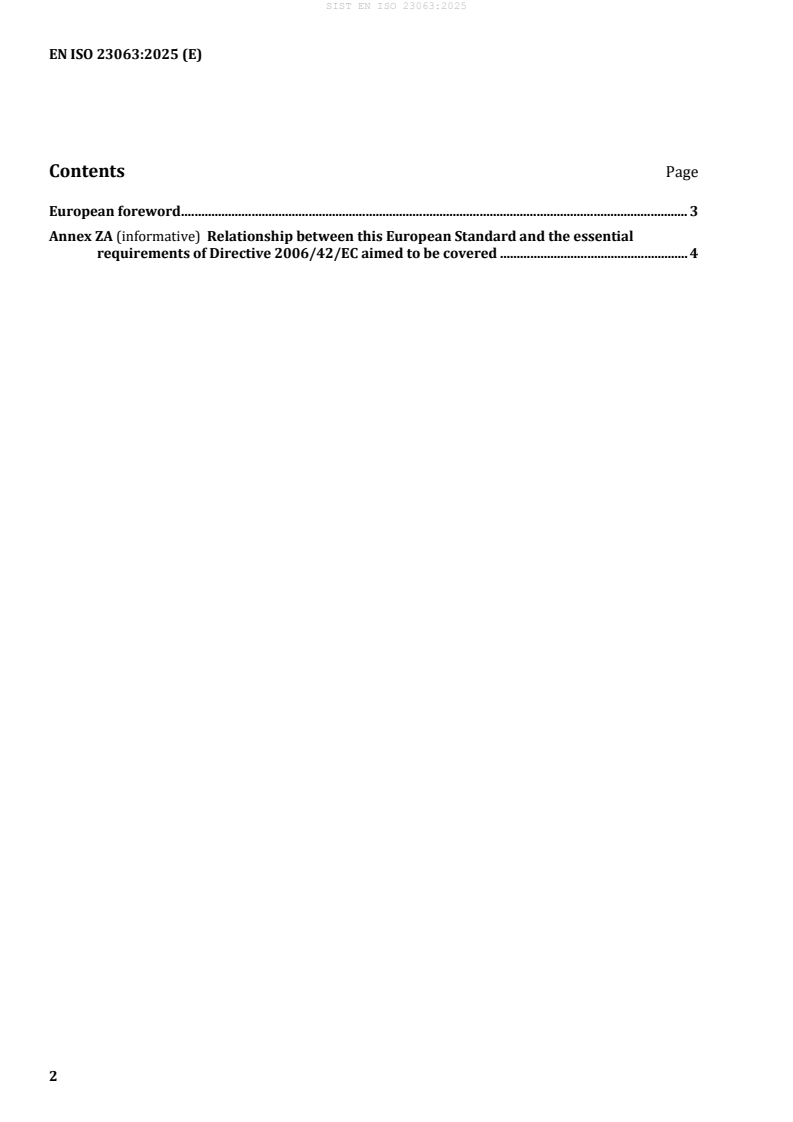
Contents Page
European foreword . 3
Annex ZA (informative) Relationship between this European Standard and the essential
requirements of Directive 2006/42/EC aimed to be covered . 4
European foreword
This document (EN ISO 23063:2025) has been prepared by Technical Committee ISO/TC 306 "Foundry
machinery" in collaboration with Technical Committee CEN/TC 202 “Foundry machinery” the
secretariat of which is held by DIN.
This European Standard shall be given the status of a national standard, either by publication of an
identical text or by endorsement, at the latest by January 2026, and conflicting national standards shall
be withdrawn at the latest by January 2026.
Attention is drawn to the possibility that some of the elements of this document may be the subject of
patent rights. CEN shall not be held responsible for identifying any or all such patent rights.
This document supersedes EN 869:2006+A1:2009.
This document has been prepared under a standardization request addressed to CEN by the European
Commission. The Standing Committee of the EFTA States subsequently approves these requests for its
Member States.
For the relationship with EU Legislation, see informative Annex ZA, which is an integral part of this
document.
Any feedback and questions on this document should be directed to the users’ national standards
body/national committee. A complete listing of these bodies can be found on the CEN website.
According to the CEN-CENELEC Internal Regulations, the national standards organizations of the
following countries are bound to implement this European Standard: Austria, Belgium, Bulgaria,
Croatia, Cyprus, Czech Republic, Denmark, Estonia, Finland, France, Germany, Greece, Hungary, Iceland,
Ireland, Italy, Latvia, Lithuania, Luxembourg, Malta, Netherlands, Norway, Poland, Portugal, Republic of
North Macedonia, Romania, Serbia, Slovakia, Slovenia, Spain, Sweden, Switzerland, Türkiye and the
United Kingdom.
Endorsement notice
The text of ISO 23063:2024 has been approved by CEN as EN ISO 23063:2025 without any modification.
Annex ZA
(informative)
Relationship between this European Standard and the essential
requirements of Directive 2006/42/EC aimed to be covered
This European Standard has been prepared under a Commission’s standardization request “M/396
Mandate to CEN and CENELEC for Standardisation in the field of machinery" to provide one voluntary
means of conforming to essential requirements of Directive 2006/42/EC of the European Parliament
and of the Council of 17 May 2006 on machinery, and amending Directive 95/16/EC (recast)
Once this standard is cited in the Official Journal of the European Union under that Directive,
compliance with the normative clauses of this standard given in Table ZA.1 confers, within the limits of
the scope of this standard, a presumption of conformity with the corresponding essential requirements
of that Directive, and associated EFTA regulations.
Table ZA.1 — Correspondence between this European Standard and Annex I of Directive
2006/42/EC
The relevant Essential Clause(s)/sub-clause(s) of Remarks/Notes
Requirements of Directive this EN
2006/42/EC
1.1.2. a) Principles of safety 5, 6, 7
integration
1.1.2. c) Principles of safety 5, 6, 7
integration
1.1.2. d) Principles of safety 5, 6, 7
integration
1.1.2. e) Principles of safety 5, 6, 7
integration
1.1.3. Materials and products 4.2, 4.7, 5.5.3, 7.3
1.1.5. Design of machinery to Not covered (only informative
facilitate its handling in 7.3.1)
1.1.6. Ergonomics 5.2.4, 7.3.1
1.2.1. Safety and reliability of 5.3.
control systems
1.2.2. Control devices 5.2.2.2 b, 5.2.2.2 e
1.2.3. Starting 7.3.1, 5.2.3a, 5.2.3 b, 5.2.4 f,
5.2.4g
1.2.4.3. Emergency stop 5.3.3, 5.2.5, 7.3.1
1.2.4.4. Assembly of machinery Not covered (only informative
in 5.2.5, 7.3.1)
1.2.5. Selection of control or 5.2.2, 5.2.3, 5.2.4, 5.9.1, 5.9.2
operating modes
1.2.6. Failure of the power 7.3.1, 5.2.2.2, 5.2.3
supply
1.3.2. Risk of break-up during 5.3.4.3.2, 5.5.2
operation
1.3.3. Risks due to falling or 5.11.1, 5.12.1, 7.3.1
ejected objects
1.3.5. Risks related to combined 5.2, 5.2.2.2, 5.3.5, 7.3.1
machinery
1.3.7. Risks related to moving 5.2.2, 5.2.3, 5.2.4, 5.2.5
parts
1.3.8. Choice of protection 5.2, 5.11.1
against risks arising from
moving parts
1.4.1. General requirements 5.1, 5.2.1
1.4.2. Special requirements for 5.2, 5.3, 5.4
guards
1.4.2.1. Fixed guards 5.2, 5.3, 5.4
1.4.2.2. Interlocking movable 5.2, 5.3, 5.4
guards
1.4.3. Special requirements for 5.2, 5.3, 5.4
protective devices
1.5.1. Electricity supply 5.3.1
1.5.5. Extreme temperatures 5.4.1, 5.4.2
1.5.6. Fire 5.5.2, 5.5.3
1.5.7. Explosion Not covered (only informative
in 7.3.1)
1.5.8. Noise Not covered (only informative
in 5.6.1, Annex B)
1.5.14. Risk of being trapped in 5.2.2, 5.2.3, 5.2.4, 5.2.5
a machine
1.5.15. Risk of slipping, tripping 5.10
or falling
1.6.1. Machinery maintenance Not covered
1.6.2. Access to operating 4.8, 5.2.4
positions and servicing points
1.6.4. Operator intervention 5.2.4, 5.8, 4.7
1.6.5. Cleaning of internal parts Not covered
1.7.1. Information and warnings 7.2
on the machinery
1.7.1.2. Warning devices 7.2
1.7.2. Warning of residual risks 7.2
1.7.3. Marking of machinery 7.4
1.7.4. Instructions 7.3.1
1.7.4.1. General principles for 7.3.1
the drafting of instructions
1.7.4.2. Contents of the 7.3.1
instructions
1.7.4.2 u) Not covered (EN
1265:1999+A1:2008 is not
harmonized under
2006/42/EC)
1.7.4.3. Sales literature Not covered
WARNING 1 — Presumption of conformity stays valid only as long as a reference to this European
Standard is maintained in the list published in the Official Journal of the European Union. Users of this
standard should consult frequently the latest list published in the Official Journal of the European
Union.
WARNING 2 — Other Union legislation may be applicable to the product(s) falling within the scope of
this standard.
International
Standard
ISO 23063
First edition
Foundry machinery — Safety
2024-11
requirements for high pressure die
casting machines
Machines de fonderie — Exigences de sécurité pour les machines
à couler sous haute pression
Reference number
ISO 23063:2024(en) © ISO 2024
ISO 23063:2024(en)
© ISO 2024
All rights reserved. Unless otherwise specified, or required in the context of its implementation, no part of this publication may
be reproduced or utilized otherwise in any form or by any means, electronic or mechanical, including photocopying, or posting on
the internet or an intranet, without prior written permission. Permission can be requested from either ISO at the address below
or ISO’s member body in the country of the requester.
ISO copyright office
CP 401 • Ch. de Blandonnet 8
CH-1214 Vernier, Geneva
Phone: +41 22 749 01 11
Email: copyright@iso.org
Website: www.iso.org
Published in Switzerland
ii
ISO 23063:2024(en)
Contents Page
Foreword .v
Introduction .vi
1 Scope . 1
2 Normative references . 1
3 Terms and definitions . 3
4 List of significant hazards . 7
4.1 General .7
4.2 Mechanical hazards .7
4.3 Electrical and control system hazards .7
4.3.1 Electrical hazards.7
4.3.2 Control system hazards .7
4.4 Thermal hazards . .8
4.5 Fire hazards .8
4.6 Noise hazards .8
4.7 Hazards caused by gases, vapours, fumes and dusts .8
4.8 Hazards generated by neglecting ergonomic principles in machinery design.8
4.9 Hazards during the setting mode .9
4.10 Falls from heights.9
4.11 Hazards related to cold-chamber die casting machines .9
4.11.1 Bursting of biscuits .9
4.11.2 Injection drive area .9
4.12 Hazards related to hot-chamber die casting machines .9
4.12.1 Nozzle .9
4.12.2 Initiation of the casting process due to a fault in the control system .9
4.13 Hazards due to hydraulics and pneumatics . .9
5 Safety requirements and/or protective measures . 10
5.1 General .10
5.2 Mechanical .10
5.2.1 General .10
5.2.2 Guards and protective devices for the die area .10
5.2.3 Access to the die closing mechanism area . 12
5.2.4 Additional requirements for movable guards and access doors . 12
5.2.5 Die casting units . 13
5.3 Electric equipment and control systems .14
5.3.1 Electric equipment .14
5.3.2 Safety related parts of the control system: General .14
5.3.3 Emergency stop functions .14
5.3.4 Safety related control system of the dangerous movements of the die .14
5.3.5 Control of ancillary equipment . 15
5.4 Measures against thermal hazards .16
5.4.1 Spurting of molten metal .16
5.4.2 Contact with hot surfaces .16
5.5 Hydraulics, pneumatics and combustible fluids .16
5.5.1 Hydraulics, pneumatics .16
5.5.2 Pressure fluids .16
5.5.3 Spray systems for release agents .16
5.6 Noise .17
5.6.1 Noise reduction as a safety requirement .17
5.6.2 Noise emission measurement and declaration on die casting machines .17
5.6.3 Noise test code.17
5.7 Gases, vapours, fumes and dusts .19
5.8 Ergonomic aspects .19
iii
ISO 23063:2024(en)
5.9 Protective measures when setting-up of die casting machines, inserting and removing
appliances, tie bar pulling devices and other ancillary equipment .19
5.9.1 Setting-up without protective devices for the die area .19
5.9.2 Movement of core pullers and ejectors . . 20
5.9.3 Movement of tie bars . 20
5.9.4 Movement of the plunger of cold-chamber machines . 20
5.10 Elevated working places . 20
5.11 Additional protective measures for cold-chamber die casting machines .21
5.11.1 Bursting and removal of biscuit .21
5.11.2 Guards and protective devices for the injection area .21
5.12 Additional protective measures for hot-chamber die casting machines .21
5.12.1 Metal splashing .21
5.12.2 Movement of the injection piston .21
6 Verification of the safety requirements and/or protective measures .22
7 Information for use .23
7.1 General . 23
7.2 Warning devices and safety signs . 23
7.3 Accompanying documents . 23
7.3.1 Instruction handbook . 23
7.4 Marking . 25
Annex A (informative) Examples .27
Annex B (normative) Requirements for the European Union and associated countries .40
Annex C (normative) Requirements for China (noise test code) . 41
Bibliography .42
iv
ISO 23063:2024(en)
Foreword
ISO (the International Organization for Standardization) is a worldwide federation of national standards
bodies (ISO member bodies). The work of preparing International Standards is normally carried out through
ISO technical committees. Each member body interested in a subject for which a technical committee
has been established has the right to be represented on that committee. International organizations,
governmental and non-governmental, in liaison with ISO, also take part in the work. ISO collaborates closely
with the International Electrotechnical Commission (IEC) on all matters of electrotechnical standardization.
The procedures used to develop this document and those intended for its further maintenance are described
in the ISO/IEC Directives, Part 1. In particular, the different approval criteria needed for the different types
of ISO document should be noted. This document was drafted in accordance with the editorial rules of the
ISO/IEC Directives, Part 2 (see www.iso.org/directives).
ISO draws attention to the possibility that the implementation of this document may involve the use of (a)
patent(s). ISO takes no position concerning the evidence, validity or applicability of any claimed patent
rights in respect thereof. As of the date of publication of this document, ISO had not received notice of (a)
patent(s) which may be required to implement this document. However, implementers are cautioned that
this may not represent the latest information, which may be obtained from the patent database available at
www.iso.org/patents. ISO shall not be held responsible for identifying any or all such patent rights.
Any trade name used in this document is information given for the convenience of users and does not
constitute an endorsement.
For an explanation of the voluntary nature of standards, the meaning of ISO specific terms and expressions
related to conformity assessment, as well as information about ISO's adherence to the World Trade
Organization (WTO) principles in the Technical Barriers to Trade (TBT), see www.iso.org/iso/foreword.html.
This document was prepared by Technical Committee ISO/TC 306, Foundry machinery, in collaboration with
the European Committee for Standardization (CEN) Technical Committee CEN/TC 202, Foundry machinery,
in accordance with the Agreement on technical cooperation between ISO and CEN (Vienna Agreement).
Any feedback or questions on this document should be directed to the user’s national standards body. A
complete listing of these bodies can be found at www.iso.org/members.html.
v
ISO 23063:2024(en)
Introduction
This document is a type C standard as stated in ISO 12100.
This document is of relevance, in particular, for the following stakeholder groups representing the market
players with regard to machinery safety:
— machine manufacturers (small, medium and large enterprises);
— health and safety bodies (e.g. regulators, accident prevention organisations, market surveillance).
Others can be affected by the level of machinery safety achieved with the means of the document by the
above-mentioned stakeholder groups:
— machine users/employers (small, medium and large enterprises);
— machine users/employees (e.g. trade unions, organizations for people with special needs);
— service providers, for example, for maintenance (small, medium and large enterprises);
— consumers (in case of machinery intended for use by consumers).
The above-mentioned stakeholder groups have been given the possibility to participate at the drafting
process of this document.
The machinery concerned and the extent to which hazards, hazardous situations or hazardous events are
covered are indicated in the Scope of this document.
When requirements of this type-C standard are different from those which are stated in type-A or type-B
standards, the requirements of this type-C standard take precedence over the requirements of the other
standards for machines that have been designed and built according to the requirements of this type-C
standard.
Where, for clarity, an example of a preventive measure is given in this document, this should not be
considered as the only possible solution. Any other solution leading to the same risk reduction is permissible
if an equivalent level of safety is achieved.
It is assumed that the machinery according to the scope is operated and maintained by trained personnel.
vi
International Standard ISO 23063:2024(en)
Foundry machinery — Safety requirements for high pressure
die casting machines
1 Scope
This document applies to high pressure die casting machines:
a) hot-chamber die casting machines (horizontal die closing system);
b) horizontal cold-chamber die casting machines (horizontal die closing system).
This document applies to high pressure die casting units, i.e. high pressure die casting machines (HPDCM),
and their interfaces with the following ancillary equipment:
a) die;
b) melting, holding and dosing furnaces (see ISO 13577-1:2016);
c) metal feeding equipment;
d) inserting and removal devices;
e) spraying appliances;
f) heating and cooling devices for the die.
This ancillary equipment itself is not covered.
Additional risks arising from the material being cast are not covered.
This document does not apply to either low pressure die casting machines or gravity die casting machines,
or both.
This document deals with all significant hazards, hazardous situations and events relevant to pressure die
casting machines when used as intended and under conditions of misuse which are reasonably foreseeable
by the manufacturer (see Clause 4).
This includes hazards coming from intentional interactions as well as unintentional but foreseeable
interactions between movable parts of the machine and persons.
This document provides the requirements to be met by the manufacturer to ensure the safety of persons
and property during transport, commissioning, use, de-commissioning and maintenance periods, as well as
in the event of foreseeable failures or malfunctions that can occur in the equipment.
2 Normative references
The following documents are referred to in the text in such a way that some or all of their content constitutes
requirements of this document. For dated references, only the edition cited applies. For undated references,
the latest edition of the referenced document (including any amendments) applies.
ISO 3864-1:2011, Graphical symbols — Safety colours and safety signs — Part 1: Design principles for safety
signs and safety markings
ISO 4413:2010, Hydraulic fluid power — General rules and safety requirements for systems and their components
ISO 23063:2024(en)
ISO 4414:2010, Pneumatic fluid power — General rules and safety requirements for systems and their
components
ISO 7000:2019, Graphical symbols for use on equipment — Registered symbols
ISO 7731:2003, Ergonomics — Danger signals for public and work areas — Auditory danger signals
ISO 7745:2024, Hydraulic fluid power — Fire-resistant fluids — Requirements and guidelines for use
ISO 11201:2010, Acoustics — Noise emitted by machinery and equipment — Determination of emission sound
pressure levels at a work station and at other specified positions in an essentially free field over a reflecting
plane with negligible environmental corrections
ISO 11202:2010, Acoustics — Noise emitted by machinery and equipment — Determination of emission
sound pressure levels at a work station and at other specified positions applying approximate environmental
corrections
ISO 11204:2010, Acoustics — Noise emitted by machinery and equipment — Determination of emission sound
pressure levels at a work station and at other specified positions applying accurate environmental corrections
ISO 11429:1996, Ergonomics — System of auditory and visual danger and information signals
ISO/TR 11688-1:1995, Acoustics — Recommended practice for the design of low-noise machinery and equipment
— Part 1: Planning
ISO 12100:2010, Safety of machinery — General principles for design — Risk assessment and risk reduction
ISO 13732-1:2006, Ergonomics of the thermal environment — Methods for the assessment of human responses
to contact with surfaces — Part 1: Hot surfaces
ISO 13849-1:2023, Safety of machinery — Safety-related parts of control systems — Part 1: General principles
for design
ISO 13850:2015, Safety of machinery — Emergency stop function — Principles for design
ISO 13851:2019, Safety of machinery — Two-hand control devices — Principles for design and selection
ISO 13854:2017, Safety of machinery — Minimum gaps to avoid crushing of parts of the human body
ISO 13855:2010, Safety of machinery — Positioning of safeguards with respect to the approach speeds of parts
of the human body
ISO 13856-2:2013, Safety of machinery — Pressure-sensitive protective devices — Part 2: General principles for
design and testing of pressure-sensitive edges and pressure-sensitive bars
ISO 13857:2019, Safety of machinery — Safety distances to prevent hazard zones being reached by upper and
lower limbs
ISO 14119:2024, Safety of machinery — Interlocking devices associated with guards — Principles for design and
selection
ISO 14120:2015, Safety of machinery — Guards — General requirements for the design and construction of fixed
and movable guards
ISO 14122-1:2016, Safety of machinery — Permanent means of access to machinery — Part 1: Choice of fixed
means and general requirements of access
ISO 14122-2:2016, Safety of machinery — Permanent means of access to machinery — Part 2: Working platforms
and walkways
ISO 14122-3:2016, Safety of machinery — Permanent means of access to machinery — Part 3: Stairs, stepladders
and guard-rails
IEC 60204-1:2016, Safety of machinery — Electrical equipment of machines — Part 1: General requirements
ISO 23063:2024(en)
IEC 61310-1:2007, Safety of machinery — Indication, marking and actuation — Part 1: Requirements for visual,
acoustic and tactile signals
IEC 61310-2:2007, Safety of machinery — Indication, marking and actuation — Part 2: Requirements for marking
3 Terms and definitions
For the purposes of this document, the terms and definitions given in ISO 12100 and the following apply.
ISO and IEC maintain terminology databases for use in standardization at the following addresses:
— ISO Online browsing platform: available at https:// www .iso .org/ obp
— IEC Electropedia: available at https:// www .electropedia .org/
3.1
casting
component or product that has obtained its shape through the process of die casting (3.2)
3.2
die casting
process in which molten metal (3.7) is injected into a die and held under pressure until complete solidification
3.3
die casting machine
machine with the purpose to inject molten metal (3.7) under pressure into a parted die which is connected
to the platens of the machine
3.4
die casting cell
die casting machine (3.3), together with auxiliary and ancillary equipment (3.6), which form a complete
production unit
3.5
auxiliary equipment
set of all the devices which carry out additional process functions within a die casting cell (3.4)
3.6
ancillary equipment
devices which automatically carry out process functions additional to those of the die casting machine (3.3)
itself, e.g. feeding the metal (3.7), removing the castings, spraying the die
3.7
metal
material, which is suitable for being cast in the die casting (3.2) process
3.8
hot-chamber die casting machine
die casting machine (3.3) with an inclined or horizontal die closing system (3.10) having the shot sleeve (3.19)
and plunger (3.20) which are submerged in the molten metal (3.7) of the furnace
Note 1 to entry: See Figure A.1.
3.9
cold-chamber die casting machine
die casting machine (3.3) with a horizontal die closing system (3.10), where molten metal (3.7) is delivered to
the shot sleeve (3.19) in measured amounts from a separate furnace
Note 1 to entry: There are cold-chamber die casting machines with toggle (see Figure A.2) and toggle-free (see
Figure A.3) closing systems.
ISO 23063:2024(en)
3.10
die closing system
assembly which opens and closes the die, and holds the die against the force exerted on the molten metal
(3.7) during injection and solidification
3.11
injection system
assembly which forces molten metal (3.7) from the shot sleeve (3.19) into the die cavity and applies pressure
to the molten metal during solidification
3.12
ejector
system of assembled machine components (e.g. ejector plate and ejector rod) connected to the ejector device
of the die, which allows the ejection of castings from the die cavity
3.13
core puller
assembly which controls movements of cores
3.14
tie bar pulling device
device for pulling tie bars (3.17) in order to facilitate die set-up procedure
3.15
die clamping device
device for clamping the die to the platens of the machine (automatically or manually)
3.16
moving platen
movable platen
platen to which the moving die-half is connected
3.17
tie bar
bar which carries the locking load and guide the moving platen (3.16)
3.18
injection drive
system (e.g. hydraulic) which moves the plunger (3.20) and applies force to it
3.19
shot sleeve
cylindrical container of a cold-chamber die casting machine (3.9) in which pressure is applied to molten
metal (3.7)
3.20
plunger
plunger tip
piston which forces molten metal (3.7) from the shot sleeve (3.19) into the die and applies pressure to the
molten metal during solidification
3.21
gooseneck
part of an injection system (3.11) [containing the shot sleeve (3.19) and metal (3.7) flow channel] which is
submerged in molten metal
Note 1 to entry: Only applies to hot-chamber die casting machines (3.8).
3.22
nozzle
connection between the gooseneck (3.21) and the fixed die-half
ISO 23063:2024(en)
3.23
biscuit
slug
metal (3.7) surplus which solidifies in the cold-chamber shot sleeve (3.19) and is ejected with the casting
3.24
fixed platen
platen to which the fixed die-half and the metal (3.7) injection system (3.11) are connected
3.25
die area
area between the fixed platen (3.24) and the moving platen (3.16)
3.26
cylinder platen
platen to which the die closing mechanism and the closing cylinder are connected
Note 1 to entry: Also known as thrust platen, reaction platen, link housing or rear platen.
3.27
die closing mechanism area
area between the moving platen (3.16) and the cylinder platen (3.26)
3.28
injection drive area
area between the fixed platen (3.24) and the shot cylinder
3.29
closing safety device
device actuated by the movable guard which prevents the die from closing if a failure occurs in the control system
3.30
setting mode
operating mode where any step in the process can be selected and hand operated in any sequence with
restricted operation of the safety functions
EXAMPLE To perform individual steps of the process (not necessarily in operating cycle sequence), like
changing a die.
3.31
manual mode
operating mode where the individual steps in the machine cycle are hand initiated
EXAMPLE To perform the individual steps of the process (only in the sequence which is fixed by the program),
such as to finish the casting cycle or to run the casting cycle in order to examine or to look for faults.
3.32
semi-automatic mode
operating mode where each cycle is hand initiated but thereafter automatically proceeds to completion
EXAMPLE To produce castings in which at least one of the steps of the process which is performed outside the
machine is executed by the operator (3.35).
3.33
automatic mode
operating mode where the completion of a casting cycle initiates the next casting cycle
EXAMPLE To continuously produce castings with any external process steps being automatically carried out by
ancillary device.
ISO 23063:2024(en)
3.34
machine-setter
designated person, trained and skilled to carry out adjusting, die changing, setting and starting-up the die
casting (3.2) process
3.35
operator
designated person trained and skilled to run the die casting machine (3.3)
3.36
access door
door of the distance guards of a die casting cell (3.4)
3.37
inspection
measure to observe and assess the current condition as well as fault finding
Note 1 to entry: Measures (e.g. measuring, testing, diagnostics) including the determination of the causes of wear or
damage and the derivation of the necessary consequences for the continued use.
Note 2 to entry: This definition does not cover “material inspection”.
3.38
maintenance
combination of service, inspection (3.37), reconditioning and functional test of the equipment
Note 1 to entry: The purpose is to preserve the working condition or returning to this condition so that the required
function can be performed (including safety requirements).
Note 2 to entry: Service is a measure to maintain the nominal condition. The nominal condition can be maintained
in general without dismantling/disassembling major parts of the equipment (e.g. cleaning, lubrication of the work
equipment as well as addition or replacement of agents) or by replacing tools or operational changing parts.
Note 3 to entry: Reconditioning is a measure to return to the nominal condition. Foreseeable measures to replace
worn parts or parts having expired the foreseen lifetime (can require dismantling/disassembling). These parts should
meet manufacturers' specification.
Note 4 to entry: A functional test is checking the functionality of the exchanged or repaired parts. Adjustment work
can be required (e.g. test runs, verifying safety functions).
3.39
dry cycle
operation mode of the die casting machine (3.3), with all movements of the die casting machine, which are
typical for a production cycle [e.g. with injection cylinder movements but without molten metal (3.7) and
with die opening, die closing and interlocking using a die or a test block (3.40) mounted in the die area (3.25)]
3.40
test block
object for simulating the presence of a die in the die area (3.25) of the machine
3.41
performance level
PL
discrete level used to specify the ability of safety-related parts of control systems to perform a safety
function under foreseeable conditions
Note 1 to entry: The symbols “a”, “b”, “c”, “d”, and “e” in this document indicate the performance level of safety-related
components with respect to their average probability of dangerous failure. More information on these symbols is
given in ISO 13849-1.
[SOURCE: ISO 13849-1:2023, 3.1.5, modified — Note 1 to entry has been replaced.]
ISO 23063:2024(en)
4 List of significant hazards
4.1 General
Clause 4 contains all the significant hazards, hazardous situations and events, as far as they are dealt with
in this document, identified by risk assessment as significant for this type of machinery and which require
action to eliminate or reduce the risk.
If, because of the special de
...