

SIST EN 16663:2026
(Main)Biological durability of wood and wood-based products - Determination of emissions from preservative treated wood to the environment - Wooden commodities exposed in Use Class 3 (Not covered, not in contact with the ground) - Semi-field method
General Information
- Abstract
This document specifies a method for determining the leaching of active ingredients or other compounds from preservative treated wood by a semi-field method for Use Class 3 (outdoor above ground). The preservative treated wood can be tested with or without subsequently surface coating or other water-repellent treatment. The method is applicable to the testing of commercial or experimental preservatives or paint systems applied to timber by methods appropriate to commercial practice.
- Status
- Published In Edit
- Public Enquiry End Date
- 11-Sep-2024
- Publication Date
- 07-Dec-2025
- Technical Committee
- LLZ - Les, lesni izdelki in zaščita lesa
- Current Stage
- 6060 - National Implementation/Publication (Adopted Project)
- Start Date
- 04-Dec-2025
- Due Date
- 08-Feb-2026
- Completion Date
- 08-Dec-2025
Buy Documents



Overview
EN 16663:2025 - "Biological durability of wood and wood-based products - Determination of emissions from preservative treated wood to the environment - Wooden commodities exposed in Use Class 3 (Not covered, not in contact with the ground) - Semi-field method" (CEN) specifies a semi-field test method to quantify leaching and emissions from preservative‑treated wood exposed outdoors above ground (Use Class 3). The method collects rainwater leachate from representative test panels under natural weathering and reports emissions related to wood surface area for environmental assessment.
Key topics and technical requirements
- Scope and applicability: Method for commercial or experimental preservatives and paint systems, with or without subsequent coatings or water‑repellent treatments; targeted at Use Class 3 (outdoor, not covered, not in contact with ground).
- Test principle: Semi‑field exposure of treated test panels; retention and periodic collection of rainwater (leachate) for chemical analysis.
- Quality criteria for analysis: accuracy, specificity, limit of detection (LOD), limit of quantification (LOQ), and precision.
- Apparatus and monitoring:
- Vessels for receiving water (glass/plastic free from interfering impurities)
- Gutters/collecting systems and inert fixings (stainless steel recommended)
- Weather station to record rainfall, wind direction and speed
- Exposure racks to maintain panel orientation (described in Annex A)
- Storage (refrigerator/freezer min. −18 °C) to preserve leachate
- Chemical analysis equipment suitable for expected analyte concentrations
- Test specimens and preparation:
- Representative commercial timber (e.g. Scots pine sapwood as typical example)
- Conditioning and dimensional guidance (e.g. specimen cross sections and panel lengths described)
- Documentation of product identity, active ingredients and any coating used
- Results and reporting: Emissions expressed relative to surface area; test report must include treatment details, exposure site, specimen data and analytical method validation.
Practical applications and users
EN 16663:2025 is used to:
- Provide quantitative emission data for environmental risk assessment of treated wood (e.g., under Biocidal Products Regulation, EU 528/2012).
- Support manufacturers of wood preservatives, paint and coating systems in product characterization.
- Inform regulators, testing laboratories, environmental consultants, and certification bodies assessing environmental impact and compliance.
- Provide leachate samples for ecotoxicity testing (e.g., Daphnia tests) and scenario modelling.
Related standards and references
- EN 335 (Use classes of wood)
- EN ISO 5667‑3 (Water sampling - preservation and handling)
- Nordtest NT Build 509 (basis for the semi‑field approach)
- Biocidal Products Regulation (EU) 528/2012
EN 16663:2025 standardizes semi‑field leaching tests, enabling consistent, reproducible emission data for treated wood used above ground. Keywords: EN 16663:2025, leaching, preservative treated wood, Use Class 3, semi‑field method, emissions, environmental risk assessment.
Relations
- Effective Date
- 28-Jan-2026
- Effective Date
- 19-Jan-2023
Buy Documents
Get Certified
Connect with accredited certification bodies for this standard

BSI Group
BSI (British Standards Institution) is the business standards company that helps organizations make excellence a habit.

Bureau Veritas
Bureau Veritas is a world leader in laboratory testing, inspection and certification services.

DNV
DNV is an independent assurance and risk management provider.
Sponsored listings
Frequently Asked Questions
SIST EN 16663:2026 is a standard published by the Slovenian Institute for Standardization (SIST). Its full title is "Biological durability of wood and wood-based products - Determination of emissions from preservative treated wood to the environment - Wooden commodities exposed in Use Class 3 (Not covered, not in contact with the ground) - Semi-field method". This standard covers: This document specifies a method for determining the leaching of active ingredients or other compounds from preservative treated wood by a semi-field method for Use Class 3 (outdoor above ground). The preservative treated wood can be tested with or without subsequently surface coating or other water-repellent treatment. The method is applicable to the testing of commercial or experimental preservatives or paint systems applied to timber by methods appropriate to commercial practice.
This document specifies a method for determining the leaching of active ingredients or other compounds from preservative treated wood by a semi-field method for Use Class 3 (outdoor above ground). The preservative treated wood can be tested with or without subsequently surface coating or other water-repellent treatment. The method is applicable to the testing of commercial or experimental preservatives or paint systems applied to timber by methods appropriate to commercial practice.
SIST EN 16663:2026 is classified under the following ICS (International Classification for Standards) categories: 13.020.30 - Environmental impact assessment; 71.100.50 - Wood-protecting chemicals. The ICS classification helps identify the subject area and facilitates finding related standards.
SIST EN 16663:2026 has the following relationships with other standards: It is inter standard links to SIST EN ISO 5667-3:2024, SIST-TS CEN/TS 16663:2017. Understanding these relationships helps ensure you are using the most current and applicable version of the standard.
SIST EN 16663:2026 is available in PDF format for immediate download after purchase. The document can be added to your cart and obtained through the secure checkout process. Digital delivery ensures instant access to the complete standard document.
Standards Content (Sample)
SLOVENSKI STANDARD
01-januar-2026
Biološka trajnost lesa in lesnih proizvodov - Ugotavljanje emisij iz zaščitenega
lesa v okolje - Leseni izdelki, izpostavljeni 3. razredu uporabe (nepokrita uporaba,
niso v stiku z zemljo) - Delno terenska metoda
Biological durability of wood and wood-based products - Determination of emissions from
preservative treated wood to the environment - Wooden commodities exposed in Use
Class 3 (Not covered, not in contact with the ground) - Semi-field method
Biologische Dauerhaftigkeit von Holz und Holzprodukten - Bestimmung von Emissionen
von mit Holzschutzmitteln behandeltem Holz an die Umwelt - Holzprodukte in
Gebrauchsklasse 3 (nicht abgedeckt, ohne Erdkontakt) - Semi-Feldverfahren
Durabilité du bois et des matériaux dérivés du bois - Détermination des émissions dans
l'environnement du bois traité avec des produits de préservation - Produits de base en
bois exposés à la classe d'emploi 3 (dans un endroit non abrité, n'étant pas en contact
avec le sol) - Méthode semi-terrain
Ta slovenski standard je istoveten z: EN 16663:2025
ICS:
13.020.30 Ocenjevanje vpliva na okolje Environmental impact
assessment
71.100.50 Kemikalije za zaščito lesa Wood-protecting chemicals
2003-01.Slovenski inštitut za standardizacijo. Razmnoževanje celote ali delov tega standarda ni dovoljeno.
EN 16663
EUROPEAN STANDARD
NORME EUROPÉENNE
November 2025
EUROPÄISCHE NORM
ICS 13.020.30; 71.100.50 Supersedes CEN/TS 16663:2016
English Version
Biological durability of wood and wood-based products -
Determination of emissions from preservative treated
wood to the environment - Wooden commodities exposed
in Use Class 3 (Not covered, not in contact with the
ground) - Semi-field method
Durabilité biologique du bois et des matériaux dérivés Biologische Dauerhaftigkeit von Holz und
du bois - Détermination des émissions dans Holzprodukten - Bestimmung von Emissionen von mit
l'environnement du bois traité avec des produits de Holzschutzmitteln behandeltem Holz an die Umwelt -
préservation - Produits de base en bois exposés à la Holzprodukte in Gebrauchsklasse 3 (nicht abgedeckt,
classe d'emploi 3 (dans un endroit non abrité, n'étant ohne Erdkontakt) - Semi-Feldverfahren
pas en contact avec le sol) - Méthode semi-terrain
This European Standard was approved by CEN on 19 October 2025.
CEN members are bound to comply with the CEN/CENELEC Internal Regulations which stipulate the conditions for giving this
European Standard the status of a national standard without any alteration. Up-to-date lists and bibliographical references
concerning such national standards may be obtained on application to the CEN-CENELEC Management Centre or to any CEN
member.
This European Standard exists in three official versions (English, French, German). A version in any other language made by
translation under the responsibility of a CEN member into its own language and notified to the CEN-CENELEC Management
Centre has the same status as the official versions.
CEN members are the national standards bodies of Austria, Belgium, Bulgaria, Croatia, Cyprus, Czech Republic, Denmark, Estonia,
Finland, France, Germany, Greece, Hungary, Iceland, Ireland, Italy, Latvia, Lithuania, Luxembourg, Malta, Netherlands, Norway,
Poland, Portugal, Republic of North Macedonia, Romania, Serbia, Slovakia, Slovenia, Spain, Sweden, Switzerland, Türkiye and
United Kingdom.
EUROPEAN COMMITTEE FOR STANDARDIZATION
COMITÉ EUROPÉEN DE NORMALISATION
EUROPÄISCHES KOMITEE FÜR NORMUNG
CEN-CENELEC Management Centre: Rue de la Science 23, B-1040 Brussels
© 2025 CEN All rights of exploitation in any form and by any means reserved Ref. No. EN 16663:2025 E
worldwide for CEN national Members.
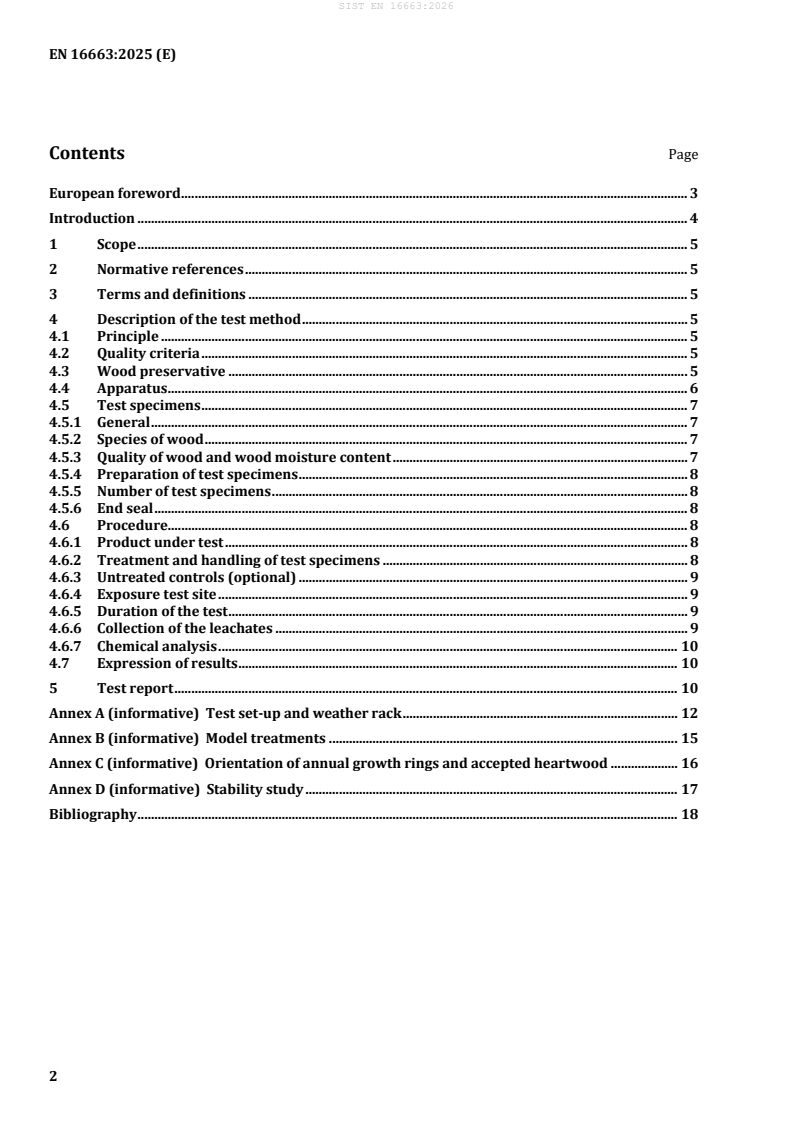
Contents Page
European foreword . 3
Introduction . 4
1 Scope . 5
2 Normative references . 5
3 Terms and definitions . 5
4 Description of the test method . 5
4.1 Principle . 5
4.2 Quality criteria . 5
4.3 Wood preservative . 5
4.4 Apparatus . 6
4.5 Test specimens . 7
4.5.1 General . 7
4.5.2 Species of wood . 7
4.5.3 Quality of wood and wood moisture content . 7
4.5.4 Preparation of test specimens . 8
4.5.5 Number of test specimens . 8
4.5.6 End seal . 8
4.6 Procedure. 8
4.6.1 Product under test . 8
4.6.2 Treatment and handling of test specimens . 8
4.6.3 Untreated controls (optional) . 9
4.6.4 Exposure test site . 9
4.6.5 Duration of the test . 9
4.6.6 Collection of the leachates . 9
4.6.7 Chemical analysis . 10
4.7 Expression of results . 10
5 Test report . 10
Annex A (informative) Test set-up and weather rack . 12
Annex B (informative) Model treatments . 15
Annex C (informative) Orientation of annual growth rings and accepted heartwood . 16
Annex D (informative) Stability study . 17
Bibliography . 18
European foreword
This document (EN 16663:2025) has been prepared by Technical Committee CEN/TC 38 “Biological
durability of wood and wood-based products”, the secretariat of which is held by SIS.
This European Standard shall be given the status of a national standard, either by publication of an
identical text or by endorsement, at the latest by May 2026, and conflicting national standards shall be
withdrawn at the latest by May 2026.
Attention is drawn to the possibility that some of the elements of this document may be the subject of
patent rights. CEN shall not be held responsible for identifying any or all such patent rights.
This document supersedes CEN/TS 16663:2016.
Any feedback and questions on this document should be directed to the users’ national standards body.
A complete listing of these bodies can be found on the CEN website.
According to the CEN-CENELEC Internal Regulations, the national standards organisations of the
following countries are bound to implement this European Standard: Austria, Belgium, Bulgaria, Croatia,
Cyprus, Czech Republic, Denmark, Estonia, Finland, France, Germany, Greece, Hungary, Iceland, Ireland,
Italy, Latvia, Lithuania, Luxembourg, Malta, Netherlands, Norway, Poland, Portugal, Republic of North
Macedonia, Romania, Serbia, Slovakia, Slovenia, Spain, Sweden, Switzerland, Türkiye and the United
Kingdom.
Introduction
The leaching from preservative treated wood into the environment needs to be quantified to enable an
environmental risk assessment to be made of the treated wood, e.g. according to the Biocidal Products
Regulation, Regulation (EU) 528/2012 [2]. This document describes a semi-field method for the
determination of leachate from wood treated with preservatives where the treated wood is not covered
and not in contact with the ground or water (Use Class 3 according to EN 335).
The method is a semi-field procedure for obtaining water samples (leachate) from treated wood exposed
out of ground contact, during natural exposure. The quantities of emissions in the leachate are related to
the surface area of the wood and can be used in scenarios for the environmental risk assessment of the
treated wood.
The principle of this test is based on Nordtest Standard NT Build 509: NORDTEST Method; Leaching of
active ingredients from preservative-treated timber – Semi-field testing [1].
Test results obtained with earlier versions of this document from tests commissioned prior to the
publication of this document are still valid.
NOTE The leachate can also be tested for eco-toxicological effects (example: OECD 202 testing on Daphnia sp.).
1 Scope
This document specifies a method for determining the leaching of active ingredients or other compounds
from preservative treated wood by a semi-field method for Use Class 3 (outdoor above ground). The
preservative treated wood can be tested with or without subsequently surface coating or other water-
repellent treatment. The method is applicable to the testing of commercial or experimental preservatives
or paint systems applied to timber by methods appropriate to commercial practice.
2 Normative references
The following documents are referred to in the text in such a way that some or all of their content
constitutes requirements of this document. For dated references, only the edition cited applies. For
undated references, the latest edition of the referenced document (including any amendments) applies.
EN ISO 5667-3, Water quality — Sampling — Part 3: Preservation and handling of water samples
(ISO 5667-3)
3 Terms and definitions
No terms and definitions are listed in this document.
4 Description of the test method
4.1 Principle
Test panels are treated, assembled and placed outdoors, out of ground contact and exposed to the normal
environmental and ecological factors which affect preservative treated wood so exposed in practice. The
rainwater is retained and the leachate is monitored by chemical analyses of the active ingredients and/or
other compounds.
4.2 Quality criteria
The validity of the analytical method for the substances in question should be determined before
conducting the test:
a) accuracy;
b) specificity;
c) limit of detection (LOD);
d) limit of quantification (LOQ);
e) precision.
4.3 Wood preservative
The test report shall state the name and other designation of the tested product, and the trade or common
name of the active ingredient(s).
Use of a coating is possible (identity and amount of coating used shall be stated in the test report).
4.4 Apparatus
4.4.1 Vessel for receiving water
Laboratory protected glass bottles or plastic jars with no impurities that can influence the active
ingredient which shall be protected from heat and sunlight.
NOTE EN ISO 5667-3 gives the good practices to preserve water samples.
The capacity of the vessels depends on the exposure scenario. If the expected annual precipitation is
approximately 700 mm and the test set-up is placed horizontal 25 l containers are recommended. If the
test set-ups are exposed vertically 5 l containers are recommended.
4.4.2 Gutter, screws, hooks
All materials used to fix and support the test panels and collect the rainwater shall be made of inert
materials. Stainless steel has been found to be suitable (see Annex A).
4.4.3 Weather station
A weather station capable of monitoring the quantity of rainfall, the wind direction and wind speed at the
test site shall be used.
4.4.4 Wood working equipment
Equipment capable of producing the desired finish of the surface; e.g. fine sawn or planed.
4.4.5 Condition chamber
Conditioning chamber, well ventilated, controlled at (20 ± 2) °C and (65 ± 5) % relative humidity.
4.4.6 Mixing vessel
4.4.7 Preservative treatment
Equipment suitable for carrying out vacuum, vacuum-pressure, immersion or surface treatment of
specimens.
4.4.8 Balance
A balance capable of weighing to the nearest 0,1 g.
4.4.9 Kiln
A kiln suitable to dry the preservative treated timber after treatment and post treatment conditioning, if
required.
NOTE There can be recommendations from the sponsor/client of the product under test.
4.4.10 Safety equipment and protection clothing
Appropriate for the test product, to ensure the safety of the operator.
4.4.11 Refrigerator/freezer
A refrigerator or freezer (minimum - 18°C) to store the leachate at low temperature to reduce
degradation of the substances to be analysed and the growth of microorganisms in the leachate.
NOTE There can be recommendations from the sponsor/client for the storage procedure of the product under
test, or EN ISO 5667-3 is an example of a relevant standard.
4.4.12 Chemical analysis equipment
Analytical equipment appropriate to determine the compounds of interest to be analysed in the leachate
at the expected concentration.
4.4.13 Exposure site
An open area, free from tall vegetation and not excessively influenced by industrial or agricultural
pollution and no obstacle to the rain. Distance to building should be specified in the test report.
4.4.14 Exposure weathering racks
The exposure racks, to which the test panels are attached, should be robust to maintain the test specimens
in the required orientation for the duration of the test. Racks that have been found to be suitable are
illustrated in Annex A.
4.5 Test specimens
4.5.1 General
The test specimens that make up the test panel are representative or typical of commercial timber, and
exposed to mimic service exposure (e.g. vertical softwood/ pine shiplap cladding). Alternatively, the test
specimens may be s
...
SLOVENSKI STANDARD
01-januar-2026
Biološka odpornost lesa in lesnih proizvodov - Ugotavljanje emisij, ki prehajajo iz
zaščitenega lesa v okolje - Leseni izdelki, izpostavljeni 3. razredu uporabe
(nepokrita uporaba, brez stika z zemljo) - Delno terenska metoda
Biological durability of wood and wood-based products - Determination of emissions from
preservative treated wood to the environment - Wooden commodities exposed in Use
Class 3 (Not covered, not in contact with the ground) - Semi-field method
Biologische Dauerhaftigkeit von Holz und Holzprodukten - Bestimmung von Emissionen
von mit Holzschutzmitteln behandeltem Holz an die Umwelt - Holzprodukte in
Gebrauchsklasse 3 (nicht abgedeckt, ohne Erdkontakt) - Semi-Feldverfahren
Durabilité du bois et des matériaux dérivés du bois - Détermination des émissions dans
l'environnement du bois traité avec des produits de préservation - Produits de base en
bois exposés à la classe d'emploi 3 (dans un endroit non abrité, n'étant pas en contact
avec le sol) - Méthode semi-terrain
Ta slovenski standard je istoveten z: EN 16663:2025
ICS:
13.020.30 Ocenjevanje vpliva na okolje Environmental impact
assessment
71.100.50 Kemikalije za zaščito lesa Wood-protecting chemicals
2003-01.Slovenski inštitut za standardizacijo. Razmnoževanje celote ali delov tega standarda ni dovoljeno.
EN 16663
EUROPEAN STANDARD
NORME EUROPÉENNE
November 2025
EUROPÄISCHE NORM
ICS 13.020.30; 71.100.50 Supersedes CEN/TS 16663:2016
English Version
Biological durability of wood and wood-based products -
Determination of emissions from preservative treated
wood to the environment - Wooden commodities exposed
in Use Class 3 (Not covered, not in contact with the
ground) - Semi-field method
Durabilité biologique du bois et des matériaux dérivés Biologische Dauerhaftigkeit von Holz und
du bois - Détermination des émissions dans Holzprodukten - Bestimmung von Emissionen von mit
l'environnement du bois traité avec des produits de Holzschutzmitteln behandeltem Holz an die Umwelt -
préservation - Produits de base en bois exposés à la Holzprodukte in Gebrauchsklasse 3 (nicht abgedeckt,
classe d'emploi 3 (dans un endroit non abrité, n'étant ohne Erdkontakt) - Semi-Feldverfahren
pas en contact avec le sol) - Méthode semi-terrain
This European Standard was approved by CEN on 19 October 2025.
CEN members are bound to comply with the CEN/CENELEC Internal Regulations which stipulate the conditions for giving this
European Standard the status of a national standard without any alteration. Up-to-date lists and bibliographical references
concerning such national standards may be obtained on application to the CEN-CENELEC Management Centre or to any CEN
member.
This European Standard exists in three official versions (English, French, German). A version in any other language made by
translation under the responsibility of a CEN member into its own language and notified to the CEN-CENELEC Management
Centre has the same status as the official versions.
CEN members are the national standards bodies of Austria, Belgium, Bulgaria, Croatia, Cyprus, Czech Republic, Denmark, Estonia,
Finland, France, Germany, Greece, Hungary, Iceland, Ireland, Italy, Latvia, Lithuania, Luxembourg, Malta, Netherlands, Norway,
Poland, Portugal, Republic of North Macedonia, Romania, Serbia, Slovakia, Slovenia, Spain, Sweden, Switzerland, Türkiye and
United Kingdom.
EUROPEAN COMMITTEE FOR STANDARDIZATION
COMITÉ EUROPÉEN DE NORMALISATION
EUROPÄISCHES KOMITEE FÜR NORMUNG
CEN-CENELEC Management Centre: Rue de la Science 23, B-1040 Brussels
© 2025 CEN All rights of exploitation in any form and by any means reserved Ref. No. EN 16663:2025 E
worldwide for CEN national Members.
Contents Page
European foreword . 3
Introduction . 4
1 Scope . 5
2 Normative references . 5
3 Terms and definitions . 5
4 Description of the test method . 5
4.1 Principle . 5
4.2 Quality criteria . 5
4.3 Wood preservative . 5
4.4 Apparatus . 6
4.5 Test specimens . 7
4.5.1 General . 7
4.5.2 Species of wood . 7
4.5.3 Quality of wood and wood moisture content . 7
4.5.4 Preparation of test specimens . 8
4.5.5 Number of test specimens . 8
4.5.6 End seal . 8
4.6 Procedure. 8
4.6.1 Product under test . 8
4.6.2 Treatment and handling of test specimens . 8
4.6.3 Untreated controls (optional) . 9
4.6.4 Exposure test site . 9
4.6.5 Duration of the test . 9
4.6.6 Collection of the leachates . 9
4.6.7 Chemical analysis . 10
4.7 Expression of results . 10
5 Test report . 10
Annex A (informative) Test set-up and weather rack . 12
Annex B (informative) Model treatments . 15
Annex C (informative) Orientation of annual growth rings and accepted heartwood . 16
Annex D (informative) Stability study . 17
Bibliography . 18
European foreword
This document (EN 16663:2025) has been prepared by Technical Committee CEN/TC 38 “Biological
durability of wood and wood-based products”, the secretariat of which is held by SIS.
This European Standard shall be given the status of a national standard, either by publication of an
identical text or by endorsement, at the latest by May 2026, and conflicting national standards shall be
withdrawn at the latest by May 2026.
Attention is drawn to the possibility that some of the elements of this document may be the subject of
patent rights. CEN shall not be held responsible for identifying any or all such patent rights.
This document supersedes CEN/TS 16663:2016.
Any feedback and questions on this document should be directed to the users’ national standards body.
A complete listing of these bodies can be found on the CEN website.
According to the CEN-CENELEC Internal Regulations, the national standards organisations of the
following countries are bound to implement this European Standard: Austria, Belgium, Bulgaria, Croatia,
Cyprus, Czech Republic, Denmark, Estonia, Finland, France, Germany, Greece, Hungary, Iceland, Ireland,
Italy, Latvia, Lithuania, Luxembourg, Malta, Netherlands, Norway, Poland, Portugal, Republic of North
Macedonia, Romania, Serbia, Slovakia, Slovenia, Spain, Sweden, Switzerland, Türkiye and the United
Kingdom.
Introduction
The leaching from preservative treated wood into the environment needs to be quantified to enable an
environmental risk assessment to be made of the treated wood, e.g. according to the Biocidal Products
Regulation, Regulation (EU) 528/2012 [2]. This document describes a semi-field method for the
determination of leachate from wood treated with preservatives where the treated wood is not covered
and not in contact with the ground or water (Use Class 3 according to EN 335).
The method is a semi-field procedure for obtaining water samples (leachate) from treated wood exposed
out of ground contact, during natural exposure. The quantities of emissions in the leachate are related to
the surface area of the wood and can be used in scenarios for the environmental risk assessment of the
treated wood.
The principle of this test is based on Nordtest Standard NT Build 509: NORDTEST Method; Leaching of
active ingredients from preservative-treated timber – Semi-field testing [1].
Test results obtained with earlier versions of this document from tests commissioned prior to the
publication of this document are still valid.
NOTE The leachate can also be tested for eco-toxicological effects (example: OECD 202 testing on Daphnia sp.).
1 Scope
This document specifies a method for determining the leaching of active ingredients or other compounds
from preservative treated wood by a semi-field method for Use Class 3 (outdoor above ground). The
preservative treated wood can be tested with or without subsequently surface coating or other water-
repellent treatment. The method is applicable to the testing of commercial or experimental preservatives
or paint systems applied to timber by methods appropriate to commercial practice.
2 Normative references
The following documents are referred to in the text in such a way that some or all of their content
constitutes requirements of this document. For dated references, only the edition cited applies. For
undated references, the latest edition of the referenced document (including any amendments) applies.
EN ISO 5667-3, Water quality — Sampling — Part 3: Preservation and handling of water samples
(ISO 5667-3)
3 Terms and definitions
No terms and definitions are listed in this document.
4 Description of the test method
4.1 Principle
Test panels are treated, assembled and placed outdoors, out of ground contact and exposed to the normal
environmental and ecological factors which affect preservative treated wood so exposed in practice. The
rainwater is retained and the leachate is monitored by chemical analyses of the active ingredients and/or
other compounds.
4.2 Quality criteria
The validity of the analytical method for the substances in question should be determined before
conducting the test:
a) accuracy;
b) specificity;
c) limit of detection (LOD);
d) limit of quantification (LOQ);
e) precision.
4.3 Wood preservative
The test report shall state the name and other designation of the tested product, and the trade or common
name of the active ingredient(s).
Use of a coating is possible (identity and amount of coating used shall be stated in the test report).
4.4 Apparatus
4.4.1 Vessel for receiving water
Laboratory protected glass bottles or plastic jars with no impurities that can influence the active
ingredient which shall be protected from heat and sunlight.
NOTE EN ISO 5667-3 gives the good practices to preserve water samples.
The capacity of the vessels depends on the exposure scenario. If the expected annual precipitation is
approximately 700 mm and the test set-up is placed horizontal 25 l containers are recommended. If the
test set-ups are exposed vertically 5 l containers are recommended.
4.4.2 Gutter, screws, hooks
All materials used to fix and support the test panels and collect the rainwater shall be made of inert
materials. Stainless steel has been found to be suitable (see Annex A).
4.4.3 Weather station
A weather station capable of monitoring the quantity of rainfall, the wind direction and wind speed at the
test site shall be used.
4.4.4 Wood working equipment
Equipment capable of producing the desired finish of the surface; e.g. fine sawn or planed.
4.4.5 Condition chamber
Conditioning chamber, well ventilated, controlled at (20 ± 2) °C and (65 ± 5) % relative humidity.
4.4.6 Mixing vessel
4.4.7 Preservative treatment
Equipment suitable for carrying out vacuum, vacuum-pressure, immersion or surface treatment of
specimens.
4.4.8 Balance
A balance capable of weighing to the nearest 0,1 g.
4.4.9 Kiln
A kiln suitable to dry the preservative treated timber after treatment and post treatment conditioning, if
required.
NOTE There can be recommendations from the sponsor/client of the product under test.
4.4.10 Safety equipment and protection clothing
Appropriate for the test product, to ensure the safety of the operator.
4.4.11 Refrigerator/freezer
A refrigerator or freezer (minimum - 18°C) to store the leachate at low temperature to reduce
degradation of the substances to be analysed and the growth of microorganisms in the leachate.
NOTE There can be recommendations from the sponsor/client for the storage procedure of the product under
test, or EN ISO 5667-3 is an example of a relevant standard.
4.4.12 Chemical analysis equipment
Analytical equipment appropriate to determine the compounds of interest to be analysed in the leachate
at the expected concentration.
4.4.13 Exposure site
An open area, free from tall vegetation and not excessively influenced by industrial or agricultural
pollution and no obstacle to the rain. Distance to building should be specified in the test report.
4.4.14 Exposure weathering racks
The exposure racks, to which the test panels are attached, should be robust to maintain the test specimens
in the required orientation for the duration of the test. Racks that have been found to be suitable are
illustrated in Annex A.
4.5 Test specimens
4.5.1 General
The test specimens that make up the test panel are representative or typical of commercial timber, and
exposed to mimic service exposure (e.g. vertical softwood/ pine shiplap cladding). Alternatively, the test
specimens ma
...