

oSIST prEN 50463-5:2025
(Main)Railway applications - Energy measurement on board trains - Part 5: Conformity assessment
General Information
- Abstract
EN 50463-5 specifies the conformity assessment arrangements for newly manufactured EMS installed on a traction unit. This includes the integration conformity assessment and installation conformity assessment. In addition, EN 50463-5 also specifies the conformity assessment procedures for device and ancillary component replacement (e.g. due to damage in service), and periodic check to verify the EMS conformity assessment remains valid.
- Status
- Not Published
- Public Enquiry End Date
- 31-Dec-2025
- Technical Committee
- ŽEN - Electrical applications for railways
- Current Stage
- 4020 - Public enquire (PE) (Adopted Project)
- Start Date
- 05-Nov-2025
- Due Date
- 25-Mar-2026
- Completion Date
- 18-Dec-2025


Overview
oSIST prEN 50463-5:2025 - Railway Applications: Energy Measurement On Board Trains – Part 5: Conformity Assessment, published by the Slovenian Institute for Standardization (SIST), details the conformity assessment framework for energy measurement systems (EMS) installed on railway traction units. As part of the EN 50463 series, this document sets out the required procedures to demonstrate-and keep valid-the compliance of newly manufactured EMS, replacements, and periodic reviews.
Reliable conformity assessment for EMS is essential for accurate energy measurement, energy billing, and efficient energy management in the railway sector. This European Standard ensures that EMS equipment and integrations meet prescribed requirements and perform as intended throughout their operational lifecycle.
Key Topics
- Conformity Assessment Procedures: Defines the structured steps and methodologies for evaluating EMS at both integration and installation levels.
- EMS Integration and Installation: Specifies design reviews and testing activities necessary for integrating the EMS and its successful installation on various traction units.
- Device and Ancillary Component Replacement: Describes requirements for ensuring conformity when parts of the EMS are replaced, such as after damage or maintenance.
- Periodic Re-Verification: Outlines procedures for routine checks to ensure the continued validity of conformity assessment over time.
- Reporting and Documentation:
- Integration Design Review Report (IDRR)
- Integration Type Test Report (ITTR)
- Installation Design Review Report (SDRR)
- Installation Type Test Report (STTR)
- Installation Routine Test Report (IRTR)
- Re-Verification Report (RVR)
- Replacement Report
- Functional Structure and Dataflow: Presents the EMS’s architecture, including main interfaces and the data exchange processes.
- Normative References: Links to other parts of the EN 50463 series and related rail electronics standards.
Applications
The procedures defined in oSIST prEN 50463-5:2025 are widely applicable across the rail industry and relevant for:
- Train Manufacturers and System Integrators: Ensures that newly-produced or retrofitted trains equipped with EMS comply with European requirements before entering service.
- Railway Operators: Facilitates accurate onboard energy measurement for billing, monitoring, and energy optimization.
- Maintenance and Engineering Teams: Enables standardized replacement and verification practices, reducing downtime and ensuring continued system conformity.
- Certification Bodies and Regulatory Authorities: Provides a harmonized framework for assessing and certifying conformity of railway EMS installations in accordance with EU requirements.
- Component Suppliers: Ensures the interchangeability and compliance of ancillary parts supporting the EMS functions.
Successful implementation of this standard supports accurate energy data collection, facilitates cross-border rail operations, and underpins transparent energy billing and settlement in the European rail sector.
Related Standards
oSIST prEN 50463-5:2025 is part of the broader EN 50463 series, which provides a comprehensive framework for railway onboard energy measurement systems:
- prEN 50463-1:2025 - General system requirements for EMS
- prEN 50463-2:2025 - Energy measuring methods and functions
- prEN 50463-3:2025 - Data handling requirements
- prEN 50463-4:2025 - Communication protocols and services
Other key references:
- EN 50155:2021 - Railway applications – Rolling stock – Electronic equipment
- EN/ISO/IEC 17000 - Principles and terminology for conformity assessment
These related standards ensure full lifecycle coverage from measurement accuracy and data transmission to robust conformity assessment methods, enabling interoperable energy management for modern railways.
Keywords: railway applications, energy measurement system, EMS, conformity assessment, EN 50463, train energy metering, periodic re-verification, device replacement, railway standardization, SIST, onboard train systems, energy billing, rail compliance, European rail standards.
Relations
- Effective Date
- 10-Dec-2024
- Effective Date
- 10-Dec-2024
Get Certified
Connect with accredited certification bodies for this standard

BSI Group
BSI (British Standards Institution) is the business standards company that helps organizations make excellence a habit.

Bureau Veritas
Bureau Veritas is a world leader in laboratory testing, inspection and certification services.

DNV
DNV is an independent assurance and risk management provider.
Sponsored listings
Frequently Asked Questions
oSIST prEN 50463-5:2025 is a draft published by the Slovenian Institute for Standardization (SIST). Its full title is "Railway applications - Energy measurement on board trains - Part 5: Conformity assessment". This standard covers: EN 50463-5 specifies the conformity assessment arrangements for newly manufactured EMS installed on a traction unit. This includes the integration conformity assessment and installation conformity assessment. In addition, EN 50463-5 also specifies the conformity assessment procedures for device and ancillary component replacement (e.g. due to damage in service), and periodic check to verify the EMS conformity assessment remains valid.
EN 50463-5 specifies the conformity assessment arrangements for newly manufactured EMS installed on a traction unit. This includes the integration conformity assessment and installation conformity assessment. In addition, EN 50463-5 also specifies the conformity assessment procedures for device and ancillary component replacement (e.g. due to damage in service), and periodic check to verify the EMS conformity assessment remains valid.
oSIST prEN 50463-5:2025 is classified under the following ICS (International Classification for Standards) categories: 03.120.20 - Product and company certification. Conformity assessment; 45.060.10 - Tractive stock. The ICS classification helps identify the subject area and facilitates finding related standards.
oSIST prEN 50463-5:2025 has the following relationships with other standards: It is inter standard links to SIST EN 50463-5:2018, SIST EN 50463-5:2018/A1:2024. Understanding these relationships helps ensure you are using the most current and applicable version of the standard.
oSIST prEN 50463-5:2025 is associated with the following European legislation: EU Directives/Regulations: 2016/797/EU; Standardization Mandates: M/591. When a standard is cited in the Official Journal of the European Union, products manufactured in conformity with it benefit from a presumption of conformity with the essential requirements of the corresponding EU directive or regulation.
oSIST prEN 50463-5:2025 is available in PDF format for immediate download after purchase. The document can be added to your cart and obtained through the secure checkout process. Digital delivery ensures instant access to the complete standard document.
Standards Content (Sample)
SLOVENSKI STANDARD
01-december-2025
Železniške naprave - Merjenje energije na vlaku - 5. del: Ugotavljanje skladnosti
Railway applications - Energy measurement on board trains - Part 5: Conformity
assessment
Bahnanwendungen - Energiemessung auf Bahnfahrzeugen - Teil 5:
Konformitätsbewertung
Applications ferroviaires - Mesure d'énergie à bord des trains - Partie 5 : Evaluation de la
conformité
Ta slovenski standard je istoveten z: prEN 50463-5:2025
ICS:
03.120.20 Certificiranje proizvodov in Product and company
podjetij. Ugotavljanje certification. Conformity
skladnosti assessment
45.060.10 Vlečna vozila Tractive stock
2003-01.Slovenski inštitut za standardizacijo. Razmnoževanje celote ali delov tega standarda ni dovoljeno.
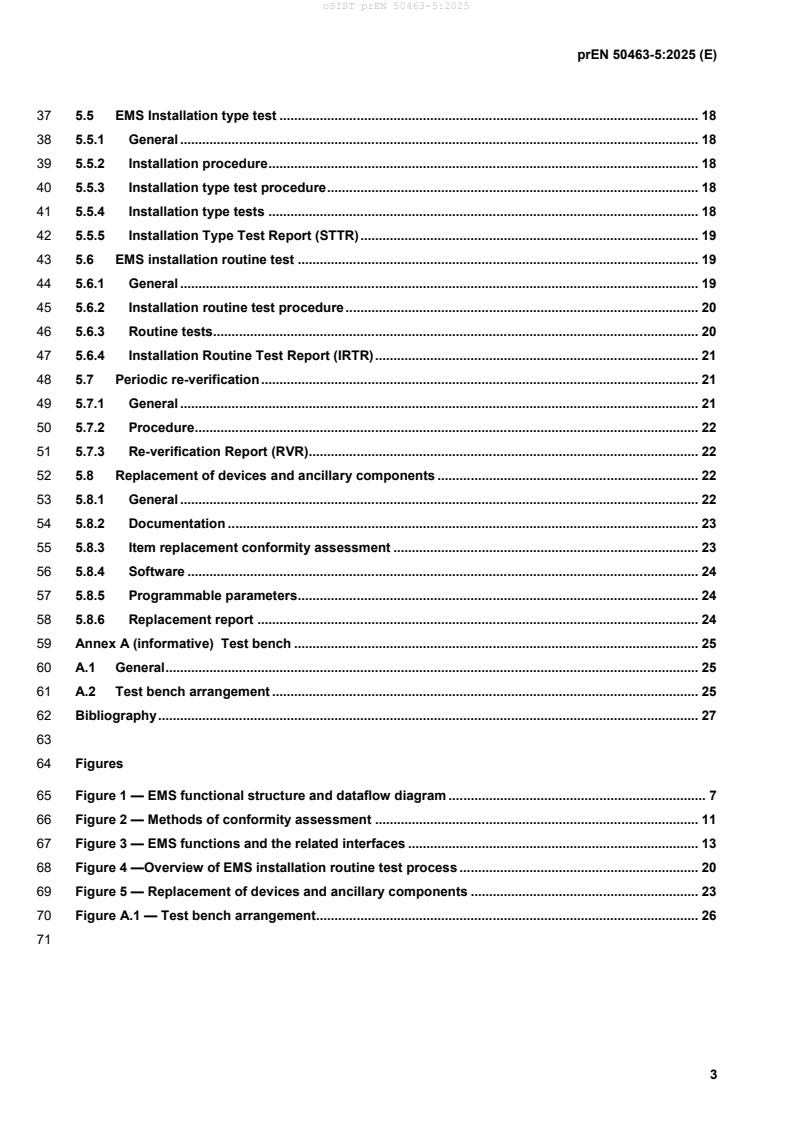
1 Contents Page
2 European foreword . 4
3 Introduction . 5
4 1 Scope . 8
5 2 Normative references . 8
6 3 Terms, definitions and abbreviations . 8
7 3.1 Terms and definitions . 8
8 3.2 Abbreviations . 9
9 4 Conformity assessment approach . 10
10 4.1 General . 10
11 4.2 Situation of applicability . 10
12 4.3 General Methodology . 10
13 4.4 EMS Specific Methodology . 12
14 4.4.1 General . 12
15 4.4.2 EMS integration design review . 12
16 4.4.3 EMS integration type test . 12
17 4.4.4 EMS installation design review . 12
18 4.4.5 EMS installation type test . 12
19 4.4.6 EMS installation routine test . 12
20 4.4.7 CP periodic re-verification . 12
21 4.4.8 Replacement of devices and ancillary components. 12
22 5 Conformity assessment procedures . 12
23 5.1 General . 12
24 5.2 EMS integration design review . 14
25 5.2.1 EMS integration design review documentation . 14
26 5.2.2 EMS integration design review assessment . 14
27 5.2.3 Integration Design Review Report (IDRR) . 15
28 5.3 EMS integration type test . 15
29 5.3.1 General . 15
30 5.3.2 Integration type test procedure . 15
31 5.3.3 Integration type tests . 15
32 5.3.4 Integration Type Test Report (ITTR) . 16
33 5.4 EMS installation design review . 16
34 5.4.1 EMS installation design review documentation . 16
35 5.4.2 EMS installation design review assessment . 17
36 5.4.3 Installation Design Review Report (SDRR) . 18
37 5.5 EMS Installation type test . 18
38 5.5.1 General . 18
39 5.5.2 Installation procedure . 18
40 5.5.3 Installation type test procedure . 18
41 5.5.4 Installation type tests . 18
42 5.5.5 Installation Type Test Report (STTR) . 19
43 5.6 EMS installation routine test . 19
44 5.6.1 General . 19
45 5.6.2 Installation routine test procedure . 20
46 5.6.3 Routine tests . 20
47 5.6.4 Installation Routine Test Report (IRTR) . 21
48 5.7 Periodic re-verification . 21
49 5.7.1 General . 21
50 5.7.2 Procedure . 22
51 5.7.3 Re-verification Report (RVR) . 22
52 5.8 Replacement of devices and ancillary components . 22
53 5.8.1 General . 22
54 5.8.2 Documentation . 23
55 5.8.3 Item replacement conformity assessment . 23
56 5.8.4 Software . 24
57 5.8.5 Programmable parameters . 24
58 5.8.6 Replacement report . 24
59 Annex A (informative) Test bench . 25
60 A.1 General . 25
61 A.2 Test bench arrangement . 25
62 Bibliography . 27
64 Figures
65 Figure 1 — EMS functional structure and dataflow diagram . 7
66 Figure 2 — Methods of conformity assessment . 11
67 Figure 3 — EMS functions and the related interfaces . 13
68 Figure 4 —Overview of EMS installation routine test process . 20
69 Figure 5 — Replacement of devices and ancillary components . 23
70 Figure A.1 — Test bench arrangement . 26
72 European foreword
73 This document (prEN 50463-5:2025) has been prepared by CLC/TC 9X “Electrical and electronic
74 applications for railways”.
75 The following dates are proposed:
• latest date by which the existence of this (doa) dav + 6 months
document has to be announced at national
level
• latest date by which this document has to be (dop) dav + 12 months
implemented at national level by publication of
an identical national standard or by
endorsement
• latest date by which the national standards (dow) dav + 36 months
conflicting with this document have to be (to be confirmed or
withdrawn modified when voting)
76 This document will supersede EN 50463-5:2017 and all of its amendments and corrigenda (if any).
77 prEN 50463-5:2025 includes the following significant technical changes with respect to EN 50463-5:2017:
78 — no technical changes introduced in document; only aligning with changes made in EN 50463-1
79 (commissioning and maintenance) and EN 50463-2 (explicitly adding verifications not possible on
80 equipment level).
81 This document has been prepared under a standardization request addressed to CENELEC by the
82 European Commission. The Standing Committee of the EFTA States subsequently approves these requests
83 for its Member States.
84 This document is Part 5 of EN 50463 series which consists of the following parts, under the common title
85 Railway applications — Energy measurement on board trains:
86 — Part 1: General;
87 — Part 2: Energy measuring;
88 — Part 3: Data handling;
89 — Part 4: Communication;
90 — Part 5: Conformity assessment.
91 This series of European Standards follows the functional guidelines description in EN ISO/IEC 17000:2004,
92 Annex A “Principles of conformity assessment”, tailored to the energy measurement system (EMS).
93 Introduction
94 The energy measurement system (EMS) provides measurement and data suitable for billing and may also
95 be used for energy management, e.g. energy saving.
96 This series of European Standards uses the functional approach to describe the EMS and on-ground data
97 collecting system (DCS). These functions are implemented in one or more physical devices. The user of this
98 Series of standards is free to choose the physical implementation arrangements.
99 a) Structure and main contents of EN 50463 series:
100 This series of European Standards is divided into five parts. The titles and brief descriptions of each part
101 are given below:
102 1) EN 50463-1 — General:
103 The scope of EN 50463-1 is the energy measurement system (EMS).
104 EN 50463-1 provides system level requirements for the complete EMS and common requirements
105 for all devices implementing one or more functions of the EMS.
106 2) EN 50463-2 — Energy measuring:
107 The scope of EN 50463-2 is the energy measurement function (EMF).
108 The EMF provides measurement of the consumed and regenerated active energy of a railway
109 traction unit. If the traction unit is designed for use on AC electric traction power supply systems the
110 EMF also provides measurement of reactive energy. The EMF provides the measured quantities via
111 an interface to the data handling system.
112 The EMF consists of the three functions: voltage measurement function, current measurement
113 function and energy calculation function. For each of these functions, accuracy classes are
114 specified and associated reference conditions are defined. EN 50463-2 also defines all specific
115 requirements for all functions of the EMF.
116 The voltage measurement function measures the voltage of the contact line (CL) system and the
117 current measurement function measures the current taken from and returned to the CL system.
118 These functions provide signal inputs to the energy calculation function.
119 The energy calculation function inputs the signals from the current and voltage measurement
120 functions and calculates a set of values representing the consumed and regenerated energies.
121 These values are transferred to the data handling system and are used in the creation of compiled
122 energy billing data (CEBD).
123 The standard has been developed taking into account that in some applications the EMF is
124 subjected to legal metrological control. All relevant metrological aspects are covered in EN 50463-2.
125 EN 50463-2 also defines the conformity assessment of the EMF and the functions of the EMF.
126 3) EN 50463-3 — Data handling:
127 The scope of EN 50463-3 is the data handling system (DHS) and the associated requirements of
128 data collecting system (DCS).
129 The on board DHS receives, produces and stores data, ready for transmission to any authorized
130 receiver of data onboard or on ground. The main goal of the DHS is to produce compiled energy
131 billing data (CEBD) and transfer it to an on ground data collecting system (DCS). The DHS can
132 support other functions on board or on ground with data, as long as this does not conflict with the
133 main goal.
134 The DCS on ground receives CEBD, stores the CEBD and transfer it to upstream servers such as
135 settlement system.
136 EN 50463-3 also defines the conformity assessment of the DHS and for the transfer of CEBD to an
137 on-ground DCS.
138 4) EN 50463-4 — Communication:
139 The scope of EN 50463-4 is the communication services.
140 EN 50463-4 gives requirements and guidance regarding the data communication between the
141 functions implemented within EMS as well as between such functions and other on board units
142 where data are exchanged using a communications protocol stack over a dedicated physical
143 interface or a shared network.
144 It includes the board to ground communication service and covers the requirements necessary to
145 support data transfer between DHS and DCS.
146 EN 50463-4 also defines the conformity assessment of the communications services.
147 5) EN 50463-5 — Conformity assessment:
148 The scope of EN 50463-5 is the conformity assessment procedures for the EMS.
149 EN 50463-5 also covers re-verification procedures and conformity assessment in the event of the
150 replacement of a device of the EMS.
151 b) EMS functional structure and dataflow:
152 Figure 1 illustrates the functional structure of the EMS, the relevant operating dataflow and is informative
153 only. Only the main interfaces required by this EN 50463 series are displayed by arrows.
154 Since the communication function is distributed throughout the EMS, it has been widely omitted for
155 clarity, except for the train to ground communication. Not all interfaces are shown.
157 Figure 1 — EMS functional structure and dataflow diagram
158 1 Scope
159 This part of the EN 50463 series specifies the conformity assessment methodology to be used to asses
160 newly manufactured EMS to be installed on a traction unit. This includes the conformity assessment at
161 integration and installation level of the EMS equipment type. In addition, this document also specifies the
162 conformity assessment procedures for device and ancillary component replacement (e.g. due to damage in
163 service), and periodic check to verify the EMS conformity assessment remains valid.
164 This document does not include elements related to conformity assessment aspects other than design
165 review and testing provisions for the products, processes or services specified. Consequently, this part does
166 not delete, change or interpret the general requirements for conformity assessment procedures and
167 vocabulary detailed in EN/ISO/IEC 17000.
168 This document does not cover the conformity assessment schemes that, according to the CEN-CENELEC
169 Internal Regulations, are the responsibility of ISO policy committee “Committee on conformity assessment”
170 (ISO/CASCO).
171 2 Normative references
172 The following documents are referred to in the text in such a way that some or all of their content constitutes
173 requirements of this document. For dated references, only the edition cited applies. For undated references,
174 the latest edition of the referenced document (including any amendments) applies.
175 EN 50155:2021, Railway applications - Rolling stock - Electronic equipment
176 prEN 50463-1:2025, Railway applications - Energy measurement on board trains - Part 1: General
177 prEN 50463-2:2025, Railway applications - Energy measurement on board trains - Part 2: Energy measuring
178 prEN 50463-3:2025, Railway applications - Energy measurement on board trains - Part 3: Data handling
179 prEN 50463-4:2025, Railway applications - Energy measurement on board trains - Part 4: Communication
180 3 Terms, definitions and abbreviations
181 3.1 Terms and definitions
182 For the purposes of this document, the terms and definitions given in prEN 50463-1:2025 and the following
183 apply.
184 ISO and IEC maintain terminology databases for use in standardization at the following addresses:
185 • ISO Online browsing platform: available at https://www.iso.org/obp
186 • IEC Electropedia: available at http://www.electropedia.org
187 NOTE When possible, the following definitions have been taken from the relevant chapters of the International
188 Electrotechnical Vocabulary (IEV), IEC 60050 series. In such cases, the appropriate IEV reference is given. Certain new
189 definitions or modifications of IEV definitions have been added in this document in order to facilitate understanding.
190 Expression of the performance of electrical and electronic measuring equipment has been taken from EN 60359.
191 3.1.1
192 ancillary component
193 component providing something additional to a main part or function. e.g. casing, cabling, mechanical fixing
194 part, insulation components
195 3.1.2
196 conformity assessment
197 demonstration that specified requirements are fulfilled
198 [SOURCE: IEC 60050-902:2013, 902-01-01, modified – “relating to a product, process, system, person or
199 body” has been removed. Notes 1 and 2 to entry have been omitted.]
200 3.1.3
201 conformity assessment file
202 CAF
203 folder holding all documentation produced during conformity assessment
204 3.1.4
205 EMS installation
206 installation of an EMS equipment type into a traction unit of a specified type
207 3.1.5
208 EMS integration
209 integration of devices, interconnections and ancillary components, forming a specific EMS equipment type
210 3.1.6
211 Integrator
212 entity responsible for integrating devices, interconnections and ancillary components, forming an
213 EMS equipment type
214 3.1.7
215 periodic re-verification
216 activities carried out periodically to check that the conformity assessment of an in-service EMS remains valid
217 Note 1 to entry: These re-verification activities are solely for the purpose stated, consequently other in-service activities
218 such as maintenance and fault finding, etc. are not covered by this term.
219 3.1.8
220 protective interface
221 interface which permits intended data to be exchanged, and prevents unintended data being exchanged
222 3.1.9
223 traction unit type
224 specific design of traction unit, produced by one manufacturer and having similar properties, the same
225 uniform construction of parts determining these properties and the same functional components
226 Note 1 to entry: The type is represented by the traction unit sample provided for the EMS installation type tests.
227 3.2 Abbreviations
228 For the purposes of this document, the abbreviations given in prEN 50463-1:2025 and the following apply.
CAF Conformity Assessment File
CF Communication Function
IDRR Integration Design Review Report
IRTR Installation Routine Test Report
ITTR Integration Type Test Report
RVR Re-verification Report
STTR Installation Type Test Report
229 4 Conformity assessment approach
230 4.1 General
231 Clause 4 specifies the structure and methodology for the conformity assessment at integration and
232 installation level of the EMS equipment type. The procedures, design review requirements, testing
233 requirements, and conformity assessment documentation requirements are specified in Clause 5.
234 Completion of device level conformity assessment is a pre-requisite to carry out EMS conformity
235 assessment, this shall be carried out by system integrator according to relevant requirements in Clause 4
236 and 5.
237 The conformity assessment is undertaken in the following key stages:
238 1) device level;
239 2) EMS level;
240 3) EMS re-verification and device / ancillary component replacement.
241 Stage 1 is mandatory for newly manufactured devices and is covered by prEN 50463-2:2025,
242 prEN 50463-3:2025 and prEN 50463-4:2025. Stages 2, 3 are mandatory for every EMS in accordance with
243 the scope as specified in Clause 1. The conformity assessment, undertaken during stages 2 and 3, deals
244 primarily with system level requirements, and it does not replicate any assessment already carried out in
245 stage 1. The integration design review also covers those requirements that could not be verified at device
246 level.
247 4.2 Situation of applicability
248 The EMS conformity assessment described in this document applies in case of:
249 — EMS integration;
250 — EMS installation;
251 — EMS periodic re-verification;
252 — EMS device / ancillary component replacement.
253 4.3 General Methodology
254 The conformity assessment is undertaken using the following methods:
255 a) device design review;
256 b) device type test;
257 c) device routine test;
258 d) EMS integration design review;
259 e) EMS integration type test;
260 f) EMS installation design review;
261 g) EMS installation type test;
262 h) EMS installation routine test.
263 Furthermore the following methods cover re-verification and replacement:
264 i) CP periodic re-verification;
265 j) EMS device / ancillary component replacement.
266 Methods a) to c) are used at device level and the conformity assessment arrangements are covered by
267 prEN 50463-2:2025, prEN 50463-3:2025 and prEN 50463-4:2025, in so far as applicable; otherwise, device
268 design review shall be carried out by the system integrator of EMS equipment type and relevant
269 requirements shall be fulfilled at system integration level, according to provisions set out in Clause 5.
270 Methods d) to j) always apply at EMS system level and are described in this document.
271 Each method described generates evidence of conformity. Methods d) to h) are listed in logical order. They
272 may be undertaken in the same testing environment.
273 Completing the integration methods d) and e) allows the possibility of using this integration conformity
274 assessment in conjunction with multiple installation conformity assessment’s. This approach can be
275 employed when the same EMS equipment type is to be used on several different traction unit types, using
276 multiple installation conformity assessment’s to deal with the installation issues only.
277 Figure 2 illustrates the methods of conformity assessment arrangements.
280 Figure 2 — Methods of conformity assessment
281 4.4 EMS Specific Methodology
282 4.4.1 General
283 Methods d) to j) apply at EMS system level. Method a) applies at system level only when the equipment type
284 doesn't include the whole EMF, the methods i) and j) address re-verification and device component
285 replacement. Methods are listed in logical order. They may be undertaken in the same testing environment.
286 4.4.2 EMS integration design review
287 In the integration design review stage, the system integrator shall verify that all the devices used to form a
288 specific EMS equipment type can be brought together correctly in accordance with an EMS design and when
289 integrated together provides the intended functionality in accordance with this series of standards. When the
290 equipment type doesn't include the whole EMF, the system integrator shall verify the integration device
291 design review according to Clause 5. The EMS equipment type shall include at least the ECF and DHS
292 functions.
293 4.4.3 EMS integration type test
294 The integration type test demonstrates that the equipment type that constitutes the EMS, when integrated,
295 functions as intended. When the EMS integration design review has been verified and found to comply with
296 4.4.2, integration type tests are performed on the EMS equipment type to verify functional properties, as
297 described in 5.3.3.
298 4.4.4 EMS installation design review
299 The installation design review assesses the compatibility between an EMS of a specific equipment type and
300 a traction unit type, so that its functionality is maintained when installed on board. When the equipment type
301 doesn't include the whole EMF, the EMS equipment type installer shall verify the device installation design
302 review according to Clause 5.
303 4.4.5 EMS installation type test
304 The installation type test demonstrates that the integrated EMS of a specific equipment type, when installed
305 on board on a specimen representative of the traction unit type, is functioning as intended. When the EMS
306 integration design review has been verified and found compliant with 4.4.4, the installation type tests are
307 carried out on the EMS equipment type limited to verify the functional properties as described in 5.5.
308 4.4.6 EMS installation routine test
309 The installation routine test demonstrates that the type tested EMS functionality is ensured for each
310 installation on traction units of the same type.
311 4.4.7 CP periodic re-verification
312 The CP periodic re-verification activities are used to ensure the conformity assessment of an in-service CP
313 remains valid, where necessary confirm metrological properties, so that the CP can continue to be used.
314 4.4.8 Replacement of devices and ancillary components
315 If a device / ancillary component of an in-service EMS is replaced, the substitution procedure ensures that
316 the EMS conformity assessment remains valid and the EMS can continue to be used.
317 5 Conformity assessment procedures
318 5.1 General
319 Before undertaking conformity assessment in accordance with Clause 5, all devices forming a specific EMS
320 equipment type shall have passed the relevant device level conformity assessment in accordance with
321 prEN 50463-2:2025, prEN 50463-3:2025, and prEN 50463-4:2025 in so far as applicable, otherwise the
322 related requirements shall be fulfilled at integration and installation level according to the procedure set out in
323 this clause.
324 If design changes are made to the traction unit, no conformance test of EMS is required, unless the changes
325 affect the EMS.
326 The integration design review also covers those requirements that could not be verified at equipment level
327 (e.g. CMF or VMF ports are not available).
328 The different tests (e.g. type, routine and reverification) could be performed using the available testing
329 interface dedicated to this purpose; those interfaces may exist according to the structure of the EMS
330 implementation, Figure 3 show the EMS functions and the related interfaces.
332 Figure 3 — EMS functions and the related interfaces
333 ESI, DMI and DSI are exposed interfaces which are intended to be used for:
334 1) maintenance;
335 2) EMF and/or DHS management;
...