

SIST EN ISO 4135:2022
(Main)Anaesthetic and respiratory equipment - Vocabulary (ISO 4135:2022)
General Information
- Abstract
This document establishes a vocabulary of terms used for anaesthetic and respiratory equipment and supplies, related devices and supply systems.
NOTE 1 To avoid multiple definitions of the same term in different categories, this document attempts to ensure consistency by the inclusion of a ‘general’ category, and by use of domain specifiers and unique pre-coordinated domain-specific term names.
NOTE 2 In addition to terms and definitions used in two of the three official ISO languages (English and French), this document gives the equivalent terms in the German language; these are published under the responsibility of the member body for Germany. However, only the terms and definitions given in the official languages can be considered as ISO terms and definitions.
- Status
- Published
- Public Enquiry End Date
- 14-Feb-2020
- Publication Date
- 14-Mar-2022
- Technical Committee
- VAZ - Healthcare
- Current Stage
- 6060 - National Implementation/Publication (Adopted Project)
- Start Date
- 22-Feb-2022
- Due Date
- 29-Apr-2022
- Completion Date
- 15-Mar-2022


Overview
SIST EN ISO 4135:2022 (ISO 4135:2022) establishes a standardized vocabulary for anaesthetic and respiratory equipment and related supply systems. This fourth-edition international standard defines terms and definitions used across devices, components, gases, metrology, physiological concepts and clinical workflows to ensure consistent communication between manufacturers, clinicians, regulators and standards bodies.
Key features:
- Centralized, domain‑specific terminology to avoid multiple definitions.
- Use of a general category plus domain specifiers and pre‑coordinated domain‑specific term names.
- Official ISO terms and definitions provided in English and French; German equivalents are included under the responsibility of the German member body.
Key topics and technical scope
ISO 4135 is a vocabulary standard rather than a performance specification. Its structured glossary covers terms across these technical areas:
- General concepts: properties of gases and materials, equipment properties, metrology, components, physiological terms, use environment and workflow.
- Medical gas supply systems: pipeline systems, terminal units, low‑pressure hoses, pressure regulators, cylinders and accessories.
- Anaesthetic machines and workstations: general terms and component definitions.
- Ventilators and resuscitators: ports, pressures, flowrates and related nomenclature.
- Oxygen delivery and liquid oxygen systems.
- Breathing systems: classification, adaptors, valves, masks and cannulae.
- Humidifiers, nebulizers and heat & moisture exchangers.
- Airways and intubation equipment: tracheal and tracheostomy tubes, bronchial blockers, laryngoscopes.
- Scavenging/plume evacuation and suction devices.
- Monitoring terminology: gas monitors, pulse oximetry, thermometry, ECG, blood pressure and transcutaneous gas monitors.
Practical applications - who uses this standard
ISO 4135 is essential for stakeholders who need precise and consistent terminology:
- Medical device manufacturers - product specifications, labeling, user manuals and technical documentation.
- Clinical professionals (anesthesiologists, respiratory therapists, intensive care teams) - clear device descriptions, protocols and training materials.
- Biomedical engineers and maintenance teams - spare parts lists, system integration and procurement.
- Regulators and standards committees - harmonized definitions for conformity assessment and regulatory submissions.
- Technical writers and translators - consistent multilingual terminology for documentation and localization.
Related standards
ISO 4135 complements other ISO/CEN/IEC standards covering medical device safety, performance, gas pipeline installations and electrical/EMC requirements. It was prepared by ISO/TC 121 (Anaesthetic and respiratory equipment) in collaboration with CEN/TC 215.
For precise term definitions and authoritative usage, consult the full ISO 4135:2022 text or your national standards body.
Relations
- Effective Date
- 01-Apr-2022
- Referred By
SIST-TS CEN/TS 14507-1:2003 - Inhalational nitric oxide systems - Part 1: Delivery systems - Effective Date
- 28-Jan-2026
- Referred By
SIST EN 13544-3:2002+A1:2009 - Respiratory therapy equipment - Part 3: Air entrainment devices - Effective Date
- 28-Jan-2026
- Effective Date
- 16-Jul-2025
Get Certified
Connect with accredited certification bodies for this standard

BSI Group
BSI (British Standards Institution) is the business standards company that helps organizations make excellence a habit.

TÜV Rheinland
TÜV Rheinland is a leading international provider of technical services.

TÜV SÜD
TÜV SÜD is a trusted partner of choice for safety, security and sustainability solutions.
Sponsored listings
Frequently Asked Questions
SIST EN ISO 4135:2022 is a standard published by the Slovenian Institute for Standardization (SIST). Its full title is "Anaesthetic and respiratory equipment - Vocabulary (ISO 4135:2022)". This standard covers: This document establishes a vocabulary of terms used for anaesthetic and respiratory equipment and supplies, related devices and supply systems. NOTE 1 To avoid multiple definitions of the same term in different categories, this document attempts to ensure consistency by the inclusion of a ‘general’ category, and by use of domain specifiers and unique pre-coordinated domain-specific term names. NOTE 2 In addition to terms and definitions used in two of the three official ISO languages (English and French), this document gives the equivalent terms in the German language; these are published under the responsibility of the member body for Germany. However, only the terms and definitions given in the official languages can be considered as ISO terms and definitions.
This document establishes a vocabulary of terms used for anaesthetic and respiratory equipment and supplies, related devices and supply systems. NOTE 1 To avoid multiple definitions of the same term in different categories, this document attempts to ensure consistency by the inclusion of a ‘general’ category, and by use of domain specifiers and unique pre-coordinated domain-specific term names. NOTE 2 In addition to terms and definitions used in two of the three official ISO languages (English and French), this document gives the equivalent terms in the German language; these are published under the responsibility of the member body for Germany. However, only the terms and definitions given in the official languages can be considered as ISO terms and definitions.
SIST EN ISO 4135:2022 is classified under the following ICS (International Classification for Standards) categories: 01.040.11 - Health care technology (Vocabularies); 11.040.10 - Anaesthetic, respiratory and reanimation equipment. The ICS classification helps identify the subject area and facilitates finding related standards.
SIST EN ISO 4135:2022 has the following relationships with other standards: It is inter standard links to SIST EN ISO 4135:2002, SIST-TS CEN/TS 14507-1:2003, SIST EN 13544-3:2002+A1:2009, SIST EN ISO 4135:2022/kFprA1:2026. Understanding these relationships helps ensure you are using the most current and applicable version of the standard.
SIST EN ISO 4135:2022 is associated with the following European legislation: EU Directives/Regulations: 2007/47/EC; Standardization Mandates: M/023. When a standard is cited in the Official Journal of the European Union, products manufactured in conformity with it benefit from a presumption of conformity with the essential requirements of the corresponding EU directive or regulation.
SIST EN ISO 4135:2022 is available in PDF format for immediate download after purchase. The document can be added to your cart and obtained through the secure checkout process. Digital delivery ensures instant access to the complete standard document.
Standards Content (Sample)
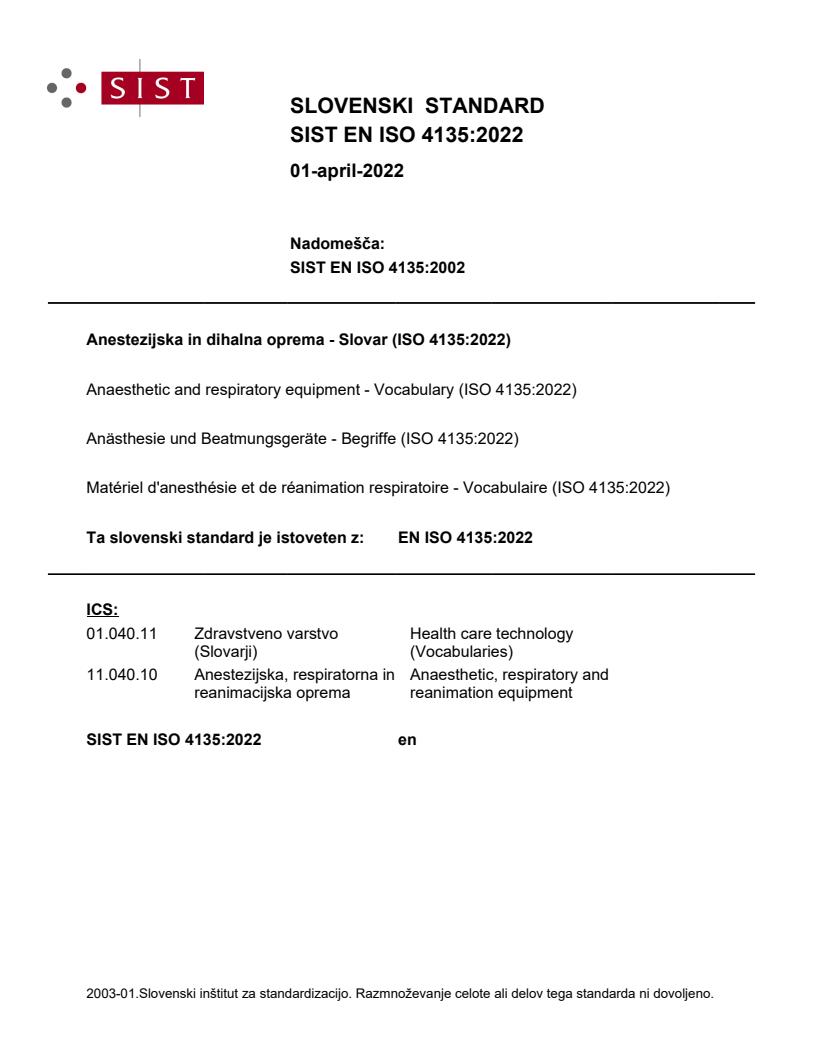
SLOVENSKI STANDARD
01-april-2022
Nadomešča:
SIST EN ISO 4135:2002
Anestezijska in dihalna oprema - Slovar (ISO 4135:2022)
Anaesthetic and respiratory equipment - Vocabulary (ISO 4135:2022)
Anästhesie und Beatmungsgeräte - Begriffe (ISO 4135:2022)
Matériel d'anesthésie et de réanimation respiratoire - Vocabulaire (ISO 4135:2022)
Ta slovenski standard je istoveten z: EN ISO 4135:2022
ICS:
01.040.11 Zdravstveno varstvo Health care technology
(Slovarji) (Vocabularies)
11.040.10 Anestezijska, respiratorna in Anaesthetic, respiratory and
reanimacijska oprema reanimation equipment
2003-01.Slovenski inštitut za standardizacijo. Razmnoževanje celote ali delov tega standarda ni dovoljeno.
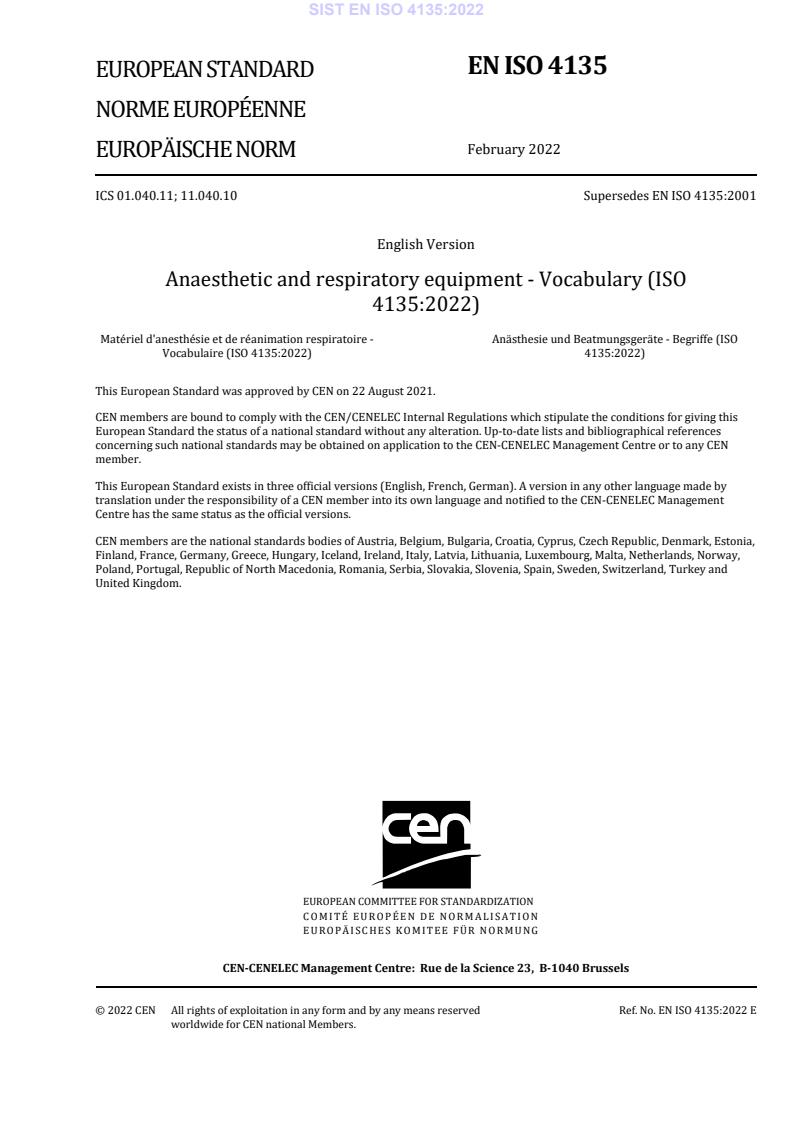
EN ISO 4135
EUROPEAN STANDARD
NORME EUROPÉENNE
February 2022
EUROPÄISCHE NORM
ICS 01.040.11; 11.040.10 Supersedes EN ISO 4135:2001
English Version
Anaesthetic and respiratory equipment - Vocabulary (ISO
4135:2022)
Matériel d'anesthésie et de réanimation respiratoire - Anästhesie und Beatmungsgeräte - Begriffe (ISO
Vocabulaire (ISO 4135:2022) 4135:2022)
This European Standard was approved by CEN on 22 August 2021.
CEN members are bound to comply with the CEN/CENELEC Internal Regulations which stipulate the conditions for giving this
European Standard the status of a national standard without any alteration. Up-to-date lists and bibliographical references
concerning such national standards may be obtained on application to the CEN-CENELEC Management Centre or to any CEN
member.
This European Standard exists in three official versions (English, French, German). A version in any other language made by
translation under the responsibility of a CEN member into its own language and notified to the CEN-CENELEC Management
Centre has the same status as the official versions.
CEN members are the national standards bodies of Austria, Belgium, Bulgaria, Croatia, Cyprus, Czech Republic, Denmark, Estonia,
Finland, France, Germany, Greece, Hungary, Iceland, Ireland, Italy, Latvia, Lithuania, Luxembourg, Malta, Netherlands, Norway,
Poland, Portugal, Republic of North Macedonia, Romania, Serbia, Slovakia, Slovenia, Spain, Sweden, Switzerland, Turkey and
United Kingdom.
EUROPEAN COMMITTEE FOR STANDARDIZATION
COMITÉ EUROPÉEN DE NORMALISATION
EUROPÄISCHES KOMITEE FÜR NORMUNG
CEN-CENELEC Management Centre: Rue de la Science 23, B-1040 Brussels
© 2022 CEN All rights of exploitation in any form and by any means reserved Ref. No. EN ISO 4135:2022 E
worldwide for CEN national Members.
Contents Page
European foreword . 3
European foreword
This document (EN ISO 4135:2022) has been prepared by Technical Committee ISO/TC 121
"Anaesthetic and respiratory equipment" in collaboration with Technical Committee CEN/TC 215
“Respiratory and anaesthetic equipment” the secretariat of which is held by BSI.
This European Standard shall be given the status of a national standard, either by publication of an
identical text or by endorsement, at the latest by August 2022, and conflicting national standards shall
be withdrawn at the latest by August 2022.
Attention is drawn to the possibility that some of the elements of this document may be the subject of
patent rights. CEN shall not be held responsible for identifying any or all such patent rights.
This document supersedes EN ISO 4135:2001.
Any feedback and questions on this document should be directed to the users’ national standards
body/national committee. A complete listing of these bodies can be found on the CEN website.
According to the CEN-CENELEC Internal Regulations, the national standards organizations of the
following countries are bound to implement this European Standard: Austria, Belgium, Bulgaria,
Croatia, Cyprus, Czech Republic, Denmark, Estonia, Finland, France, Germany, Greece, Hungary, Iceland,
Ireland, Italy, Latvia, Lithuania, Luxembourg, Malta, Netherlands, Norway, Poland, Portugal, Republic of
North Macedonia, Romania, Serbia, Slovakia, Slovenia, Spain, Sweden, Switzerland, Turkey and the
United Kingdom.
Endorsement notice
The text of ISO 4135:2022 has been approved by CEN as EN ISO 4135:2022 without any modification.
INTERNATIONAL ISO
STANDARD 4135
Fourth edition
2022-01
Anaesthetic and respiratory
equipment — Vocabulary
Anästhesie und Beatmungsgeräte — Begriffe
Matériel d'anesthésie et de réanimation respiratoire — Vocabulaire
Reference number
ISO 4135:2022(E)
ISO 4135:2022(E)
© ISO 2022
All rights reserved. Unless otherwise specified, or required in the context of its implementation, no part of this publication may
be reproduced or utilized otherwise in any form or by any means, electronic or mechanical, including photocopying, or posting on
the internet or an intranet, without prior written permission. Permission can be requested from either ISO at the address below
or ISO’s member body in the country of the requester.
ISO copyright office
CP 401 • Ch. de Blandonnet 8
CH-1214 Vernier, Geneva
Phone: +41 22 749 01 11
Email: copyright@iso.org
Website: www.iso.org
Published in Switzerland
ii
ISO 4135:2022(E)
Contents Page
Foreword .v
Introduction . vi
1 Scope . 1
2 Normative references . 1
3 Terms and definitions . 1
3.1 General concepts . 1
3.1.1 Properties of gases and materials . 1
3.1.2 Properties of equipment . 4
3.1.3 Metrology concepts . 5
3.1.4 Equipment components. 7
3.1.5 Physiological terms . 14
3.1.6 Use environment and workflow . 16
3.2 Medical gas supply systems . 18
3.2.1 Pipeline systems . 18
3.2.2 Terminal units . 21
3.2.3 Low-pressure hose assemblies for use with medical gases .22
3.2.4 Pressure regulators .22
3.2.5 Gas cylinders and accessories . 23
3.3 Anaesthetic machines and workstations . 24
3.3.1 General terms . 24
3.3.2 Components . 25
3.4 Ventilators and resuscitators .26
3.4.1 General terms . 26
3.4.2 Ports .28
3.4.3 Pressures . .28
3.4.4 Flowrates .28
3.5 Oxygen therapy delivery systems .29
3.5.1 Liquid oxygen systems .29
3.6 Breathing systems .29
3.6.1 General terms and classification .29
3.6.2 Adaptors . . 31
3.6.3 Valves . 31
3.7 Humidifiers, nebulizers and moisture exchangers . 32
3.7.1 General terms . 32
3.7.2 Humidifiers . 32
3.7.3 Nebulizers. 33
3.7.4 Heat and moisture exchangers .34
3.8 Airways, tracheal tubes, tracheostomy tubes and intubation equipment .34
3.8.1 General .34
3.8.2 Pharyngeal airway . 35
3.8.3 Tracheal tubes . 35
3.8.4 Bronchial tubes and blockers . 37
3.8.5 Tracheostomy tubes . 37
3.8.6 Masks and cannulae .38
3.8.7 Voice prostheses . 39
3.8.8 Laryngoscopes . 39
3.9 Anaesthetic gas scavenging and plume evacuation systems .39
3.9.1 General terms .39
3.10 Suction devices . 43
3.10.1 General terms . 43
3.10.2 Suction equipment .44
3.10.3 Suction catheters for the respiratory tract . .44
3.11 Monitoring . 45
iii
ISO 4135:2022(E)
3.11.1 General terms . 45
3.11.2 Gas monitors .46
3.11.3 Pulse oximeters . 47
3.11.4 Thermometers .48
3.11.5 ECG equipment .48
3.11.6 Sphygmomanometers . 51
3.11.7 Transcutaneous gas monitors . 52
Bibliography .53
Index .54
iv
ISO 4135:2022(E)
Foreword
ISO (the International Organization for Standardization) is a worldwide federation of national standards
bodies (ISO member bodies). The work of preparing International Standards is normally carried out
through ISO technical committees. Each member body interested in a subject for which a technical
committee has been established has the right to be represented on that committee. International
organizations, governmental and non-governmental, in liaison with ISO, also take part in the work.
ISO collaborates closely with the International Electrotechnical Commission (IEC) on all matters of
electrotechnical standardization.
The procedures used to develop this document and those intended for its further maintenance are
described in the ISO/IEC Directives, Part 1. In particular, the different approval criteria needed for the
different types of ISO documents should be noted. This document was drafted in accordance with the
editorial rules of the ISO/IEC Directives, Part 2 (see www.iso.org/directives).
Attention is drawn to the possibility that some of the elements of this document may be the subject of
patent rights. ISO shall not be held responsible for identifying any or all such patent rights. Details of
any patent rights identified during the development of the document will be in the Introduction or on
the ISO list of patent declarations received (see www.iso.org/patents).
Any trade name used in this document is information given for the convenience of users and does not
constitute an endorsement.
For an explanation of the voluntary nature of standards, the meaning of ISO specific terms and
expressions related to conformity assessment, as well as information about ISO's adherence to
the World Trade Organization (WTO) principles in the Technical Barriers to Trade (TBT), see
www.iso.org/iso/foreword.html.
This document was prepared by Technical Committee ISO/TC 121, Anaesthetic and respiratory
equipment, Subcommittee SC 4, Vocabulary and semantics, in collaboration with the European Committee
for Standardization (CEN) Technical Committee CEN/TC 215, Respiratory and anaesthetic equipment, in
accordance with the Agreement on technical cooperation between ISO and CEN (Vienna Agreement).
This fourth edition cancels and replaces the third edition (ISO 4135:2001), which has been technically
revised.
The main changes compared to the previous edition are as follows:
— Deletion of terms that are no longer relevant to International Standards prepared by ISO/TC 121, or
that are defined in more widely applicable International Standards, such as ISO 14971.
— Deletion of terms that are specific to lung ventilators and that are covered in ISO 19223.
Any feedback or questions on this document should be directed to the user’s national standards body. A
complete listing of these bodies can be found at www.iso.org/members.html.
v
ISO 4135:2022(E)
Introduction
The primary objective for this document has been to facilitate consistent use of terminology across all
the standards relevant to manufacturers, test laboratories and regulatory agencies with an interest in
equipment for use in anaesthesiology and respiratory care.
Terms defined in ISO 19223 have been included in this document where they have applicability outside
the scope of mechanical ventilation.
EXAMPLE 1 Airway pressure is included in this document because it has applicability in fields such as
pulmonary function testing.
EXAMPLE 2 Airway resistance is not included in this document because the only context of use of this term is
within standards for lung ventilators, for which ISO 19223 is an appropriate source.
Particular emphasis has been placed on the identification of instances where the same term is used for
different concepts, or where the same concept is identified by different terms.
The terms, names and acronyms listed in this document have been described in a manner that
formalizes their interpretation to the extent that it minimizes ambiguity and provides a rigid usage
discipline for formal data handling and informatics, whilst retaining phraseology that is suitable for
user instructions and clinical dialog.
In the application of the vocabulary of this document, the full term should always be used wherever
any ambiguity might arise from use of an abbreviated term and where there is no trade-off with
conciseness, for example, in the formulation of data bases. However, in many applications the context of
use may make some of the parts of a compound preferred term redundant, in which case abbreviations,
symbols and permitted terms may be used, as appropriate.
The vocabulary of this document is primarily arranged in a systematic order, with a secondary
alphabetical order. An alphabetical index of the terms defined is provided at the end of this document.
For terms that have different definitions in differing contexts, the definition context is specified in <>
before the definition.
This document is a “controlled vocabulary”, which includes “pre-coordinated terms”. It is expected
that users of this document may also create “post-coordinated terms” by a process of concatenation as
appropriate to the field of use. Within the field of terminology standards, a pre-coordinated term is a
verbal designation of a concept with more than one root that can be split morphologically into separate
components and which is predefined in a controlled vocabulary, for example minute volume and
pressure-limiting valve, while a post-coordinated term is a verbal designation of a concept with more
than one root, created by a user by combining terms from controlled vocabularies. An example of this
would be supraglottic airway device, which can be created by combining the two individually defined
terms supraglottic and airway device.
vi
INTERNATIONAL STANDARD ISO 4135:2022(E)
Anaesthetic and respiratory equipment — Vocabulary
1 Scope
This document establishes a vocabulary of terms used for anaesthetic and respiratory equipment and
supplies, related devices and supply systems.
NOTE 1 To avoid multiple definitions of the same term in different categories, this document attempts to
ensure consistency by the inclusion of a ‘general’ category, and by use of domain specifiers and unique pre-
coordinated domain-specific term names.
NOTE 2 In addition to terms and definitions used in two of the three official ISO languages (English and
French), this document gives the equivalent terms in the German language; these are published under the
responsibility of the member body for Germany. However, only the terms and definitions given in the official
languages can be considered as ISO terms and definitions.
2 Normative references
There are no normative references in this document.
3 Terms and definitions
For the purposes of this document, the following terms and definitions apply.
ISO and IEC maintain terminological databases for use in standardization at the following addresses:
— ISO Online browsing platform: available at https:// www .iso .org/ obp
— IEC Electropedia: available at http:// www .electropedia .org/
3.1 General concepts
3.1.1 Properties of gases and materials
3.1.1.1
absolute humidity
mass of water vapour present in a unit volume of gas
Note 1 to entry: In respiratory applications absolute humidity is commonly represented in units of milligrams per
litre or grams per cubic metre, with volume expressed at BPTS condition.
Note 2 to entry: See also relative humidity (3.1.2.4).
3.1.1.2
adiabatic compression
compression process that occurs without transfer of heat into or out of a system
3.1.1.3
aerosol
suspension of liquid or solid particles in a gas
ISO 4135:2022(E)
3.1.1.4
air for driving surgical tools
natural or synthetic mixture of gases, mainly composed of oxygen and nitrogen in specified proportions,
with defined limits for the concentration of contaminants, and intended to act as a power source for
surgical tools
3.1.1.5
anaesthetic gas
gas, which may be the vapour of a volatile anaesthetic agent, or mixture of gases, used in anaesthesia
Note 1 to entry: In parts of an anaesthetic breathing system (3.6.1.8), anaesthetic gas includes gases exhaled by
the patient.
3.1.1.6
auto-ignition temperature
temperature at which a material will spontaneously ignite under specified conditions
3.1.1.7
body temperature and pressure saturated
BTPS
ambient atmospheric pressure, at a temperature of 37 °C, and at a relative humidity (3.1.2.4) of 100 %
3.1.1.8
standard temperature and pressure dry
STPD
pressure of 101,325 kPa at a temperature of 20 °C, dry
3.1.1.9
carrier gas
respirable gas that conveys a substance or substances to the patient
EXAMPLE Medical air (3.1.1.18) used to convey a bronchodilatory drug.
3.1.1.10
carrier gas
respirable gas that conveys one or more anaesthetic gases (3.1.1.5) to the patient
EXAMPLE Ambient air and oxygen (3.1.1.21) mixture in a draw-over vaporiser (3.3.2.3).
3.1.1.11
combustion
rapid oxidation to produce heat and light
3.1.1.12
compliance
change in volume of gas per unit pressure change within an enclosed space
Note 1 to entry: It is deprecated to include the measurement conditions into the definition of compliance; in
general compliance may be expressed at any specified measurement condition.
Note 2 to entry: ISO 19223 provides definitions for pulmonary compliance, respiratory system compliance, static
compliance and dynamic compliance, all of which relate to the patient. Various other standards from ISO/TC 121
reference compliance with respect to items of equipment such as breathing tubes (3.1.4.4) and reservoir bags.
3.1.1.13
delivered gas temperature
temperature of the gas, or aerosol (3.1.1.3) or both, being delivered to a patient, referenced to the
patient-connection port (3.1.4.41)
ISO 4135:2022(E)
3.1.1.14
delivered oxygen concentration
concentration of oxygen in the gas delivered at a specified location
EXAMPLE In a closed anaesthetic breathing system (3.6.1.8), 100 % oxygen can be added to the breathing
system (3.6.1.1) to match the patient’s oxygen consumption, with the respiratory gas monitor (3.11.2.1) at the
patient-connection port (3.1.4.41) measuring a much lower value for FiO (3.1.1.15).
3.1.1.15
FiO
fraction of inspired oxygen
concentration of oxygen in the gas inspired by a patient
Note 1 to entry: The measurement site for FiO should be specified by the equipment manufacturer but should be
referenced to the concentration of oxygen in the gas that is intended to be inspired.
EXAMPLE In a closed anaesthetic breathing system (3.6.1.8), 100 % oxygen can be added to the breathing
system (3.6.1.1) to match the patient’s oxygen consumption, with the respiratory gas monitor (3.11.2.1) at the
patient-connection port (3.1.4.41) measuring a much lower value for FiO .
3.1.1.16
fresh gas
respirable gas delivered to a breathing system (3.6.1.1)
Note 1 to entry: In a circle breathing system (3.6.1.8.1), the fresh gas is all respirable gas delivered into the circle
breathing system (including anaesthetic gases (3.1.1.5) and vapours). This can include oxygen (3.1.1.21) or air
delivered into an anaesthetic vaporiser (3.3.2.2), and it can also include the vapour generated by an anaesthetic
vaporiser.
Note 2 to entry: In an open breathing system (3.6.1.1), the fresh gas is all respirable gas delivered into the breathing
system (which can be at any point within the breathing system).
3.1.1.17
gas for medicinal use
gas or mixture of gases that can be used either with a view to restore, correct or modify physiological
functions by exerting a pharmacological, immunological or metabolic action, or to make a medical
diagnosis
3.1.1.18
medical air
natural or synthetic mixture of gases, mainly composed of oxygen and nitrogen in specified proportions,
with defined limits for the concentration of contaminants, intended for administration to patients
3.1.1.19
medical device gas
gas or mixture of gases intended by the manufacturer to be used as a medical device or as an accessory
to a medical device
Note 1 to entry: This encompasses uses for investigation or modification of the anatomy or of a physiological
process, and which does not achieve its principal intended action by pharmacological, immunological or
metabolic means, in or on the human body, but which may be assisted in its function by such means.
Note 2 to entry: In some countries, medical device gases may be regulated as a medical device, a drug or not
subject to regulation.
EXAMPLE 1 Liquid gases used for cryoablation.
EXAMPLE 2 Gases used to provide an anaerobic atmosphere.
EXAMPLE 3 Compressed air for hyperbaric chambers.
EXAMPLE 4 Driving gas for surgical tools.
EXAMPLE 5 Inflating gases for laparoscopy.
ISO 4135:2022(E)
3.1.1.20
medical gas
any gas or mixture of gases intended for administration to patients for anaesthetic, therapeutic,
diagnostic or prophylactic purposes, or as a source of pneumatic power for medical or surgical tools
3.1.1.21
oxygen
gas for medicinal use (3.1.1.17) where the oxygen concentration is at least the minimum specified in the
relevant pharmacopoeia monograph
3.1.1.22
oxygen 93
DEPRECATED: oxygen-enriched air
gas for medicinal use (3.1.1.17) where the oxygen concentration is at least the minimum specified in the
relevant pharmacopoeial monograph for oxygen 93
Note 1 to entry: Oxygen 93 is usually manufactured at the healthcare provider site by a pressure-swing adsorption
oxygen concentrator (3.2.1.3.7).
3.1.1.23
partial pressure
pressure that each gas in a gas mixture would exert if it alone occupied the volume of the mixture at the
same temperature
3.1.1.24
saturation vapour pressure
partial pressure (3.1.1.23) of vapour at a given temperature at a liquid-gas interface when a dynamic
equilibrium between vaporisation and condensation is reached
3.1.1.25
suction
application of vacuum (3.1.1.27) to remove liquid, solid particles, aerosol (3.1.1.3) or gas
3.1.1.26
thermal conductivity
rate of heat flow through a unit area, per unit temperature gradient, in the direction perpendicular to
the area
3.1.1.27
vacuum
pressure less than ambient pressure
3.1.1.28
volume fraction
volume percent
volume of a gas in a mixture, expressed as a proportion of the total volume
Note 1 to entry: Volume fraction can be expressed as a percentage or as a fraction.
Note 2 to entry: The synonym volume percent is reserved for the expression of volume fraction as a percentage.
3.1.2 Properties of equipment
3.1.2.1
accessible surface temperature
temperature of any surface of the device that can come into contact with any part of the human body
during normal use, including during maintenance operations that occur during clinical use
Note 1 to entry: Maintenance operations include refilling a reservoir with water or medication; cleaning and
decontamination; and replacement of batteries.
ISO 4135:2022(E)
3.1.2.2
antistatic
property of a material or procedure that disperses or inhibits the accumulation of electrostatic charges
3.1.2.3
gas-specific
having characteristics which prevent connections between different gas services, vacuum (3.1.1.27)
services and anaesthetic gas scavenging systems (3.9.1.1).
Note 1 to entry: Terminal units (3.2.2.1), cylinder outlets (3.1.4.40), low-pressure hose assemblies (3.2.3.1), and
equipment gas inlets (3.1.4.26) and outlets (3.1.4.40) are examples of gas services.
3.1.2.4
relative humidity
water vapour pressure, expressed as a percentage of the saturation vapour pressure (3.1.1.24), at a
particular temperature
Note 1 to entry: See also absolute humidity (3.1.1.1).
3.1.3 Metrology concepts
3.1.3.1
accuracy
measurement accuracy
DEPRECATED: accuracy of measurement
closeness of agreement between a measured quantity and a true quantity value of a measurand
Note 1 to entry: The term accuracy, when applied to a set of test results, involves a combination of a random
component and of a common systematic error or bias error (3.1.3.3) component.
Note 2 to entry: In practical terms, a reference value is commonly used with an assumption that it represents the
true quantity value.
3.1.3.2
accuracy of flow
difference between the indicated flow and the actual flow
3.1.3.3
bias error
DEPRECATED: bias
difference between the expectation of the test results and an accepted reference value
Note 1 to entry: Bias error is the total systematic error as contrasted to random error. There can be one or more
systematic error components contributing to the bias error. A larger systematic difference from the accepted
reference value is reflected by a larger bias error value.
Note 2 to entry: Expectation is a statistical term which can be interpreted approximately as the mean of the
values that would be obtained if the measurement were made many times.
3.1.3.4
calibration
operation that, under specified conditions, in a first step, establishes a relation between the quantity
values with measurement uncertainties provided by measurement standards and corresponding
indications with associated measurement uncertainties and, in a second step, uses this information to
establish a relation for obtaining a measurement result from an indication
3.1.3.5
calibration range
range of values over which a monitoring device or a control should be tested and verified
ISO 4135:2022(E)
3.1.3.6
declared range
DEPRECATED: measurement range
portion of the displayed range (3.1.3.10) of measured values over which there is specified accuracy
(3.1.3.1)
3.1.3.7
display
visual representation of quantitative or qualitative information
3.1.3.8
display update period
duration of time, or number of events (e.g. pulses), between possible changes in the displayed values
3.1.3.9
data update period
duration of time, or number of events (e.g. pulses), between possible changes in the data provided by a
monitoring equipment (3.11.1.3) algorithm to the display (3.1.3.7) or to the signal input/output part
Note 1 to entry: This definition does not refer to any regular refresh period of the display (3.1.3.7), but rather to
the output of new values of the monitored parameter. The definition encompasses both that the measurement
may be taken at asynchronous intervals, and also that the data transmitted to another device may be queued
asynchronously due to communication bandwidth or other issues.
Note 2 to entry: A device can have more than one signal input/output part, each with its own specified data
update period.
3.1.3.10
displayed range
range of values that can be displayed for a specific parameter
Note 1 to entry: The displayed range can extend beyond the declared range (3.1.3.6).
3.1.3.11
drift
change in the reading of a measuring instrument over a stated period of time, under reference conditions
that remain constant, where the quantity or property that is measured remains the same
3.1.3.12
laboratory accuracy
closeness of agreement between the output of a measuring device under laboratory conditions and the
true value of the measurand.
Note 1 to entry: Laboratory accuracy is a qualitative concept. For a quantitative description, the term 'uncertainty'
should be used.
3.1.3.13
long-term automatic mode
mode in which a timer, set by the user, initiates multiple intermittent (3.11.1.2) measurements
3.1.3.14
measuring site
part of a patient or equipment where a quantity is measured
EXAMPLE Pulmonary artery, distal oesophagus, sublingual space in the mouth, rectum, ear canal, axilla
(armpit), forehead skin, ventilator breathing system (3.4.1.9).
Note 1 to entry: See also reference body site (3.1.3.17).
3.1.3.15
normalized
displayed at constant amplitude, independent of the actual magnitude of the signal being displayed
ISO 4135:2022(E)
3.1.3.16
precision
closeness of agreement between indications or measured quantity values obtained by replicate
measurements on the same or similar objects under specified conditions
Note 1 to entry: Measurement precision is usually expressed numerically by measures of imprecision, such as
standard deviation, variance, or coefficient of variation under the specified conditions of measurement.
Note 2 to entry: The ‘specified conditions’ can be, for example, repeatability (3.1.3.18) conditions of measurement,
intermediate precision conditions of measurement, or reproducibility conditions of measurement (see
ISO 5725-1).
Note 3 to entry: Measurement precision is used to define measurement repeatability (3.1.3.18), intermediate
measurement precision, and measurement reproducibility.
Note 4 to entry: Sometimes “measurement precision” is erroneously used to mean measurement accuracy (3.1.3.1).
Note 5 to entry: Precision depends on random errors and does not relate to the true value or the specified value.
Note 6 to entry: “Independent test results” means results obtained in a manner not influenced by any previous
result on the same or similar test object. Quantitative measures of precision depend critically on the stipulated
conditions. Repeatability (3.1.3.18) and reproducibility conditions are particular sets of extreme stipulated
conditions.
3.1.3.17
reference body site
part of a patient to which the indicated quantity refers
Note 1 to entry: A clinical measuring device may estimate a parameter such as core temperature based on
measurements from a different measuring site (3.1.3.14), such as the ear canal.
3.1.3.18
repeatability
precision (3.1.3.16) of the same measurand carried out under the same conditions of measurement
3.1.3.19
self-measurement automatic mode
mode in which a user action initiates a limited number of intermittent (3.11.1.2) measurements
3.1.3.20
short-term automatic mode
mode in which a user action initiates a sequence of repetitive automatic intermittent (3.11.1.2)
measurements within a specified time period
3.1.4 Equipment components
3.1.4.1
adaptor
specialized connector (3.1.4.5) to establish functional continuity between otherwise disparate or
incompatible components
3.1.4.2
adsorber
device that removes volatile organic compounds or specified gases from a gas stream by a process of
adsorption
Note 1 to entry: In specific applications an adsorber may be intended to remove a single gas, such as nitrogen
from air; or a category of gases, such as odorous volatile organic compounds.
ISO 4135:2022(E)
3.1.4.3
blackbody
reference temperature source of infrared radiation made in the shape of a cavity and characterized
by precisely known temperature of the cavity walls and having an effective emissivity at the cavity
opening as close as practical to unity
3.1.4.4
breathing tube
non-rigid tube used to convey gases or vapours within the user-detachable (3.1.4.38) section of a
breathing system (3.6.1.1)
Note 1 to entry: A breathing set (3.6.1.6) typically comprises one or more breathing tubes, connectors (3.1.4.5) and
other components that provide for the functions of the detachable section of a breathing system (3.6.1.1).
3.1.4.5
connector
fitting to join two or more components
EXAMPLE Connectors for low-pressure hose assembly (3.2.3.1) are any of a range of mating components
intended to maintain gas specificity (3.1.2.3) by the allocation of a set of different diameters to the mating
connectors for each particular gas.
3.1.4.6
control system
device or set of devices to manage, command, direct or regulate the behaviour of other device(s) or
system(s)
3.1.4.7
cuff
inflatable balloon permanently attached around the airway device (3.8.1.2) near the
patient end (3.1.4.42) to provide a seal between the device and the patient's airway (3.8.1.1)
3.1.4.8
cuff
part of the automated sphygmomanometer (3.11.6.1.1) that is wrapped
around the limb of the patient
3.1.4.9
equipment mount
component used to attach medical equipment to an equipment mount holder (3.1.4.9.1)
3.1.4.9.1
equipment mount holder
component of a rail system (3.1.4.50) to which an equipment mount (3.1.4.9) can be attached and detached
3.1.4.9.2
equipment mount pin
component of a rail system (3.1.4.50) used to attach medical equipment to an equipment mount pin holder
(3.1.4.9.3)
3.1.4.9.3
equipment mount pin holder
component of a rail system (3.1.4.50) to which an equipment mount pin (3.1.4.9.2) can be attached and
removed
3.1.4.10
port
opening(s) for the passage of a fluid through a specified interface
Note 1 to entry: A port can be in the form of a specific connector (3.1.4.5) or designed to not allow connection
with any connector.
ISO 4135:2022(E)
3.1.4.11
exhaust port
port (3.1.4.10) through which gas is discharged to the atmosphere or to an anaesthetic gas scavenging
system (3.9.1.1)
Note 1 to entry: This definition is intentionally generic. The exhaust gas may be leaving the breathing system
(3.6.1.1), from an over-pressure relief device, or from other components.
Note 2 to entry: This term encompasses applications in which an exhaust port is connected to the input of an
anaesthetic gas scavenging system (3.9.1.1).
3.1.4.12
exhaust valve
valve with an outlet (3.1.4.40) connected to an exhaust port (3.1.4.11)
EXAMPLE An adjustable pressure-limiting valve (3.6.3.5).
3.1.4.13
eye
lateral aperture near the end of a catheter or airway device (3.8.1.2)
3.1.4.14
flow outlet
outlet (3.1.4.40) intended to deliver a controlled flow of gas
3.1.4.15
flow-direction-sensitive component
component or accessory through which gas flow has to be in one direction only for proper functioning
or patient safety
3.1.4.16
flowgauge
device that measures pressure and is calibrated in units of flow
Note 1 to entry: The flowgauge does not measure flow. It indicates flow by measuring the pressure upstream of a
fixed orifice (3.1.4.39)
3.1.4.17
flowmeter
equipment that measures and indicates the rate of flow of a specific gas or gas mixture
Note 1 to entry: A flowmeter can be calibrated for use within specified conditions for gas temperature, pressure,
and composition.
3.1.4.18
flow-metering device
device
...