

SIST EN 15434-1:2023
(Main)Bonding sealants - Part 1: Bonded glazing sealants for direct light exposure
General Information
- Abstract
This document covers the requirements for, and testing of sealants for use in one or more of the following applications:
a) Manufacturing of insulating glass units where direct ultraviolet resistance and mechanical resistance (bonding use) of the insulating glass edge seal are required;
b) Manufacturing of factory-made bonded sealant glazing elements when referred to by the relevant European Standards and/or European Technical Approval Guidelines;
c) Assembling of glass products into or onto supports, where also direct ultraviolet resistance and/or mechanical resistance (bonding use) of the seal are required, under controlled environmental conditions as described in EN 13022-2.
This document covers the evaluation of conformity and the factory production control with respect to the production of sealants in conformity with this document.
This document describes the role of sealants that are in conformity with this document, with respect to sealing and bonding.
This document does not apply to sealants for the manufacture of insulating glass units where the seal is fully protected, i.e. by a frame, from ultraviolet radiation.
- Status
- Published
- Public Enquiry End Date
- 19-Mar-2021
- Publication Date
- 04-May-2023
- Technical Committee
- VLA - Water proofing
- Current Stage
- 6060 - National Implementation/Publication (Adopted Project)
- Start Date
- 25-Apr-2023
- Due Date
- 30-Jun-2023
- Completion Date
- 05-May-2023

Overview
EN 15434-1:2023 - published by CEN - defines requirements and test methods for bonded glazing sealants for direct light exposure. It covers sealants used where ultraviolet (UV) resistance and mechanical (bonding) performance are required, including insulating glass edge seals, factory-made bonded glazing elements and assemblies of glass to supports under controlled conditions. The standard also addresses evaluation of conformity and factory production control (FPC) for sealant manufacture. It supersedes EN 15434:2006+A1:2010 and clarifies the role of compliant sealants with respect to sealing and load transfer. Note: it does not apply when the seal is fully protected from UV (e.g., framed IG units).
Key topics and technical requirements
EN 15434-1:2023 specifies a comprehensive set of characterization and performance tests, including:
- Identification and description of the sealant (product data and labelling).
- Physical and chemical characterisation: thermogravimetric analysis, density.
- Mechanical properties: hardness (Shore), elastic modulus, elastic recovery, breaking stress.
- Deformation and stability: change in volume/shrinkage, tensile and shear behaviour, resistance to tearing.
- Long-term performance tests: fatigue (dynamic cyclic tensile loading), creep under simultaneous long-term shear and tensile loads, residual mechanical strength after artificial aging.
- Durability under exposure: water immersion and exposure to artificial light (xenon-arc or other specified sources) to assess UV resistance.
- Permeability tests: water vapour and gas transmission rates.
- Compatibility with adjacent materials (with and without UV).
- Reaction to fire requirements and relevant fire tests.
- Evaluation of conformity and factory production control (FPC) procedures to demonstrate ongoing compliance.
The standard references several normative EN/ISO documents for test methods (e.g., EN ISO 4892-2 for light exposure, EN ISO 8339 for tensile properties).
Applications
EN 15434-1:2023 applies to sealants used for:
- Manufacturing insulating glass units (IGUs) where the edge seal is exposed to light and must transfer loads.
- Producing factory-made bonded sealant glazing elements when required by other European standards or ETA guidance.
- Assembling glass to frames or supports where sealing and bonding must resist UV and mechanical loads under controlled assembly conditions (see EN 13022-2).
This standard is particularly relevant where the sealant performs both a sealing and structural bonding role in façades, windows, doors and curtain walls exposed to sunlight.
Who uses this standard
- Sealant and IGU manufacturers (product development, quality control, FPC)
- Façade and glazing system designers and engineers
- Test laboratories and certification bodies
- Architects, specifiers and contractors requiring compliant bonded glazing materials
- Authorities assessing product conformity for European markets
Related standards
- EN 13022-1 / EN 13022-2 (structural sealant glazing)
- EN 1279 series (insulating glass units)
- EN ISO 4892-2, EN ISO 8339, EN ISO 11600 and other EN/ISO test standards referenced in the document
Keywords: EN 15434-1:2023, bonding sealants, bonded glazing sealants, direct light exposure, UV resistance, insulating glass units, structural sealant glazing, factory production control.
Relations
- Effective Date
- 01-Jun-2023
- Effective Date
- 04-Feb-2026
- Effective Date
- 28-Jan-2026
- Effective Date
- 28-Jan-2026
- Effective Date
- 28-Jan-2026
- Effective Date
- 28-Jan-2026
- Effective Date
- 28-Jan-2026
- Effective Date
- 28-Jan-2026
- Effective Date
- 28-Jan-2026
- Effective Date
- 28-Jan-2026
- Effective Date
- 28-Jan-2026
- Refers
SIST EN ISO 9227:2023 - Corrosion tests in artificial atmospheres - Salt spray tests (ISO 9227:2022) - Effective Date
- 28-Jan-2026
- Effective Date
- 28-Jan-2026
- Effective Date
- 28-Jan-2026
- Effective Date
- 28-Jan-2026
Get Certified
Connect with accredited certification bodies for this standard

DIBt (Deutsches Institut für Bautechnik)
German Institute for Building Technology.
DIN CERTCO
DIN Group product certification.

Aboma Certification B.V.
Specialized in construction, metal, and transport sectors.
Sponsored listings
Frequently Asked Questions
SIST EN 15434-1:2023 is a standard published by the Slovenian Institute for Standardization (SIST). Its full title is "Bonding sealants - Part 1: Bonded glazing sealants for direct light exposure". This standard covers: This document covers the requirements for, and testing of sealants for use in one or more of the following applications: a) Manufacturing of insulating glass units where direct ultraviolet resistance and mechanical resistance (bonding use) of the insulating glass edge seal are required; b) Manufacturing of factory-made bonded sealant glazing elements when referred to by the relevant European Standards and/or European Technical Approval Guidelines; c) Assembling of glass products into or onto supports, where also direct ultraviolet resistance and/or mechanical resistance (bonding use) of the seal are required, under controlled environmental conditions as described in EN 13022-2. This document covers the evaluation of conformity and the factory production control with respect to the production of sealants in conformity with this document. This document describes the role of sealants that are in conformity with this document, with respect to sealing and bonding. This document does not apply to sealants for the manufacture of insulating glass units where the seal is fully protected, i.e. by a frame, from ultraviolet radiation.
This document covers the requirements for, and testing of sealants for use in one or more of the following applications: a) Manufacturing of insulating glass units where direct ultraviolet resistance and mechanical resistance (bonding use) of the insulating glass edge seal are required; b) Manufacturing of factory-made bonded sealant glazing elements when referred to by the relevant European Standards and/or European Technical Approval Guidelines; c) Assembling of glass products into or onto supports, where also direct ultraviolet resistance and/or mechanical resistance (bonding use) of the seal are required, under controlled environmental conditions as described in EN 13022-2. This document covers the evaluation of conformity and the factory production control with respect to the production of sealants in conformity with this document. This document describes the role of sealants that are in conformity with this document, with respect to sealing and bonding. This document does not apply to sealants for the manufacture of insulating glass units where the seal is fully protected, i.e. by a frame, from ultraviolet radiation.
SIST EN 15434-1:2023 is classified under the following ICS (International Classification for Standards) categories: 81.040.20 - Glass in building; 91.100.50 - Binders. Sealing materials. The ICS classification helps identify the subject area and facilitates finding related standards.
SIST EN 15434-1:2023 has the following relationships with other standards: It is inter standard links to SIST EN 15434:2006+A1:2010, SIST EN ISO 11925-2:2026, SIST EN ISO 8339:2005, SIST EN 1279-1:2018, SIST EN ISO 11358-1:2022, SIST EN ISO 868:2003, SIST EN ISO 10563:2023, SIST EN 572-1:2012+A1:2016, SIST EN ISO 4892-2:2013, SIST EN ISO 11925-2:2020, SIST EN ISO 11600:2004, SIST EN ISO 9227:2023, SIST EN ISO 6927:2021, SIST EN 13022-1:2014, SIST EN ISO 527-3:2019. Understanding these relationships helps ensure you are using the most current and applicable version of the standard.
SIST EN 15434-1:2023 is available in PDF format for immediate download after purchase. The document can be added to your cart and obtained through the secure checkout process. Digital delivery ensures instant access to the complete standard document.
Standards Content (Sample)
SLOVENSKI STANDARD
01-junij-2023
Nadomešča:
SIST EN 15434:2006+A1:2010
Tesnilne mase za lepljenje - 1. del: Tesnilne mase za lepljenje steklenih konstrukcij
Bonding sealants - Part 1: Bonded glazing sealants for direct light exposure
Klebende Dichtstoffe - Teil 1: Klebende Dichtstoffe für Glaskonstruktionen
Mastics de collage - Partie 1 : Mastics de scellement et/ou de collage en exposition
direct à la lumière
Ta slovenski standard je istoveten z: EN 15434-1:2023
ICS:
81.040.20 Steklo v gradbeništvu Glass in building
91.100.50 Veziva. Tesnilni materiali Binders. Sealing materials
2003-01.Slovenski inštitut za standardizacijo. Razmnoževanje celote ali delov tega standarda ni dovoljeno.
EN 15434-1
EUROPEAN STANDARD
NORME EUROPÉENNE
April 2023
EUROPÄISCHE NORM
ICS 81.040.20; 91.100.50 Supersedes EN 15434:2006+A1:2010
English Version
Bonding sealants - Part 1: Bonded glazing sealants for
direct light exposure
Mastics de collage - Partie 1 : Mastics de scellement Klebende Dichtstoffe - Teil 1: Klebende Dichtstoffe für
et/ou de collage en exposition direct à la lumière Glaskonstruktionen
This European Standard was approved by CEN on 3 March 2023.
CEN members are bound to comply with the CEN/CENELEC Internal Regulations which stipulate the conditions for giving this
European Standard the status of a national standard without any alteration. Up-to-date lists and bibliographical references
concerning such national standards may be obtained on application to the CEN-CENELEC Management Centre or to any CEN
member.
This European Standard exists in three official versions (English, French, German). A version in any other language made by
translation under the responsibility of a CEN member into its own language and notified to the CEN-CENELEC Management
Centre has the same status as the official versions.
CEN members are the national standards bodies of Austria, Belgium, Bulgaria, Croatia, Cyprus, Czech Republic, Denmark, Estonia,
Finland, France, Germany, Greece, Hungary, Iceland, Ireland, Italy, Latvia, Lithuania, Luxembourg, Malta, Netherlands, Norway,
Poland, Portugal, Republic of North Macedonia, Romania, Serbia, Slovakia, Slovenia, Spain, Sweden, Switzerland, Türkiye and
United Kingdom.
EUROPEAN COMMITTEE FOR STANDARDIZATION
COMITÉ EUROPÉEN DE NORMALISATION
EUROPÄISCHES KOMITEE FÜR NORMUNG
CEN-CENELEC Management Centre: Rue de la Science 23, B-1040 Brussels
© 2023 CEN All rights of exploitation in any form and by any means reserved Ref. No. EN 15434-1:2023 E
worldwide for CEN national Members.
EN 15431-1:2023 (E)
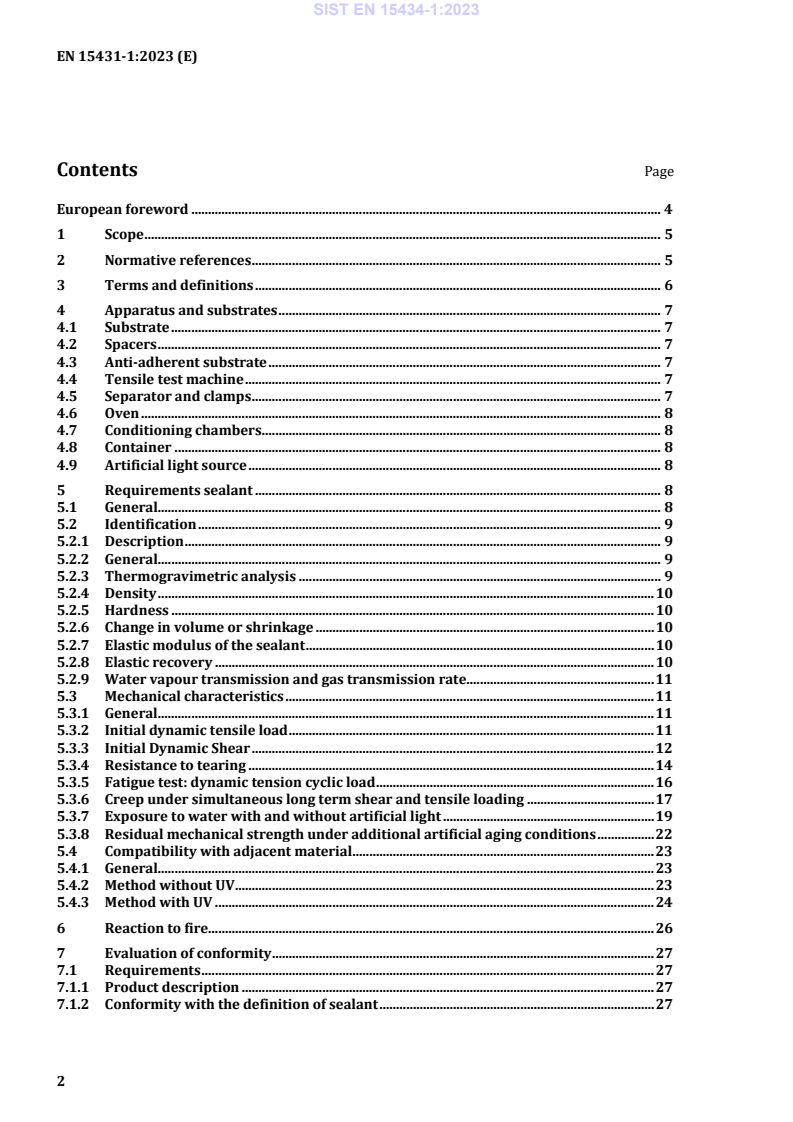
Contents Page
European foreword . 4
1 Scope . 5
2 Normative references . 5
3 Terms and definitions . 6
4 Apparatus and substrates . 7
4.1 Substrate . 7
4.2 Spacers . 7
4.3 Anti-adherent substrate . 7
4.4 Tensile test machine . 7
4.5 Separator and clamps . 7
4.6 Oven . 8
4.7 Conditioning chambers . 8
4.8 Container . 8
4.9 Artificial light source . 8
5 Requirements sealant . 8
5.1 General. 8
5.2 Identification . 9
5.2.1 Description . 9
5.2.2 General. 9
5.2.3 Thermogravimetric analysis . 9
5.2.4 Density . 10
5.2.5 Hardness . 10
5.2.6 Change in volume or shrinkage . 10
5.2.7 Elastic modulus of the sealant . 10
5.2.8 Elastic recovery . 10
5.2.9 Water vapour transmission and gas transmission rate . 11
5.3 Mechanical characteristics . 11
5.3.1 General. 11
5.3.2 Initial dynamic tensile load . 11
5.3.3 Initial Dynamic Shear . 12
5.3.4 Resistance to tearing . 14
5.3.5 Fatigue test: dynamic tension cyclic load . 16
5.3.6 Creep under simultaneous long term shear and tensile loading . 17
5.3.7 Exposure to water with and without artificial light . 19
5.3.8 Residual mechanical strength under additional artificial aging conditions . 22
5.4 Compatibility with adjacent material . 23
5.4.1 General. 23
5.4.2 Method without UV . 23
5.4.3 Method with UV . 24
6 Reaction to fire. 26
7 Evaluation of conformity . 27
7.1 Requirements . 27
7.1.1 Product description . 27
7.1.2 Conformity with the definition of sealant . 27
7.1.3 Determination of the characteristic’s performances . 27
Annex A (normative) Test sample description for testing mechanical characteristics . 31
Annex B (informative) Evaluation of mechanical test results . 32
B.1 Evaluation of the characteristic values R . 32
u,5
Annex C (informative) Carrying out and evaluating the creep test . 33
C.1 Description of testing device . 33
C.2 Procedure . 33
Bibliography . 36
European foreword
This document (EN 15434-1:2023) has been prepared by Technical Committee CEN/TC 349 “Sealants for
joints in building construction”, the secretariat of which is held by AFNOR.
This European Standard shall be given the status of a national standard, either by publication of an
identical text or by endorsement, at the latest by October 2023, and conflicting national standards shall
be withdrawn at the latest by October 2023.
Attention is drawn to the possibility that some of the elements of this document may be the subject of
patent rights. CEN shall not be held responsible for identifying any or all such patent rights.
This document supersedes EN 15434:2006+A1:2010.
The main changes compared to the previous edition are listed below:
— clauses prepared for the purposes of the Construction Products Directive (CPD) were deleted;
— updated technically and improved editorially.
This document is one part of the product European Standards within the EN 15434 series on Bonding
sealants.
This document is one of a series of interrelated standard parts dealing with:
— glass products for bonded sealant glazing systems;
— installation of glass products in a bonded manner on building facades;
— bonding sealants.
The interrelated parts are:
— EN 13022-1, Glass in building — Structural sealant glazing — Part 1: Glass products for structural
sealant glazing systems for supported and unsupported monolithic and multiple glazing;
— EN 13022-2, Glass in building — Structural sealant glazing — Part 2: Assembly rules.
Any feedback and questions on this document should be directed to the users’ national standards body.
A complete listing of these bodies can be found on the CEN website.
According to the CEN-CENELEC Internal Regulations, the national standards organisations of the
following countries are bound to implement this European Standard: Austria, Belgium, Bulgaria, Croatia,
Cyprus, Czech Republic, Denmark, Estonia, Finland, France, Germany, Greece, Hungary, Iceland, Ireland,
Italy, Latvia, Lithuania, Luxembourg, Malta, Netherlands, Norway, Poland, Portugal, Republic of North
Macedonia, Romania, Serbia, Slovakia, Slovenia, Spain, Sweden, Switzerland, Türkiye and the United
Kingdom.
1 Scope
This document covers the requirements for, and testing of sealants for use in one or more of the following
applications:
a) Manufacturing of insulating glass units where direct ultraviolet resistance and mechanical resistance
(bonding use) of the insulating glass edge seal are required;
b) Manufacturing of factory-made bonded sealant glazing elements when referred to by the relevant
European Standards and/or European Technical Approval Guidelines;
c) Assembling of glass products into or onto supports, where also direct ultraviolet resistance and/or
mechanical resistance (bonding use) of the seal are required, under controlled environmental
conditions as described in EN 13022-2.
This document covers the evaluation of conformity and the factory production control with respect to the
production of sealants in conformity with this document.
This document describes the role of sealants that are in conformity with this document, with respect to
sealing and bonding.
This document does not apply to sealants for the manufacture of insulating glass units where the seal is
fully protected, i.e. by a frame, from ultraviolet radiation.
2 Normative references
The following documents are referred to in the text in such a way that some or all of their content
constitutes requirements of this document. For dated references, only the edition cited applies. For
undated references, the latest edition of the referenced document (including any amendments) applies.
EN 572-1:2012+A1:2016, Glass in building - Basic soda-lime silicate glass products - Part 1: Definitions and
general physical and mechanical properties
EN 572-2, Glass in building - Basic soda lime silicate glass products - Part 2: Float glass
EN 1279-1, Glass in Building - Insulating glass units - Part 1: Generalities, system description, rules for
substitution, tolerances and visual quality
EN 1279-4:2018, Glass in Building - Insulating Glass Units - Part 4: Methods of test for the physical attributes
of edge seal components and inserts
EN ISO 6927, Buildings and civil engineering sealants - Vocabulary (ISO 6927)
EN 13022-1, Glass in building - Structural sealant glazing - Part 1: Glass products for structural sealant
glazing systems for supported and unsupported monolithic and multiple glazing
EN 13022-2, Glass in building - Structural sealant glazing - Part 2: Assembly rules
EN ISO 527-3:2018, Plastics - Determination of tensile properties - Part 3: Test conditions for films and
sheets (ISO 527-3:2018)
EN ISO 868, Plastics and ebonite - Determination of indentation hardness by means of a durometer (Shore
hardness) (ISO 868)
EN ISO 1183-1, Plastics - Methods for determining the density of non-cellular plastics - Part 1: Immersion
method, liquid pycnometer method and titration method (ISO 1183-1)
EN ISO 4892-2, Plastics - Methods of exposure to laboratory light sources - Part 2: Xenon-arc lamps (ISO
4892-2)
EN ISO 7389:2003, Building construction - Jointing products - Determination of elastic recovery of sealants
(ISO 7389:2002)
EN ISO 8339:2005, Building construction - Sealants - Determination of tensile properties (Extension to
break) (ISO 8339:2005)
EN ISO 9227, Corrosion tests in artificial atmospheres - Salt spray tests (ISO 9227)
EN ISO 10563, Buildings and civil engineering works - Sealants - Determination of change in mass and
volume (ISO 10563)
EN ISO 11358-1:2022, Plastics - Thermogravimetry (TG) of polymers - Part 1: General principles (ISO
11358-1:2022)
EN ISO 11600, Building construction - Jointing products - Classification and requirements for sealants (ISO
11600)
EN ISO 11925-2, Reaction to fire tests - Ignitability of products subjected to direct impingement of flame -
Part 2: Single-flame source test (ISO 11925-2)
EN 16759, Bonded Glazing for doors, windows and curtain walling - Verification of mechanical performance
of bonding on aluminium and steel surfaces
3 Terms and definitions
For the purposes of this document, the terms and definitions given in EN ISO 11600, EN 13022-1,
EN 13022-2, EN 1279-1 and EN ISO 6927 and the following apply.
ISO and IEC maintain terminology databases for use in standardization at the following addresses:
— ISO Online browsing platform: available at https://www.iso.org/obp
— IEC Electropedia: available at https://www.electropedia.org/
3.1
cure
irreversible transformation of a sealant from a liquid or paste-like state into a hardened or rubber-like
solid state
3.2
initial cure
stage in the curing where sealant has appropriate cohesive strength to resist to different levels of
action/loads
3.3
bonding
joining elements with as result transfer of imposed loads (permanent or variable actions) to the support
frame
3.4
significant change
variation in performance beyond the permitted tolerance for the characteristic
3.5
sealing
making gas and water tight
3.6
failure patterns
state when a sealant in a joint no longer performs its intended function. Can be cohesive (in the body of
the sealant), adhesive (at the interface between sealant and substrate), boundary/thin film (in a portion
of a joint very close to the interface between sealant and substrate)
3.7
breaking stress
breaking stress of each sample shall be calculated using the maximum force and the measured
dimensions of this sample; these values are then used to determine the average value of X and R
mean u,5
stress at the maximum value
3.8
design elongation
maximum relative elongation, corresponding to the linear and elastic recovery domain
[SOURCE: EN 13022-2]
3.9
design stress
design stress in tension (σ ) or in shear (Γ )
des des
[SOURCE: EN 13022-2]
4 Apparatus and substrates
4.1 Substrate
For preparation of the specimens as defined in Annex A. The substrate material shall be flat float glass in
accordance with EN 572-1:2012+A1:2016 and EN 572-2 to be used as standard glass substrate unless
otherwise indicated in the various clauses.
4.2 Spacers
Cross section (12 mm x 12 mm) with anti-adherent surface.
4.3 Anti-adherent substrate
For the preparation of the test specimens, e.g. polyethylene (PE) film, according to the advice of the
sealant manufacturer (see EN ISO 8339:2005, 5.3).
4.4 Tensile test machine
A test machine with recording device, for direct pull tensile force test at a rate of (5,5 ± 0,5) mm/min and
with suitable capacity and sensitivity for the tests.
4.5 Separator and clamps
Clamps with appropriate dimensions to hold the test specimens extended or compressed to various % of
the original width or any other width agreed between the parties concerned. The fitting should not exert
any bending force (axial movement only).
4.6 Oven
Air circulating oven with mechanical ventilation (open valve), capable of controlling the temperature to
within ± 2 °C.
4.7 Conditioning chambers
Conditioning chamber suitable for controlling the temperature to (60 ± 2) °C and RH to (85 ± 10) %.
Cold Chamber capable of controlling the temperature to (−20 ± 2) °C or optionally (−40 ± 2) °C or
(−30 ± 2) °C.
Artificial ageing chamber capable of exposing test pieces to water and radiation.
4.8 Container
Recipient used for immersion in distilled water with the ability to keep the water temperature constant
at ± 1 °C.
4.9 Artificial light source
The artificial source shall be Xenon lamps in accordance with EN ISO 4892-2.
The power of the artificial light source shall be (60 ± 5) W/m measured at the level of the sample, and
between 300 and 400 nm. The irradiance shall not vary by more than ± 10 % over the whole specimen
exposure area. The temperature at the level of the surface of the test specimen shall be of (60 ± 5) °C,
measured by a black panel thermometer. The black panel thermometer shall be used with a blackened
absorbing metal plate that approximates the absorption characteristics of a “black body”. The plate shall
be at least 1 mm thick and of a size to fit the test specimen holders. The temperature of the metal plate is
measured by a suitable thermometer or thermocouple with good thermal contact. For measuring the test
temperature, it shall be mounted in a test specimen holder with the blackened side of the metal plate
facing the artificial light source. Readings shall only be taken after sufficient time has elapsed for the
temperature to become steady. In case a black standard panel is used instead of a black standard
thermometer, it shall be validated at the beginning of the test that an equivalent temperature can be
made sure.
5 Requirements sealant
5.1 General
For conformity purposes, the sealant manufacturer shall describe the product in a product description,
which will be part of the factory production control documentation, or of the quality insurance system,
whichever is applied.
Disclosure of the product description is entirely at the discretion of the sealant manufacturer or his agent.
The product description shall contain at least a normative part and may contain an informative part when
the manufacturer foresees further development of the product.
The product description shall be prepared under the responsibility of the sealant manufacturer or his
agent.
Sealants are described by the tests given in 5.2, 5.3 and 5.4. The same conditioning procedure shall be
used in all relevant test methods except where mentioned.
5.2 Identification
5.2.1 Description
The description consists of three sub parts:
1) Component description:
name and/or type of the sealant, together if it concerns a mono or a multiple components sealant. In
the case of a multiple components sealant, the mixing ratio and the tolerances of the mixing ratio
within which the performances of the characteristics and properties do not change significantly;
2) Initial cure information:
relevant data (or figure or values) depending on the temperature and the relative humidity, the
chemistry of the curing system, number of components, section of the sealant to be applied, the
nature of the adhesion surfaces …;
3) Cured sealant description:
list of identification test results in accordance with 5.2 in order to ensure no significant change in the
characteristics, properties and durability of the sealant.
The definition of product families shall be consistent with the normative part of the product description.
The substitution of raw materials or change in the process shall maintain the conformity with the product
description. The substituting material can be added to the product family and also the product
description when compliance has been demonstrated.
5.2.2 General
All tests of 5.2 except 5.2.6 are carried out on cured products. When no conditioning procedure (cure)
has explicitly been stated by the sealant manufacturer, use only method A or method B as described in
EN ISO 8339. For multiple components sealants the tests shall be performed at the nominal mixing ratio
as defined in 5.2.
5.2.3 Thermogravimetric analysis
The determination of the thermogravimetric analysis shall be carried out following
EN ISO 11358-1:2022, 8.2, “Temperature scanning mode” according to the following specific conditions:
— conditioning before testing: at least 1 day at standard laboratory conditions;
— purging gas: nitrogen and synthetic air respectively, with flow rate approximately 100 ml/min,
depending on equipment;
— sample size: approximately 50 mg;
— heating rate: 20 K/min;
— heating mode: heating up from 40 °C to minimum 900 °C in nitrogen flow, then 10 min isotherm at
900 °C in synthetic air flow.
The rate of heating shall not change during significant weight loss. In cases where the given method
departs from this requirement, the method shall be adapted to prevent this.
Number of test specimens: 1.
Evaluation:
— oxidative or non-oxidative conditions;
— curve and the first derivate of the curve;
— the percentage of cumulative losses up to 900 °C;
— zones of maximum loss through volatilisation;
— exo- or endothermic conversion zones.
5.2.4 Density
The determination of the density on three fully cured specimens shall be in accordance with
EN ISO 1183-1.
5.2.5 Hardness
The determination of the indentation hardness shall be in accordance with EN ISO 868. The test shall be
performed on the cured sealant after (28 ± 3) days for single component sealant and after seven days for
two-component sealants.
At least three samples shall be tested and five measurements taken per sample. The average value and
tolerances of all measurements, recorded to the nearest unit, shall be declared.
5.2.6 Change in volume or shrinkage
The aim of this test is to evaluate the degree of change of volume or shrinkage of the bonding sealants to
limit the initial stresses in the bonding joints. The test shall be carried out on three samples in accordance
with EN ISO 10563 using a mechanically ventilated oven. Shrinkage shall be less than 10 %.
5.2.7 Elastic modulus of the sealant
The aim of this test is to provide the (stress, strain) values needed to allow determining a linear
approximation of the elastic modulus E (Young modulus). This value can subsequently be used for
calculations in related application standards.
The test shall be carried out on five test samples prepared in conformity with EN ISO 527-3:2018, 6.1,
type 5 with all the dumbbell test specimens having a thickness of (2,2 ± 0,2) mm. Speed of the traction:
(5,5 ± 0,5) mm/min. All other parameters of the test procedure follow EN ISO 527-1.
From the stress-at-elongation graph recorded, the following shall be noted:
— stress at elongations of 5 %, 10 %, 15 %, 20 % and 25 %;
— stress and elongation at rupture.
5.2.8 Elastic recovery
The purpose of the test is to evaluate the elastic recovery behaviour and consequently the relaxation
behaviour after long term loading.
The test shall be carried out on three test specimens in accordance with EN ISO 7389:2003, method A
using an imposed elongation equal to (2x the design elongation). Adapted equipment should be used to
ensure adequate accuracy of measurement better than or equal to 0,1 mm.
Record and calculate:
— the initial width L in mm between the contact surfaces after conditioning;
— the width L in mm between the contact surfaces after 24 h extension;
— the width L in mm between the contact surfaces after 1 h in the unloaded condition at room
temperature;
— the elastic recovery R = (L –L )/(L –L ) × 100. The elastic recovery result of each specimen should
1 2 1 0
be rounded to the closest 1 %;
— the average elastic recovery is the mathematical average of the elastic recoveries of each test
specimen rounded to the closest 1 %;
— the elastic recovery shall be ≥ 95 %.
5.2.9 Water vapour transmission and gas transmission rate
For sealants intended to be used in insulating glass unit edge seals this information can be made available.
These properties shall be determined in accordance with EN 1279-4:2018 for a membrane of 2 mm
thickness.
5.3 Mechanical characteristics
5.3.1 General
For determining the mechanical properties, the tests are to be carried out on test specimens prepared
according to Annex A and cured (initial cure) according to EN ISO 8339 (Method A or B).
The pulling system is made of a static and a mobile part which are connected to the sample holder. This
system allows for:
— centralization (alignment) of a sample on the testing machine and maintains it throughout the
duration of the test;
— displacement at constant speed of (5,5 ± 0,5) mm/min of the mobile part versus the static part;
— accurate measurement of the force within ± 1 %;
— accurate measurement of the relative displacement of the two parts of the testing machine to the
nearest 0,1 mm;
— recording of a stress-strain curve.
The system is illustrated in Figure 1 for tension.
The characteristic value R is determined according to Annex B.
u,5
When determining the classification of a bonding sealant according to the requirements of this document,
the same conditioning procedure shall be used in all relevant test methods. The same batch of sealant
(and primer, if used) shall be used in all tests. The same substrates (material and surface finish) shall be
used in all tests. Tests shall be performed on glass according to EN 572-1:2012+A1:2016 and EN 572-2.
5.3.2 Initial dynamic tensile load
The aim of this test is to evaluate the resistance of the bonding sealant to the tensile forces acting on the
joints.
Key
b width of the bead
l length of the bead (as described in Annex A Figure A.1)
e thickness of the bead
Figure 1 — Example of tension induced in the test specimen
After initial cure, the test specimens shall be further conditioned at various temperatures for (24 ± 4) h:
— 5 test specimens conditioned and tested at (–20 ± 2) °C. This temperature can be (–40 ± 2) °C for
European Nordic countries if required by the Applicant and then subjected to a tensile test to rupture;
— 10 test specimens conditioned and tested at (+23 ± 2) °C;
— 5 test specimens conditioned and tested at (+80 ± 2) °C.
Test procedure is carried out in accordance to EN ISO 8339. From the stress-at-elongation graph
recorded, the following shall be noted:
— type of failure;
— stress at elongations of 5 %, 10 %, 15 %, 20 % and 25 %;
— stress and elongation at rupture.
For the tests at −20 °C (or −40 °C), +23 °C, +80 °C, the characteristic value R shall be calculated following
u,5
Annex B:
R = X - τ . s
u,5 mean,n αß
Validation criteria for the tests at −20°C (or −40°C) and +80°C are as follows:
— The change in average breaking stress after ageing calculated following Annex B shall be larger or
equal to 0,75: ΔX = X /X ≥ 0,75 and ΔX = X /X ≥ 0,75
mean mean −20°C mean,n 23°C mean mean 80°C mean,n 23°C
and
— Rupture ≥ 90 % cohesive failure for each sample.
5.3.3 Initial Dynamic Shear
The aim of this test is to evaluate the inherent resistance of bonding sealants to dynamic shear forces
acting on the joints. Figure 2 is an example of shear induced in the test specimen.
Key
b width of the bead
l length of the bead (as described in Annex A Figure A.1)
e thickness of the bead
Figure 2 — Example of shear induced in the test specimen
After initial cure, the test specimens shall be further conditioned at various temperatures for (24 ± 4) h:
— 5 test specimens conditioned and tested at (–20 ± 2) °C;
This temperature can be (–40 ± 2) °C for European Nordic countries if required by the Applicant and then
shall be subjected to a shear test to rupture.
— 10 test specimens conditioned and tested at (+23 ± 2) °C;
— 5 test specimens conditioned and tested at (+80 ± 2) °C.
Temperature of the sample during testing shall not deviate more than ± 2 °C.
From the stress-at-elongation graph recorded, the following shall be noted:
— type of failure;
— stress at rela
...