

SIST-TP ISO/TR 19814:2018
Information and documentation -- Collections management for archives and libraries
General Information
- Abstract
ISO/TR 19814:2017 provides guidance and recommendations in the planning, implementation, maintenance and improvement of the preservation of archive and library collections through:
- recommendations and guidance for preservation planning and ongoing management of physical collections in archives and libraries;
- procedures for managing collections in the stacks, research and reading rooms, conservation facilities and while on exhibit and during transportation.
- guidance and recommendations for appropriate enclosures and containers for archive and library collections.
ISO/TR 19814:2017 applies to preservation of archive and library physical collections of institutions and volumes small and large. It applies to all collections housed by an institution; their own collections and deposits or loans from other institutions. Some information on digital collections, born digital and digitized, for conservation is included for reference.
ISO/TR 19814:2017 also applies to collections that are being managed by governmental agencies.
This guidance is intended for collections that are being preserved for long-term use.
Collections intended for long-term use need to be managed to mitigate many risks that can cause loss, including catastrophic loss from fire and floods, risks of vandalism and theft, to instability of materials, including acetate film and acidic paper. Collections management addresses the risks from a holistic perspective. It is recognized that compromises are necessary based on, among other factors, the quantity of collections in archives and libraries. The compromises can be managed when the factors of use, significance, vulnerability of the collections and the expertise and best practices from several fields are included in the decision-making process.
ISO/TR 19814:2017 covers specifically the operations required to manage the collections environment that are relevant to the preservation policy and plan of the institution. This includes the monitoring of climate stability, control of exposure to light, preventive cleanliness measures and cleaning of the collections storage areas.
The conservation treatment of individual items within the collections is not covered in ISO/TR 19814:2017.
- Status
- Published
- Publication Date
- 04-Sep-2018
- Technical Committee
- IDT - Information, documentation, language and terminology
- Current Stage
- 6060 - National Implementation/Publication (Adopted Project)
- Start Date
- 30-Jul-2018
- Due Date
- 04-Oct-2018
- Completion Date
- 05-Sep-2018
Buy Documents





ISO/TR 19814:2017 - Information and documentation -- Collections management for archives and libraries

ISO/TR 19814:2017 - Information and documentation — Collections management for archives and libraries/3/2017


ISO/TR 19814:2017 - Information et documentation -- Gestion des fonds et collections pour les archives et les bibliotheques
ISO/TR 19814:2017 - Information et documentation — Gestion des fonds et collections pour les archives et les bibliothèques/21/2017
Overview
SIST-TP ISO/TR 19814:2018 (identical to ISO/TR 19814:2017) is a technical report that provides guidance for the long-term preservation and ongoing management of physical collections in archives and libraries. It covers practical measures for planning, implementing, maintaining and improving preservation of institutional holdings - including owned collections, deposits, loans and collections managed by government agencies. The document focuses on holistic collections management rather than individual conservation treatments and also includes reference-level information on digitized and born-digital material.
Key topics and technical requirements
The standard addresses a wide range of operational topics relevant to preservation policy and planning. Major areas include:
- Preservation policy and planning
- Developing documented preservation policies and procedures
- Preservation risk management cycle and documentation for planning
- Emergency preparedness and security
- Emergency preparedness and response planning for collections
- Security planning for storage, transport, loans and exhibits
- Collections storage environment
- Monitoring and management of environmental conditions (climate stability)
- Controlling light exposure and preventive cleanliness of storage areas
- Managing interior and exterior pollution sources
- Integrated pest management (IPM)
- Preventive measures to reduce pest infestation risk
- Shelving and storage systems
- Shelf planning and design, materials, gangways and mobile shelving safety/stability
- Storage solutions for oversize, rolled and heavy-bound volumes
- Packaging, enclosures and containers
- Guidance on appropriate enclosures for paper, photographic, film, audiovisual and machine-readable media
- Collections handling and use
- Time out of storage, handling during research, exhibition and transport
- Documentation requirements for loans, transfers and ownership records
- Training and documentation
- Staff and external-user training recommendations
- Recordkeeping for preservation planning and decision-making
Note: the standard excludes the conservation treatment of individual items; it focuses on preventive care and systems-level management.
Practical applications - who uses this standard
SIST-TP ISO/TR 19814:2018 is intended for professionals and organizations responsible for preserving physical collections, including:
- Archivists and librarians
- Collections and facilities managers
- Preservation planners and conservators (for preventive strategies)
- Museum and heritage managers
- Government agencies managing public records
Use cases include developing institutional preservation policies, designing storage and shelving systems, creating emergency response plans, selecting enclosures and packaging for transport or exhibition, and establishing monitoring and IPM programs.
Related standards and further reading
This Technical Report complements other international guidance on information and documentation and preventive conservation. Institutions typically use it alongside standards and best practice documents covering environmental monitoring, collections care, and documentation to form a complete preservation program.
Keywords: SIST-TP ISO/TR 19814:2018, ISO/TR 19814, collections management standard, archives and libraries preservation, preservation planning, shelving and storage, enclosures and containers, preventive conservation, emergency preparedness, integrated pest management.
Buy Documents
ISO/TR 19814:2017 - Information and documentation -- Collections management for archives and libraries
ISO/TR 19814:2017 - Information and documentation — Collections management for archives and libraries/3/2017
ISO/TR 19814:2017 - Information et documentation -- Gestion des fonds et collections pour les archives et les bibliotheques
ISO/TR 19814:2017 - Information et documentation — Gestion des fonds et collections pour les archives et les bibliothèques/21/2017
Frequently Asked Questions
SIST-TP ISO/TR 19814:2018 is a technical report published by the Slovenian Institute for Standardization (SIST). Its full title is "Information and documentation -- Collections management for archives and libraries". This standard covers: ISO/TR 19814:2017 provides guidance and recommendations in the planning, implementation, maintenance and improvement of the preservation of archive and library collections through: - recommendations and guidance for preservation planning and ongoing management of physical collections in archives and libraries; - procedures for managing collections in the stacks, research and reading rooms, conservation facilities and while on exhibit and during transportation. - guidance and recommendations for appropriate enclosures and containers for archive and library collections. ISO/TR 19814:2017 applies to preservation of archive and library physical collections of institutions and volumes small and large. It applies to all collections housed by an institution; their own collections and deposits or loans from other institutions. Some information on digital collections, born digital and digitized, for conservation is included for reference. ISO/TR 19814:2017 also applies to collections that are being managed by governmental agencies. This guidance is intended for collections that are being preserved for long-term use. Collections intended for long-term use need to be managed to mitigate many risks that can cause loss, including catastrophic loss from fire and floods, risks of vandalism and theft, to instability of materials, including acetate film and acidic paper. Collections management addresses the risks from a holistic perspective. It is recognized that compromises are necessary based on, among other factors, the quantity of collections in archives and libraries. The compromises can be managed when the factors of use, significance, vulnerability of the collections and the expertise and best practices from several fields are included in the decision-making process. ISO/TR 19814:2017 covers specifically the operations required to manage the collections environment that are relevant to the preservation policy and plan of the institution. This includes the monitoring of climate stability, control of exposure to light, preventive cleanliness measures and cleaning of the collections storage areas. The conservation treatment of individual items within the collections is not covered in ISO/TR 19814:2017.
ISO/TR 19814:2017 provides guidance and recommendations in the planning, implementation, maintenance and improvement of the preservation of archive and library collections through: - recommendations and guidance for preservation planning and ongoing management of physical collections in archives and libraries; - procedures for managing collections in the stacks, research and reading rooms, conservation facilities and while on exhibit and during transportation. - guidance and recommendations for appropriate enclosures and containers for archive and library collections. ISO/TR 19814:2017 applies to preservation of archive and library physical collections of institutions and volumes small and large. It applies to all collections housed by an institution; their own collections and deposits or loans from other institutions. Some information on digital collections, born digital and digitized, for conservation is included for reference. ISO/TR 19814:2017 also applies to collections that are being managed by governmental agencies. This guidance is intended for collections that are being preserved for long-term use. Collections intended for long-term use need to be managed to mitigate many risks that can cause loss, including catastrophic loss from fire and floods, risks of vandalism and theft, to instability of materials, including acetate film and acidic paper. Collections management addresses the risks from a holistic perspective. It is recognized that compromises are necessary based on, among other factors, the quantity of collections in archives and libraries. The compromises can be managed when the factors of use, significance, vulnerability of the collections and the expertise and best practices from several fields are included in the decision-making process. ISO/TR 19814:2017 covers specifically the operations required to manage the collections environment that are relevant to the preservation policy and plan of the institution. This includes the monitoring of climate stability, control of exposure to light, preventive cleanliness measures and cleaning of the collections storage areas. The conservation treatment of individual items within the collections is not covered in ISO/TR 19814:2017.
SIST-TP ISO/TR 19814:2018 is classified under the following ICS (International Classification for Standards) categories: 01.140.20 - Information sciences. The ICS classification helps identify the subject area and facilitates finding related standards.
SIST-TP ISO/TR 19814:2018 is available in PDF format for immediate download after purchase. The document can be added to your cart and obtained through the secure checkout process. Digital delivery ensures instant access to the complete standard document.
Standards Content (Sample)
SLOVENSKI STANDARD
01-oktober-2018
Informatika in dokumentacija - Upravljanje zbirk arhivov in knjižnic
Information and documentation -- Collections management for archives and libraries
Information et documentation -- Gestion des fonds et collections pour les archives et les
bibliothèques
Ta slovenski standard je istoveten z: ISO/TR 19814:2017
ICS:
01.140.20 Informacijske vede Information sciences
2003-01.Slovenski inštitut za standardizacijo. Razmnoževanje celote ali delov tega standarda ni dovoljeno.
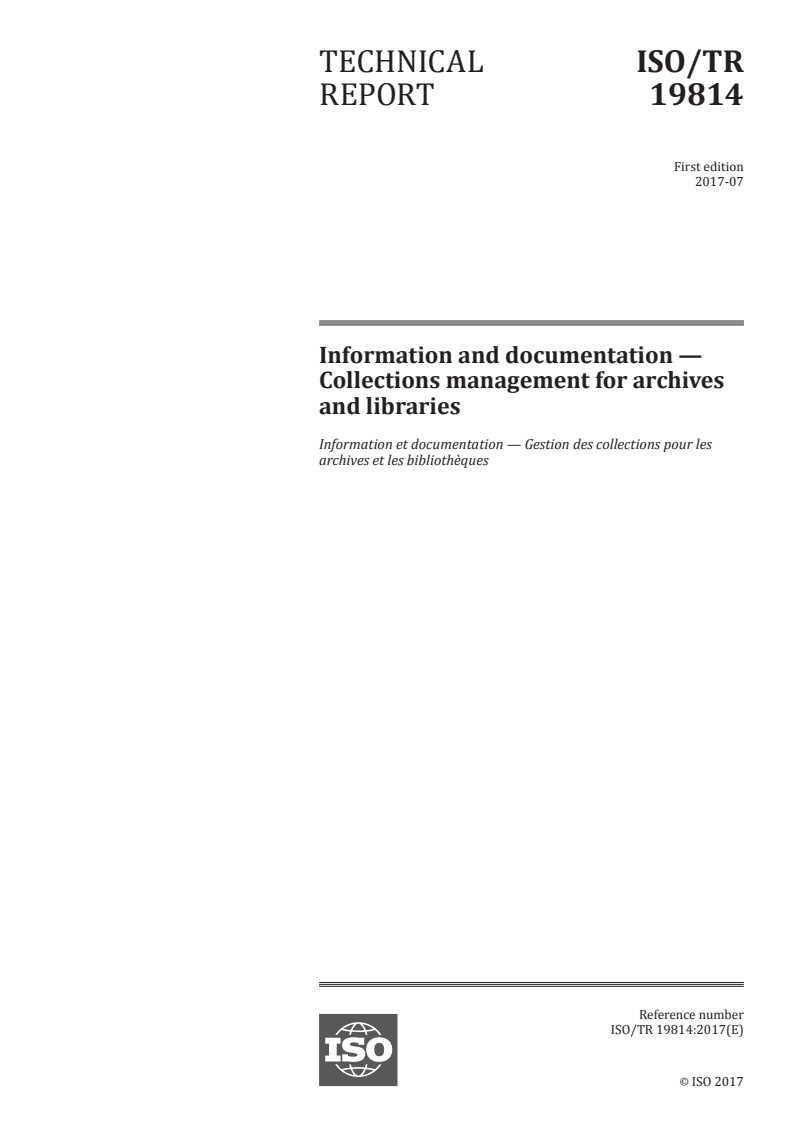
TECHNICAL ISO/TR
REPORT 19814
First edition
2017-07
Information and documentation —
Collections management for archives
and libraries
Information et documentation — Gestion des collections pour les
archives et les bibliothèques
Reference number
©
ISO 2017
© ISO 2017, Published in Switzerland
All rights reserved. Unless otherwise specified, no part of this publication may be reproduced or utilized otherwise in any form
or by any means, electronic or mechanical, including photocopying, or posting on the internet or an intranet, without prior
written permission. Permission can be requested from either ISO at the address below or ISO’s member body in the country of
the requester.
ISO copyright office
Ch. de Blandonnet 8 • CP 401
CH-1214 Vernier, Geneva, Switzerland
Tel. +41 22 749 01 11
Fax +41 22 749 09 47
copyright@iso.org
www.iso.org
ii © ISO 2017 – All rights reserved
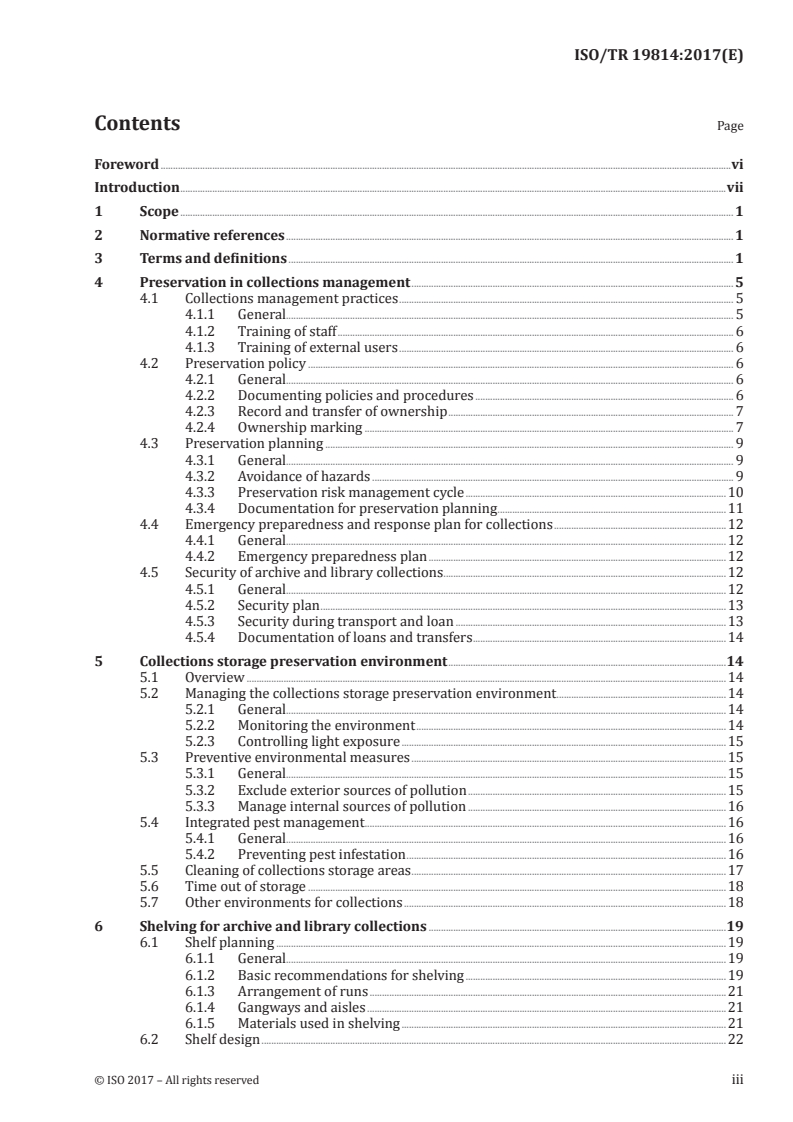
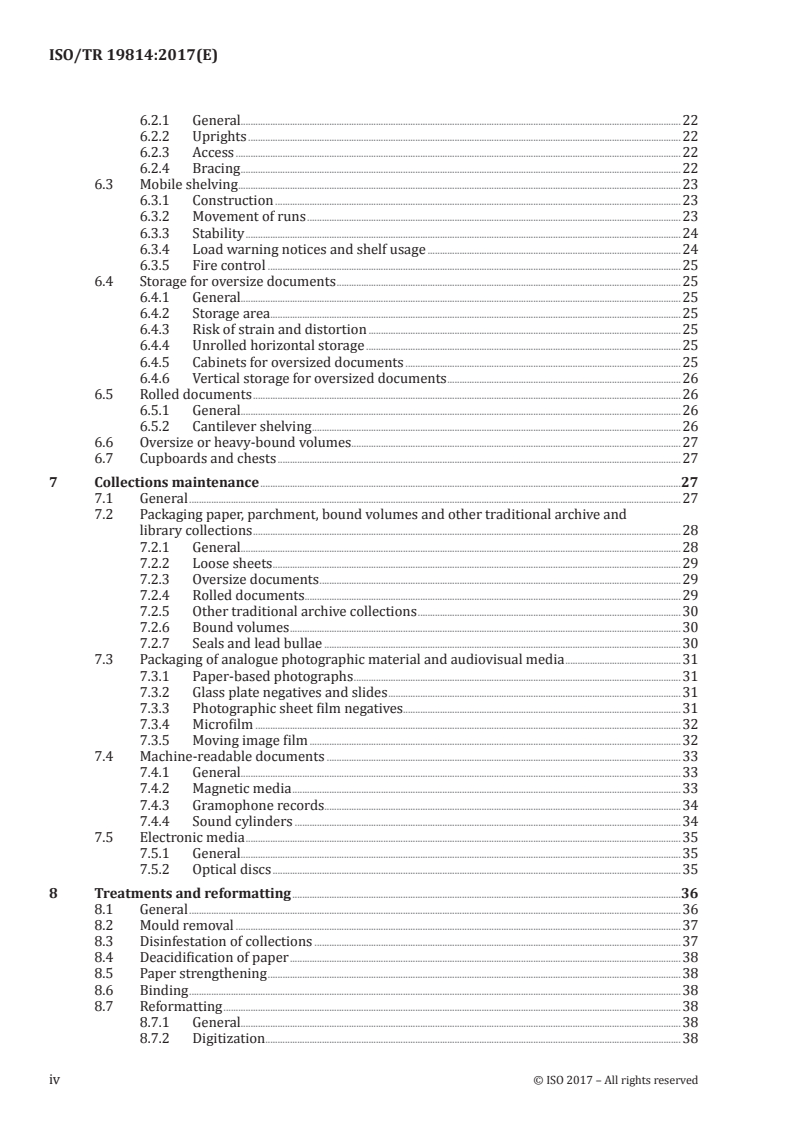
Contents Page
Foreword .vi
Introduction .vii
1 Scope . 1
2 Normative references . 1
3 Terms and definitions . 1
4 Preservation in collections management . 5
4.1 Collections management practices . 5
4.1.1 General. 5
4.1.2 Training of staff . 6
4.1.3 Training of external users . 6
4.2 Preservation policy . 6
4.2.1 General. 6
4.2.2 Documenting policies and procedures . 6
4.2.3 Record and transfer of ownership . 7
4.2.4 Ownership marking . 7
4.3 Preservation planning . 9
4.3.1 General. 9
4.3.2 Avoidance of hazards . 9
4.3.3 Preservation risk management cycle .10
4.3.4 Documentation for preservation planning .11
4.4 Emergency preparedness and response plan for collections .12
4.4.1 General.12
4.4.2 Emergency preparedness plan .12
4.5 Security of archive and library collections .12
4.5.1 General.12
4.5.2 Security plan .13
4.5.3 Security during transport and loan .13
4.5.4 Documentation of loans and transfers .14
5 Collections storage preservation environment .14
5.1 Overview .14
5.2 Managing the collections storage preservation environment .14
5.2.1 General.14
5.2.2 Monitoring the environment .14
5.2.3 Controlling light exposure .15
5.3 Preventive environmental measures .15
5.3.1 General.15
5.3.2 Exclude exterior sources of pollution .15
5.3.3 Manage internal sources of pollution .16
5.4 Integrated pest management .16
5.4.1 General.16
5.4.2 Preventing pest infestation .16
5.5 Cleaning of collections storage areas .17
5.6 Time out of storage .18
5.7 Other environments for collections .18
6 Shelving for archive and library collections .19
6.1 Shelf planning .19
6.1.1 General.19
6.1.2 Basic recommendations for shelving .19
6.1.3 Arrangement of runs .21
6.1.4 Gangways and aisles .21
6.1.5 Materials used in shelving .21
6.2 Shelf design .22
6.2.1 General.22
6.2.2 Uprights .22
6.2.3 Access .22
6.2.4 Bracing .22
6.3 Mobile shelving .23
6.3.1 Construction .23
6.3.2 Movement of runs .23
6.3.3 Stability .24
6.3.4 Load warning notices and shelf usage .24
6.3.5 Fire control .25
6.4 Storage for oversize documents .25
6.4.1 General.25
6.4.2 Storage area . . .25
6.4.3 Risk of strain and distortion .25
6.4.4 Unrolled horizontal storage .25
6.4.5 Cabinets for oversized documents .25
6.4.6 Vertical storage for oversized documents .26
6.5 Rolled documents .26
6.5.1 General.26
6.5.2 Cantilever shelving .26
6.6 Oversize or heavy-bound volumes.27
6.7 Cupboards and chests .27
7 Collections maintenance .27
7.1 General .27
7.2 Packaging paper, parchment, bound volumes and other traditional archive and
library collections .28
7.2.1 General.28
7.2.2 Loose sheets .29
7.2.3 Oversize documents .29
7.2.4 Rolled documents.29
7.2.5 Other traditional archive collections .30
7.2.6 Bound volumes .30
7.2.7 Seals and lead bullae .30
7.3 Packaging of analogue photographic material and audiovisual media .31
7.3.1 Paper-based photographs .31
7.3.2 Glass plate negatives and slides .31
7.3.3 Photographic sheet film negatives.31
7.3.4 Microfilm .32
7.3.5 Moving image film .32
7.4 Machine-readable documents .33
7.4.1 General.33
7.4.2 Magnetic media .33
7.4.3 Gramophone records.34
7.4.4 Sound cylinders .34
7.5 Electronic media .35
7.5.1 General.35
7.5.2 Optical discs .35
8 Treatments and reformatting .36
8.1 General .36
8.2 Mould removal .37
8.3 Disinfestation of collections .37
8.4 Deacidification of paper .38
8.5 Paper strengthening .38
8.6 Binding .38
8.7 Reformatting .38
8.7.1 General.38
8.7.2 Digitization.38
iv © ISO 2017 – All rights reserved
8.7.3 Digitized archive and library collections.39
8.7.4 Photocopying .40
8.7.5 Microfilming.40
Annex A (informative) Packaging enclosures and materials .41
Annex B (informative) Exhibition of archives and library collections .48
Bibliography .53
Foreword
ISO (the International Organization for Standardization) is a worldwide federation of national standards
bodies (ISO member bodies). The work of preparing International Standards is normally carried out
through ISO technical committees. Each member body interested in a subject for which a technical
committee has been established has the right to be represented on that committee. International
organizations, governmental and non-governmental, in liaison with ISO, also take part in the work.
ISO collaborates closely with the International Electrotechnical Commission (IEC) on all matters of
electrotechnical standardization.
The procedures used to develop this document and those intended for its further maintenance are
described in the ISO/IEC Directives, Part 1. In particular, the different approval criteria needed for the
different types of ISO documents should be noted. This document was drafted in accordance with the
editorial rules of the ISO/IEC Directives, Part 2 (see www .iso .org/ directives).
Attention is drawn to the possibility that some of the elements of this document may be the subject of
patent rights. ISO shall not be held responsible for identifying any or all such patent rights. Details of
any patent rights identified during the development of the document will be in the Introduction and/or
on the ISO list of patent declarations received (see www .iso .org/ patents).
Any trade name used in this document is information given for the convenience of users and does not
constitute an endorsement.
For an explanation on the voluntary nature of standards, the meaning of ISO specific terms and
expressions related to conformity assessment, as well as information about ISO’s adherence to the
World Trade Organization (WTO) principles in the Technical Barriers to Trade (TBT), see the following
URL: w w w . i s o .org/ iso/ foreword .html.
This document was prepared by Technical Committee ISO/TC 46, Information and documentation, SC 10,
Requirements for document storage and conditions for preservation.
vi © ISO 2017 – All rights reserved
Introduction
This document is based on ISO 11799 and BS 5454:2012. It is intended to be used with ISO 11799 and
ISO/TR 19815.
TECHNICAL REPORT ISO/TR 19814:2017(E)
Information and documentation — Collections
management for archives and libraries
1 Scope
This document provides guidance and recommendations in the planning, implementation, maintenance
and improvement of the preservation of archive and library collections through:
— recommendations and guidance for preservation planning and ongoing management of physical
collections in archives and libraries;
— procedures for managing collections in the stacks, research and reading rooms, conservation
facilities and while on exhibit and during transportation.
— guidance and recommendations for appropriate enclosures and containers for archive and library
collections.
This document applies to preservation of archive and library physical collections of institutions and
volumes small and large. It applies to all collections housed by an institution; their own collections
and deposits or loans from other institutions. Some information on digital collections, born digital and
digitized, for conservation is included for reference.
This document also applies to collections that are being managed by governmental agencies.
This guidance is intended for collections that are being preserved for long-term use.
Collections intended for long-term use need to be managed to mitigate many risks that can cause loss,
including catastrophic loss from fire and floods, risks of vandalism and theft, to instability of materials,
including acetate film and acidic paper. Collections management addresses the risks from a holistic
perspective. It is recognized that compromises are necessary based on, among other factors, the
quantity of collections in archives and libraries. The compromises can be managed when the factors
of use, significance, vulnerability of the collections and the expertise and best practices from several
fields are included in the decision-making process.
This document covers specifically the operations required to manage the collections environment
that are relevant to the preservation policy and plan of the institution. This includes the monitoring
of climate stability, control of exposure to light, preventive cleanliness measures and cleaning of the
collections storage areas.
The conservation treatment of individual items within the collections is not covered in this document.
2 Normative references
There are no normative references in this document.
3 Terms and definitions
For the purposes of this document, the following terms and definitions apply.
ISO and IEC maintain terminological databases for use in standardization at the following addresses:
— IEC Electropedia: available at http:// www .electropedia .org/
— ISO Online browsing platform: available at http:// www .iso .org/ obp
3.1
accessioning
action of adding document (3.8) or group of documents to the collections of an information and
documentation organization
[SOURCE: ISO 5127:2001, 4.1.2.16, modified.]
3.2
archival-quality material
material that does not cause harm or reduced life expectancy when in contact with other items (3.16)
[SOURCE: SAA Glossary — A Glossary of Archival and Records Terminology]
3.3
archive
organization or part of an organization responsible for selection, acquisition, preservation (3.21) and
availability of one or more archives (3.4)
[SOURCE: ISO 5127:2001, 3.1.02]
3.4
archives
records of the same provenance accumulated by an organization or person in the course of the conduct
of affairs and preserved because of their enduring value
[SOURCE: ISO 5127:2001, 3.1.01]
3.5
collection
gathering of documents (3.8) assembled on the basis of some common characteristics without regard to
their provenance
[SOURCE: ISO 5127:2001, 3.1.07]
3.6
conservation
intervention techniques applied to prevent, arrest or delay deterioration (3.7) of a document (3.8)
[SOURCE: ISO 5127:2001, 6.1.03]
3.7
deterioration
gradual degradation and possible ultimate destruction of materials arising from damaging inherent
properties or interaction with environmental influences
[SOURCE: ISO 5127:2001, 6.1.13]
3.8
document
recorded information or material object which can be treated as a unit in a documentation process
Note 1 to entry: Documents can differ in form and characteristic.
[SOURCE: ISO 5127:2001, 1.2.02]
3.9
dry-stamping
embossed mark for security
2 © ISO 2017 – All rights reserved
3.10
hazard
source of potential harm
[SOURCE: ISO Guide 73:2009, 3.5.1.4]
3.11
memory organization
institution involved in the collection (3.5) and preservation (3.21) of cultural information, such as
a library (3.17), archive (3.3) or museum that is itself together with its collections, established as a
permanent entity
[SOURCE: ISO 27730:2012, 3.6]
3.12
holdings
totality of materials in the custody of an information and documentation organization
Note 1 to entry: Holdings includes all types of materials kept in archives and libraries regardless of their physical
format, mainly books, manuscripts, files, maps, seals and graphic collections and other documents consisting of
paper, but also parchment, papyrus, films, photographic materials, audiovisual recordings, magnetic and optical
media and materials such as stone, metal, wax, textiles. (Partial source ISO 11799)
[SOURCE: ISO 5127:2001, 3.1.13, modified — Note 1 to entry has been added.]
3.13
collections management
activities to stabilize materials for long-term storage by placing materials in appropriate housings and
environments
Note 1 to entry: Collections management includes ensuring materials are in containers, that the documents are
supported within containers and that fragile documents have individual enclosures for additional protection.
Note 2 to entry: Collections management also includes all aspects of the storage environment, including
temperature, humidity and shelving.
[SOURCE: Partial source SAA Glossary — A Glossary of Archival and Records Terminology]
3.14
collections maintenance
actions taken to prepare collections for storage and for use (e.g. packaging)
3.15
housing
actions to enclose collections in packaging (3.19) before they are placed in storage
Note 1 to entry: Housing is an action in collections maintenance.
3.16
item
archive or library item
smallest intellectually indivisible unit (e.g. a letter, memorandum, report, photograph, sound recording,
book, graphic or map)
[SOURCE: ISO 5127:2001, 2.1.13, modified.]
3.17
library
organization or part of an organization the main aim of which is to facilitate the use of such information
resources, services and facilities as are required to meet the informational, research, educational,
cultural or recreational needs of its users
[SOURCE: ISO 5127:2001, 3.1.03]
3.18
ownership mark
unique identifying mark made on each item (3.16) by the owner
3.19
packaging
layer of protection for items (3.16)
Note 1 to entry: Examples include a box, folder and envelope.
Note 2 to entry: Packaging should protect the items from light and pollutants. It also provides some protection
from physical damage, pests and moderate changes in temperature or humidity.
3.20
powder-coating
protective and decorative coating formed by the application of a coating powder to a substrate and
fusion (and curing if necessary) to give a continuous film
[SOURCE: ISO 8130]
3.21
preservation
all measures taken including financial and strategic decisions to maintain the integrity and extend the
life of documents (3.8) or collections
[SOURCE: ISO 5127:2001, 6.1.01]
3.22
preventive conservation
measures and actions aimed at avoiding and minimizing future deterioration (3.7), damage and loss
Note 1 to entry: Generally indirect measures or actions.
[SOURCE: EN 15898:2011, 3.3.5, modified.]
3.23
radio frequency identification
RFID
electronic device used for security and tracking
3.24
record
document (3.8) created or received and maintained by an agency, organization or individual in
pursuance of legal obligations or in the transaction of business
[SOURCE: ISO 5127:2001, 2.2.1.08]
3.25
reformatting
action to create a copy with a format or structure different from the original especially for preservation
(3.21) or access
[SOURCE: SAA Glossary — A Glossary of Archival and Records Terminology]
3.26
restoration
actions taken to return a document (3.8) which has suffered deterioration (3.7) or damage as closely as
practicable to its original state
[SOURCE: ISO 5127:2001, 6.1.04]
4 © ISO 2017 – All rights reserved
3.27
reversibility
quality of a conservation (3.6) treatment (3.31) which would allow the document (3.8) to be returned to
its pre-treated state without damage
Note 1 to entry: Ethical principle within conservation; often difficult, but a consideration in the decision-making
before treatment.
3.28
risk
effect of uncertainty on objectives
Note 1 to entry: Risk is often characterized by potential events and consequences or a combination of these.
Note 2 to entry: Risk is often expressed in terms of a combination of the consequences of an event (including
change in circumstances) and the associated likelihood of occurrence.
[SOURCE: ISO 31000:2009, 2.1, modified.]
3.29
risk management
coordinated activities to direct and control an organization with regard to risk (3.28)
[SOURCE: ISO 31000:2009, 2.2]
3.30
storage area
area of the information and documentation organization where the collections are kept under controlled
conditions
3.31
treatment
direct action carried out on an item (3.16) or collections for conservation (3.6)
3.32
vulnerability
intrinsic properties of something resulting in susceptibility to a risk (3.28) source that can lead to an
event with consequence
[SOURCE: ISO Guide 73:2009, 3.6.1.6]
4 Preservation in collections management
4.1 Collections management practices
4.1.1 General
Preservation planning and policies are fundamental to the mission and strategic plan of preserving
collections in archives, libraries and other cultural institutions. Collections management is integrated
into the goals and objectives of the institution through preservation policies and preservation planning.
Written collections management procedures are essential to achieving the preservation plan in archives
and libraries, ensuring consistency of procedures followed by staff throughout the institution.
Scientific and technical exchanges with other sectors of heritage preservation are advisable to avoid
redundant preservation activities.
4.1.2 Training of staff
All staff responsible for the preservation and use of collections in archives, libraries and other cultural
institutions should be informed about their role and the principles of preservation of the materials and
types of collections in their care.
Each employee should be instructed and trained in the implementation of the collections emergency plan.
Those responsible for supervising others in the care of collections should have dedicated training in
collections management to define the preservation needs of collections, define priority actions and to
prepare and implement a preservation plan.
This training may include knowledge of heritage legislation, the standards that apply to the preservation
of the collections in their care, the doctrine and professional preservation techniques and practices.
The training and experience of the staff should be relevant to the types of materials in the collections
and significance of the collections. The training and experience should include techniques for individual
and collective treatments of the appropriate collections. Training in chemical or biological health risks
from treatment of collections should also be included.
Continuing training regarding preservation should be included in the preservation plan.
4.1.3 Training of external users
The public, contractors, volunteers and others who handle collections items should be provided with
simple information and/or training on preservation and guidelines for handling collections. This may
be done through signage or information provided where collections are being handling.
4.2 Preservation policy
4.2.1 General
Formal preservation policies are fundamental to collections management. The purpose of the
preservation policies is to ensure that all staff and managers are aware of their preservation responsibility.
Preservation policy guides all staff and managers in appropriate actions that ensure the preservation
of collections based on specialized knowledge provided by the preservation profession. Guidance that
accompanies the policy may explain impacts and consequences of deviation from the policy.
Preservation policies may include: regulations for security and handling of collections, exhibition
and loan regulations, transportation regulations, operational rules for collections storage locations,
including policies related to cleaning. Additionally, decisions about acquisition, transfer and loans and
conservation should adhere to the preservation policy of the institution.
NOTE Policies that avoid smoking, eating and drinking in any area where collections are stored or used is a
primary restriction. Smoking leaves tar and nicotine deposits. Food and drink attract insects and rodents, leave
residues that cause surface contamination and pose a direct threat to the collections and equipment if spilled.
4.2.2 Documenting policies and procedures
Written collections management procedures are essential to achieving the preservation plan in archives
and libraries by ensuring consistency of procedures followed by staff throughout the institution. It is
advisable that these procedures are documented in policies or guidance and maintained permanently.
Preservation documentation should include decisions made that may impact the preservation of the
collections.
The documentation should specify the date, the name of the person taking the decision and under which
authority the procedures of recording, transfer, loan, preservation or conservation are taken.
6 © ISO 2017 – All rights reserved
The record of actions that impact the preservation of the collections may include:
a) documentation of receipt/accessioning/cataloguing, location transfers, or deaccessioning decisions
according to institutional policy or regulations;
b) documentation of conservation treatments and preservation actions, including treatments for
mould or disinfestations and loans and exhibition times and locations for individual items;
c) documentation of preservation actions including environmental data, specifications for materials
used in contact with collections.
4.2.3 Record and transfer of ownership
Information relevant to the acquisition or transfer of collections is kept in a file relative to the
collections.
All items being received into the collections should be inventoried, clearly identified and described,
with condition information about its state of preservation and location information.
Pre-existing numbers, shelf locations, or inventory numbers should not be removed.
The identification and the description of a document should use the rules and controlled vocabularies
relevant to the institution.
Significant items received into the collections, based on the mission, historical or acquisitive value
should be identified and provided with appropriate condition assessment and security protection.
It is recommended that significant items be transferred with a signature in any movement or transfer
of responsibility.
A list of these significant items may be maintained in a secure location for emergency response planning
and to ensure that security protections are maintained, with the list jointly verified annually, or when a
change in management occurs.
It is recommended that heritage collections be regularly inspected and inventoried in whole or in part.
This may be combined with a condition assessment.
The inspection, or inventory, should be endorsed by at least two people.
4.2.4 Ownership marking
4.2.4.1 General
It is advisable that institutions prepare written documentation of policies on ownership marking
unique identifying marks on each item and provide training to all staff who work with the collections.
Traditional collecting practices have often included ownership marking of items. The two reasons given
for ownership marking are to deter theft and to establish ownership if the item is recovered.
Ownership marking is advisable, particularly for high use items or items with a risks such as commercial
value, items being sent out of the institution on loan and may be required by national regulations.
Options for permanently marking paper-based items include embossing, punching or perforating and
ink stamping. Many institutions mark ownership by stamping with indelible ink on the edge or use
electronic strips inserted in the spine or text block for theft deterrence for use with exit monitoring.
Electronic strips inserted into collections have additional concerns related to adhesives used and the
potential for damage to the book structures if inserted into the spine.
It is recognized that the resources required for ownership marking at the item level in an archive or
library may be extensive.
There are significant costs associated with marking all collections in an archive or library. It is advisable
to consider all options for providing appropriate security.
4.2.4.2 Placement of ownership marks
Ownership marking, primarily for theft deterrence, requires careful consideration. The ownership
mark should be indelible to be useful; this is difficult to achieve. The placement of the mark requires
consideration and training, so as not to potentially deface an item. It is not recommended to stamp rare
or unique collection items with ink. Consulting preservation specialists is advisable.
Placement of the ownership mark is a balance between attempting to deter theft, by making it difficult
to remove the mark, without defacing or detracting from the preservation and purpose of the item.
If the mark is too close to the edge it is easily removed by trimming or removing a part of the item. If
the mark is placed close to, or over the text or writing, it may obscure or detract from the information
contained in the document.
Ownership marking should be visible and legible.
To limit handling of items, the ownership mark should be located in the same position for each type of
item fo
...
TECHNICAL ISO/TR
REPORT 19814
First edition
2017-07
Information and documentation —
Collections management for archives
and libraries
Information et documentation — Gestion des collections pour les
archives et les bibliothèques
Reference number
©
ISO 2017
© ISO 2017, Published in Switzerland
All rights reserved. Unless otherwise specified, no part of this publication may be reproduced or utilized otherwise in any form
or by any means, electronic or mechanical, including photocopying, or posting on the internet or an intranet, without prior
written permission. Permission can be requested from either ISO at the address below or ISO’s member body in the country of
the requester.
ISO copyright office
Ch. de Blandonnet 8 • CP 401
CH-1214 Vernier, Geneva, Switzerland
Tel. +41 22 749 01 11
Fax +41 22 749 09 47
copyright@iso.org
www.iso.org
ii © ISO 2017 – All rights reserved
Contents Page
Foreword .vi
Introduction .vii
1 Scope . 1
2 Normative references . 1
3 Terms and definitions . 1
4 Preservation in collections management . 5
4.1 Collections management practices . 5
4.1.1 General. 5
4.1.2 Training of staff . 6
4.1.3 Training of external users . 6
4.2 Preservation policy . 6
4.2.1 General. 6
4.2.2 Documenting policies and procedures . 6
4.2.3 Record and transfer of ownership . 7
4.2.4 Ownership marking . 7
4.3 Preservation planning . 9
4.3.1 General. 9
4.3.2 Avoidance of hazards . 9
4.3.3 Preservation risk management cycle .10
4.3.4 Documentation for preservation planning .11
4.4 Emergency preparedness and response plan for collections .12
4.4.1 General.12
4.4.2 Emergency preparedness plan .12
4.5 Security of archive and library collections .12
4.5.1 General.12
4.5.2 Security plan .13
4.5.3 Security during transport and loan .13
4.5.4 Documentation of loans and transfers .14
5 Collections storage preservation environment .14
5.1 Overview .14
5.2 Managing the collections storage preservation environment .14
5.2.1 General.14
5.2.2 Monitoring the environment .14
5.2.3 Controlling light exposure .15
5.3 Preventive environmental measures .15
5.3.1 General.15
5.3.2 Exclude exterior sources of pollution .15
5.3.3 Manage internal sources of pollution .16
5.4 Integrated pest management .16
5.4.1 General.16
5.4.2 Preventing pest infestation .16
5.5 Cleaning of collections storage areas .17
5.6 Time out of storage .18
5.7 Other environments for collections .18
6 Shelving for archive and library collections .19
6.1 Shelf planning .19
6.1.1 General.19
6.1.2 Basic recommendations for shelving .19
6.1.3 Arrangement of runs .21
6.1.4 Gangways and aisles .21
6.1.5 Materials used in shelving .21
6.2 Shelf design .22
6.2.1 General.22
6.2.2 Uprights .22
6.2.3 Access .22
6.2.4 Bracing .22
6.3 Mobile shelving .23
6.3.1 Construction .23
6.3.2 Movement of runs .23
6.3.3 Stability .24
6.3.4 Load warning notices and shelf usage .24
6.3.5 Fire control .25
6.4 Storage for oversize documents .25
6.4.1 General.25
6.4.2 Storage area . . .25
6.4.3 Risk of strain and distortion .25
6.4.4 Unrolled horizontal storage .25
6.4.5 Cabinets for oversized documents .25
6.4.6 Vertical storage for oversized documents .26
6.5 Rolled documents .26
6.5.1 General.26
6.5.2 Cantilever shelving .26
6.6 Oversize or heavy-bound volumes.27
6.7 Cupboards and chests .27
7 Collections maintenance .27
7.1 General .27
7.2 Packaging paper, parchment, bound volumes and other traditional archive and
library collections .28
7.2.1 General.28
7.2.2 Loose sheets .29
7.2.3 Oversize documents .29
7.2.4 Rolled documents.29
7.2.5 Other traditional archive collections .30
7.2.6 Bound volumes .30
7.2.7 Seals and lead bullae .30
7.3 Packaging of analogue photographic material and audiovisual media .31
7.3.1 Paper-based photographs .31
7.3.2 Glass plate negatives and slides .31
7.3.3 Photographic sheet film negatives.31
7.3.4 Microfilm .32
7.3.5 Moving image film .32
7.4 Machine-readable documents .33
7.4.1 General.33
7.4.2 Magnetic media .33
7.4.3 Gramophone records.34
7.4.4 Sound cylinders .34
7.5 Electronic media .35
7.5.1 General.35
7.5.2 Optical discs .35
8 Treatments and reformatting .36
8.1 General .36
8.2 Mould removal .37
8.3 Disinfestation of collections .37
8.4 Deacidification of paper .38
8.5 Paper strengthening .38
8.6 Binding .38
8.7 Reformatting .38
8.7.1 General.38
8.7.2 Digitization.38
iv © ISO 2017 – All rights reserved
8.7.3 Digitized archive and library collections.39
8.7.4 Photocopying .40
8.7.5 Microfilming.40
Annex A (informative) Packaging enclosures and materials .41
Annex B (informative) Exhibition of archives and library collections .48
Bibliography .53
Foreword
ISO (the International Organization for Standardization) is a worldwide federation of national standards
bodies (ISO member bodies). The work of preparing International Standards is normally carried out
through ISO technical committees. Each member body interested in a subject for which a technical
committee has been established has the right to be represented on that committee. International
organizations, governmental and non-governmental, in liaison with ISO, also take part in the work.
ISO collaborates closely with the International Electrotechnical Commission (IEC) on all matters of
electrotechnical standardization.
The procedures used to develop this document and those intended for its further maintenance are
described in the ISO/IEC Directives, Part 1. In particular, the different approval criteria needed for the
different types of ISO documents should be noted. This document was drafted in accordance with the
editorial rules of the ISO/IEC Directives, Part 2 (see www .iso .org/ directives).
Attention is drawn to the possibility that some of the elements of this document may be the subject of
patent rights. ISO shall not be held responsible for identifying any or all such patent rights. Details of
any patent rights identified during the development of the document will be in the Introduction and/or
on the ISO list of patent declarations received (see www .iso .org/ patents).
Any trade name used in this document is information given for the convenience of users and does not
constitute an endorsement.
For an explanation on the voluntary nature of standards, the meaning of ISO specific terms and
expressions related to conformity assessment, as well as information about ISO’s adherence to the
World Trade Organization (WTO) principles in the Technical Barriers to Trade (TBT), see the following
URL: w w w . i s o .org/ iso/ foreword .html.
This document was prepared by Technical Committee ISO/TC 46, Information and documentation, SC 10,
Requirements for document storage and conditions for preservation.
vi © ISO 2017 – All rights reserved
Introduction
This document is based on ISO 11799 and BS 5454:2012. It is intended to be used with ISO 11799 and
ISO/TR 19815.
TECHNICAL REPORT ISO/TR 19814:2017(E)
Information and documentation — Collections
management for archives and libraries
1 Scope
This document provides guidance and recommendations in the planning, implementation, maintenance
and improvement of the preservation of archive and library collections through:
— recommendations and guidance for preservation planning and ongoing management of physical
collections in archives and libraries;
— procedures for managing collections in the stacks, research and reading rooms, conservation
facilities and while on exhibit and during transportation.
— guidance and recommendations for appropriate enclosures and containers for archive and library
collections.
This document applies to preservation of archive and library physical collections of institutions and
volumes small and large. It applies to all collections housed by an institution; their own collections
and deposits or loans from other institutions. Some information on digital collections, born digital and
digitized, for conservation is included for reference.
This document also applies to collections that are being managed by governmental agencies.
This guidance is intended for collections that are being preserved for long-term use.
Collections intended for long-term use need to be managed to mitigate many risks that can cause loss,
including catastrophic loss from fire and floods, risks of vandalism and theft, to instability of materials,
including acetate film and acidic paper. Collections management addresses the risks from a holistic
perspective. It is recognized that compromises are necessary based on, among other factors, the
quantity of collections in archives and libraries. The compromises can be managed when the factors
of use, significance, vulnerability of the collections and the expertise and best practices from several
fields are included in the decision-making process.
This document covers specifically the operations required to manage the collections environment
that are relevant to the preservation policy and plan of the institution. This includes the monitoring
of climate stability, control of exposure to light, preventive cleanliness measures and cleaning of the
collections storage areas.
The conservation treatment of individual items within the collections is not covered in this document.
2 Normative references
There are no normative references in this document.
3 Terms and definitions
For the purposes of this document, the following terms and definitions apply.
ISO and IEC maintain terminological databases for use in standardization at the following addresses:
— IEC Electropedia: available at http:// www .electropedia .org/
— ISO Online browsing platform: available at http:// www .iso .org/ obp
3.1
accessioning
action of adding document (3.8) or group of documents to the collections of an information and
documentation organization
[SOURCE: ISO 5127:2001, 4.1.2.16, modified.]
3.2
archival-quality material
material that does not cause harm or reduced life expectancy when in contact with other items (3.16)
[SOURCE: SAA Glossary — A Glossary of Archival and Records Terminology]
3.3
archive
organization or part of an organization responsible for selection, acquisition, preservation (3.21) and
availability of one or more archives (3.4)
[SOURCE: ISO 5127:2001, 3.1.02]
3.4
archives
records of the same provenance accumulated by an organization or person in the course of the conduct
of affairs and preserved because of their enduring value
[SOURCE: ISO 5127:2001, 3.1.01]
3.5
collection
gathering of documents (3.8) assembled on the basis of some common characteristics without regard to
their provenance
[SOURCE: ISO 5127:2001, 3.1.07]
3.6
conservation
intervention techniques applied to prevent, arrest or delay deterioration (3.7) of a document (3.8)
[SOURCE: ISO 5127:2001, 6.1.03]
3.7
deterioration
gradual degradation and possible ultimate destruction of materials arising from damaging inherent
properties or interaction with environmental influences
[SOURCE: ISO 5127:2001, 6.1.13]
3.8
document
recorded information or material object which can be treated as a unit in a documentation process
Note 1 to entry: Documents can differ in form and characteristic.
[SOURCE: ISO 5127:2001, 1.2.02]
3.9
dry-stamping
embossed mark for security
2 © ISO 2017 – All rights reserved
3.10
hazard
source of potential harm
[SOURCE: ISO Guide 73:2009, 3.5.1.4]
3.11
memory organization
institution involved in the collection (3.5) and preservation (3.21) of cultural information, such as
a library (3.17), archive (3.3) or museum that is itself together with its collections, established as a
permanent entity
[SOURCE: ISO 27730:2012, 3.6]
3.12
holdings
totality of materials in the custody of an information and documentation organization
Note 1 to entry: Holdings includes all types of materials kept in archives and libraries regardless of their physical
format, mainly books, manuscripts, files, maps, seals and graphic collections and other documents consisting of
paper, but also parchment, papyrus, films, photographic materials, audiovisual recordings, magnetic and optical
media and materials such as stone, metal, wax, textiles. (Partial source ISO 11799)
[SOURCE: ISO 5127:2001, 3.1.13, modified — Note 1 to entry has been added.]
3.13
collections management
activities to stabilize materials for long-term storage by placing materials in appropriate housings and
environments
Note 1 to entry: Collections management includes ensuring materials are in containers, that the documents are
supported within containers and that fragile documents have individual enclosures for additional protection.
Note 2 to entry: Collections management also includes all aspects of the storage environment, including
temperature, humidity and shelving.
[SOURCE: Partial source SAA Glossary — A Glossary of Archival and Records Terminology]
3.14
collections maintenance
actions taken to prepare collections for storage and for use (e.g. packaging)
3.15
housing
actions to enclose collections in packaging (3.19) before they are placed in storage
Note 1 to entry: Housing is an action in collections maintenance.
3.16
item
archive or library item
smallest intellectually indivisible unit (e.g. a letter, memorandum, report, photograph, sound recording,
book, graphic or map)
[SOURCE: ISO 5127:2001, 2.1.13, modified.]
3.17
library
organization or part of an organization the main aim of which is to facilitate the use of such information
resources, services and facilities as are required to meet the informational, research, educational,
cultural or recreational needs of its users
[SOURCE: ISO 5127:2001, 3.1.03]
3.18
ownership mark
unique identifying mark made on each item (3.16) by the owner
3.19
packaging
layer of protection for items (3.16)
Note 1 to entry: Examples include a box, folder and envelope.
Note 2 to entry: Packaging should protect the items from light and pollutants. It also provides some protection
from physical damage, pests and moderate changes in temperature or humidity.
3.20
powder-coating
protective and decorative coating formed by the application of a coating powder to a substrate and
fusion (and curing if necessary) to give a continuous film
[SOURCE: ISO 8130]
3.21
preservation
all measures taken including financial and strategic decisions to maintain the integrity and extend the
life of documents (3.8) or collections
[SOURCE: ISO 5127:2001, 6.1.01]
3.22
preventive conservation
measures and actions aimed at avoiding and minimizing future deterioration (3.7), damage and loss
Note 1 to entry: Generally indirect measures or actions.
[SOURCE: EN 15898:2011, 3.3.5, modified.]
3.23
radio frequency identification
RFID
electronic device used for security and tracking
3.24
record
document (3.8) created or received and maintained by an agency, organization or individual in
pursuance of legal obligations or in the transaction of business
[SOURCE: ISO 5127:2001, 2.2.1.08]
3.25
reformatting
action to create a copy with a format or structure different from the original especially for preservation
(3.21) or access
[SOURCE: SAA Glossary — A Glossary of Archival and Records Terminology]
3.26
restoration
actions taken to return a document (3.8) which has suffered deterioration (3.7) or damage as closely as
practicable to its original state
[SOURCE: ISO 5127:2001, 6.1.04]
4 © ISO 2017 – All rights reserved
3.27
reversibility
quality of a conservation (3.6) treatment (3.31) which would allow the document (3.8) to be returned to
its pre-treated state without damage
Note 1 to entry: Ethical principle within conservation; often difficult, but a consideration in the decision-making
before treatment.
3.28
risk
effect of uncertainty on objectives
Note 1 to entry: Risk is often characterized by potential events and consequences or a combination of these.
Note 2 to entry: Risk is often expressed in terms of a combination of the consequences of an event (including
change in circumstances) and the associated likelihood of occurrence.
[SOURCE: ISO 31000:2009, 2.1, modified.]
3.29
risk management
coordinated activities to direct and control an organization with regard to risk (3.28)
[SOURCE: ISO 31000:2009, 2.2]
3.30
storage area
area of the information and documentation organization where the collections are kept under controlled
conditions
3.31
treatment
direct action carried out on an item (3.16) or collections for conservation (3.6)
3.32
vulnerability
intrinsic properties of something resulting in susceptibility to a risk (3.28) source that can lead to an
event with consequence
[SOURCE: ISO Guide 73:2009, 3.6.1.6]
4 Preservation in collections management
4.1 Collections management practices
4.1.1 General
Preservation planning and policies are fundamental to the mission and strategic plan of preserving
collections in archives, libraries and other cultural institutions. Collections management is integrated
into the goals and objectives of the institution through preservation policies and preservation planning.
Written collections management procedures are essential to achieving the preservation plan in archives
and libraries, ensuring consistency of procedures followed by staff throughout the institution.
Scientific and technical exchanges with other sectors of heritage preservation are advisable to avoid
redundant preservation activities.
4.1.2 Training of staff
All staff responsible for the preservation and use of collections in archives, libraries and other cultural
institutions should be informed about their role and the principles of preservation of the materials and
types of collections in their care.
Each employee should be instructed and trained in the implementation of the collections emergency plan.
Those responsible for supervising others in the care of collections should have dedicated training in
collections management to define the preservation needs of collections, define priority actions and to
prepare and implement a preservation plan.
This training may include knowledge of heritage legislation, the standards that apply to the preservation
of the collections in their care, the doctrine and professional preservation techniques and practices.
The training and experience of the staff should be relevant to the types of materials in the collections
and significance of the collections. The training and experience should include techniques for individual
and collective treatments of the appropriate collections. Training in chemical or biological health risks
from treatment of collections should also be included.
Continuing training regarding preservation should be included in the preservation plan.
4.1.3 Training of external users
The public, contractors, volunteers and others who handle collections items should be provided with
simple information and/or training on preservation and guidelines for handling collections. This may
be done through signage or information provided where collections are being handling.
4.2 Preservation policy
4.2.1 General
Formal preservation policies are fundamental to collections management. The purpose of the
preservation policies is to ensure that all staff and managers are aware of their preservation responsibility.
Preservation policy guides all staff and managers in appropriate actions that ensure the preservation
of collections based on specialized knowledge provided by the preservation profession. Guidance that
accompanies the policy may explain impacts and consequences of deviation from the policy.
Preservation policies may include: regulations for security and handling of collections, exhibition
and loan regulations, transportation regulations, operational rules for collections storage locations,
including policies related to cleaning. Additionally, decisions about acquisition, transfer and loans and
conservation should adhere to the preservation policy of the institution.
NOTE Policies that avoid smoking, eating and drinking in any area where collections are stored or used is a
primary restriction. Smoking leaves tar and nicotine deposits. Food and drink attract insects and rodents, leave
residues that cause surface contamination and pose a direct threat to the collections and equipment if spilled.
4.2.2 Documenting policies and procedures
Written collections management procedures are essential to achieving the preservation plan in archives
and libraries by ensuring consistency of procedures followed by staff throughout the institution. It is
advisable that these procedures are documented in policies or guidance and maintained permanently.
Preservation documentation should include decisions made that may impact the preservation of the
collections.
The documentation should specify the date, the name of the person taking the decision and under which
authority the procedures of recording, transfer, loan, preservation or conservation are taken.
6 © ISO 2017 – All rights reserved
The record of actions that impact the preservation of the collections may include:
a) documentation of receipt/accessioning/cataloguing, location transfers, or deaccessioning decisions
according to institutional policy or regulations;
b) documentation of conservation treatments and preservation actions, including treatments for
mould or disinfestations and loans and exhibition times and locations for individual items;
c) documentation of preservation actions including environmental data, specifications for materials
used in contact with collections.
4.2.3 Record and transfer of ownership
Information relevant to the acquisition or transfer of collections is kept in a file relative to the
collections.
All items being received into the collections should be inventoried, clearly identified and described,
with condition information about its state of preservation and location information.
Pre-existing numbers, shelf locations, or inventory numbers should not be removed.
The identification and the description of a document should use the rules and controlled vocabularies
relevant to the institution.
Significant items received into the collections, based on the mission, historical or acquisitive value
should be identified and provided with appropriate condition assessment and security protection.
It is recommended that significant items be transferred with a signature in any movement or transfer
of responsibility.
A list of these significant items may be maintained in a secure location for emergency response planning
and to ensure that security protections are maintained, with the list jointly verified annually, or when a
change in management occurs.
It is recommended that heritage collections be regularly inspected and inventoried in whole or in part.
This may be combined with a condition assessment.
The inspection, or inventory, should be endorsed by at least two people.
4.2.4 Ownership marking
4.2.4.1 General
It is advisable that institutions prepare written documentation of policies on ownership marking
unique identifying marks on each item and provide training to all staff who work with the collections.
Traditional collecting practices have often included ownership marking of items. The two reasons given
for ownership marking are to deter theft and to establish ownership if the item is recovered.
Ownership marking is advisable, particularly for high use items or items with a risks such as commercial
value, items being sent out of the institution on loan and may be required by national regulations.
Options for permanently marking paper-based items include embossing, punching or perforating and
ink stamping. Many institutions mark ownership by stamping with indelible ink on the edge or use
electronic strips inserted in the spine or text block for theft deterrence for use with exit monitoring.
Electronic strips inserted into collections have additional concerns related to adhesives used and the
potential for damage to the book structures if inserted into the spine.
It is recognized that the resources required for ownership marking at the item level in an archive or
library may be extensive.
There are significant costs associated with marking all collections in an archive or library. It is advisable
to consider all options for providing appropriate security.
4.2.4.2 Placement of ownership marks
Ownership marking, primarily for theft deterrence, requires careful consideration. The ownership
mark should be indelible to be useful; this is difficult to achieve. The placement of the mark requires
consideration and training, so as not to potentially deface an item. It is not recommended to stamp rare
or unique collection items with ink. Consulting preservation specialists is advisable.
Placement of the ownership mark is a balance between attempting to deter theft, by making it difficult
to remove the mark, without defacing or detracting from the preservation and purpose of the item.
If the mark is too close to the edge it is easily removed by trimming or removing a part of the item. If
the mark is placed close to, or over the text or writing, it may obscure or detract from the information
contained in the document.
Ownership marking should be visible and legible.
To limit handling of items, the ownership mark should be located in the same position for each type of
item for ease of inventory.
It is advisable to avoid marking on repaired areas or handling zones.
The ownership marking should not damage the item.
Different types of ownership marking may need to be used for different types of supports or containers.
If ownership marking on the item would deface or devalue the original, the ownership marking may be
applied to the container, on an attached tag or on a bookmark.
Photographs of the item with its inventory number may be taken as additional documentation.
Stamping is type of ownership marking and facilitates claims for return if the item is recovered after
a theft.
The two systems commonly used in archive and library collections are
— an embossed mark that indicates ownership and
— ink mark that will not bleed if exposed to water or other solvents, that is resistant to fading and
has no components that would have adverse effects on paper substrates. It is recommended that
pigment/ink conform to ISO 11798.
Another form of property control includes the use of barcodes. The barcode has graphically encoded
digital data that allows rapid identification when the barcode is scanned.
A barcode attached to an item can be linked to the identity of the item. The barcodes r
...
TECHNICAL ISO/TR
REPORT 19814
First edition
2017-07
Information and documentation —
Collections management for archives
and libraries
Information et documentation — Gestion des collections pour les
archives et les bibliothèques
Reference number
©
ISO 2017
© ISO 2017, Published in Switzerland
All rights reserved. Unless otherwise specified, no part of this publication may be reproduced or utilized otherwise in any form
or by any means, electronic or mechanical, including photocopying, or posting on the internet or an intranet, without prior
written permission. Permission can be requested from either ISO at the address below or ISO’s member body in the country of
the requester.
ISO copyright office
Ch. de Blandonnet 8 • CP 401
CH-1214 Vernier, Geneva, Switzerland
Tel. +41 22 749 01 11
Fax +41 22 749 09 47
copyright@iso.org
www.iso.org
ii © ISO 2017 – All rights reserved
Contents Page
Foreword .vi
Introduction .vii
1 Scope . 1
2 Normative references . 1
3 Terms and definitions . 1
4 Preservation in collections management . 5
4.1 Collections management practices . 5
4.1.1 General. 5
4.1.2 Training of staff . 6
4.1.3 Training of external users . 6
4.2 Preservation policy . 6
4.2.1 General. 6
4.2.2 Documenting policies and procedures . 6
4.2.3 Record and transfer of ownership . 7
4.2.4 Ownership marking . 7
4.3 Preservation planning . 9
4.3.1 General. 9
4.3.2 Avoidance of hazards . 9
4.3.3 Preservation risk management cycle .10
4.3.4 Documentation for preservation planning .11
4.4 Emergency preparedness and response plan for collections .12
4.4.1 General.12
4.4.2 Emergency preparedness plan .12
4.5 Security of archive and library collections .12
4.5.1 General.12
4.5.2 Security plan .13
4.5.3 Security during transport and loan .13
4.5.4 Documentation of loans and transfers .14
5 Collections storage preservation environment .14
5.1 Overview .14
5.2 Managing the collections storage preservation environment .14
5.2.1 General.14
5.2.2 Monitoring the environment .14
5.2.3 Controlling light exposure .15
5.3 Preventive environmental measures .15
5.3.1 General.15
5.3.2 Exclude exterior sources of pollution .15
5.3.3 Manage internal sources of pollution .16
5.4 Integrated pest management .16
5.4.1 General.16
5.4.2 Preventing pest infestation .16
5.5 Cleaning of collections storage areas .17
5.6 Time out of storage .18
5.7 Other environments for collections .18
6 Shelving for archive and library collections .19
6.1 Shelf planning .19
6.1.1 General.19
6.1.2 Basic recommendations for shelving .19
6.1.3 Arrangement of runs .21
6.1.4 Gangways and aisles .21
6.1.5 Materials used in shelving .21
6.2 Shelf design .22
6.2.1 General.22
6.2.2 Uprights .22
6.2.3 Access .22
6.2.4 Bracing .22
6.3 Mobile shelving .23
6.3.1 Construction .23
6.3.2 Movement of runs .23
6.3.3 Stability .24
6.3.4 Load warning notices and shelf usage .24
6.3.5 Fire control .25
6.4 Storage for oversize documents .25
6.4.1 General.25
6.4.2 Storage area . . .25
6.4.3 Risk of strain and distortion .25
6.4.4 Unrolled horizontal storage .25
6.4.5 Cabinets for oversized documents .25
6.4.6 Vertical storage for oversized documents .26
6.5 Rolled documents .26
6.5.1 General.26
6.5.2 Cantilever shelving .26
6.6 Oversize or heavy-bound volumes.27
6.7 Cupboards and chests .27
7 Collections maintenance .27
7.1 General .27
7.2 Packaging paper, parchment, bound volumes and other traditional archive and
library collections .28
7.2.1 General.28
7.2.2 Loose sheets .29
7.2.3 Oversize documents .29
7.2.4 Rolled documents.29
7.2.5 Other traditional archive collections .30
7.2.6 Bound volumes .30
7.2.7 Seals and lead bullae .30
7.3 Packaging of analogue photographic material and audiovisual media .31
7.3.1 Paper-based photographs .31
7.3.2 Glass plate negatives and slides .31
7.3.3 Photographic sheet film negatives.31
7.3.4 Microfilm .32
7.3.5 Moving image film .32
7.4 Machine-readable documents .33
7.4.1 General.33
7.4.2 Magnetic media .33
7.4.3 Gramophone records.34
7.4.4 Sound cylinders .34
7.5 Electronic media .35
7.5.1 General.35
7.5.2 Optical discs .35
8 Treatments and reformatting .36
8.1 General .36
8.2 Mould removal .37
8.3 Disinfestation of collections .37
8.4 Deacidification of paper .38
8.5 Paper strengthening .38
8.6 Binding .38
8.7 Reformatting .38
8.7.1 General.38
8.7.2 Digitization.38
iv © ISO 2017 – All rights reserved
8.7.3 Digitized archive and library collections.39
8.7.4 Photocopying .40
8.7.5 Microfilming.40
Annex A (informative) Packaging enclosures and materials .41
Annex B (informative) Exhibition of archives and library collections .48
Bibliography .53
Foreword
ISO (the International Organization for Standardization) is a worldwide federation of national standards
bodies (ISO member bodies). The work of preparing International Standards is normally carried out
through ISO technical committees. Each member body interested in a subject for which a technical
committee has been established has the right to be represented on that committee. International
organizations, governmental and non-governmental, in liaison with ISO, also take part in the work.
ISO collaborates closely with the International Electrotechnical Commission (IEC) on all matters of
electrotechnical standardization.
The procedures used to develop this document and those intended for its further maintenance are
described in the ISO/IEC Directives, Part 1. In particular, the different approval criteria needed for the
different types of ISO documents should be noted. This document was drafted in accordance with the
editorial rules of the ISO/IEC Directives, Part 2 (see www .iso .org/ directives).
Attention is drawn to the possibility that some of the elements of this document may be the subject of
patent rights. ISO shall not be held responsible for identifying any or all such patent rights. Details of
any patent rights identified during the development of the document will be in the Introduction and/or
on the ISO list of patent declarations received (see www .iso .org/ patents).
Any trade name used in this document is information given for the convenience of users and does not
constitute an endorsement.
For an explanation on the voluntary nature of standards, the meaning of ISO specific terms and
expressions related to conformity assessment, as well as information about ISO’s adherence to the
World Trade Organization (WTO) principles in the Technical Barriers to Trade (TBT), see the following
URL: w w w . i s o .org/ iso/ foreword .html.
This document was prepared by Technical Committee ISO/TC 46, Information and documentation, SC 10,
Requirements for document storage and conditions for preservation.
vi © ISO 2017 – All rights reserved
Introduction
This document is based on ISO 11799 and BS 5454:2012. It is intended to be used with ISO 11799 and
ISO/TR 19815.
TECHNICAL REPORT ISO/TR 19814:2017(E)
Information and documentation — Collections
management for archives and libraries
1 Scope
This document provides guidance and recommendations in the planning, implementation, maintenance
and improvement of the preservation of archive and library collections through:
— recommendations and guidance for preservation planning and ongoing management of physical
collections in archives and libraries;
— procedures for managing collections in the stacks, research and reading rooms, conservation
facilities and while on exhibit and during transportation.
— guidance and recommendations for appropriate enclosures and containers for archive and library
collections.
This document applies to preservation of archive and library physical collections of institutions and
volumes small and large. It applies to all collections housed by an institution; their own collections
and deposits or loans from other institutions. Some information on digital collections, born digital and
digitized, for conservation is included for reference.
This document also applies to collections that are being managed by governmental agencies.
This guidance is intended for collections that are being preserved for long-term use.
Collections intended for long-term use need to be managed to mitigate many risks that can cause loss,
including catastrophic loss from fire and floods, risks of vandalism and theft, to instability of materials,
including acetate film and acidic paper. Collections management addresses the risks from a holistic
perspective. It is recognized that compromises are necessary based on, among other factors, the
quantity of collections in archives and libraries. The compromises can be managed when the factors
of use, significance, vulnerability of the collections and the expertise and best practices from several
fields are included in the decision-making process.
This document covers specifically the operations required to manage the collections environment
that are relevant to the preservation policy and plan of the institution. This includes the monitoring
of climate stability, control of exposure to light, preventive cleanliness measures and cleaning of the
collections storage areas.
The conservation treatment of individual items within the collections is not covered in this document.
2 Normative references
There are no normative references in this document.
3 Terms and definitions
For the purposes of this document, the following terms and definitions apply.
ISO and IEC maintain terminological databases for use in standardization at the following addresses:
— IEC Electropedia: available at http:// www .electropedia .org/
— ISO Online browsing platform: available at http:// www .iso .org/ obp
3.1
accessioning
action of adding document (3.8) or group of documents to the collections of an information and
documentation organization
[SOURCE: ISO 5127:2001, 4.1.2.16, modified.]
3.2
archival-quality material
material that does not cause harm or reduced life expectancy when in contact with other items (3.16)
[SOURCE: SAA Glossary — A Glossary of Archival and Records Terminology]
3.3
archive
organization or part of an organization responsible for selection, acquisition, preservation (3.21) and
availability of one or more archives (3.4)
[SOURCE: ISO 5127:2001, 3.1.02]
3.4
archives
records of the same provenance accumulated by an organization or person in the course of the conduct
of affairs and preserved because of their enduring value
[SOURCE: ISO 5127:2001, 3.1.01]
3.5
collection
gathering of documents (3.8) assembled on the basis of some common characteristics without regard to
their provenance
[SOURCE: ISO 5127:2001, 3.1.07]
3.6
conservation
intervention techniques applied to prevent, arrest or delay deterioration (3.7) of a document (3.8)
[SOURCE: ISO 5127:2001, 6.1.03]
3.7
deterioration
gradual degradation and possible ultimate destruction of materials arising from damaging inherent
properties or interaction with environmental influences
[SOURCE: ISO 5127:2001, 6.1.13]
3.8
document
recorded information or material object which can be treated as a unit in a documentation process
Note 1 to entry: Documents can differ in form and characteristic.
[SOURCE: ISO 5127:2001, 1.2.02]
3.9
dry-stamping
embossed mark for security
2 © ISO 2017 – All rights reserved
3.10
hazard
source of potential harm
[SOURCE: ISO Guide 73:2009, 3.5.1.4]
3.11
memory organization
institution involved in the collection (3.5) and preservation (3.21) of cultural information, such as
a library (3.17), archive (3.3) or museum that is itself together with its collections, established as a
permanent entity
[SOURCE: ISO 27730:2012, 3.6]
3.12
holdings
totality of materials in the custody of an information and documentation organization
Note 1 to entry: Holdings includes all types of materials kept in archives and libraries regardless of their physical
format, mainly books, manuscripts, files, maps, seals and graphic collections and other documents consisting of
paper, but also parchment, papyrus, films, photographic materials, audiovisual recordings, magnetic and optical
media and materials such as stone, metal, wax, textiles. (Partial source ISO 11799)
[SOURCE: ISO 5127:2001, 3.1.13, modified — Note 1 to entry has been added.]
3.13
collections management
activities to stabilize materials for long-term storage by placing materials in appropriate housings and
environments
Note 1 to entry: Collections management includes ensuring materials are in containers, that the documents are
supported within containers and that fragile documents have individual enclosures for additional protection.
Note 2 to entry: Collections management also includes all aspects of the storage environment, including
temperature, humidity and shelving.
[SOURCE: Partial source SAA Glossary — A Glossary of Archival and Records Terminology]
3.14
collections maintenance
actions taken to prepare collections for storage and for use (e.g. packaging)
3.15
housing
actions to enclose collections in packaging (3.19) before they are placed in storage
Note 1 to entry: Housing is an action in collections maintenance.
3.16
item
archive or library item
smallest intellectually indivisible unit (e.g. a letter, memorandum, report, photograph, sound recording,
book, graphic or map)
[SOURCE: ISO 5127:2001, 2.1.13, modified.]
3.17
library
organization or part of an organization the main aim of which is to facilitate the use of such information
resources, services and facilities as are required to meet the informational, research, educational,
cultural or recreational needs of its users
[SOURCE: ISO 5127:2001, 3.1.03]
3.18
ownership mark
unique identifying mark made on each item (3.16) by the owner
3.19
packaging
layer of protection for items (3.16)
Note 1 to entry: Examples include a box, folder and envelope.
Note 2 to entry: Packaging should protect the items from light and pollutants. It also provides some protection
from physical damage, pests and moderate changes in temperature or humidity.
3.20
powder-coating
protective and decorative coating formed by the application of a coating powder to a substrate and
fusion (and curing if necessary) to give a continuous film
[SOURCE: ISO 8130]
3.21
preservation
all measures taken including financial and strategic decisions to maintain the integrity and extend the
life of documents (3.8) or collections
[SOURCE: ISO 5127:2001, 6.1.01]
3.22
preventive conservation
measures and actions aimed at avoiding and minimizing future deterioration (3.7), damage and loss
Note 1 to entry: Generally indirect measures or actions.
[SOURCE: EN 15898:2011, 3.3.5, modified.]
3.23
radio frequency identification
RFID
electronic device used for security and tracking
3.24
record
document (3.8) created or received and maintained by an agency, organization or individual in
pursuance of legal obligations or in the transaction of business
[SOURCE: ISO 5127:2001, 2.2.1.08]
3.25
reformatting
action to create a copy with a format or structure different from the original especially for preservation
(3.21) or access
[SOURCE: SAA Glossary — A Glossary of Archival and Records Terminology]
3.26
restoration
actions taken to return a document (3.8) which has suffered deterioration (3.7) or damage as closely as
practicable to its original state
[SOURCE: ISO 5127:2001, 6.1.04]
4 © ISO 2017 – All rights reserved
3.27
reversibility
quality of a conservation (3.6) treatment (3.31) which would allow the document (3.8) to be returned to
its pre-treated state without damage
Note 1 to entry: Ethical principle within conservation; often difficult, but a consideration in the decision-making
before treatment.
3.28
risk
effect of uncertainty on objectives
Note 1 to entry: Risk is often characterized by potential events and consequences or a combination of these.
Note 2 to entry: Risk is often expressed in terms of a combination of the consequences of an event (including
change in circumstances) and the associated likelihood of occurrence.
[SOURCE: ISO 31000:2009, 2.1, modified.]
3.29
risk management
coordinated activities to direct and control an organization with regard to risk (3.28)
[SOURCE: ISO 31000:2009, 2.2]
3.30
storage area
area of the information and documentation organization where the collections are kept under controlled
conditions
3.31
treatment
direct action carried out on an item (3.16) or collections for conservation (3.6)
3.32
vulnerability
intrinsic properties of something resulting in susceptibility to a risk (3.28) source that can lead to an
event with consequence
[SOURCE: ISO Guide 73:2009, 3.6.1.6]
4 Preservation in collections management
4.1 Collections management practices
4.1.1 General
Preservation planning and policies are fundamental to the mission and strategic plan of preserving
collections in archives, libraries and other cultural institutions. Collections management is integrated
into the goals and objectives of the institution through preservation policies and preservation planning.
Written collections management procedures are essential to achieving the preservation plan in archives
and libraries, ensuring consistency of procedures followed by staff throughout the institution.
Scientific and technical exchanges with other sectors of heritage preservation are advisable to avoid
redundant preservation activities.
4.1.2 Training of staff
All staff responsible for the preservation and use of collections in archives, libraries and other cultural
institutions should be informed about their role and the principles of preservation of the materials and
types of collections in their care.
Each employee should be instructed and trained in the implementation of the collections emergency plan.
Those responsible for supervising others in the care of collections should have dedicated training in
collections management to define the preservation needs of collections, define priority actions and to
prepare and implement a preservation plan.
This training may include knowledge of heritage legislation, the standards that apply to the preservation
of the collections in their care, the doctrine and professional preservation techniques and practices.
The training and experience of the staff should be relevant to the types of materials in the collections
and significance of the collections. The training and experience should include techniques for individual
and collective treatments of the appropriate collections. Training in chemical or biological health risks
from treatment of collections should also be included.
Continuing training regarding preservation should be included in the preservation plan.
4.1.3 Training of external users
The public, contractors, volunteers and others who handle collections items should be provided with
simple information and/or training on preservation and guidelines for handling collections. This may
be done through signage or information provided where collections are being handling.
4.2 Preservation policy
4.2.1 General
Formal preservation policies are fundamental to collections management. The purpose of the
preservation policies is to ensure that all staff and managers are aware of their preservation responsibility.
Preservation policy guides all staff and managers in appropriate actions that ensure the preservation
of collections based on specialized knowledge provided by the preservation profession. Guidance that
accompanies the policy may explain impacts and consequences of deviation from the policy.
Preservation policies may include: regulations for security and handling of collections, exhibition
and loan regulations, transportation regulations, operational rules for collections storage locations,
including policies related to cleaning. Additionally, decisions about acquisition, transfer and loans and
conservation should adhere to the preservation policy of the institution.
NOTE Policies that avoid smoking, eating and drinking in any area where collections are stored or used is a
primary restriction. Smoking leaves tar and nicotine deposits. Food and drink attract insects and rodents, leave
residues that cause surface contamination and pose a direct threat to the collections and equipment if spilled.
4.2.2 Documenting policies and procedures
Written collections management procedures are essential to achieving the preservation plan in archives
and libraries by ensuring consistency of procedures followed by staff throughout the institution. It is
advisable that these procedures are documented in policies or guidance and maintained permanently.
Preservation documentation should include decisions made that may impact the preservation of the
collections.
The documentation should specify the date, the name of the person taking the decision and under which
authority the procedures of recording, transfer, loan, preservation or conservation are taken.
6 © ISO 2017 – All rights reserved
The record of actions that impact the preservation of the collections may include:
a) documentation of receipt/accessioning/cataloguing, location transfers, or deaccessioning decisions
according to institutional policy or regulations;
b) documentation of conservation treatments and preservation actions, including treatments for
mould or disinfestations and loans and exhibition times and locations for individual items;
c) documentation of preservation actions including environmental data, specifications for materials
used in contact with collections.
4.2.3 Record and transfer of ownership
Information relevant to the acquisition or transfer of collections is kept in a file relative to the
collections.
All items being received into the collections should be inventoried, clearly identified and described,
with condition information about its state of preservation and location information.
Pre-existing numbers, shelf locations, or inventory numbers should not be removed.
The identification and the description of a document should use the rules and controlled vocabularies
relevant to the institution.
Significant items received into the collections, based on the mission, historical or acquisitive value
should be identified and provided with appropriate condition assessment and security protection.
It is recommended that significant items be transferred with a signature in any movement or transfer
of responsibility.
A list of these significant items may be maintained in a secure location for emergency response planning
and to ensure that security protections are maintained, with the list jointly verified annually, or when a
change in management occurs.
It is recommended that heritage collections be regularly inspected and inventoried in whole or in part.
This may be combined with a condition assessment.
The inspection, or inventory, should be endorsed by at least two people.
4.2.4 Ownership marking
4.2.4.1 General
It is advisable that institutions prepare written documentation of policies on ownership marking
unique identifying marks on each item and provide training to all staff who work with the collections.
Traditional collecting practices have often included ownership marking of items. The two reasons given
for ownership marking are to deter theft and to establish ownership if the item is recovered.
Ownership marking is advisable, particularly for high use items or items with a risks such as commercial
value, items being sent out of the institution on loan and may be required by national regulations.
Options for permanently marking paper-based items include embossing, punching or perforating and
ink stamping. Many institutions mark ownership by stamping with indelible ink on the edge or use
electronic strips inserted in the spine or text block for theft deterrence for use with exit monitoring.
Electronic strips inserted into collections have additional concerns related to adhesives used and the
potential for damage to the book structures if inserted into the spine.
It is recognized that the resources required for ownership marking at the item level in an archive or
library may be extensive.
There are significant costs associated with marking all collections in an archive or library. It is advisable
to consider all options for providing appropriate security.
4.2.4.2 Placement of ownership marks
Ownership marking, primarily for theft deterrence, requires careful consideration. The ownership
mark should be indelible to be useful; this is difficult to achieve. The placement of the mark requires
consideration and training, so as not to potentially deface an item. It is not recommended to stamp rare
or unique collection items with ink. Consulting preservation specialists is advisable.
Placement of the ownership mark is a balance between attempting to deter theft, by making it difficult
to remove the mark, without defacing or detracting from the preservation and purpose of the item.
If the mark is too close to the edge it is easily removed by trimming or removing a part of the item. If
the mark is placed close to, or over the text or writing, it may obscure or detract from the information
contained in the document.
Ownership marking should be visible and legible.
To limit handling of items, the ownership mark should be located in the same position for each type of
item for ease of inventory.
It is advisable to avoid marking on repaired areas or handling zones.
The ownership marking should not damage the item.
Different types of ownership marking may need to be used for different types of supports or containers.
If ownership marking on the item would deface or devalue the original, the ownership marking may be
applied to the container, on an attached tag or on a bookmark.
Photographs of the item with its inventory number may be taken as additional documentation.
Stamping is type of ownership marking and facilitates claims for return if the item is recovered after
a theft.
The two systems commonly used in archive and library collections are
— an embossed mark that indicates ownership and
— ink mark that will not bleed if exposed to water or other solvents, that is resistant to fading and
has no components that would have adverse effects on paper substrates. It is recommended that
pigment/ink conform to ISO 11798.
Another form of property control includes the use of barcodes. The barcode has graphically encoded
digital data that allows rapid identification when the barcode is scanned.
A barcode attached to an item can be linked to the identity of the item. The barcodes r
...
RAPPORT ISO/TR
TECHNIQUE 19814
Première édition
2017-10
Information et documentation —
Gestion des fonds et collections pour
les archives et les bibliothèques
Information and documentation — Collections management for
archives and libraries
Numéro de référence
©
ISO 2017
DOCUMENT PROTÉGÉ PAR COPYRIGHT
© ISO 2017, Publié en Suisse
Droits de reproduction réservés. Sauf indication contraire, aucune partie de cette publication ne peut être reproduite ni utilisée
sous quelque forme que ce soit et par aucun procédé, électronique ou mécanique, y compris la photocopie, l’affichage sur
l’internet ou sur un Intranet, sans autorisation écrite préalable. Les demandes d’autorisation peuvent être adressées à l’ISO à
l’adresse ci-après ou au comité membre de l’ISO dans le pays du demandeur.
ISO copyright office
Ch. de Blandonnet 8 • CP 401
CH-1214 Vernier, Geneva, Switzerland
Tel. +41 22 749 01 11
Fax +41 22 749 09 47
copyright@iso.org
www.iso.org
ii © ISO 2017 – Tous droits réservés
Sommaire Page
Avant-propos .vi
Introduction .vii
1 Domaine d’application . 1
2 Références normatives . 1
3 Termes et définitions . 2
4 La conservation dans le domaine de la gestion des fonds et collections .6
4.1 Pratiques de gestion des fonds et collections . 6
4.1.1 Généralités . 6
4.1.2 Formation du personnel . 6
4.1.3 Formation des utilisateurs externes . 6
4.2 Politique de conservation . 7
4.2.1 Généralités . 7
4.2.2 Documentation des politiques et des procédures . 7
4.2.3 Inscription à l’inventaire et transfert de propriété . 7
4.2.4 Marquage de propriété . 8
4.3 Planification de la conservation .10
4.3.1 Généralités .10
4.3.2 Prévention des phénomènes dangereux .10
4.3.3 Cycle de management du risque relatif à la conservation.11
4.3.4 Documentation relative à la planification de la conservation .12
4.4 Plan de préparation et de réponse aux situations d’urgence pour les fonds
ou collections .13
4.4.1 Généralités .13
4.4.2 Plan de préparation aux situations d’urgence .13
4.5 Sûreté des fonds et collections d’archives et de bibliothèques .14
4.5.1 Généralités .14
4.5.2 Plan de sûreté .15
4.5.3 Sûreté lors du transport et du prêt .15
4.5.4 Documentation des prêts et déplacements .15
5 Environnement de rangement des fonds et collections .16
5.1 Introduction .16
5.2 Gestion de l’environnement de rangement des fonds et collections .16
5.2.1 Généralités .16
5.2.2 Surveillance de l’environnement .16
5.2.3 Maîtrise de l’exposition à la lumière .17
5.3 Mesures environnementales préventives .17
5.3.1 Généralités .17
5.3.2 Protection contre les sources extérieures de pollution .17
5.3.3 Gestion des sources internes de pollution .17
5.4 Gestion intégrée des nuisibles .18
5.4.1 Généralités .18
5.4.2 Prévention des infestations de nuisibles .18
5.5 Nettoyage des magasins .20
5.6 Sortie des magasins .20
5.7 Autres environnements pour les fonds et collections .21
6 Rayonnages pour les fonds et collections d’archives et de bibliothèques .21
6.1 Planification des rayonnages .21
6.1.1 Généralités .21
6.1.2 Recommandations de base pour les rayonnages .22
6.1.3 Disposition des épis .23
6.1.4 Couloirs et allées .24
6.1.5 Matériaux utilisés pour les rayonnages .24
6.2 Conception des tablettes .25
6.2.1 Généralités .25
6.2.2 Montants .25
6.2.3 Accès .25
6.2.4 Contreventements .25
6.3 Rayonnages mobiles .26
6.3.1 Construction .26
6.3.2 Déplacement des épis .26
6.3.3 Stabilité .27
6.3.4 Notices d’avertissement relatives au chargement et utilisation des tablettes .28
6.3.5 Lutte contre les incendies .28
6.4 Rangement des documents de grande taille.28
6.4.1 Généralités .28
6.4.2 Emplacement du magasin .28
6.4.3 Risques de déformation et de contrainte .28
6.4.4 Rangement à plat en position horizontale .29
6.4.5 Meubles pour documents de grande taille .29
6.4.6 Rangement en position verticale des documents de grande taille .29
6.5 Documents roulés .29
6.5.1 Généralités .29
6.5.2 Rayonnages en porte-à-faux .30
6.6 Volumes reliés de grande taille ou lourds .30
6.7 Armoires et coffres .30
7 Entretien des fonds et collections .31
7.1 Généralités .31
7.2 Conditionnement des papiers, parchemins, volumes reliés et autres fonds et
collections traditionnels d’archives et de bibliothèques .31
7.2.1 Généralités .31
7.2.2 Feuillets volants .32
7.2.3 Documents de grande taille .33
7.2.4 Documents roulés .33
7.2.5 Autres fonds traditionnels d’archives .33
7.2.6 Volumes reliés .34
7.2.7 Sceaux et bulles de plomb .34
7.3 Conditionnement des documents photographiques et supports
audiovisuels analogiques .35
7.3.1 Photographies sur papier .35
7.3.2 Diapositives et négatifs sur plaque de verre .35
7.3.3 Négatifs photographiques en feuilles .36
7.3.4 Microfilms .36
7.3.5 Film cinématographique .36
7.4 Documents lisibles par machine .37
7.4.1 Généralités .37
7.4.2 Supports magnétiques .37
7.4.3 Disques phonographiques .39
7.4.4 Cylindres phonographiques .39
7.5 Supports électroniques .39
7.5.1 Généralités .39
7.5.2 Disques optiques.40
8 Traitement et changement de support .40
8.1 Généralités .40
8.2 Élimination des moisissures .41
8.3 Désinsectisation des fonds et collections .42
8.4 Désacidification du papier .43
8.5 Renforcement du papier .43
8.6 Reliure .43
8.7 Changement de support .43
iv © ISO 2017 – Tous droits réservés
8.7.1 Généralités .43
8.7.2 Numérisation .44
8.7.3 Fonds et collections d’archives et de bibliothèques numérisés .45
8.7.4 Photocopie . . .45
8.7.5 Microfilmage .46
Annexe A (informative) Matériaux et contenants de conditionnement.47
Annexe B (informative) Exposition des fonds et collections d’archives et de bibliothèques .55
Bibliographie .61
Avant-propos
L'ISO (Organisation internationale de normalisation) est une fédération mondiale d'organismes
nationaux de normalisation (comités membres de l'ISO). L'élaboration des Normes internationales est
en général confiée aux comités techniques de l'ISO. Chaque comité membre intéressé par une étude
a le droit de faire partie du comité technique créé à cet effet. Les organisations internationales,
gouvernementales et non gouvernementales, en liaison avec l'ISO participent également aux travaux.
L'ISO collabore étroitement avec la Commission électrotechnique internationale (IEC) en ce qui
concerne la normalisation électrotechnique.
Les procédures utilisées pour élaborer le présent document et celles destinées à sa mise à jour sont
décrites dans les Directives ISO/IEC, Partie 1. Il convient, en particulier de prendre note des différents
critères d'approbation requis pour les différents types de documents ISO. Le présent document a été
rédigé conformément aux règles de rédaction données dans les Directives ISO/IEC, Partie 2 (voir www.
iso.org/directives).
L'attention est attirée sur le fait que certains des éléments du présent document peuvent faire l'objet de
droits de propriété intellectuelle ou de droits analogues. L'ISO ne saurait être tenue pour responsable
de ne pas avoir identifié de tels droits de propriété et averti de leur existence. Les détails concernant
les références aux droits de propriété intellectuelle ou autres droits analogues identifiés lors de
l'élaboration du document sont indiqués dans l'Introduction et/ou dans la liste des déclarations de
brevets reçues par l'ISO (voir www.iso.org/brevets).
Les appellations commerciales éventuellement mentionnées dans le présent document sont données
pour information, par souci de commodité, à l’intention des utilisateurs et ne sauraient constituer un
engagement.
Pour une explication de la nature volontaire des normes, la signification des termes et expressions
spécifiques de l'ISO liés à l'évaluation de la conformité, ou pour toute information au sujet de l'adhésion
de l'ISO aux principes de l’Organisation mondiale du commerce (OMC) concernant les obstacles
techniques au commerce (OTC), voir le lien suivant: www.iso.org/avant-propos.
Le présent document a été élaboré par le comité technique ISO/TC 46, Information et documentation,
SC 10, Exigences pour le stockage et la conservation des documents.
vi © ISO 2017 – Tous droits réservés
Introduction
Le présent document est basé sur les normes ISO 11799 et BS 5454:2012. Il est destiné à être utilisé
avec l’ISO 11799 et l’ISO/TR 19815.
RAPPORT TECHNIQUE ISO/TR 19814:2017(F)
Information et documentation — Gestion des fonds et
collections pour les archives et les bibliothèques
1 Domaine d’application
Le présent document fournit des recommandations relatives à la planification, à la mise en œuvre, à
l’entretien et à l’amélioration de la conservation des fonds et collections d’archives et de bibliothèques
sous les formes suivantes:
— recommandations relatives à la planification de la conservation et à la gestion continue des fonds et
collections physiques d’archives et de bibliothèques;
— procédures de gestion des fonds et collections dans les magasins, salles de recherche et de lecture
et installations de conservation-restauration, et lors de leur exposition et de leur transport;
— recommandations relatives au choix de contenants et de conditionnements appropriés pour les
fonds et collections d’archives et de bibliothèques.
Le présent document s’applique à la conservation des fonds et collections physiques des archives et
des bibliothèques d’institutions de toutes tailles. Il s’applique à tous les fonds et collections qui sont
conservés par une institution, c’est-à-dire aussi bien aux fonds ou collections qui lui sont propres qu’aux
dépôts ou prêts effectués par d’autres institutions. Certaines informations relatives aux collections
numériques, qu’elles soient nativement numériques ou numérisées à des fins de conservation-
restauration, y sont incluses à titre de référence.
Le présent document s’applique également aux fonds et collections qui sont gérés par des organismes
publics.
La présente recommandation s’adresse aux fonds et collections qui sont conservés dans une perspective
d’utilisation à long terme.
Les fonds et collections destinés à un usage à long terme doivent être gérés de manière à atténuer les
nombreux risques qui peuvent être à l’origine de pertes, y compris de pertes majeures qui peuvent aller
des incendies et inondations au vandalisme et au vol, et jusqu’à l’instabilité des matériaux, y compris le
film acétate et le papier acide. La gestion des fonds et collections aborde les risques selon une approche
globale. Il est admis que des compromis, basés sur l’ampleur des fonds et collections d’archives et de
bibliothèques concernés, entre autres facteurs, sont nécessaires. Il est possible de gérer ces compromis
lorsque les critères d’utilisation, de valeur et de vulnérabilité des fonds et collections et l’expertise et les
bonnes pratiques dans différents domaines sont intégrés dans le processus décisionnel.
Le présent document traite spécifiquement des opérations nécessaires à la gestion de l’environnement
des fonds ou collections, qui concernent la politique et le plan de conservation de l’institution. Sont
ainsi inclus la surveillance de la stabilité climatique, la maîtrise de l’exposition à la lumière, les mesures
préventives de propreté et le nettoyage des magasins.
Le présent document n’aborde pas le traitement de conservation-restauration des différents documents
qui composent les fonds et collections.
2 Références normatives
Le présent document ne contient aucune référence normative.
3 Termes et définitions
Pour les besoins du présent document, les termes et définitions suivants s’appliquent.
L’ISO et l’IEC tiennent à jour des bases de données terminologiques destinées à être utilisées en
normalisation, consultables aux adresses suivantes:
— IEC Electropedia: disponible à l’adresse http://www.electropedia.org/
— ISO Online browsing platform: disponible à l’adresse https://www.iso.org/obp
3.1
inscription à l’inventaire
action consistant à ajouter un document (3.8) ou un groupe de documents aux fonds ou collections d’un
organisme d’information et de documentation
[SOURCE: ISO 5127:2001, 4.1.2.16, modifiée]
3.2
matériau de qualité archives
matériau qui ne cause pas de dommages ou n’entraîne pas de réduction de la durée de vie lorsqu’il est
en contact avec d’autres documents (3.16)
[SOURCE: SAA Glossary — A Glossary of Archival and Records Terminology]
3.3
service d’archives
organisme ou partie d’un organisme responsable de la sélection, de l’acquisition, de la conservation (3.21)
et de la disponibilité d’un ou plusieurs fonds d’archives (3.4)
[SOURCE: ISO 5127:2001, 3.1.02]
3.4
fonds d’archives
documents d’activité de même provenance, recueillis par un organisme ou une personne dans le cadre
de la conduite de ses affaires et conservés en raison de leur valeur dans la durée
[SOURCE: ISO 5127:2001, 3.1.01]
3.5
recueil
rassemblement de documents (3.8) réunis sur la base de caractéristiques communes, sans considération
pour leur provenance
[SOURCE: ISO 5127:2001, 3.1.07]
3.6
conservation-restauration
techniques d’intervention appliquées dans le but d’éviter, d’arrêter ou de retarder toute
détérioration (3.7) d’un document (3.8)
[SOURCE: ISO 5127:2001, 6.1.03]
3.7
détérioration
dégradation progressive et éventuelle destruction finale de matériaux, découlant de propriétés
intrinsèques néfastes ou d’interactions avec l’environnement
[SOURCE: ISO 5127:2001, 6.1.13]
2 © ISO 2017 – Tous droits réservés
3.8
document
information portée sur un support, ou objet matériel, qui peut être traité(e) comme une unité dans un
processus de traitement documentaire
Note 1 à l'article: Des documents peuvent avoir des formes et des caractéristiques différentes.
[SOURCE: ISO 5127:2001, 1.2.02]
3.9
estampage à sec
marque en relief apposée pour des raisons de sûreté
3.10
phénomène dangereux
source de dommage potentiel
[SOURCE: Guide ISO 73:2009, 3.5.1.4]
3.11
organisme patrimonial
établissement impliqué dans le recueil (3.5) et la préservation d’informations culturelles, comme une
bibliothèque (3.17), un service d’archives (3.3) ou un musée, et qui constitue lui-même, ainsi que ses
collections, une entité permanente
[SOURCE: ISO 27730:2012, 3.6]
3.12
collections
ensemble des documents placés sous la garde d’un organisme d’information et de documentation
Note 1 à l'article: Les collections comprennent tout type de documents conservés dans les archives et les
bibliothèques, quel que soit leur format physique, principalement les livres, les manuscrits, les dossiers, les cartes
et plans, les sceaux, les collections graphiques et autres documents sur papier, mais aussi les parchemins, les
papyrus, les films, les documents photographiques, les enregistrements audiovisuels, les supports magnétiques
et optiques, de même que les matériaux tels que la pierre, le métal, la cire et les textiles. (Source partielle
ISO 11799)
[SOURCE: ISO 5127:2001, 3.1.13, modifiée — La Note 1 à l’article a été ajoutée.]
3.13
gestion des fonds et collections
activités visant à stabiliser des documents en vue de leur rangement à long terme en les plaçant dans
des conditionnements et des environnements appropriés
Note 1 à l'article: La gestion des fonds et collections comprend le fait de s’assurer que les documents se trouvent
dans des conditionnements, que les documents sont soutenus à l’intérieur de ces conditionnements et que les
documents fragiles disposent de contenants individuels qui leur offrent une protection supplémentaire.
Note 2 à l'article: La gestion des fonds et collections comprend également tous les aspects liés à l’environnement
de rangement, y compris la température, l’humidité et les rayonnages.
[SOURCE: Source partielle: SAA Glossary — A Glossary of Archival et Records Terminology]
3.14
entretien des fonds et collections
actions entreprises dans le but de préparer les fonds et collections en vue de leur rangement et de leur
utilisation (par exemple, conditionnement)
3.15
conditionnement
actions entreprises dans le but de placer les fonds et collections dans un conditionnement (3.19) avant
leur installation dans le lieu de rangement
Note 1 à l'article: Le conditionnement est une mesure d’entretien des fonds et collections.
3.16
document
document d’archive ou de bibliothèque
plus petite unité intellectuellement indivisible (par exemple, lettre, mémorandum, rapport,
photographie, enregistrement sonore, livre, graphique ou carte)
[SOURCE: ISO 5127:2001, 2.1.13, modifiée]
3.17
bibliothèque
organisation ou partie d’organisation, dont le but principal est de faciliter l’utilisation des ressources
documentaires, des services et des équipements adaptés aux besoins d’information, de recherche,
d’éducation, de culture et de loisirs de ses utilisateurs
[SOURCE: ISO 5127:2001, 3.1.03]
3.18
marque de propriété
marque d’identification unique apposée sur chaque document (3.16) par son propriétaire
3.19
conditionnement
couche protectrice destinée aux documents (3.16)
Note 1 à l'article: Exemples: boîte, chemise ou enveloppe.
Note 2 à l'article: Il convient que le conditionnement protège les documents de la lumière et des polluants. Le
conditionnement offre également une certaine protection contre les dommages matériels, les nuisibles et les
variations modérées de température ou d’humidité.
3.20
revêtement de poudre
revêtement protecteur et/ou décoratif formé par application sur un subjectile d’une poudre pour
revêtements fondue (et cuite si nécessaire) pour former un film continu
[SOURCE: ISO 8130]
3.21
conservation
toutes les mesures prises, y compris les décisions d’ordre financier et stratégique, pour maintenir
l’intégrité des documents (3.8) et des fonds ou collections et en prolonger la durée de vie
[SOURCE: ISO 5127:2001, 6.1.01]
3.22
conservation préventive
mesures et actions visant à éviter et à limiter les détériorations (3.7), les dommages et les pertes futurs
Note 1 à l'article: Il s’agit en règle générale de mesures ou d’actions indirectes.
[SOURCE: EN 15898:2011, 3.3.5, modifiée]
3.23
RFID
dispositif électronique utilisé pour assurer la sûreté et le suivi des documents
4 © ISO 2017 – Tous droits réservés
3.24
document d’activité
document (3.8) créé ou reçu et préservé par une institution, un organisme ou une personne dans
l’exercice de ses obligations légales ou la conduite des opérations liées à son activité
[SOURCE: ISO 5127:2001, 2.2.1.08]
3.25
changement de support
action entreprise dans le but de créer une copie sur un support différent ou avec une structure différente
de l’original, en particulier à des fins de conservation (3.21) ou d’accès
[SOURCE: SAA Glossary — A Glossary of Archival and Records Terminology]
3.26
restitution
actions entreprises dans le but de remettre, dans toute la mesure du possible, un document (3.8) ayant
subi une détérioration (3.7) ou des dommages dans son état initial
[SOURCE: ISO 5127:2001, 6.1.04]
3.27
réversibilité
qualité d’un traitement (3.31) de conservation-restauration (3.6) qui permettrait de remettre le
document (3.8) dans l’état préalable au traitement sans dommage
Note 1 à l'article: Il s’agit d’un principe éthique dans le domaine de la conservation-restauration, souvent difficile
à atteindre, mais qui doit être pris en compte dans la prise de décision avant traitement.
3.28
risque
effet de l’incertitude sur l’atteinte des objectifs
Note 1 à l'article: Un risque est souvent caractérisé par des événements et des conséquences potentiels ou par
une combinaison des deux.
Note 2 à l'article: Un risque est souvent exprimé en termes de combinaison entre les conséquences d’un événement
(incluant un changement de circonstances) et la probabilité de son occurrence.
[SOURCE: ISO 31000:2009, 2.1, modifiée]
3.29
management du risque
activités coordonnées dans le but de diriger et piloter un organisme vis-à-vis du risque (3.28)
[SOURCE: ISO 31000:2009, 2.2]
3.30
magasin
espace de l’organisme d’information et de documentation où les fonds ou collections sont conservés
dans des conditions maîtrisées
3.31
traitement
action directe entreprise sur un document (3.16) ou sur des fonds ou collections à des fins de
conservation-restauration (3.6)
3.32
vulnérabilité
propriétés intrinsèques de quelque chose entraînant une sensibilité à une source de risque (3.28)
pouvant induire un événement avec une conséquence
[SOURCE: Guide ISO 73:2009, 3.6.1.6]
4 La conservation dans le domaine de la gestion des fonds et collections
4.1 Pratiques de gestion des fonds et collections
4.1.1 Généralités
La planification et les politiques de conservation sont essentielles à la mission et au plan stratégique de
conservation des fonds et collections dans les archives, bibliothèques et autres institutions culturelles.
La gestion des fonds et collections est intégrée aux objectifs généraux et opérationnels de l’institution
au travers des politiques de conservation et de la planification de la conservation.
Des procédures écrites de gestion des fonds et collections sont indispensables pour mener à bien le
plan de conservation dans les archives et les bibliothèques, car elles garantissent la cohérence des
procédures appliquées par le personnel dans l’ensemble de l’institution.
Il est recommandé de mettre en place des échanges scientifiques et techniques avec d’autres acteurs de
la conservation du patrimoine afin d’éviter toute redondance dans les activités de conservation.
4.1.2 Formation du personnel
Il convient d’informer l’ensemble du personnel responsable de la conservation et de l’utilisation des
fonds et collections dans les archives, bibliothèques et autres institutions culturelles de son rôle, et des
principes de conservation des documents et des types de fonds et collections qui lui sont confiés.
Il convient d’informer et de former chaque employé quant à la mise en œuvre du plan d’urgence associé
aux fonds et collections.
Il convient que les personnes encadrant les équipes chargées des fonds et collections reçoivent une
formation spécifique en gestion des fonds et collections leur permettant de définir les besoins des fonds
et collections en matière de conservation, de définir des actions prioritaires et d’élaborer et mettre en
œuvre un plan de conservation.
Ladite formation peut comprendre la connaissance de la législation en matière de patrimoine, les
normes qui s’appliquent à la conservation des fonds et collections confiés à ces personnes, la doctrine et
les techniques et pratiques professionnelles de conservation.
Il convient que la formation et l’expérience du personnel soient pertinentes par rapport aux types de
documents qui composent les fonds et collections et à la valeur de ceux-ci. Il convient que la formation
et l’expérience comprennent des techniques de traitement individuel et collectif des fonds et collections
concernés. Il convient de prévoir également une formation sur les risques d’origine chimique ou
biologique que le traitement des fonds et collections présente pour la santé.
Il convient que le plan de conservation comprenne une formation continue en conservation.
4.1.3 Formation des utilisateurs externes
Il convient de fournir au public, aux prestataires, aux bénévoles et aux autres personnes qui manipulent
des documents issus des fonds ou collections, des informations simples et/ou une formation sur la
conservation, ainsi que des lignes directrices sur la manipulation des fonds ou collections. Cela peut être
fait sous la forme d’affichages ou d’informations placés là où les fonds ou collections sont manipulés.
6 © ISO 2017 – Tous droits réservés
4.2 Politique de conservation
4.2.1 Généralités
La mise en place de politiques de conservation formalisées est essentielle à la gestion des fonds et
collections. Les politiques de conservation ont pour objectif de garantir que chacun des employés et des
responsables est conscient de la responsabilité qui est la sienne en matière de conservation. La politique
de conservation guide tous les employés et responsables en leur indiquant les mesures adéquates
qui garantissent la conservation des fonds ou collections sur la base de connaissances spécialisées
fournies par les professionnels du secteur de la conservation. Les recommandations qui accompagnent
la politique peuvent expliquer les impacts et les conséquences d’un éventuel écart par rapport à cette
dernière.
Les politiques de conservation peuvent comprendre: des règles relatives à la sûreté-sécurité et à la
manipulation des fonds ou collections, des règles relatives aux expositions et aux prêts, des règles en
matière de transport et des consignes opérationnelles applicables aux magasins des fonds ou collections,
y compris des politiques en matière de nettoyage. De plus, il convient que les décisions relatives à
l’acquisition, aux déplacements et aux prêts et à la conservation-restauration soient conformes à la
politique de conservation de l’institution.
NOTE Les politiques qui interdisent de fumer, de manger et de boire dans tous les espaces où des fonds ou
collections sont rangés ou utilisés constituent une restriction prioritaire. La fumée de tabac entraîne la formation
de dépôts de goudron et de nicotine. La nourriture et les boissons attirent les insectes et les rongeurs, laissent
des résidus qui provoquent une contamination des surfaces et constituent une menace directe pour les fonds ou
collections et l’équipement en cas de déversement.
4.2.2 Documentation des politiques et des procédures
Des procédures écrites de gestion des fonds et collections sont indispensables pour mener à bien
le plan de conservation dans les archives et les bibliothèques, car elles garantissent la cohérence
des procédures appliquées par le personnel dans l’ensemble de l’institution. Il est recommandé de
documenter ces procédures dans les documents stratégiques ou les recommandations et de les tenir en
permanence à jour.
Il convient que la documentation de la conservation comprenne les décisions prises pouvant avoir une
incidence sur la conservation des fonds ou collections.
Il convient que la documentation indique la date, le nom de la personne qui prend la décision et le nom
de l’autorité sous laquelle se trouvent les procédures d’inscription à l’inventaire, de déplacement, de
prêt, de préservation ou de conservation-restauration.
L’enregistrement des actions qui ont une incidence sur la conservation des fonds ou collections peut
comprendre:
a) la documentation de la réception/inscription à l’inventaire/catalogage, des changements
d’emplacement ou des décisions d’élimination en fonction des réglementations ou de la politique de
l’institution;
b) la documentation des traitements de conservation-restauration et des mesures de conservation, y
compris les traitements contre les moisissures ou les désinsectisations, ainsi que les lieux et durées
de prêt et d’exposition des différents documents;
c) la documentation des mesures de conservation, y compris les données environnementales, ainsi
que des spécifications des matériaux utilisés au contact des fonds ou collections.
4.2.3 Inscription à l’inventaire et transfert de propriété
Les informations relatives à l’acquisition des collections ou au versement des fonds sont conservées
dans un dossier dédié.
Il convient que tous les documents intégrés aux fonds ou collections soient récolés, clairement identifiés
et décrits, avec des informations relatives à leur état de conservation et à leur localisation.
Il convient de ne pas retirer les numéros, cotes ou numéros d’inventaire préexistants.
Il convient que l’identification et la description d’un document utilisent les règles et les vocabulaires
contrôlés pertinents pour l’institution.
Il convient d’identifier les documents importants qui sont intégrés aux fonds ou collections sur la base
de leur valeur pour la mission de l’institution, de leur valeur historique ou de leur valeur financière, d’en
évaluer l’état et de leur offrir une protection de sûreté-sécurité appropriée.
Il est recommandé que tout déplacement lié à la circulation ou à un transfert de responsabilité relatif
aux documents importants soit soumis à signature.
Une liste de ces documents importants peut être conservée en lieu sûr pour planifier la réponse aux
situations d’urgence et s’assurer que les protections de sûreté sont maintenues; cette liste peut être
vérifiée de façon conjointe chaque année, ou à chaque changement de direction.
Il est recommandé d’inspecter et de récoler régulièrement, de façon tot
...
RAPPORT ISO/TR
TECHNIQUE 19814
Première édition
2017-10
Information et documentation —
Gestion des fonds et collections pour
les archives et les bibliothèques
Information and documentation — Collections management for
archives and libraries
Numéro de référence
©
ISO 2017
DOCUMENT PROTÉGÉ PAR COPYRIGHT
© ISO 2017, Publié en Suisse
Droits de reproduction réservés. Sauf indication contraire, aucune partie de cette publication ne peut être reproduite ni utilisée
sous quelque forme que ce soit et par aucun procédé, électronique ou mécanique, y compris la photocopie, l’affichage sur
l’internet ou sur un Intranet, sans autorisation écrite préalable. Les demandes d’autorisation peuvent être adressées à l’ISO à
l’adresse ci-après ou au comité membre de l’ISO dans le pays du demandeur.
ISO copyright office
Ch. de Blandonnet 8 • CP 401
CH-1214 Vernier, Geneva, Switzerland
Tel. +41 22 749 01 11
Fax +41 22 749 09 47
copyright@iso.org
www.iso.org
ii © ISO 2017 – Tous droits réservés
Sommaire Page
Avant-propos .vi
Introduction .vii
1 Domaine d’application . 1
2 Références normatives . 1
3 Termes et définitions . 2
4 La conservation dans le domaine de la gestion des fonds et collections .6
4.1 Pratiques de gestion des fonds et collections . 6
4.1.1 Généralités . 6
4.1.2 Formation du personnel . 6
4.1.3 Formation des utilisateurs externes . 6
4.2 Politique de conservation . 7
4.2.1 Généralités . 7
4.2.2 Documentation des politiques et des procédures . 7
4.2.3 Inscription à l’inventaire et transfert de propriété . 7
4.2.4 Marquage de propriété . 8
4.3 Planification de la conservation .10
4.3.1 Généralités .10
4.3.2 Prévention des phénomènes dangereux .10
4.3.3 Cycle de management du risque relatif à la conservation.11
4.3.4 Documentation relative à la planification de la conservation .12
4.4 Plan de préparation et de réponse aux situations d’urgence pour les fonds
ou collections .13
4.4.1 Généralités .13
4.4.2 Plan de préparation aux situations d’urgence .13
4.5 Sûreté des fonds et collections d’archives et de bibliothèques .14
4.5.1 Généralités .14
4.5.2 Plan de sûreté .15
4.5.3 Sûreté lors du transport et du prêt .15
4.5.4 Documentation des prêts et déplacements .15
5 Environnement de rangement des fonds et collections .16
5.1 Introduction .16
5.2 Gestion de l’environnement de rangement des fonds et collections .16
5.2.1 Généralités .16
5.2.2 Surveillance de l’environnement .16
5.2.3 Maîtrise de l’exposition à la lumière .17
5.3 Mesures environnementales préventives .17
5.3.1 Généralités .17
5.3.2 Protection contre les sources extérieures de pollution .17
5.3.3 Gestion des sources internes de pollution .17
5.4 Gestion intégrée des nuisibles .18
5.4.1 Généralités .18
5.4.2 Prévention des infestations de nuisibles .18
5.5 Nettoyage des magasins .20
5.6 Sortie des magasins .20
5.7 Autres environnements pour les fonds et collections .21
6 Rayonnages pour les fonds et collections d’archives et de bibliothèques .21
6.1 Planification des rayonnages .21
6.1.1 Généralités .21
6.1.2 Recommandations de base pour les rayonnages .22
6.1.3 Disposition des épis .23
6.1.4 Couloirs et allées .24
6.1.5 Matériaux utilisés pour les rayonnages .24
6.2 Conception des tablettes .25
6.2.1 Généralités .25
6.2.2 Montants .25
6.2.3 Accès .25
6.2.4 Contreventements .25
6.3 Rayonnages mobiles .26
6.3.1 Construction .26
6.3.2 Déplacement des épis .26
6.3.3 Stabilité .27
6.3.4 Notices d’avertissement relatives au chargement et utilisation des tablettes .28
6.3.5 Lutte contre les incendies .28
6.4 Rangement des documents de grande taille.28
6.4.1 Généralités .28
6.4.2 Emplacement du magasin .28
6.4.3 Risques de déformation et de contrainte .28
6.4.4 Rangement à plat en position horizontale .29
6.4.5 Meubles pour documents de grande taille .29
6.4.6 Rangement en position verticale des documents de grande taille .29
6.5 Documents roulés .29
6.5.1 Généralités .29
6.5.2 Rayonnages en porte-à-faux .30
6.6 Volumes reliés de grande taille ou lourds .30
6.7 Armoires et coffres .30
7 Entretien des fonds et collections .31
7.1 Généralités .31
7.2 Conditionnement des papiers, parchemins, volumes reliés et autres fonds et
collections traditionnels d’archives et de bibliothèques .31
7.2.1 Généralités .31
7.2.2 Feuillets volants .32
7.2.3 Documents de grande taille .33
7.2.4 Documents roulés .33
7.2.5 Autres fonds traditionnels d’archives .33
7.2.6 Volumes reliés .34
7.2.7 Sceaux et bulles de plomb .34
7.3 Conditionnement des documents photographiques et supports
audiovisuels analogiques .35
7.3.1 Photographies sur papier .35
7.3.2 Diapositives et négatifs sur plaque de verre .35
7.3.3 Négatifs photographiques en feuilles .36
7.3.4 Microfilms .36
7.3.5 Film cinématographique .36
7.4 Documents lisibles par machine .37
7.4.1 Généralités .37
7.4.2 Supports magnétiques .37
7.4.3 Disques phonographiques .39
7.4.4 Cylindres phonographiques .39
7.5 Supports électroniques .39
7.5.1 Généralités .39
7.5.2 Disques optiques.40
8 Traitement et changement de support .40
8.1 Généralités .40
8.2 Élimination des moisissures .41
8.3 Désinsectisation des fonds et collections .42
8.4 Désacidification du papier .43
8.5 Renforcement du papier .43
8.6 Reliure .43
8.7 Changement de support .43
iv © ISO 2017 – Tous droits réservés
8.7.1 Généralités .43
8.7.2 Numérisation .44
8.7.3 Fonds et collections d’archives et de bibliothèques numérisés .45
8.7.4 Photocopie . . .45
8.7.5 Microfilmage .46
Annexe A (informative) Matériaux et contenants de conditionnement.47
Annexe B (informative) Exposition des fonds et collections d’archives et de bibliothèques .55
Bibliographie .61
Avant-propos
L'ISO (Organisation internationale de normalisation) est une fédération mondiale d'organismes
nationaux de normalisation (comités membres de l'ISO). L'élaboration des Normes internationales est
en général confiée aux comités techniques de l'ISO. Chaque comité membre intéressé par une étude
a le droit de faire partie du comité technique créé à cet effet. Les organisations internationales,
gouvernementales et non gouvernementales, en liaison avec l'ISO participent également aux travaux.
L'ISO collabore étroitement avec la Commission électrotechnique internationale (IEC) en ce qui
concerne la normalisation électrotechnique.
Les procédures utilisées pour élaborer le présent document et celles destinées à sa mise à jour sont
décrites dans les Directives ISO/IEC, Partie 1. Il convient, en particulier de prendre note des différents
critères d'approbation requis pour les différents types de documents ISO. Le présent document a été
rédigé conformément aux règles de rédaction données dans les Directives ISO/IEC, Partie 2 (voir www.
iso.org/directives).
L'attention est attirée sur le fait que certains des éléments du présent document peuvent faire l'objet de
droits de propriété intellectuelle ou de droits analogues. L'ISO ne saurait être tenue pour responsable
de ne pas avoir identifié de tels droits de propriété et averti de leur existence. Les détails concernant
les références aux droits de propriété intellectuelle ou autres droits analogues identifiés lors de
l'élaboration du document sont indiqués dans l'Introduction et/ou dans la liste des déclarations de
brevets reçues par l'ISO (voir www.iso.org/brevets).
Les appellations commerciales éventuellement mentionnées dans le présent document sont données
pour information, par souci de commodité, à l’intention des utilisateurs et ne sauraient constituer un
engagement.
Pour une explication de la nature volontaire des normes, la signification des termes et expressions
spécifiques de l'ISO liés à l'évaluation de la conformité, ou pour toute information au sujet de l'adhésion
de l'ISO aux principes de l’Organisation mondiale du commerce (OMC) concernant les obstacles
techniques au commerce (OTC), voir le lien suivant: www.iso.org/avant-propos.
Le présent document a été élaboré par le comité technique ISO/TC 46, Information et documentation,
SC 10, Exigences pour le stockage et la conservation des documents.
vi © ISO 2017 – Tous droits réservés
Introduction
Le présent document est basé sur les normes ISO 11799 et BS 5454:2012. Il est destiné à être utilisé
avec l’ISO 11799 et l’ISO/TR 19815.
RAPPORT TECHNIQUE ISO/TR 19814:2017(F)
Information et documentation — Gestion des fonds et
collections pour les archives et les bibliothèques
1 Domaine d’application
Le présent document fournit des recommandations relatives à la planification, à la mise en œuvre, à
l’entretien et à l’amélioration de la conservation des fonds et collections d’archives et de bibliothèques
sous les formes suivantes:
— recommandations relatives à la planification de la conservation et à la gestion continue des fonds et
collections physiques d’archives et de bibliothèques;
— procédures de gestion des fonds et collections dans les magasins, salles de recherche et de lecture
et installations de conservation-restauration, et lors de leur exposition et de leur transport;
— recommandations relatives au choix de contenants et de conditionnements appropriés pour les
fonds et collections d’archives et de bibliothèques.
Le présent document s’applique à la conservation des fonds et collections physiques des archives et
des bibliothèques d’institutions de toutes tailles. Il s’applique à tous les fonds et collections qui sont
conservés par une institution, c’est-à-dire aussi bien aux fonds ou collections qui lui sont propres qu’aux
dépôts ou prêts effectués par d’autres institutions. Certaines informations relatives aux collections
numériques, qu’elles soient nativement numériques ou numérisées à des fins de conservation-
restauration, y sont incluses à titre de référence.
Le présent document s’applique également aux fonds et collections qui sont gérés par des organismes
publics.
La présente recommandation s’adresse aux fonds et collections qui sont conservés dans une perspective
d’utilisation à long terme.
Les fonds et collections destinés à un usage à long terme doivent être gérés de manière à atténuer les
nombreux risques qui peuvent être à l’origine de pertes, y compris de pertes majeures qui peuvent aller
des incendies et inondations au vandalisme et au vol, et jusqu’à l’instabilité des matériaux, y compris le
film acétate et le papier acide. La gestion des fonds et collections aborde les risques selon une approche
globale. Il est admis que des compromis, basés sur l’ampleur des fonds et collections d’archives et de
bibliothèques concernés, entre autres facteurs, sont nécessaires. Il est possible de gérer ces compromis
lorsque les critères d’utilisation, de valeur et de vulnérabilité des fonds et collections et l’expertise et les
bonnes pratiques dans différents domaines sont intégrés dans le processus décisionnel.
Le présent document traite spécifiquement des opérations nécessaires à la gestion de l’environnement
des fonds ou collections, qui concernent la politique et le plan de conservation de l’institution. Sont
ainsi inclus la surveillance de la stabilité climatique, la maîtrise de l’exposition à la lumière, les mesures
préventives de propreté et le nettoyage des magasins.
Le présent document n’aborde pas le traitement de conservation-restauration des différents documents
qui composent les fonds et collections.
2 Références normatives
Le présent document ne contient aucune référence normative.
3 Termes et définitions
Pour les besoins du présent document, les termes et définitions suivants s’appliquent.
L’ISO et l’IEC tiennent à jour des bases de données terminologiques destinées à être utilisées en
normalisation, consultables aux adresses suivantes:
— IEC Electropedia: disponible à l’adresse http://www.electropedia.org/
— ISO Online browsing platform: disponible à l’adresse https://www.iso.org/obp
3.1
inscription à l’inventaire
action consistant à ajouter un document (3.8) ou un groupe de documents aux fonds ou collections d’un
organisme d’information et de documentation
[SOURCE: ISO 5127:2001, 4.1.2.16, modifiée]
3.2
matériau de qualité archives
matériau qui ne cause pas de dommages ou n’entraîne pas de réduction de la durée de vie lorsqu’il est
en contact avec d’autres documents (3.16)
[SOURCE: SAA Glossary — A Glossary of Archival and Records Terminology]
3.3
service d’archives
organisme ou partie d’un organisme responsable de la sélection, de l’acquisition, de la conservation (3.21)
et de la disponibilité d’un ou plusieurs fonds d’archives (3.4)
[SOURCE: ISO 5127:2001, 3.1.02]
3.4
fonds d’archives
documents d’activité de même provenance, recueillis par un organisme ou une personne dans le cadre
de la conduite de ses affaires et conservés en raison de leur valeur dans la durée
[SOURCE: ISO 5127:2001, 3.1.01]
3.5
recueil
rassemblement de documents (3.8) réunis sur la base de caractéristiques communes, sans considération
pour leur provenance
[SOURCE: ISO 5127:2001, 3.1.07]
3.6
conservation-restauration
techniques d’intervention appliquées dans le but d’éviter, d’arrêter ou de retarder toute
détérioration (3.7) d’un document (3.8)
[SOURCE: ISO 5127:2001, 6.1.03]
3.7
détérioration
dégradation progressive et éventuelle destruction finale de matériaux, découlant de propriétés
intrinsèques néfastes ou d’interactions avec l’environnement
[SOURCE: ISO 5127:2001, 6.1.13]
2 © ISO 2017 – Tous droits réservés
3.8
document
information portée sur un support, ou objet matériel, qui peut être traité(e) comme une unité dans un
processus de traitement documentaire
Note 1 à l'article: Des documents peuvent avoir des formes et des caractéristiques différentes.
[SOURCE: ISO 5127:2001, 1.2.02]
3.9
estampage à sec
marque en relief apposée pour des raisons de sûreté
3.10
phénomène dangereux
source de dommage potentiel
[SOURCE: Guide ISO 73:2009, 3.5.1.4]
3.11
organisme patrimonial
établissement impliqué dans le recueil (3.5) et la préservation d’informations culturelles, comme une
bibliothèque (3.17), un service d’archives (3.3) ou un musée, et qui constitue lui-même, ainsi que ses
collections, une entité permanente
[SOURCE: ISO 27730:2012, 3.6]
3.12
collections
ensemble des documents placés sous la garde d’un organisme d’information et de documentation
Note 1 à l'article: Les collections comprennent tout type de documents conservés dans les archives et les
bibliothèques, quel que soit leur format physique, principalement les livres, les manuscrits, les dossiers, les cartes
et plans, les sceaux, les collections graphiques et autres documents sur papier, mais aussi les parchemins, les
papyrus, les films, les documents photographiques, les enregistrements audiovisuels, les supports magnétiques
et optiques, de même que les matériaux tels que la pierre, le métal, la cire et les textiles. (Source partielle
ISO 11799)
[SOURCE: ISO 5127:2001, 3.1.13, modifiée — La Note 1 à l’article a été ajoutée.]
3.13
gestion des fonds et collections
activités visant à stabiliser des documents en vue de leur rangement à long terme en les plaçant dans
des conditionnements et des environnements appropriés
Note 1 à l'article: La gestion des fonds et collections comprend le fait de s’assurer que les documents se trouvent
dans des conditionnements, que les documents sont soutenus à l’intérieur de ces conditionnements et que les
documents fragiles disposent de contenants individuels qui leur offrent une protection supplémentaire.
Note 2 à l'article: La gestion des fonds et collections comprend également tous les aspects liés à l’environnement
de rangement, y compris la température, l’humidité et les rayonnages.
[SOURCE: Source partielle: SAA Glossary — A Glossary of Archival et Records Terminology]
3.14
entretien des fonds et collections
actions entreprises dans le but de préparer les fonds et collections en vue de leur rangement et de leur
utilisation (par exemple, conditionnement)
3.15
conditionnement
actions entreprises dans le but de placer les fonds et collections dans un conditionnement (3.19) avant
leur installation dans le lieu de rangement
Note 1 à l'article: Le conditionnement est une mesure d’entretien des fonds et collections.
3.16
document
document d’archive ou de bibliothèque
plus petite unité intellectuellement indivisible (par exemple, lettre, mémorandum, rapport,
photographie, enregistrement sonore, livre, graphique ou carte)
[SOURCE: ISO 5127:2001, 2.1.13, modifiée]
3.17
bibliothèque
organisation ou partie d’organisation, dont le but principal est de faciliter l’utilisation des ressources
documentaires, des services et des équipements adaptés aux besoins d’information, de recherche,
d’éducation, de culture et de loisirs de ses utilisateurs
[SOURCE: ISO 5127:2001, 3.1.03]
3.18
marque de propriété
marque d’identification unique apposée sur chaque document (3.16) par son propriétaire
3.19
conditionnement
couche protectrice destinée aux documents (3.16)
Note 1 à l'article: Exemples: boîte, chemise ou enveloppe.
Note 2 à l'article: Il convient que le conditionnement protège les documents de la lumière et des polluants. Le
conditionnement offre également une certaine protection contre les dommages matériels, les nuisibles et les
variations modérées de température ou d’humidité.
3.20
revêtement de poudre
revêtement protecteur et/ou décoratif formé par application sur un subjectile d’une poudre pour
revêtements fondue (et cuite si nécessaire) pour former un film continu
[SOURCE: ISO 8130]
3.21
conservation
toutes les mesures prises, y compris les décisions d’ordre financier et stratégique, pour maintenir
l’intégrité des documents (3.8) et des fonds ou collections et en prolonger la durée de vie
[SOURCE: ISO 5127:2001, 6.1.01]
3.22
conservation préventive
mesures et actions visant à éviter et à limiter les détériorations (3.7), les dommages et les pertes futurs
Note 1 à l'article: Il s’agit en règle générale de mesures ou d’actions indirectes.
[SOURCE: EN 15898:2011, 3.3.5, modifiée]
3.23
RFID
dispositif électronique utilisé pour assurer la sûreté et le suivi des documents
4 © ISO 2017 – Tous droits réservés
3.24
document d’activité
document (3.8) créé ou reçu et préservé par une institution, un organisme ou une personne dans
l’exercice de ses obligations légales ou la conduite des opérations liées à son activité
[SOURCE: ISO 5127:2001, 2.2.1.08]
3.25
changement de support
action entreprise dans le but de créer une copie sur un support différent ou avec une structure différente
de l’original, en particulier à des fins de conservation (3.21) ou d’accès
[SOURCE: SAA Glossary — A Glossary of Archival and Records Terminology]
3.26
restitution
actions entreprises dans le but de remettre, dans toute la mesure du possible, un document (3.8) ayant
subi une détérioration (3.7) ou des dommages dans son état initial
[SOURCE: ISO 5127:2001, 6.1.04]
3.27
réversibilité
qualité d’un traitement (3.31) de conservation-restauration (3.6) qui permettrait de remettre le
document (3.8) dans l’état préalable au traitement sans dommage
Note 1 à l'article: Il s’agit d’un principe éthique dans le domaine de la conservation-restauration, souvent difficile
à atteindre, mais qui doit être pris en compte dans la prise de décision avant traitement.
3.28
risque
effet de l’incertitude sur l’atteinte des objectifs
Note 1 à l'article: Un risque est souvent caractérisé par des événements et des conséquences potentiels ou par
une combinaison des deux.
Note 2 à l'article: Un risque est souvent exprimé en termes de combinaison entre les conséquences d’un événement
(incluant un changement de circonstances) et la probabilité de son occurrence.
[SOURCE: ISO 31000:2009, 2.1, modifiée]
3.29
management du risque
activités coordonnées dans le but de diriger et piloter un organisme vis-à-vis du risque (3.28)
[SOURCE: ISO 31000:2009, 2.2]
3.30
magasin
espace de l’organisme d’information et de documentation où les fonds ou collections sont conservés
dans des conditions maîtrisées
3.31
traitement
action directe entreprise sur un document (3.16) ou sur des fonds ou collections à des fins de
conservation-restauration (3.6)
3.32
vulnérabilité
propriétés intrinsèques de quelque chose entraînant une sensibilité à une source de risque (3.28)
pouvant induire un événement avec une conséquence
[SOURCE: Guide ISO 73:2009, 3.6.1.6]
4 La conservation dans le domaine de la gestion des fonds et collections
4.1 Pratiques de gestion des fonds et collections
4.1.1 Généralités
La planification et les politiques de conservation sont essentielles à la mission et au plan stratégique de
conservation des fonds et collections dans les archives, bibliothèques et autres institutions culturelles.
La gestion des fonds et collections est intégrée aux objectifs généraux et opérationnels de l’institution
au travers des politiques de conservation et de la planification de la conservation.
Des procédures écrites de gestion des fonds et collections sont indispensables pour mener à bien le
plan de conservation dans les archives et les bibliothèques, car elles garantissent la cohérence des
procédures appliquées par le personnel dans l’ensemble de l’institution.
Il est recommandé de mettre en place des échanges scientifiques et techniques avec d’autres acteurs de
la conservation du patrimoine afin d’éviter toute redondance dans les activités de conservation.
4.1.2 Formation du personnel
Il convient d’informer l’ensemble du personnel responsable de la conservation et de l’utilisation des
fonds et collections dans les archives, bibliothèques et autres institutions culturelles de son rôle, et des
principes de conservation des documents et des types de fonds et collections qui lui sont confiés.
Il convient d’informer et de former chaque employé quant à la mise en œuvre du plan d’urgence associé
aux fonds et collections.
Il convient que les personnes encadrant les équipes chargées des fonds et collections reçoivent une
formation spécifique en gestion des fonds et collections leur permettant de définir les besoins des fonds
et collections en matière de conservation, de définir des actions prioritaires et d’élaborer et mettre en
œuvre un plan de conservation.
Ladite formation peut comprendre la connaissance de la législation en matière de patrimoine, les
normes qui s’appliquent à la conservation des fonds et collections confiés à ces personnes, la doctrine et
les techniques et pratiques professionnelles de conservation.
Il convient que la formation et l’expérience du personnel soient pertinentes par rapport aux types de
documents qui composent les fonds et collections et à la valeur de ceux-ci. Il convient que la formation
et l’expérience comprennent des techniques de traitement individuel et collectif des fonds et collections
concernés. Il convient de prévoir également une formation sur les risques d’origine chimique ou
biologique que le traitement des fonds et collections présente pour la santé.
Il convient que le plan de conservation comprenne une formation continue en conservation.
4.1.3 Formation des utilisateurs externes
Il convient de fournir au public, aux prestataires, aux bénévoles et aux autres personnes qui manipulent
des documents issus des fonds ou collections, des informations simples et/ou une formation sur la
conservation, ainsi que des lignes directrices sur la manipulation des fonds ou collections. Cela peut être
fait sous la forme d’affichages ou d’informations placés là où les fonds ou collections sont manipulés.
6 © ISO 2017 – Tous droits réservés
4.2 Politique de conservation
4.2.1 Généralités
La mise en place de politiques de conservation formalisées est essentielle à la gestion des fonds et
collections. Les politiques de conservation ont pour objectif de garantir que chacun des employés et des
responsables est conscient de la responsabilité qui est la sienne en matière de conservation. La politique
de conservation guide tous les employés et responsables en leur indiquant les mesures adéquates
qui garantissent la conservation des fonds ou collections sur la base de connaissances spécialisées
fournies par les professionnels du secteur de la conservation. Les recommandations qui accompagnent
la politique peuvent expliquer les impacts et les conséquences d’un éventuel écart par rapport à cette
dernière.
Les politiques de conservation peuvent comprendre: des règles relatives à la sûreté-sécurité et à la
manipulation des fonds ou collections, des règles relatives aux expositions et aux prêts, des règles en
matière de transport et des consignes opérationnelles applicables aux magasins des fonds ou collections,
y compris des politiques en matière de nettoyage. De plus, il convient que les décisions relatives à
l’acquisition, aux déplacements et aux prêts et à la conservation-restauration soient conformes à la
politique de conservation de l’institution.
NOTE Les politiques qui interdisent de fumer, de manger et de boire dans tous les espaces où des fonds ou
collections sont rangés ou utilisés constituent une restriction prioritaire. La fumée de tabac entraîne la formation
de dépôts de goudron et de nicotine. La nourriture et les boissons attirent les insectes et les rongeurs, laissent
des résidus qui provoquent une contamination des surfaces et constituent une menace directe pour les fonds ou
collections et l’équipement en cas de déversement.
4.2.2 Documentation des politiques et des procédures
Des procédures écrites de gestion des fonds et collections sont indispensables pour mener à bien
le plan de conservation dans les archives et les bibliothèques, car elles garantissent la cohérence
des procédures appliquées par le personnel dans l’ensemble de l’institution. Il est recommandé de
documenter ces procédures dans les documents stratégiques ou les recommandations et de les tenir en
permanence à jour.
Il convient que la documentation de la conservation comprenne les décisions prises pouvant avoir une
incidence sur la conservation des fonds ou collections.
Il convient que la documentation indique la date, le nom de la personne qui prend la décision et le nom
de l’autorité sous laquelle se trouvent les procédures d’inscription à l’inventaire, de déplacement, de
prêt, de préservation ou de conservation-restauration.
L’enregistrement des actions qui ont une incidence sur la conservation des fonds ou collections peut
comprendre:
a) la documentation de la réception/inscription à l’inventaire/catalogage, des changements
d’emplacement ou des décisions d’élimination en fonction des réglementations ou de la politique de
l’institution;
b) la documentation des traitements de conservation-restauration et des mesures de conservation, y
compris les traitements contre les moisissures ou les désinsectisations, ainsi que les lieux et durées
de prêt et d’exposition des différents documents;
c) la documentation des mesures de conservation, y compris les données environnementales, ainsi
que des spécifications des matériaux utilisés au contact des fonds ou collections.
4.2.3 Inscription à l’inventaire et transfert de propriété
Les informations relatives à l’acquisition des collections ou au versement des fonds sont conservées
dans un dossier dédié.
Il convient que tous les documents intégrés aux fonds ou collections soient récolés, clairement identifiés
et décrits, avec des informations relatives à leur état de conservation et à leur localisation.
Il convient de ne pas retirer les numéros, cotes ou numéros d’inventaire préexistants.
Il convient que l’identification et la description d’un document utilisent les règles et les vocabulaires
contrôlés pertinents pour l’institution.
Il convient d’identifier les documents importants qui sont intégrés aux fonds ou collections sur la base
de leur valeur pour la mission de l’institution, de leur valeur historique ou de leur valeur financière, d’en
évaluer l’état et de leur offrir une protection de sûreté-sécurité appropriée.
Il est recommandé que tout déplacement lié à la circulation ou à un transfert de responsabilité relatif
aux documents importants soit soumis à signature.
Une liste de ces documents importants peut être conservée en lieu sûr pour planifier la réponse aux
situations d’urgence et s’assurer que les protections de sûreté sont maintenues; cette liste peut être
vérifiée de façon conjointe chaque année, ou à chaque changement de direction.
Il est recommandé d’inspecter et de récoler régulièrement, de façon tot
...