

SIST EN 1998-5:2005
(Main)Eurocode 8: Design of structures for earthquake resistance Part 5: Foundations, retaining structures and geotechnical aspects
- Abstract
Additional rules for the design of various foundation systems, earth retaining structures and soil-structure interaction under seismic actions in conjunction with the structural design of buildings, bridges, towers, masts, chimneys, silos, tanks and pipelines.
- Status
- Published
- Publication Date
- 30-Apr-2005
- Technical Committee
- KON - Structures
- Current Stage
- 6060 - National Implementation/Publication (Adopted Project)
- Start Date
- 01-May-2005
- Due Date
- 01-May-2005
- Completion Date
- 01-May-2005


SIST EN 1998-5:2005 is the Slovenian adoption of EN 1998-5:2004, published by SIST as part of Eurocode 8. It gives additional rules for the seismic design of foundations, retaining structures and soil-structure interaction for buildings, bridges, towers, masts, chimneys, silos, tanks and pipelines. In practice, it helps engineers and geotechnical specialists decide how the ground, the foundation and the wall should be checked when earthquake loading governs the design.
What does SIST EN 1998-5:2005 specify?
SIST EN 1998-5:2005 specifies requirements, criteria and rules for siting, foundation soils, foundation systems, soil-structure interaction and earth retaining structures under seismic actions. It complements Eurocode 7 because the seismic design questions are treated here.
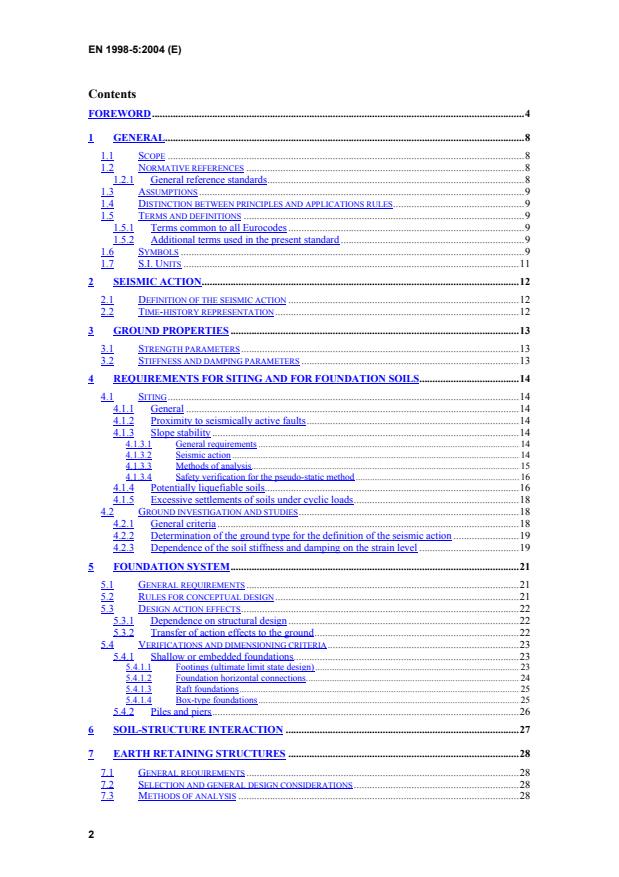
The document is organized into 7 clauses and 6 annexes:
- Clause 1 - general provisions, references, terms, symbols and units
- Clause 2 - seismic action
- Clause 3 - ground properties
- Clause 4 - siting and foundation soils
- Clause 5 - foundation system
- Clause 6 - soil-structure interaction
- Clause 7 - earth retaining structures
| Annex | What it covers |
|---|---|
| A | Topographic amplification factors |
| B | Empirical charts for simplified liquefaction analysis |
| C | Pile-head static stiffnesses |
| D | Dynamic soil-structure interaction, general effects and significance |
| E | Simplified analysis for retaining structures |
| F | Seismic bearing capacity of shallow foundations |
What are the key requirements of SIST EN 1998-5:2005?
Site and ground conditions
Clause 4 requires the site to be assessed for rupture, slope instability, liquefaction and densification susceptibility. For importance classes II, III and IV, structures are not to be placed in the immediate vicinity of faults recognized as seismically active in official documents.
For slopes, the standard requires stability checks under the design earthquake. It allows simplified pseudo-static methods only within stated limits, and it requires special care where pore pressure build-up or stiffness degradation can occur. Annex A gives topographic amplification factors used in slope stability verification, which matters because ridge and cliff locations can increase demand.
Clause 4.1.4 sets out when liquefaction checks are needed and what field data are needed, including SPT or CPT and grain-size curves. The document also gives normalization rules for SPT results and conditions where liquefaction may be neglected. In practice, this tells the designer when soil improvement or piling is needed to keep the foundation stable.
Clause 4.2 links the ground investigation to the seismic action. The shear wave velocity profile vs is treated as the most reliable indicator of site-dependent seismic response, and soil stiffness and damping must be adjusted for strain level. That matters because the soil properties used in analysis should reflect earthquake loading, not only static test values.
Foundation design
Clause 5 requires the foundation to transfer superstructure forces without substantial permanent deformation and to remain compatible with the structure's functional needs. Mixed foundation types are only allowed when a specific study shows they are adequate.
The standard distinguishes dissipative and non-dissipative structures. For dissipative structures, foundation action effects are based on capacity design and overstrength; for non-dissipative structures, they come from the seismic design situation without capacity design. This affects the forces that must be carried by footings, piles and piers.
For shallow and embedded foundations, Clause 5.4.1 requires checks against sliding and bearing capacity failure. It also gives rules for tie-beams, foundation slabs, raft foundations and box-type foundations. For piles and piers, Clause 5.4.2 requires resistance to both inertia forces from the superstructure and kinematic forces from ground deformation, and it limits the use of side resistance in liquefiable or strongly degrading soil.
Earth retaining structures and SSI
Clause 7 requires retaining structures to function during and after an earthquake, with only limited permanent displacement if it remains acceptable for the project. It provides both general analysis routes and simplified pseudo-static methods, including earth and water pressure, hydrodynamic pressure and anchor checks. Annex E supports the simplified analysis with formula-based procedures.
Clause 6 requires dynamic soil-structure interaction to be considered for structures where second-order effects matter, for massive or deep foundations, for slender tall structures and for very soft soils. Annex D explains why the seismic response can change when the base is deformable.
What terms does SIST EN 1998-5:2005 define?
- Liquefaction - a loss of shear strength and stiffness in saturated cohesionless soil caused by earthquake-induced pore pressure increase.
- Soil-structure interaction (SSI) - the effect of deformable ground on the seismic response of the supported structure.
- Standard Penetration Test (SPT) - an in situ test used to assess liquefaction susceptibility and other soil properties.
- Cone Penetration Test (CPT) - an in situ test that provides continuous soil resistance data with depth.
- Shear modulus G - the main stiffness parameter used for earthquake loading, derived from soil density and shear-wave velocity.
- Importance factor γI - the factor that scales seismic demand according to the importance class of the structure.
- Seismic bearing capacity - the foundation bearing resistance checked under seismic action effects and soil inertia.
Who uses SIST EN 1998-5:2005?
SIST EN 1998-5:2005 is intended for clients, designers, constructors and relevant authorities. In practice, it is used by structural engineers, geotechnical engineers, reviewers and public authorities when checking foundations, retaining walls and site conditions for earthquake-resistant design. It is relevant for seismic regions and for projects where foundation behavior, soil stability or retaining structure performance affects safety or function.
What changed in SIST EN 1998-5:2005 from the previous edition?
SIST EN 1998-5:2005 supersedes ENV 1998-5:1994.
Which standards are used with SIST EN 1998-5:2005?
- EN 1990 - provides the basic structural design assumptions and combination rules.
- EN 1997-1 - supplies general geotechnical design rules that this part extends for seismic conditions.
- EN 1997-2 - supports ground investigation and testing.
- EN 1998-1 - gives the general seismic action rules and building provisions used throughout this part.
- EN 1998-2 - provides bridge-related seismic provisions.
- EN 1998-4 - covers silos, tanks and pipelines.
- EN 1998-6 - covers towers, masts and chimneys.
What does the SIST EN 1998-5:2005 document contain?
The document contains design rules, decision criteria and calculation methods for seismic geotechnical design. It includes symbol definitions, tables for soil damping and reduction factors, and tables for seismic coefficients and model factors. Annex B gives empirical liquefaction charts, Annex E gives a simplified retaining wall procedure, and Annex F gives a bearing-capacity expression for shallow foundations.
It also includes formulas for sliding resistance, earth pressures, hydrodynamic pressure, pile stiffness guidance and anchor length checks. These are the parts a designer uses for calculations, while the main clauses explain when each method is appropriate and what must be verified.
Relations
- Effective Date
- 25-Mar-2026
- Effective Date
- 28-Jan-2026
- Effective Date
- 28-Jan-2026
- Effective Date
- 28-Jan-2026
- Effective Date
- 28-Jan-2026
- Effective Date
- 28-Jan-2026
- Effective Date
- 28-Jan-2026
- Referred By
SIST EN 1998-2:2006 - Eurocode 8 - Design of structures for earthquake resistance - Part 2: Bridges - Effective Date
- 28-Jan-2026
- Effective Date
- 18-Jan-2023
- Effective Date
- 23-Jun-2021
Get Certified
Connect with accredited certification bodies for this standard

DIBt (Deutsches Institut für Bautechnik)
German Institute for Building Technology.
DIN CERTCO
DIN Group product certification.

Aboma Certification B.V.
Specialized in construction, metal, and transport sectors.
Sponsored listings
Frequently Asked Questions
SIST EN 1998-5:2005 is a standard published by the Slovenian Institute for Standardization (SIST). Its full title is "Eurocode 8: Design of structures for earthquake resistance Part 5: Foundations, retaining structures and geotechnical aspects". This standard covers: Additional rules for the design of various foundation systems, earth retaining structures and soil-structure interaction under seismic actions in conjunction with the structural design of buildings, bridges, towers, masts, chimneys, silos, tanks and pipelines.
Additional rules for the design of various foundation systems, earth retaining structures and soil-structure interaction under seismic actions in conjunction with the structural design of buildings, bridges, towers, masts, chimneys, silos, tanks and pipelines.
SIST EN 1998-5:2005 is classified under the following ICS (International Classification for Standards) categories: 91.010.30 - Technical aspects; 91.120.25 - Seismic and vibration protection. The ICS classification helps identify the subject area and facilitates finding related standards.
SIST EN 1998-5:2005 has the following relationships with other standards: It is inter standard links to kSIST FprEN 1998-1-2:2025, kSIST FprEN 1997-1:2024, kSIST FprEN 1998-4:2025, kSIST FprEN 1998-1-1:2024, kSIST FprEN 1998-2:2024, SIST EN 14620-1:2024, SIST EN 1998-4:2006, SIST EN 1998-2:2006, kSIST FprEN 1998-5:2024, kSIST FprEN 1998-5:2024. Understanding these relationships helps ensure you are using the most current and applicable version of the standard.
SIST EN 1998-5:2005 is associated with the following European legislation: EU Directives/Regulations: 2005-01-4408, 305/2011, 89/106/EEC; Standardization Mandates: M/265, M/BC/CEN/89/11. When a standard is cited in the Official Journal of the European Union, products manufactured in conformity with it benefit from a presumption of conformity with the essential requirements of the corresponding EU directive or regulation.
SIST EN 1998-5:2005 is available in PDF format for immediate download after purchase. The document can be added to your cart and obtained through the secure checkout process. Digital delivery ensures instant access to the complete standard document.
Standards Content (Sample)
2003-01.Slovenski inštitut za standardizacijo. Razmnoževanje celote ali delov tega standarda ni dovoljeno.Eurocode 8: Design of structures for earthquake resistance Part 5: Foundations, retaining structures and geotechnical aspectsEurocode 8: Calcul des structures pour leur résistance aux séismes Partie 5: Fondations, ouvrages de soutenement et aspects géotechniquesEurocode 8: Auslegung von Bauwerken gegen Erdbeben - Teil 5: Gründungen, Stützbauwerke und geotechnische AspekteTa slovenski standard je istoveten z:EN 1998-5:2004SIST EN 1998-5:2005en91.120.25YLEUDFLMDPLSeismic and vibration protection91.010.30Technical aspectsICS:SIST ENV 1998-5:1995+D1:19951DGRPHãþDSLOVENSKI
STANDARDSIST EN 1998-5:200501-maj-2005
EUROPEAN STANDARD NORME EUROPÉENNE EUROPÄISCHE NORM
EN 1998-5
November 2004 ICS 91.120.25 Supersedes ENV 1998-5:1994 English version
Eurocode 8: Design of structures for earthquake resistance Part 5: Foundations, retaining structures and geotechnical aspects
Eurocode 8: Calcul des structures pour leur résistance aux séismes Partie 5: Fondations, ouvrages de soutènement et aspects géotechniques
Eurocode 8: Auslegung von Bauwerken gegen Erdbeben Teil 5: Gründungen, Stützbauwerke und geotechnische Aspekte This European Standard was approved by CEN on 16 April 2004.
CEN members are bound to comply with the CEN/CENELEC Internal Regulations which stipulate the conditions for giving this European Standard the status of a national standard without any alteration. Up-to-date lists and bibliographical references concerning such national standards may be obtained on application to the Central Secretariat or to any CEN member.
This European Standard exists in three official versions (English, French, German). A version in any other language made by translation under the responsibility of a CEN member into its own language and notified to the Central Secretariat has the same status as the official versions.
CEN members are the national standards bodies of Austria, Belgium, Cyprus, Czech Republic, Denmark, Estonia, Finland, France, Germany, Greece, Hungary, Iceland, Ireland, Italy, Latvia, Lithuania, Luxembourg, Malta, Netherlands, Norway, Poland, Portugal, Slovakia, Slovenia, Spain, Sweden, Switzerland and United Kingdom.
EUROPEAN COMMITTEE FOR STANDARDIZATION
COMITÉ EUROPÉEN DE NORMALISATION EUROPÄISCHES KOMITEE FÜR NORMUNG
Management Centre: rue de Stassart, 36
B-1050 Brussels © 2004 CEN All rights of exploitation in any form and by any means reserved worldwide for CEN national Members. Ref. No. EN 1998-5:2004: E
1 Agreement between the Commission of the European Communities and the European Committee for Standardisation (CEN)concerning the work on EUROCODES for the design of building and civil engineering works (BC/CEN/03/89).
2 According to Art. 3.3 of the CPD, the essential requirements (ERs) shall be given concrete form in interpretative documents for thecreation of the necessary links between the essential requirements and the mandates for harmonised ENs and ETAGs/ETAs.3 According to Art. 12 of the CPD the interpretative documents shall :a) give concrete form to the essential requirements by harmonising the terminology and the technical bases and indicating classesor levels for each requirement where necessary ;b) indicate methods of correlating these classes or levels of requirement with the technical specifications, e.g. methods ofcalculation and of proof, technical rules for project design, etc. ;c) serve as a reference for the establishment of harmonised standards and guidelines for European technical approvals.The Eurocodes, de facto, play a similar role in the field of the ER 1 and a part of ER 2.
country specific data (geographical, climatic, etc.), e.g. snow map,– the procedure to be used where alternative procedures are given in the Eurocode.It may also contain– decisions on the application of informative annexes,– references to non-contradictory complementary information to assist the user toapply the Eurocode.Links between Eurocodes and harmonised technical specifications (ENs and ETAs)for productsThere is a need for consistency between the harmonised technical specifications forconstruction products and the technical rules for works4. Furthermore, all theinformation accompanying the CE Marking of the construction products which refer toEurocodes shall clearly mention which Nationally Determined Parameters have beentaken into account.Additional information specific to EN 1998-5The scope of Eurocode 8 is defined in EN 1998-1:2004, 1.1.1 and the scope of this Partof Eurocode 8 is defined in 1.1. Additional Parts of Eurocode 8 are listed in EN 1998-1:2004, 1.1.3.
4 see Art.3.3 and Art.12 of the CPD, as well as
4.2, 4.3.1, 4.3.2 and 5.2 of ID 1.
In theabsence of such tests, and for the purpose of preliminary design, it may be estimatedthrough empirical correlations.4.1.3.4 Safety verification for the pseudo-static method(1)PFor saturated soils in areas where α⋅S > 0,15, consideration shall be given topossible strength degradation and increases in pore pressure due to cyclic loadingsubject to the limitations stated in 4.1.3.3 (8).(2)For quiescent slides where the chances of reactivation by earthquakes are higher,large strain values of the ground strength parameters should be used. In cohesionlessmaterials susceptible to cyclic pore-pressure increase within the limits of 4.1.3.3, thelatter may be accounted for by decreasing the resisting frictional force through anappropriate pore pressure coefficient proportional to the maximum increment of porepressure. Such an increment may be estimated as indicated in 4.1.3.3 (9).(3)No reduction of the shear strength need be applied for strongly dilatantcohesionless soils, such as dense sands.(4)PThe safety verification of the ground slope shall be executed according to theprinciples of EN 1997-1:2004.4.1.4 Potentially liquefiable soils(1)PA decrease in the shear strength and/or stiffness caused by the increase in porewater pressures in saturated cohesionless materials during earthquake ground motion,such as to give rise to significant permanent deformations or even to a condition ofnear-zero effective stress in the soil, shall be hereinafter referred to as liquefaction.(2)PAn evaluation of the liquefaction susceptibility shall be made when thefoundation soils include extended layers or thick lenses of loose sand, with or withoutsilt/clay fines, beneath the water table level, and when the water table level is close tothe ground surface. This evaluation shall be performed for the free-field site conditions(ground surface elevation, water table elevation) prevailing during the lifetime of thestructure.
ratio of impact energy
to theoretical free-fall energy of 0,6. For depths ofless than 3 m, the measured NSPT values should be reduced by 25%.(5)Normalisation with respect to overburden effects may be performed bymultiplying the measured NSPT value by the factor (100/σ′vo)1/2, where σ′vo (kPa) is theeffective overburden pressure acting at the depth where the SPT measurement has beenmade, and at the time of its execution. The normalisation factor (100/σ′vo)1/2 should betaken as being not smaller than 0,5 and not greater than 2.(6)Energy normalisation requires multiplying the blowcount value obtained in (5)of this subclause by the factor ER/60, where ER is one hundred times the energy ratiospecific to the testing equipment.(7)For buildings on shallow foundations, evaluation of the liquefactionsusceptibility may be omitted when the saturated sandy soils are found at depths greaterthan 15 m from ground surface.(8) The liquefaction hazard may be neglected when α⋅S < 0,15 and at least one ofthe following conditions is fulfilled:- the sands have a clay content greater than 20% with plasticity index PI > 10;- the sands have a silt content greater than 35% and, at the same time, the SPTblowcount value normalised for overburden effects and for the energy ratioN1(60) > 20;- the sands are clean, with the SPT blowcount value normalised for overburdeneffects and for the energy ratio N1(60) > 30.(9)PIf the liquefaction hazard may not be neglected, it shall as a minimum beevaluated by well-established methods of geotechnical engineering, based on fieldcorrelations between in situ measurements and the critical cyclic shear stresses knownto have caused liquefaction during past earthquakes.(10)Empirical liquefaction charts illustrating the field correlation approach underlevel ground conditions applied to different types of in situ measurements are given inAnnex B. In this approach, the seismic shear stress τe, may be estimated from thesimplified expressionτe = 0,65 α ⋅S⋅σvo(4.4)where σvo is the total overburden pressure and the other variables are as in expressions(4.1) to (4.3). This expression may not be applied for depths larger than 20 m.(11)PIf the field correlation approach is used, a soil shall be considered susceptible toliquefaction under level ground conditions whenever the earthquake-induced shear
...