

SIST EN 1998-2:2006
(Main)Eurocode 8 - Design of structures for earthquake resistance - Part 2: Bridges
- Abstract
Complementary to EN 1992-2, EN 1993-2 and EN 1994-2. Design rules for earthquake resistant design of steel, concrete and composite bridges.
- Status
- Published
- Publication Date
- 30-Apr-2006
- Technical Committee
- KON - Structures
- Current Stage
- 6060 - National Implementation/Publication (Adopted Project)
- Start Date
- 01-May-2006
- Due Date
- 01-May-2006
- Completion Date
- 01-May-2006


SIST EN 1998-2:2006 is the Slovenian standard identical to EN 1998-2:2005 from CEN, published by SIST. It gives Eurocode 8 rules for the earthquake-resistant design of bridges, with a focus on steel, concrete and composite bridges and on the engineers who design, check or specify them.
What does SIST EN 1998-2:2006 specify?
SIST EN 1998-2:2006 specifies the special seismic design rules for bridges within Eurocode 8. It is complementary to EN 1992-2, EN 1993-2 and EN 1994-2, so the bridge material rules come from those parts while this document adds earthquake-specific requirements.
The standard primarily covers bridges where horizontal earthquake actions are resisted mainly by bending in piers or at abutments. It also applies to cable-stayed and arched bridges, while suspension bridges, timber and masonry bridges, moveable bridges and floating bridges are outside its scope.
The document is organised into:
- Introduction
- Basic requirements and compliance criteria
- Seismic action
- Analysis
- Strength verification
- Detailing
- Bridges with seismic isolation
- Annexes
| Annex | What it covers |
|---|---|
| A | Probabilities related to the reference seismic action and guidance for construction phase design action |
| B | Displacement ductility and curvature ductility factors of plastic hinges in concrete piers |
| C | Effective stiffness of reinforced concrete ductile members |
| D | Spatial variability of earthquake ground motion and analysis methods |
| E | Probable material properties and plastic hinge deformation capacities for non-linear analyses |
| F | Added mass of entrained water for immersed piers |
| G | Calculation of capacity design effects |
| H | Static non-linear analysis (pushover) |
| J | Variation of design properties of seismic isolator units |
| JJ | λ-factors for common isolator types |
| K | Tests for validation of design properties of seismic isolator units |
What are the key requirements of SIST EN 1998-2:2006?
Design basis and seismic performance
The standard requires the bridge to satisfy the no-collapse requirement for the design seismic action, and it also addresses damage minimisation. In practice, that means the bridge must retain structural integrity after the design earthquake, and damage should be concentrated where it can be tolerated and repaired.
Bridges are classified by importance class, and the importance factor (γI) adjusts the design seismic action. This matters because a critical bridge may need a higher design earthquake level than a less important one.
The intended seismic behaviour must be either ductile or limited ductile/essentially elastic. Ductile design allows plastic hinges in piers, while the deck is generally kept elastic so the main dissipation and damage stay in predictable locations.
Analysis and modelling
The bridge model must represent the stiffness and mass distribution so that significant deformation modes and inertia forces are activated. The standard covers linear dynamic methods, the fundamental mode method, alternative linear methods, non-linear time-history analysis and static non-linear pushover analysis.
The document also sets requirements for masses, damping, soil-structure interaction and torsional effects. This matters in practice because bridge response can change significantly with soil flexibility, skew, deck width, or vertical and horizontal distribution of mass.
For linear analysis, the behaviour factor (q) reduces elastic action effects to represent ductile response. The standard ties the use of q to the detailing and capacity design rules, so the design model and the reinforcement or steel detailing must be consistent.
Strength, capacity design and detailing
Capacity design is central to the standard. It requires the designer to establish a hierarchy of strengths so that intended plastic hinges form first and brittle failure modes are avoided.
The seismic design action is combined with permanent actions, prestressing, traffic load and other long-duration actions as specified in the relevant clause. Wind and snow are neglected in the seismic design situation, while imposed deformations are generally not combined with seismic effects except in the specific elastomeric-bearing case.
The resistance checks cover concrete sections, steel and composite members, foundations, and special checks for shear, second-order effects and brittle failure. Detailing rules are given for concrete piers, steel piers, foundations, bearings, seismic links, abutments and retaining walls. These rules matter because seismic safety often depends on confinement, anchorage, bearing movement capacity and controlled damage, not only on section strength.
Seismic isolation
Section 7 gives a separate design route for bridges with seismic isolation. It specifies design spectra, analysis procedures, design properties of the isolating system, verification of displacements and forces, and special requirements for restoring capability, restraint and inspection.
For isolators, the document requires validation of design properties by qualification and prototype tests for most unit types. Annex J and Annex K support this by treating property variation, temperature, ageing, contamination, wear, and test validation. In practice, this means the isolator cannot be treated as a generic component - its tested behaviour is part of the design.
What terms does SIST EN 1998-2:2006 define?
- Capacity design - a design procedure that arranges the strength hierarchy so plastic hinges form in the intended members and brittle failure is avoided.
- Ductile members - members that can dissipate energy through plastic hinges.
- Ductile structure - a structure that can dissipate significant seismic energy through intended plastic mechanisms or similar means.
- Limited ductile behaviour - bridge behaviour with little energy dissipation in plastic hinges under the design seismic action.
- Seismic isolation - the use of special isolating devices to reduce seismic forces and/or displacements.
- Seismic links - restrainers that can transmit part or all of the seismic action and may include slack so they activate only beyond the design displacement.
- Design seismic displacement - the displacement caused only by the design seismic action.
- Spatial variability - a case where ground motion differs between bridge supports, so one support motion cannot represent the whole bridge.
Who uses SIST EN 1998-2:2006?
Bridge structural engineers use SIST EN 1998-2:2006 to design or verify bridges in seismic regions. Geotechnical engineers use it when soil-structure interaction, foundations or retaining structures affect the bridge response.
It is also used by plan reviewers, checking engineers, public authorities, bridge owners and buyers who need to specify seismic design requirements for road and railway bridges. It is especially relevant for projects involving piers, bearings, seismic links or seismic isolation devices.
What changed in SIST EN 1998-2:2006 from the previous edition?
SIST EN 1998-2:2006 supersedes ENV 1998-2:1994 and is identical to EN 1998-2:2005.
Which standards are used with SIST EN 1998-2:2006?
- EN 1990: Annex A2 - basis of structural design for bridges.
- EN 1991-2 - traffic loads on bridges.
- EN 1992-2 - concrete bridge design rules used with the seismic clauses.
- EN 1993-2 - steel bridge design rules used with the seismic clauses.
- EN 1994-2 - composite bridge design rules used with the seismic clauses.
- EN 1998-1 - general seismic rules, seismic actions and many common Eurocode 8 terms and procedures.
- EN 1998-5 - foundations, retaining structures and geotechnical aspects.
- EN 1337-2 - sliding elements for structural bearings.
- EN 1337-3 - elastomeric bearings.
- prEN 15129 - antiseismic devices and testing context for isolators.
What does the SIST EN 1998-2:2006 document contain?
The document contains clause-by-clause rules for seismic bridge design, including the definition of seismic action, modelling assumptions, analysis methods, strength checks and detailing rules. It also includes figures, equations and tables for behaviour factors, torsion, capacity design, shear checks, joint reinforcement, and isolator displacement and resistance checks.
Several annexes support special calculations and test-based design, including spatially varying ground motion, added water mass for immersed piers, pushover guidance, isolator property variation and isolator validation tests. For users, this means the standard is not just a high-level policy document - it provides the procedures needed for design, verification and testing of seismic bridge systems.
Relations
- Effective Date
- 28-Jan-2026
- Effective Date
- 28-Jan-2026
- Effective Date
- 28-Jan-2026
- Effective Date
- 28-Jan-2026
- Effective Date
- 28-Jan-2026
- Effective Date
- 28-Jan-2026
- Effective Date
- 28-Jan-2026
- Effective Date
- 28-Jan-2026
- Effective Date
- 28-Jan-2026
- Effective Date
- 28-Jan-2026
- Effective Date
- 10-Jul-2010
- Effective Date
- 01-Jun-2009
- Corrected By
SIST EN 1998-2:2006/AC:2010 - Eurocode 8 - Design of structures for earthquake resistance - Part 2: Bridges - Effective Date
- 01-Apr-2010
- Effective Date
- 19-Jan-2023
Get Certified
Connect with accredited certification bodies for this standard

DIBt (Deutsches Institut für Bautechnik)
German Institute for Building Technology.
DIN CERTCO
DIN Group product certification.
Zavod za gradbeništvo Slovenije (ZAG) - Inšpekcija
ZAG inspection body for construction products, structures, and materials.
Sponsored listings
Frequently Asked Questions
SIST EN 1998-2:2006 is a standard published by the Slovenian Institute for Standardization (SIST). Its full title is "Eurocode 8 - Design of structures for earthquake resistance - Part 2: Bridges". This standard covers: Complementary to EN 1992-2, EN 1993-2 and EN 1994-2. Design rules for earthquake resistant design of steel, concrete and composite bridges.
Complementary to EN 1992-2, EN 1993-2 and EN 1994-2. Design rules for earthquake resistant design of steel, concrete and composite bridges.
SIST EN 1998-2:2006 is classified under the following ICS (International Classification for Standards) categories: 91.120.25 - Seismic and vibration protection; 93.040 - Bridge construction. The ICS classification helps identify the subject area and facilitates finding related standards.
SIST EN 1998-2:2006 has the following relationships with other standards: It is inter standard links to SIST EN 1991-2:2004, SIST EN 1337-3:2005, SIST EN 1998-5:2005, SIST EN 1992-2:2005, SIST EN 15129:2018, SIST EN 1994-2:2005, SIST EN 1998-1:2005, SIST EN 1993-2:2007, SIST EN 1337-2:2001, SIST EN 1998-4:2006, SIST EN 1998-2:2006/A2:2012, SIST EN 1998-2:2006/A1:2009, SIST EN 1998-2:2006/AC:2010, kSIST FprEN 1998-2:2024. Understanding these relationships helps ensure you are using the most current and applicable version of the standard.
SIST EN 1998-2:2006 is associated with the following European legislation: EU Directives/Regulations: 2005-01-4408, 305/2011, 89/106/EEC; Standardization Mandates: M/265, M/BC/CEN/89/11. When a standard is cited in the Official Journal of the European Union, products manufactured in conformity with it benefit from a presumption of conformity with the essential requirements of the corresponding EU directive or regulation.
SIST EN 1998-2:2006 is available in PDF format for immediate download after purchase. The document can be added to your cart and obtained through the secure checkout process. Digital delivery ensures instant access to the complete standard document.
Standards Content (Sample)
2003-01.Slovenski inštitut za standardizacijo. Razmnoževanje celote ali delov tega standarda ni dovoljeno.Eurocode 8 - Design of structures for earthquake resistance - Part 2: BridgesEurocode 8 - Calcul des structures pour leur résistance aux séismes - Partie 2: PontsEurocode 8 - Auslegung von Bauwerken gegen Erdbeben - Teil 2: BrückenTa slovenski standard je istoveten z:EN 1998-2:2005SIST EN 1998-2:2006en93.040Gradnja mostovBridge construction91.120.25YLEUDFLMDPLSeismic and vibration protectionICS:SIST ENV 1998-2:1995+D1:20011DGRPHãþDSLOVENSKI
STANDARDSIST EN 1998-2:200601-maj-2006
EUROPEAN STANDARDNORME EUROPÉENNEEUROPÄISCHE NORMEN 1998-2November 2005ICS 91.120.25; 93.040Supersedes ENV 1998-2:1994
English VersionEurocode 8 - Design of structures for earthquake resistance -Part 2: BridgesEurocode 8 - Calcul des structures pour leur résistance auxséismes - Partie 2: PontsEurocode 8 - Auslegung von Bauwerken gegen Erdbeben -Teil 2: BrückenThis European Standard was approved by CEN on 7 July 2005.CEN members are bound to comply with the CEN/CENELEC Internal Regulations which stipulate the conditions for giving this EuropeanStandard the status of a national standard without any alteration. Up-to-date lists and bibliographical references concerning such nationalstandards may be obtained on application to the Central Secretariat or to any CEN member.This European Standard exists in three official versions (English, French, German). A version in any other language made by translationunder the responsibility of a CEN member into its own language and notified to the Central Secretariat has the same status as the officialversions.CEN members are the national standards bodies of Austria, Belgium, Cyprus, Czech Republic, Denmark, Estonia, Finland, France,Germany, Greece, Hungary, Iceland, Ireland, Italy, Latvia, Lithuania, Luxembourg, Malta, Netherlands, Norway, Poland, Portugal, Slovakia,Slovenia, Spain, Sweden, Switzerland and United Kingdom.EUROPEAN COMMITTEE FOR STANDARDIZATIONCOMITÉ EUROPÉEN DE NORMALISATIONEUROPÄISCHES KOMITEE FÜR NORMUNGManagement Centre: rue de Stassart, 36
B-1050 Brussels© 2005 CENAll rights of exploitation in any form and by any means reservedworldwide for CEN national Members.Ref. No. EN 1998-2:2005: E
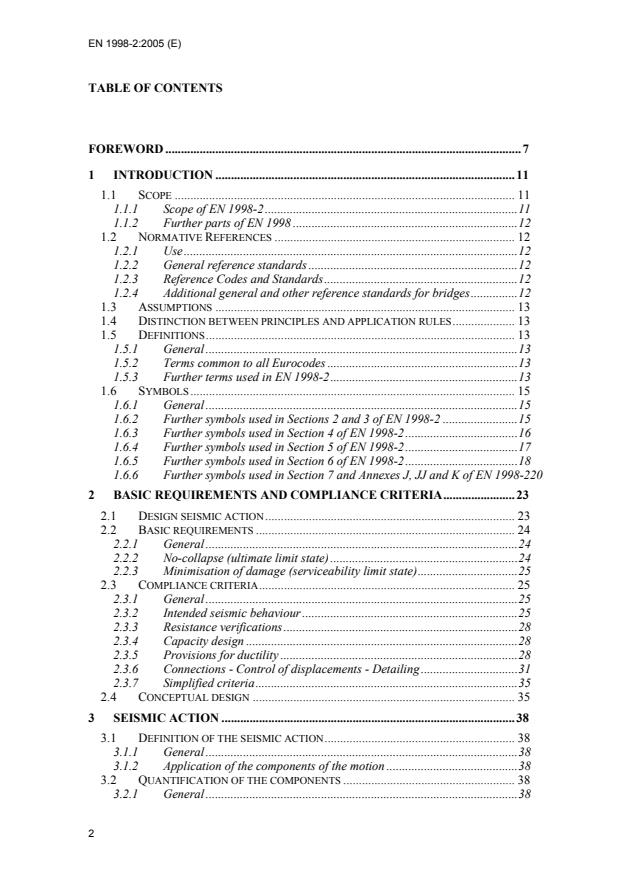
FOREWORD.7 1 INTRODUCTION.11 1.1 SCOPE.11 1.1.1 Scope of EN 1998-2.11 1.1.2 Further parts of EN 1998.12 1.2 NORMATIVE REFERENCES.12 1.2.1 Use.12 1.2.2 General reference standards.12 1.2.3 Reference Codes and Standards.12 1.2.4 Additional general and other reference standards for bridges.12 1.3 ASSUMPTIONS.13 1.4 DISTINCTION BETWEEN PRINCIPLES AND APPLICATION RULES.13 1.5 DEFINITIONS.13 1.5.1 General.13 1.5.2 Terms common to all Eurocodes.13 1.5.3 Further terms used in EN 1998-2.13 1.6 SYMBOLS.15 1.6.1 General.15 1.6.2 Further symbols used in Sections 2 and 3 of EN 1998-2.15 1.6.3 Further symbols used in Section 4 of EN 1998-2.16 1.6.4 Further symbols used in Section 5 of EN 1998-2.17 1.6.5 Further symbols used in Section 6 of EN 1998-2.18 1.6.6 Further symbols used in Section 7 and Annexes J, JJ and K of EN 1998-220 2 BASIC REQUIREMENTS AND COMPLIANCE CRITERIA.23 2.1 DESIGN SEISMIC ACTION.23 2.2 BASIC REQUIREMENTS.24 2.2.1 General.24 2.2.2 No-collapse (ultimate limit state).24 2.2.3 Minimisation of damage (serviceability limit state).25 2.3 COMPLIANCE CRITERIA.25 2.3.1 General.25 2.3.2 Intended seismic behaviour.25 2.3.3 Resistance verifications.28 2.3.4 Capacity design.28 2.3.5 Provisions for ductility.28 2.3.6 Connections - Control of displacements - Detailing.31 2.3.7 Simplified criteria.35 2.4 CONCEPTUAL DESIGN.35 3 SEISMIC ACTION.38 3.1 DEFINITION OF THE SEISMIC ACTION.38 3.1.1 General.38 3.1.2 Application of the components of the motion.38 3.2 QUANTIFICATION OF THE COMPONENTS.38 3.2.1 General.38
3 3.2.2 Site dependent elastic response spectrum.39 3.2.3 Time-history representation.39 3.2.4 Site dependent design spectrum for linear analysis.40 3.3 SPATIAL VARIABILITY OF THE SEISMIC ACTION.40 4 ANALYSIS.44 4.1 MODELLING.44 4.1.1 Dynamic degrees of freedom.44 4.1.2 Masses.44 4.1.3 Damping of the structure and stiffness of members.45 4.1.4 Modelling of the soil.45 4.1.5 Torsional effects.46 4.1.6 Behaviour factors for linear analysis.47 4.1.7 Vertical component of the seismic action.50 4.1.8 Regular and irregular seismic behaviour of ductile bridges.50 4.1.9 Non-linear analysis of irregular bridges.51 4.2 METHODS OF ANALYSIS.51 4.2.1 Linear dynamic analysis - Response spectrum method.51 4.2.2 Fundamental mode method.53 4.2.3 Alternative linear methods.57 4.2.4 Non-linear dynamic time-history analysis.57 4.2.5 Static non-linear analysis (pushover analysis).59 5 STRENGTH VERIFICATION.61 5.1 GENERAL.61 5.2 MATERIALS AND DESIGN STRENGTH.61 5.2.1 Materials.61 5.2.2 Design strength.61 5.3 CAPACITY DESIGN.61 5.4 SECOND ORDER EFFECTS.63 5.5 COMBINATION OF THE SEISMIC ACTION WITH OTHER ACTIONS.64 5.6 RESISTANCE VERIFICATION OF CONCRETE SECTIONS.65 5.6.1 Design resistance.65 5.6.2 Structures of limited ductile behaviour.65 5.6.3 Structures of ductile behaviour.65 5.7 RESISTANCE VERIFICATION FOR STEEL AND COMPOSITE MEMBERS.73 5.7.1 Steel piers.73 5.7.2 Steel or composite deck.74 5.8 FOUNDATIONS.74 5.8.1 General.74 5.8.2 Design action effects.75 5.8.3 Resistance verification.75 6 DETAILING.76 6.1 GENERAL.76 6.2 CONCRETE PIERS.76 6.2.1 Confinement.76 6.2.2 Buckling of longitudinal compression reinforcement.80 6.2.3 Other rules.81 6.2.4 Hollow piers.82 6.3 STEEL PIERS.82
5 ANNEX D (INFORMATIVE) SPATIAL VARIABILITY OF EARTHQUAKE GROUND MOTION: MODEL AND METHODS OF ANALYSIS.118 ANNEX E (INFORMATIVE) PROBABLE MATERIAL PROPERTIES AND PLASTIC HINGE DEFORMATION CAPACITIES FOR NON-LINEAR ANALYSES .125 ANNEX F (INFORMATIVE) ADDED MASS OF ENTRAINED WATER FOR IMMERSED PIERS.131 ANNEX G (NORMATIVE) CALCULATION OF CAPACITY DESIGN EFFECTS
..........................................................................................................133 ANNEX H (INFORMATIVE) STATIC NON-LINEAR ANALYSIS (PUSHOVER) ......................................................................................................135 ANNEX J (NORMATIVE)
VARIATION OF DESIGN PROPERTIES OF SEISMIC ISOLATOR UNITS.138 ANNEX JJ (INFORMATIVE)
λ-FACTORS FOR COMMON ISOLATOR TYPES
..........................................................................................................140 ANNEX K (INFORMATIVE)
TESTS FOR VALIDATION OF DESIGN PROPERTIES OF SEISMIC ISOLATOR UNITS.143
For fifteen years, the Commission, with the help of a Steering Committee with Representatives of Member States, conducted the development of the Eurocodes programme, which led to the first generation of European codes in the 1980s.
In 1989, the Commission and the Member States of the EU and EFTA decided, on the basis of an agreement1 between the Commission and CEN, to transfer the preparation and the publication of the Eurocodes to CEN through a series of Mandates, in order to provide them with a future status of European Standard (EN). This links de facto the Eurocodes with the provisions of all the Council’s Directives and/or Commission’s Decisions dealing with European standards (e.g. the Council Directive 89/106/EEC on construction products - CPD - and Council Directives 93/37/EEC, 92/50/EEC and 89/440/EEC on public works and services and equivalent EFTA Directives initiated in pursuit of setting up the internal market).
1 Agreement between the Commission of the European Communities and the European Committee for Standardisation (CEN) concerning the work on EUROCODES for the design of building and civil engineering works (BC/CEN/03/89).
7 The Structural Eurocode programme comprises the following standards generally consisting of a number of Parts: EN 1990 Eurocode: Basis of structural design
EN 1991 Eurocode 1: Actions on structures EN 1992 Eurocode 2: Design of concrete structures EN 1993 Eurocode 3: Design of steel structures EN 1994 Eurocode 4: Design of composite steel and concrete structures EN 1995 Eurocode 5: Design of timber structures EN 1996 Eurocode 6: Design of masonry structures EN 1997 Eurocode 7: Geotechnical design EN 1998 Eurocode 8: Design of structures for earthquake resistance EN 1999 Eurocode 9: Design of aluminium structures Eurocode standards recognise the responsibility of regulatory authorities in each Member State and have safeguarded their right to determine values related to regulatory safety matters at national level where these continue to vary from State to State. Status and field of application of Eurocodes The Member States of the EU and EFTA recognise that Eurocodes serve as reference documents for the following purposes: − as a means to prove compliance of building and civil engineering works with the essential requirements of Council Directive 89/106/EEC, particularly Essential Requirement N°1 – Mechanical resistance and stability – and Essential Requirement N°2 – Safety in case of fire; − as a basis for specifying contracts for construction works and related engineering services; − as a framework for drawing up harmonised technical specifications for construction products (ENs and ETAs). The Eurocodes, as far as they concern the construction works themselves, have a direct relationship with the Interpretative Documents2 referred to in Article 12 of the CPD, although they are of a different nature from harmonised product standards3. Therefore, technical aspects arising from the Eurocodes work need to be adequately considered by
2 In accordance with Art. 3.3 of the CPD, the essential requirements (ERs) shall be given concrete form in interpretative documents for the creation of the necessary links between the essential requirements and the mandates for harmonised ENs and ETAGs/ETAs. 3 In accordance with Art. 12 of the CPD the interpretative documents shall: a) give concrete form to the essential requirements by harmonising the terminology and the technical bases and indicating classes or levels for each requirement where necessary ; b) indicate methods of correlating these classes or levels of requirement with the technical specifications, e.g. methods of calculation and of proof, technical rules for project design, etc.; c) serve as a reference for the establishment of harmonised standards and guidelines for European technical approvals. The Eurocodes, de facto, play a similar role in the field of the ER 1 and a part of ER 2.
− decisions on the use of informative annexes, and
− references to non-contradictory complementary information to assist the user to apply the Eurocode. Links between Eurocodes and harmonised technical specifications (ENs and ETAs) for products There is a need for consistency between the harmonised technical specifications for construction products and the technical rules for works4. Furthermore, all the information accompanying the CE Marking of the construction products which refer to Eurocodes shall clearly mention which Nationally Determined Parameters have been taken into account. Additional information specific to EN 1998-2 The scope of this Part of EN 1998 is defined in 1.1.
Except where otherwise specified in this Part, the seismic actions are as defined in EN 1998-1:2004, Section 3.
4 see Art.3.3 and Art.12 of the CPD, as well as 4.2, 4.3.1, 4.3.2 and 5.2 of ID 1.
9 Due to the peculiarities of the bridge seismic resisting systems, in comparison to those of buildings and other structures, all other sections of this Part are in general not directly related to those of EN 1998-1:2004. However several provisions of EN 1998-1:2004 are used by direct reference.
Since the seismic action is mainly resisted by the piers and the latter are usually constructed of reinforced concrete, a greater emphasis has been given to such piers.
Bearings are in many cases important parts of the seismic resisting system of a bridge and are therefore treated accordingly. The same holds for seismic isolation devices.
National annex for EN 1998-2 This standard gives alternative procedures, values and recommendations for classes, with notes indicating where national choices may have to be made. Therefore the National Standard implementing EN 1998-2 should have a National annex containing all Nationally Determined Parameters to be used for the design of buildings and civil engineering works to be constructed in the relevant country. National choice is allowed in EN 1998-2:2005 through clauses: Reference Item 1.1.1(8) Informative Annexes A, B, C, D, E, F, H and JJ 2.1(3)P Reference return period TNCR of seismic action for the no-collapse requirement of the bridge (or, equivalently, reference probability of exceedance in 50 years, PNCR). 2.1(4)P Importance classes for bridges
2.1(6) Importance factors for bridges 2.2.2(5) Conditions under which the seismic action may be considered as accidental action, and the requirements of 2.2.2(3) and 2.2.2 (4) may be relaxed. 2.3.5.3(1) Expression for the length of plastic hinges
2.3.6.3(5) Fractions of design displacements for non-critical structural elements
2.3.7(1) Cases of low seismicity 2.3.7(1) Simplified criteria for the design of bridges in cases of low seismicity 3.2.2.3 Definition of active fault
3.3(1)P Length of continuous deck beyond which the spatial variability of seismic action may have to be taken into account 3.3(6) Distance beyond which the seismic ground motions may be considered as completely uncorrelated
3.3(6) factor accounting for the magnitude of ground displacements occurring in opposite direction at adjacent supports 4.1.2(4)P ψ21 values for traffic loads assumed concurrent with the design seismic action
5.3(4) Value of ovestrength factor γo 5.4(1) Simplified methods for second order effects in linear analysis 5.6.2(2)P b Value of additional safety factor γBd1 on shear resistance 5.6.3.3(1)P b Alternatives for determination of additional safety factor γBd on shear resistance of ductile members outside plastic hinges 6.2.1.4(1)P Type of confinement reinforcement
6.5.1(1)P Simplified verification rules for bridges of limited ductile behaviour in low seismicity cases
6.6.2.3(3) Allowable extent of damage of elastomeric bearings in bridges where the seismic action is considered as accidental action, but is not resisted entirely by elastomeric bearings
6.6.3.2(1)P Percentage of the compressive (downward) reaction due to the permanent load that is exceeded by the total vertical reaction on a support due to the design seismic action, for holding-down devices to be required. 6.7.3(7) Upper value of design seismic displacement to limit damage of the soil or embankment behind abutments rigidly connected to the deck. 7.4.1(1)P Value of control period TD for the design spectrum of bridges with seismic isolation 7.6.2(1)P Value of amplication factor γIS on design displacement of isolator units 7.6.2(5) Value of γm for elastomeric bearings
7.7.1(2) Values of factors δw and δb for the lateral restoring capability of the isolation system J.1(2) Values of minimum isolator temperature in the seismic design situation J.2(1) Values of λ-factors for commonly used isolators
11 1 INTRODUCTION 1.1 Scope 1.1.1 Scope of EN 1998-2 (1) The scope of Eurocode 8 is defined in EN 1998-1:2004, 1.1.1 and the scope of this Standard is defined in 1.1.1. Additional parts of Eurocode 8 are indicated in EN 1998-1:2004, 1.1.3. (2) Within the framework of the scope set forth in EN 1998-1:2004, this part of the Standard contains the particular Performance Requirements, Compliance Criteria and Application Rules applicable to the design of earthquake resistant bridges. (3) This Part primarily covers the seismic design of bridges in which the horizontal seismic actions are mainly resisted through bending of the piers or at the abutments; i.e. of bridges composed of vertical or nearly vertical pier systems supporting the traffic deck superstructure. It is also applicable to the seismic design of cable-stayed and arched bridges, although its provisions should not be considered as fully covering these cases.
(4) Suspension bridges, timber and masonry bridges, moveable bridges and floating bridges are not included in the scope of this Part. (5) This Part contains only those provisions that, in addition to other relevant Eurocodes or relevant Parts of EN 1998, should be observed for the design of bridges in seismic regions. In cases of low seismicity, simplified design criteria may be established (see 2.3.7(1)). (6) The following topics are dealt with in the text of this Part:
− Basic requirements and Compliance Criteria,
− Seismic Action,
− Analysis,
− Strength Verification,
− Detailing.
This Part also includes a special section on seismic isolation with provisions covering the application of this method of seismic protection to bridges. (7) Annex G contains rules for the calculation of capacity design effects.
(8) Annex J contains rules regarding the variation of design properties of seismic isolator units and how such variation may be taken into account in design.
NOTE 1 Informative Annex A provides information for the probabilities of the reference seismic event and recommendations for the selection of the design seismic action during the construction phase.
NOTE 3 Informative Annex C provides information for the estimation of the effective stiffness of reinforced concrete ductile members.
NOTE 4 Informative Annex D provides information for modelling and analysis for the spatial variability of earthquake ground motion.
NOTE 5 Informative Annex E gives information on probable material properties and plastic hinge deformation capacities for non-linear analyses.
NOTE 6 Informative Annex F gives information and guidance for the added mass of entrained water in immersed piers.
NOTE 7 Informative Annex H provides guidance and information for static non-linear analysis (pushover).
NOTE 8 Informative Annex JJ provides information on λ-factors for common isolator types.
NOTE 9 Informative Annex K contains tests requirements for validation of design properties of seismic isolator units.
1.1.2 Further parts of EN 1998 See EN 1998-1:2004. 1.2 Normative References
1.2.1 Use (1)P The following normative documents contain provisions, which through references in this text, constitute provisions of this European standard. For dated references, subsequent amendments to or revisions of any of these publications do not apply. However, parties to agreements based on this European standard are encouraged to investigate the possibility of applying the most recent editions of the normative documents indicated below. For undated references the latest edition of the normative document referred to applies
(including amendments). 1.2.2 General reference standards EN 1998-1:2004, 1.2.1 applies.
1.2.3 Reference Codes and Standards
EN 1998-1:2004, 1.2.2 applies.
1.2.4 Additional general and other reference standards for bridges
EN 1990: Annex A2 Basis of structural design: Application for bridges
EN 1991-2:2003 Actions on structures: Traffic loads on bridges
13 EN 1992-2:2005 Design of concrete structures. Part 2 – Bridges
EN 1993-2:2005
Design of steel structures. Part 2 – Bridges
EN 1994-2:2005
Design of composite (steel-concrete) structures. Part 2 – Bridges
EN 1998-1:2004 Design of structures for earthquake resistance. General rules, seismic actions and rules for buildings
EN 1998-5:2004 Design of structures for earthquake resistance. Foundations, retaining structures and geotechnical aspects. EN 1337-2:2000 Structural bearings – Part 2: Sliding elements
EN 1337-3:2005 Structural bearings – Part 3: Elastomeric bearings prEN 15129:200X Antiseismic Devices
1.3 Assumptions (1) In addition to the general assumptions of EN 1990:2002, 1.3 the following assumption applies. (2)P It is assumed that no change of the structure will take place during the construction phase or during the subsequent life of the structure, unless proper justification and verification is provided. Due to the specific nature of the seismic response this applies even in the case of changes that lead to an increase of the structural resistance of members. 1.4 Distinction between principles and application rules (1) The rules of EN 1990:2002, 1.4 apply. 1.5 Definitions
1.5.1 General (1) For the purposes of this standard the following definitions are applicable. 1.5.2 Terms common to all Eurocodes
(1) The terms and definitions of EN 1990:2002, 1.5 apply. 1.5.3 Further terms used in EN 1998-2
capacity design design procedure used when designing structures of ductile behaviour to ensure the hierarchy of strengths of the various structural components necessary for leading to the intended configuration of plastic hinges and for avoiding brittle failure modes
positive linkage connection implemented by seismic links
seismic isolation provision of bridge structures with special isolating devices for the purpose of reducing the seismic response (forces and/or displacements) spatial variability (of seismic action) situation in which the ground motion at different supports of the bridge differs and, hence, the seismic action cannot be based on the characterisation of the motion at a single point seismic behaviour
behaviour of the bridge under the design seismic event which, depending on the characteristics of the global force-displacement relationship of the structure, can be ductile or limited ductile/essentially elastic seismic links
restrainers through which part or all of the seismic action may be transmitted. Used in combination with bearings, they may be provided with appropriate slack, so as to be activated only in the case when the design seismic displacement is exceeded minimum overlap length safety measure in the form of a minimum distance between the inner edge of the supported and the outer edge of the supporting member. The minimum overlap is intended to ensure that the function of the support is maintained under extreme seismic displacements design seismic displacement displacement induced by the design seismic actions. total design displacement in the seismic design situation displacement used to determine adequate clearances for the protection of critical or major structural members. It includes the design seismic displacement, the displacement due to the long term effect of the permanent and quasi-permanent actions and an appropriate fraction of the displacement due to thermal movements.
15 1.6 Symbols 1.6.1 General (1) The symbols indicated in EN 1990:2002, 1.6 apply. For the material-dependent symbols, as well as for symbols not specifically related to earthquakes, the provisions of the relevant Eurocodes apply. (2) Further symbols, used in connection with the seismic actions, are defined in the text where they occur, for ease of use. However, in addition, the most frequently occurring symbols in EN 1998-2 are listed and defined in the following subsections. 1.6.2 Further symbols used in Sections 2 and 3 of EN 1998-2 dE design seismic displacement (due only to the design seismic action) dEe seismic displacement determined from linear analysis dG long term displacement due to the permanent and quasi-permanent actions
dg design ground displacement in accordance with EN 1998-1:2004, 3.2.2.4 di ground displacement of set B at support i dri ground displacement at support i relative to reference support 0
dT displacement due to thermal movements
du ultimate displacement
dy yield displacement
AEd design seismic action
FRd design value of resisting force to the earthquake action
Lg distance beyond which the ground motion may be considered completely uncorrelated
Li distance of support i from reference support 0
Li-1,i distance between consecutive supports i-1 and i Ri reaction force at the base of pier i Sa site-averaged response spectrum
Si site-dependent response spectrum
Teff effective period of the isolation system γI importance factor ∆di ground displacement of intermediate support i relative to adjacent supports i-1 and i+1 µd displacement ductility factor
ψ2 combination factor for the quasi-permanent value of thermal action
km effect of the m-th independent motion
ri required local force reduction factor at ductile member i
rmin minimum value of ri rmax maximum value of ri AEd design seismic action
AEx seismic action in direction x AEy seismic action in direction y AEz seismic action in direction y B width of the deck E probable maximum value of an action effect Ei response in mode i
F horizontal force determined in accordance with the fundamental mode method
G
total effective weight of the structure, equal to the weight of the deck plus the weight of the top half of the piers Gi weight concentrated at the i-th nodal point
K stiffness of the system L total length of the continuous deck Ls distance from the plastic hinge to the point of zero moment
M total mass MEd,i maximum value of design moment in the seismic design situation at the intended location of plastic hinge of ductile member i MRd,i design flexural resistance of the plastic hinge section of ductile member i
Mt equivalent static moment about the vertical axis through the centre of mass of the deck
17 Qk,1 characteristic value of traffic load Rd design value of resistance
Sd(T) spectral acceleration of the design spectrum T period of the fundamental mode of vibration for the direction under consideration
X horizontal longitudinal axis of the bridge
Y horizontal transverse axis of the bridge
Z vertical axis αs shear span ratio of the pier
∆d maximum difference of the displacements in the transverse direction of all pier tops under the transverse seismic action, or under the action of a transverse load of similar distribution
ηk normalized axial force (= NEd/(Acfck))
θp,d design value of plastic rotation capacity
θp,E plastic hinge rotation demand
ξ viscous damping ratio ψ2,i factor for quasi-permanent value of variable action i
1.6.4 Further symbols used in Section 5 of EN 1998-2 dEd relative transverse displacement of the ends of the ductile member under consideration fck characteristic value of concrete strength fctd design value of tensile strength of concrete fsd
reduced stress of reinforcement, for limitation of cracking fsy design value of yield strength of the joint reinforcement zb internal lever arm of the beam end sections
zc internal lever arm of the plastic hinge section of the column AC (VC, MC, NC) capacity design effects
Ac
area of the concrete section
AEd design seismic action (seismic action alone)
ASd action in the seismic design situation
Asx area of horizontal joint reinforcement
Asz area of vertical joint reinforcement
Ed design value of action effect of in the seismic design situation
Gk characteristic value of permanent load Mo overstrength moment
design moment in the seismic design situation MRd design value of flexural strength of the section NEd axial force in the seismic design situation
NcG axial force in the column under the permanent and the quasi-permanent actions in the seismic design situation
Njz vertical axial force in a joint
Q1k characteristic value of the traffic load Q2
quasi-permanent value of actions of long duration Pk characteristic value of prestressing after all losses Rd
design value of the resistance of the section Rdf design value of the maximum friction force of sliding bearing TRc resultant force of the tensile reinforcement of the column
VE,d design value of shear force
Vjx design value of horizontal shear of the joint
Vjz design value of vertical shear of the joint V1bC shear force of the beam adjacent to the tensile face of the column γM material partial factor
γo overstrength factor
γof magnification factor for friction due to ageing effects
γBd, γBd1 additional safety factor against brittle failure modes
ρx ratio of horizontal reinforcement in joint ρy reinforcement ratio of closed stirrups in the transverse direction of the joint panel (orthogonal to the plane of action)
ρz ratio of vertical reinforcement in joint ψ21 combination factor
ûAsx area of horizontal joint reinforcement placed outside joint body ûAsz area of vertical joint reinforcement placed outside joint body 1.6.5 Further symbols used in Section 6 of EN 1998-2 ag
design ground acceleration on type A ground (see EN 1998-1:2004, 3.2.2.2). b cross-sectional dimension of the concrete core perpendicular to the direction of the confinement under consideration, measured to the centre line of the perimeter hoop bmin smallest dimension of the concrete core dbL diameter of longitudinal bar
deg effective displacement due to the spatial variation of the seismic ground displacement
19 des effective seismic displacement of the support due to the deformation of the structure dg design peak ground displacement as specified by EN 1998-1:2004, 3.2.2.4 ft tensile strength fy yield strength fys yield strength of the longitudinal reinforcement fyt
...