

SIST EN 1998-3:2005
(Main)Eurocode 8: Design of structures for earthquake resistance - Part 3: Assessment and retrofitting of buildings
- Abstract
(1) The scope of Eurocode 8 is defined in EN 1998-1: 2004, 1.1.1 and the scope of this Standard is defined in (2), (4) and (5). Additional parts of Eurocode 8 are indicated in EN 1998-1: 2004, 1.1.3.
(2) The scope of EN 1998-3 is as follows:
- To provide criteria for the evaluation of the seismic performance of existing individual building structures.
- To describe the approach in selecting necessary corrective measures
- To set forth criteria for the design of retrofitting measures (i.e. conception, structural analysis including intervention measures, final dimensioning of structural parts and their connections to existing structural elements).
NOTE For the purposes of this standard, retrofitting covers both the strengthening of undamaged structures and the repair of earthquake damaged structures.
(3) When designing a structural intervention to provide adequate resistance against seismic actions, structural verifications should also be made with respect to non-seismic load combinations.
(4) Reflecting the basic requirements of EN 1998-1: 2004, this Standard covers the seismic assessment and retrofitting of buildings made of the more commonly used structural materials: concrete, steel, and masonry.
NOTE Informative Annexes A, B and C contain additional information related to the assessment of reinforced concrete, steel and composite, and masonry buildings, respectively, and to their upgrading when necessary.
(5) Although the provisions of this Standard are applicable to all categories of buildings, the seismic assessment and retrofitting of monuments and historical buildings often requires different types of provisions and approaches, depending on the nature of the monuments.
- Status
- Published
- Publication Date
- 30-Sep-2005
- Technical Committee
- KON - Structures
- Current Stage
- 6100 - Translation of adopted SIST standards (Adopted Project)
- Start Date
- 17-Apr-2012
- Due Date
- 16-Apr-2013
- Completion Date
- 19-Oct-2012
Buy Documents




SIST EN 1998-3:2005 is the Slovenian national standard identical to EN 1998-3:2005, part of Eurocode 8 for earthquake resistance. It gives criteria for assessing the seismic performance of existing buildings and for designing retrofitting measures for concrete, steel and masonry structures. In practice, it helps engineers decide what to inspect, how to analyse an existing building, and how to justify repair or strengthening actions.
What does SIST EN 1998-3:2005 specify?
SIST EN 1998-3:2005 specifies how to evaluate, intervene on, and retrofit existing buildings for seismic resistance. It covers individual buildings, the selection of corrective measures, and the design of retrofitting measures, including analysis and final sizing of added or modified structural parts.
The standard applies to the usual structural materials - concrete, steel and masonry - and its provisions are intended for all categories of buildings. Monuments and historical buildings may need different provisions and approaches, depending on their nature.
The document is organized into six main clauses and three informative annexes.
| Annex | What it covers |
|---|---|
| Annex A | Reinforced concrete structures |
| Annex B | Steel and composite structures |
| Annex C | Masonry buildings |
What are the key requirements of SIST EN 1998-3:2005?
SIST EN 1998-3:2005 is built around three limit states: Near Collapse (NC), Significant Damage (SD) and Damage Limitation (DL). The national authorities choose whether one, two or all three are checked, and the chosen return periods govern the seismic action for each limit state.
For compliance, SIST EN 1998-3:2005 requires the use of the seismic action, analysis method, verification rules and detailing rules appropriate to the material and situation. Existing materials are checked with mean properties from tests and other evidence, reduced by confidence factors; new or added materials are checked with nominal properties. This matters because retrofit design is based on measured condition, not just on drawings.
The standard places strong emphasis on information gathering before analysis. Clause 3 requires data from documentation, site investigation, in-situ testing and laboratory testing, and it defines knowledge levels KL1, KL2 and KL3. The knowledge level controls which analysis methods are allowed and what confidence factors apply, so the extent of survey and testing directly affects the design basis.
Clause 4 sets out the assessment methods. These include lateral force analysis, multi-modal response spectrum analysis, nonlinear static analysis, nonlinear time-history analysis and the q-factor approach. For masonry infilled structures, special measures may be needed in the analysis. In practice, the chosen method must match the quality of available information and the structural behaviour being studied.
Clause 5 guides intervention decisions. It calls for the correction of gross defects, improvement of irregular buildings where possible, and selection of interventions such as repair, strengthening, replacement, added structural elements, system modification, passive protection, mass reduction, change of use or partial demolition. It also requires attention to non-structural elements when their failure could endanger people or goods.
Clause 6 sets the retrofit design procedure: conceptual design, analysis and verifications. Existing materials are verified using mean values adjusted by confidence factors, while new materials use nominal values. If the retrofitted system can satisfy EN 1998-1, that part may be used for the final verifications.
What terms does SIST EN 1998-3:2005 define?
- Near Collapse (NC) - a heavily damaged state with low residual lateral strength and stiffness, where the structure is close to collapse.
- Significant Damage (SD) - a state with clear structural damage and some residual capacity, but likely uneconomic to repair.
- Damage Limitation (DL) - a lightly damaged state where strength and stiffness are largely retained and repair is limited or unnecessary.
- Knowledge Level (KL1, KL2, KL3) - the level of information available on geometry, details and materials, which controls analysis options and confidence factors.
- Confidence factor (CF) - a factor used to reduce the assessed properties of existing materials to reflect uncertainty.
- q-factor - the seismic force reduction factor used in the reduced-action approach.
- Primary seismic - structural elements treated as part of the main seismic resisting system.
- Secondary seismic - elements checked with the same compliance criteria but with less conservative capacity assumptions.
Who uses SIST EN 1998-3:2005?
SIST EN 1998-3:2005 is used by structural engineers, seismic assessors, retrofit designers, and inspection teams working on existing buildings. It is also relevant to owners, authorities and project teams that need to decide whether a building should be repaired, strengthened or otherwise modified after assessment, damage or a change in use.
It is especially useful for projects involving reinforced concrete, steel, composite and masonry buildings, where the engineer must combine document review, site investigation, testing, analysis and retrofit detailing.
What changed in SIST EN 1998-3:2005 from the previous edition?
SIST EN 1998-3:2005 supersedes ENV 1998-1-4:1996.
Which standards are used with SIST EN 1998-3:2005?
- EN 1990 - provides the basis of structural design and the principles for distinguishing between principles and application rules.
- EN 1998-1 - supplies the general Eurocode 8 rules, seismic actions, building rules, definitions and national parameters used throughout this part.
- EN 1992-1-1 - is used in Annex A for reinforced concrete capacity checks and shear-related verifications.
- EN 1993-1-8 - is used in Annex B for steel connection design and local verification rules.
What does the SIST EN 1998-3:2005 document contain?
SIST EN 1998-3:2005 includes tables for knowledge levels, analysis methods, confidence factors and retrofit connection capacities, plus clause-by-clause procedures for assessment and intervention. It also contains annex formulas and capacity models for concrete, steel, composite and masonry structures.
Annex A provides models for chord rotation, shear resistance, jacketing and FRP strengthening of reinforced concrete members. Annex B gives retrofit procedures for steel and composite members, including reduced beam sections, haunches, cover plates, column splices, panel zones and bracing connections. Annex C covers masonry testing, modelling and both linear and nonlinear assessment approaches.
Relations
- Effective Date
- 01-Nov-2005
- Effective Date
- 18-May-2022
- Effective Date
- 25-Mar-2026
- Effective Date
- 28-Jan-2026
- Effective Date
- 19-Jun-2013
- Effective Date
- 01-Jul-2010
Buy Documents
Get Certified
Connect with accredited certification bodies for this standard

DIBt (Deutsches Institut für Bautechnik)
German Institute for Building Technology.
DIN CERTCO
DIN Group product certification.

Aboma Certification B.V.
Specialized in construction, metal, and transport sectors.
Sponsored listings
Frequently Asked Questions
SIST EN 1998-3:2005 is a standard published by the Slovenian Institute for Standardization (SIST). Its full title is "Eurocode 8: Design of structures for earthquake resistance - Part 3: Assessment and retrofitting of buildings". This standard covers: (1) The scope of Eurocode 8 is defined in EN 1998-1: 2004, 1.1.1 and the scope of this Standard is defined in (2), (4) and (5). Additional parts of Eurocode 8 are indicated in EN 1998-1: 2004, 1.1.3. (2) The scope of EN 1998-3 is as follows: - To provide criteria for the evaluation of the seismic performance of existing individual building structures. - To describe the approach in selecting necessary corrective measures - To set forth criteria for the design of retrofitting measures (i.e. conception, structural analysis including intervention measures, final dimensioning of structural parts and their connections to existing structural elements). NOTE For the purposes of this standard, retrofitting covers both the strengthening of undamaged structures and the repair of earthquake damaged structures. (3) When designing a structural intervention to provide adequate resistance against seismic actions, structural verifications should also be made with respect to non-seismic load combinations. (4) Reflecting the basic requirements of EN 1998-1: 2004, this Standard covers the seismic assessment and retrofitting of buildings made of the more commonly used structural materials: concrete, steel, and masonry. NOTE Informative Annexes A, B and C contain additional information related to the assessment of reinforced concrete, steel and composite, and masonry buildings, respectively, and to their upgrading when necessary. (5) Although the provisions of this Standard are applicable to all categories of buildings, the seismic assessment and retrofitting of monuments and historical buildings often requires different types of provisions and approaches, depending on the nature of the monuments.
(1) The scope of Eurocode 8 is defined in EN 1998-1: 2004, 1.1.1 and the scope of this Standard is defined in (2), (4) and (5). Additional parts of Eurocode 8 are indicated in EN 1998-1: 2004, 1.1.3. (2) The scope of EN 1998-3 is as follows: - To provide criteria for the evaluation of the seismic performance of existing individual building structures. - To describe the approach in selecting necessary corrective measures - To set forth criteria for the design of retrofitting measures (i.e. conception, structural analysis including intervention measures, final dimensioning of structural parts and their connections to existing structural elements). NOTE For the purposes of this standard, retrofitting covers both the strengthening of undamaged structures and the repair of earthquake damaged structures. (3) When designing a structural intervention to provide adequate resistance against seismic actions, structural verifications should also be made with respect to non-seismic load combinations. (4) Reflecting the basic requirements of EN 1998-1: 2004, this Standard covers the seismic assessment and retrofitting of buildings made of the more commonly used structural materials: concrete, steel, and masonry. NOTE Informative Annexes A, B and C contain additional information related to the assessment of reinforced concrete, steel and composite, and masonry buildings, respectively, and to their upgrading when necessary. (5) Although the provisions of this Standard are applicable to all categories of buildings, the seismic assessment and retrofitting of monuments and historical buildings often requires different types of provisions and approaches, depending on the nature of the monuments.
SIST EN 1998-3:2005 is classified under the following ICS (International Classification for Standards) categories: 91.010.30 - Technical aspects; 91.120.25 - Seismic and vibration protection. The ICS classification helps identify the subject area and facilitates finding related standards.
SIST EN 1998-3:2005 has the following relationships with other standards: It is inter standard links to SIST ENV 1998-1-4:2000+D1:2001, kSIST FprEN 1998-3:2025, kSIST FprEN 1998-1-2:2025, kSIST FprEN 1998-1-1:2024, SIST EN 1998-3:2005/AC:2013, SIST EN 1998-3:2005/AC:2010. Understanding these relationships helps ensure you are using the most current and applicable version of the standard.
SIST EN 1998-3:2005 is associated with the following European legislation: EU Directives/Regulations: 2005-01-4408, 305/2011, 89/106/EEC, TRRTP129; Standardization Mandates: M/265, M/BC/CEN/89/11. When a standard is cited in the Official Journal of the European Union, products manufactured in conformity with it benefit from a presumption of conformity with the essential requirements of the corresponding EU directive or regulation.
SIST EN 1998-3:2005 is available in PDF format for immediate download after purchase. The document can be added to your cart and obtained through the secure checkout process. Digital delivery ensures instant access to the complete standard document.
Standards Content (Sample)
2003-01.Slovenski inštitut za standardizacijo. Razmnoževanje celote ali delov tega standarda ni dovoljeno.Eurocode 8: Design of structures for earthquake resistance - Part 3: Assessment and retrofitting of buildingsEvrokod 8: Projektiranje potresnoodpornih konstrukcij – 3. del: Ocena in prenova stavbEurocode 8: Calcul des structures pour leur résistance aux séismes - Partie 3: Evaluation et renforcement des bâtimentsEurocode 8: Auslegung von Bauwerken gegen Erdbeben - Teil 3: Beurteilung und Ertüchtigung von GebäudenTa slovenski standard je istoveten z:EN 1998-3:2005SIST EN 1998-3:2005en91.120.25YLEUDFLMDPLSeismic and vibration protection91.010.30Technical aspectsICS:SIST ENV 1998-3:2001SIST ENV 1998-1-4:2000+D1:20011DGRPHãþDSLOVENSKI
STANDARDSIST EN 1998-3:200501-oktober-2005
EUROPEAN STANDARD NORME EUROPÉENNE EUROPÄISCHE NORM
EN 1998-3
June 2005 ICS 91.120.25 Supersedes ENV 1998-1-4:1996 English version
Eurocode 8: Design of structures for earthquake resistance - Part 3: Assessment and retrofitting of buildings
Eurocode 8: Calcul des structures pour leur résistance aux séismes - Partie 3: Evaluation et renforcement des bâtiments
Eurocode 8: Auslegung von Bauwerken gegen Erdbeben - Teil 3: Beurteilung und Ertüchtigung von Gebäuden This European Standard was approved by CEN on 15 March 2005.
CEN members are bound to comply with the CEN/CENELEC Internal Regulations which stipulate the conditions for giving this European Standard the status of a national standard without any alteration. Up-to-date lists and bibliographical references concerning such national standards may be obtained on application to the Central Secretariat or to any CEN member.
This European Standard exists in three official versions (English, French, German). A version in any other language made by translation under the responsibility of a CEN member into its own language and notified to the Central Secretariat has the same status as the official versions.
CEN members are the national standards bodies of Austria, Belgium, Cyprus, Czech Republic, Denmark, Estonia, Finland, France, Germany, Greece, Hungary, Iceland, Ireland, Italy, Latvia, Lithuania, Luxembourg, Malta, Netherlands, Norway, Poland, Portugal, Slovakia, Slovenia, Spain, Sweden, Switzerland and United Kingdom.
EUROPEAN COMMITTEE FOR STANDARDIZATION
COMITÉ EUROPÉEN DE NORMALISATION EUROPÄISCHES KOMITEE FÜR NORMUNG
Management Centre: rue de Stassart, 36
B-1050 Brussels © 2005 CEN All rights of exploitation in any form and by any means reserved worldwide for CEN national Members. Ref. No. EN 1998-3:2005: E
EN 1998-3: 2005 (E)
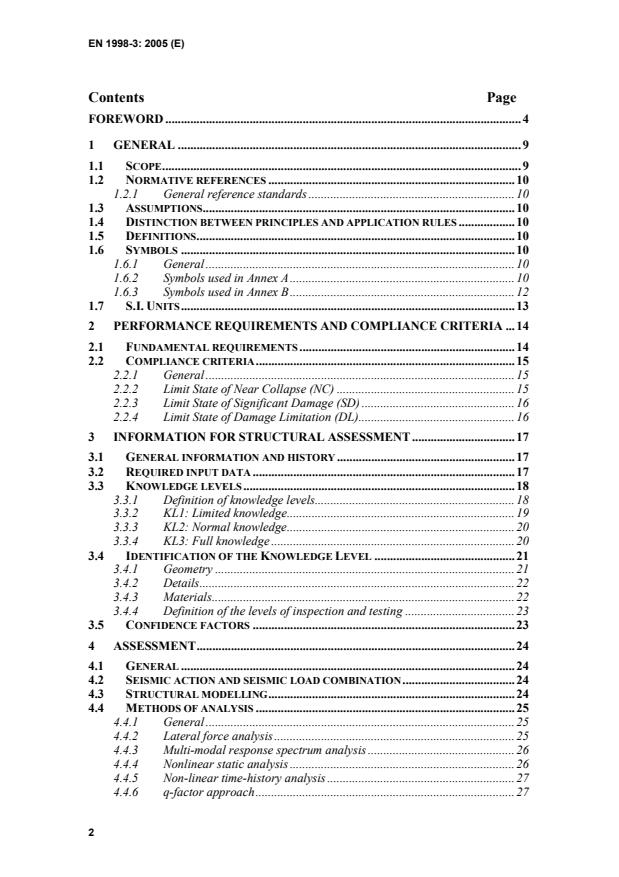
2 Contents Page FOREWORD.4 1 GENERAL.9 1.1 SCOPE.9 1.2 NORMATIVE REFERENCES.10 1.2.1 General reference standards.10 1.3 ASSUMPTIONS.10 1.4 DISTINCTION BETWEEN PRINCIPLES AND APPLICATION RULES.10 1.5 DEFINITIONS.10 1.6 SYMBOLS.10 1.6.1 General.10 1.6.2 Symbols used in Annex A.10 1.6.3 Symbols used in Annex B.12 1.7 S.I. UNITS.13 2 PERFORMANCE REQUIREMENTS AND COMPLIANCE CRITERIA.14 2.1 FUNDAMENTAL REQUIREMENTS.14 2.2 COMPLIANCE CRITERIA.15 2.2.1 General.15 2.2.2 Limit State of Near Collapse (NC).15 2.2.3 Limit State of Significant Damage (SD).16 2.2.4 Limit State of Damage Limitation (DL).16 3 INFORMATION FOR STRUCTURAL ASSESSMENT.17 3.1 GENERAL INFORMATION AND HISTORY.17 3.2 REQUIRED INPUT DATA.17 3.3 KNOWLEDGE LEVELS.18 3.3.1 Definition of knowledge levels.18 3.3.2 KL1: Limited knowledge.19 3.3.3 KL2: Normal knowledge.20 3.3.4 KL3: Full knowledge.20 3.4 IDENTIFICATION OF THE KNOWLEDGE LEVEL.21 3.4.1 Geometry.21 3.4.2 Details.22 3.4.3 Materials.22 3.4.4 Definition of the levels of inspection and testing.23 3.5 CONFIDENCE FACTORS.23 4 ASSESSMENT.24 4.1 GENERAL.24 4.2 SEISMIC ACTION AND SEISMIC LOAD COMBINATION.24 4.3 STRUCTURAL MODELLING.24 4.4 METHODS OF ANALYSIS.25 4.4.1 General.25 4.4.2 Lateral force analysis.25 4.4.3 Multi-modal response spectrum analysis.26 4.4.4 Nonlinear static analysis.26 4.4.5 Non-linear time-history analysis.27 4.4.6 q-factor approach.27
EN 1998-3: 2005 (E)
3 4.4.7 Combination of the components of the seismic action.27 4.4.8 Additional measures for masonry infilled structures.28 4.4.9 Combination coefficients for variable actions.28 4.4.10 Importance classes and importance factors.28 4.5 SAFETY VERIFICATIONS.28 4.5.1 Linear methods of analysis (lateral force or modal response spectrum analysis) 28 4.5.2 Nonlinear methods of analysis (static or dynamic).29 4.5.3 q-factor approach.29 4.6 SUMMARY OF CRITERIA FOR ANALYSIS AND SAFETY VERIFICATIONS.29 5 DECISIONS FOR STRUCTURAL INTERVENTION.31 5.1 CRITERIA FOR A STRUCTURAL INTERVENTION.31 5.1.1 Introduction.31 5.1.2 Technical criteria.31 5.1.3 Type of intervention.31 5.1.4 Non-structural elements.32 5.1.5 Justification of the selected intervention type.32 6 DESIGN OF STRUCTURAL INTERVENTION.34 6.1 RETROFIT DESIGN PROCEDURE.34 ANNEX A (INFORMATIVE) REINFORCED CONCRETE STRUCTURES.35 ANNEX B (INFORMATIVE) STEEL AND COMPOSITE STRUCTURES.55 ANNEX C (INFORMATIVE) MASONRY BUILDINGS.81
EN 1998-3: 2005 (E)
4 Foreword This European Standard EN 1998-3, Eurocode 8: Design of structures for earthquake resistance: Assessment and Retrofitting of buildings, has been prepared by Technical Committee CEN/TC 250 "Structural Eurocodes", the secretariat of which is held by BSI. CEN/TC 250 is responsible for all Structural Eurocodes. This European Standard shall be given the status of a national standard, either by publication of an identical text or by endorsement, at the latest by December 2005, and conflicting national standards shall be withdrawn at the latest by March 2010. This document supersedes ENV 1998-1-4:1996. According to the CEN-CENELEC Internal Regulations, the National Standard Organisations of the following countries are bound to implement this European Standard: Austria, Belgium, Cyprus, Czech Republic, Denmark, Estonia, Finland, France, Germany, Greece, Hungary, Iceland, Ireland, Italy, Latvia, Lithuania, Luxembourg, Malta, Netherlands, Norway, Poland, Portugal, Slovakia, Slovenia, Spain, Sweden, Switzerland and United Kingdom. Background of the Eurocode programme In 1975, the Commission of the European Community decided on an action programme in the field of construction, based on article 95 of the Treaty. The objective of the programme was the elimination of technical obstacles to trade and the harmonisation of technical specifications. Within this action programme, the Commission took the initiative to establish a set of harmonised technical rules for the design of construction works which, in a first stage, would serve as an alternative to the national rules in force in the Member States and, ultimately, would replace them.
For fifteen years, the Commission, with the help of a Steering Committee with Representatives of Member States, conducted the development of the Eurocodes programme, which led to the first generation of European codes in the 1980’s. In 1989, the Commission and the Member States of the EU and EFTA decided, on the basis of an agreement1 between the Commission and CEN, to transfer the preparation and the publication of the Eurocodes to CEN through a series of Mandates, in order to provide them with a future status of European Standard (EN). This links de facto the Eurocodes with the provisions of all the Council’s Directives and/or Commission’s Decisions dealing with European standards (e.g. the Council Directive 89/106/EEC on construction products - CPD - and Council Directives 93/37/EEC, 92/50/EEC and 89/440/EEC on public works and services and equivalent EFTA Directives initiated in pursuit of setting up the internal market). The Structural Eurocode programme comprises the following standards generally consisting of a number of Parts:
1 Agreement between the Commission of the European Communities and the European Committee for Standardisation (CEN) concerning the work on EUROCODES for the design of building and civil engineering works (BC/CEN/03/89).
EN 1998-3: 2005 (E)
5 EN 1990 Eurocode: Basis of structural design EN 1991 Eurocode 1: Actions on structures EN 1992 Eurocode 2: Design of concrete structures EN 1993 Eurocode 3: Design of steel structures EN 1994 Eurocode 4: Design of composite steel and concrete structures EN 1995 Eurocode 5: Design of timber structures EN 1996 Eurocode 6: Design of masonry structures EN 1997 Eurocode 7: Geotechnical design EN 1998 Eurocode 8: Design of structures for earthquake resistance EN 1999 Eurocode 9: Design of aluminium structures Eurocode standards recognise the responsibility of regulatory authorities in each Member State and have safeguarded their right to determine values related to regulatory safety matters at national level where these continue to vary from State to State. Status and field of application of Eurocodes The Member States of the EU and EFTA recognise that Eurocodes serve as reference documents for the following purposes: − as a means to prove compliance of building and civil engineering works with the essential requirements of Council Directive 89/106/EEC, particularly Essential Requirement N°1 - Mechanical resistance and stability - and Essential Requirement N°2 - Safety in case of fire; − as a basis for specifying contracts for construction works and related engineering services; − as a framework for drawing up harmonised technical specifications for construction products (ENs and ETAs) The Eurocodes, as far as they concern the construction works themselves, have a direct relationship with the Interpretative Documents2 referred to in Article 12 of the CPD, although they are of a different nature from harmonised product standards3. Therefore, technical aspects arising from the Eurocodes work need to be adequately considered by
2 According to Art. 3.3 of the CPD, the essential requirements (ERs) shall be given concrete form in interpretative documents for the creation of the necessary links between the essential requirements and the mandates for hENs and ETAGs/ETAs. 3 According to Art. 12 of the CPD the interpretative documents shall: a) give concrete form to the essential requirements by harmonising the terminology and the technical bases and indicating classes or levels for each requirement where necessary ; b) indicate methods of correlating these classes or levels of requirement with the technical specifications, e.g. methods of calculation and of proof, technical rules for project design, etc. ; c) serve as a reference for the establishment of harmonised standards and guidelines for European technical approvals. The Eurocodes, de facto, play a similar role in the field of the ER 1 and a part of ER 2.
EN 1998-3: 2005 (E)
6 CEN Technical Committees and/or EOTA Working Groups working on product standards with a view to achieving a full compatibility of these technical specifications with the Eurocodes. The Eurocode standards provide common structural design rules for everyday use for the design of whole structures and component products of both a traditional and an innovative nature. Unusual forms of construction or design conditions are not specifically covered and additional expert consideration will be required by the designer in such cases. National Standards implementing Eurocodes The National Standards implementing Eurocodes will comprise the full text of the Eurocode (including any annexes), as published by CEN, which may be preceded by a National title page and National foreword, and may be followed by a National annex (informative). The National annex may only contain information on those parameters which are left open in the Eurocode for national choice, known as Nationally Determined Parameters, to be used for the design of buildings and civil engineering works to be constructed in the country concerned, i.e.: − values and/or classes where alternatives are given in the Eurocode, − values to be used where a symbol only is given in the Eurocode, − country specific data (geographical, climatic, etc.), e.g. snow map, − the procedure to be used where alternative procedures are given in the Eurocode. It may also contain
− decisions on the application of informative annexes, − references to non-contradictory complementary information to assist the user to apply the Eurocode. Links between Eurocodes and harmonised technical specifications (ENs and ETAs) for products There is a need for consistency between the harmonised technical specifications for construction products and the technical rules for works4. Furthermore, all the information accompanying the CE Marking of the construction products which refer to Eurocodes shall clearly mention which Nationally Determined Parameters have been taken into account. Additional information specific to EN 1998-3 Although assessment and retrofitting of existing structures for non-seismic actions is not yet covered by the relevant material-dependent Eurocodes, this Part of Eurocode 8 was specifically developed because:
See Art.3.3 and Art.12 of the CPD, as well as clauses 4.2, 4.3.1, 4.3.2 and 5.2 of ID 1.
EN 1998-3: 2005 (E)
7 − For many older structures, seismic resistance was not considered during the original construction, whereas non-seismic actions were catered for, at least by means of traditional construction rules. − Seismic hazard evaluations in accordance with present knowledge may indicate the need for retrofitting campaigns. − Damage caused by earthquakes may create the need for major repairs. Furthermore, since within the philosophy of Eurocode 8 the seismic design of new structures is based on a certain acceptable degree of structural damage in the event of the design earthquake, criteria for seismic assessment (of structures designed in accordance with Eurocode 8 and subsequently damaged) constitute an integral part of the entire process for seismic structural safety. In seismic retrofitting situations, qualitative verifications for the identification and elimination of major structural defects are very important and should not be discouraged by the quantitative analytical approach proper to this Part of Eurocode 8. Preparation of documents of more qualitative nature is left to the initiative of the National Authorities. This Standard addresses only the structural aspects of seismic assessment and retrofitting, which may form only one component of a broader strategy for seismic risk mitigation. This Standard will apply once the requirement to assess a particular building has been established. The conditions under which seismic assessment of individual buildings – possibly leading to retrofitting – may be required are beyond the scope of this Standard. National programmes for seismic risk mitigation through seismic assessment and retrofitting may differentiate between “active” and “passive” seismic assessment and retrofitting programmes. “Active” programmes may require owners of certain categories of buildings to meet specific deadlines for the completion of the seismic assessment and – depending on its outcome – of the retrofitting. The categories of buildings selected to be targeted may depend on seismicity and ground conditions, importance class and occupancy and perceived vulnerability of the building (as influenced by type of material and construction, number of storeys, age of the building with respect to dates of older code enforcement, etc.). “Passive” programmes associate seismic assessment – possibly leading to retrofitting – with other events or activities related to the use of the building and its continuity, such as a change in use that increases occupancy or importance class, remodelling above certain limits (as a percentage of the building area or of the total building value), repair of damage after an earthquake, etc. The choice of the Limit States to be checked, as well as the return periods of the seismic action ascribed to the various Limit States, may depend on the adopted programme for assessment and retrofitting. The relevant requirements may be less stringent in “active” programmes than in “passive” ones; for example, in “passive” programmes triggered by remodelling, the relevant requirements may gradate with the extent and cost of the remodelling work undertaken.
In cases of low seismicity (see EN1998-1, 3.2.1(4)), this Standard may be adapted to local conditions by appropriate National Annexes. National annex for EN 1998-3 This standard gives alternative procedures, values and recommendations for classes
EN 1998-3: 2005 (E)
8 with notes indicating where national choices may have to be made. Therefore the National Standard implementing EN 1998-3: 2005 should have a National annex containing all Nationally Determined Parameters to be used for the design of buildings and civil engineering works to be constructed in the relevant country. National choice is allowed in EN 1998-3: 2005 through clauses: Reference Item 1.1(4) Informative Annexes A, B and C. 2.1(2)P Number of Limit States to be considered
2.1(3)P Return period of seismic actions under which the Limit States should not be exceeded. 2.2.1(7)P Partial factors for materials 3.3.1(4) Confidence factors 3.4.4(1) Levels of inspection and testing 4.4.2(1)P Maximum value of the ratio ρmax/ρmin
4.4.4.5(2) Complementary, non-contradictory information on non-linear static analysis procedures that can capture the effects of higher modes.
EN 1998-3: 2005 (E) 9 1 GENERAL 1.1 Scope (1) The scope of Eurocode 8 is defined in EN 1998-1: 2004, 1.1.1 and the scope of this Standard is defined in (2), (4) and (5). Additional parts of Eurocode 8 are indicated in EN 1998-1: 2004, 1.1.3. (2) The scope of EN 1998-3 is as follows: − To provide criteria for the evaluation of the seismic performance of existing individual building structures. − To describe the approach in selecting necessary corrective measures − To set forth criteria for the design of retrofitting measures (i.e. conception, structural analysis including intervention measures, final dimensioning of structural parts and their connections to existing structural elements). NOTE For the purposes of this standard, retrofitting covers both the strengthening of undamaged structures and the repair of earthquake damaged structures. (3) When designing a structural intervention to provide adequate resistance against seismic actions, structural verifications should also be made with respect to non-seismic load combinations. (4) Reflecting the basic requirements of EN 1998-1: 2004, this Standard covers the seismic assessment and retrofitting of buildings made of the more commonly used structural materials: concrete, steel, and masonry. NOTE Informative Annexes A, B and C contain additional information related to the assessment of reinforced concrete, steel and composite, and masonry buildings, respectively, and to their upgrading when necessary. (5) Although the provisions of this Standard are applicable to all categories of buildings, the seismic assessment and retrofitting of monuments and historical buildings often requires different types of provisions and approaches, depending on the nature of the monuments. (6) Since existing structures: (i) reflect the state of knowledge at the time of their construction, (ii) possibly contain hidden gross errors, (iii) may have been submitted to previous earthquakes or other accidental actions with unknown effects,
structural evaluation and possible structural intervention are typically subjected to a different degree of uncertainty (level of knowledge) than the design of new structures. Different sets of material and structural safety factors are therefore required, as well as different analysis procedures, depending on the completeness and reliability of the information available.
EN 1998-3: 2005 (E)
10 1.2 Normative references (1)P This European Standard incorporates by dated or undated reference, provisions from other publications. These normative references are cited at the appropriate places in the text and the publications are listed hereafter. For dated references, subsequent amendments to or revisions of any of these publications apply to this European Standard only when incorporated in it by amendment or revision. For undated references the latest edition of the publication referred to applies (including amendments). 1.2.1 General reference standards EN 1990 Eurocode - Basis of structural design EN 1998-1 Eurocode 8 - Design of structures for earthquake resistance – Part 1: General rules, seismic actions and rules for buildings
1.3 Assumptions (1) Reference is made to EN 1998-1: 2004, 1.3. (2) The provisions of this Standard assume that the data collection and tests is performed by experienced personnel and that the engineer responsible for the assessment, the possible design of the retrofitting and the execution of work has appropriate experience of the type of structures being strengthened or repaired. (3) Inspection procedures, check-lists and other data-collection procedures should be documented and filed, and should be referred to in the design documents. 1.4 Distinction between principles and application rules (1) The rules of EN 1990: 2002, 1.4 apply. 1.5 Definitions (1) Reference is made to EN 1998-1: 2004, 1.5. 1.6 Symbols 1.6.1 General (1) Reference is made to EN 1998-1: 2004, 1.6. (2) Further symbols used in this Standard are defined in the text where they occur. 1.6.2 Symbols used in Annex A b width of steel straps in steel jacket bo and ho dimension of confined concrete core to the centreline of the hoop bi centreline spacing of longitudinal bars c concrete cover to reinforcement d effective depth of section (depth to the tension reinforcement)
EN 1998-3: 2005 (E)
11 d’ depth to the compression reinforcement
dbL diameter of tension reinforcement fc concrete compressive strength (MPa) fcc confined concrete strength fcd design value of concrete strength fctm concrete mean tensile strength ffdd,e design value of FRP (fibre-reinforced polymer) effective debonding strength ffu,W(R) ultimate strength of FRP sheet wrapped around corner with radius R, expression (A.25) fy estimated mean value of steel yield strength
fyd design value of yield strength of (longitudinal) reinforcement fyj,d design value of yield strength jacket steel fyw yield stress of transverse or confinement reinforcement h depth of cross-section )mm1001()2(5,1fffbwswk+−⋅= covering coefficient of FRP (fibre-reinforced polymer) strips/sheet n number of spliced bars along perimeter p p length of perimeter line in column section along the inside of longitudinal steel s centreline spacing of stirrups sf centreline spacing of FRP (fibre-reinforced polymer) strips (=wf for FRP sheets) tf thickness of FRP (fibre-reinforced polymer) sheet tj thickness of steel jacket x compression zone depth wf width of FRP (fibre-reinforced polymer) strip/sheet z length of section internal lever arm Ac column cross-section area Af = tf⋅wf⋅sinβ : horizontally projected cross-section area of FRP (fibre-reinforced polymer) strip/sheet with thickness tf, width wf and angle β As cross-sectional area of longitudinal steel reinforcement
Asw cross-sectional area of stirrup Ef FRP (fibre-reinforced polymer) modulus LV=M/V shear span at member end N axial force (positive for compression) VR,c
shear resistance of member without web reinforcement VR,max shear resistance as determined by crushing in the diagonal compression strut Vw contribution of transverse reinforcement to shear resistance
EN 1998-3: 2005 (E)
12 α confinement effectiveness factor γel factor, greater than 1,0 for primary seismic and equal to 1,0 for secondary seismic elements γfd partial factor for FRP (fibre-reinforced polymer) debonding / angle between the diagonal and the axis of a column εcu concrete ultimate strain
εju FRP (fibre-reinforced polymer) ultimate strain 0su,w ultimate strain of confinement reinforcement θ strut inclination angle in shear design θy chord rotation at yielding of concrete member θu ultimate chord rotation of concrete member ν = N / bhfc (b width of compression zone) ρd steel ratio of diagonal reinforcement ρf volumetric ratio of FRP (fibre-reinforced polymer) ρs geometric steel ratio ρsx = Asx / bwsh = ratio of transverse steel parallel to direction x of loading (hs= stirrup spacing) ρtot total longitudinal reinforcement ratio ρsw volumetric ratio of confinement reinforcement ρw transverse reinforcement ratio ϕu ultimate curvature at end section ϕy yield curvature at end section ω, ω´ mechanical reinforcement ratio of tension and compression reinforcement 1.6.3 Symbols used in Annex B bcp width of the cover plate bf
flange width dc column depth dz panel-zone depth between continuity plates e distance between the plastic hinge and the column face fc concrete compressive strength fct tensile strength of the concrete fuw tensile strength of the welds fywh yield strength of transverse reinforcement fy,pl nominal yield strength of each flange
EN 1998-3: 2005 (E)
13 lcp length of the cover plate
tcp thickness of the cover plate tf thickness thw web thickness wz panel-zone width between column flanges Ag gross area of the section Ahf area of the haunch flange Apl
area of each flange BS width of the steel flat-bar brace B width of the composite section E Young’s modulus of the beam EB elastic modulus of the RC (reinforced concrete) panel Ft seismic base shear H frame height Hc storey height of the frame Kϕ connection rotation stiffness I moment of inertia L beam span Mpb,Rd beam plastic moment Nd design axial Ny yield strength of the steel brace Sx beam elastic (major) modulus; TC thickness of the panel Vpl,Rd,b shear force at a beam plastic hinge Zb plastic modulus of the beam Ze effective plastic modulus of the section at the plastic hinge location ρw
ratio of transverse reinforcement 1.7 S.I. Units (1) Reference is made to EN 1998-1: 2004, 1.7.
EN 1998-3: 2005 (E)
14 2 PERFORMANCE REQUIREMENTS AND COMPLIANCE CRITERIA 2.1 Fundamental requirements (1)P The fundamental requirements refer to the state of damage in the structure, herein defined through three Limit States (LS), namely Near Collapse (NC), Significant Damage (SD), and Damage Limitation (DL). These Limit States shall be characterised as follows: LS of Near Collapse (NC). The structure is heavily damaged, with low residual lateral strength and stiffness, although vertical elements are still capable of sustaining vertical loads. Most non-structural components have collapsed. Large permanent drifts are present. The structure is near collapse and would probably not survive another earthquake, even of moderate intensity. LS of Significant Damage (SD). The structure is significantly damaged, with some residual lateral strength and stiffness, and vertical elements are capable of sustaining vertical loads. Non-structural components are damaged, although partitions and infills have not failed out-of-plane. Moderate permanent drifts are present. The structure can sustain after-shocks of moderate intensity. The structure is likely to be uneconomic to repair. LS of Damage Limitation (DL). The structure is only lightly damaged, with structural elements prevented from significant yielding and retaining their strength and stiffness properties. Non-structural components, such as partitions and infills, may show distributed cracking, but the damage could be economically repaired. Permanent drifts are negligible. The structure does not need any repair measures. NOTE The definition of the Limit State of Collapse given in this Part 3 of Eurocode 8 is closer to the actual collapse of the building than the one given in EN1998-1: 2004 and corresponds to the fullest exploitation of the deformation capacity of the structural elements. The Limit State associated with the ‘no collapse’ requirement in EN1998-1: 2004 is roughly equivalent to the one that is here defined as Limit State of Significant Damage. (2)P The National Authorities decide whether all three Limit States shall be checked, or two of them, or just one of them. NOTE The choice of the Limit States will be checked in a country, among the three Limit States defined in 2.1(1)P, may be found in the National Annex. (3)P The appropriate levels of protection are achieved by selecting, for each of the Limit States, a return period for the seismic action.
NOTE The return periods ascribed to the various Limit States to be checked in a country may be found in its National Annex. The protection normally considered appropriate for ordinary new buildings is considered to be achieved by selecting the following values for the return periods: – LS of Near Collapse (NC): 2.475 years, corresponding to a probability of exceedance of 2% in 50 years – LS of Significant Damage (SD): 475 years, corresponding to a probability of exceedance of 10% in 50 years – LS of Damage Limitation (DL): 225 years, corresponding to a probability of exceedance of 20% in 50 years.
EN 1998-3: 2005 (E)
15 2.2 Compliance criteria 2.2.1 General (1)P Compliance with the requirements in 2.1 is achieved by adoption of the seismic action, method of analysis, verification and detailing procedures contained in this part of EN 1998, as appropriate for the different structural materials within its scope (i.e. concrete, steel, masonry). (2)P Except when using the q-factor approach, compliance is checked by making use of the full (unreduced, elastic) seismic action as defined in 2.1 and 4.2 for the appropriate return period.
(3)P For the verification of the structural elements a distinction is made between ‘ductile’ and ‘brittle’ ones. Except when using the q-factor approach, the former shall be verified by checking that demands do not exceed the corresponding capacities in terms of deformations. The latter shall be verified by checking that demands do not exceed the corresponding capacities in terms of strengths. NOTE Information for classifying components/mechanisms as “ductile” or “brittle” may be found in the relevant material-related Annexes. (4)P Alternatively, a q-factor approach may be used, where use is made of a seismic action reduced by a q-factor, as indicated in 4.2(3)P. In safety verifications all structural elements shall be verified by checking that demands due to the reduced seismic action do not exceed the corresponding capacities in terms of strengths evaluated in accordance with (5)P. (5)P For the calculation of the capacities of ductile or brittle elements, where these will be compared with demands for safety verifications in accordance with (3)P and (4)P, mean value properties of the existing materials shall be used as directly obtained from in-situ tests and from the additional sources of information, appropriately divided by the confidence factors defined in 3.5, accounting for the level of knowledge attained. Nominal properties shall be used for new or added materials. (6)P Some of the existing structural elements may be designated as “secondary seismic”, in accordance with the definitions in EN 1998-1: 2004, 4.2.2 (1)P, (2) and (3). “Secondary seismic” elements shall be verified with the same compliance criteria as primary seismic ones, but using less conservative estimates of their capacity than for the elements considered as “primary seismic”. (7)P In the calculation of strength capacities of brittle “primary seismic”elements, material strengths shall be divided by the partial factor of the material. NOTE: The values ascribed to the partial factors for steel, concrete, structural steel, masonry and other materials for use in a country can be found in the National Annex to this standard. Notes to clauses 5.2.4(3), 6.1.3(1), 7.1.3(1) and 9.6(3) in EN1998-1: 2004 refer to the values of partial factors for steel, concrete, structural steel and masonry to be used for the design of new buildings in different countries. 2.2.2 Limit State of Near Collapse (NC) (1)P Demands shall be based on the design seismic action relevant to this Limit State. For ductile and brittle elements demands shall be evaluated based on the results
EN 1998-3: 2005 (E)
16 of the analysis. If a linear method of analysis is used, demands on brittle elements shall be modified in accordance to 4.5.1(1)P. (2)P Capacities shall be based on appropriately defined ultimate deformations for ductile elements and on ultimate strengths for brittle ones.
(3) The q-factor approach (see 2.2.1(4)P, 4.2(3)P) is generally not suitable for checking this Limit State. NOTE The values of q = 1,5 and 2,0 quoted in 4.2(3)P for reinforced concrete and steel structures, respectively, as well as the higher values of q possibly justified with reference to the local and global available ductility in accordance with the relevant provisions of EN 1998-1: 2004, correspond to fulfilment of the Significant Damage Limit State. If it is chosen to use this approach to check the Near Collapse Limit State, then 2.2.3(3)P may be applied, with a value of the q-factor exceeding those in 4.2(3)P by about one-third. 2.2.3 Limit State of Significant Damage (SD) (1)P Demands shall be based on the design seismic action relevant to this Limit State. For ductile and brittle elements demands shall be evaluated based on the results of the analysis. In case a linear method of analysis is used, demands on brittle elements shall be modified in accordance to 4.5.1(1)P. (2)P Except when using the q-factor approach, capacities shall be based on damage-related deformations for ductile elements and on conservatively estimated strengths for brittle ones. (3)P In the q-factor approach (see 2.2.1(4)P, 4.2(3)P), demands shall be based on the reduced seismic action and capacities shall be evaluated as for non-seismic design situations. 2.2.4 Limit State of Damage Limitation (DL) (1)P Demands shall be based on the design seismic action relevant to this Limit State. (2)P Except when using the q-factor approach, capacities shall be based on yield strengths for all structural elements, both ductile and brittle. Capacities of infills shall be based on mean interstorey drift capacity for the infills. (3)P In the q-factor approach (see 2.2.1(4)P, 4.2(3)P), demands and capacities shall be compared in terms of mean interstorey drift.
EN 1998-3: 2005 (E) 17 3 INFORMATION FOR STRUCTURAL ASSESSMENT 3.1 General information and history (1)P In assessing the earthquake resistance of existing structures, the input data shall be collected from a variety of sources, including: − available documentation specific to the building in question,
− relevant generic data sources (e.g. contemporary codes and standards),
− field investigations and,
− in most cases, in-situ and/or laboratory measurements and tests, as described in more detail in 3.2 and 3.4. (2) Cross-checks should be made between the data collected from different sources to minimise uncertainties. 3.2 Required input data (1) In general, the information for structural evaluation should cover the following points from a) to i). a) Identification of the structural system and of its compliance with the regularity criteria in EN 1998-1: 2004, 4.2.3. The information should be collected either from on site investigation or from original design drawings, if available. In this latter case, information on possible structural changes since construction should also be collected. b) Identification of the type of building foundations. c) Identification of the ground conditions as categorised in EN 1998-1: 2004, 3.1. d) Information about the overall dimensions and cross-sectional properties of the building elements and the mechanical properties and condition of constituent materials. e) Information about identifiable material defects and inadequate detailing. f) Information on the seismic design criteria used for the initial design, including the value of the force reduction factor (q-factor), if applicable. g) Description of the present and/or the planned use of the building (with identification of its importance class, as described in EN 1998-1: 2004, 4.2.5). h) Re-assessment of imposed actions taking into account the use of the building. i) Information about the type and extent of previous and present structural damage, if any, including earlier repair measures. (2)P Depending on the amount and quality of the information collected on the points above, different types of analysis and different values of the confidence factors shall be adopted, as indicated in 3.3.
EN 1998-3: 2005 (E)
18 3.3 Knowledge levels 3.3.1 Definition of knowledge levels (1) For the purpose of choosing the admissible type of analysis and the appropriate confidence factor values, the following three knowledge levels are defined: KL1 : Limited knowledge KL2 : Normal knowledge KL3 : Full knowledge (2) The factors determining the appropriate knowledge level (i.e. KL1, KL2 or KL3) are:
i) geometry: the geometrical properties of the structural system, and of such non-structural elements (e.g. masonry infill panels) as may affect structural response. ii) details: these include the amount and detailing of reinforcement in reinforced concrete, connections between steel members, the connection of floor diaphragms to lateral resisting structure, the bond and mortar jointing of masonry and the nature of any reinforcing elements in masonry,
iii) materials: the mechanical properties of the constituent materials. (3) The knowledge level achieved determines the allowable method of analysis (see 4.4), as well as the values to be adopted for the confidence factors (CF). The procedures for obtaining the required data are given in 3.4. (4) The relationship between knowledge levels and applicable methods of analysis and confidence factors is illustrated in Table 3.1. The definitions of the terms ‘visual’, ‘full’, ‘limited’, ‘extended’ and ‘comprehensive’ in the Table are given in 3.4.
EN 1998-3: 2005 (E)
19 Table 3.1: Knowledge levels and corresponding methods of analysis (LF: Lateral Force procedure, MRS: Modal Response Spectrum analysis) and confidence factors (CF). Knowledge Level Geometry Details Materials Analysis CF KL1 Simulated design in accordance with relevant practice and from limited in-situ inspection Default values in accordance with standards of the time of construction and
from limited in-situ testing LF- MRS CFKL1 KL2 From incomplete original detailed construction drawings with limited in-situ inspection or
from extended in-situ inspection From original design specifications with limited in-situ testing or
from extended in-situ testing All CFKL2 KL3 From original outline construction
drawings with sample visual survey or
from full survey From original detailed construction drawings with limited in-situ inspection or
from comprehensive in-situ inspection From original test reports with limited in-situ testing or
from comprehensive in-situ testing All CFKL3 NOTE The values ascribed to the confidence factors to be used in a country may be found in its National Annex. The recommended values are CFKL1 = 1,35, CFKL2 = 1,20 and CFKL3 = 1,00. 3.3.2 KL1: Limited knowledge (1) KL1 corresponds to the following state of knowledge: i) geometry: the overall structural geometry and member sizes are known either (a) from survey; or (b) from original outline construction drawings used for both the
EN 1998-3: 2005 (E)
20 original construction and any subsequent modifications. In case (b), a sufficient sample of dimensions of both overall geometry and member sizes should be checked on site; if there are significant discrepancies from the outline construction drawings, a fuller dimensional survey should be performed. ii) details: the structural details are not known from detailed construction drawings and may be assumed based on simulated design in accordance with usual practice at the time of construction; in this case, limited inspections in the most critical elements should be performed to check that the assumptions correspond to the actual situation. Otherwise, more extensive in-situ inspection is required. iii) materials: no direct information on the mechanical properties of the construction materials is available, either from original design specifications or from original test reports. Default values should be assumed in accordance with standards at the time of construction, accompanied by limited in-situ testing in the most critical elements. (2) The information collected should be sufficient for performing local verifications of element capacity and for setting up a linear structural analysis model. (3) Structural evaluation based on a state of limited knowledge should be performed through linear analysis methods, either static or dynamic (see 4.4).
3.3.3 KL2: Normal knowledge (1) KL2 corresponds to the following state of knowledge: i) geom
...
SLOVENSKI SIST EN 1998-3
STANDARD
oktober 2005
Evrokod 8: Projektiranje potresnoodpornih konstrukcij – 3. del: Ocena in
prenova stavb (vključuje tudi popravek SIST EN 1998-3:2005/AC:2010)
Eurocode 8: Design of structures for earthquake resistance – Part 3: Assessment
and retrofitting of buildings
Eurocode 8: Calcul des structures pour leur résistance aux séismes – Partie 3:
Evaluation et renforcement des bâtiments
Eurocode 8: Auslegung von Bauwerken gegen Erdbeben – Teil 3: Beurteilung und
Ertüchtigung von Gebäuden
Referenčna oznaka
ICS 91.010.30; 91.120.25 SIST EN 1998-3:2005 (sl)
Nadaljevanje na straneh II in od 2 do 69
© 2012-11. Slovenski inštitut za standardizacijo. Razmnoževanje celote ali delov tega standarda ni dovoljeno.
SIST EN 1998-3 : 2005
NACIONALNI UVOD
Standard SIST EN 1998-3:2005 (sl), Evrokod 8: Projektiranje potresnoodpornih konstrukcij – 3. del:
Ocena in prenova stavb (vključuje tudi popravek SIST EN 1998-3:2005/AC:2010) ima status
slovenskega standarda in je enakovreden evropskemu standardu EN 1998-3:2005 (en), (2005-06),
Eurocode 8: Design of structures for earthquake resistance – Part 3: Assessment and retrofitting of
buildings, in popravku EN 1998-3:2005/AC:2010.
NACIONALNI PREDGOVOR
Evropski standard EN 1998-3:2005 je pripravil tehnični odbor Evropskega komiteja za standardizacijo
CEN/TC 250 Konstrukcije, katerega tajništvo je v pristojnosti BSI.
Slovenski standard SIST EN 1998-3:2005 je prevod evropskega standarda EN 1998-3:2005. V primeru spora
glede besedila slovenskega prevoda v tem standardu je odločilen izvirni evropski standard v angleškem
jeziku. Slovensko izdajo standarda je pripravil tehnični odbor SIST/TC KON Konstrukcije.
Odločitev za izdajo tega standarda je dne 11. oktobra 2005 sprejel SIST/TC KON.
ZVEZA Z NACIONALNIMI STANDARDI
V standardu SIST EN 1998-3:2005 pomeni sklicevanje na evropske in mednarodne standarde, ki je
vključeno v ta evropski standard, sklicevanje na enakovredne slovenske standarde, npr. EN 1998-3
pomeni SIST EN 1998-3.
SIST EN 1990 Evrokod: Osnove projektiranja konstrukcij
SIST EN 1991 Evrokod 1: Vplivi na konstrukcije
SIST EN 1992 Evrokod 2: Projektiranje betonskih konstrukcij
SIST EN 1993 Evrokod 3: Projektiranje jeklenih konstrukcij
SIST EN 1994 Evrokod 4: Projektiranje sovprežnih jeklenih in betonskih konstrukcij
SIST EN 1995 Evrokod 5: Projektiranje lesenih konstrukcij
SIST EN 1996 Evrokod 6: Projektiranje zidanih konstrukcij
SIST EN 1997 Evrokod 7: Geotehnično projektiranje
SIST EN 1998 Evrokod 8: Projektiranje potresnoodpornih konstrukcij
SIST EN 1998-1 Evrokod 8: Projektiranje potresnoodpornih konstrukcij – 1. del: Splošna pravila,
potresni vplivi in pravila za stavbe
SIST EN 1999 Evrokod 9: Projektiranje aluminijastih konstrukcij
OPOMBE
– Povsod, kjer se v besedilu standarda uporablja izraz “evropski standard”, v
– Nacionalni uvod in nacionalni predgovor nista sestavni del standarda.
– Ta nacionalni dokument je enakovreden EN 1998-3:2005 in je objavljen z dovoljenjem
CEN
Rue de Stassart 36
1050 Bruselj
Belgija
This national document is identical with EN 1998-3:2005 and is published with the permission of
CEN
Rue de Stassart, 36
1050 Bruxelles
Belgium
II
EVROPSKI STANDARD EN 1998-3
EUROPEAN STANDARD
NORME EUROPÉENNE
EUROPÄISCHE NORM junij 2005
ICS 91.120.25 Nadomešča ENV 1998-1-4 :1996
Slovenska izdaja
Evrokod 8: Projektiranje potresnoodpornih konstrukcij –
3. del: Ocena in prenova stavb
Eurocode 8: Design of structures Eurocode 8: Calcul des structures Eurocode 8: Auslegung von
for earthquake resistance – Part 3: pour leur résistance aux séismes – Bauwerken gegen Erdbeben –
Assessment and retrofitting of Partie 3: Evaluation et Teil 3: Beurteilung und
buildings renforcement des bâtiments Ertüchtigung von Gebäuden
Ta evropski standard je CEN sprejel 15. marca 2005.
Člani CEN morajo izpolnjevati notranje predpise CEN/CENELEC, s katerimi je predpisano, da mora
biti ta standard brez kakršnih koli sprememb sprejet kot nacionalni standard. Seznami najnovejših
izdaj teh nacionalnih standardov in njihovi bibliografski podatki so na voljo pri Upravnem centru CEN
in članicah CEN.
Ta evropski standard obstaja v treh izvirnih izdajah (angleški, francoski, nemški). Izdaje v drugih
jezikih, ki jih članice CEN na lastno odgovornost prevedejo in izdajo ter prijavijo pri Upravnem centru
CEN, veljajo kot uradne izdaje.
Člani CEN so nacionalni organi za standardizacijo Avstrije, Belgije, Cipra, Češke republike, Danske,
Estonije, Finske, Francije, Grčije, Hrvaške, Islandije, Irske, Italije, Latvije, Litve, Luksemburga,
Madžarske, Malte, Nemčije, Nizozemske, Norveške, Poljske, Portugalske, Slovaške, Slovenije,
Španije, Švedske, Švice in Združenega kraljestva.
CEN
Evropski komite za standardizacijo
European Committee for Standardisation
Europäisches Komitee für Normung
Comité Européen de Normalisation
Upravni center: rue de Stassart, 36, B-1050 Brussels
© 2005 CEN Lastnice avtorskih pravic so vse države članice CEN Ref. št. EN 1998-3:2005 E
SIST EN 1998-3 : 2005
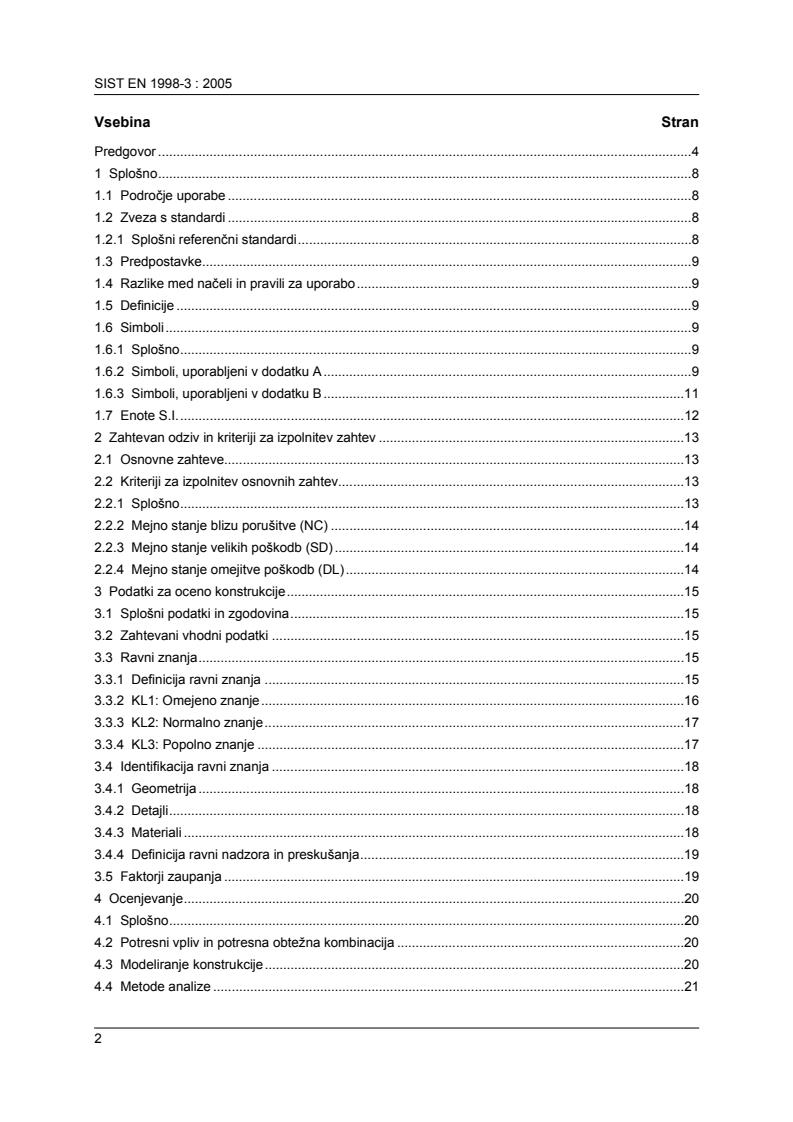
Vsebina Stran
Predgovor .4
1 Splošno.8
1.1 Področje uporabe .8
1.2 Zveza s standardi .8
1.2.1 Splošni referenčni standardi.8
1.3 Predpostavke.9
1.4 Razlike med načeli in pravili za uporabo.9
1.5 Definicije .9
1.6 Simboli.9
1.6.1 Splošno.9
1.6.2 Simboli, uporabljeni v dodatku A.9
1.6.3 Simboli, uporabljeni v dodatku B.11
1.7 Enote S.I.12
2 Zahtevan odziv in kriteriji za izpolnitev zahtev .13
2.1 Osnovne zahteve.13
2.2 Kriteriji za izpolnitev osnovnih zahtev.13
2.2.1 Splošno.13
2.2.2 Mejno stanje blizu porušitve (NC) .14
2.2.3 Mejno stanje velikih poškodb (SD).14
2.2.4 Mejno stanje omejitve poškodb (DL).14
3 Podatki za oceno konstrukcije.15
3.1 Splošni podatki in zgodovina.15
3.2 Zahtevani vhodni podatki .15
3.3 Ravni znanja.15
3.3.1 Definicija ravni znanja .15
3.3.2 KL1: Omejeno znanje.16
3.3.3 KL2: Normalno znanje.17
3.3.4 KL3: Popolno znanje .17
3.4 Identifikacija ravni znanja .18
3.4.1 Geometrija .18
3.4.2 Detajli.18
3.4.3 Materiali .18
3.4.4 Definicija ravni nadzora in preskušanja.19
3.5 Faktorji zaupanja .19
4 Ocenjevanje.20
4.1 Splošno.20
4.2 Potresni vpliv in potresna obtežna kombinacija .20
4.3 Modeliranje konstrukcije.20
4.4 Metode analize .21
SIST EN 1998-3 : 2005
4.4.1 Splošno.21
4.4.2 Metoda z vodoravnimi silami.21
4.4.3 Modalna analiza s spektri odziva .21
4.4.4 Nelinearna statična analiza .22
4.4.5 Nelinearna analiza časovnega odziva.22
4.4.6 Postopek s q-faktorjem.22
4.4.7 Kombinacija komponent potresnega vpliva.23
4.4.8 Dodatne zahteve za konstrukcije z zidanimi polnili.23
4.4.9 Koeficienti za kombinacijo spremenljivih vplivov.23
4.4.10 Kategorije in faktorji pomembnosti .23
4.5 Preverjanje varnosti.23
4.5.1 Linearne metode analize (metoda z vodoravnimi silami ali modalna analiza s spektri odziva).23
4.5.2 Nelinearne metode analize (statične ali dinamične).23
4.5.3 Postopek s q-faktorjem.24
4.6 Povzetek kriterijev za analizo in preverjanje varnosti.24
5 Odločitve za posege v konstrukcijo.25
5.1 Kriteriji za posege v konstrukcijo.25
5.1.1 Uvod .25
5.1.2 Tehnični kriteriji.25
5.1.3 Vrsta posega .25
5.1.4 Nekonstrukcijski elementi.26
5.1.5 Upravičenost izbrane vrste posega v konstrukcijo.26
6 Projektiranje posega v konstrukcijo.26
6.1 Postopek projektiranja prenove.26
Dodatek A (informativni): Armiranobetonske konstrukcije .27
Dodatek B (informativni): Jeklene in sovprežne konstrukcije.43
Dodatek C (informativni): Zidane stavbe.64
SIST EN 1998-3 : 2005
PREDGOVOR
Ta evropski standard EN 1998-3, Evrokod 8: Projektiranje potresnoodpornih konstrukcij – Ocena in
prenova stavb, je pripravil tehnični odbor CEN/TC 250 Konstrukcijski evrokodi, katerega sekretariat je
na BSI. CEN/TC 250 je odgovoren za vse konstrukcijske evrokode.
Ta evropski standard mora postati nacionalni standard z objavo istovetnega besedila ali z uradno
razglasitvijo najpozneje do decembra 2005, nacionalni standardi, ki so z njim v nasprotju, pa morajo
biti umaknjeni najpozneje marca 2010.
Ta dokument nadomešča ENV 1998-1-4:1996.
Glede na notranja pravila CEN/CENELEC morajo ta evropski standard sprejeti nacionalne organizacije
za standardizacijo naslednjih držav: Avstrije, Belgije, Cipra, Češke republike, Danske, Estonije, Finske,
Francije, Nemčije, Grčije, Madžarske, Islandije, Irske, Italije, Latvije, Litve, Luksemburga, Malte,
Nizozemske, Norveške, Poljske, Portugalske, Slovaške, Slovenije, Španije, Švedske, Švice in
Združenega kraljestva.
Ozadje programa evrokodov
Komisija Evropske skupnosti se je v letu 1975 na podlagi 95. člena Rimske pogodbe odločila, da
sprejme akcijski program na področju gradbeništva. Cilj programa je bil odstraniti tehnične ovire pri
trgovanju in uskladiti tehnične specifikacije.
Znotraj tega programa je Komisija spodbudila pripravo niza usklajenih tehničnih pravil za projektiranje
gradbenih objektov, ki bi se sprva uporabljali kot alternativa različnim pravilom, veljavnim v
posameznih državah članicah, končno pa bi jih v celoti nadomestili.
Komisija je s pomočjo upravnega odbora, v katerem so bili predstavniki držav članic, petnajst let vodila
razvoj programa evrokodov, katerega rezultat je bila prva generacija evrokodov v 80-ih letih prejšnjega
stoletja.
Leta 1989 so se Komisija in države članice EU in EFTA odločile, da na podlagi dogovora med Komisijo
in CEN z več pooblastili prenesejo pripravo in objavljanje evrokodov na CEN, da bi evrokodi (EC) v
prihodnje imeli status evropskih standardov (EN). To je evrokode dejansko povezalo z določbami vseh
direktiv Sveta in/ali odločbami Komisije, ki se nanašajo na evropske standarde (npr. Direktiva Sveta
89/106/EGS o gradbenih proizvodih (CPD) in Direktive Sveta 93/37/EGS, 92/50/EGS ter 89/440/EGS o
javnih delih in storitvah ter ustrezne direktive EFTA, ki so bile sprejete za uveljavitev notranjega trga).
Program konstrukcijskih evrokodov obsega naslednje standarde, ki imajo na splošno več delov:
EN 1990 Evrokod: Osnove projektiranja konstrukcij
EN 1991 Evrokod 1: Vplivi na konstrukcije
EN 1992 Evrokod 2: Projektiranje betonskih konstrukcij
EN 1993 Evrokod 3: Projektiranje jeklenih konstrukcij
EN 1994 Evrokod 4: Projektiranje sovprežnih jeklenih in betonskih konstrukcij
EN 1995 Evrokod 5: Projektiranje lesenih konstrukcij
EN 1996 Evrokod 6: Projektiranje zidanih konstrukcij
EN 1997 Evrokod 7: Geotehnično projektiranje
EN 1998 Evrokod 8: Projektiranje potresnoodpornih konstrukcij
EN 1999 Evrokod 9: Projektiranje aluminijastih konstrukcij
Dogovor med Komisijo Evropske skupnosti in Evropskega odbora za standardizacijo (CEN) o pripravi evrokodov za
projektiranje stavb in gradbenih inženirskih objektov (BC/CEN/03/89).
SIST EN 1998-3 : 2005
Evrokodi priznavajo odgovornost pristojnih oblasti v vsaki državi članici in jim dopuščajo pravico, da
vrednosti, povezane z varnostjo, določajo na nacionalni ravni, od države do države različno.
Status in področje veljavnosti evrokodov
Članice EU in EFTA priznavajo evrokode kot referenčne dokumente za naslednje namene:
– kot način za dokazovanje ustreznosti stavb in gradbenih inženirskih objektov bistvenim zahtevam
Direktive Sveta 89/106/EGS, zlasti bistveni zahtevi št. 1 »Mehanska odpornost in stabilnost« in
bistveni zahtevi št. 2 »Varnost pri požaru«;
– kot podlago za specifikacijo pogodb za gradnjo gradbenih objektov in spremljajoče inženirske
storitve;
– kot ogrodje za pripravo harmoniziranih tehničnih specifikacij za gradbene proizvode (EN in ETA).
Kjer se evrokodi nanašajo na gradbene objekte, so neposredno povezani z razlagalnimi dokumenti ,
navedenimi v 12. členu Direktive o gradbenih proizvodih (CPD), čeprav je njihova narava drugačna od
narave harmoniziranih standardov za proizvode . Zato morajo tehnični odbori CEN in/ali delovne
skupine EOTA, ki pripravljajo standarde za proizvode, upoštevati tehnične vidike evrokodov, da bi s
tem dosegli popolno usklajenost teh tehničnih specifikacij z evrokodi.
Evrokodi vsebujejo skupna pravila za vsakdanjo rabo pri projektiranju običajnih in inovativnih
konstrukcij kot celote ali posameznih konstrukcijskih delov. Evrokodi ne vsebujejo posebnih določb za
nenavadne oblike konstrukcij ali nenavadne projektne pogoje. V teh primerih je potrebna dodatna
strokovna obravnava.
Nacionalne izdaje evrokodov
Nacionalna izdaja evrokoda vsebuje poleg celotnega besedila evrokoda (z vsemi dodatki), kot ga je
objavil CEN, tudi morebitno nacionalno naslovnico, nacionalni predgovor in nacionalni dodatek.
Nacionalni dodatek lahko vsebuje le podatke o parametrih, ki so v evrokodu navedeni kot nacionalno
določeni parametri (NDP). Ti parametri veljajo za projektiranje konstrukcij stavb in gradbenih
inženirskih objektov v državi, v kateri bodo zgrajeni. To so:
– vrednosti in/ali razredi, kjer evrokodi dopuščajo alternative,
– vrednosti, kjer evrokodi navajajo le simbole,
– podatki, specifični za državo (geografski, klimatski itn.), kot je npr. karta snega,
– postopek, če jih evrokod dopušča več.
Nacionalni dodatek lahko vsebuje tudi:
– odločitev o uporabi informativnih dodatkov,
– napotke o dodatnih informacijah, ki niso v nasprotju z evrokodi, za pomoč uporabniku.
V skladu s točko 3.3 CPD je treba bistvene zahteve v razlagalnih dokumentih konkretizirati tako, da se pri tem vzpostavi
zveza med bistvenimi zahtevami in pooblastili za pripravo harmoniziranih EN in smernic ETAG/ETA.
V skladu z 12. členom CPD morajo razlagalni dokumenti:
a) konkretizirati bistvene zahteve s poenotenjem izrazov in tehničnih podlag ter določitvijo razredov ali stopenj zahtevnosti za
vsako zahtevo, takrat ko je to potrebno;
b) nakazati metode za povezavo razredov ali stopenj zahtevnosti s tehničnimi specifikacijami, npr. metode izračuna in
dokazov, tehnična pravila za projektiranje ipd.;
c) biti uporabni kot podlaga za pripravo harmoniziranih standardov ali smernic za evropska tehnična soglasja.
Evrokodi imajo dejansko podobno vlogo pri bistveni zahtevi št. 1 in delno pri bistveni zahtevi št. 2.
SIST EN 1998-3 : 2005
Zveze med evrokodi in harmoniziranimi tehničnimi specifikacijami (EN in ETA) za proizvode
Harmonizirane tehnične specifikacije za gradbene proizvode morajo biti usklajene s tehničnimi pravili
za objekte . Nadalje morajo navodila, povezana z označevanjem CE gradbenih proizvodov, ki se
sklicujejo na evrokode, natančno določiti, katere nacionalno predpisane parametre upoštevajo.
Dodatne informacije o EN 1998-3
Čeprav Evrokodi, ki se nanašajo na posamezne materiale, še ne obravnavajo ocenjevanja in prenove
obstoječih objektov pri nepotresnih vplivih, je bil ta del Evrokoda 8 izdelan iz naslednjih razlogov:
– Pri gradnji številnih starejših objektov potresna odpornost ni bila upoštevana, medtem ko so bili
ostali (nepotresni) vplivi upoštevani vsaj z uporabo tradicionalnih pravil konstruiranja, če ne tudi
drugače.
– Ocene potresne nevarnosti v skladu z obstoječim znanjem lahko pokažejo potrebo za širše akcije
prenove.
– Zaradi poškodb, ki jih povzročijo potresi, se lahko pojavi potreba po večjih popravilih.
Poleg tega kriteriji za potresno oceno (konstrukcij, ki so bile projektirane po Evrokodu 8 in nato
poškodovane) predstavljajo integralni del celotnega procesa zagotavljanja potresne odpornosti, saj
filozofija EC 8 tudi pri novih objektih temelji na sprejemljivosti določenih poškodb v primeru
projektnega potresnega vpliva.
Pri potresni prenovi so zelo pomembna kvalitativna preverjanja za ugotavljanje in odpravo glavnih
napak konstrukcije. Kvantitativen analitičen postopek, ki je značilnost tega standarda, ne bi smel
ovirati kvalitativnih preverjanj. Priprava dokumentov s kvalitativnimi postopki je prepuščena
posameznim državam.
Standard obravnava le konstrukcijske vidike za potresno oceno in prenovo, ki lahko predstavljajo le
del širše strategije za zmanjševanje potresnega tveganja. Standard se uporablja, ko je podana
zahteva za oceno določene stavbe. Določanje pogojev, ki morajo biti izpolnjeni, da se zahteva
potresno ocenjevanje posameznih objektov (ki mogoče vodi do utrjevanja), ni predmet tega standarda.
Nacionalni programi za zmanjševanje potresnega tveganja, ki vključujejo ocenjevanje in prenovo
objektov, lahko razlikujejo med “aktivnimi” in “pasivnimi” programi za potresno ocenjevanje in
utrjevanje. Pri “aktivnih” programih je lahko zahtevano, da lastniki določenih kategorij objektov do
določenega roka pridobijo potresno oceno in, v odvisnosti od rezultata ocene, tudi opravijo prenovo.
Kategorije stavb, pri katerih se zahteva potresna ocena, so lahko izbrane v odvisnosti od seizmičnosti
in vrste tal, od pomembnosti in namembnosti ter od zaznane ranljivosti stavbe (na katero vplivajo vrsta
materiala in tip konstrukcije, število nadstropij, starost stavbe v povezavi z datumi uveljavitve starejših
predpisov itd.). Pri “pasivnih” programih je potresna ocena, ki lahko vodi do potresne prenove,
povezana z drugimi aktivnostmi na objektu, povezanimi z uporabo stavbe, npr. s spremembo
namembnosti, ki poveča število uporabnikov ali pomembnost objekta, z rekonstrukcijo nad določeno
mejo (izraženo z odstotkom površine ali celotne vrednosti stavbe), s popravilom poškodb po potresu
itd. Izbira mejnih stanj, ki jih je treba preveriti, in izbira povratnih dob potresnega vpliva, ki so
povezane s temi mejnimi stanji, sta lahko odvisni od izbranega programa za ocenjevanje in utrjevanje.
Zahteve pri “aktivnih” programih so lahko manj stroge kot pri “pasivnih”. Na primer, pri “pasivnih”
programih, ki jih je sprožila prenova, so zahteve lahko povezane z obsegom in stroški celotne
prenove.
V primeru nizke seizmičnosti (glej EN 1998-1, 3.2.1(4)) je ta standard s pomočjo ustreznih nacionalnih
dodatkov lahko prilagojen lokalnim razmeram.
Glej člen 3.3 in 12. člen CPD in tudi točke 4.2, 4.3.1, 4.3.2 in 5.2 v ID 1.
SIST EN 1998-3 : 2005
Nacionalni dodatek za EN 1998-3
Ta standard vsebuje alternativne postopke, vrednosti in priporočila za razrede z opombami, ki kažejo,
kje se lahko uveljavi nacionalna izbira. Zato mora nacionalni standard, ki uvaja EN 1998-3: 2005, imeti
nacionalni dodatek, ki vsebuje vse nacionalno določene parametre, ki jih je treba uporabiti pri
projektiranju stavb in gradbenih inženirskih objektov, ki bodo zgrajeni v tej državi.
Nacionalna izbira je v EN 1998-3: 2005 dovoljena v točkah:
Točka Predmet
1.1(4) Informativni dodatki A, B in C.
2.1(2)P Število mejnih stanj, ki jih je treba upoštevati.
2.1(3)P Povratne dobe potresnih vplivov, pri katerih mejna stanja ne smejo biti prekoračena.
2.2.1(7)P Delni materialni faktorji
3.3.1(4) Faktorji zaupanja
3.4.4(1) Ravni pregleda in preskušanja
4.4.2(1)P
Največja vrednost razmerja ρ /ρ
max min
Komplementarna neprotislovna informacija o metodah za nelinearno statično analizo,
4.4.4.5(2)
ki upoštevajo vpliv nihajnih oblik.
A.4.4.2
Delni faktor γ za odlepljenje FRP
fd
(5)
γ
A.4.4.2(9) Delni faktor fd za FRP
SIST EN 1998-3 : 2005
1 Splošno
1.1 Področje uporabe
(1) Vsebina Evrokoda 8 je opredeljena v EN 1998-1: 2004, 1.1.1, vsebina tega standarda pa je
opredeljena v (2), (4) in (5). Dodatni deli Evrokoda 8 so navedeni v EN 1998-1: 2004, 1.1.3.
(2) Vsebina EN 1998-3 je naslednja:
– Daje kriterije za oceno potresnega obnašanja obstoječih individualnih konstrukcij stavb.
– Opisuje postopek izbire potrebnih popravnih ukrepov.
– Priporoča kriterije za projektiranje ukrepov za utrjevanje (to so zasnova, analiza konstrukcije, ki
vključuje posege v konstrukcijo, končno dimenzioniranje delov konstrukcije in njihovih priključkov
na obstoječe konstrukcijske elemente).
OPOMBA: V tem standardu pomeni “utrjevanje” tako utrjevanje nepoškodovanih konstrukcij kot tudi popravilo konstrukcij,
ki jih je poškodoval potres.
(3) Pri projektiranju posega v konstrukcijo, ki ima namen, da zagotovi ustrezno odpornost v primeru
potresne akcije, je treba preveriti tudi vpliv nepotresnih obtežnih kombinacij.
(4) Ta standard zajema potresno ocenjevanje in utrjevanje stavb iz najobičajnejših materialov:
betona, jekla in opeke ter pri tem odraža osnovne zahteve EN 1998-1: 2004.
OPOMBA: Informativni dodatki A, B in C vsebujejo dodatne informacije o ocenjevanju armiranobetonskih, jeklenih,
sovprežnih in opečnih stavb ter o njihovem utrjevanju.
(5) Določila standarda so uporabna za vse vrste stavb, tudi za spomenike in objekte zgodovinske
vrednosti. Dejstvo pa je, da ti objekti pogosto zahtevajo drugačne predpise in pristop k prenovi,
odvisno od narave spomenikov.
(6) Ker obstoječe konstrukcije:
(i) odražajo raven znanja v času njihove gradnje,
(ii) imajo lahko skrite velike napake,
(iii) so lahko preživele prejšnje potrese ali druge nezgodne vplive z neznanimi posledicami,
so ocenjevanje konstrukcij in posegi v konstrukcije tipično povezani z večjo stopnjo negotovosti (ravni
znanja) kot projektiranje novih objektov. Zaradi tega so potrebni drugačni materialni in varnostni
faktorji, pa tudi drugačne metode analize, odvisno od popolnosti in zanesljivosti razpoložljivih
informacij.
1.2 Zveze s standardi
(1) P Ta evropski standard vsebuje z datiranim ali nedatiranim sklicevanjem določila iz drugih
publikacij. Ta sklicevanja na standarde so citirana na ustreznih mestih v besedilu, publikacije pa so
naštete na koncu. Pri datiranih sklicevanjih se pri uporabi tega evropskega standarda upoštevajo
poznejša dopolnila ali spremembe katerekoli od teh publikacij le, če so z dopolnilom ali spremembo
vključene vanj. Pri nedatiranih sklicevanjih pa se uporablja zadnja izdaja publikacije, na katero se
sklicuje (vključno z dopolnili).
1.2.1 Splošni referenčni standardi
EN 1990 Evrokod – Osnove projektiranja konstrukcij
EN 1998-1 Evrokod 8 – Projektiranje potresnoodpornih konstrukcij – 1. del: Splošna pravila, potresni
vplivi in pravila za stavbe
SIST EN 1998-3 : 2005
1.3 Predpostavke
(1) Sklic na EN 1998-1: 2004, 1.3.
(2) Določila tega standarda predpostavljajo, da zbiranje podatkov in preskušanja opravljajo izkušeni
strokovnjaki. Predpostavljeno je tudi, da ima inženir, ki je odgovoren za ocenjevanje, za morebitno
projektiranje utrjevanja in za izvedbo del ustrezne izkušnje pri tistem tipu konstrukcije, ki jo je treba
utrditi ali popraviti.
(3) Postopki za preglede, kontrolni seznami in drugi postopki zbiranja podatkov morajo biti
dokumentirani in shranjeni. Nanje se je treba sklicevati v projektnih dokumentih.
1.4 Razlike med načeli in pravili za uporabo
(1) Veljajo pravila v EN 1990: 2002, 1.4.
1.5 Definicije
(1) Sklic na EN 1998-1: 2004, 1.5.
1.6 Simboli
1.6.1 Splošno
(1) Sklic na EN 1998-1: 2004, 1.6.
(2) Dodatni simboli, ki se uporabljajo v tem standardu, so opredeljeni v besedilu, ko se pojavijo.
1.6.2 Simboli, uporabljeni v dodatku A
b širina jeklenih trakov v jeklenem ovoju
b in h dimenziji objetega betonskega jedra do centra stremena
o o
b osne razdalje med palicami vzdolžne armature
i
c betonski pokrivni sloj armature
d efektivna višina prereza (razdalja do natezne armature)
d’ razdalja do tlačne armature
d premer natezne armature
bL
f tlačna trdnost betona (MPa)
c
f trdnost objetega betona
cc
f projektna vrednost trdnosti betona
cd
f povprečna natezna trdnost betona
ctm
f projektna vrednost efektivne trdnosti odlepljenja za FRP (polimer, utrjen z vlakni; angl. fibre-
fdd,e
reinforced polymer)
f (R) mejna trdnost tkanine iz FRP, ovite okrog vogala s polmerom R, izraz (A.25)
fu,W
f ocenjena povprečna vrednost napetosti na meji tečenja jekla
y
f projektna vrednost napetosti na meji tečenja (vzdolžne) armature
yd
f projektna vrednost napetosti na meji tečenja jekla za ovoj
yj,d
SIST EN 1998-3 : 2005
f napetost na meji tečenja za prečno armaturo ali armaturo za objetje
yw
h višina prereza
pokrivni koeficient za trak/tkanino iz FRP
k = 1,5⋅(2 − w s ) (1+ w 100 mm)
b f f f
n število preklopljenih palic po obodu p
p dolžina linije oboda v prerezu stebra na notranji strani vzdolžne armature
s osna razdalja med stremeni
s osna razdalja med trakovi iz FRP (= w za liste FRP)
f f
t debelina tkanine iz FRP
f
t debelina jeklenega ovoja
j
x višina tlačne cone
w širina traku/lista iz FRP
f
z ročica notranjih sil prereza
A ploščina prereza stebra
c
A = t ⋅w ⋅sinβ : vodoravna projekcija prereza traka/lista iz FRP z debelino t , širino w in kotom β
f f f f f
A ploščina prereza vzdolžne armature
s
A ploščina prereza stremena
sw
E modul FRP
f
L =M/V strižni razpon na krajišču elementa
V
N osna sila (pozitivna pri tlaku)
V strižna nosilnost elementa brez armature v stojini
R,c
V strižna nosilnost, določena pri porušitvi tlačne diagonale
R,max
V prispevek prečne armature k strižni nosilnosti
w
α faktor učinkovitosti objetja
γ faktor, večji od 1,0 za primarne potresne elemente in enak 1,0 za sekundarne potresne elemente
el
γ delni faktor za odlepljenje FRP
fd
δ kot med diagonalo in osjo stebra
ε mejna specifična deformacija (angl. “strain”) betona
cu
ε mejna specifična deformacija (angl. “strain”) FRP
ju
ε mejna specifična deformacija (angl. “strain”) armature za objetje
su,w
θ naklonski kot tlačne diagonale pri projektiranju striga
θ tetivna (angl. “chord”) rotacija pri tečenju betonskega elementa
y
SIST EN 1998-3 : 2005
θ tetivna (angl. “chord”) rotacija betonskega elementa
u
ν = N / bhf (b širina tlačne cone)
c
ρ delež diagonalne armature
d
ρ prostorninski delež FRP
f
ρ geometrijski delež armature
s
ρ = A / b s = delež prečne armature, ki je vzporedna smeri x obtežbe (s = razdalja med stremeni)
sx SX w h h
ρ delež celotne vzdolžne armature
tot
ρ prostorninski delež armature za objetje
sw
ρ delež prečne armature
w
ϕ mejna ukrivljenost prereza na krajišču elementa
u
ϕ ukrivljenost na meji tečenja za prerez na krajišču elementa
y
ω, ω´ mehanski delež natezne in tlačne armature
1.6.3 Simboli, uporabljeni v dodatku B
b širina vezne pločevine
cp
b širina pasnice
f
d višina prečnega prereza stebra
c
d višina panela stojine stebra med ojačitvama
z
e razdalja med plastičnim členkom in zunanjim robom stebra
f tlačna trdnost betona
c
f natezna trdnost betona
ct
f natezna trdnost zvarov
uw
f napetost na meji tečenja prečne armature
ywh
f nominalna napetost na meji tečenja obeh pasnic
y,pl
l dolžina vezne pločevine
cp
t debelina vezne pločevine
cp
t debelina
f
t debelina stojine
hw
w širina panela stojine stebra med pasnicama stebra
z
A bruto površina preseka
g
A površina pasnice vute
hf
A površina posamezne pasnice
pl
SIST EN 1998-3 : 2005
B širina jeklene diagonale v obliki traku
S
B širina sovprežnega prereza
E elastični modul nosilca
E elastični modul AB (armiranobetonskega) panela
B
F potresna prečna sila
t
H višina okvira
H etažna višina okvira
c
K rotacijska togost spoja
ϕ
I vztrajnostni moment
L razpon nosilca
M plastični moment nosilca
pb,Rd
N projektna osna sila
d
N natezna plastična nosilnost diagonale jeklenega povezja
y
S elastični odpornostni moment nosilca (močna os)
x
T debelina panela
C
V prečna sila pri plastičnem členku nosilca
pl,Rd,b
Z plastični odpornostni moment nosilca
b
Z efektivni plastični odpornostni moment prereza na mestu plastičnega členka
e
ρ delež prečne armature
w
1.7 Enote S.I.
(1) Sklic na EN 1998-1: 2004, 1.7.
SIST EN 1998-3 : 2005
2 Zahtevan odziv in kriteriji za izpolnitev zahtev
2.1 Osnovne zahteve
(1)P Osnovne zahteve se nanašajo na stanje poškodovanosti konstrukcije, ki so opredeljene s tremi
mejnimi stanji (LS, angl. “Limit States”), in sicer: mejno stanje blizu porušitve (NC, angl. “Near
Collapse”), mejno stanje velikih poškodb (SD, angl. “Significant Damage”) in mejno stanje
omejitve poškodb (DL, angl. “Damage Limitation”). Značilnosti mejnih stanj so naslednje:
Mejno stanje blizu porušitve (NC). Konstrukcija je močno poškodovana in ima le še malo preostale
nosilnosti in togosti, vendar so navpični elementi še sposobni prenašati navpično obtežbo. Večina
nekonstrukcijskih elementov je porušenih. Pojavile so se velike trajne deformacije. Kontrukcija je
na meji porušitve in se bo lahko povsem porušila pri naslednjem potresu, tudi pri takšnem z
zmerno jakostjo.
Mejno stanje velikih poškodb (SD). Konstrukcija je pomembno poškodovana, ima še nekaj
preostale nosilnosti in togosti, navpični elementi so še sposobni prenašati navpično obtežbo.
Nekonstrukcijski elementi so poškodovani, vendar predelne stene in polnila niso padli iz svoje
ravnine. Pojavile so se zmerne trajne deformacije. Konstrukcija lahko prenese popotrese
zmerne jakosti. Verjetno pa je, da konstrukcije ni ekonomično popravljati.
Mejno stanje omejitve poškodb (DL). Konstrukcija je le lažje poškodovana. Ne pride do
pomembne plastifikacije nosilnih elementov, ki obdržijo svojo nosilnost in togost. Pri
nekonstrukcijskih elementih, kot so predelne stene in polnila, se lahko pojavijo porazdeljene
razpoke, vendar je poškodbe mogoče ekonomično popraviti. Trajne deformacije so zanemarljivo
majhne. Pri konstrukciji popravila niso potrebna.
OPOMBA: Definicija mejnega stanja blizu porušitve v tem delu (3. del) Evrokoda 8 je bliže dejanski porušitvi stavbe
kot tista v EN 1998-1: 2004 in ustreza popolnemu izkoristku deformacijske kapacitete konstrukcijskih
elementov. Mejno stanje nosilnosti v EN 1998-1: 2004 približno ustreza mejnemu stanju, ki je v tem delu
opredeljeno kot mejno stanje velikih poškodb (SD).
(2)P Posamezne države morajo določiti, ali je treba kontrolirati vsa tri mejna stanja, dve mejni stanji
ali samo eno mejno stanje.
OPOMBA: Izbira mejnih stanj (izmed treh, ki so opredeljena v 2.1(1)P), ki jih je treba kontrolirati v državi
,
je podana v nacionalnem dodatku.
(3)P Ustrezna raven zaščite se doseže z izbiro povratne dobe za potresno akcijo za vsako mejno stanje.
OPOMBA: Povratne dobe, predpisane za različna mejna stanja, ki jih je treba kontrolirati v državi, so podane v
nacionalnem dodatku. Ponavadi velja, da je mogoče doseči primerno zaščito za običajne nove stavbe,
če so izbrane naslednje vrednosti za povratne dobe:
– mejno stanje NC: 2475 let, kar ustreza 2 % verjetnosti porušitve v 50 letih,
– mejno stanje SD: 475 let, kar ustreza 10 % verjetnosti porušitve v 50 letih,
– mejno stanje DL: 225 let, kar ustreza 20 % verjetnosti porušitve v 50 letih.
2.2 Kriteriji za izpolnitev osnovnih zahtev
2.2.1 Splošno
(1)P Zahteve, navedene v 2.1, je mogoče izpolniti z uporabo potresne akcije, metode analize ter
postopkov za preverjanje in detajliranje, ki jih vsebuje ta del EN 1998 za različne konstrukcijske
materiale (beton, jeklo, opeka).
(2)P Razen pri postopku s q-faktorjem se uporablja poln (nezmanjšan, elastičen) potresni vpliv, kot je
opredeljen v 2.1 in 4.2 za ustrezno povratno dobo.
(3)P Pri preverjanju konstrukcijskih elementov je treba ločiti “duktilne” in “krhke” elemente. Razen pri
uporabi postopka s q-faktorjem je pri duktilnih elementih treba preveriti, da zahteve, izražene z
deformacijami, ne prekoračijo ustreznih kapacitet. Pri krhkih elementih je treba preveriti, da
zahteve ne prekoračijo kapacitet, ki so izražene z nosilnostjo.
SIST EN 1998-3 : 2005
OPOMBA: Informacija o razvrstitvi komponent in mehanizmov kot “duktilne” ali “krhke” je podana v ustreznih
dodatkih za posamezne materiale.
(4)P Kot drugo možnost je mogoče uporabiti postopek s q-faktorjem, kjer se uporablja potresna
akcija, zmanjšana s q-faktorjem, kot je navedeno v 4.2(3)P. Pri preverjanju varnosti je pri vseh
konstrukcijskih elementih treba preveriti, da zahteve zaradi zmanjšane potresne akcije ne
prekoračijo pripadajočih kapacitet, izraženih z nosilnostjo, določenih po (5)P.
(5)P Za izračun kapacitet duktilnih in krhkih elementov, ki se primerjajo z zahtevami pri preverjanju
varnosti po (3)P in (4)P, je za značilnosti obstoječega materiala treba uporabiti povprečne
vrednosti. Te so dobljene s preiskavami na objektu in iz dodatnih virov informacij. Dobljene
vrednosti so zmanjšane s faktorji zaupanja, opredeljenimi v 3.5, ki upoštevajo doseženo raven
znanja. Za nove ali dodane materiale je treba upoštevati nominalne vrednosti.
(6)P Nekateri obstoječi konstrukcijski elementi so lahko opredeljeni kot “sekundarni potresni” skladno
z opredelitvami v EN 1998-1: 2004, 4.2.2 (1)P, (2) in (3). “Sekundarne potresne” elemente je
treba preveriti z istimi merili kot “primarne potresne” elemente, vendar se pri določitvi njihovih
kapacitet uporabljajo manj konservativne ocene kot pri “primarnih potresnih” elementih.
(7)P Pri izračunu nosilnosti krhkih “primarnih potresnih” elementov je treba trdnost materiala deliti z
delnim materialnim faktorjem.
OPOMBA: Vrednosti, predpisane za delne faktorje za jeklo, beton, konstrukcijsko jeklo, opeko in druge materiale,
ki se uporabljajo v državi, so podane v nacionalnem dodatku. Opombe k določilom 5.2.4(3), 6.1.3(1),
7.1.3(1) in 9.6(3) v EN 1998-1: 2004 se nanašajo na vrednost delnih faktorjev za jeklo, beton,
konstrukcijsko jeklo in opeko, ki se uporabljajo pri projektiranju novih stavb v različnih državah.
2.2.2 Mejno stanje blizu porušitve (NC)
(1)P Zahteve morajo izhajati iz projektnega potresnega vpliva, ki ustreza temu mejnemu stanju.
Zahteve za duktilne in krhke elemente morajo biti določene iz rezultatov analize. Če se za
analizo uporablja linearna metoda, je treba zahteve za krhke elemente spremeniti v skladu z
4.5.1(1)P.
(2)P Kapacitete za duktilne elemente morajo biti določene s pomočjo ustrezno definiranih mejnih
deformacij, kapacitete krhkih elementov pa s pomočjo ustrezno definiranih mejnih nosilnosti.
(3) Postopek s q-faktorjem (glej 2.2.1(4)P, 4.2(3)P) v splošnem ni primeren za kontrolo tega
mejnega stanja.
OPOMBA: Vrednosti q = 1,5 in 2,0, navedene v 4.2(3)P za armiranobetonske in jeklene konstrukcije, in tudi večje
vrednosti za q, ki so morebiti upravičene ob upoštevanju obstoječe lokalne in globalne duktilnosti v
skladu z ustreznimi določbami EN 1998-1: 2004, se nanašajo na izpolnitev mejnega stanja SD. Če se
postopek s q-faktorjem uporabi za kontrolo mejnega stanja NC, potem se lahko uporabi 2.2.3(3)P, pri
čemer je lahko vrednost q-faktorja večja od tiste v 4.2(3)P za približno eno tretjino.
2.2.3 Mejno stanje velikih poškodb (SD)
(1)P Zahteve morajo izhajati iz projektnega potresnega vpliva, ki ustreza temu mejnemu stanju.
Zahteve za duktilne in krhke elemente morajo biti določene iz rezultatov analize. Če se za
analizo uporablja linearna metoda, je treba zahteve za krhke elemente spremeniti v skladu z
4.5.1(1)P.
(2)P Kapacitete za duktilne elemente morajo biti določene s pomočjo deformacij, ki so povezane s
poškodbami, kapacitete krhkih elementov pa s pomočjo konservativno definiranih nosilnosti,
razen v primeru postopka s q-faktorjem.
(3)P Pri postopku s q-faktorjem (glej 2.2.1(4)P, 4.2(3)P) morajo biti zahteve določene z zmanjšanimi
potresnimi vplivi, medtem ko morajo biti kapacitete takšne kot pri nepotresnih projektnih stanjih.
SIST EN 1998-3 : 2005
2.2.4 Mejno stanje omejitve poškodb (DL)
(1)P Zahteve morajo izhajajo iz projektnega potresnega vpliva, ki ustreza temu mejnemu stanju.
(2)P Za vse konstrukcijske elemente, tako duktilne kot krhke, morajo kapacitete ustrezati nosilnosti
na meji tečenja, razen pri uporabi postopka s q-faktorjem. Kapacitete polnil morajo biti določene
na podlagi povprečne kapacitete polnil za medetažne zamike (angl. “drift”).
(3)P Pri postopku s q-faktorjem (glej 2.2.1(4)P, 4.2(3)P) je treba primerjati zahteve in kapacitete,
izražene s povprečnim medetažnim zamikom.
3 Podatki za oceno konstrukcije
3.1 Splošni podatki in zgodovina
(1)P Za oceno potresne odpornosti obstoječih zgradb morajo biti zbrani vhodni podatki iz različnih
virov, ki vsebujejo:
– razpoložljivo dokumentacijo, specifično za obravnavano stavbo,
– ustrezne generične podatkovne vire (npr. sodobne predpise in standarde),
– terenske raziskave in
– v večini primerov meritve in preskuse na objektu in/ali v laboratoriju, kot je opisano bolj
detaljno v 3.2 in 3.4.
(2) Izvede se navzkrižno preverjanje podatkov iz različnih virov z namenom, da se zmanjšajo
negotovosti.
3.2 Zahtevani vhodni podatki
(1) Na splošno morajo podatki za oceno konstrukcije obsegati naslednje točke od a) do i).
a) Identifikacija konstrukcij
...